Megaliths as sources: Cut-out cards
Cut-out cards
C1 Megaliths as sources
2 pages, A4 or US Letter3 pages, A4 or US Letter
Print at actual size, with scaling turned off.
Lesson C1 · Ages 11 to 14 · Cut-out cards
Cut along the lines. One set for each group.
Key words English · Malayalam · Tamil
umbrella stoneകുടക്കല്ല്குடைக்கல்
A Kerala stone monument: a laterite dome resting on four shaped stone supports.
lateriteചെങ്കല്ല് / വെട്ടുകല്ല്செம்புறைக்கல் / செம்பாறை / வெட்டுக்கல்
An iron-rich weathered rock that can be cut and shaped with hand tools.
megalith
A monument made of large stones. Kerala's Iron Age is known mainly from such burial monuments.
excavate
To dig a site carefully, recording what is found and where.
urn
A large pot. At Cheramanangad, an urn under one monument held bone.
symbolic burial
The excavators' name for a grave monument with no burial in it.
laboratory date
An age measured in a laboratory from a sample, such as charcoal.
elite
A small group with more wealth or rank than others.
millennium
A thousand years.
BCE
Years before year one, counted backwards.
hood stone
A name for a kind of Kerala stone monument. Different authors use it, and "hat stone", in different ways.
first millennium BCE
The thousand years from 1000 BCE down to the last year before year one begins.
C1-SC1 · From the ground
An umbrella stone

Photo: Ranjith Siji (Wikimedia Commons). Licence: CC BY-SA 4.0 (https://creativecommons.org/licenses/by-sa/4.0). Source: https://commons.wikimedia.org/wiki/File:Kudakkallu_Parambu_DSC_0638.JPG
- The photograph shows an umbrella stone at Kudakkallu Parambu, Cheramanangad.
- An umbrella stone is a dome of laterite resting on four shaped stone supports.
- Laterite is a rock that can be cut and shaped with hand tools.
- Umbrella stones cluster in central and northern Kerala.
- They are distinctive, but they have not been shown to be found only in Kerala.
What it cannot tell us The shape on the surface does not, on its own, tell us what lies beneath.
- Look Describe the monument: its parts, its shape and what it is made of.
- Talk What can you tell from the outside, and what can't you?
- Ask What would you need to do to find out what lies beneath it?
Lesson C1 · Ages 11 to 14 · Cut-out cards
Cut along the lines. One set for each group.
C1-SC2 · From the ground
What lay beneath at Cheramanangad
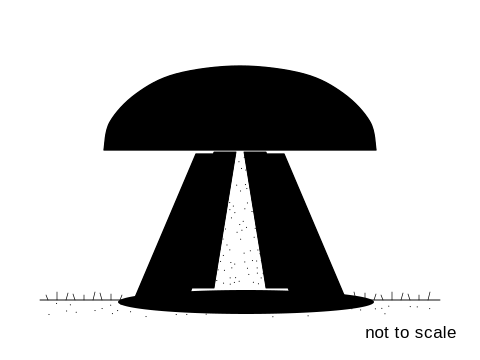
Drawing: Not to scale.
- In 1990–91 the Archaeological Survey of India opened one example of five monument types here.
- Two of the five held no burial; one of these was an umbrella stone.
- Another held an urn with bones, pots and an iron object.
- A monument with a granite capstone covered an urn, pots and bone.
- A stone circle held three pits, each with iron objects and a copper bowl.
- The excavators called the empty monuments symbolic burials.
What it cannot tell us The study found no laboratory date for this site.
- Look What was found under each kind of monument?
- Talk Which sentence on this card was worked out rather than found?
- Ask Why might people build a grave monument with no burial in it?
C1-SC3 · From a laboratory
Many graves, few dates

Drawing: A strip of this website’s 1000 BCE–600 CE window zooms to 1000–400 BCE, where two Adichanallur urn paddy samples show their ASI-reported calibrated ranges and probabilities.
- More than a thousand Iron Age burial sites are recorded in Kerala.
- The oldest laboratory dates from any Kerala burial come from two charcoal samples at Mangadu.
- Scientists think that charcoal dates to roughly 1300–800 BCE.
- A laboratory date measures the sample, such as charcoal, not the building of a monument.
- No umbrella stone has a laboratory date in the published sources the study read.
- Excavated umbrella stones lack the beads that are used to date graves by comparison.
What it cannot tell us The Mangadu samples do not date the whole of southern Kerala's Iron Age.
- Look Which monuments on this card have a laboratory date, and which have none?
- Talk A laboratory date measures a sample. Why does that matter when we try to date a monument?
- Ask Which sample would you most like to find under an umbrella stone, and why?
Lesson C1 · Ages 11 to 14 · Cut-out cards
Cut along the lines. One set for each group.
C1-SC1 · From the ground
An umbrella stone
Photo: Ranjith Siji (Wikimedia Commons). Licence: CC BY-SA 4.0 (https://creativecommons.org/licenses/by-sa/4.0). Source: https://commons.wikimedia.org/wiki/File:Kudakkallu_Parambu_DSC_0638.JPG
- The photograph shows an umbrella stone at Kudakkallu Parambu, Cheramanangad.
- An umbrella stone is a dome of laterite resting on four shaped stone supports.
- Laterite is a rock that can be cut and shaped with hand tools.
- Umbrella stones cluster in central and northern Kerala.
- They are distinctive, but they have not been shown to be found only in Kerala.
What it cannot tell us The shape on the surface does not, on its own, tell us what lies beneath.
- Look Describe the monument: its parts, its shape and what it is made of.
- Talk What can you tell from the outside, and what can't you?
- Ask What would you need to do to find out what lies beneath it?
C1-SC2 · From the ground
What lay beneath at Cheramanangad
Drawing: Not to scale.
- In 1990–91 the Archaeological Survey of India opened one example of five monument types here.
- Two of the five held no burial; one of these was an umbrella stone.
- Another held an urn with bones, pots and an iron object.
- A monument with a granite capstone covered an urn, pots and bone.
- A stone circle held three pits, each with iron objects and a copper bowl.
- The excavators called the empty monuments symbolic burials.
What it cannot tell us The study found no laboratory date for this site.
- Look What was found under each kind of monument?
- Talk Which sentence on this card was worked out rather than found?
- Ask Why might people build a grave monument with no burial in it?
Lesson C1 · Ages 11 to 14 · Cut-out cards
Cut along the lines. One set for each group.
C1-SC3 · From a laboratory
Many graves, few dates
Drawing: A strip of this website’s 1000 BCE–600 CE window zooms to 1000–400 BCE, where two Adichanallur urn paddy samples show their ASI-reported calibrated ranges and probabilities.
- More than a thousand Iron Age burial sites are recorded in Kerala.
- The oldest laboratory dates from any Kerala burial come from two charcoal samples at Mangadu.
- Scientists think that charcoal dates to roughly 1300–800 BCE.
- A laboratory date measures the sample, such as charcoal, not the building of a monument.
- No umbrella stone has a laboratory date in the published sources the study read.
- Excavated umbrella stones lack the beads that are used to date graves by comparison.
What it cannot tell us The Mangadu samples do not date the whole of southern Kerala's Iron Age.
- Look Which monuments on this card have a laboratory date, and which have none?
- Talk A laboratory date measures a sample. Why does that matter when we try to date a monument?
- Ask Which sample would you most like to find under an umbrella stone, and why?
Lesson C1 · Ages 11 to 14 · Cut-out cards
Cut along the lines. One set for each group.
Key words English · Malayalam · Tamil
umbrella stoneകുടക്കല്ല്குடைக்கல்
A Kerala stone monument: a laterite dome resting on four shaped stone supports.
lateriteചെങ്കല്ല് / വെട്ടുകല്ല്செம்புறைக்கல் / செம்பாறை / வெட்டுக்கல்
An iron-rich weathered rock that can be cut and shaped with hand tools.
megalith
A monument made of large stones. Kerala's Iron Age is known mainly from such burial monuments.
excavate
To dig a site carefully, recording what is found and where.
urn
A large pot. At Cheramanangad, an urn under one monument held bone.
symbolic burial
The excavators' name for a grave monument with no burial in it.
laboratory date
An age measured in a laboratory from a sample, such as charcoal.
elite
A small group with more wealth or rank than others.
millennium
A thousand years.
BCE
Years before year one, counted backwards.
hood stone
A name for a kind of Kerala stone monument. Different authors use it, and "hat stone", in different ways.
first millennium BCE
The thousand years from 1000 BCE down to the last year before year one begins.