Weigh real statements from this site's studies, then see how sure each study is, and why. Practise for tests, read sources like a historian, and plan a project.
How sure can we be? The four levels
Well supported
Direct, clear evidence supports this specific statement.
Likely
The available evidence favours this interpretation, with uncertainty.
Possible
Plausible, but the evidence is limited or contested.
Not known
The evidence reviewed here does not settle the question.
000The evidence bench
Grade the evidence for one question
Pick a question. Each card is a statement from one of this site's studies. Decide how sure we can be about it, then compare your choice with the study. There is no score: a different level with a good reason is good history.
For each card, choose how sure we can be about it.
Set C1 · 45 cards · Megaliths as sources
What can megaliths tell us, and what can't they?
Ground
Umbrella stones cluster in central and northern Kerala.
Ground
The empty monuments were symbolic burials.
Ground
How old are Kerala's umbrella stones and hood stones?
Ground
Graves with gold and bronze mark a ranked elite.
Laboratory
Monument burial in Kerala had begun by the first half of the first millennium BCE.
Likely Both the Periplus (section 55) and Pliny place it below Nelkynda and link it with Cottonara pepper; they are usually taken as one port, though its modern site is not identified. Pliny's forty days run from Ocelis to Muziris, not from Egypt
See one defensible order
One possible answer, not the only one. The reasons are the studies' own.
Pepper was carried both overland and by boat.
Pliny's forty days run from Ocelis to Muziris, not from Berenice or Egypt.
How long did any particular ancient voyage take, and on what sailing dates?
Pliny's Becare and the Periplus's Bacare are the same port.
Muziris lay at Kodungallur, with Pattanam as a satellite.
Ground
Settlement centres shifted within a changing Periyar delta.
Ground
The 1968–69 Cheraman Parambu trench held only medieval occupation.
Later writing
A temple to Augustus stood at Muziris.
Ground
Persian merchants lived at Pattanam.
The studies' levels and reasons for this question
Possible Its dates, imports and river setting make Pattanam a leading candidate, while other scholars propose Kodungallur or a wider estuary; excavators still keep the match open with no naming inscription. The Periplus describes linked ports on the southwest Indian coast
Likely The one laboratory-dated cist in this span, at Niramakulam (about 360-170 BCE), falls just before the main trading centuries. The overlap rests on comparative dates for Porkalam and Machad and on specialists' broad frames, and few graves are dated. Kerala's Iron Age graves are many; only a handful are dated
Whether Sivagalai's rice was irrigated, rainfed or a staple food
Likely Ceramic study (Begley 1988) and elemental geochemistry (Ford et al. 2005) converge on a South Asian origin; both were read as abstracts, and no Arikamedu kiln is demonstrated. Arikamedu was a South Indian craft port, not a Roman colony
Put the cards in order: the one that helps most to answer the question goes first.
Put the statements in order: the one that a test below would change most goes first.
Use one card as evidence and say how sure we can be.
The link holds your grades, so a teacher or friend can open the same bench. Nothing is saved on this site.
Move upMove downYour level differs from the study's. Read its reason: is yours just as good?Same level as the study.You did not grade this card.Copied.Select the text and copy it yourself.Link copied.The studies' levels are shown beside your choices.Question changed.The studiesSetcardsThe studies' levels and reasons for this questionSee one defensible orderOne possible answer, not the only one. The reasons are the studies' own.Print this set as a bench sheetmatchesdiffersOpen study reason
001Write it up
As sure as the evidence
Build an evidence-backed paragraph one sentence at a time. Pin each sentence to a graded statement from a study on this site; a gentle reminder flags wording that sounds surer than your source. This is a reminder, not a mark, and nothing you write is saved or sent.
The wording reminder checks English sentences only until a Malayalam hedge list is reviewed.
The level of the statements you cite
One square per pinned sentence in your paragraph, at full ink. Not a grade for your writing.
Pin a graded statement in any sentence below to draw the levels your paragraph cites.
Well supported
Likely
Possible
Not known
Copy paragraph with citations
Writing method and printable blank writing frame
Pin each sentence to a graded statement from a study on this site.
Match your opening words to the study's How-sure level so your paragraph never sounds surer than its source.
Avoid absolute words such as "certainly", "we are sure", or "proves" even when citing well-supported evidence.
Study level
Starter phrase
Wording to reach for
Well supported
The evidence strongly supports that ...
strong evidence, the record shows
Likely
Probably, ...
probably, likely, suggests
Possible
One possibility is that ...
possibly, perhaps, may, one possibility is
Not known
It is still not known whether ...
not known, unclear, still not known
2.1.2SentenceRemovePin a graded statement from this siteSearch by place, find, or topic (for example Pattanam, iron, script)No matching graded statements found.Statement pinned ({level}).Level starter:Write your sentence (stays in this tab only)Write one sentence grounded in your pinned statement...A reminder, not a mark"{word}" sounds stronger than historical evidence supports, even for {level} statements. Try one of these instead:This sounds surer than the study ({level}). Add a word such as {words}.Wording fits the cited study level ({level}). A reminder, not a mark.The wording reminder checks English sentences only until a Malayalam hedge list is reviewed.Paragraph and citations copied.Select the box above and copy it yourself.Well supportedLikelyPossibleNot knownThe evidence strongly supports that ...Probably, ...One possibility is that ...It is still not known whether ...
002Two views drill
Weigh two views along a fault
Where specialists disagree, this site prints both views at equal weight. Read View A and View B, note what new evidence could test between them, then reveal what the study says would settle it.
Does the evidence for early South Indian rice point to settled paddy farming with possible irrigation, or to rain-fed or groundwater rice, not intensive irrigation?
View A
Premathilake and colleagues read the Porunthal burial rice as settled paddy farming with possible irrigation; tanks and canals in poetry fit this.
View B
Kingwell-Banham (2019) argues the Kodumanal and Perur phytoliths point to rain-fed or groundwater rice, not intensive irrigation.
What would settle it
Directly dated fields or reservoirs tied to cultivation layers, with large weed samples and rice phytolith water indices.
Question {n} of {total}
003Project & lab starters
Start from an open question or a dating sample
Nobody knows yet · Project starter
Start a project from an open question
Not known This study marks this statement Not known:
When the wharf was built, used, repaired or abandoned.
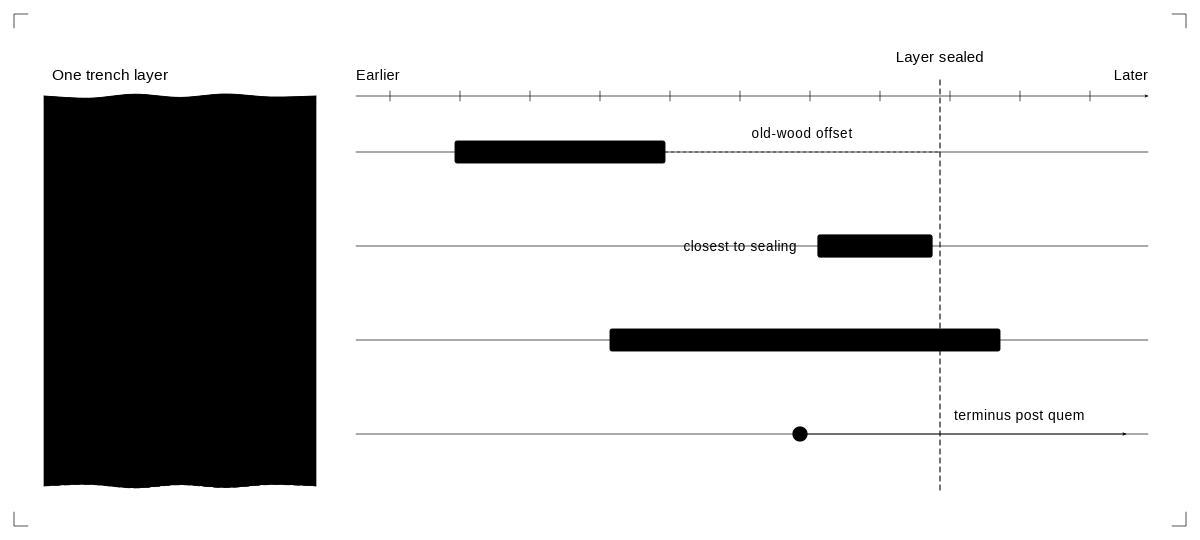
The wood ranges are too broad and date tree growth, not building or use.
Radiocarbon ages are measured in BP, not calendar years. Open the dating bench to drop three real samples through the conversion each study reports and see where dates split or stop.
Multi-piece range (Kuttikol charred wood, 2526 ± 20 BP): Drop the Kuttikol charred-wood sample on the bench and record all three published calendar pieces (792-744 BCE at 37.1%, 686-665 BCE at 14.3%, and 644-551 BCE at 44.0%). Explain why one measured age splits into three separate windows, and check whether outer rings or heartwood were dated.
Same sample, several studies (Adichchanallur Urn 105 paddy, 2700 ± 30 BP): Open the Adichchanallur paddy sample (905-806 BCE, 95.4%) and note how three studies on this site cite the same measurement, and why short-lived paddy avoids old-wood offset.
Where the record stops (S. Pappinayakkanpatti, 2040 ± 150 BP): Select the S. Pappinayakkanpatti sample and note why the bench stops at the conversion plate instead of computing a calendar date when no published range is recorded.
Up to six questions for each of the sixteen themes, each built from one study and checked against it. The mark schemes give the study's own level and reason, and credit a different level when the reason is good.
Each topic page sets out one lesson for ages 11 to 18 to read on any screen: the three source cards, the tasks, and the statements to grade. Answer on paper or in your notes.