Read the three cards first. Then work through the tasks on paper or in your notes. The answers are not on this page: compare your levels with the studies on the evidence bench.
001Source cards
The three source cards
Ground
An umbrella stone
Photo: Ranjith Siji (Wikimedia Commons). Licence: CC BY-SA 4.0 (https://creativecommons.org/licenses/by-sa/4.0). Source: https://commons.wikimedia.org/wiki/File:Kudakkallu_Parambu_DSC_0638.JPG
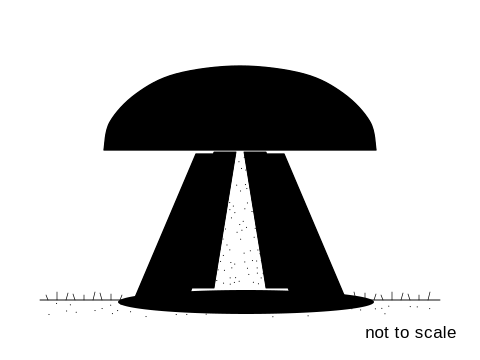
The photograph shows an umbrella stone at Kudakkallu Parambu, Cheramanangad.
An umbrella stone is a dome of laterite resting on four shaped stone supports.
Laterite is a rock that can be cut and shaped with hand tools.
Umbrella stones cluster in central and northern Kerala.
They are distinctive, but they have not been shown to be found only in Kerala.
What it cannot tell us The shape on the surface does not, on its own, tell us what lies beneath.
Look
Describe the monument: its parts, its shape and what it is made of.
Talk
What can you tell from the outside, and what can't you?
Ask
What would you need to do to find out what lies beneath it?
Ground
What lay beneath at Cheramanangad
In 1990–91 the Archaeological Survey of India opened one example of five monument types here.
Two of the five held no burial; one of these was an umbrella stone.
Another held an urn with bones, pots and an iron object.
A monument with a granite capstone covered an urn, pots and bone.
A stone circle held three pits, each with iron objects and a copper bowl.
The excavators called the empty monuments symbolic burials.
What it cannot tell us The study found no laboratory date for this site.
Look
What was found under each kind of monument?
Talk
Which sentence on this card was worked out rather than found?
Ask
Why might people build a grave monument with no burial in it?
Laboratory
Many graves, few dates
More than a thousand Iron Age burial sites are recorded in Kerala.
The oldest laboratory dates from any Kerala burial come from two charcoal samples at Mangadu.
Scientists think that charcoal dates to roughly 1300–800 BCE.
A laboratory date measures the sample, such as charcoal, not the building of a monument.
No umbrella stone has a laboratory date in the published sources the study read.
Excavated umbrella stones lack the beads that are used to date graves by comparison.
What it cannot tell us The Mangadu samples do not date the whole of southern Kerala's Iron Age.
Look
Which monuments on this card have a laboratory date, and which have none?
Talk
A laboratory date measures a sample. Why does that matter when we try to date a monument?
Ask
Which sample would you most like to find under an umbrella stone, and why?
002Tasks
Work through the tasks
I can see … It is made of …
Under the monuments at Cheramanangad, the excavators found …
A laboratory date measures … so it does not tell us …
I graded this statement … because …
Megaliths can tell us … but they can't tell us …
003How sure can we be?
Grade each statement
For each statement, choose one of the four levels and give one reason from the cards. A different level with a good reason is good history.
Umbrella stones cluster in central and northern Kerala.
Monument burial in Kerala had begun by the first half of the first millennium BCE.
The empty monuments were symbolic burials.
How old are Kerala's umbrella stones and hood stones?