Well supported
271Direct, clear evidence supports this specific statement.
Example: “Writing on pottery was part of everyday settlement life at Keezhadi” (R109)
001Nobody knows yet
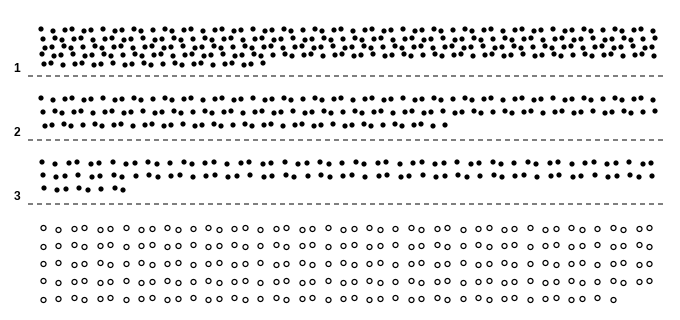
All 779 graded statements across 199 studies, one column per study in the order each study stores them. Every fill stays at full ink; the 227 hollow squares mark statements rated Not known here, from genuinely open questions to popular claims without primary evidence.
Across the water47
Land & water43
Words & worlds34
Belief & memory34
Everyday lives30
Made by hand25
How we know14
One column per study (three cells where a study holds three rows). Arrow keys move across open squares; Enter opens a question.
Layers of the South · Open question project sheet
Not known · LTS-SUP01
“The sixth century BCE marks the Early Historic start across Tamil Nadu.”
This study marks it Not known. Tamil Nadu: no single Iron Age to Early Historic boundary shown
Defensible for some western and Vaigai sites, but not a demonstrated universal boundary.
Also in this study: Two views (not an answer to the statement above)
When the Early Historic period began in Tamil Nadu
What would settle it: Several stratified dates above and below key cultural changes in each region, with full calibration and secure links to inscriptions or structures.
1. What new find, date or text would help settle this question?
2. Which study rows, places or primary sources will you check first?
002How we weigh evidence
Each graded statement carries one of four fills in the same ink. They describe the strength of the evidence for that specific claim, not how interesting the idea is.
Direct, clear evidence supports this specific statement.
Example: “Writing on pottery was part of everyday settlement life at Keezhadi” (R109)
The available evidence favours this interpretation, with uncertainty.
Example: “Pattanam was part of the wider Muziris port landscape on the lower Periyar.” (R002)
Plausible, but the evidence is limited or contested.
Example: “A short label publicized in 2012 is the earliest Malayalam inscription” (R107)
The evidence reviewed here does not settle the question.
Example: “The sixth century BCE marks the Early Historic start across Tamil Nadu.” (LTS-SUP01)
Context before object
A find means more when its soil layer, pit cut and neighbouring finds are recorded together. Objects from surface collections or disturbed earth carry narrower conclusions.
Samples, not whole sites
A radiocarbon date measures when an organic sample stopped taking in carbon. Old wood, disturbed charcoal or loose layer links can separate a sample age from the human event around it.
Letters on stone and clay
Tamil-Brahmi and Vatteluttu inscriptions anchor names, gifts and crafts directly to places. Where a script style spans centuries, letter shape alone gives a broad range rather than a single year.
Hoards show movement, not motive
Roman and local coin hoards prove that silver and gold reached inland Kerala and Tamil Nadu. Coin mint dates set an earliest possible burial date, never the year a jar was buried or why.
Copied across centuries
Early Tamil poems and Greek or Latin trade notices preserve place names, goods and voices, but they reach us through later manuscripts and literary conventions rather than excavated ledgers.
003Twelve exhibits
Each exhibit separates what was found from what it suggests and what stays uncertain, with its own recorded How-sure grade. We chose these 12 exhibits from published studies; no outside specialist has reviewed them yet.
PATTANAM · KERALA · STONE BEADS
Likely Unfinished pieces suggest stone bead working at Pattanam; their dates remain tentative.
Kelly 2024, pp. 52–57 (chronology discussion on p. 56; Tables 2–6 on pp. 54–57).
Sources: Kelly (2024)
Studies: Pattanam finds: wide trade links, unevenly dated and sourced · Kodumanal made stone beads and smelted iron on site · Arikamedu was a South Indian craft port, not a Roman colony
PATTANAM · KODUMANAL · ARIKAMEDU
Not known Whether these compared beads travelled between the sites remains unproven in Kelly’s comparison.
Kelly 2024, comparative discussion on pp. 52–56; “Kodumanal made stone beads and smelted iron on site” (Kodumanal), “Arikamedu was a South Indian craft port, not a Roman colony” (Arikamedu), and “Pattanam finds: wide trade links, unevenly dated and sourced” (Pattanam inventory). Separate site samples and layer limits remain distinct.
Sources: Kelly (2024)
Studies: Kodumanal made stone beads and smelted iron on site · Arikamedu was a South Indian craft port, not a Roman colony · Pattanam finds: wide trade links, unevenly dated and sourced
PERUR · TAMIL NADU · 260–557 CE
Likely A 2019 paper reports that rice from Perur has been dated to 260–557 CE; it gives no laboratory details, and the 2015 thesis was not consulted.
Kingwell-Banham 2019, site descriptions and radiocarbon discussion. Cooke, Fuller and Rajan 2005, pp. 341–350, is related work on overlapping archaeological material, not a second independent date.
Sources: Kingwell-Banham (2019) · Cooke, Fuller and Rajan (2005), Early Historic...
Studies: Perur yielded glass beads but no sign that they were made there · Sivagalai's dated rice grain came from inside a burial urn · Early South Indian farming mixed rain-fed crops and managed water
KODUMANAL AND PERUR · TAMIL NADU · RICE FARMING
Likely The rice at these two sites was rain-fed. The plant evidence favours it, but only two sites were tested.
Kingwell-Banham 2019, methods and discussion; Cooke, Fuller and Rajan 2005, Perur sequence and agricultural evidence.
Sources: Kingwell-Banham (2019) · Cooke, Fuller and Rajan (2005), Early Historic...
Studies: Early South Indian farming mixed rain-fed crops and managed water · Perur yielded glass beads but no sign that they were made there
PATTANAM · KERALA · WATERLOGGED PEAT
Not known It is not known how old the peat plants are; the specimens have no direct date.
Varghese et al. 2020 (Proc. Indian Natn. Sci. Acad. 86(2), published June 2020 on peat collected in 2015; PDF indexed 2019 Art. 59), methods and discussion; p. 1099, chronology statement.
Sources: Varghese et al. (2020 [article PDF indexed 2019], Proc. Indian Natn. Sci. Acad. 86(2)
Studies: Western Ghats uplands were settled; forest producers are unnamed · Malabathrum and cardamom: Kerala hill origins not shown · Early South Indian farming mixed rain-fed crops and managed water · Pattanam finds: wide trade links, unevenly dated and sourced
VIZHINJAM · KERALA COAST · 1ST–8TH CENTURY CE
Likely Marine animals dominate the small identified Period I sample (about three quarters of 52 fragments; 1st century–800 CE). This shows that sea animals were used, not what share of the diet they made up.
Abhayan et al. 2014, pp. 253–271; periodization and Table 1; recovery and identification discussion.
Sources: Abhayan, Joglekar, Kumar and Rajesh (2014),...
Studies: Vizhinjam's earliest phase: sea foods and West Asian jars · Animal bones show livestock and wild game, not working animals
PATTANAM · KERALA · MUZIRIS
Likely Pattanam was probably a major part of the Muziris port landscape; the case rests on excavated finds and texts, not on a written port name.
KCHR 2008 handbook; Shajan et al. 2008 ceramic report; Das et al. 2024 title and abstract only (core logs and figures not consulted).
Sources: Kerala Council for Historical Research, Pattanam... · Das et al. (2024) · Shajan, Cherian, Tomber and Selvakumar (2008), The...
Studies: Pattanam is a candidate for ancient Muziris · Pattanam's radiocarbon dates give no single date for its wharf · Pattanam finds: wide trade links, unevenly dated and sourced
AKANANURU 149 · PURANANURU 343 · TAMIL POEMS
Not known It is not known when either poem was composed; scholars disagree sharply on Sangam dates, and these manuscript-transmitted poems carry no date of their own.
Tamilex project descriptions accessed 18 October 2026; exact Akananuru 149/Purananuru 343 comparison retained in “Two Tamil poems use Muziris's wealth for different ends”.
Sources: University of Hamburg Tamilex, Puṟanāṉūṟu critical... · University of Hamburg Tamilex, Akanāṉūṟu critical...
Studies: Two Tamil poems use Muziris's wealth for different ends
PUGALUR · TAMIL NADU · CAVE INSCRIPTIONS 61 AND 62
Possible The standard edition reads the causative verb as the grandson having the rock cut at his investiture; the inscription does not say who paid, so this stays Possible.
Electronic edition, Pugalur 61 and 62: normalized readings, translations and notes; no. 62 note 5 restores damaged letters from no. 61. Compare genealogy, investiture wording and causative carving as separate propositions. No independent decipherment from the images is claimed.
Sources: CICT-associated electronic edition, Pugalur inscription 61 · CICT-supported Tamil-Brahmi electronic edition: Pugalur 62
Studies: Pugalur inscriptions record a three-generation royal genealogy · The Patiṟṟuppattu is layered Chera praise poetry, not an archive
EDAKKAL · WAYANAD, KERALA · ROCK LABEL
Possible Iravatham Mahadevan proposed that Edakkal label 5 is the earliest Malayalam inscription; other epigraphists have disputed both the reading and the language claim.
Mahadevan (2012; revised Early Tamil Epigraphy 2014); Palaniappan 2012 INDOLOGY note; Govindankutty Menon 1990 publisher extract only. Full linguistic works remain to be consulted.
Sources: Sudalaimuthu Palaniappan (2012) · Govindankutty Menon (1990)
Studies: Written Malayalam is clearly documented from the 800s · Tamil-Brahmi comes from Brahmi; when it began is still disputed
VELVIKKUDI · TAMIL NADU · EIGHTH-CENTURY CHARTER
Not known It is not known whether Kalabhra rule lasted three centuries across the Tamil country; the eighth-century charter gives no date, length or territory.
Vēḷvikkuṭi, Epigraphia Indica XVII, no. 16: printed p. 306, translation lines 38–40 (old grant and resumption), and p. 308 (petition and regrant sequence). DHARMA INSPandya10002 supplies complementary metadata and apparatus.
Sources: DHARMA, Vēḷvikkuṭi grant, time of Neṭuñcaṭaiyaṉ, year 3 · H. Krishna Sastri, Vēḷvikkuṭi grant, Epigraphia Indica...
Studies: Velvikkudi plates: an eighth-century memory of the Kalabhras · South India around 600 CE: change in stages, not one break · Northern Tamil Nadu's firmest Deccan link is the Pallava charters
NIRAMAKULAM · PAMBA BASIN, KERALA · CIST BURIAL
Likely The 2021 excavator's report (non-specialist journal; laboratory certificates not seen) states that one charcoal sample came from inside the cist and one from outside, correcting an earlier description.
Ambily 2021 (JETIR, non-specialist venue), p. 776, sample-location correction; laboratory references reported as Beta-377787/Beta-377788 (certificates not seen, calibration not recomputed).
Sources: Ambily (2021)
Studies: Porkalam 1948: one urn burial that became a reference point · Russet-coated ware occurs in Kerala; its source and age are open
004Weigh a claim
Statements from the studies, each graded by the study that makes it. Decide how sure you would be, then compare your grading with the study's and read its reason. There is no score: the point is the reason.
01 / 10
Everyday lives
Timber uprights held up the Keeladi roofs.
The study grades it
Likely
Inferred from post-holes, nails and tiles; the wooden posts themselves do not survive.
Early houses survive as walls, post-holes and tiles, not plans
Across the water
Tamil was written on pottery that reached Egypt's Red Sea ports
The study grades it
Well supported
Published Tamil-Brahmi inscriptions come from both Quseir al-Qadim and Berenike.
Land & water
Black pepper's evolutionary origin lay in a Sri Lankan clade rather than a Western Ghats hybrid origin.
The study grades it
Possible
Metschina et al. (April 2026 abstract) propose a Sri Lankan endemic clade, whereas Kew POWO (listing both SW. India and Sri Lanka as native), Ravindran (2000), Sen et al. (2019) and ICAR–IISR support a Western Ghats/SW Indian native range.
Kerala's spice coast grew from habitats, cultivation and trade
Made by hand
Whether Rouletted Ware was fired at Arikamedu itself, or whether Mediterranean merchants lived there permanently.
The study grades it
Not known
No Arikamedu kiln or waster dump is demonstrated, and imported goods do not prove permanent foreign residence.
How we know
People were active at Keezhadi by the sixth century BCE (the earliest samples calibrate between the eighth and fifth centuries BCE)
The study grades it
Likely
Beta Analytic radiocarbon ages (such as Beta-519476, 2530 ± 30 BP, calibrating to ~792–545 cal BCE) fall on the Hallstatt calibration plateau (c. 800–400 BCE), and complete sample certificates and trench stratigraphy remain incomplete in public summaries.
Keezhadi's excavations reveal a substantial brick settlement
Belief & memory
Mangadu’s iron finds were tools, with no spears
The study grades it
Well supported
T. Satyamurthy's 1992 excavation report, the department page, and Vinuraj et al. (2020) all report iron tools without spears, tridents or horse bits.
Mangadu's urn burials give southern Kerala early dated charcoal
Across the water
A temple to Augustus stood at Muziris.
The study grades it
Possible
Plausible given strong trade, but one map label is the only evidence.
A medieval map copy labels a Temple of Augustus near Muziris
Words & worlds
Pepper reached Puhar by cart from the Western Ghats
The study grades it
Not known
Commentators read the key phrase as wind or carts; the mountain clause concerns sandalwood.
Pattinappalai shows a taxed, busy port, not a customs bureau
Made by hand
Stone beads, especially quartz beads, were made at Kodumanal.
The study grades it
Well supported
Rough-outs, blanks and debris are reported across the site; the study marks this supported.
Across the water
The coin names belong to kings praised in early Tamil poems
The study grades it
Possible
The names match, but no independent date or text links issuer and poem king.
Chera silver portrait coins carry Tamil-Brahmi names and titles