Each period has the same width, so spacing is not to scale.
- Words & worlds
- 200 BCE–300 CE
- 300–600 CE
Malaipadukadam: mountain travel, sound and welcome in Tamil verse
A 583-line Tamil guide-poem presents a mountain journey through sounds, dangers and generous hosts, but its route cannot be fixed on a modern map.
- This page
- 3,665 words · revision 6
Draft study · Awaiting specialist review · Updated
001Dates and places

No mapped place in this study.
1000–500 BCE
Different beginnings
500–200 BCE
Marks & materials
200 BCE–300 CE
Connected worlds
300–600 CE
Change & continuity
After 600 CE
- Tamil Nadu Department of Archaeology interprets Andipatti as showing occupation from about the first century BCE to the twelfth century CE.
- Period assigned by excavators or scholars
Each date belongs to what was dated (a sample, an object, a layer or a text), which is not always the event the study asks about.
Each period has the same width, so spacing is not to scale.
The full table of dates, with their ranges, is under How we know.
- 2 Well supported
- 1 Likely
- 1 Not known
002How sure
In brief
Malaipadukadam is a 583-line classical Tamil poem attributed to the poet Peruṅkaucikaṉār. It belongs to the āṟṟuppaṭai genre, in which one performer guides others toward a generous patron. Here the patron is Nannan, and the travellers are performers carrying instruments through mountain country. A long passage lists what they hear: hunters, elephants, honey gatherers, drums, rushing water and field guards. Its title pictures the mountain as an elephant whose must (kaṭām) is the mass of sound rising from it (l. 348), though English translations vary between literal 'secretion' and intended 'sound'. Hosts along the way offer honey, tubers, meat, milk and shelter, and the journey ends with feasting and lavish gifts at Nannan's court. These scenes show valued customs within the poem, not organised hostels or a state service. Modern writers link the route to Chengam, Parvathamalai or the Javadi Hills, but neither the route on a modern map nor the poem's exact composition date is settled.
Key researchers cited in this study: Kamil Zvelebil (Classical Tamil Philology) · Eva Wilden (Sangam Critical Editions & Manuscriptology) · Vaidehi Herbert (Sangam Poetry Translations & Commentaries) · U. V. Swaminatha Iyer (Classical Tamil Manuscript Editions) · Full bibliography
How sure
- Well supported
The poem is a 583-line guide-poem addressed to the patron Nannan.
Project Madurai and the Central Institute of Classical Tamil records agree.
- Well supported
Sound is central to how the poem presents the mountain journey.
A long passage around lines 291 to 350 deliberately catalogues human, animal, work and musical sounds.
- Likely
The title Malaipadukadam pictures mountain sound through the metaphor of an elephant's must (kaṭām).
Nacciṉārkkiṉiyar's commentary (l. 348) pictures the mountain as an elephant whose must (kaṭām) is the sound rising from it; Zvelebil and CICT record both a secretion and a sound reading.
- Not known
Where the poem's route ran on a modern map.
Chengam, Parvathamalai and Javadi proposals coexist; nothing ties the literary names to one place.
Why it matters
It shows how a classical Tamil poem made mountain country understandable through sound, work and hospitality, and where its value as evidence stops.
003Key findings
What the study concludes
- The poem is conventionally counted at 583 lines and is an āṟṟuppaṭai guiding performers toward Nannan.
- The title is conventionally connected with the poem's mountain-sound image; its exact semantic explanation is debated.
- Sound is structural to the poem: the route is made intelligible through voices, animals, work sounds, music, water and percussion.
- Hospitality appears repeatedly across settlements and occupational settings before culminating in courtly provisioning and gifts.
- Modern Chengam, Jawadhu/Javadi and Parvathamalai identifications remain proposals; the poem alone cannot pin its itinerary to a modern pass.
In the study’s own words. How sure each point is, is shown above.
The summary above is the short read. The full study is the complete text it was drawn from, with its tables and source notes.
What the full study covers
004The study
The question
What does Malaipaṭukaṭām reveal about represented mountain life, travel and hospitality?
The strongest answer is literary rather than institutional. Malaipaṭukaṭām is a 583-line Tamil poem conventionally classified among the Pattuppāṭṭu (“Ten Idylls/Long Songs”) and as an āṟṟuppaṭai, a “guiding” poem in which successful performers direct other performers toward a generous patron. The poem represents mountain travel as an embodied passage through changing terrain and communities: instruments are carried; travellers negotiate traps, snakes, steep and wet ground; local people give directions and assistance; hunters, herders, cultivators and other workers are heard and encountered; food and shelter recur along the way; and the journey culminates in reception and gifts at Nannan's court. ↗1 ↗2 ↗3
Three tests have clear outcomes. Text, attribution and numbering: the consulted independent records converge on a 583-line poem attributed to Iraṇiya Muṭṭattup Peruṅkuṉṟūrp Peruṅkaucikaṉār and addressed to Nannan; Project Madurai's separate commentary page contains a conflicting “Kapilar” header, best treated as a derivative-web metadata problem rather than grounds for changing the poem's established attribution. Soundscape versus institutions: the poem offers unusually dense literary evidence for how a mountain country could be imagined acoustically and socially, but scenes of hunting, cultivation, guidance, food, shelter and courtly generosity do not by themselves demonstrate formal “highland institutions.” Geography: modern identifications around Chengam, Parvathamalai and the Jawadhu/Javadi Hills exist, but even an official district history presents alternatives; the evidence reviewed here therefore does not justify converting the literary itinerary into a particular modern mountain pass. ↗1 ↗3 ↗4 ↗5
Dating: mixed. The poem belongs to the classical Tamil corpus relevant to this site's principal period, 1000 BCE–600 CE, but a secure poem-specific absolute date was not established from the sources read. Eva Wilden's manuscript-history research is especially useful as a warning against collapsing composition, oral antecedents, manuscript transmission, commentary and print publication into one date: the Cankam corpus has a long and complicated textual afterlife. The securely documentable modern reception history includes nineteenth- and twentieth-century print editions, translations and twenty-first-century critical and thematic work. ↗1 ↗6 ↗7
Principal findings at a glance
| Question | Finding | Confidence |
|---|---|---|
| What kind of source is it? | A literary āṟṟuppaṭai, not a travel log or administrative survey. | High |
| Is the poem 583 lines? | Yes in the consulted Project Madurai and CICT records. | High |
| Who is the attributed poet? | Iraṇiya Muṭṭattup Peruṅkuṉṟūrp Peruṅkaucikaṉār / variant Romanizations of Peruṅkaucikaṉār. | High |
| What does the title mean? | Literally “the kaṭām (elephant's must/rut) arising from the mountain”: the poem pictures the mountain as an elephant whose kaṭām is the mass of sound rising from it (l. 348), as Nacciṉārkkiṉiyar explains; Zvelebil and CICT treat the title as uncertain. | Likely |
| Is “The Mountain Secretions” an adequate English title? | It reflects one literalizing interpretation but should not be presented as the single settled meaning. | High |
| Is sound central? | Yes. A long section deliberately catalogues human, animal, occupational, musical and environmental sounds. | High |
| Does the poem portray hospitality? | Repeatedly, from small settlements and occupational communities through Nannan's court. | High |
| Does this establish organized pass hospitality institutions? | No. That requires evidence beyond literary representation. | High |
| Can the itinerary be pinned to a modern pass? | Not from the poem and evidence read here. Modern regional identifications remain contested/provisional. | High |
Text, attribution, title, numbering, and transmission
The Project Madurai Unicode text identifies the poem as malaipaṭukaṭām of Peruṅkaucikaṉār, associates it with Nannan, identifies its tiṇai/genre as āṟṟuppaṭai, and counts 583 lines. The Central Institute of Classical Tamil likewise identifies the attributed poet more fully as Iraṇiya Muṭṭattup Peruṅkuṉṟūrp Peruṅkaucikaṉār, gives 583 lines, and records the alternative title Kūttarāṟṟuppaṭai, meaning an āṟṟuppaṭai concerned with performers/dancers. CICT's overview of Pattuppāṭṭu confirms that Malaipaṭukaṭām belongs among the āṟṟuppaṭai works in which a bard or performer directs another toward a munificent patron. ↗1 ↗2 ↗3
This genre identification matters methodologically. Route description, danger, welcome and patronage are not incidental documentary notes embedded in a neutral gazetteer: they participate in a poem whose communicative purpose is to make movement toward a patron imaginable, desirable and achievable. Its geographic and social observations can therefore be historically suggestive without being literal field records. ↗2 ↗3
The two English renderings often contrasted for the title are actually the two halves of a single classical metaphor. Kaṭām is an elephant's must (rut secretion): at the climax of the acoustic catalogue around line 348, the poet figures the mountain as a great elephant and the mass of sounds rising from it as its kaṭām, and Nacciṉārkkiṉiyar's commentary explicitly notes that the poem takes its name from this image (Zvelebil and the CICT catalogue, by contrast, present the “oozing” and “sound” readings as alternatives). English titles vary between literal “secretion” and acoustic “sound” renderings. The clearest practice in English is therefore to keep the Tamil title and explain the elephant-must metaphor. ↗1 ↗3 ↗4 ↗7
The line numbering is conventional modern editorial numbering, useful for stable citation but not evidence that an ancient author numbered verses this way. Project Madurai provides numbered divisions running through line 583, while the title-defining phrase falls around line 348. The consulted web transcription of the Nacciṉārkkiṉiyar commentary brackets the relevant region with line markers around 345 and 350, corroborating the conventional locator. ↗3 ↗4
A bibliographic complication deserves explicit recording. Project Madurai's stand-alone poem page attributes the poem to Peruṅkaucikaṉār, as do CICT and Zvelebil, but its separate Nacciṉārkkiṉiyar-commentary web page has a header naming Kapilar. The same commentary page identifies itself as based on U. V. Swaminatha Iyer's 1931 third edition. Given the convergence of the independent poem page, institutional CICT record and Zvelebil on Peruṅkaucikaṉār, the Kapilar header is insufficient to overturn the attribution and is best flagged for correction as derivative metadata. This study does not infer that the underlying 1931 printed edition itself made that attribution without inspecting its title page. ↗1 ↗3 ↗4 ↗7
Montane landscape in the Nilgiris, Western Ghats (modern ecological context)
Photographed 2025-08-25
Print history likewise needs finer distinctions than a bare “J. V. Chelliah, 1946” date. Zvelebil reports publication of Malaipaṭukaṭām in 1889; CICT lists U. V. Swaminatha Iyer's 1912 edition with Nacciṉārkkiṉiyar's commentary and a 1956 P. V. Somasundaranar edition. Open Library identifies the Tamil University 1985 edition of J. V. Chelliah's Pattupattu, Ten Tamil Idylls, while the National Diet Library record describes it as a reprint of an earlier Colombo publication and gives the earlier date only approximately as “[1947?].” Consequently, Chelliah is an important modern translator/edition, not a primary ancient source, and the exact original Colombo imprint year remains unsettled rather than a fixed “1946” fact. ↗1 ↗8 ↗9 ↗7
Transmission history also counsels caution about treating any modern e-text as identical with an authorial original. Wilden's study of Cankam manuscripts, print and memory describes a corpus preserved and reshaped through a long history of manuscripts, commentary, print editions and later literary reception. For this topic, that means composition date, manuscript witness date, commentary date, first modern publication and current digital transcription must remain separate chronological categories. ↗6
Soundscape, animals, work, and represented mountain life
The poem opens with musical equipment and performance culture rather than with a detached topographic survey. The travelling group carries instruments, including the yāḻ, which immediately identifies these travellers as performers and conditions how the landscape is experienced. Later, the poem explicitly pivots toward what travellers will hear and develops a long acoustic sequence. ↗3
The long sound passage, conventionally around lines 291–350, is one of the strongest grounds for treating sound as central to the poem. Its represented sounds include cries and songs associated with hunters and wounded people, interactions between elephants and tigers, monkey distress, honey gathering, kuravai performance and drumming, rushing water, elephant handlers' voices, crop-protection and agricultural sounds, fighting animals, sugarcane processing, millet-related songs and percussion used in connection with pigs. The sequence culminates in the malai-paṭu-kaṭām expression around line 348, giving the title problem an immediate acoustic context. ↗10 ↗3 ↗11
The important historical insight is not merely that “mountains were noisy.” The poem composes a socially differentiated acoustic landscape: natural forces, non-human animals, human labour, warning, performance, subsistence and communication overlap. Sound helps travellers read the country. In literary terms, hearing is a means of orientation: one senses occupation, danger and social presence before or alongside seeing them. Recent scholarship by V. Mariselvi independently treats sound references as a major analytical feature of the poem and classifies them into human, animal, instrumental, occupational and affective categories, although broader social-historical conclusions in that article should not be substituted for close reading of the poem itself. ↗10 ↗3
Animals play an equally strong representational role. Wild elephants, boars, snakes, monkeys and predators appear in hazard and sound scenes, while cattle and horses enter pastoral and gift contexts. These references establish that the poem imagines a mountain country crowded with human-animal interactions. They do not, without external ecological data, establish ancient population densities, precise species ranges or a statistical fauna of any specific modern mountain system. ↗3
The poem's work sounds and food scenes also represent production: field guarding, crop processing, herding, hunting/foraging and food preparation all form part of the route. Yet moving from such images to institutional claims requires an extra inferential step. A poetic reference to a guard, herder, honey gatherer or cultivated field supports the existence of that activity within the represented world; it does not automatically prove a formal occupational corporation, tax regime, territorial bureaucracy or ethnographically fixed community. ↗3 “Western Ghats uplands were settled; forest producers are unnamed” uses the same honey-gathering and field-guarding passages in its study of upland forest economies, where they are compared with later ethnography of Kanikkar honey gathering.
| Evidence layer | What the poem directly supports | What requires independent evidence |
|---|---|---|
| Sound | A composed catalogue of human, animal, occupational, musical and environmental sounds | Reconstructed ancient acoustics, measured sound levels, exact instrument performance |
| Animals | Literary encounters with wild and domestic animals | Population density, exact historical ranges, herd statistics |
| Work | Representations of guarding, collecting, herding, processing and cultivation | Occupational institutions, taxation, administrative organization |
| Community | Encounters among performers, forest/mountain dwellers, herders and cultivators | Direct mapping onto modern ethnic, caste or tribal categories |
| Hospitality | Food, drink, shelter, welcome and courtly gifts along a route | A formal state-managed “hospitality system” or pass administration |
The poem's organization can therefore be summarized as a sequence of functions in the narrative, not a reconstructed archaeological sound recording:
- Travelling performers enter the mountain route carrying musical instruments.
- Hazards, work sounds, animals, water, and music unfold together across the landscape, building the perceived mountain soundscape.
- Local knowledge and assistance guide the travellers past hazards toward food, shelter, and onward movement.
- Nannan's settlement and court conclude the sequence with feasting, recognition, and departure gifts.
This sequence summarizes the poem's literary organization, not a modern geospatial route. ↗3
Travel, danger, assistance, and hospitality
The route passages are strikingly practical in literary form. Travellers are warned about boar traps, concealed snakes, stones used by crop guards, dangerous or slippery water and terrain, and the need to manage when and how particular stretches are crossed. Elsewhere caves provide places associated with halting or shelter, and people knowledgeable about the forest can help travellers who lose the way and indicate usable foods or landscape signs. Such material gives the poem a persuasive “route-knowledge” texture. ↗3
That texture still differs from a literal itinerary. An āṟṟuppaṭai must persuade its imagined addressees that the journey is possible and that a patron is worth reaching. Hazard knowledge therefore performs at least two functions simultaneously: it evokes a credible mountain environment, and it narratively demonstrates that danger can be overcome by knowledge, timing, assistance and hospitality. ↗2 ↗3
Hospitality begins well before the destination. In a passage around lines 151–184, travellers are represented as entering small mountain communities where they receive honey, tubers and meat and are treated with intimate, kin-like generosity; hosts press them to eat and stay. The significance is not simply the food list. The passage imagines hospitality as a mechanism that converts outsiders moving through difficult terrain into temporarily protected guests. ↗3
ഇല്ലി (Bambusa bambos) – Modern bamboo identification, for material and soundscape context
Photographed 12 January 2026 (according to Exif data)
Later stretches diversify the provisioning. Pastoral settings offer milk and shelter; other communities provide meat and tubers; agricultural food passages mention bamboo rice or grain, paddy, pulses such as avarai, sour/tamarind preparations and dairy fats including butter or ghee. A modern English translation by Vaidehi Herbert is useful for checking the broad semantic sense of these passages, but it remains a modern translation of the same literary witness, not independent confirmation that particular menus existed at a particular archaeological site. ↗3 ↗11
The courtly climax changes the scale and rhetoric. The travellers reach Nannan's town and are received as performers from afar. Near the poem's conclusion, generosity is represented as renewed day after day, followed by prestigious departure gifts that include fine clothing, food, golden ornaments or lotus imagery, chariots, elephants, cattle, horses and wealth. This is emphatically patronal praise, and its rhetorical excess is part of the evidence: it shows what the poem presents as exemplary munificence, not a quantitative inventory of an excavated treasury. ↗3 ↗11
Hospitality therefore operates at several represented scales:
| Stage | Literary form of support | Cautious historical inference |
|---|---|---|
| Mountain settlements | Immediate food, drink, welcome, invitations to stay | Hospitality toward travellers is an intelligible and valued social expectation in the poem |
| Forest/mountain route | Guidance and practical local knowledge | Mobility is represented as dependent on people who know terrain and resources |
| Pastoral/agricultural zones | Milk, meat, tubers, grain and prepared foods | The poem differentiates subsistence and productive settings along the route |
| Nannan's centre | Formal reception, repeated feeding and prestigious gifts | Patronal generosity is central to āṟṟuppaṭai ideology |
| Proposed “institution” | Not directly described | A formal pass-hostel network, state provisioning service or administrative hospitality system remains unproved |
Accordingly, “mountain pass hospitality” is useful only if understood descriptively: hospitality encountered during mountain travel. It should not become the name of an institution unless independent inscriptional, archaeological or administrative evidence can demonstrate one.
Geography, chronology, and the boundary between literature and history
The poem names places and political figures, but precise modern mapping is the weakest part of the evidence. A modern Tiruvannamalai District government history page connects Malaipaṭukaṭām, Nannan and Naviramalai with the region around Chengam, while also reporting competing scholarly identifications: Naviramalai has been related by some to present-day Parvathamalai and in broader proposals to the Jawadhu/Javadi hill country. The coexistence of alternatives on the same institutional page is itself a reason not to place a single “correct” pin on a map. ↗5 This Nannan should not be assumed to be the Nannan whom other poems link with Eḻil, the hill that later commentary identifies with Ezhimala in north Kerala; “Ezhimala and Nannan: strong in Tamil poems, unexcavated on the ground” explains why the two traditions are best held apart.
Regional archaeology shows that the broader area has substantial antiquity, but it does not solve the literary route. The Tamil Nadu Department of Archaeology reports excavation at Andipatti near Chengam and describes Megalithic and Historic-period material, with a long occupation sequence interpreted from roughly the first century BCE into the medieval period. That is independent evidence that the regional landscape was inhabited over a long span. It is not independent identification of Andipatti with Nannan's centre, Naviramalai, or a particular stop in the poem. ↗12
This distinction can be stated formally:
Observation from poem → named or described literary landscape Modern proposal → candidate correspondence to a modern place Independent regional evidence → confirms human activity in the broader region Required but missing step → evidence demonstrating that the literary name and modern place are historically identical
Skipping the fourth step would turn plausibility into identification.
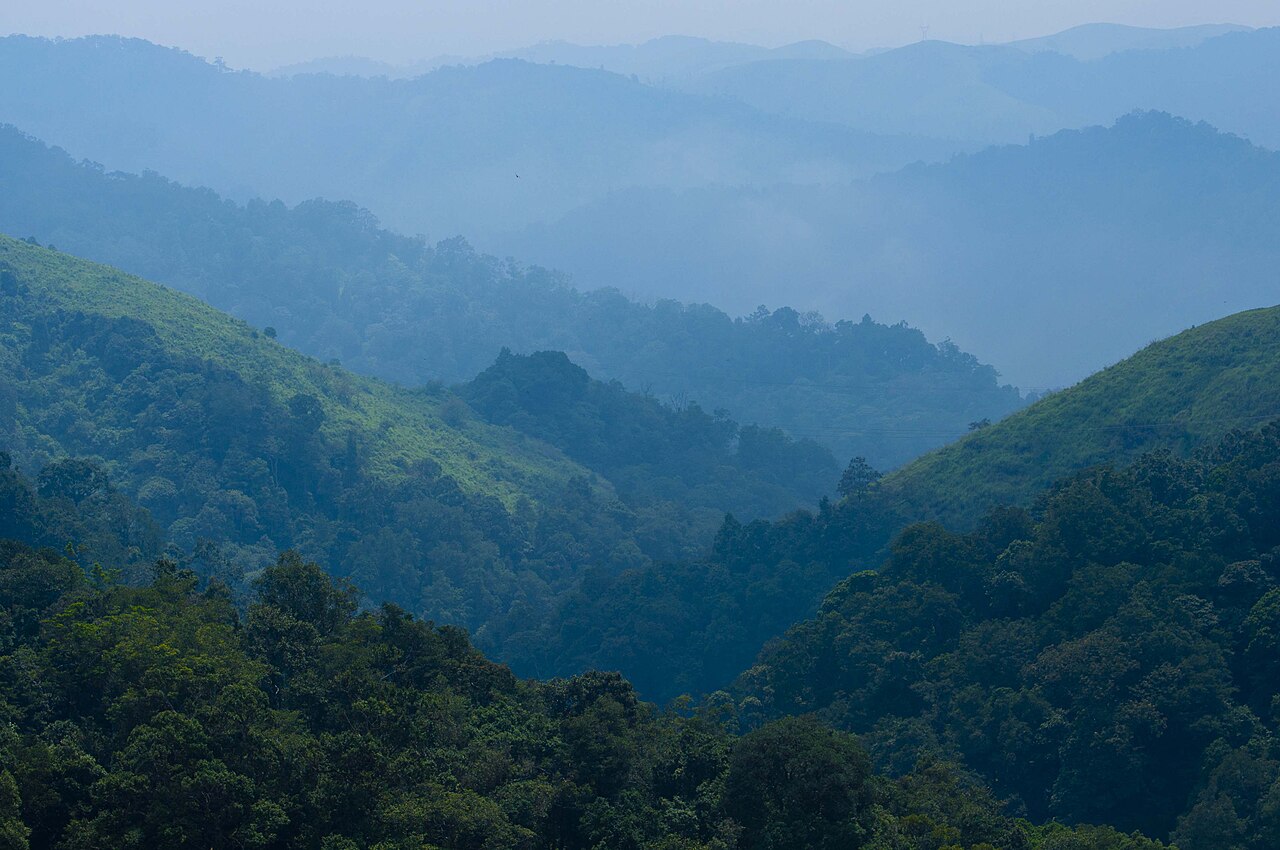
Mountains of Western Ghats – Modern woodland context
Photographed 2011-10-22
A reported medieval inscription or verse from a Chengam temple is potentially useful for a different question: later reception and localization. Derivative online accounts cite a phrase that appears to remember a mountain “sung in Malaikaṭām/Malaipaṭukaṭām” and point to a Kalvettu quarterly publication. The original epigraphic publication, estampage and reading were not obtained for this study, so the item is treated here as unverified. Even if authenticated, a medieval textual memory would establish later reception/local identification, not automatically prove that the original poem was composed on, or literally described, the same modern route. ↗13 ↗14
The same restraint applies to chronology. The poem is conventionally studied as Cankam/Sangam literature, but the sources read here did not yield a securely established, poem-specific absolute composition date based on datable manuscript evidence, inscriptional synchronism or scientific dating. Wilden's work emphasizes the long textual history separating putative early oral/literary formation from surviving manuscript and print transmission. The defensible classification is therefore core-period relevance with unresolved poem-specific dating, plus substantial later reception and transmission. ↗6
Recent scholarship has not made those evidentiary layers obsolete. In 2024 the University of Hamburg's Tamilex/DHARMA profile for Indra Manuel listed a critical edition of Malaipaṭukaṭām among current work, making it an important edition to consult when it appears. A 2024 article by V. Mariselvi focuses directly on sound references in the poem, demonstrating continuing scholarly interest in precisely the acoustic feature central to this study. The searches made for this study did not find a completed Manuel critical edition, but that absence should not be converted into a claim that none exists. ↗10 ↗15
The principal disagreement landscape is thus:
| Issue | Position A | Position B / qualification | What would discriminate |
|---|---|---|---|
| Title rendering in English | Literal vehicle (“mountain's kaṭām / elephant's must”) | Intended acoustic sense (“sound rising from the mountain”) | Both halves belong to one elephant metaphor (l. 348; Nacciṉārkkiṉiyar); translators differ in English phrasing |
| Poet attribution | Peruṅkaucikaṉār in CICT, PM poem text and Zvelebil | Kapilar appears in one PM commentary webpage header | Inspect source edition title page and correct derivative metadata |
| Naviramalai geography | Parvathamalai candidate | Wider Jawadhu/Javadi identification or other alternatives | Historical-toponymic argument plus early inscriptions and route/topographic evidence |
| Historical value of hospitality | May preserve recognizable social expectations | Genre and praise rhetoric shape every scene | Comparative texts plus archaeology/inscriptions for independent corroboration |
| Courtly gifts | Evidence for ideals of munificence and prestige | Not a literal audited inventory | Comparative patronage evidence, inscriptions, material record |
| Poem date | Broad early/classical assignment | Exact composition date unresolved here | Critical edition, manuscript stemma, linguistic chronology, secure external synchronisms |
Conclusions and sources
The central conclusion is robust: Malaipaṭukaṭām is exceptionally useful for studying how a classical Tamil poem represents a mountain country as a travelled, heard, worked and hospitable landscape. Its mountains are not empty scenic background. They are made legible through danger, noise, labour, animals, cultivated zones, local expertise, food exchange, performance and patronage. ↗3
What the evidence does not presently support is equally important. The poem should not be presented as proof of a formally administered mountain-pass hospitality network; its social categories should not be mapped directly onto present-day caste, ethnic or tribal identities; the itinerary should not be drawn as a precise modern pass route; Andipatti archaeology should not be used as if it identifies Nannan's court; and the English label “The Mountain Secretions” should not be treated as an uncontested translation. ↗1 ↗5 ↗12
Sources
| Priority | Source | Use and access outcome |
|---|---|---|
| A | Project Madurai, malaipaTukaTAm of perungkaucikanAr – https://projectmadurai.org/pm_etexts/utf8/pmuni0078.html | Full searchable Tamil e-text used for line-based analysis. ↗3 |
| A | Project Madurai, Nacciṉārkkiṉiyar commentary transcription – https://projectmadurai.org/pm_etexts/utf8/pmuni0505.html | Commentary transcription and 1931-edition metadata; conflicting Kapilar web header flagged. ↗4 |
| A | Central Institute of Classical Tamil, Malaipaṭukaṭām – https://library.cict.in/ebooks/malaipatukatam | Official institutional overview for attribution, line count, title problem and editions. ↗1 |
| A | CICT Pattuppāṭṭu overview | Institutional genre context for the āṟṟuppaṭai poems. ↗2 |
| A | Eva Wilden, Manuscript, Print and Memory: Relics of the Cankam in Tamilnadu (2014), DOI 10.1515/9783110352764 – https://www.csmc.uni-hamburg.de/publications/smc/smc03.html | Corpus-level transmission and chronology caution; official abstract read. ↗6 |
| A | Indra Manuel, Tamilex/DHARMA profile – https://www.tamilex.uni-hamburg.de/team/indra.html | Establishes an announced critical-edition project; future source to read next. ↗15 |
| B | Kamil V. Zvelebil, The Smile of Murugan: On Tamil Literature of South India (Leiden: E. J. Brill, 1973; ISBN 978-90-04-03591-1), ch. 4, pp. 53 ff. – https://brill.com/display/title/712 | Title interpretation, line 348, attribution and print-history context. ↗7 |
| B | J. V. Chelliah, Pattupattu, Ten Tamil Idylls, Tamil University edition – https://openlibrary.org/books/OL2694962M/Pattupattu_ten_Tamil_idylls | Bibliographic recovery for 1985 edition; original Colombo edition not consulted. ↗8 ↗9 |
| B | Vaidehi Herbert, Malaipadukadam translation – https://sangamtranslationsbyvaidehi.com/pathuppattu-malaipadukadam/ | Modern translation aid for consequential food/gift passages; not an independent ancient witness. ↗11 |
| B | Tamil Nadu Department of Archaeology, Andipatti – https://www.tnarch.gov.in/node/34 | Independent regional archaeology; context only, not route identification. ↗12 |
| C | V. Mariselvi, “Sound References in Kootharatruppadai Kurinjinilam,” 2024, DOI 10.5281/zenodo.10594988 – https://doi.org/10.5281/zenodo.10594988 | Recent thematic corroboration; abstract-level use here. ↗10 |
Several points remain open. The original imprint year of Chelliah's Colombo edition (1946 or 1947) is unsettled. The reported Chengam medieval verse cannot count as inscriptional evidence until its primary publication and estampage are checked. Indra Manuel's critical edition, when available, may change readings around line 348 and in the route and hospitality passages. Tamil philological review of the title, the attribution anomaly and selected passages is still needed. None of these points undermines the core conclusion already supported here. ↗14 ↗8 ↗15
005Photographs
Photographs of the places and objects this study discusses. Each item carries its creator’s credit, licence and documented source. See all 412 photographs and source images ↗

Photographed 2025-08-25 12:12:09
Montane landscape in the Nilgiris, Western Ghats (modern ecological context)
Montane landscape in the Nilgiris, Western Ghats, shown for ecological context.

Photographed 12 January 2026 (according to Exif data)
ഇല്ലി (Bambusa bambos) – Modern bamboo identification, for material and soundscape context
ഇല്ലി (Bambusa bambos). Modern bamboo identification, for material and soundscape context.
Photographed 2011-10-22 12:29:47
Mountains of Western Ghats – Modern woodland context
Mountains of Western Ghats. Modern woodland context; no inference of unchanged communities or ancient vegetation.

Photographed 2021-07-30 07:07:47
Western Ghats foothills at Malampuzha, Palakkad Gap margin (modern woodland context)
Western Ghats foothills at Malampuzha near the Palakkad Gap, Kerala.

Photographed 2023-02-26 06:45:35
Sunrise light on mountain peak near Munnar Kerala – Modern mountain landscape for understanding a poetic landscape category
Sunrise light on mountain peak near Munnar Kerala. Modern mountain landscape for understanding a poetic landscape category; not a photograph of Sangam-period land use.
006Two views
Both views are shown at equal weight; this site does not choose between them.
What the poem's title means
- One view
- It names something oozing or issuing from the mountain, a literal sense that Zvelebil and the Central Institute of Classical Tamil both report.
- Another view
- It names the gathered sounds of the mountain, a reading the same two sources also report. It fits the title's place at the climax of the sound passage near line 348.
- What would settle it
- Close study of the word with commentary variants and a full critical edition of the poem.
Where Nannan's mountain, Naviramalai, lay
- One view
- Some scholars, as reported on a Tiruvannamalai District history page, identify it with present-day Parvathamalai.
- Another view
- Broader proposals, reported on the same page, place it in the Jawadhu (Javadi) hill country.
- What would settle it
- Early inscriptions or place-name evidence that tie the literary name to one modern place.
007Where next
All related studies, connected material, books and sources19 · 13
Elsewhere on this site
Read this study with a guided path: Read a Tamil poem
Multi-Script Glossary Terms: pāṇar (Bards) & viṟaliyar (Dancers / Vocalists) (பாணர் & விறலியர் / പാണരും വിറലിയരും) · yāḻ (Arched Harp) & muḻavu (Concert Drum) (யாழ் & முழவு / യാഴും മുഴവും) · āṟṟuppaṭai (Bardic Guide-Poem Genre) (ஆற்றுப்படை / ആറ്റുപ്പടൈ (വഴികാട്ടി കാവ്യശൈലി))
Connected material
Photographs, drawings, books, videos and other studies linked to this study. A link helps you explore; it does not prove a historical claim.
- Sunrise light on mountain peak near Munnar Kerala – Modern mountain landscape for understanding a poetic landscape categoryphotographBackground
- Montane landscape in the Nilgiris, Western Ghats (modern ecological context)photographBackground
- Western Ghats foothills at Malampuzha, Palakkad Gap margin (modern woodland context)photographBackground
- Mountains of Western Ghats – Modern woodland contextphotographBackground
- ഇല്ലി (Bambusa bambos) – Modern bamboo identification, for material and soundscape contextphotographBackground
008Sources
The study lists the sources it consulted; we have not rechecked them. A working link does not show that a source was read, and a valid identifier does not show that it supports a claim. We do not link to unofficial uploads or copies of publications. Where a study cited one, we show the published citation, or a publisher, DOI or Internet Archive link when we have one. Tracking codes are removed from links, and the sources themselves are not republished here.
Project Madurai, malaipaTukaTAm of perungkaucikanAr, Tamil Unicode e-text, pmuni0078.
Project Madurai transcription of Malaipaṭukaṭām with Nacciṉārkkiṉiyar commentary, stated to derive from U. V. Swaminatha Iyer's 1931 third edition.
Central Institute of Classical Tamil, Classical Tamil Digital Library, Malaipaṭukaṭām overview.
Central Institute of Classical Tamil, Pattuppāṭṭu overview.
Print or offline sourceSource recordThe Smile of Murugan: On Tamil Literature of South India
Kamil V. Zvelebil, The Smile of Murugan, chapter 4, web reproduction.
Eva Wilden, Manuscript, Print and Memory: Relics of the Cankam in Tamilnadu, 2014.
University of Hamburg Tamilex/DHARMA profile for Indra Manuel, listing a critical edition of Malaipaṭukaṭām.
V. Mariselvi, Sound References in Kootharatruppadai Kurinjinilam, 2024.
Pathuppattu – Malaipadukadam
Vaidehi Herbert, modern English translation of Malaipadukadam.
Pattupattu, Ten Tamil Idylls: Tamil Verses with English Translation
J. V. Chelliah, Pattupattu, Ten Tamil Idylls, Tamil University, 1985; Open Library and National Diet Library metadata.
Tiruvannamalai District Government history page discussing Nannan, Malaipadukadam, Naviramalai, Parvathamalai/Jawadhu proposals and Chengam.
Print or offline sourceSource recordTamil Nadu Department of Archaeology, Andipatti excavation/site overview.
Reported Chengam inscription/verse discovery lead
Derivative online discussions reporting a later Chengam temple verse referring to a mountain sung in Malaikaṭām/Malaipaṭukaṭām and citing Kalvettu Quarterly no. 5, p. 13.
Print or offline sourceSource record
Researchers and institutions whose work this study uses: Kamil Zvelebil, Eva Wilden, Vaidehi Herbert, U. V. Swaminatha Iyer
How we know The evidence, claims and dates behind this study
What this study draws on
- Close reading of the Tamil text on Project Madurai, checked against the Central Institute of Classical Tamil record and Zvelebil.
- A modern English translation by Vaidehi Herbert, used to check the food and gift passages.
- Excavations at Andipatti near Chengam, used only as regional background, not to locate the route.
- Print and manuscript history from Eva Wilden's research and library catalogue records.
Dates in this study
| What is dated | Date | How it was dated |
|---|---|---|
| Tamil Nadu Department of Archaeology interprets Andipatti as showing occupation from about the first century BCE to the twelfth century CE. | 100 BCE – 1200 CE | Period assigned by excavators or scholars |
See these dates on the timeline
The study’s claims
9 claims · 20 source passages · 43 paragraphs
Browse the study paragraph by paragraphMalaipaṭukaṭām is classified as an āṟṟuppaṭai and is also known as Kūttarāṟṟuppaṭai, framing the poem as guidance of performers toward a patron.
Supported in this study
The conventional title is connected with an expression around line 348, but its semantic explanation is not singularly settled: secretion/oozing and sound-emission interpretations both occur in the consulted scholarship.
Supported with qualifications
Do not present 'The Mountain Secretions' as the only secure English rendering.
A sustained section around lines 291–350 composes a mountain soundscape from human voices, animals, work, music, percussion and water.
Supported in this study
The claim concerns literary representation, not reconstructed decibel levels or exact historical acoustics.
The poem's scenes of hospitality, work and route assistance do not by themselves establish a formal state-managed mountain-pass hospitality institution.
Supported in this study
Independent inscriptional, archaeological or administrative evidence would be required for a formal institutional claim.
Andipatti provides independent evidence for long-term habitation in the broader Chengam region but does not independently identify the poem's route, Naviramalai or Nannan's court.
Supported in this study
No archaeological material from Andipatti is claimed here as evidence for a particular Malaipaṭukaṭām episode.
The consulted evidence is insufficient to map the literary itinerary onto a single modern mountain pass.
Supported in this study
A future independent geographical argument could change this assessment.
The poem-specific absolute composition date remains unresolved in the sources read, and must be distinguished from manuscript, commentary and print dates.
Supported with qualifications
Broad Cankam-period classification is not converted here into a narrow absolute year range.
The consulted library metadata securely establishes a 1985 Tamil University Chelliah edition but does not securely resolve the inherited 1946 versus approximately 1947 dating of the original Colombo publication.
Supported with qualifications
Chelliah is a modern translator and must not be categorized as an ancient primary witness.
As of the institutional profile read, Indra Manuel had a critical edition of Malaipaṭukaṭām listed as scholarly work, making it a priority future textual source.
Supported in this study
Absence of a later publication of the search made for this study is not proof that none exists.
Trace one claim through the study’s records
Explore the evidenceOther source lists
Numbered citation links from the study
The numbered links in the study text point here.
CICT Library | CICT – AI-Powered Digital Library
CICT Library | CICT – AI-Powered Digital Library
malaipaTukaTAm of perungkaucikanAr (in tamil script, unicode format)
maliapaTukaTAm with naccinArkiniyar urai (in tamil script, unicode format)
History | Tiruvannamalai District, Govt. of Tamil Nadu | India
SMC 3 : CSMC : University of Hamburg
4 The Caṅkam Legend. The Texts – The Smile of Murugan
Pattupattu, ten Tamil idylls : Tamil verses with English translation 1st ed | NDLサーチ | 国立国会図書館
Pattupattu, ten Tamil idylls by J. V. Chelliah | Open Library
கூத்தராற்றுப்படை குறிஞ்சிநிலச் சூழலில் ஒலிக்குறிப்புப் பதிவுகள் / Sound References in Kootharatruppadai Kurinchi Landscape – DOAJ
Pathuppāttu – Malaipadukadām – Sangam Poems Translated by Vaidehi
Andipatti | Department Of Archaeology
சங்க இலக்கியமும் தொல்லியலும் » இனியவை கற்றல் பன்னாட்டுத் தமிழியல் மின்னிதழ்
Know Your Heritage: Naviram Hills (Parvathamalai) and Chieftain Nannan as Portrayed in Sangam Poem Malaipadukadam
Dr. Indra Manuel : Historical dictionary of Classical Tamil : University of Hamburg
About this study Status, corrections and how it was made
Status
Draft study, revision 6. No historian, archaeologist, or Tamil or Malayalam specialist has reviewed it yet.
How it was made
Compiled as an editorial synthesis from published scholarship around questions we framed. About this project & workflow
The summary, How sure lines and Two views notes on this page were prepared from this study and cross-checked against its passages. That is an editorial check, not a specialist review.
Technical details
Study code R228. The text fingerprint changes whenever the study text changes.
- The study text is shown as written. Links from its paragraphs to citations help you move around the study; they are not new claims or checked source passages.
See how this study’s records were extracted
Text fingerprint (SHA-256): R228 · 0072fd204723eb687d096558… · v6
Evidence tables and technical details are on the web page: https://layersofthesouth.org/read/890e92bbd3