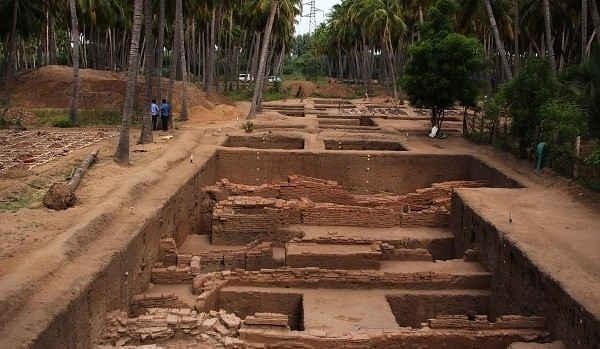
Long view across excavation trenches and exposed brick structures at Keezhadi (Keeladi)
Keezhadi
Photographed 2018-05-28
- Words & worlds
- 200 BCE–300 CE
- 300–600 CE
Sangam poems: early verse in later anthologies, dates debated
Eighteen early Tamil works, commonly dated to the first centuries CE, reach us through later anthologies, commentaries and copies; excavation dates cannot date them.
- This page
- 6,706 words · revision 4
Draft study · Awaiting specialist review · Updated
001Dates and places

No mapped place in this study.
1000–500 BCE
Different beginnings
500–200 BCE
Marks & materials
200 BCE–300 CE
Connected worlds
300–600 CE
Change & continuity
After 600 CE
- 6th century BCE to 1st century CE: TNSDA dating of the Keezhadi cultural deposit
- 580 BCE: TNSDA wording for the sample from 353 cm at Keezhadi
- c. 100 BC – AD 250: Zvelebil's range for the earliest corpus (bulk 100–250)
- 1st–3rd centuries CE: Hart's accepted date; Columbia University Press framing of the Puṟanāṉūṟu
- 171–193 or 174–195 CE: dates for Gajabāhu I cited by Zvelebil
- around the 6th or early 7th century: Wilden's hypothesis for collection and first writing-down
- c. 650–750, possibly 8th–9th century: commentary on Iṟaiyaṉār Akapporuḷ carrying the academy legend
- late 8th and 9th centuries: Tieken's proposed creation of the corpus at the Pandya court
- Laboratory date
- Date from writing, coins or texts
- Period assigned by excavators or scholars
Each date belongs to what was dated (a sample, an object, a layer or a text), which is not always the event the study asks about.
Each period has the same width, so spacing is not to scale.
The full table of dates, with their ranges, is under How we know.
- 2 Well supported
- 1 Likely
- 1 Possible
002How sure
In brief
"Sangam literature" is the modern name for eighteen works of early Tamil poetry: the Eight Anthologies and the Ten Songs. Their poems speak of love, war, kings, gifts and ports, including Chera rulers and Musiri. Each poem reaches us inside later layers: usually a note naming its poet, an anthology, often a commentary, a palm-leaf copy and a printed edition. Most specialists date the older poems to about the first century BCE to the third century CE. Herman Tieken argues for the eighth or ninth century instead. The anthologies were probably gathered later, and the legend of three royal academies later still. Editors printed the anthologies from the 1880s. Radiocarbon dates from Keezhadi date layers of a settlement, not the writing of any poem.
Key researchers cited in this study: George L. Hart (Classical Tamil Literature) · Eva Wilden (Sangam Critical Editions & Manuscriptology) · Kamil Zvelebil (Classical Tamil Philology) · U. V. Swaminatha Iyer (Classical Tamil Manuscript Editions) · Full bibliography
How sure
- Well supported
The corpus is eighteen works in two collections, the Eight Anthologies and the Ten Songs.
The set is fixed in tradition and print, though editors partly settled which eight anthologies belong.
- Likely
The older poems were composed roughly between the first century BCE and the third century CE.
Most specialists accept this from inscriptions, trade and language, but no poem is dated directly and Tieken disputes it.
- Possible
The anthologies were collected and first written down between about the sixth and ninth centuries.
This rests on colophon names and reasoning about transmission; no palm leaf from that period survives.
- Well supported
Keezhadi's radiocarbon dates do not date the composition of any poem.
A radiocarbon date measures when a sample's organism lived; it dates a layer, not words composed elsewhere.
Why it matters
Many studies here quote Sangam poems; readers need to know what the poems are, how they survived, and how far their dates hold.
003Key findings
What the study concludes
- The corpus is eighteen works in two collections: the Eight Anthologies and the Ten Songs.
- Each poem comes with later layers: colophon, anthology, commentary, manuscript and printed edition.
- The older poems are commonly dated c. 100 BCE–250 CE or the 1st–3rd centuries CE; Tieken argues for the 8th–9th century.
- The three-academies story is a later tradition, set out in the preface to a commentary of about the eighth century or later.
- Keezhadi's radiocarbon dates date layers of a settlement, not the composition of any poem.
In the study’s own words. How sure each point is, is shown above.
The summary above is the short read. The full study is the complete text it was drawn from, with its tables and source notes.
What the full study covers
- Main findings
- Eighteen works in two collections
- Six layers to keep apart
- What the anthology colophons say about compilers and kings
- The three academies: a later story about the poems
- From palm leaf to print
- Dating the poems: the kinds of evidence
- Dating the poems: who holds which view
- What Keezhadi's dates can and cannot settle
- Stating the date without averaging it
- What remains uncertain
- Related studies
- Sources
004The study
"Sangam literature" is the modern name for eighteen works of early Tamil poetry. They form two collections, the Eight Anthologies and the Ten Songs. Together they hold more than two thousand poems by several hundred named poets. The poems speak of love, war, kings, gifts, landscapes and ports. Some praise Chera rulers or describe Musiri, a Chera port.
The poems did not reach us on their own. Later scholars gathered them into anthologies and added notes naming each poet and situation. Commentators explained them, and palm-leaf copies carried them to the nineteenth century. Editors printed full editions from the 1880s. The name "Sangam", meaning "academy", comes from a later legend about three royal academies at Madurai.
When the poems were composed is disputed. Most specialists place the older poems between the first century BCE and the third century CE. Herman Tieken argues that they were written in the eighth or ninth century. Excavation dates from sites such as Keezhadi date soil layers and the objects in them. They cannot, on their own, date a poem.
Main findings
- The Eight Anthologies (Eṭṭuttokai) and the Ten Songs (Pattuppāṭṭu) are two collections, later grouped as one corpus of eighteen works. How sure: Established.
- Every poem reaches us inside later layers: usually a note naming poet and situation, an anthology, often a commentary, a manuscript and a printed edition. Each layer has its own date.
- The older poems are commonly dated to about 100 BCE–250 CE (Kamil Zvelebil) or the first to third centuries CE (George Hart). Kalittokai, Paripāṭal and the poem Tirumurukāṟṟuppaṭai are treated as later. How sure: Likely.
- Herman Tieken argues that the poems were composed at the Pandya court in the eighth or ninth century and depict a society of the past. Hart and Eva Wilden reject that date, while Wilden accepts that his critique exposed weak points in the usual arguments.
- The poems were probably collected into anthologies and first written down between about the sixth and ninth centuries. This is a reasoned proposal, not a recorded event. How sure: Possible.
- The three-academies story is a later tradition about the poems. It is set out in the preface to a commentary of about the eighth century, and the preface may be later still. It is not evidence for when or how the poems were made. How sure: Established.
- The corpus fell out of general reading after about the fifteenth century. Editors such as C. W. Damodaram Pillai and U. V. Swaminatha Iyer printed it from the 1880s into the early twentieth century. Whether "rediscovery" is the right word is debated.
- Keezhadi's radiocarbon dates (laboratory measurements of age) date charred material from layers of a settlement. They show what kind of settlement existed in the Vaigai valley, but they cannot date the composition of any poem. How sure: Established.
Eighteen works in two collections
Evidence. Eva Wilden describes the corpus as two large collections of anthologies, of love and heroic poetry, the Eṭṭuttokai ("Eight Anthologies") and the Pattuppāṭṭu ("Ten Songs"), known together as the Caṅkam or "academy" corpus ↗5. The love poetry is called akam; the poetry of war, kings and public life is called puṟam ↗4↗5↗11. The eight anthologies, in the order of a traditional four-line stanza that lists them, are Naṟṟiṇai, Kuṟuntokai, Aiṅkuṟunūṟu, Patiṟṟuppattu, Paripāṭal, Kalittokai, Akanāṉūṟu and Puṟanāṉūṟu ↗5. The stanza abbreviates the last three as kali, akam and puṟam ↗5.
Zvelebil's survey gives the shape of the older anthologies ↗2. Aiṅkuṟunūṟu has 500 short poems of three to six lines, arranged in hundreds by five poets. Kuṟuntokai and Naṟṟiṇai each have 400 poems plus an invocation, of four to eight and eight to thirteen lines respectively. Akanāṉūṟu has 400 longer love poems of thirteen to thirty-one lines, plus an invocation. Puṟanāṉūṟu has about 400 poems on war, rulers and patrons; a few are lost ↗2↗11. Patiṟṟuppattu was arranged as ten tens of praise poems for Chera kings, of which the first and last tens are lost ↗2↗4; study “The Patiṟṟuppattu is layered Chera praise poetry, not an archive” examines it in detail. Kalittokai has 150 poems, including an invocation, grouped by landscape ↗12. A traditional stanza says that Paripāṭal had seventy hymns; about two dozen survive, with fragments of others ↗5.
A second mnemonic stanza lists the Ten Songs, which are long poems: Tirumurukāṟṟuppaṭai, Porunarāṟṟuppaṭai, Ciṟupāṇāṟṟuppaṭai, Perumpāṇāṟṟuppaṭai, Mullaippāṭṭu, Maturaikkāñci, Neṭunalvāṭai, Kuṟiñcippāṭṭu, Paṭṭiṉappālai and Malaipaṭukaṭām ↗5. They range from 103 lines (Mullaippāṭṭu) to 782 lines (Maturaikkāñci) ↗4↗2.
Counting poets depends on the edition. A standard collected edition of 1940, cited by Zvelebil, counts 473 poets plus 88 anonymous ones; 35 of the 473 are named after a phrase in their poems ↗2. A third group of eighteen works, the Patiṉeṇkīḻkkaṇakku or "Eighteen Minor Classics", is a separate set, mostly moral and didactic. Wilden places the start of its collections at about the same time as, or slightly before, the gathering of the Sangam anthologies; it was later grouped as eighteen to mirror the older corpus ↗5. The Tirukkuṟaḷ belongs to that later set, not to the Sangam corpus ↗5.
Kerala in the corpus. The anthologies are not only Pandya or Chola texts. The colophon of Aiṅkuṟunūṟu says that it was compiled under a Chera king, Yāṉaikkaṭcey Māntaraṉ Cēral Irumpoṟai ↗4↗2. Patiṟṟuppattu praises Chera rulers (“The Patiṟṟuppattu is layered Chera praise poetry, not an archive”), and Akanāṉūṟu 149 and Puṟanāṉūṟu 343 describe Musiri ↗1 (“Two Tamil poems use Muziris's wealth for different ends”, “Hear the Sangam poem before using its evidence”).
How sure: Established. The list of eighteen is fixed in tradition and print, though editors partly settled the grouping.
Six layers to keep apart
A "Sangam" passage combines six things with different authors and dates. Zvelebil warned in 1973 that dating goes wrong when the stages in a text's life are mixed together ↗1. Studies “Hear the Sangam poem before using its evidence” and “Two Tamil poems use Muziris's wealth for different ends” apply the same distinction to single poems.
1. The poem. Most poems are attributed to a named poet. Whether the poems were composed orally or in writing is itself debated. K. Kailasapathy argued for an oral origin, and Zvelebil saw the old poems as the last layer of an oral bardic tradition. Hart argued that they are already written texts modelled on earlier songs. Wilden regards one point as rather certain: the corpus stands at a transition from oral to written composition ↗4.
2. The colophon (a note attached to a poem). In the older anthologies each poem carries a short note naming its poet; the Kalittokai manuscripts have no such notes ↗5. In the love anthologies the notes also give its landscape (tiṇai) and classify its situation (tuṟai); Wilden calls the tuṟai notes miniature commentaries ↗4↗5. The five landscapes are mountain, forest, seashore, river valley and the dry wasteland of separation (pālai) ↗5. In Puṟanāṉūṟu the note also names the hero; Zvelebil reports 121 poems whose notes are defective, so their heroes are unknown ↗2. Wilden classes traditional colophons of this kind as textual colophons: they belong to the making of the text, not to a particular copy ↗5. She also warns that author names vary considerably between manuscripts, so their reliability is an open question ↗5. The tuṟai notes developed in stages, and some share wording with the early treatises on poetics, the Tolkāppiyam's Poruḷatikāram and Iṟaiyaṉār Akapporuḷ ↗4.
3. The anthology. Someone chose the poems, ordered them and named the collection. The older anthologies are thought to have been arranged largely by poem length; others were grouped by landscape ↗5. Akanāṉūṟu follows a numerical scheme: odd-numbered poems are pālai poems of separation, the second and eighth of every ten in the mountains, and so on ↗5. Invocation stanzas to five anthologies are attributed to one poet, Pāratam Pāṭiya Peruntēvaṉār, and differ in style from the poems they introduce ↗4↗5.
4. The commentary. Medieval scholars wrote prose explanations. An old commentary survives for the first 266 poems of Puṟanāṉūṟu ↗11. Commentaries attributed to Nacciṉārkkiṉiyar cover the Ten Songs and Kalittokai, but no traditional commentary survives for Kuṟuntokai ↗5. Kalittokai and Paripāṭal always travel with their commentaries ↗5. Wilden places a peak of commentary-writing around the fourteenth or fifteenth century ↗5.
5. The manuscript. Palm leaves decay in the South Indian climate. The direct manuscript evidence goes back only about three hundred years ↗5. Fifteen manuscripts of Puṟanāṉūṟu survive, all but one on palm leaf, and only two contain poems 267–400 ↗11. Eleven manuscripts of Kalittokai survive ↗5. Tirumurukāṟṟuppaṭai, a hymn to Murukaṉ, survives in fifty-seven manuscripts because it entered the Śaiva devotional canon ↗5. Study “Palm-leaf texts survived because people kept copying them” explains how copying kept texts alive.
6. The printed edition. Nineteenth- and twentieth-century editors compared manuscripts and printed texts. Their choices still shape what readers see.
Interpretation. Wilden stresses that the colophons do not date the texts; if they did, they would date the anthologies, not the poems ↗4. A modern translation adds a seventh layer (“Hear the Sangam poem before using its evidence”).
How sure: Established. The six layers are documented directly in manuscripts and editions.
What the anthology colophons say about compilers and kings
Evidence. For about half of the anthologies, information about compilers and patrons is missing or fragmentary ↗4. Where it survives, Wilden summarises it as follows ↗4. Akanāṉūṟu was compiled by Uruttiracaṉmaṉ, son of Uppūrikuṭi Kiḻār of Madurai, under the Pandya king Ukkiraperuvaḻuti. Naṟṟiṇai's patron was a Pandya king, Paṉṉāṭu Tanta Pāṇṭiyaṉ Māṟaṉ Vaḻuti, though its compiler is unknown. Kuṟuntokai was compiled by Pūrikkō, with no patron named. Aiṅkuṟunūṟu was compiled by Pulattuṟai Muṟṟiya Kūṭalūr Kiḻār under a Chera king. Kalittokai's compiler is named as Nallantuvaṉār, with no patron ↗4. Patiṟṟuppattu has lost its first and last tens, presumably with its colophon. The Ten Songs have no colophon for the whole collection; each song's note gives only the author ↗4.
Interpretation. Wilden used these names to propose a sequence of compilation ↗4. In her 2002 proposal, Kuṟuntokai and Naṟṟiṇai were compiled under the Pandyas, then Akanāṉūṟu; the Cheras had Aiṅkuṟunūṟu compiled at about the same time. All of this, she suggested, was complete before the end of the eighth century. Puṟanāṉūṟu and the invocation stanzas might then belong to a Pandya revival in the early ninth century ↗4. She stated plainly that no single argument is conclusive; the parts only fit together plausibly ↗4. In 2017 she described the corpus more briefly as collected and presumably first written down around the sixth or early seventh century, and she called this a hypothesis, because no palm leaf from anywhere near that period survives ↗5.
The names of Ukkiraperuvaḻuti and Uruttiracaṉmaṉ also appear in the preface to the commentary on Iṟaiyaṉār Akapporuḷ, the treatise that carries the academy legend ↗4. Scholars have long suspected that they are the same men named in the Akanāṉūṟu colophon ↗4. If so, the compiling of Akanāṉūṟu and that commentary belong to the same Pandya court setting, a link Wilden uses in her sequence ↗4.
How sure: Possible. The colophon names are documented; the dates of compilation are reasoned proposals.
The three academies: a later story about the poems
Evidence. The classic account appears in the preface to the commentary on Iṟaiyaṉār Akapporuḷ, a short treatise on love poetry. The commentary is attributed to Nakkīrar ↗2. In Zvelebil's summary ↗2, the first academy sat at a southern Madurai later swallowed by the sea. It lasted 4,440 years, had 4,449 poets, and counted gods and sages such as Śiva, Murukaṉ and Agastya among its members. The second sat at Kapāṭapuram, also lost to the sea, and lasted 3,700 years with 3,700 poets. The third sat at the present Madurai under forty-nine kings for 1,850 years, with 449 poets presided over by Nakkīrar ↗2.
Zvelebil dates the commentary to about 650–750 CE, adding that it may be as late as the eighth or ninth century ↗2. Wilden notes that the preface carrying the legend is very likely a later addition, harder to date than the commentary itself ↗4. Zvelebil notes that the word caṅkam in this sense seems to appear first in a verse by the seventh-century poet Appar ↗2. The works of the first two academies are listed in the legend only as titles, said to be lost ↗5. The list for the third academy includes all the titles of the Eight Anthologies but is silent about the Ten Songs ↗5. Later Pandya copper-plate grants, the Larger Sinnamanur and Dalavaypuram plates, credit Pandya kings with establishing a Sangam at Madurai and having the Mahābhārata translated into Tamil ↗4. Zvelebil dates the Sinnamanur plates to the tenth century ↗2. Wilden reads the plates as evidence for the literary programme of the Pandya kings of the late eighth and ninth centuries ↗4.
Interpretation. Zvelebil judged that the silence of the early poems and the earliest Pandya inscriptions about any academy seriously damages the legend's claim to be history ↗2. He noted that every duration is a multiple of thirty-seven, which he read as a Jain trait. He listed the Jain Drāviḍa Saṅgha, reportedly founded at Madurai around 470 CE, among possible sources of the legend ↗2. He also suggested a rational core: some poets and kings named in the legend appear in inscriptions, and its figure of 449 poets is close to the number of named poets in the corpus ↗2. He quotes K. A. Nilakanta Sastri's judgement that fact and fiction are so mixed that no reliable conclusion can be drawn ↗2.
The legend therefore tells us how learned readers of the later first millennium wanted the poems to be understood: as the work of a royal academy at Madurai. It does not tell us how the poems were made. The modern label, "Sangam" or "academy" literature, takes its name from this tradition ↗2↗5.
How sure: Established that the legend is a later tradition. Whether any real gathering of poets lay behind it is Not known.
From palm leaf to print
Evidence. Wilden describes a long fade ↗5. After the peak of commentary-writing, the texts slowly left general consciousness. Stories about the lives of the academy poets replaced them. By the nineteenth century the whole corpus had dropped out of the Tamil literary canon entirely and had to be recovered ↗5. The recovered corpus was soon seen as the most precious Tamil literary heritage, and its publication was strongly promoted by rising Tamil nationalism ↗5.
U. V. Swaminatha Iyer (U. Vē. Cāminātaiyar) described his first encounter with the manuscripts in his autobiography, Eṉ Carittiram, quoted by Wilden in Zvelebil's translation ↗5. In the library of the Tiruvāvaṭutuṟai monastery he found a bundle labelled "Eṭṭut tokai". It held the plain texts of the anthologies, but Kalittokai and Paripāṭal were not in it. He knew the names of the eight only from an old verse ↗5. Wilden adds that the surviving serial manuscripts suggest that the usual manuscript of the Eight Anthologies contained only the six older collections ↗5. Editors in the late nineteenth and early twentieth centuries had to decide that Kalittokai and Paripāṭal completed the eight; the mnemonic stanza, not the manuscripts, put exactly eight titles together ↗5.
C. W. Damodaram Pillai (Ci. Vai. Tāmōtaram Piḷḷai) published the first printed edition of Kalittokai in 1887 ↗5↗1↗13. Swaminatha Iyer's Pattuppāṭṭu, with Nacciṉārkkiṉiyar's commentary, was printed in Chennai in 1889 ↗5↗2↗14. He was also the first editor of Puṟanāṉūṟu ↗11. Zvelebil dates its first edition to 1894 ↗1↗2, and the preface to the third edition (1935) gives 1894 and 1923 for the first two editions ↗15. Zvelebil gives later first editions for the other anthologies: Aiṅkuṟunūṟu 1903, Patiṟṟuppattu 1904, Naṟṟiṇai 1914, Kuṟuntokai 1915 and Akanāṉūṟu 1920 ↗2. Wilden lists Swaminatha Iyer's Paripāṭal of 1918 ↗5. When Akanāṉūṟu was prepared for print, two separate manuscript traditions were combined for the first time ↗5.
Title page of the 1894 printed Purananuru edition, naming U. V. Swaminatha Iyer
1894
Some details of the printed corpus were shaped by editors. A stanza naming one poet for each section of Kalittokai is not in the 1887 edition. It first appears in later editions and in an undated paper manuscript. Wilden suspects that it was produced during the editing phase ↗5. Mnemonic stanzas of this kind were fixed in their wording only when early editions printed them in their prefaces ↗5.
Two readings of the nineteenth century. Zvelebil's survey speaks of a "Tamil Renaissance", with Damodaram Pillai and Swaminatha Iyer as the scholars chiefly responsible for recovering the classical heritage ↗3. V. Rajesh questions the "rediscovery" and "renaissance" narrative. He argues that the usual account rests on a few selected narratives, including those of middle-class men. It rarely considers works circulating in Jain monasteries, missionary records, colonial collections such as Mackenzie's, or data on book production ↗16. The disagreement is over how completely the poems had dropped out of circulation before print. Only the abstract of Rajesh's chapter was read for this study.
How sure: Established for the 1887, 1889 and 1894 dates, which agree across catalogue records and scholarly accounts. The later first-edition dates follow Zvelebil and Wilden. "Rediscovery" as a description is contested.
Dating the poems: the kinds of evidence
No poem carries a date. Every proposed date rests on links between the poems and something datable elsewhere, or on comparisons within the corpus.
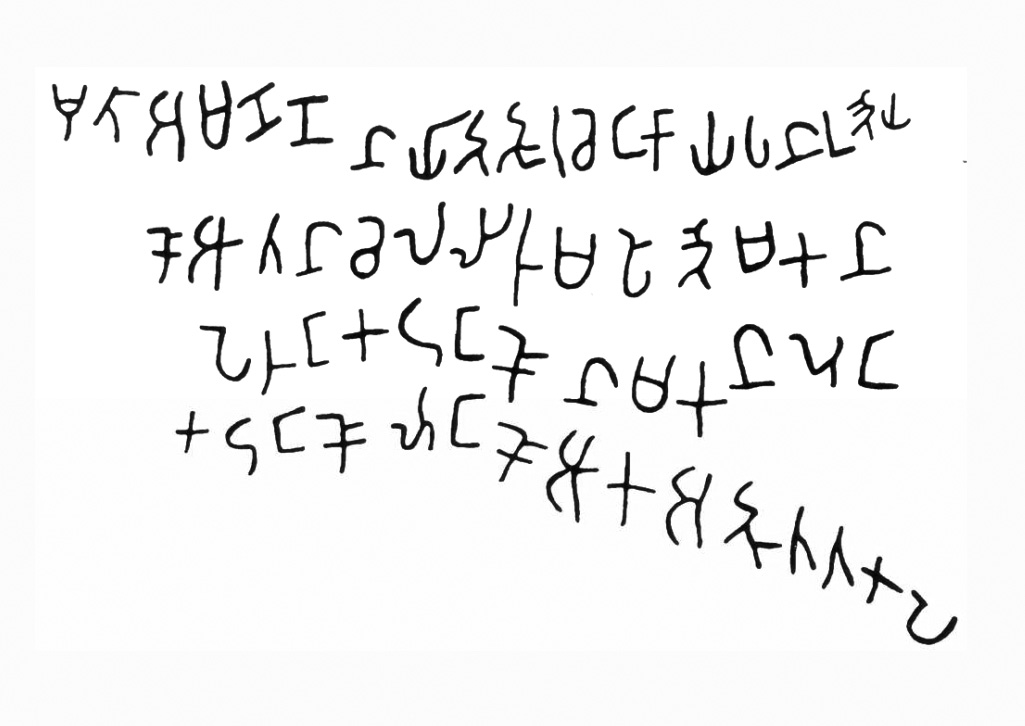
Inscriptions that name kings. Two Tamil-Brahmi inscriptions at Pugalur, near Karur, name three generations of Chera kings: Kō Ātaṉ Cellirumpoṟai, his son Peruṅkaṭuṅkōṉ and grandson Iḷaṅkaṭuṅkō, the shelter being cut when the grandson became heir (iḷaṅkō) ↗4. These have been identified with the kings praised in the seventh, eighth and ninth tens of Patiṟṟuppattu ↗4↗8 (“Pugalur inscriptions record a three-generation royal genealogy”). Zvelebil treated the Pugalur inscription as "another sheet-anchor" of early Tamil chronology and dated it to about 200 CE ↗1. Wilden notes that its date is fixed only by comparing letter forms with the graffiti from Arikamedu, giving about the end of the second century CE ↗4. Tieken has disputed that the names match ↗8. The Mangulam inscriptions near Madurai, dated to the late second century BCE, name a Pandya king Neṭuñceḻiyaṉ who has not been securely identified with a king of the poems ↗4↗1.
Modern line tracing of a Pugalur Tamil-Brahmi inscription, credited to Rajesh of Raigad in the 2018 Commons record
Pugalur
Ancient inscription assigned by source to circa 1st–2nd century CE; this tracing was created/uploaded in 2018
The Gajabahu synchronism. The Tamil epic Cilappatikāram, which is not one of the eighteen works, says that a king Kayavāku attended the consecration of a temple to the goddess Pattini held by the Chera king Ceṅkuṭṭuvaṉ ↗4↗10. Ceṅkuṭṭuvaṉ is also the hero of the fifth ten of Patiṟṟuppattu ↗1. Kayavāku has been identified with Gajabāhu I of Sri Lanka, known from the chronicle Mahāvaṃsa ↗4↗10. Zvelebil ↗1 gives Gajabāhu I's reign as around 173–195 CE (hence placing Ceṅkuṭṭuvaṉ around 180 CE), while Obeyesekere ↗10 notes revised Sri Lankan chronologies placing Gajabāhu in the second century CE (earlier Sri Lankan chronological monographs were not read directly here). On either figure, the synchronism rests on the epic alone. Wilden notes that the synchronism rests on many conjectures, beginning with the identity of the two names. The Pugalur inscriptions have since replaced it as the main anchor ↗4. Gananath Obeyesekere argued in 1970 that the Gajabāhu of the epic is a figure of myth. On his reading the synchronism is "worthless for purposes of historical chronology" ↗10.
Trade, coins and silence. Zvelebil cited the poems' references to Yavanas as guards, merchants and sea-traders, the import of Roman gold and silver coins, and Greek and Roman writers' knowledge of Tamil India ↗1. He also noted that the poems never mention the Pallava kings, whose first important Tamil inscription he dated to about 550 CE, while calling this an argument from silence ↗1. Tieken calls that reasoning circular ↗6. He also notes a mention of the Pallavas in one of the Ten Songs, Perumpāṇāṟṟuppaṭai, and uses it to set that collection apart ↗4. Hart cites Roman coins, trade described in foreign sources, and kings who also appear on coins and in datable inscriptions ↗7↗8.
Language and metre. Zvelebil cited older grammatical forms in the poems, such as yāṉ ("I"), where the later Tēvāram devotional hymns use nāṉ ↗1. Hart, citing a reference grammar of classical Tamil, holds that the language of the corpus is markedly more archaic than that of texts from the sixth century onward. He also notes that the poems do not use Sanskrit metres ↗7.
Wilden's caution. Wilden sorts the external evidence into four kinds: archaeological, epigraphic, literary and the colophons. She argues that none dates a poem directly ↗4. The dates of the archaeological and epigraphic items are themselves disputed. Their link to a poem usually rests on an assumption, such as that a poet sang about a living king. A poem will not describe a Roman lamp before such lamps were imported. Yet mentioning a second-century king is not a sufficient reason to date the poem to that century ↗4. For the poems themselves, she concludes, scholars must work toward a relative chronology built from internal and external evidence together ↗4.
How sure: Likely that the older poems belong to the early centuries CE. The supporting evidence is real but indirect, and each link has been disputed.
Dating the poems: who holds which view
The conventional early dating. Zvelebil concluded in 1973 that the earliest body of Tamil literature may be dated between 100 BCE and 250 CE, with the bulk of the poems in 100–250 CE ↗1. He allowed that a few poems may be as old as the first century BCE, and others as late as the fourth to sixth centuries ↗1. He judged Paripāṭal and Kalittokai to be, in their entirety, later than the rest ↗1. Tirumurukāṟṟuppaṭai, he wrote, is undoubtedly later than the other Ten Songs; he dated its author to about 700–800 CE ↗1. He rejected an earlier proposal by Swamikannu Pillai to put the poems in the seventh or eighth century ↗1. Hart holds that the accepted date of the first to third centuries CE is correct ↗7↗8. Columbia University Press presents Hart and Hank Heifetz's complete translation of Puṟanāṉūṟu as poems composed between the first and third centuries CE ↗9. Wilden reports two further estimates ↗4. Takanobu Takahashi, working from the development of poetic themes, dated the early anthologies roughly to the first three centuries CE, following Zvelebil's 1975 handbook. R. Champakalakshmi, studying urbanisation, placed the core "Sangam age" as a historical period between 300 BCE and 300 CE.
Tieken's late dating. In Kāvya in South India (2001) and a 2003 article, Herman Tieken argues that the usual early dating is circular ↗4↗6. In his reading, Sangam poetry does not describe a contemporary society. It portrays a past, or simple villages seen from a sophisticated urban viewpoint ↗6. He compares it with North Indian kāvya genres. He argues that it uses Tamil in the role that Prakrit plays in those genres, a use otherwise found only in Pandya inscriptions of the eighth and ninth centuries ↗6. He places the creation of the corpus at the Pandya court in the late eighth and ninth centuries ↗4↗6. The back cover of his book, as quoted by Hart, gives the ninth or tenth century ↗7. He also excludes the Ten Songs from the original corpus, because the earliest list of anthologies, in the academy legend, omits them ↗4.
Responses. Hart rejects the redating ↗7. He points to the archaic language and the absence of Sanskrit metre, and to the large, coherent set of named poets and kings. He also points to Roman coins and foreign trade records, and to a religious world in which Murukaṉ is still a folk deity ↗7. He argues that Tieken's statistical case for poems composed in sequence contains an elementary error. In his own test on Kuṟuntokai, non-adjacent poems shared more words than the adjacent poems Tieken cited ↗7. In a 2008 exchange, Tieken argued that the names in the Pugalur inscriptions and in the poems do not in fact match. Hart replied by defending the first three centuries CE, citing finds at Muziris, Roman sources and the consistency of the king lists ↗8. Wilden's 2002 review article gives a detailed response. She finds that Tieken shakes much of the received opinion and shows that many common arguments are less stable than assumed. She judges his own solutions "totally unacceptable", faulting overstatement and a failure to separate fact, probability and possibility ↗4. She is also critical of the conventional side. Zvelebil's range was, in her view, a common-sense middle course between competing schemes, and his dates shifted by centuries between his books ↗4.
The transmission view. Wilden's later outline keeps several timelines apart ↗5. Oral predecessors of the core poems probably go back about two thousand years. Collection and first writing-down may date to the sixth or early seventh century. The texts were canonised and associated with the Pandya court by about 1000 CE. Commentary peaked around the fourteenth or fifteenth century. Surviving manuscripts are about three hundred years old ↗5. This outline is compatible with an early date for the poems and a much later date for the anthologies.
Purananuru 343 in the 1894 Swaminatha Iyer edition
1894
How sure: Likely for an early-centuries-CE date for the older poems. Not known for the date of any individual poem.
What Keezhadi's dates can and cannot settle
Evidence. In 2019 the Tamil Nadu State Department of Archaeology published an English summary of its Keezhadi (Keeladi) excavations. It was titled "Keeladi – An Urban Settlement of Sangam Age on the bank of Vaigai River" ↗17. The booklet calls the results a turning point in the cultural historiography of the Sangam age ↗17. It reports that a carbon sample from a depth of 353 cm was dated to 580 BCE. It states that the cultural deposit could be dated between the sixth century BCE and the first century CE ↗17. It reports 56 sherds inscribed in Tamil-Brahmi from the state's seasons. Some carry personal names such as Ātaṉ, engraved after firing; others carry only one or two letters. The booklet argues that writing was known by the sixth century BCE ↗17. Study “Keezhadi's excavations reveal a substantial brick settlement” explains how the 580 BCE figure was reported and calibrated. Study “Keezhadi's inscribed pots show writing in everyday life” examines the inscribed pottery.
The chronology of the site is itself disputed. In June 2026 ThePrint reported that the Archaeological Survey of India had decided to send an internal committee to re-examine, on site, the excavation report by K. Amarnath Ramakrishna on the 2014–15 and 2015–16 seasons (“Keezhadi's excavations reveal a substantial brick settlement”) ↗18. That report divides the site into periods. The earliest runs from the eighth to the fifth century BCE. According to ThePrint, the Survey regards that time bracket as "not justified at all" ↗18.
What a radiocarbon date measures. A radiocarbon date tells when the organism that formed the sample was alive. It does not tell when the material was used. Raw radiocarbon results must be calibrated against material of known age to give calendar dates ↗19. A date on charcoal from a layer therefore dates that charcoal. Only through careful recording of layers can it help date the deposit and the objects found with it.
Interpretation. Wilden insists that two chronologies be kept apart: that of the "Sangam era" as a historical period, and that of the Sangam texts. Within the texts, she separates the age of the poems from the time of anthology-making ↗4. Keezhadi's dates belong to the first chronology. The phrase "Sangam age" in the booklet's title is a period label borrowed from literary history and applied to a site. Extending that label back to the sixth century BCE changes the label's range. It does not change the evidence for when any poem was composed.
Keezhadi can do several things for the study of the poems. It shows that brick buildings, wells, craft production and writing on pottery existed in the Vaigai valley in the periods its excavators report (“Keezhadi's excavations reveal a substantial brick settlement”, “Keezhadi's inscribed pots show writing in everyday life”). That gives a dated material world against which the poems' descriptions of towns, crafts and goods can be compared. Where a poem mentions an object or practice that archaeology can date, archaeology can supply an earliest possible date for that mention. This is the kind of limit Wilden describes ↗4.
Keezhadi cannot do other things. The published reports used here record no poem from the site; the inscribed sherds carry short names, not verses ↗17. A date from a trench cannot tell when a poet composed a poem, when the poems were collected, or when they were written down. It also cannot settle the dispute between Tieken and his critics. Tieken argues that the poems portray an earlier-looking society from a later vantage point ↗6. Evidence that such a society existed early is compatible with both early composition and later retrospective composition. Settling it requires evidence about the texts themselves.
There is also a risk of circular reasoning. A site called "Sangam age" because it resembles the world of the poems cannot then be used to date the poems.
How sure: Established that Keezhadi's radiocarbon dates do not date any poem. The site's own chronology is under official re-examination.
Stating the date without averaging it
Because each layer has its own date, a single span such as "Sangam age, 300 BCE–300 CE" mixes different things. Study “Evidence has layers: observed, stated, inferred and unknown” records the chronology as contested and declines to average the positions. A statement that follows the evidence here names the layer, gives the range with its source, and marks the dispute:
- Older poems (the six earlier anthologies and most of the Ten Songs): commonly dated to about the first century BCE to the third century CE (Zvelebil 100 BCE–250 CE; Hart first to third centuries CE). Herman Tieken argues for the eighth to ninth century. Likely.
- Later members: Kalittokai, Paripāṭal and Tirumurukāṟṟuppaṭai are later than the rest. Zvelebil dates the author of Tirumurukāṟṟuppaṭai to about 700–800 CE. Likely.
- Anthology-making and first writing-down: proposed for about the sixth to the early ninth century. Possible.
- Academy legend: set out in the preface to a commentary of about 650–750 CE or later; the preface may be later still. Established as a later tradition.
- Surviving manuscripts: about the last three hundred years. Established.
- Printed editions: Kalittokai 1887, Pattuppāṭṭu 1889, Puṟanāṉūṟu 1894; the other anthologies 1903–1920. Established for 1887–1894; Likely for the later dates.
- Excavated "Sangam age" sites: dates belong to the site and its layers, not to any poem.
What remains uncertain
- The date of any single poem. No poem is dated directly. Wilden noted in 2002 that dating studies still worked at the level of whole anthologies, not individual poems ↗4.
- How the poems were composed. Whether the old anthologies preserve oral bardic songs, written imitations of them, or a mixture remains debated ↗4.
- When and by whom the anthologies were made. The colophons name some compilers and patrons. Their dates depend on identifications that Wilden herself calls inconclusive ↗4.
- Whether any academy existed. The early poems are silent ↗2. Later Pandya grants credit Pandya kings with founding a Sangam at Madurai ↗4. Whether any gathering of poets lies behind the legend is Not known.
- The Pugalur and Gajabahu links. The identification of the Pugalur kings with Patiṟṟuppattu kings is disputed (“Pugalur inscriptions record a three-generation royal genealogy”, “The Patiṟṟuppattu is layered Chera praise poetry, not an archive”). The Gajabahu synchronism depends on a name identification and on an epic outside the corpus. Obeyesekere rejects it ↗10.
- The reliability of author names. Names vary between manuscripts, and some ascriptions may have been supplied late ↗5.
- Statistics that could decide the dispute. Wilden called for counts of formulae, loanwords and grammatical features across the corpus. Such counts would allow a relative chronology ↗4. This study did not locate a completed study of that kind.
- Edition history. No title page was read for this study. The 1887 and 1889 dates rest on catalogue records that agree with Wilden and Zvelebil ↗13↗14; 1894 rests on Zvelebil and a later preface ↗15. The 1903–1920 dates follow Zvelebil and Wilden only. Zvelebil gives 1884 for Neṭunalvāṭai alone, against 1889 for the other songs; this was not checked. Earlier printings of single poems, such as Tirumurukāṟṟuppaṭai, were not checked either.
- Specialist review. This study was not reviewed by a Tamil scholar, historian or archaeologist. Tamil-language scholarship on the dating debate was not surveyed.
Related studies
- “Hear the Sangam poem before using its evidence”: how to read a single poem before using it as evidence.
- “Evidence has layers: observed, stated, inferred and unknown”: how this collection weighs evidence, including the contested chronology.
- “Palm-leaf texts survived because people kept copying them”: how manuscripts survived by being copied.
- “Keezhadi's excavations reveal a substantial brick settlement” and “Keezhadi's inscribed pots show writing in everyday life”: the Keezhadi excavation reports, their radiocarbon dates and the inscribed pottery.
- “Maduraikkanchi shows a city of markets, crafts and night guards”: Maturaikkāñci and Madurai.
- “Pugalur inscriptions record a three-generation royal genealogy” and “The Patiṟṟuppattu is layered Chera praise poetry, not an archive”: the Pugalur inscriptions and Patiṟṟuppattu.
- “Two Tamil poems use Muziris's wealth for different ends”: Musiri in Akanāṉūṟu 149 and Puṟanāṉūṟu 343.
- “Poems praise a Chera king's sea victory but name no fleet” and “Chera poems show bards and dancers travelling for royal gifts”: Chera war poems and bardic patronage.
- “Early Tamil records show rank, not the later caste order”: what dated sources show about early Tamil society.
Sources
- Kamil V. Zvelebil (1973). "Problems of Dating, Relative and Absolute Chronology", ch. 3 of The Smile of Murugan: On Tamil Literature of South India (Leiden: E. J. Brill; ISBN 978-90-04-03591-1), pp. 29 ff. Read in an unofficial online reproduction of the chapter; printed page numbers not checked. Supports: the 100 BCE–250 CE range; later members of the corpus; the stages in the life of a text; Pugalur and Gajabahu anchors; trade, Pallava and language arguments; the Musiri passages; Damodaram Pillai's 1887 Kalittokai and the 1894 Puṟanāṉūṟu.
- Kamil V. Zvelebil (1973). "The Caṅkam Legend. The Texts", ch. 4 of The Smile of Murugan (Leiden: E. J. Brill, 1973), pp. 53 ff. Read in an unofficial online reproduction of the chapter; printed page numbers not checked. Supports: the academy legend, its earliest attestations and Zvelebil's assessment; the tenth-century date of the Sinnamanur plates; descriptions of the anthologies, colophons and Ten Songs; a 1940 edition's count of poets; first-publication dates of the anthologies and Ten Songs.
- Kamil V. Zvelebil (1973). "Tamil Renaissance", ch. 18 of The Smile of Murugan (Leiden: E. J. Brill, 1973), pp. 264 ff. Read in an unofficial online reproduction of the chapter; printed page numbers not checked. Supports: the "renaissance" framing of the nineteenth-century recovery, crediting Damodaram Pillai and Swaminatha Iyer. Gives no edition dates.
- Eva Wilden (2002). "Towards an Internal Chronology of Old Tamil Caṅkam Literature, or How to Trace the Laws of a Poetic Universe". Wiener Zeitschrift für die Kunde Südasiens 46: 105–133. https://doi.org/10.1553/wzksXLVIs105 (open-access PDF). Full text read. Supports: the summary and critique of Tieken; other estimates; the limits of external evidence; the era/text distinction; Pugalur, Mangulam and Gajabahu; anthology colophons and compilation; the preface carrying the legend as a probable later addition; Pandya plates; orality; tuṟai notes.
- Eva Wilden (2017). "Making Order in the Vaults of Memory: Tamil Satellite Stanzas on the Transmission of Texts". Kervan 21: 317–337. https://ojs.unito.it/index.php/kervan/article/download/2265/2064/7927. Full text read. Supports: the transmission outline; manuscript survival; the stanzas listing the Eight Anthologies and Ten Songs; Swaminatha Iyer's account; Kalittokai and Paripāṭal as late-comers; the 1887 Kalittokai, the 1889 Pattuppāṭṭu and the 1918 Paripāṭal in its list of editions; editorial shaping; author-name reliability.
- Herman Tieken (2003). "Old Tamil Caṅkam Literature and the So-called Caṅkam Period". The Indian Economic and Social History Review 40(3): 247–278. https://doi.org/10.1177/001946460304000301. Abstract read (via RePEc/IDEAS); full article not read. Supports: Tieken's thesis that the poetry depicts a past society, uses Tamil in a Prakrit-like role, and belongs to eighth-century Pandya cultural politics.
- George L. Hart (2001). "Some Remarks on Herman Tieken's Kāvya in South India". University of California, Berkeley; mirror at https://tamilnation.org/literature/hart. Full text read. Supports: Hart's counterarguments (language, metre, names, coins, trade, religion, statistics); his acceptance of a first-to-third-century CE date; the back-cover text of Tieken's book that he quotes. Hart's published review of Tieken's book: Journal of the American Oriental Society 124.1 (2004): 180–184 (not read).
- George L. Hart (2008). Reply to H. J. H. Tieken, "Dating Old Tamil Cankam poetry", INDOLOGY mailing list, 31 July 2008. https://list.indology.info/pipermail/indology/2008-July/031870.html. Full message read. Supports: Tieken's rejoinder (published in Asiatische Studien/Études Asiatiques 62(2), 2008: 575–605), quoted in the message, which lists the proposed matches with the seventh, eighth and ninth tens of Patiṟṟuppattu and disputes them; Hart's restated defence of the early date.
- Columbia University Press (n.d.). Publisher's description of George L. Hart and Hank Heifetz, trans. and eds., The Four Hundred Songs of War and Wisdom: An Anthology of Poems from Classical Tamil, the Puṟanāṉūṟu (1999; paperback 2002). https://cup.columbia.edu/book/the-four-hundred-songs-of-war-and-wisdom/9780231115636/. Page read. Supports: the translators' framing of the poems as composed between the first and third centuries CE.
- Gananath Obeyesekere (1970). "Gajabahu and the Gajabahu Synchronism: An Inquiry into the Relationship between Myth and History". The Ceylon Journal of the Humanities 1(1): 25–56. https://ir.lib.pdn.ac.lk/handle/20.500.14444/2038. Full text read (scanned PDF). Supports: the content of the synchronism, the scholarly reliance on it, and Obeyesekere's argument that it is worthless for chronology because the epic's Gajabāhu is mythical.
- Tamilex project, University of Hamburg (n.d.). "Puṟanāṉūṟu: Critical Edition and Annotated Translation with Glossary" (G. Vijayavenugopal and Eva Wilden). https://www.tamilex.uni-hamburg.de/research/purananuru.html. Page read. Supports: old commentary on poems 1–266; fifteen surviving manuscripts, two for poems 267–400; Swaminatha Iyer as first editor.
- Central Institute of Classical Tamil (n.d.). "Kalittokai", Classical Tamil Digital Library. https://library.cict.in/ebooks/kalittokai. Page read. Supports: 150 verses including the invocation, landscape sections and their attributed poets, and Nacciṉārkkiṉiyar's commentary.
- Internet Archive / University of Toronto (François Gros collection). Catalogue record: Kalittokai, Madras: The Scottish Press, 1887; iv, 34, 3, 487 pp. https://archive.org/details/gc-sh5-0112 (also Open Library OL37750213M). Metadata read; scan not collated. Supports: an 1887 Madras printing of Kalittokai.
- Internet Archive / University of Toronto (François Gros collection). Catalogue record: Pattuppāṭṭu, Ceṉṉai: Tirāviṭaratnākara accukkūṭam, 1889; 8, 240 pp. https://archive.org/details/gc-sh5-0303. Metadata read; scan not collated. Supports: an 1889 Chennai printing of the Ten Songs from the press that Wilden ↗5 gives for Swaminatha Iyer's 1889 edition.
- U. V. Swaminatha Iyer, ed. (1935). Puṟanāṉūṟu, third edition, Madras; preface. Scan at https://archive.org/details/Tamil-Purananuru-U-Ve-Sa-3rd-Edition-1935. Machine-read text of the preface read; the text layer is poor, but 1894 and 1923 are legible as the years of the first and second editions, and the imprint reads Madras Law Journal Press. Supports: the first-edition date of Puṟanāṉūṟu, with that caveat; Zvelebil ↗1↗2 gives the same year.
- V. Rajesh (2014). "Interrogating 'Rediscovery' and an Enquiry into the Transmission of Sangam Literature during the Pre-modern Period", in Manuscripts, Memory and History: Classical Tamil Literature in Colonial India, 20–82. New Delhi: Foundation Books (Cambridge University Press India). https://doi.org/10.1017/9789382993629.002. Chapter abstract read on Cambridge Core; full text not read. Supports: the critique of the "rediscovery" and "renaissance" narratives and the sources they rarely consider.
- Tamil Nadu State Department of Archaeology (2019). Keeladi – An Urban Settlement of Sangam Age on the bank of Vaigai River (English summary booklet). https://cdn.thewire.in/wp-content/uploads/2019/09/20102444/%E0%AE%95%E0%AF%80%E0%AE%B4%E0%AE%9F%E0%AE%BF-English-08.08.19-1776Words.pdf. Full text read. Supports: the "Sangam age" framing; the 580 BCE sample at 353 cm; the sixth century BCE to first century CE deposit; 56 Tamil-Brahmi sherds with personal names; the literacy claim.
- Krishan Murari (2026). "ASI to re-examine Keezhadi excavation report on site". ThePrint, 29 June 2026. https://theprint.in/feature/asi-keezhadi-excavation-report-committee/2972380/. Full article read. Supports: the periodisation in the report on the 2014–15 and 2015–16 seasons; the Archaeological Survey of India's view, as reported, that the earliest bracket is not justified; the decision to re-examine the report on site.
- Oxford Radiocarbon Accelerator Unit, University of Oxford (n.d.). "Radiocarbon Dating". https://c14.arch.ox.ac.uk/dating.html. Page read. Supports: what a radiocarbon date measures and the need for calibration.
005Photographs
Photographs of the places and objects this study discusses. Each item carries its creator’s credit, licence and documented source. See all 412 photographs and source images ↗
Keezhadi · Photographed 2018-05-28
Long view across excavation trenches and exposed brick structures at Keezhadi
Pugalur · Ancient inscription assigned by source to circa 1st–2nd century CE; this tracing was created/uploaded in 2018
Modern line tracing of a Pugalur Tamil-Brahmi inscription, credited to Rajesh of Raigad in the 2018 Commons record
Modern line tracing of a Pugalur Tamil-Brahmi inscription, credited to Rajesh of Raigad in the 2018 Commons record. This is an epigraphic representation, not a photograph of the inscribed rock.

1894
Title page of the 1894 printed Purananuru edition, naming U. V. Swaminatha Iyer
Title page of the 1894 printed Purananuru edition, naming U. V. Swaminatha Iyer and the Chennai printing house.

1894
Purananuru 343 in the 1894 Swaminatha Iyer edition
Purananuru 343 in the 1894 Swaminatha Iyer edition. The poem evokes fish exchanged for rice, pepper sacks, gold brought by ships and Musiri before turning to a refused marriage demand.

Keezhadi · Photographed 2015-09-14
Stratified trench wall and exposed features at Keezhadi in 2015
006Two views
Both views are shown at equal weight; this site does not choose between them.
When the Sangam poems were composed
- One view
- Kamil Zvelebil (100 BCE–250 CE) and George Hart (1st–3rd centuries CE) place the older poems early. They cite the Pugalur inscriptions, Roman trade, archaic language and the poems' silence about the Pallava kings. Takanobu Takahashi, working from poetic themes, follows a similar range.
- Another view
- Herman Tieken dates the corpus to the Pandya court of the late eighth and ninth centuries. He argues that the poems depict a past society in genres modelled on North Indian kāvya. In them Tamil plays the role of Prakrit, and he calls the early dating circular.
- What would settle it
- Statistics of formulae, loanwords and grammar across the poems, compared with dated inscriptions, or a securely dated text quoting a poem before the eighth century.
Whether the Gajabahu synchronism dates the Chera king Ceṅkuṭṭuvaṉ and his poets
- One view
- Zvelebil treated it as an anchor of early Tamil chronology, placing Ceṅkuṭṭuvaṉ and Gajabāhu I of Sri Lanka around 180 CE.
- Another view
- Gananath Obeyesekere argued that the epic's Gajabāhu is a mythical figure, so the synchronism is useless for dating. Wilden notes that it rests on many conjectures.
- What would settle it
- An independent inscription or document linking a Chera ruler of the poems to a securely dated Sri Lankan king.
007Where next

The guide to weighing evidence records the poems' dates as contested. The survey of the poems sets out the competing dates, who holds them and why.
On the timelineDates in this studySee these dates on the timeline
Explore nextRead a Tamil poemAll related studies, connected material, books and sources24 · 19
Elsewhere on this site
Read this study with a guided path: Read a Tamil poem
Connected material
Photographs, drawings, books, videos and other studies linked to this study. A link helps you explore; it does not prove a historical claim.
- Stratified trench wall and exposed features at Keezhadi in 2015photographBackground
- Long view across excavation trenches and exposed brick structures at KeezhadiphotographBackground
- Title page of the 1894 printed Purananuru edition, naming U. V. Swaminatha Iyerhistorical printed pageBackground
- Purananuru 343 in the 1894 Swaminatha Iyer editionhistorical printed pageBackground
- Modern line tracing of a Pugalur Tamil-Brahmi inscription, credited to Rajesh of Raigad in the 2018 Commons recordmodern epigraphic tracingBackground
008Sources
The study lists the sources it consulted; we have not rechecked them. A working link does not show that a source was read, and a valid identifier does not show that it supports a claim. We do not link to unofficial uploads or copies of publications. Where a study cited one, we show the published citation, or a publisher, DOI or Internet Archive link when we have one. Tracking codes are removed from links, and the sources themselves are not republished here.
Kamil V. Zvelebil. 1973. Problems of Dating, Relative and Absolute Chronology (chapter 3). The Smile of Murugan: On Tamil Literature of South India. E. J. Brill, Leiden. https://brill.com/display/title/712
Kamil V. Zvelebil. 1973. The Caṅkam Legend. The Texts (chapter 4). The Smile of Murugan: On Tamil Literature of South India. E. J. Brill, Leiden. https://brill.com/display/title/712
Kamil V. Zvelebil. 1973. Tamil Renaissance (chapter 18). The Smile of Murugan: On Tamil Literature of South India. E. J. Brill, Leiden. https://brill.com/display/title/712
Eva Wilden. 2002. Towards an Internal Chronology of Old Tamil Caṅkam Literature, or How to Trace the Laws of a Poetic Universe. Wiener Zeitschrift für die Kunde Südasiens 46: 105–133. Austrian Academy of Sciences Press. https://doi.org/10.1553/wzksXLVIs105
Eva Wilden. 2017. Making Order in the Vaults of Memory: Tamil Satellite Stanzas on the Transmission of Texts. Kervan – International Journal of Afro-Asiatic Studies 21: 317–337. Università di Torino. https://ojs.unito.it/index.php/kervan/article/download/2265/2064/7927
Herman Tieken. 2003. Old Tamil Caṅkam Literature and the So-called Caṅkam Period. The Indian Economic and Social History Review 40(3): 247–278. SAGE. https://doi.org/10.1177/001946460304000301
George L. Hart. 2001. Some Remarks on Herman Tieken's Kāvya in South India. University of California, Berkeley (mirror on tamilnation.org). https://tamilnation.org/literature/hart
George L. Hart; Herman Tieken. 2008. Dating Old Tamil Cankam poetry (INDOLOGY list, 31 July 2008). INDOLOGY mailing list archive. https://list.indology.info/pipermail/indology/2008-July/031870.html
Columbia University Press. n.d.. The Four Hundred Songs of War and Wisdom: An Anthology of Poems from Classical Tamil, the Puṟanāṉūṟu (publisher description; trans. and ed. George L. Hart and Hank Heifetz, 1999/2002). Columbia University Press catalogue. Columbia University Press. https://cup.columbia.edu/book/the-four-hundred-songs-of-war-and-wisdom/9780231115636/
Gananath Obeyesekere. 1970. Gajabahu and the Gajabahu Synchronism: An Inquiry into the Relationship between Myth and History. The Ceylon Journal of the Humanities 1(1): 25–56. University of Ceylon, Peradeniya. https://ir.lib.pdn.ac.lk/handle/20.500.14444/2038
G. Vijayavenugopal; Eva Wilden. n.d.. Puṟanāṉūṟu: Critical Edition and Annotated Translation with Glossary (project page). Tamilex, University of Hamburg. University of Hamburg. https://www.tamilex.uni-hamburg.de/research/purananuru.html
Central Institute of Classical Tamil. n.d.. Kalittokai. Classical Tamil Digital Library. Central Institute of Classical Tamil, Chennai. https://library.cict.in/ebooks/kalittokai
Nallantuvaṉār (attributed compiler). 1887. Kalittokai (catalogue record). Internet Archive / University of Toronto, François Gros collection (Open Library OL37750213M). The Scottish Press, Madras. https://archive.org/details/gc-sh5-0112
1889. Pattuppāṭṭu (catalogue record). Internet Archive / University of Toronto, François Gros collection. Tirāviṭaratnākara accukkūṭam, Ceṉṉai. https://archive.org/details/gc-sh5-0303
U. V. Swaminatha Iyer (ed.). 1935. Puṟanāṉūṟu, third edition: preface. Internet Archive scan (uploaded copy). Madras Law Journal Press, Madras. https://archive.org/details/Tamil-Purananuru-U-Ve-Sa-3rd-Edition-1935
V. Rajesh. 2014. Interrogating 'Rediscovery' and an Enquiry into the Transmission of Sangam Literature during the Pre-modern Period. Manuscripts, Memory and History: Classical Tamil Literature in Colonial India, pp. 20–82. Foundation Books / Cambridge University Press India, New Delhi. https://doi.org/10.1017/9789382993629.002
Tamil Nadu State Department of Archaeology. 2019. Keeladi – An Urban Settlement of Sangam Age on the bank of Vaigai River (English summary booklet). Tamil Nadu State Department of Archaeology. Government of Tamil Nadu. https://cdn.thewire.in/wp-content/uploads/2019/09/20102444/%E0%AE%95%E0%AF%80%E0%AE%B4%E0%AE%9F%E0%AE%BF-English-08.08.19-1776Words.pdf
Krishan Murari. 2026. ASI to re-examine Keezhadi excavation report on site. ThePrint, 29 June 2026. ThePrint. https://theprint.in/feature/asi-keezhadi-excavation-report-committee/2972380/
Oxford Radiocarbon Accelerator Unit. n.d.. Radiocarbon Dating. University of Oxford, Research Laboratory for Archaeology and the History of Art. University of Oxford. https://c14.arch.ox.ac.uk/dating.html
Researchers and institutions whose work this study uses: George L. Hart, Eva Wilden, Kamil Zvelebil, U. V. Swaminatha Iyer, Archaeological Survey of India, Tamil Nadu State Dept. of Archaeology
How we know The evidence, claims and dates behind this study
What this study draws on
- Read in full: Zvelebil (1973) on dating and the academy legend, Wilden (2002, 2017) on chronology and manuscripts, Obeyesekere (1970), and Hart's replies to Tieken.
- Tieken's 2003 article and Rajesh's 2014 chapter were read only as abstracts; several key books were not consulted directly.
- Edition dates agree across catalogue records and scholarly accounts for Kalittokai 1887, Pattuppāṭṭu 1889 and Puṟanāṉūṟu 1894; later first editions follow Zvelebil and Wilden. No title page was read.
- Keezhadi evidence comes from the state's 2019 booklet and a June 2026 report on the national re-examination; an Oxford laboratory explains radiocarbon dating.
Dates in this study
| What is dated | Date | How it was dated |
|---|---|---|
| 6th century BCE to 1st century CE: TNSDA dating of the Keezhadi cultural deposit | 600 BCE – 100 CE | Laboratory date |
| 580 BCE: TNSDA wording for the sample from 353 cm at Keezhadi | 580 BCE | Laboratory date |
| c. 100 BC – AD 250: Zvelebil's range for the earliest corpus (bulk 100–250) | 100 BCE – 250 CE | Period assigned by excavators or scholars |
| 1st–3rd centuries CE: Hart's accepted date; Columbia University Press framing of the Puṟanāṉūṟu | 1–300 CE | Period assigned by excavators or scholars |
| 171–193 or 174–195 CE: dates for Gajabāhu I cited by Zvelebil | 171–195 CE | Date from writing, coins or texts |
| around the 6th or early 7th century: Wilden's hypothesis for collection and first writing-down | 501–650 CE | Period assigned by excavators or scholars |
| c. 650–750, possibly 8th–9th century: commentary on Iṟaiyaṉār Akapporuḷ carrying the academy legend | 650–900 CE | Period assigned by excavators or scholars |
| late 8th and 9th centuries: Tieken's proposed creation of the corpus at the Pandya court | 750–900 CE | Period assigned by excavators or scholars |
See these dates on the timeline
The study’s claims
17 claims · 36 source passages · 59 paragraphs
Browse the study paragraph by paragraphThe Sangam corpus consists of two collections, the Eight Anthologies (Eṭṭuttokai) and the Ten Songs (Pattuppāṭṭu), eighteen works in all.
Supported in this study
The grouping of exactly eight anthologies was partly fixed by a mnemonic stanza and by late nineteenth- and early twentieth-century editors.
Kalittokai, Paripāṭal and Tirumurukāṟṟuppaṭai are later than the rest of the corpus, and the usual serial manuscripts of the Eight Anthologies contained only the six older collections.
Supported in this study
Relative, not absolute, dating; the serial-manuscript evidence is described by Wilden as precarious.
In the older anthologies each poem carries a later note (colophon) naming its poet and, in the love anthologies, its landscape and situation; these notes do not date the texts, and author names vary between manuscripts.
Supported in this study
Even if colophons dated anything, they would date the anthologies, not the poems (Wilden).
The direct manuscript evidence for the corpus goes back only about three hundred years; Puṟanāṉūṟu survives in fifteen manuscripts, only two of which contain poems 267–400.
Supported in this study
No palm leaf from anywhere near the period of composition or compilation survives.
Anthology colophons name some compilers and patrons: Pandya kings for Akanāṉūṟu and Naṟṟiṇai and a Chera king for Aiṅkuṟunūṟu.
Supported in this study
For about half the anthologies compiler and patron information is missing or fragmentary.
The anthologies were probably collected and first written down between about the sixth and the early ninth century.
Supported with qualifications
Wilden calls the 6th/early-7th-century writing-down a hypothesis; her 2002 sequence admits that no argument is conclusive.
The three-academies account is fully set out in the preface to the commentary on Iṟaiyaṉār Akapporuḷ (commentary c. 650–750 CE or later; the preface possibly later still); it is a later tradition about the poems, not evidence for how or when they were made.
Supported in this study
Whether any real gathering of poets lies behind the legend is not known; later Pandya copper plates (the Sinnamanur plates, dated by Zvelebil to the 10th century) credit Pandya kings with founding a Sangam at Madurai.
Printed editions began in the 1880s: C. W. Damodaram Pillai's first edition of Kalittokai (1887), U. V. Swaminatha Iyer's Pattuppāṭṭu (1889) and his Puṟanāṉūṟu (first edition 1894); the other anthologies followed between 1903 and 1920.
Supported with qualifications
No title page was read; 1887, 1889 and 1894 agree across catalogue records and the accounts of Zvelebil and Wilden. The 1903–1920 dates rest on Zvelebil (Wilden for Paripāṭal 1918); Zvelebil gives 1884 for Neṭunalvāṭai alone, which was not checked.
Late nineteenth- and early twentieth-century editors decided that Kalittokai and Paripāṭal completed the Eight Anthologies, relying on a mnemonic stanza rather than on manuscripts, and some stanzas may have been produced during editing.
Supported with qualifications
Wilden presents this as an inference from surviving manuscripts and editions.
Whether the nineteenth-century printing of the corpus is best described as a "rediscovery" or "renaissance" is contested.
Debated in the sources
Only the abstract of Rajesh's chapter was read; the dispute is over how completely the poems had dropped out of circulation before print.
The older poems are commonly dated to about 100 BCE–250 CE (Zvelebil) or the first to third centuries CE (Hart; Takahashi), an early-centuries-CE date that most specialists accept on indirect evidence.
Supported with qualifications
No poem is dated directly; each link (inscriptions, trade, language) has been disputed. Wilden regards Zvelebil's range as a common-sense middle course.
Herman Tieken argues that the corpus was created at the Pandya court in the late eighth and ninth centuries and depicts a society of the past; Hart and Wilden reject this dating.
Debated in the sources
Wilden accepts that Tieken exposed weak points in the conventional arguments.
The Pugalur Tamil-Brahmi inscriptions, naming three generations of Chera kings and dated by letter forms to about the end of the second century CE, are the main external anchor, but their identification with Patiṟṟuppattu kings is disputed.
Debated in the sources
The inscription date itself is palaeographic, relative to the Arikamedu graffiti. See “Pugalur inscriptions record a three-generation royal genealogy” and “The Patiṟṟuppattu is layered Chera praise poetry, not an archive”.
The Gajabahu synchronism, drawn from the Cilappatikāram, once served as the main anchor for Sangam chronology; it rests on a name identification and Obeyesekere rejects it as mythical.
Debated in the sources
Dates given for Gajabāhu I differ between authors (c. 113–125 vs 171–193 or 174–195 CE); Zvelebil reports the 113–125 dating as shown incorrect.
Radiocarbon dates from Keezhadi date samples and the layers they come from; they cannot date the composition, compilation or writing-down of any poem.
Supported in this study
Archaeology can give an earliest possible date for a poem's mention of a datable object; it cannot fix when the poem was composed.
The Tamil Nadu State Department of Archaeology presents Keezhadi as a Sangam-age settlement with a cultural deposit from the sixth century BCE to the first century CE; the site's chronology is itself under re-examination by the Archaeological Survey of India.
Supported with qualifications
The ASI objection, as reported by ThePrint, concerns the 8th–5th-century-BCE bracket in the report on the 2014–15 and 2015–16 seasons; see “Keezhadi's excavations reveal a substantial brick settlement”.
Wilden distinguishes the chronology of the "Sangam era" as a historical period from that of the Sangam texts, and the age of the poems from the time of anthology-making.
Supported in this study
Trace one claim through the study’s records
Explore the evidenceOther source lists
Numbered citation links from the study
The numbered links in the study text point here.
Kamil V. Zvelebil. 1973. Problems of Dating, Relative and Absolute Chronology (chapter 3). The Smile of Murugan: On Tamil Literature of South India. E. J. Brill, Leiden. https://brill.com/display/title/712
Kamil V. Zvelebil. 1973. The Caṅkam Legend. The Texts (chapter 4). The Smile of Murugan: On Tamil Literature of South India. E. J. Brill, Leiden. https://brill.com/display/title/712
Kamil V. Zvelebil. 1973. Tamil Renaissance (chapter 18). The Smile of Murugan: On Tamil Literature of South India. E. J. Brill, Leiden. https://brill.com/display/title/712
Eva Wilden. 2002. Towards an Internal Chronology of Old Tamil Caṅkam Literature, or How to Trace the Laws of a Poetic Universe. Wiener Zeitschrift für die Kunde Südasiens 46: 105–133. Austrian Academy of Sciences Press. https://doi.org/10.1553/wzksXLVIs105
Eva Wilden. 2017. Making Order in the Vaults of Memory: Tamil Satellite Stanzas on the Transmission of Texts. Kervan – International Journal of Afro-Asiatic Studies 21: 317–337. Università di Torino. https://ojs.unito.it/index.php/kervan/article/download/2265/2064/7927
Herman Tieken. 2003. Old Tamil Caṅkam Literature and the So-called Caṅkam Period. The Indian Economic and Social History Review 40(3): 247–278. SAGE. https://doi.org/10.1177/001946460304000301
George L. Hart. 2001. Some Remarks on Herman Tieken's Kāvya in South India. University of California, Berkeley (mirror on tamilnation.org). https://tamilnation.org/literature/hart
George L. Hart; Herman Tieken. 2008. Dating Old Tamil Cankam poetry (INDOLOGY list, 31 July 2008). INDOLOGY mailing list archive. https://list.indology.info/pipermail/indology/2008-July/031870.html
Columbia University Press. n.d.. The Four Hundred Songs of War and Wisdom: An Anthology of Poems from Classical Tamil, the Puṟanāṉūṟu (publisher description; trans. and ed. George L. Hart and Hank Heifetz, 1999/2002). Columbia University Press catalogue. Columbia University Press. https://cup.columbia.edu/book/the-four-hundred-songs-of-war-and-wisdom/9780231115636/
Gananath Obeyesekere. 1970. Gajabahu and the Gajabahu Synchronism: An Inquiry into the Relationship between Myth and History. The Ceylon Journal of the Humanities 1(1): 25–56. University of Ceylon, Peradeniya. https://ir.lib.pdn.ac.lk/handle/20.500.14444/2038
G. Vijayavenugopal; Eva Wilden. n.d.. Puṟanāṉūṟu: Critical Edition and Annotated Translation with Glossary (project page). Tamilex, University of Hamburg. University of Hamburg. https://www.tamilex.uni-hamburg.de/research/purananuru.html
Central Institute of Classical Tamil. n.d.. Kalittokai. Classical Tamil Digital Library. Central Institute of Classical Tamil, Chennai. https://library.cict.in/ebooks/kalittokai
Nallantuvaṉār (attributed compiler). 1887. Kalittokai (catalogue record). Internet Archive / University of Toronto, François Gros collection (Open Library OL37750213M). The Scottish Press, Madras. https://archive.org/details/gc-sh5-0112
1889. Pattuppāṭṭu (catalogue record). Internet Archive / University of Toronto, François Gros collection. Tirāviṭaratnākara accukkūṭam, Ceṉṉai. https://archive.org/details/gc-sh5-0303
U. V. Swaminatha Iyer (ed.). 1935. Puṟanāṉūṟu, third edition: preface. Internet Archive scan (uploaded copy). Madras Law Journal Press, Madras. https://archive.org/details/Tamil-Purananuru-U-Ve-Sa-3rd-Edition-1935
V. Rajesh. 2014. Interrogating 'Rediscovery' and an Enquiry into the Transmission of Sangam Literature during the Pre-modern Period. Manuscripts, Memory and History: Classical Tamil Literature in Colonial India, pp. 20–82. Foundation Books / Cambridge University Press India, New Delhi. https://doi.org/10.1017/9789382993629.002
Tamil Nadu State Department of Archaeology. 2019. Keeladi – An Urban Settlement of Sangam Age on the bank of Vaigai River (English summary booklet). Tamil Nadu State Department of Archaeology. Government of Tamil Nadu. https://cdn.thewire.in/wp-content/uploads/2019/09/20102444/%E0%AE%95%E0%AF%80%E0%AE%B4%E0%AE%9F%E0%AE%BF-English-08.08.19-1776Words.pdf
Krishan Murari. 2026. ASI to re-examine Keezhadi excavation report on site. ThePrint, 29 June 2026. ThePrint. https://theprint.in/feature/asi-keezhadi-excavation-report-committee/2972380/
Oxford Radiocarbon Accelerator Unit. n.d.. Radiocarbon Dating. University of Oxford, Research Laboratory for Archaeology and the History of Art. University of Oxford. https://c14.arch.ox.ac.uk/dating.html
About this study Status, corrections and how it was made
Status
Draft study, revision 4. No historian, archaeologist, or Tamil or Malayalam specialist has reviewed it yet.
How it was made
Compiled as an editorial synthesis from published scholarship around questions we framed. About this project & workflow
The summary, How sure lines and Two views notes on this page were prepared from this study and cross-checked against its passages. That is an editorial check, not a specialist review.
Technical details
Study code R253. The text fingerprint changes whenever the study text changes.
- The study text is shown as written. Links from its paragraphs to citations help you move around the study; they are not new claims or checked source passages.
See how this study’s records were extracted
Text fingerprint (SHA-256): R253 · 2a6c7edc7f1c9585841347e1… · v4
Evidence tables and technical details are on the web page: https://layersofthesouth.org/read/dbc93380e9