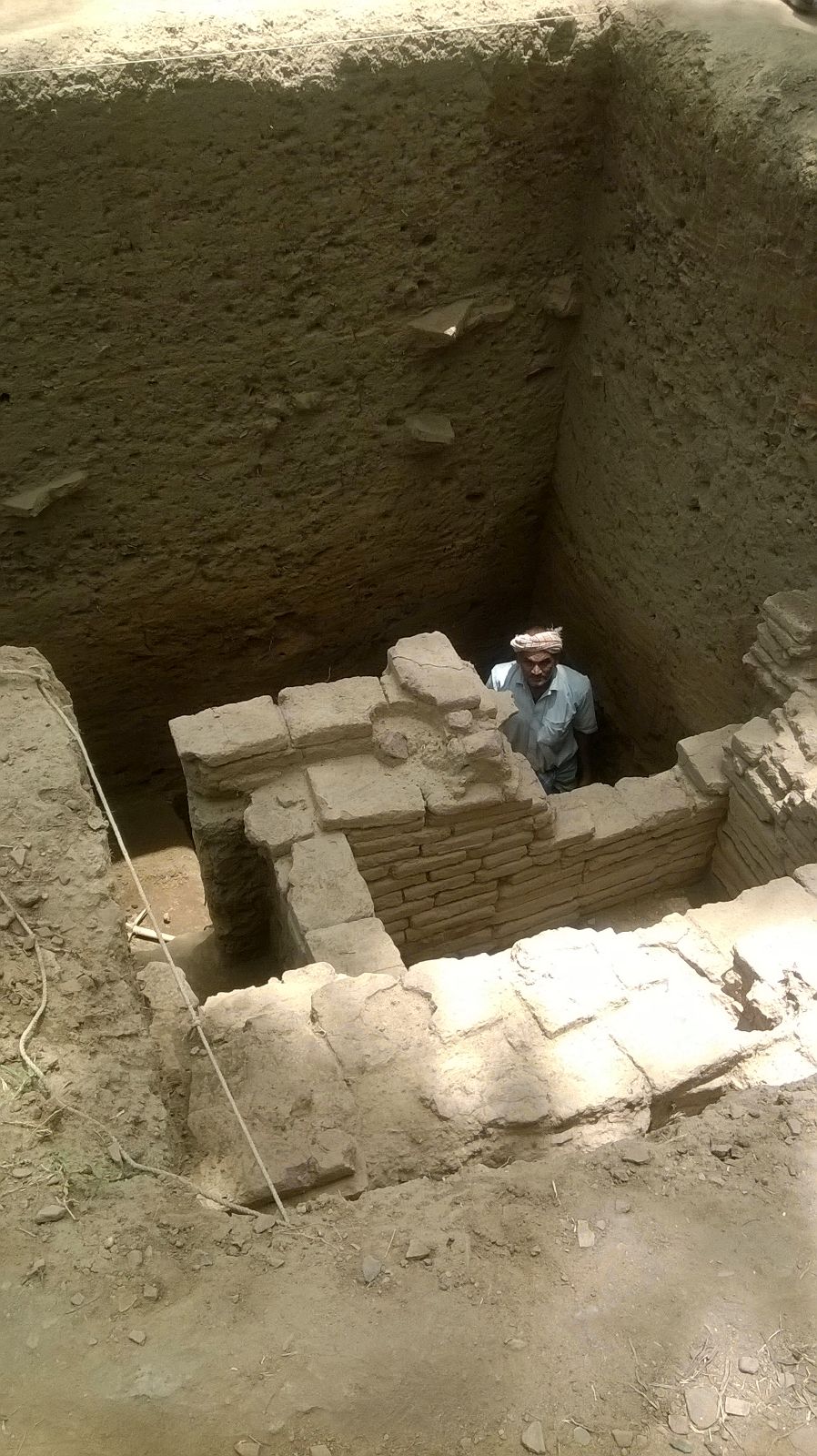
Preserved brick feature within the Keezhadi (Keeladi) excavation trenches
Keezhadi
Photographed 2019-09-06
- How we know
- Keezhadi
Keezhadi's excavations reveal a substantial brick settlement
Keezhadi's excavations found brick buildings, ring wells, drains and furnaces, with published radiocarbon dates supporting activity there in the sixth century BCE.
- This page
- 4,782 words · revision 8
Draft study · Awaiting specialist review · Updated
001Dates and places
002How sure
In brief
Keezhadi (also spelled Keeladi) is a large settlement mound in the Vaigai basin of Sivaganga district, Tamil Nadu. The Archaeological Survey of India began excavating there in the 2014–15 season, and the state archaeology department led later seasons. Trenches exposed brick walls and floors, roof tiles, ring wells of stacked clay rings, brick drains, terracotta pipes and furnaces. Overlapping channels show that drains were rebuilt or redirected over time. Spindle whorls, pointed bone tools and a copper needle point to spinning and weaving, though published reports contain no residue tests proving any brick tank was a dye vat. A charred sample often quoted as 580 BCE was measured at 2530 ± 30 radiocarbon years BP; 580 BCE is simply that figure minus 1950. Properly calibrated (IntCal20, 95.4%), the sample falls somewhere between about 792 and 545 cal BCE on the Hallstatt calibration plateau (c. 800–400 BCE) and cannot be narrowed to a single year; TNSDA's printed table figure of 531 BCE lies outside that 95.4% interval. At the last official statements consulted (2025), ASI's report on its first two seasons had not been published; ASI had returned it to the excavator asking for corrections.
Key researchers cited in this study: R. Sivanantham (TNSDA Keezhadi / Keeladi & Tamil Nadu Excavations) · K. Amarnath Ramakrishna (ASI Keezhadi / Keeladi Excavations, Seasons I–II) · Tamil Nadu State Dept. of Archaeology (TNSDA) · Full bibliography
How sure
- Well supported
Keezhadi was a substantial settlement with brick buildings, ring wells, drains and furnaces
Excavation reports describe and illustrate these structures directly, trench by trench.
- Likely
People were active at Keezhadi by the sixth century BCE (the earliest samples calibrate between the eighth and fifth centuries BCE)
Beta Analytic radiocarbon ages (such as Beta-519476, 2530 ± 30 BP, calibrating to ~792–545 cal BCE) fall on the Hallstatt calibration plateau (c. 800–400 BCE), and complete sample certificates and trench stratigraphy remain incomplete in public summaries.
- Possible
Particular brick tanks were dye vats
Textile tools are well attested, but the reports checked publish no residue analysis from a named tank.
- Not known
Keezhadi was a secular society
Not finding worship objects in part of a site cannot show that a society was secular.
Why it matters
Keezhadi's finds are often quoted with labels such as urban, secular and 580 BCE, so it matters what the trenches actually show.
The summary above is the short read. The full study is the complete text it was drawn from, with its tables and source notes.
What the full study covers
003The study
Question, scope and orientation
Question and scope. The question is:** What do the excavation reports establish about settlement, buildings, water management and chronology at Keezhadi?**
Trench section and small exposed archaeological features at Keezhadi in 2015
Keezhadi
Photographed 2015-09-14
The geographic focus is the Keezhadi/Keeladi archaeological mound in Sivaganga district, Tamil Nadu, within the Vaigai basin. Agaram, Manalur and Kondagai are treated as nearby but distinct archaeological localities rather than interchangeable sources of evidence for Keezhadi proper: the 2025 Tamil Nadu State Department of Archaeology synthesis itself describes them as separate localities within a later Keezhadi cluster and distinguishes Kondagai as a burial locality. ↗1 The period classification is therefore mixed chronology, with the principal settlement evidence falling inside the 1000 BCE–600 CE period this site covers, particularly the sixth century BCE through the early centuries CE (with calibrated ranges of the earliest charred samples extending back into the eighth century BCE), while later archaeological and publication history is kept separate.
The spelling Keeladi predominates in the consulted excavation publications, while Keezhadi is common in later government and public usage; this study treats them as spelling variants of the same site. The Tamil-language 2019 edition was located, but its body was not used to settle technical terminology because the extracted text was poorly encoded and competent Tamil-language review was unavailable. No uncertain Tamil-language reading has therefore been used as evidence.
Orientation. Keezhadi unquestionably contains substantial settlement archaeology: brick walls and floors, roof tiles, ring wells, channels, fitted terracotta pipes, furnaces, pottery, inscribed sherds and craft-related objects are all documented in excavation-team publications. The difficult questions begin when these observations are converted into labels such as urban, secular, drainage system, dyeing complex, or a settlement simply “dated to 580 BCE.” The first two ASI seasons published in 2018 are noticeably cautious about several structural functions, while later TNSDA syntheses give more confident interpretations of water management, urbanism and weaving/dyeing. The radiocarbon record likewise expanded: the first ASI pair was presented around the third century BCE, whereas later state excavations produced multiple reported dates in the sixth–fifth centuries BCE. ↗2 ↗1
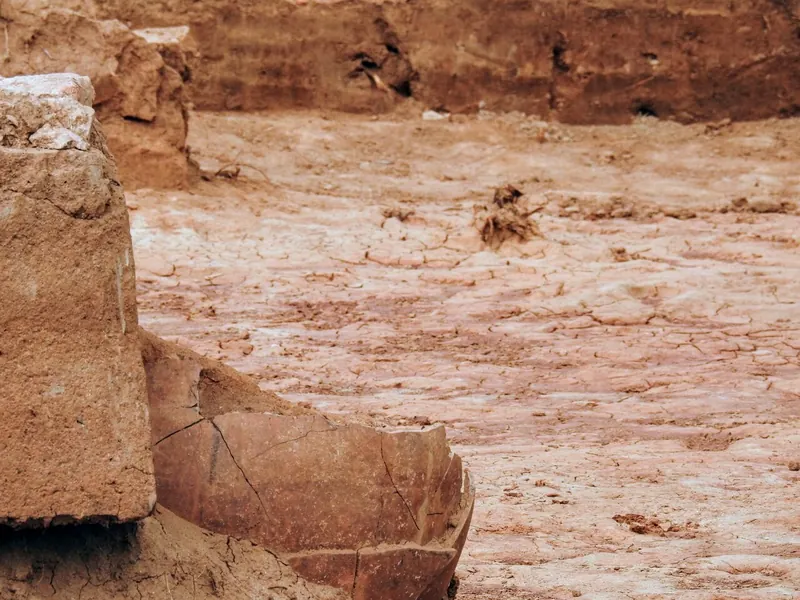
A pottery vessel exposed within the excavated ground at Keezhadi
Keezhadi
Photographed 2019-09-06
The central result of this study is therefore one of evidence separation. A brick tank is an observation; calling it a dye vat is an interpretation. A dated piece of charred material dates that sample and its archaeological context before it dates an adjacent wall or inscription. “Urban” is a synthesis built from evidence, not something literally excavated from a trench.
Historical Narrative & Main Investigation
Accessible explanation. The most useful way to picture Keezhadi is not as a complete buried city suddenly exposed in plan, but as a large mound sampled through many trenches over multiple excavation seasons. In those trenches archaeologists found pieces of built space: walls, brick floors, roof tiles, circular wells assembled from stacked fired-clay rings, channels, fitted pipes and furnace-like installations. Some structures overlap one another or have been altered, disturbed by pits, damaged by later activity or only partly uncovered. The archaeology therefore records both settlement and change within the settlement. ↗2
Water and other liquids were clearly important. The ASI team documented ring wells descending into natural soil and river sand, a long sloping brick channel, brick-lined drains and terracotta pipes. In one area a covered brick channel and another channel overlapped, providing unusually clear evidence that the routing or use of the installation changed through time. But the same excavation report warns that the exact functions of tanks, platforms, furnaces, drains and channels were often difficult to determine because they were only partly exposed. ↗2
The furnaces are secure archaeological features. One well-described ASI example was semicircular and double-walled, with heat-hardened fabric, a brick work surface and an ash deposit. Crucially, however, the excavators said they could not identify what was being manufactured because no diagnostic production residue or waste survived in that furnace. ↗2 That is a good example of what Keezhadi permits us to say confidently: people carried out controlled high-temperature work there, but archaeology does not yet tell us the product of every heating installation.
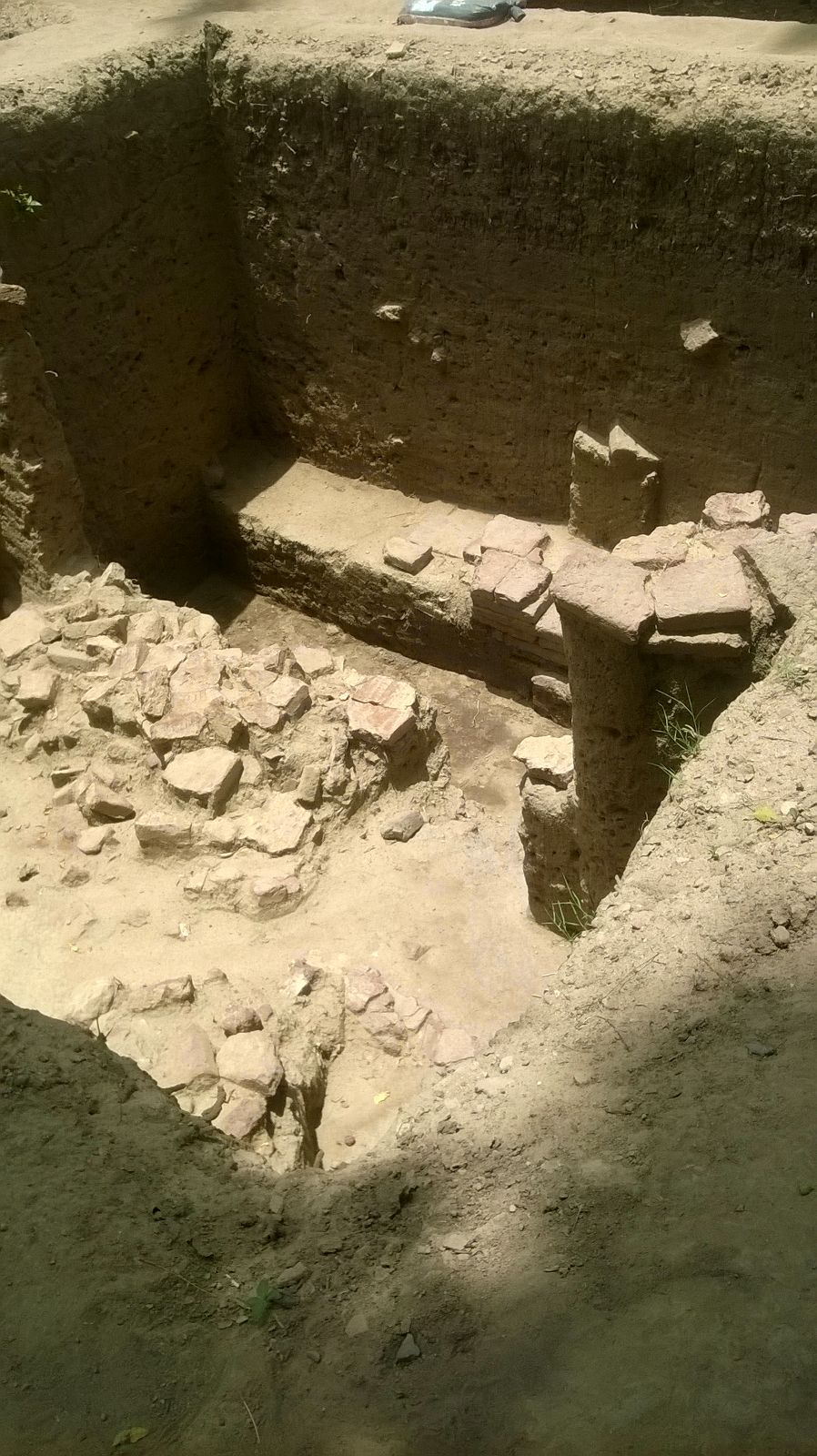
Brick structural remains exposed in a Keezhadi trench in 2015
Keezhadi
Photographed 2015-09-14
Textile activity has a stronger artefactual basis. TNSDA’s 2019 publication lists spindle whorls, pointed bone tools, yarn-related weights, terracotta spheres, a copper needle and vessels that could hold liquids, interpreting the assemblage in terms of spinning, weaving and dyeing. ↗3 Its 2025 synthesis goes further, explicitly describing dyeing vats and connecting them with ring wells, channels, pipes, containers and textile-working tools. ↗1 Yet the earlier ASI publication never securely identifies the tanks as dye vats and repeatedly cautions that functions were tentative. The safest formulation is thus “textile working is well supported; specific dye-vat identifications remain a TNSDA interpretation pending stronger analytical confirmation.”
Chronology needs the same care. A 2017 Government of India answer reported Beta Analytic sample Beta 454596, YF1/1, as 2160 ± 30 BP, and Beta 454597, YF4/2, as 2200 ± 30 BP. ↗4 The 2018 excavation-team article stated that those lower-level samples produced calibrated dates around 200–195 BCE and explicitly said that the still-lower deposit required firm dating. ↗2 Later state work expanded the series dramatically. The 2025 TNSDA table lists Beta 519476, from YP7/4 at 353 cm, as 2530 ± 30 BP, alongside 580 BCE (the simple arithmetic subtraction 2530 − 1950) and a printed table value of 531 BCE in its single-year “Calibrated Age” column (alongside single years 516, 540, and 563 BCE for other early entries). Under standard IntCal20 (95.4% HPD), however, 2530 ± 30 BP calibrates to roughly 792–545 cal BCE on the Hallstatt calibration plateau (c. 800–400 BCE), a flat stretch of the radiocarbon curve that prevents narrowing a measurement to a single century or exact year; TNSDA’s printed single year 531 BCE lies outside that standard 95.4% calibrated interval and must not be cited as the sample’s calibrated age. ↗1
That distinction corrects one of the most widely repeated claims about the site. It is reasonable to say that TNSDA’s published radiocarbon series places human activity at Keezhadi by the sixth century BCE, with its earliest charred-material measurements calibrating between roughly the eighth and fifth centuries BCE. It is not precise to say that “the settlement was founded in 580 BCE” or “calibrated to 531 BCE.” The often-quoted 580 BCE figure is simply 2530 − 1950 for one charred-material sample (Beta 519476, 2530 ± 30 BP), whose standard calibrated span (~792–545 cal BCE) actually tends older than 580 BCE and does not include 531 BCE. Neither the measurement nor any single table value automatically dates every wall, inscription, or craft feature at the site. ↗1
Settlement and excavation history. The ASI article by K. Amarnath Ramakrishna, Nanda Kishor Swain, M. Rajesh and N. Veeraraghavan reports that the first two seasons opened 31 quadrants in Locality I and its extension and about 71 in Locality II. Locality II produced particularly extensive structural remains. Cultural deposits generally reached around 2.5–4 m and occasionally about 4.5 m. The excavators tentatively divided the sequence into Period I, Iron Age before 300 BCE; Period II, Early Historic around 300 BCE–300 CE; and Period III, post-Early Historic after 300 CE. They explicitly described these dates as provisional and dependent on further scientific analysis. ↗2
This matters because the first publication was not presenting a final chronology. The authors knew that the lowest deposits had not yet been satisfactorily dated. Later TNSDA campaigns consequently did more than add objects: they changed the available chronological evidence.
The 2025 state synthesis describes work over ten seasons at Keezhadi and parallel excavations at Agaram, Manalur and Kondagai. Since the sixth season, the four have been considered a cluster for wider settlement research, but TNSDA still distinguishes them spatially and archaeologically. ↗1 Claims about Keezhadi should therefore not silently borrow a ring well, burial or other feature discovered at one of its neighboring sites.
The structural record is extensive but incomplete. The ASI article specifically warns that an area containing square or rectangular tank-like features, brick paving, platforms, furnaces and drains or channels may preserve different structural periods, and that their functional identification remains highly tentative because many were only partly exposed. ↗2 This caution is one of the most important sentences for interpreting the whole site. Keezhadi should be reconstructed context by context, not as though every trench exposed one contemporaneous master plan.
Buildings and built space. Brick construction is among the strongest observations at Keezhadi. The ASI report describes walls, paved floors, channels, tank-like structures and working platforms. One particularly long channel-like structure consisted of parallel brick walls extending about 16.5 m. Its southern end stood higher than its northern end, and the excavators inferred that the slope probably helped discharge water or some other material. Parts had been destroyed by pits and displaced brickwork, so the original beginning and complete plan could not be reconstructed. ↗2
Floors were associated with quantities of grooved roof tiles. The tiles support the existence of roofed structures, even though the timber or other organic superstructure no longer survives. This makes ordinary building practice unusually visible: earth and clay were turned into fired bricks and tiles, wall courses were laid and repaired, floors were paved, and ceramic roofing was combined with perishable structural supports.
Later TNSDA excavations expanded the architectural sample. Its 2025 report records, among other things, an east–west brick alignment in YP7/2, ring wells in A1/2 and A3/2, a long wall crossing several quadrants, open brick channels, a rectangular eight-course brick enclosure in X8/3 and a circular brick furnace in YD5/1. ↗1 TNSDA sometimes interprets the incomplete structures as industrial rather than residential. That remains an interpretation: scattered walls and workshop-like features can support an industrial reading without proving that an area had no domestic use.
Water, drains, pipes and ring wells. Ring wells are the clearest water-related installations. ASI documented examples with stacked terracotta rings extending through occupation deposits into natural soil and river sand. One example found at about 3 m depth consisted of six rings, with the lowest rings set in river sand. ↗2 The excavators inferred that wells could have been constructed when seasonal water levels were lower and then reached groundwater as conditions changed. That is plausible hydrological reasoning, but it should still be distinguished from the physical observation of the rings themselves.
The drainage evidence is also substantial. Between two tank-like structures, the ASI team found a covered brick drain and a terracotta-pipe channel close together. The channels overlapped. One branched and another appears to have been blocked and redirected, indicating more than one construction or use episode. ↗2 This is stronger evidence for settlement management than a generalized statement that Keezhadi possessed “advanced drainage,” because it actually shows alteration of infrastructure through time.
The often-repeated description of “open and closed terracotta drainage pipes” nevertheless needs narrowing. Another ASI feature was a row of fitted terracotta pipes at about 2.25 m depth, apparently joined at its ends to vessels or pots. The excavators suggested that some kind of fluid was being processed through it. In the same working zone are drains and channels, but that does not make every fitted pipe a sewer. ↗2 TNSDA’s later publications use broader water-management and industrial vocabulary. A responsible public description is therefore: Keezhadi had ring wells, brick drains, channels and fitted terracotta pipelines used to manage or convey liquids; the purpose of individual pipelines varied and is not always known.
Furnaces, craft and the proposed dye vats. The ASI YF5/3 furnace is especially useful because its report records both evidence and uncertainty. The feature was semicircular and double layered, with a brick-paved working area. Its walls had been intensely heat affected and hardened, and ash accumulated at one end. Yet there was no production waste or residue that allowed the excavators to identify its output. Nearby, lower-level furnaces were also found. ↗2
This prevents a common interpretive shortcut: “furnace” does not automatically mean “metal furnace,” “glass furnace,” “pottery kiln” or “dye furnace.” Those are functional claims requiring additional evidence.
Textile production has a different evidentiary profile. TNSDA reports spindle whorls, pointed bone implements, yarn-related weights, terracotta objects, a copper needle and containers for liquids, and it interprets these as evidence for spinning, weaving and later dyeing stages. ↗3 By 2025 the state synthesis describes “dyeing vats,” water-supplying ring wells, open and closed channels, spiral and barrel-shaped pipes, containers for coloring materials and textile tools as one technological system. ↗1
The cumulative case for textile work is substantial. The case that any particular tank was definitely a dye vat is less secure. The consulted publications do not present diagnostic residue, pigment, mordant, microbotanical or sediment-chemical results from a named vat. Earlier ASI excavators explicitly considered the functions of partially exposed tanks tentative. ↗2 The strongest defensible description is “proposed dyeing or textile-processing tanks” unless a season report or analytical publication supplies direct residue evidence.
Chronology and the meaning of “580 BCE.” The first ASI pair and the later state series should not be conflated. In 2017 a parliamentary answer reported the measured radiocarbon ages for Beta 454596 and 454597 as 2160 ± 30 BP and 2200 ± 30 BP respectively. ↗4 The 2018 ASI-team publication described the two as yielding calibrated dates around 200–195 BCE and emphasized that the deposits below them remained in need of firm dating. ↗2
The 2025 TNSDA table republishes the same laboratory numbers, but its figures create a significant documentary problem. Beta 454597 remains 2200 ± 30 BP and is listed there with a calibrated age of 320 BCE. Beta 454596 is printed as 2170 ± 30 BP, rather than the 2160 ± 30 BP given in the 2017 government answer, and is assigned a calibrated age of 332 BCE. ↗4 ↗1 The TNSDA values also do not match the 2018 article’s presentation of the pair around 200–195 BCE.
This study cannot legitimately “fix” that discrepancy. It could be a typographical error, recalibration using a different curve or software, or another reporting issue. The original Beta Analytic certificates, calibration curve, software, pretreatment information and probability distributions are needed before the contradiction can be resolved.
Later TNSDA samples are nevertheless independently important, though their table presentation requires explicit calibration control. For Beta 519476 (YP7/4, 353 cm, 2530 ± 30 BP), 580 BCE is simply 2530 − 1950; Beta 583579 (2490 ± 30 BP), Beta 583576 (2470 ± 30 BP), and Beta 583578 (2400 ± 30 BP) similarly yield standard IntCal20 (95.4%) intervals of roughly 792–545 cal BCE, 774–486 cal BCE, 766–422 cal BCE, and 731–398 cal BCE, respectively. All four measurements fall on the Hallstatt calibration plateau (c. 800–400 BCE), where wiggles and flattening in the atmospheric radiocarbon curve prevent single-century resolution. The single years printed in TNSDA’s “Calibrated Age” column (531, 563, 540, 516 BCE, described in the report text as “calibrated mid-range value[s]”) do not represent standard calibrated probability intervals: for Beta 583579, Beta 583576, and Beta 583578 the printed number is older than BP − 1950, whereas for Beta 519476 it prints 531 BCE, younger than 580 BCE and outside the standard 95.4% range (792–545 cal BCE). The authors summarize four dates between 500 and 600 BCE, nine between 300 and 500 BCE and eighteen between 80 and 300 BCE, interpreting them as supporting an early phase in the sixth–fifth centuries BCE while noting approximately another foot of undated cultural deposit beneath the earliest dated strata. ↗1
The resulting conclusion is both important and narrower than the popular claim: TNSDA’s radiocarbon series provides published support for human activity at Keezhadi in the sixth century BCE. “580 BCE,” however, is not the settlement’s calibrated founding date. A charcoal sample first dates itself. Associating it with a wall, pipe, inscription or industrial phase requires a demonstrated stratigraphic relationship.
Urban and secular. TNSDA consistently calls Keezhadi an urban settlement. Its 2025 synthesis argues that brick buildings, water-handling installations, craft activity and increasing artefact density reflect an evolving urban center. ↗1 Those are relevant archaeological arguments. But “urban” remains a classification based on chosen criteria: the consulted reports do not fully establish population size, street hierarchy, administrative organization, settlement boundaries through every period or the complete spatial distribution of specialized activities.
The most accurate museum-level wording is therefore: Keezhadi was a substantial and materially complex Early Historic settlement, interpreted by TNSDA as urban. That formulation retains the important evidence without pretending that “urban” is a neutral excavation observation.
The popular term secular is considerably weaker. The 2019 publication noted that objects identified as worship-related had not been recovered “so far.” That does not demonstrate a secular society in the modern sense. Ritual might have taken place in unexcavated areas, in domestic settings, with perishable objects or in forms archaeologists cannot confidently identify. Conversely, later-reported figurines cannot simply be declared religious either. The evidence therefore does not establish “secular settlement” as an archaeological fact. ↗3 ↗1
Likewise, the slogan that Keezhadi overturns an older theory that Indian urbanization was confined to the Gangetic plains is broader than these excavation reports can prove. The site very clearly demonstrates substantial non-Gangetic settlement complexity in Tamil Nadu during the first millennium BCE and early centuries CE. Whether it should be placed within, alongside or against the historiographic category of India’s “second urbanization” requires systematic comparison with other South Indian and South Asian sites. The excavation reports alone cannot settle that nationwide historiographical proposition.
Interpretations, disagreements and limits; Source register
Interpretations, disagreements and limits. The central chronological uncertainty is documentary and scientific rather than rhetorical. The first ASI sample pair is represented differently in three read publications. Beta 454596 is 2160 ± 30 BP in the 2017 Rajya Sabha answer but 2170 ± 30 BP in TNSDA’s 2025 table; the 2018 excavation article describes the pair as calibrating around 200–195 BCE, whereas TNSDA’s table gives 332 and 320 BCE. ↗4 ↗2 ↗1 Until the original laboratory reports and calibration outputs are read, no preferred reconstruction should be invented.
The later chronology is stronger in one respect: the sixth-century BCE conclusion no longer depends on that first pair. Several different later Beta sample codes are presented with sixth-century BCE calibrated values. ↗1 Their relationship to particular architectural features, however, still needs tighter context-by-context publication before the dates can be used as precise dates for drains, furnaces, inscriptions or individual buildings.
The dyeing disagreement is mostly about evidentiary level. ASI described partially exposed tanks and working installations cautiously. TNSDA later integrated similar structures with textile tools and explicitly called them dyeing vats. ↗2 ↗1 Those positions are not necessarily contradictory: later excavation can support a stronger reconstruction. But the consulted later synthesis does not supply diagnostic residues from a specific vat. “Proposed dyeing complex” is therefore preferable to “proven dye vats.”
The urban label should also remain attributed. TNSDA’s argument rests on genuine archaeological evidence, including brick construction, water infrastructure, craft activity and dense artefact deposition. ↗1 Yet the excavation reports alone do not exhaust the comparative criteria by which archaeologists debate urbanism. “Substantial Early Historic settlement interpreted as urban by TNSDA” is both informative and evidence-faithful.
The secular label should not be used. Neither the absence of an object archaeologists identify as religious nor the later occurrence of figurines provides a reliable binary test of whether an ancient settlement was “secular.” The evidence cannot distinguish such a modern social category from a settlement where ritual occurred through practices, places or materials not archaeologically visible in the exposed areas.
The availability of ASI’s final first-two-season report remains a serious limitation. In July 2025 the Government stated that the report had been submitted and vetted and that comments had been provided to the excavator; in August 2025 it said methodological, chronological, interpretive, presentational and analytical deficiencies had been communicated. ↗6 ↗7 Later press reports describe further rounds of review and dispute over the report. They are not summarised here because no official ASI or ministry document recording them has been consulted. Until the report is published, this study relies on Ramakrishna and colleagues' 2018 excavation-team article. ↗5
Source register.
K. Amarnath Ramakrishna, Nanda Kishor Swain, M. Rajesh and N. Veeraraghavan, “Excavations at Keeladi, Sivaganga District, Tamil Nadu (2014–2015 and 2015–16),” Heritage: Journal of Multidisciplinary Studies in Archaeology 6 (2018), 30–72. English; excavation-team research article. How it was read: partial text deeply read, especially pp. 38–39 and 45–56; one relevant page image, printed p. 50/Fig. 9, was successfully read. Durable URL: https://www.heritageuniversityofkerala.com/JournalPDF/Volume6/2.pdf. Supports/challenges C001–C007 and C010–C012. ↗2
R. Sivanantham and M. Seran, eds., Keeladi – An Urban Settlement of Sangam Age on the Banks of River Vaigai, Publication No. 302, Department of Archaeology, Government of Tamil Nadu, Chennai, first edition 2019; English preliminary booklet (official TNSDA Keeladi portal: https://www.tnarch.gov.in/keeladi). English; excavation report/preliminary synthesis. Partial text read (chronology, architecture, weaving, and concluding section). Supports C007–C010 and contextualizes C013. ↗3
R. Sivanantham and M. Seran, eds., Tamil-language edition corresponding to Publication No. 302, Department of Archaeology, Government of Tamil Nadu, 2019. Tamil; excavation report. How it was read: metadata/facsimile lead only. The document was located, but its extracted body text was unsuitable for evidentiary use without competent Tamil review. No load-bearing claim depends on it.
R. Sivanantham, M. Ramesh and R. Ajay Kumar, “Excavations at Keeladi,” pp. 163–218 in K. Rajan, R. Sivanantham, and V. P. Yathees Kumar, eds., Archaeological Excavations in Tamil Nadu: A Preliminary Report, Publication No. 362 (ISBN 978-81-977842-9-3), Department of Archaeology, Government of Tamil Nadu, Chennai, 2025. English; excavation-report chapter. How it was read: partial text deeply read, especially pp. 163–164, 196–200 and 214–217. Official volume catalogue: https://tamildigitallibrary.in/Articles/62719_Archaeological_excavations_in_Tamil_Nadu. Author-uploaded chapter used for passage inspection: https://www.researchgate.net/publication/396975088_Excavations_at_Keeladi_-_2025. Publisher, year and series were cross-checked against Tamil Digital Library. ↗9 ↗1
Government of India, Ministry of Culture, Rajya Sabha Unstarred Question No. 1152, “Artefacts Unearthed in Keeladi, Tamil Nadu for Carbon Dating,” answered 26 July 2017. English; official government document. How it was read: full text of one-page PDF. Durable URL: https://sansad.in/getFile/annex/243/Au1152.pdf?source=pqars. Supports C011. ↗4
Government of India, Ministry of Culture, Rajya Sabha Unstarred Question No. 513, “Publication of Keezhadi Excavation Report by ASI,” answered 24 July 2025. How it was read: full text. Durable URL: https://sansad.in/getFile/annex/268/AU513_xUS20b.pdf?source=pqars. Supports C015. ↗6
Government of India, Ministry of Culture, Lok Sabha Unstarred Question No. 3655, “Delay in Publication of Keezhadi Excavation Report,” answered 11 August 2025. How it was read: full text and facsimile; both pages visually read. Durable URL: https://sansad.in/getFile/loksabhaquestions/annex/185/AU3655_fbqTi1.pdf?source=pqals. Supports C015. ↗7
Archaeological Survey of India, “Excavation Reports of Archaeological Survey of India (MASI),” current online catalogue, read 13 October 2026. How it was read: full current webpage. Durable URL: https://asi.nic.in/pages/Publications/excavationReports. Used only for the qualified observation that Keezhadi was not listed on that published MASI index. ↗5
Archaeological Survey of India / Press Information Bureau, “Clarification Regarding Media Reports on Keeladi Excavation Report,” 29 May 2025, Release ID 2132267. How it was read: full text. Durable URL: https://www.pib.gov.in/PressReleasePage.aspx?PRID=2132267. Used only to establish ASI’s stated vetting/publication position. ↗8
M. Ramkumar et al., “Episodic habitation and abandonment of Neolithic civilization sites in the Vaigai River Basin, Southern India,” Geosystems and Geoenvironment 1 (2022), article 100007. DOI: 10.1016/j.geogeo.2021.10.002. English; research article. How it was read: abstract/metadata only. It was retained as regional scientific context but deliberately not used for load-bearing claims about individual Keezhadi structures because direct excavation sources were available. ↗10
Sources still to consult. The 982-page ASI report submitted in January 2023 remains unpublished, and the original Beta Analytic laboratory certificates remain unavailable in public records. Those two source gaps are blocking for the most exact possible reconciliation of chronology and stratigraphy.
Learning and claims tested
Learning.
The principal grounded takeaways are these:
- Keezhadi has directly excavated brick architecture, floors, channels, ring wells and furnaces, but many structures are incomplete and their functions should not be overstated. ↗2
- Water and other liquid handling are securely part of the settlement archaeology; not every terracotta pipeline is securely identifiable as a sewer. ↗2
- Furnaces are real archaeological installations, but their products are not always recoverable from the evidence. ↗2
- Textile-related tools strongly support spinning and weaving, while specific “dye vat” identifications remain interpretive without published residue evidence. ↗3 ↗1
- TNSDA’s expanded radiocarbon series supports activity by the sixth century BCE (its earliest samples calibrate between roughly the eighth and fifth centuries BCE on the Hallstatt plateau), but neither 580 BCE (= 2530 − 1950) nor TNSDA’s printed single year 531 BCE is a calibrated foundation date for the whole settlement. ↗1
- “Urban” is a reasonable attributed TNSDA interpretation; “secular” and a sweeping national “second urbanization” conclusion should not be presented as direct excavation facts. ↗1
Glossary. Stratigraphy is the sequence and physical relationship of archaeological deposits and features. A context is the particular archaeological unit in which a feature, object or sample occurs. A ring well is a shaft constructed from stacked fired-clay rings. AMS radiocarbon dating uses accelerator mass spectrometry to measure radioactive carbon in organic material. BP means radiocarbon years “before present,” conventionally before 1950. Calibration converts radiocarbon measurements into calendar-date probability ranges using a calibration curve. Tamil-Brahmi and Tamili are labels used in the consulted publications for early writing on pottery; the terminology still needs specialist epigraphic and Tamil review.
Useful next questions are: Which drains connect physically to which tanks and structural phases? Are chemical, pigment, mordant or microbotanical residues preserved in the proposed dye vats? Which dated samples are securely sealed within or below individual structures? What do the original Beta certificates say about pretreatment and calibration? How does Keezhadi compare with other Early Historic South Indian settlements when the same explicit criteria for urbanism are applied?
Evidence challenge. Does a charcoal sample associated with the 580 BCE claim prove that a Tamil-Brahmi sherd or wall nearby also dates to 580 BCE? No. Radiocarbon analysis first dates the sampled organic material. A wall, sherd or inscription can inherit that chronological significance only if its stratigraphic relationship to the dated material is secure and undisturbed. Keezhadi’s documented pits, rebuilding and overlapping structures make this distinction especially important. ↗2 ↗1
Claims tested.
| Claim tested | Assessment | Evidence-led conclusion |
|---|---|---|
| Multi-phase excavation at Keezhadi | Supported | Multiple excavation seasons and overlapping structural phases are documented. |
| “Secular” settlement | Contested / not established | Archaeology read here does not establish secularity. |
| “Second-urbanization settlement” | Qualified | Urbanism is TNSDA’s interpretation; “second urbanization” is a wider comparative historiographical question. |
| Settlement “dated to c. 580 BCE” | Qualified | Beta 519476 (2530 ± 30 BP) gives 580 BCE only as BP − 1950 and calibrates under IntCal20 (95.4%) across ~792–545 cal BCE on the Hallstatt plateau (TNSDA’s printed 531 BCE lies outside that range); multiple samples support activity by the sixth century BCE. ↗1 |
| Sophisticated brick masonry | Supported | Walls, floors, channels, enclosures and working surfaces are directly excavated. |
| Open and closed terracotta drainage pipes | Qualified | Drains, channels and terracotta pipelines occur, but not every pipe is securely a drain/sewer. |
| Ring wells | Supported | Multiple directly excavated examples. |
| Brick-built furnaces | Supported | Secure installations; product often unresolved. |
| Weaving dye vats | Qualified / unresolved | Textile work is well supported; vat function needs stronger analytical confirmation. |
| Keezhadi overturns Gangetic-only urbanization | Outside what the excavation reports alone establish | Requires comparative South Asian urbanism research. |
| Beta Analytic chronology | Supported but metadata-incomplete | Laboratory codes/raw ages are published, but calibration details are incomplete and published values conflict for Beta 454596. |
The main missing evidence is the published ASI final report; the original Beta Analytic certificates; exact sample-to-feature stratigraphic relationships; analytical work on the proposed dyeing installations; and a competent Tamil-language reading of the 2019 Tamil edition. “Not found” means not located in the checked documentation; “not reported” means absent from the consulted passage. Neither expression means “archaeologically absent.”
What is secure and what is not
The secure findings are the evidence-led account of brick structures, ring wells, channels, furnaces and textile tools; the distinction between observation and the labels “urban,” “secular” and “dye vat”; and the calibrated Hallstatt-plateau explanation of the 2530 ± 30 BP (“580 BCE”) measurement rather than TNSDA’s single printed year 531 BCE. Specialist work is still needed on the original radiocarbon documentation, exact structural-phase/sample relationships, dye-vat residue evidence, Tamil terminology and the final ASI report. Statements that should not be presented as unqualified history include: “Keezhadi was a secular city,” “all terracotta pipes were drains,” “the furnaces were dyeing furnaces,” “Keezhadi was founded in 580 BCE,” and “Keezhadi by itself disproves the Gangetic model of Indian urbanization.”
This study did not read every season report, every news article or the unpublished 982-page ASI submission. Original Beta certificates, internal ASI review documentation, a fully usable Tamil text and complete season-by-season structure/sample matrices remain unpublished or not yet consulted directly.
004Photographs
Photographs of the places and objects this study discusses. Each item carries its creator’s credit, licence and documented source. See all 412 photographs and source images ↗

Keezhadi · Photographed 2019-09-06
Preserved brick feature within the Keezhadi excavation trenches

Alagankulam and Keezhadi
Published chemical-composition analysis of pottery from Alagankulam and Keezhadi

Keezhadi · Photographed 2015-09-14
Trench section and small exposed archaeological features at Keezhadi in 2015
Keezhadi · Photographed 2019-09-06
A pottery vessel exposed within the excavated ground at Keezhadi
Keezhadi · Photographed 2015-09-14
Brick structural remains exposed in a Keezhadi trench in 2015

Keezhadi · Photographed 2019-09-06
Brickwork and associated deposits exposed at Keezhadi
Keezhadi · Photographed 2016-10-11
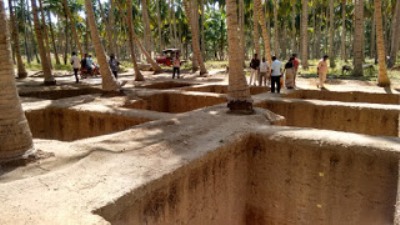
Excavation trenches between coconut palms at Keezhadi in 2016
Keezhadi · Photographed 2018-05-28
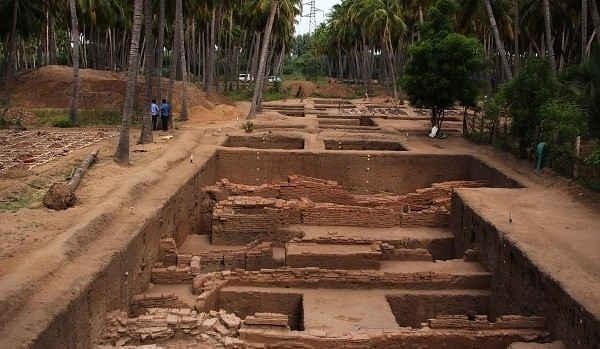
Long view across excavation trenches and exposed brick structures at Keezhadi
Show 12 more photographs and source images ↓
Keezhadi · Photographed 2015-09-14
Excavated brickwork within a Keezhadi trench in 2015

Keezhadi · Photographed 2019-09-06
Stacked ceramic rings exposed in a Keezhadi excavation section

Keezhadi · Photographed 2015-09-14
Stratified trench wall and exposed features at Keezhadi in 2015

Keezhadi
Six pottery fragments from Keezhadi, samples K7, K9, K1, K11, K16 and K2
Keezhadi · Photographed 2025-06-01 12:17:30
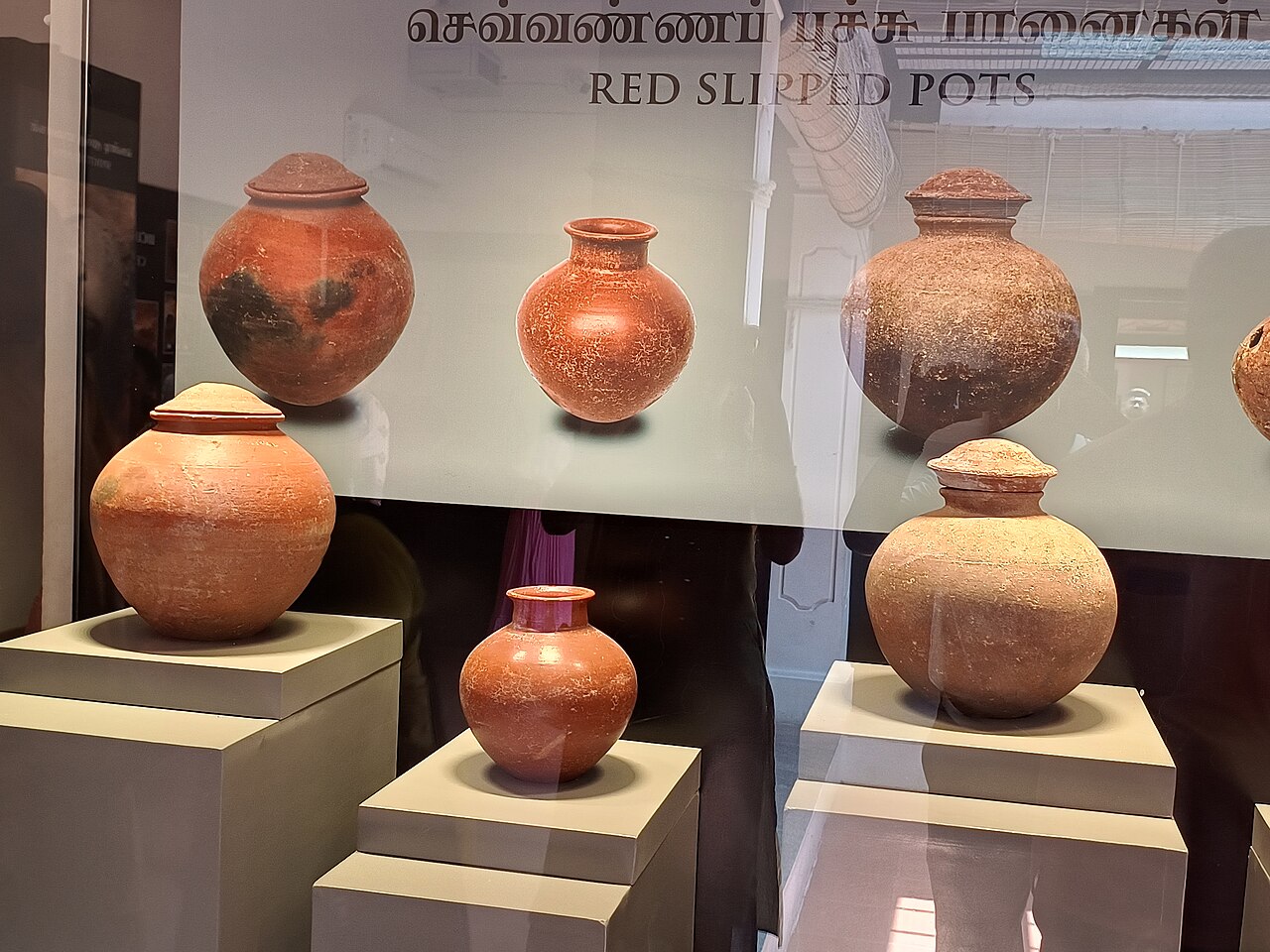
Red-slipped pottery vessels excavated at Keezhadi, photographed in a museum display
Keezhadi · Photographed 2016-10-11
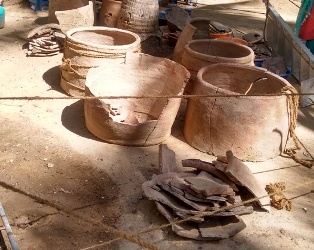
Excavated pottery vessels and sherds laid out at Keezhadi in 2016
Keezhadi · Photographed 2024-12-26 11:19:42
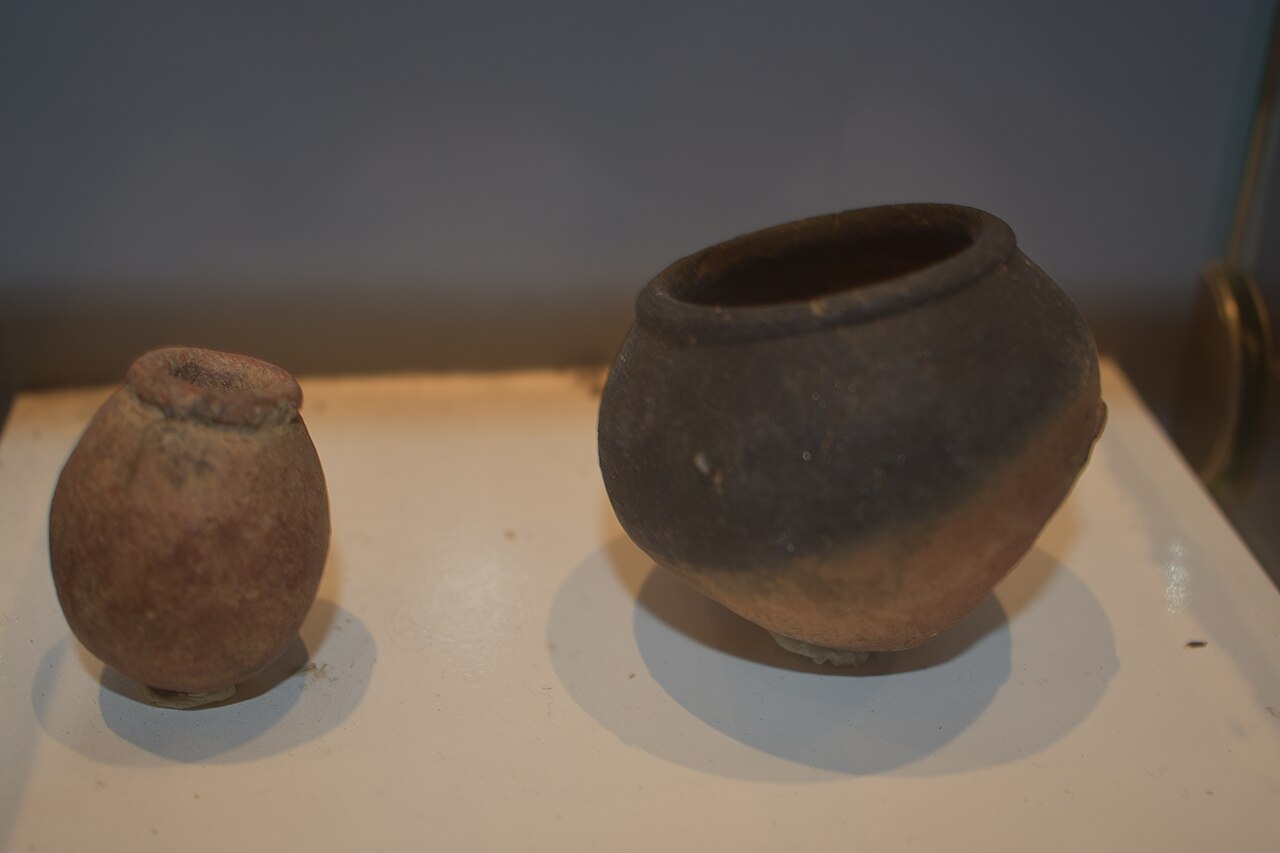
Two archaeological pottery vessels on display in the Keezhadi museum

Keezhadi
Thin-section microphotographs of Keezhadi samples K5, K1, K3, K9, K2 and K16
Thin-section microphotographs of Keezhadi samples K5, K1, K3, K9, K2 and K16; scale bars 500 micrometres.

Keezhadi · Photographed 2015-09-14
Excavation camp entrance among coconut palms at Keezhadi in 2015

Keezhadi · Photographed 4 June 2023 (according to Exif data)
Exterior of the modern Keezhadi Archaeological Museum
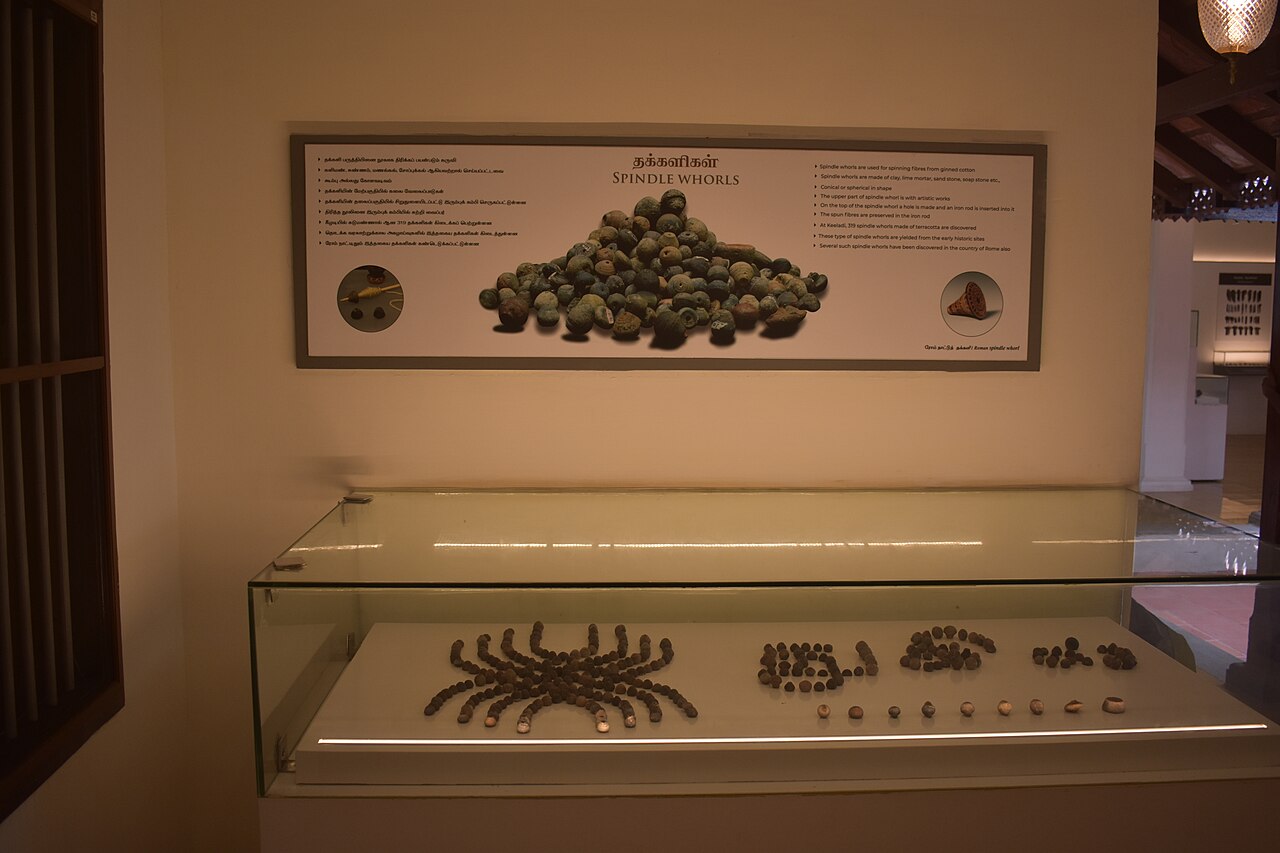
Keezhadi · Photographed 2024-12-26 10:57:01
Terracotta spindle whorls displayed at the Keezhadi museum
Terracotta spindle whorls (spinning weights) photographed in a Keezhadi museum display case labelled 'SPINDLE WHORLS' in Tamil and English; individual trench findspots require separate catalogue verification.

Keezhadi · Photographed 2024-12-26 09:25:07
Present-day ground and vegetation at the Keezhadi archaeological site
005Two views
Both views are shown at equal weight; this site does not choose between them.
Whether Keezhadi's brick tanks were dye vats
- One view
- The Tamil Nadu archaeology department's 2019 and 2025 reports read tanks, ring wells, pipes and textile tools together as a dyeing system.
- Another view
- The 2018 report on the first two Archaeological Survey of India seasons called the functions of partly exposed tanks tentative.
- What would settle it
- Residue, pigment or sediment-chemistry tests on a named tank, published with its exact context.
006Where next
Compare the Keezhadi (also spelled Keeladi) excavation evidence with the general method for keeping observation, source statements and interpretation apart.
On the atlasKeezhadiPublic on-site museum & open-air excavated brick gallery
Explore nextWriting on a Broken Pot: What Scratched Letters ShowAll related studies, connected material, books and sources20 · 10
Elsewhere on this site
Excavation Atlas Sites: Keezhadi (Vaigai River Brick Settlement)
Junior Detective Quests: Writing on a Broken Pot: What Scratched Letters Show
Multi-Script Glossary Terms: kīṟal (Graffiti Marks) (கீறல் குறியீடுகள் / പോറൽ ചിഹ്നങ്ങൾ) · karuppu-civappu pāṉai (Black-and-Red Ware) (கருப்பு சிவப்பு பானை / കറുപ്പും ചുവപ്പും മൺപാത്രങ്ങൾ) · uṟai-kiṇaṟu (உறைகிணறு / ഉറക്കിണർ) · kōṭi / tukil (கோடி / துகில் / കോടി / തുകിൽ) · Vaiyai (Vaigai) & Porunai (Tamiraparani) Basins (வையை & பொருநை (தாமிரபரணி) / വൈഗൈ, താമ്രപർണി നദീതടങ്ങൾ) · takkaḷi / nūṟpu-k-katir (Terracotta Spindle Whorls & Loom Weights) (தக்களி / நூற்புக் கதிர் & தறி எடைக்கற்கள் / തക്ലി / നൂൽക്കതിരും തറിക്കല്ലുകളും)
Connected material
Photographs, drawings, books, videos and other studies linked to this study. A link helps you explore; it does not prove a historical claim.
- Excavation camp entrance among coconut palms at Keezhadi in 2015photographBackground
- Trench section and small exposed archaeological features at Keezhadi in 2015photographShows the subject
- Excavated brickwork within a Keezhadi trench in 2015photographShows the subject
- An educational visit at the Keezhadi excavation camp in 2015photographBackground
- Stratified trench wall and exposed features at Keezhadi in 2015photographShows the subject
- Brick structural remains exposed in a Keezhadi trench in 2015photographShows the subject
- Excavation trenches between coconut palms at Keezhadi in 2016photographShows the subject
- Excavated pottery vessels and sherds laid out at Keezhadi in 2016photographShows the subject
- Coconut-grove setting and exposed ground at the Keezhadi archaeological sitephotographBackground
- Long view across excavation trenches and exposed brick structures at KeezhadiphotographShows the subject
- A pottery vessel exposed within the excavated ground at KeezhadiphotographShows the subject
- Preserved brick feature within the Keezhadi excavation trenchesphotographShows the subject
- Stacked ceramic rings exposed in a Keezhadi excavation sectionphotographShows the subject
- Brickwork and associated deposits exposed at KeezhadiphotographShows the subject
- Exterior of the modern Keezhadi Archaeological MuseumphotographBackground
- Present-day ground and vegetation at the Keezhadi archaeological sitephotographBackground
- Terracotta spindle whorls displayed at the Keezhadi museumphotographBackground
- Two archaeological pottery vessels on display in the Keezhadi museumphotographShows the subject
- Red-slipped pottery vessels excavated at Keezhadi, photographed in a museum displayphotographShows the subject
- Six pottery fragments from Keezhadi, samples K7, K9, K1, K11, K16 and K2photographic plateShows the subject
- Thin-section microphotographs of Keezhadi samples K5, K1, K3, K9, K2 and K16scientific micrographShows the subject
- Published chemical-composition analysis of pottery from Alagankulam and Keezhadiscientific plotBackground
- Published Raman spectra for black and red surfaces of Keezhadi sherd K15scientific plotBackground
- Pottery sample K7 from Keezhadi, photographed in Odelli and colleagues' 2020 studyphotograph (detail)Shows the subject
- Pottery sample K9 from Keezhadi, photographed in Odelli and colleagues' 2020 studyphotograph (detail)Shows the subject
- Pottery sample K1 from Keezhadi, photographed in Odelli and colleagues' 2020 studyphotograph (detail)Shows the subject
- Pottery sample K11 from Keezhadi, photographed in Odelli and colleagues' 2020 studyphotograph (detail)Shows the subject
- Pottery sample K16 from Keezhadi, photographed in Odelli and colleagues' 2020 studyphotograph (detail)Shows the subject
- Pottery sample K2 from Keezhadi, photographed in Odelli and colleagues' 2020 studyphotograph (detail)Shows the subject
- Read locally. Compare cautiously.diagramThe habitation section, a floor against a brick wall, stands for the brick settlement layers this study describes at Keezhadi.
- Order first. Dates second.diagramKeezhadi’s excavated layers and published radiocarbon dates in this study are the two kinds of evidence the plate keeps apart.
- Same depth. A different context.diagramReading a settlement’s chronology starts with its layers and cuts; this teaching section shows the basic rule.
- The layer is only the beginningillustrationKeezhadi’s excavated layers and published dates in this study are read with the kind of sequence the drawing explains.
Books, videos and websites
Outside reading on this topic. These are not part of the study and we have not checked every claim in them. See all books and videos
- A History of Ancient and Early Medieval India: From the Stone Age to the 12th Century Book · Upinder Singh · 2008 · Comprehensive subcontinental historical synthesis integrating peninsular Iron Age burials, Asokan edicts, Tamil-Brāhmī epigraphy, archaeobotany, Sangam chiefdoms, and Indian Ocean exchange.
- A History of South India from Prehistoric Times to the Fall of Vijayanagar Book · K. A. Nilakanta Sastri · 1955 (4th ed. 1975) · Classic mid-20th-century political and literary history of peninsular South India, framing early Chera, Chola, and Pandya dynasties before post-1980 stratigraphic and radiometric excavations.
- TNSDA – Tamil Nadu State Department of Archaeology Website · Official repository of excavation monographs, radiocarbon date tables, and epigraphic reports for Keeladi (Keezhadi), Sivagalai, Adichanallur, Korkai, Kodumanal, Mayiladumparai, Alagankulam, and Karur.
007Sources
The study lists the sources it consulted; we have not rechecked them. A working link does not show that a source was read, and a valid identifier does not show that it supports a claim. We do not link to unofficial uploads or copies of publications. Where a study cited one, we show the published citation, or a publisher, DOI or Internet Archive link when we have one. Tracking codes are removed from links, and the sources themselves are not republished here.
Excavations at Keeladi - 2025
Ramakrishna et al. (2018), Heritage 6: 30–72
K. Amarnath Ramakrishna et al., 'Excavations at Keeladi, Sivaganga District, Tamil Nadu (2014–2015 and 2015–16),' Heritage 6 (2018): 30–72
TNSDA Publication No. 302 (Keeladi, 2019)
R. Sivanantham and M. Seran, eds., Keeladi – An Urban Settlement of Sangam Age on the Banks of River Vaigai, Publication No. 302 (Chennai: TNSDA, 2019)
sansad.in
asi.nic.in · excavationReports
Rajya Sabha Unstarred Question No. 513 (24 July 2025)
Government of India, Ministry of Culture, Rajya Sabha Unstarred Question No. 513, answered 24 July 2025
sansad.in · AU3655 fbqTi1.pdf
pib.gov.in · PressReleasePage.aspx
Archaeological excavations in Tamil Nadu - நூல்
Episodic habitation and abandonment of Neolithic civilization ...
Researchers and institutions whose work this study uses: R. Sivanantham, K. Amarnath Ramakrishna, Tamil Nadu State Dept. of Archaeology
How we know The evidence, claims and dates behind this study
What this study draws on
- K. Amarnath Ramakrishna and colleagues' 2018 report on the first two ASI seasons (Heritage 6: 30–72)
- The Tamil Nadu State Department of Archaeology's 2019 booklet (Pub. No. 302) and 2025 Preliminary Report (Pub. No. 362) with its radiocarbon table
- 2017 and 2025 parliamentary answers giving raw radiocarbon ages and report status
- ASI catalogue records and 2026 public news records on the unpublished first-two-season final report
Dates in this study
This study has no dates recorded in a form we can chart, so there is no date chart. Any dates it gives are in the full study.
The study’s claims
16 claims · 0 source passages · 63 paragraphs
Browse the study paragraph by paragraphKeezhadi is a stratified, multi-period settlement with deep deposits and substantial structural remains.
Supported in this study
Period labels are archaeological classifications, not self-dating layers.
Brick walls, floors, channels and tank-like structures are directly excavated, while complete building function is often uncertain.
Supported with qualifications
Supports built fabric; challenges over-specific functional labels.
Water or liquid handling is securely evidenced by ring wells and channels, but functions varied.
Supported with qualifications
Strong water-access/liquid-conveyance evidence; not every feature is a sewer.
The ASI terracotta pipe row cannot automatically be called a closed sewer/drain.
Supported with qualifications
Earlier report describes fluid processing and tentative function; later TNSDA gives stronger craft/water interpretation.
Overlapping channels demonstrate multiple construction/use episodes.
Supported in this study
Strong stratigraphic evidence; conveyed substance unknown.
Furnaces existed, but the ASI YF5/3 furnace’s product was unidentified.
Supported in this study
No diagnostic residue or production waste.
“Dye vat” is a later TNSDA functional interpretation rather than a residue-proven ASI identification.
Supported with qualifications
Later synthesis supports dyeing label; earlier excavation cautions against certainty.
Textile production is better supported than dyeing specifically.
Supported with qualifications
Spindle whorls, bone tools and needle support textile work.
Beta 519476 is measured at 2530 ± 30 BP (580 BCE = 2530 − 1950), calibrating under IntCal20 (95.4%) across c. 792–545 cal BCE on the Hallstatt plateau; TNSDA’s printed 531 BCE lies outside that range, and 580 BCE is not a site-wide foundation date.
Supported with qualifications
Dates sampled charred material in context, not every feature.
The accessible published chronology changes from an early tentative ASI scheme to a TNSDA sixth–fifth-century BCE early phase.
Supported in this study
Expanding excavation/sample series, not a single unchanged dataset.
Published values for Beta 454596 and the calibration of the first ASI pair conflict across sources.
Unresolved in this study
Original laboratory certificate needed.
“Urban” is an interpretation supported by substantial settlement infrastructure rather than a direct excavation observation.
Supported with qualifications
TNSDA explicitly argues urban development.
“Secular settlement” is not established by the consulted excavation reports.
Withheld pending check
Absence of identified worship objects in partial excavation is insufficient.
Keezhadi supports substantial non-Gangetic settlement complexity; the excavation reports alone cannot decide national “second urbanization” historiography.
Supported with qualifications
Comparative literature required beyond site reports.
As of the last official statements consulted (PIB, 29 May 2025; Lok Sabha answer, 11 August 2025), ASI's report on the first two seasons had not been published, and ASI had sent the excavator a list of deficiencies.
Supported with qualifications
The full report remains unpublished.
Agaram, Manalur and Kondagai should not be silently conflated with Keezhadi trench evidence.
Supported in this study
Cluster interpretation is legitimate only when labelled.
About this study Status, corrections and how it was made
Status
Draft study, revision 8. No historian, archaeologist, or Tamil or Malayalam specialist has reviewed it yet.
How it was made
Compiled as an editorial synthesis from published scholarship around questions we framed. About this project & workflow
The summary, How sure lines and Two views notes on this page were prepared from this study and cross-checked against its passages. That is an editorial check, not a specialist review.
Corrections and updates
Technical details
Study code R108. The text fingerprint changes whenever the study text changes.
- Table headings decide what each column means. Citation links, sample mentions and dates copied as text are kept apart from checked source passages and calibrated measurements.
See how this study’s records were extracted
Text fingerprint (SHA-256): R108 · cb70303c22586d2977c107f8… · v8
Evidence tables and technical details are on the web page: https://layersofthesouth.org/read/b9d75f7515