The rings stand 1 km and 5 km from each stored position.
Modern coastline, main rivers and the Western Ghats ridge; ancient river mouths and shorelines differed
Modern coastline from Natural Earth (public domain). Places are at coarse town or district positions.
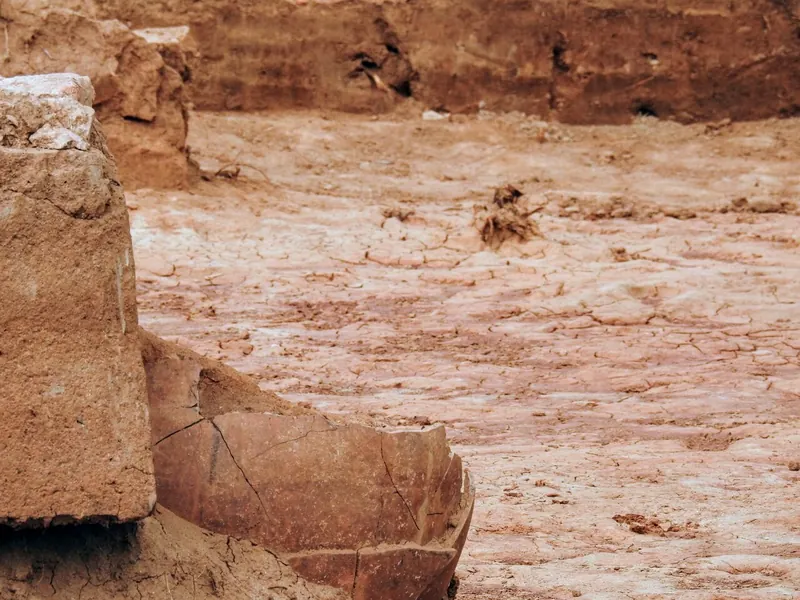
DIRECT EXCAVATION PHOTOGRAPHA pottery vessel exposed within the excavated ground at KeezhadiSundar (Wikimedia Commons) · CC BY-SA 3.0 · Source ↗ · Open photograph record
002The evidence record
What was found, what it shows, and what stays open
Keezhadi is a large settlement mound in the Vaigai basin. The Archaeological Survey of India began excavating in 2015 (2014–15 field season), and the state archaeology department led later seasons. Trenches exposed brick walls and floors, roof tiles, ring wells of stacked clay rings, brick drains, terracotta pipes and furnaces. Spindle whorls, bone points and a copper needle point to spinning and weaving. Many pots carry short names scratched in Tamil-Brahmi.
Why it matters: Names scratched on everyday pots show that writing was part of daily life in the settlement.
The place summary's grade
How sure:Likely. Several radiocarbon dates support activity in the sixth century BCE; the often-quoted 580 BCE is a conventional age printed by TNSDA alongside 531 BCE.
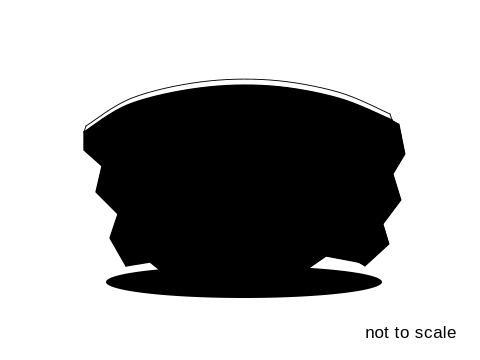
Inscribed pottery sherd showing early Tamil-Brahmi letters. Schematic drawing, not to scale.
Fired-brick structural complex, terracotta ring wells, drains, craft residues, and inscribed/graffiti sherds on the Vaigai flood plain, paired with burials at Konthagai and trenches at Agaram and Manalur.
What it is taken to show
A substantial brick settlement with craft work, water channels and names scratched on everyday pots; calling it urban is the state department's interpretation.
Still uncertain
How specific charcoal AMS dates from lower strata relate to the exact stratum of individual Tamil-Brāhmī sherds versus undeciphered graffiti marks, and whether post-firing inscriptions were made by potters, traders, or owners.
Dates and how they were obtained
c. 6th century BCE – 2nd/3rd century CE (AMS radiocarbon dates on charred samples, including Beta-519476 [2530 ± 30 BP, printed by TNSDA as 580 BCE conventional and 531 BCE intercept at 353 cm in YP7/4] and Beta-583576 [2470 ± 30 BP, printed by TNSDA as 540 BCE at 384 cm in YD4/2]; each date measures its charred sample rather than a specific sherd). (AMS radiocarbon dating (Beta Analytic), stratigraphic excavation (ASI Phases I–III; TNSDA Phases IV–X), archaeobotany, and faunal analysis.) AMS dates from the 6th century BCE into the Common Era
Who dug or recorded it
Archaeological Survey of India (K. Amarnath Ramakrishna, Phases I–II, 2014–15 to 2015–16; P. S. Sriraman, Phase III, 2017) and Tamil Nadu State Department of Archaeology (R. Sivanantham & K. Rajan, Phases IV–X, 2018–present)
Main finds
Fired-brick structures, terracotta ring wells, covered drainage channels, proposed dyeing or textile-processing tanks, spindle whorls, bone points, gold ornaments, gamesmen/dice, graffiti-marked sherds and short Tamil-Brāhmī (Tamiḻi) inscriptions scratched after firing (state count through 2025: 172 inscribed and 2,128 graffiti-marked sherds; the first two ASI seasons reported about 70 and about 600; counts from different digs are not added).
Evidence basis
Brick structures, wells, drains and inscribed pottery
Visiting
Keeladi Site Museum (TNSDA) and an open-air gallery of excavated brick structures, both open to visitors.
003Studies filed at this place
Graded statements from studies filed at this place
Each block shows one study's graded statements in stored order. A core says how sure that study is about each statement; it is not a score for the place.
Beta Analytic radiocarbon ages (such as Beta-519476, 2530 ± 30 BP, calibrating to ~792–545 cal BCE) fall on the Hallstatt calibration plateau (c. 800–400 BCE), and complete sample certificates and trench stratigraphy remain incomplete in public summaries.
The dated carbon sample (Beta-519476, 2530 ± 30 BP, calibrating ~792–545 cal BCE; conventionally 580 BCE) has not been shown to share a stratigraphic layer with inscribed sherds.
Preliminary markers were noted in 2023 and about 75,000 markers were announced to the press in August 2026, but no peer-reviewed dataset, methods or contamination controls have been published.
The published calibrated results are split across several intervals. The often quoted 540–410 BCE is only one younger 1σ interval; it is not the complete date range.
From the 6th century BCE into the early centuries CE
Photographs
DIRECT EXCAVATION PHOTOGRAPHTrench section and small exposed archaeological features at Keezhadi in 2015VijayaVSR (Wikimedia Commons) · CC BY-SA 4.0 · Source ↗ · Open photograph record8 more photographs for Keezhadi
DIRECT EXCAVATION PHOTOGRAPHExcavated brickwork within a Keezhadi trench in 2015VijayaVSR (Wikimedia Commons) · CC BY-SA 4.0 · Source ↗ · Open photograph recordDIRECT EXCAVATION PHOTOGRAPHStacked ceramic rings exposed in a Keezhadi excavation sectionSundar (Wikimedia Commons) · CC BY-SA 3.0 · Source ↗ · Open photograph recordDIRECT EXCAVATION PHOTOGRAPHPreserved brick feature within the Keezhadi excavation trenchesSundar (Wikimedia Commons) · CC BY-SA 3.0 · Source ↗ · Open photograph recordDIRECT EXCAVATION PHOTOGRAPHLong view across excavation trenches and exposed brick structures at KeezhadiOphelia S (Wikimedia Commons) · CC BY-SA 4.0 · Source ↗ · Open photograph recordEXCAVATED OBJECT SPECIMENRed-slipped pottery vessels excavated at Keezhadi, photographed in a museum displayN. Vivekananthamoorthy (Wikimedia Commons) · CC BY 4.0 · Source ↗ · Open photograph recordEXCAVATED OBJECT SPECIMENSix pottery fragments from Keezhadi, samples K7, K9, K1, K11, K16 and K2E. Odelli, T. Selvaraj, J. Perumal, V. Palleschi, S. Legnaioli and S. Raneri (Heritage Science 8, article 56 (2020), Springer Nature); CC BY 4.0. · CC BY 4.0 · Source ↗ · Open photograph recordARCHAEOMETRIC / SCIENTIFIC PLATEThin-section microphotographs of Keezhadi samples K5, K1, K3, K9, K2 and K16: scale bars 500 micrometres.E. Odelli, T. Selvaraj, J. Perumal, V. Palleschi, S. Legnaioli and S. Raneri (Heritage Science 8, article 56 (2020), Springer Nature); CC BY 4.0. · CC BY 4.0 · Source ↗ · Open photograph recordREGIONAL / DOCUMENTARY CONTEXTPublished Raman spectra for black and red surfaces of Keezhadi sherd K15E. Odelli, T. Selvaraj, J. Perumal, V. Palleschi, S. Legnaioli and S. Raneri (Heritage Science 8, article 56 (2020), Springer Nature); CC BY 4.0. · CC BY 4.0 · Source ↗ · Open photograph record