The rings stand 1 km and 5 km from each stored position.
Modern coastline, main rivers and the Western Ghats ridge; ancient river mouths and shorelines differed
Modern coastline from Natural Earth (public domain). Places are at coarse town or district positions.
COMPARATIVE REGIONAL SPECIMEN
Comparative / Regional Reference (Sulur): Not a direct trench photograph of Kodumanal.
Mounted small finds from Coimbatore megalithic tombs excavated by Col. W. K. Tucker (Sulur in source record): Mounted selection of small finds with a printed museum label reading 'Antiquities from megalithic tombs in Coimbatore, S. India, excavated by Col. W. K. Tucker'; the Commons source record identifies the locality as Sulur.Zippymarmalade (Wikimedia Commons) · CC0 · Source ↗ · Open photograph record
002The evidence record
What was found, what it shows, and what stays open
Kodumanal lies on the Noyyal river in Erode district and was dug in several campaigns between 1985 and 2021. Stone chips, rough-outs, bead blanks and half-drilled pieces show that stone beads, especially quartz, were made here. A bowl-furnace base, slag and furnace air nozzles show that iron was smelted on site. One burial urn held 782 carnelian beads.
Why it matters: Its workshop waste shows local craft more clearly than finished luxury objects can.
The place summary's grade
How sure:Well supported. Bead making and iron smelting are well supported; crucible-steel production and named export destinations are not.
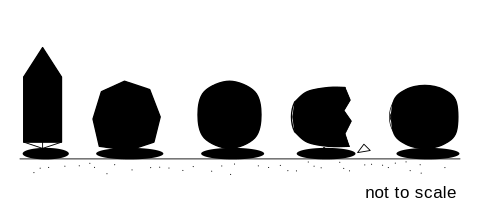
Quartz and stone bead production stages. Schematic drawing, not to scale.
Concentrated quartz/gemstone bead production debris (rough nodules, debitage, undrilled blanks, drilling misfires), iron/furnace and vitrified crucible residues, and post-firing inscribed tableware along the Noyyal river east of the Palakkad Gap.
What it is taken to show
Proposes identifying Kodumanal with the literary Kodumanam praised in Patiṟṟuppattu for its lapidary artisans (proposed by K. Rajan); while it lies on the Noyyal route east of the Palakkad Gap, inspected sources trace no specific Kodumanal workshop product to Muziris, Roman Egypt, or Poompuhar.
Still uncertain
The exact calibration bounds of the earliest Tamil-Brāhmī sherds, the specific geological source regions of non-local gemstones (with Rajan and Athiyaman proposing Gujarat for carnelian and Afghanistan for lapis lazuli), whether vitrified furnace/crucible fragments reflect bloomery carburization or true liquid crucible steel, and whether post-firing names on bowls were incised by clerks, merchants, or owners.
Dates and how they were obtained
About the 5th century BCE to the 3rd century CE (older reports: 300 BCE–300 CE; some summaries extend into the 4th century CE), based on radiocarbon dates across workshops and the megalithic cemetery. (AMS radiocarbon dating, stratigraphic trenching across 15+ seasons, Tamil-Brāhmī palaeography, and archaeometallurgical analysis.) About the 5th century BCE to the 3rd century CE (older reports: 300 BCE–300 CE; some summaries extend into the 4th century CE)
Who dug or recorded it
Tamil University, Thanjavur (Y. Subbarayalu & K. Rajan), Pondicherry University (K. Rajan), and Tamil Nadu State Department of Archaeology (R. Sivanantham)
Main finds
Crystalline quartz, beryl, carnelian and agate bead assemblages – with local habitation-workshop manufacturing waste (raw quartz nodules, knapping debitage, unperforated blanks and drilling misfires) alongside burial-urn etched carnelian beads (whose non-local manufacture is noted in Gwendolyn Kelly's study, while K. Rajan and N. Athiyaman propose Gujarat for carnelian and Afghanistan for lapis lazuli as raw-material hypotheses) – plus iron-smelting furnaces and vitrified crucible fragments, hundreds of Tamil-Brāhmī post-firing inscribed potsherds alongside a larger corpus of undeciphered graffiti marks, and stone-circle transepted cist burials.
Evidence basis
Workshop waste, furnaces and non-local carnelian
Visiting
Active research excavation area along the Noyyal River; artefacts displayed in Tamil Nadu state and university museums.
003Studies filed at this place
Graded statements from studies filed at this place
Each block shows one study's graded statements in stored order. A core says how sure that study is about each statement; it is not a score for the place.
A published 1999 furnace interpretation; the reports consulted here report no directly analysed Kodumanal crucible residue, though Sharada Srinivasan's 2007 IJHS paper on Kodumanal crucibles were not read in full for this study.
Vitrified crucibles and a 1 percent carbon blade edge point to steelmaking, but no direct date on the crucibles or analysed Kodumanal crucible ingot is reported in the checked sources.
About the 5th century BCE to the 3rd century CE (older reports: 300 BCE–300 CE; some summaries extend into the 4th century CE)
Photographs
For comparison: finds from other sites (2)
COMPARATIVE REGIONAL SPECIMEN
Comparative / Regional Reference (Contextual / Environmental): Not a direct trench photograph of Kodumanal.
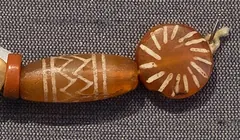
Etched carnelian beads and gold jewelry, Nilgiri Hills culture, 1st millennium CE, Asia, G33 South Asia (cropped): Museum display of etched carnelian beads and gold ornaments attributed to the Nilgiri Hills culture, broadly dated to the first millennium CE. No Kerala findspot is recorded, and the broad first-millennium CE date extends beyond 600 CE.Anthony Huan (Wikimedia Commons) · CC BY-SA 2.0 · Source ↗ · Open photograph recordCOMPARATIVE REGIONAL SPECIMEN
Comparative / Regional Reference (Contextual / Environmental): Not a direct trench photograph of Kodumanal.
Museum photograph of etched carnelian beads from IndiaNo Kerala findspot is recorded, and the broad first-millennium CE date extends beyond 600 CE.Anthony Huan (Wikimedia Commons) · CC BY-SA 2.0 · Source ↗ · Open photograph record
Talks about this place
Recorded talks by excavators and specialists open on external video hosts; all talks are also listed on Books & videos.