Glass beads and gold-foiled beads displayed at Pattanam Museum
Pattanam
Photographed 2019-01-13
- Made by hand
- Kodumanal
Pattanam's stone beads show pecking; their drilling is unresolved
Bead-making material from Pattanam shows pecking on agate, carnelian and chalcedony, but its drills, workshop set-up and work rates are not known.
- This page
- 2,726 words · revision 4
Draft study · Awaiting specialist review · Updated
001Dates and places
002How sure
In brief
Gwendolyn Kelly's 2024 study examines stone-bead material from the 2007 and 2008 excavations at Pattanam. She identifies pecking, shaping a stone by many small blows, on agate, carnelian and chalcedony. She rejects any simple link between technique and ethnic identity, and leaves the site's drilling methods for further work. Her sample spans several periods rather than one early-first-century workshop. At Kodumanal in Tamil Nadu, a small microscope sample suggests more than one drilling method. Much older Indus studies show how drill holes and worn ends can separate making from use. Modern experiments show drilling rates vary with materials and skill, so they cannot set a daily quota for an ancient worker. The Periplus links carnelian and agate with Barygaza in western India, but no source used here traces a Pattanam bead to its quarry. Her proposed sequence includes optional heating, which does not mean every red bead was heated.
Key researchers cited in this study: Gwendolyn O. Kelly (Kodumanal & Pattanam Stone Bead Studies) · Wilfred H. Schoff (Periplus Translation & Commentary) · Full bibliography
How sure
- Well supported
Bead makers at Pattanam shaped agate, carnelian and chalcedony by pecking.
Kelly's 2024 report on the 2007 and 2008 excavation material identifies it directly.
- Well supported
Bead-making technique alone cannot identify a maker's ethnic identity.
Kelly's study rejects the link; a technique can spread through people, teaching, imported blanks or independent choice.
- Possible
More than one drilling method was used at Kodumanal.
The microscope sample is small, and its author treats the drill identifications as provisional.
- Not known
Pattanam's drill types, workshop equipment and working times.
None is established for a specific early-first-century context; drilling awaits further work.
Why it matters
Knowing what bead-making traces can and cannot show keeps descriptions of Pattanam's craft workers tied to the evidence.
003Key findings
What the study concludes
- Shaping the outside, making a hole and producing a finish are separate problems; evidence does not support one universal recipe for every stone.
- A workshop reconstruction needs local and chronological support. Comparative drilling experiments cannot establish a particular ancient maker’s exact equipment or daily output.
- A finished bead can preserve evidence of use as well as manufacture; technique alone is not an ethnic identity.
In the study’s own words. How sure each point is, is shown above.
The summary above is the short read. The full study is the complete text it was drawn from, with its tables and source notes.
What the full study covers
- Main findings
- Begin with the object someone wanted to wear
- The local study is important – and bounded
- Where the stone came from is a separate question
- Decision one: choose what the piece can become
- Decision two: shape the outside
- Decision three: make a usable hole
- The drill is not the whole apparatus
- Why we do not give the maker a daily quota
- Decision four: finish – and know what finish means
- Heat, color and the temptation of a recipe
- What a responsible workshop reconstruction can contain
- What remains uncertain
- The next questions
- References and access notes
004The study
Main findings
- Shaping the outside, making a hole and producing a finish are separate problems; evidence does not support one universal recipe for every stone.
- A workshop reconstruction needs local and chronological support. Comparative drilling experiments cannot establish a particular ancient maker’s exact equipment or daily output.
- A finished bead can preserve evidence of use as well as manufacture; technique alone is not an ethnic identity.
Begin with the object someone wanted to wear
A bead is easy to reduce to a noun. In a display case it may appear as a small red barrel or a translucent oval, identified by material and date. But an ornament also embodies choices: what could be made from this piece, where its hole should pass, which imperfection could be tolerated, and how it would sit beside other beads. This study asks how much of that work can be recovered from things that survive. The evidence is deliberately separated into three levels. Pattanam’s own material is the starting point. Kodumanal offers a regional comparison with different finds. Much earlier Indus studies supply ways of examining holes, wear and experimental drilling. They are not three views of one unchanging Indian workshop. When a description below is a proposed reconstruction rather than a reported find, it is labelled accordingly.
A good label keeps four things apart: what you can see, what you infer, what stays open and how to check it. The bead is an invented teaching object with no accession number, findspot, date or laboratory result.
The drawing shows a hole drilled from both ends; this study explains what such holes can and cannot tell us.
Layers of the South editorial illustration
Unfinished pieces and waste can support a local-production interpretation when their context is secure. At Kodumanal excavators report quartz crystals, waste, rough-outs, blanks and partly drilled pieces; Kelly’s microscope work suggests more than one drilling method. Stages could repeat or branch. Objects are drawn larger than life and not to one scale.
This study explains how chipping, pecking and drilling leave different traces, and why one sequence should not stand for every bead.
Layers of the South editorial illustration
The local study is important – and bounded
COMPARE WITH ANOTHER STUDY
Two studies read one Pattanam bead report to different depths
Both studies use Kelly’s 2024 report on stone beads from Pattanam. One cites specific pages; the other read only its published summary. Reading more of the report in one study does not confirm a statement in the other. Before saying that beads were made at Pattanam in a given period, check the pages, phases and limits Kelly gives.
Read the other study: Pattanam finds: wide trade links, unevenly dated and sourced
Kelly’s 2024 study emphasizes pecking among Pattanam’s agate, carnelian and chalcedony material and rejects a simple equation between manufacturing choices and ethnicity. 10 It also leaves detailed identification of the site’s drilling technologies for further work. The sampled material spans periods and is not a single early-first-century workshop. 1 Those findings change the question we should ask. Instead of searching for “the Tamil method” and “the foreign method,” we should investigate what particular makers did with particular materials in particular contexts. Shared technique may travel with a person, through teaching, through an imported unfinished object, or through a choice independently made elsewhere. An ethnic label requires other evidence. Pattanam’s stratigraphic history matters when assigning an object or technique to a particular phase. Evidence for craft does not by itself document the biography or complete equipment of a maker.
Stone beads on display at Pattanam Museum
Pattanam
Photographed 2019-01-13
Where the stone came from is a separate question
Supply comes before manufacture. The Periplus describes products and routes associated with carnelian, agate and textiles in its account of Barygaza and its western Indian hinterland (§§48–49). Such passages are useful research leads for supply networks, but a text naming a region does not identify the quarry of an individual bead found at Pattanam. 9 Following a stone all the way to a workshop would need a material identification, a defensible method for tracing its origin, evidence of transport and an account of the market in between. Colour alone is not a complete test of where a stone came from. “Deccan cities and Konkan ports fed linked trade toward Muziris” discusses the Periplus account of carnelian from Pathana, usually identified with Paithan, and “Kodumanal made stone beads and smelted iron on site” discusses where Kodumanal’s carnelian and other raw materials may have come from.
Decision one: choose what the piece can become
As a functional reconstruction, selecting a blank means relating a desired form to the material available. A flaw near the edge may be harmless in a short piece but ruin a longer one. A band of color may become part of a design or be removed during shaping. These are geometric possibilities, not findings about any ancient maker’s aesthetic preferences. The archaeological question is different from the maker’s immediate one. Researchers need to distinguish a naturally shaped fragment, imported raw material, an unfinished blank and discarded manufacturing debris. A beautiful finished stone found in a port does not, on its own, prove that its entire manufacture took place there. The unglamorous pieces become important because they can narrow the possibilities. Kelly’s Kodumanal study makes this distinction at another site: the analyzed collection contains different local-production indicators and imported finished materials, and its account does not assign identical histories to all stones. It is a comparative reminder to investigate production rather than infer it merely from presence. 2
Decision two: shape the outside
Three words should remain distinct in a reader’s mind. Chipping removes pieces by fracture. Pecking works through repeated small impacts. Grinding wears a surface by abrasion. This vocabulary describes different actions, not automatically different communities. One object may pass through more than one operation; a final smooth finish can conceal evidence of earlier work. Our proposed explanatory model therefore branches instead of giving one mandatory procession of tools. An intended profile, the remaining flaws and the amount of material to remove all affect the choice. A diagram should make those alternatives visible. It should not display a single sequence headed “How every bead in Pattanam was made.” That would claim a uniformity the local evidence does not supply. Nor should “pecking” be used casually for both shaping the exterior and making the perforation. The object part and the operation must be named. Otherwise a reader can mistake evidence for one process as proof of the other. Precision here makes the eventual workshop description easier to imagine, not harder.
Decision three: make a usable hole
Kenoyer’s documentation study shows why the hole is an important record. Entry points, alignment, stepped profiles and wear around the ends can help distinguish manufacture from later use. Its figures also illustrate that two perforations need not meet neatly. These examples concern Indus material, not an identified Pattanam tool kit. 3 A hole is a practical passage, not just an archaeological measurement. If a rough internal meeting point catches the string, a bead’s appearance alone does not make it satisfactory. Our inference is that judging an ornament requires attention to its use. The maker’s visible work and the part hidden by the cord can be equally consequential. At Kodumanal, Kelly reports a small microscopic sample interpreted as involving more than one drilling method, including double-diamond and possible copper-and-abrasive techniques. She calls for further experimental comparison. This is evidence from Kodumanal and is cautiously expressed in the original study; it must not be relabelled as an excavated Pattanam drill. 4
Etched carnelian beads and gold jewelry, Nilgiri Hills culture, 1st millennium CE, Asia, G33 South Asia (cropped)
Photographed 2020-11-27
No Kerala findspot is recorded, and the broad first-millennium CE date extends beyond 600 CE.
The drill is not the whole apparatus
A drill tip, the means of rotating it, the support holding the stone and the removal of debris are different parts of a working arrangement. Knowing something about a hole does not identify all of them. Our reconstruction rule is to state the demonstrated feature first and name any additional apparatus as a comparison or hypothesis. Kenoyer and Vidale combined archaeological examination with experiments. Their discussion addresses bit shape, cooling and the removal of drilling debris. The comparison trials used different materials and produced different rates. They belong to a research program on much earlier Indus technologies, not to a direct observation of a workshop on the Malabar coast. 5 This makes experimental archaeology valuable without turning it into time travel. An experiment can show that an arrangement works under specified conditions. It cannot by itself show who used it at another site or whether an experienced ancient worker achieved the same pace. A demonstration that shows a working apparatus should explain that difference in its label.
Why we do not give the maker a daily quota
The 1992 experiments distinguish drill materials and the skill of the operator; the authors also compare their results with professional beadworkers. This is enough to show why a single drilling rate cannot serve as a universal clock. Even a well-recorded modern experiment is not a wage sheet from antiquity. 6 Production-time estimates require an explicit basis. Drilling time alone omits selection, preparation, resetting, maintenance, shaping, finishing and rejected work. Adding those activities does not provide an exact total either. A precise-looking calculation can be less honest than a carefully explained range. The same principle applies to a workshop’s organization. Several operations can be shared, separated or repeated by one worker. Their physical possibility does not establish an ancient apprenticeship contract, a division of labor by gender or a standard way of paying for breakage. Those social questions need their own evidence rather than being smuggled in through a tool description.
Decision four: finish – and know what finish means
Kenoyer’s study distinguishes a bead’s condition after burial from traces of manufacture and use. It documents how worn ends, string contact and altered surfaces complicate the judgment of whether an object was polished or finished. A damaged or rough-looking bead is therefore not automatically unfinished workshop waste. 7 Our reading turns that into a question a visitor can carry to a museum: is this surface telling us how the object was made, how it was worn, or what happened after it was lost? More than one answer may be present. The same small object can connect a maker, a wearer and a later depositional history without giving us the name of any of them. Finishing need not mean maximum shine. Outline, colour, the cord and neighbouring pieces raise functional and aesthetic questions. Their possible importance does not recover one buyer’s taste from an excavation. A bead’s life also includes use, repair and possible reuse, and any emotional meaning it carried needs evidence beyond its material or form.
Heat, color and the temptation of a recipe
The local study’s proposed operational sequence includes optional heating for some microcrystalline material. A possible operation is not proof that every red bead was heated, and a sequence diagram is not a complete historical recipe. 8
This study therefore gives no furnace temperature, treatment duration or household recipe. Such details would require a separate material-specific study and an explanation of how ancient evidence is distinguished from modern treatment. The future research question is valuable; the missing answer should not be replaced by a confident paragraph copied from contemporary craft practice.
What a responsible workshop reconstruction can contain
A reconstruction can explain a material decision: how a flaw changes an intended shape, how two perforations meet, or how a surface changes during finishing. Each demonstration should identify the evidence and assumptions rather than imply that a particular fragment records a complete working episode. For a public account, the documentation task is more exacting. Every eventual specimen needs its identifier, material, context, date, observed marks and published interpretation. Every demonstration needs to say whether it is based on archaeological replication, living craft practice or a simplified teaching model, and how far it reflects evidence from the period under discussion. It should declare its tools, substitutions and modern safety arrangements, and flag a speculative step before an animation makes that step look inevitable. These labels let readers enjoy the craftsmanship while still knowing what they are seeing. Archaeology can establish material constraints and offer comparisons without recovering every relationship or decision surrounding a workshop. Keeping those limits explicit allows technical skill to be studied without supplying an unsupported personal history. “Iron or steel: four questions to ask of early South Indian finds” applies the same caution to crucible steel, keeping evidence of production separate from evidence of its date.
What remains uncertain
- Pattanam drill types, exact workshop apparatus and operation timings were not established for a specific early-first-century context.
- The Kodumanal microscopy sample is small, and its primary author treats parts of the tool identification as provisional.
- Indus experiments and documentation methods are explicit comparisons; they do not prove uninterrupted continuity or an ancient worker’s ethnicity.
The next questions
- Study Pattanam’s own drill holes and abrasives rather than substituting Kodumanal results.
- Build a specimen register separating raw material, production debris, finished objects and use-worn pieces.
- Research heating and polishing separately before proposing a source-labelled demonstration.
References and access notes
1 Gwendolyn Kelly (2024). Report on the Stone Beads, Debitage and Raw Materials from the 2007 and 2008 Excavation Seasons at Pattanam, Kerala. pp. 53–56: technique, chronology and limits of drill identification. Batch 01 recorded landing-page, PDF-text and figure access. PDF text re-read; figures not checked visually. 2007–2008 excavation sample, not all seasons or a single first-century workshop. The chronology on p. 56 places much material later than the early first century CE. Figures and tables were not independently inspected or reproduced. Open source: journals.uoregon.edu
Museum photograph of etched carnelian beads from India
Photographed 2020-11-27
No Kerala findspot is recorded, and the broad first-millennium CE date extends beyond 600 CE.
2 Gwendolyn Kelly (2009). Craft production and technology during the Iron Age to Early Historic transition at Kodumanal, Tamil Nadu. pp. 5–8, bead materials and local-production discussion. Author-uploaded text read, with close attention to drilling and production organization; original micrographs not visually reanalysed. The small microscopic sample and tentative drill identifications are stated in the paper. Kodumanal is a comparison site, not a substitute for Pattanam evidence. Open source: www.researchgate.net
3 Jonathan Mark Kenoyer (2017). Stone Beads of the Indus Tradition: New Perspectives on Harappan Bead Typology, Technology and Documentation. pp. 159–162; especially p. 161, Figure 7 and bead-end documentation. PDF text read; title page and printed p. 161 / Figure 7 visually read. Indus examples are much earlier than the early first century CE and are used as methodological comparisons, not direct proof of Pattanam’s tools, workshops or social organization. Open source: www.harappa.com
4 Gwendolyn Kelly (2009). Craft production and technology during the Iron Age to Early Historic transition at Kodumanal, Tamil Nadu. pp. 6–8; sample limits and interpretations of drill-hole impressions. Author-uploaded text read, with close attention to drilling and production organization; original micrographs not visually reanalysed. The small microscopic sample and tentative drill identifications are stated in the paper. Kodumanal is a comparison site, not a substitute for Pattanam evidence. Open source: www.researchgate.net
5 J. Mark Kenoyer; Massimo Vidale (1992). A New Look at Stone Drills of the Indus Valley Tradition. pp. 499–500 and 512–513; analytical approach and experimental drilling. PDF text read; printed pp. 512–513 and Table 1 visually checked. Experimental results are conditional on the materials, apparatus and operator. Modern commercial abrasives in comparison trials are not evidence of ancient availability; none of these rates is assigned to a particular Pattanam worker. Open source: www.harappa.com
6 J. Mark Kenoyer; Massimo Vidale (1992). A New Look at Stone Drills of the Indus Valley Tradition. pp. 512–513; experimental rates and operator comparison. PDF text read; printed pp. 512–513 and Table 1 visually checked. Experimental results are conditional on the materials, apparatus and operator. Modern commercial abrasives in comparison trials are not evidence of ancient availability; none of these rates is assigned to a particular Pattanam worker. Open source: www.harappa.com
7 Jonathan Mark Kenoyer (2017). Stone Beads of the Indus Tradition: New Perspectives on Harappan Bead Typology, Technology and Documentation. pp. 158–162; surface condition, use-wear and end wear. PDF text read; title page and printed p. 161 / Figure 7 visually read. Indus examples are much earlier than the early first century CE and are used as methodological comparisons, not direct proof of Pattanam’s tools, workshops or social organization. Open source: www.harappa.com
8 Gwendolyn Kelly (2024). Report on the Stone Beads, Debitage and Raw Materials from the 2007 and 2008 Excavation Seasons at Pattanam, Kerala. p. 56, proposed production sequence. Batch 01 recorded landing-page, PDF-text and figure access. PDF text re-read; figures not checked visually. 2007–2008 excavation sample, not all seasons or a single first-century workshop. The chronology on p. 56 places much material later than the early first century CE. Figures and tables were not independently inspected or reproduced. Open source: journals.uoregon.edu
9 Anonymous; translated by Wilfred H. Schoff (1912 translation). The Periplus of the Erythraean Sea. §§48–49. Relevant numbered sections read. University of Washington transcription of the 1912 translation, with some later editorial glosses. Ancient composition is usually placed around the middle of the first century CE, not the translation date. Schoff’s translation is public domain in the United States; no complete modern translation is reproduced. Open source: depts.washington.edu
10 Gwendolyn Kelly (2024). Report on the Stone Beads, Debitage and Raw Materials from the 2007 and 2008 Excavation Seasons at Pattanam, Kerala. BEADS 36, pp. 48–62; especially the abstract and discussion of pecking on pp. 52–54. Batch 01 recorded landing-page, PDF-text and figure access. PDF text re-read; figures not checked visually. 2007–2008 excavation sample, not all seasons or a single first-century workshop. The chronology on p. 56 places much material later than the early first century CE. Figures and tables were not independently inspected or reproduced. Open source: journals.uoregon.edu
005Photographs
Photographs of the places and objects this study discusses. Each item carries its creator’s credit, licence and documented source. See all 412 photographs and source images ↗
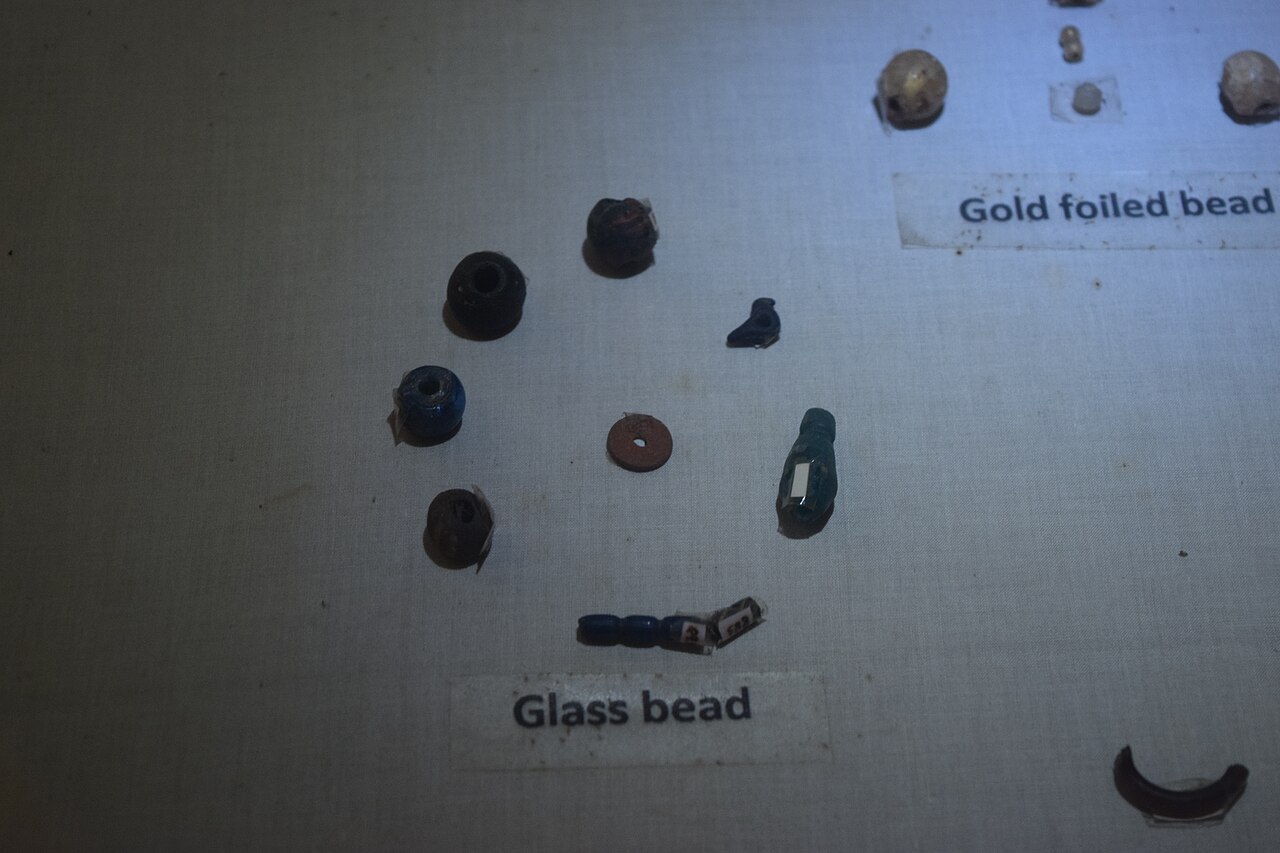
Pattanam · Photographed 2019-01-13 15:35:26
Glass beads and gold-foiled beads displayed at Pattanam Museum

Photographed 2020-11-27
Etched carnelian beads and gold jewelry, Nilgiri Hills culture, 1st millennium CE, Asia, G33 South Asia (cropped)
Museum display of etched carnelian beads and gold ornaments attributed to the Nilgiri Hills culture, broadly dated to the first millennium CE.
No Kerala findspot is recorded, and the broad first-millennium CE date extends beyond 600 CE.
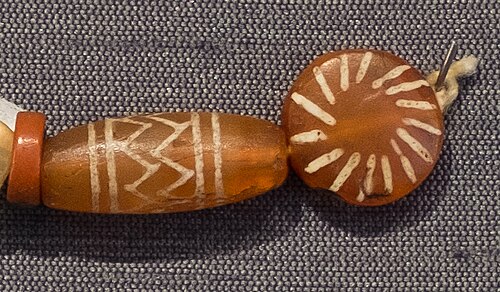
Photographed 2020-11-27
Museum photograph of etched carnelian beads from India
No Kerala findspot is recorded, and the broad first-millennium CE date extends beyond 600 CE.
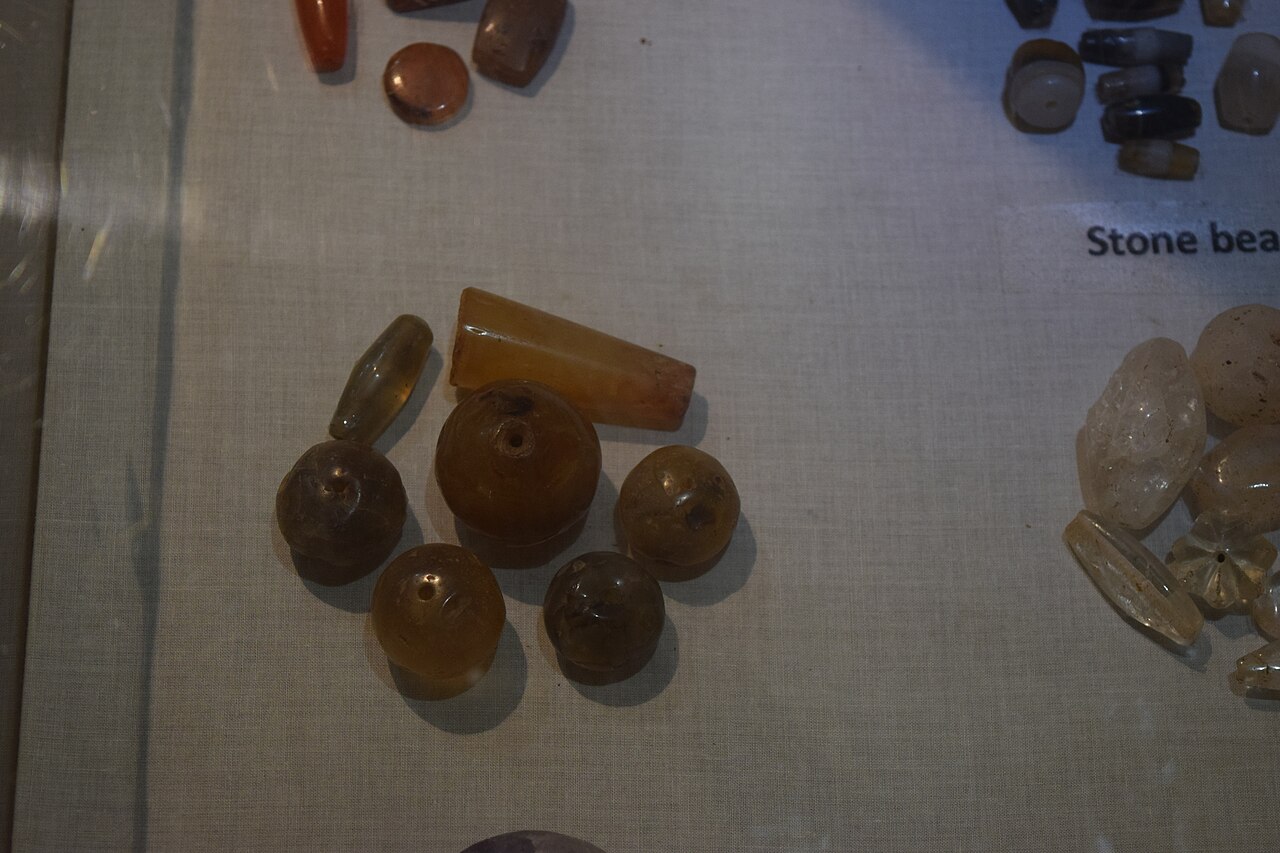
Pattanam · Photographed 2019-01-13 15:32:55
Stone beads on display at Pattanam Museum
006Where next

All related studies, connected material, books and sources16 · 10
Elsewhere on this site
Excavation Atlas Sites: Kodumanal (Noyyal River Craft & Trade Town)
Junior Detective Quests: The Bead Workshop: Waste Shows Where Beads Were Made
Multi-Script Glossary Terms: maṇi (மணி / മണി / കൽമുത്ത് (മുത്ത് = കടൽമുത്ത്)) · veḷḷai-k-kōṭu maṇi (Etched Carnelian Beads) (வெள்ளைக்கோடு பதித்த கார்னீலியன் மணி / എച്ച്ഡ് കാർണീലിയൻ മുത്തുകൾ) · Lapidary Debitage, Rough-Outs & Unperforated Blanks (மணி செய்யும் கற்கழிவுகள் & துளையிடா மணிகள் / പണിതീരാത്ത മുത്തുകളും കൽച്ചീളുകളും (ഡെബിറ്റാജും ബ്ലാങ്കുകളും)) · Twin-Cone Bead Drilling (Bow Drill) (இருமுனை மணித் துளைப்பான் (வில் துளைப்பான்) / ഇരട്ടക്കോൺ മുത്തുതുളയ്ക്കൽ (വില്ലുഡ്രിൽ)) · Banded Agate & Chalcedony Cabochon Blanks (Lapidary Roughouts) (பட்டைக் கல் மணிகள் (அரைகுறைக் கற்கள்) / അഗേറ്റ് കബോച്ചൺ ബ്ലാങ്കുകൾ (പട്ടണം))
Connected material
Photographs, drawings, books, videos and other studies linked to this study. A link helps you explore; it does not prove a historical claim.
- Stone beads on display at Pattanam MuseumphotographBackground
- Glass beads and gold-foiled beads displayed at Pattanam MuseumphotographShows the subject
- Etched carnelian beads and gold jewelry, Nilgiri Hills culture, 1st millennium CE, Asia, G33 South Asia (cropped)photographBackground
- Museum photograph of etched carnelian beads from IndiaphotographBackground
- Find the workshop cluesdiagramThis study explains how chipping, pecking and drilling leave different traces, and why one sequence should not stand for every bead.
- Write an honest labeldiagramThe drawing shows a hole drilled from both ends; this study explains what such holes can and cannot tell us.
- From quartz to beadillustrationThe plate follows this study’s point that shaping, drilling and finishing are separate steps, and that two drill holes need not meet neatly.
Books, videos and websites
Outside reading on this topic. These are not part of the study and we have not checked every claim in them. See all books and videos
- 2019SAF Awards Presentation - Bérénice Bellina Video · Bérénice Bellina · CNRS, France (event affiliation) · 28:55 · A lecture presentation examines early maritime networks from the Isthmus of Kra and its port-settlement research. Gives a leading field investigator the opportunity to explain Southeast Asian participation in exchange. The exact event day is unverified; month and year are supported by the speaker’s CV. Do not silently replace Khuan Luk Pat with the better-known Khao Sam Kaeo, or turn cultural interaction into a one-way colonization narrative.
- A Case Study of Stone Ornament Drilling Methods Video · Thanik Lertchanrit, Wannaporn Rienjang, Noel Hidalgo Tan (moderator) · Silpakorn University; Thammasat University; SEAMEO SPAFA · 1:20:21 · Two researchers explain how drilled-hole traces can distinguish stone-ornament technologies and workshop traditions. A detailed example of inferring production from material traces, presented by the people conducting the study. Separate raw-material origin, technological affinity and the identity of makers. An Indian raw material or technique does not by itself establish the ethnicity of every craftsperson.
- CPAS Talkshow Episode #27 "Ancient Southeast Asia & the Indian Ocean World" Video · Bérénice Bellina, Harry Octavianus Sofian (moderator), Kasman Setiagama (closing remarks) · CNRS–Université Paris Nanterre; CPAS / BRIN; CPAS / Indonesian Ministry of Education, Culture, Research and Technology (event affiliations) · 1:44:45 · A longer discussion of Southeast Asia’s connections with the Indian Ocean from prehistory into the early historic period. Provides a more recent and extensive research account than the 2019 awards presentation, with Indonesian scholarly hosts. English caption metadata is present, but language changes during introductions and discussion have not been checked. Exact site-specific claims and segment boundaries remain unreviewed.
- Lecture 174: "FUSION OF FIRE AND CULTURE: PABALUGALA AS A CENTRE FOR ANCIENT GLASS BEAD PRODUCTION" Video · Mangala Katugampola · University of Kelaniya; Central Cultural Fund / Sri Lanka Department of Archaeology advisory roles (organizer biography) · 1:15:31 · Katugampola presents excavated furnaces, production material and beads from the early-historic workshop complex at Pabalugala. A recent presentation by the project leader; supplies a regional craft-production comparison rather than a generic history of beads. The official abstract places peak activity in the second–fifth centuries CE. This is a different site, not direct evidence for a particular South Indian workshop. Its YouTube unlisted flag explains why ordinary searches may miss it; the organizer publicly provides the link.
007Sources
The study lists the sources it consulted; we have not rechecked them. A working link does not show that a source was read, and a valid identifier does not show that it supports a claim. We do not link to unofficial uploads or copies of publications. Where a study cited one, we show the published citation, or a publisher, DOI or Internet Archive link when we have one. Tracking codes are removed from links, and the sources themselves are not republished here.
Gwendolyn Kelly (2024). Report on the Stone Beads, Debitage and Raw Materials from the 2007 and 2008 Excavation Seasons at Pattanam, Kerala. pp. 53–56: technique, chronology and limits of drill identification. Batch 01 recorded landing-page, PDF-text and figure access. Batch 02 re-read PDF text; page images were not checked. 2007–2008 excavation sample, not all seasons or a single first-century workshop. The chronology on p. 56 places much material later than the early first century CE. Figures and tables were not independently inspected or reproduced.
Gwendolyn Kelly (2009). Craft production and technology during the Iron Age to Early Historic transition at Kodumanal, Tamil Nadu. pp. 5–8, bead materials and local-production discussion. Author-uploaded text read, with close attention to drilling and production organization; original micrographs not visually reanalysed. The small microscopic sample and tentative drill identifications are stated in the paper. Kodumanal is a comparison site, not a substitute for Pattanam evidence.
Jonathan Mark Kenoyer (2017). Stone Beads of the Indus Tradition: New Perspectives on Harappan Bead Typology, Technology and Documentation. pp. 159–162; especially p. 161, Figure 7 and bead-end documentation. PDF text read; title page and printed p. 161 / Figure 7 visually read. Indus examples are much earlier than the early first century CE and are used as methodological comparisons, not direct proof of Pattanam’s tools, workshops or social organization.
Gwendolyn Kelly (2009). Craft production and technology during the Iron Age to Early Historic transition at Kodumanal, Tamil Nadu. pp. 6–8; sample limits and interpretations of drill-hole impressions. Author-uploaded text read, with close attention to drilling and production organization; original micrographs not visually reanalysed. The small microscopic sample and tentative drill identifications are stated in the paper. Kodumanal is a comparison site, not a substitute for Pattanam evidence.
J. Mark Kenoyer; Massimo Vidale (1992). A New Look at Stone Drills of the Indus Valley Tradition. pp. 499–500 and 512–513; analytical approach and experimental drilling. PDF text i
J. Mark Kenoyer; Massimo Vidale (1992). A New Look at Stone Drills of the Indus Valley Tradition. pp. 499–500 and 512–513; analytical approach and experimental drilling. PDF text read; printed pp. 512–513 and Table 1 visually checked. Experimental results are conditional on the materials, apparatus and operator. Modern commercial abrasives in comparison trials are not evidence of ancient availability; none of these rates is assigned to a particular Pattanam worker.
J. Mark Kenoyer; Massimo Vidale (1992). A New Look at Stone Drills of the Indus Valley Tradition. pp. 512–513; experimental rates and operator comparison. PDF text read; printed pp. 512–513 and Table 1 visually checked. Experimental results are conditional on the materials, apparatus and operator. Modern commercial abrasives in comparison trials are not evidence of ancient availability; none of these rates is assigned to a particular Pattanam worker.
Jonathan Mark Kenoyer (2017). Stone Beads of the Indus Tradition: New Perspectives on Harappan Bead Typology, Technology and Documentation. pp. 158–162; surface condition, use-wear and end wear. PDF text read; title page and printed p. 161 / Figure 7 visually read. Indus examples are much earlier than the early first century CE and are used as methodological comparisons, not direct proof of Pattanam’s tools, workshops or social organization.
Gwendolyn Kelly (2024). Report on the Stone Beads, Debitage and Raw Materials from the 2007 and 2008 Excavation Seasons at Pattanam, Kerala. p. 56, proposed production sequence. Batch 01 recorded landing-page, PDF-text and figure access. Batch 02 re-read PDF text; page images were not checked. 2007–2008 excavation sample, not all seasons or a single first-century workshop. The chronology on p. 56 places much material later than the early first century CE. Figures and tables were not independently inspected or reproduced.
Anonymous; translated by Wilfred H. Schoff (1912 translation). The Periplus of the Erythraean Sea. §§48–49. Relevant numbered sections read. University of Washington transcription of the 1912 translation, with some later editorial glosses. Ancient composition is usually placed around the middle of the first century CE, not the translation date. Schoff’s translation is public domain in the United States; no complete modern translation is reproduced.
Gwendolyn Kelly (2024). Report on the Stone Beads, Debitage and Raw Materials from the 2007 and 2008 Excavation Seasons at Pattanam, Kerala. BEADS 36, pp. 48–62; especially the abstract and discussion of pecking on pp. 52–54. Batch 01 recorded landing-page, PDF-text and figure access. Batch 02 re-read PDF text; page images were not checked. 2007–2008 excavation sample, not all seasons or a single first-century workshop. The chronology on p. 56 places much material later than the early first century CE. Figures and tables were not independently inspected or reproduced.
Researchers and institutions whose work this study uses: Gwendolyn O. Kelly, Wilfred H. Schoff
How we know The evidence, claims and dates behind this study
What this study draws on
- Gwendolyn Kelly's 2024 report on stone beads, debris and raw materials from the 2007 and 2008 Pattanam seasons.
- Kelly's 2009 microscope study of drill holes at Kodumanal, used as a comparison.
- Indus bead and drilling studies by Kenoyer (2017) and Kenoyer and Vidale (1992), used only for method.
- The Periplus, sections 48 and 49, on where carnelian and agate were traded.
Dates in this study
This study has no dates recorded in a form we can chart, so there is no date chart. Any dates it gives are in the full study.
The study’s claims
0 claims · 0 source passages · 25 paragraphs
Browse the study paragraph by paragraphThis study has no separately listed claims. Its paragraphs can be browsed one by one.
About this study Status, corrections and how it was made
Status
Draft study, revision 4. No historian, archaeologist, or Tamil or Malayalam specialist has reviewed it yet.
How it was made
Compiled as an editorial synthesis from published scholarship around questions we framed. About this project & workflow
The summary, How sure lines and Two views notes on this page were prepared from this study and cross-checked against its passages. That is an editorial check, not a specialist review.
Technical details
Study code R016. The text fingerprint changes whenever the study text changes.
- The study text is shown as written. Links from its paragraphs to citations help you move around the study; they are not new claims or checked source passages.
See how this study’s records were extracted
Text fingerprint (SHA-256): R016 · 5554bc58948620f1a189cd4b… · v4
Evidence tables and technical details are on the web page: https://layersofthesouth.org/read/cfc870cdfb