Places on the atlas that name this study.
- Land & water
- 200 BCE–300 CE
- 300–600 CE
- Vizhinjam
Vizhinjam's earliest phase: sea foods and West Asian jars
Excavations at Vizhinjam found a coastal sequence beginning in the first centuries CE; its identity as Balita or a pre-600 Ay port is unproven.
- How sure
- 1 Likely
- 2 Possible
- 1 Not known
- This page
- 1,942 words · revision 8
Draft study · Awaiting specialist review · Updated
001Dates and places
Places on the atlas that name this study.
- Vizhinjam Coastal Fort & Harbour Terrace
Protected rock-cut cave monument & harbour terrace
1000–500 BCE
Different beginnings
500–200 BCE
Marks & materials
200 BCE–300 CE
Connected worlds
300–600 CE
Change & continuity
- Broad mid-first to third century CE horizon reported for Egyptian Dressel 2–4 amphora sherds at Alagankulam
- 378–383 CE minting span of a bronze issue of Valentinian II (Antioch mint) reported from Alagankulam
- Date from writing, coins or texts
- Period assigned by excavators or scholars
Each date belongs to what was dated (a sample, an object, a layer or a text), which is not always the event the study asks about.
Each period has the same width, so spacing is not to scale.
The full table of dates, with their ranges, is under How we know.
- 1 Likely
- 2 Possible
- 1 Not known
002How sure
In brief
University of Kerala archaeologists excavated eleven trenches at Vizhinjam, on the Kerala coast south of Thiruvananthapuram, between 2011 and 2013. They uncovered a long sequence beginning in the first centuries CE, with rouletted ware, West Asian torpedo jars, beads and metal objects. Their first phase, dated by seven radiocarbon measurements and artefacts, spans roughly 1–800 CE, and some layers were mixed. In that broad Period I sample (52 identifiable fragments), fish, shellfish and cuttlefish made up 73 percent of the animal remains. The excavators dated the torpedo jars broadly to the fourth to seventh centuries CE; such jars were once mistaken for Roman amphorae. A Ptolemy II gold coin came from a jeweller rather than a trench, so it cannot date the site. Vizhinjam may be the Periplus port of Balita, though Schoff (1912) identified Balita with Varkala, Casson treats it as unsettled, and no inscription confirms it. Clear evidence linking Ay rulers to Vizhinjam comes after 600 CE.
Key researchers cited in this study: Ajit Kumar (Vizhinjam Excavations, University of Kerala) · Abhayan G. S. (University of Kerala Archaeology) · Rajesh S. V. (University of Kerala Archaeology) · Roberta Tomber (Indo-Roman Ceramic Analysis) · Full bibliography
How sure
- Likely
A coastal settlement existed at Vizhinjam from the first centuries CE
Seven Beta Analytic radiocarbon dates are reported, but individual sample contexts, codes and raw ages were not tabulated in the 2013–2014 reports read (a 2015 Routledge chapter has not yet been read in full), and some layers are mixed.
- Possible
In the earliest broad phase (c. 1–800 CE) most identified food remains were marine
About 73 percent (38 of 52) of identifiable Period I remains are marine, but the sample is 52 fragments from mixed layers spanning well past 600 CE.
- Possible
Vizhinjam was the Periplus port of Balita
The sheltered bay and early sequence fit, but Schoff (1912, §58) identified Balita with Varkala, Casson (1989) treats it as not securely identified, and no name-bearing inscription or seal has been found.
- Not known
Ay rulers controlled Vizhinjam before 600 CE
The Ay poems in Purananuru 127–136 do not name Vizhinjam; the fort evidence points to the eighth century and later.
Why it matters
Claims of an early Ay harbour at Vizhinjam mix periods, and its excavation shows how to keep early settlement evidence apart from later history.
003Key findings
What the study concludes
- Excavation establishes a long-lived coastal settlement at Vizhinjam with a broad Period I phase (c. 1–800 CE), though sample-by-sample radiocarbon details are not tabulated in the 2013–2014 reports read.
- West Asian torpedo-jar sherds (broadly 4th–7th centuries CE) are better-supported evidence than popular claims of Roman amphora fragments.
- An unprovenanced Ptolemy II gold coin held by a jeweller cannot securely date an excavated Vizhinjam layer.
- Marine species account for 73.08% (38 of 52) of identifiable Period I animal remains alongside domestic livestock, though the sample is small and the Period I span extends past 600 CE.
- Vizhinjam = Balita of Periplus §58 is an unconfirmed hypothesis (Schoff 1912 earlier identified Balita with Varkala; Casson 1989 treats the name as unconfirmed).
- Clear site-specific Ay political and fortification evidence (Mathilpuram fort; Srivaramangalam plates) belongs mainly after 600 CE.
In the study’s own words. How sure each point is, is shown above.
The summary above is the short read. The full study is the complete text it was drawn from, with its tables and source notes.
What the full study covers
- Question and scope
- Orientation
- Early Vizhinjam in plain terms
- Fieldwork, stratigraphy, and chronological limits
- West Asian transport pottery and domestic evidence
- Balita and classical maritime geography
- Ay rulers: poetry and later political evidence
- What the evidence establishes and what remains open
- References and sources
004The study
Question and scope
What can available excavations and surveys establish about early Vizhinjam?
Region: Vizhinjam (Vilinjam) on the southern Kerala coast south of Thiruvananthapuram, with Indian Ocean and peninsular comparisons only where the material evidence requires them.
Period classification: Mixed chronology. The excavated sequence at Vizhinjam begins in the first centuries CE and runs into the modern era, while the clearest political and fortification evidence linking the site to Ay rulers belongs to the seventh–eleventh centuries CE and later, outside the 1000 BCE–600 CE window. ↗1 [↗2]
Vizhinjam fishing harbour and its modern waterfront
Vizhinjam
Photographed 14 March 2024 (according to Exif data)
This study treats early Vizhinjam primarily as the archaeological settlement excavated by the University of Kerala rather than the modern harbour locality, keeping excavated deposits separate from the later Mathilpuram fort, the name Balita in the Periplus Maris Erythraei, and literary or inscriptional references to Ay chiefs.
Orientation
Excavations have made early Vizhinjam far more than a place known from medieval inscriptions or later port history. Across eleven trenches dug between 2011 and 2013, archaeologists uncovered a sequence whose earliest phase begins in the first centuries CE and includes rouletted ware, West Asian transport jars, beads, metal objects, and animal remains. Yet the record is less simple than popular accounts that describe Vizhinjam as an early “Southern Ay Outpost” imply. The excavators group roughly the first through eighth centuries CE into a single broad Period I, report mixed layers caused by later cultural and natural disturbance, and do not publish individual radiocarbon tables in the 2013 and 2014 papers consulted here. [↗2]
The defensible conclusion is therefore narrower and better grounded: Vizhinjam was an occupied coastal settlement taking part in maritime exchange during the first millennium CE, with marine-oriented food remains and imported West Asian ceramics broadly dated to the fourth–seventh centuries CE. A pre-600 Ay political outpost, a megalithic horizon, and a verified Roman-amphora assemblage are not demonstrated in the consulted records. ↗4 [↗5] [↗2]
Modern fishing harbour at Vizhinjam
Vizhinjam
Photographed 2007-07-29
Early Vizhinjam in plain terms
Vizhinjam occupies a naturally sheltered bay near the southern tip of the Indian peninsula. Following earlier surface surveys around the settlement, University of Kerala archaeologists conducted three excavation seasons between 2011 and 2013 (listed as 2010–11, 2011–12, and 2012–13 in the 2013 report), opening eleven trenches (VZM I–VZM XI) across an estimated 1 sq km area and reaching up to about 3.2 m of cultural deposit. [↗2] ↗4
Because people lived, built, dug pits, and rebuilt across the same coastal ground over many centuries, some strata were mixed. Using seven Beta Analytic radiocarbon measurements (six AMS and one conventional) alongside artefacts, the excavation team divided the site into three broad phases: Period I (“Early Historic and Medieval,” c. 1–800 CE), Period II (c. 800–1500 CE), and Period III (1500–2012 CE). Because the read 2013 and 2014 articles do not tabulate individual sample contexts, laboratory codes, raw BP ages, or calibrated ranges for those seven dates, the broad c. 1–800 CE Period I bracket cannot be narrowed to a particular founding century from these papers alone. [↗2]
Ceramics nevertheless anchor external connections. From the earliest excavated levels, Ajit Kumar and colleagues report rouletted ware and sherds of elongated West Asian transport vessels known as torpedo jars, some coated internally with bitumen and assigned broadly to the fourth–seventh centuries CE. ↗4 As Roberta Tomber demonstrated in her 2007 Antiquity survey, transport jars from India once called “Roman amphorae” in older reports frequently prove to be Mesopotamian torpedo jars instead. At Vizhinjam itself, the detailed 2013 trade report documents rouletted ware, West Asian torpedo jars (with petrographic groupings attributed to Iraq and possibly Syria), turquoise-glazed pottery, and later Chinese, Southeast Asian, and European ceramics – not a securely catalogued Roman-amphora assemblage. ↗4 [↗5] [↗6]
Modern harbour entrance at Vizhinjam
Vizhinjam
Photographed 2015-10-22
Animal bones and shells offer an equally clear window onto daily life, though on a small sample. Dry-sieving yielded 710 bone fragments overall (487 identifiable), of which Period I supplied 71 fragments and 52 identifiable specimens. Within that small Period I group – drawn from a broad 800-year phase that spans well past 600 CE and includes mixed strata – fish accounted for 31 fragments (59.62%) and shellfish and cuttlefish brought the marine share to 38 of 52 fragments (73.08%), alongside sheep/goat and cattle/buffalo remains. [↗2]
Fieldwork, stratigraphy, and chronological limits
Explorations preceded formal trenching at Vizhinjam, and the 2011–2013 excavations yielded pottery, stone beads, glass beads and objects, generic metal objects, terracotta items, and roof tiles across eleven trenches. [↗2] ↗4 Three chronological cautions govern how these finds are read:
- Broad Period I binning (c. 1–800 CE). Because Period I spans eight centuries across mixed deposits and the 2013–2014 publications do not list the seven Beta Analytic radiocarbon measurements individually, an artefact or bone assigned to Period I is not automatically earlier than 600 CE. Fuller stratigraphic and radiocarbon documentation may appear in the 2015 chapter by Ajit Kumar and colleagues in Imperial Rome, Indian Ocean Regions and Muziris, which has not yet been read in full. [↗2] [↗9]
- Rouletted ware and the Ptolemy II coin. Although rouletted ware appears in the earliest reported levels, the circulating span of a ceramic type does not supply an independent radiocarbon date for every sherd’s deposition without sealed-context association tables. Weaker still is a gold coin attributed to the third-century BCE ruler Ptolemy II, reported from a local jeweller’s possession on the basis of a photograph rather than a stratified trench; an unprovenanced coin cannot date the settlement to the third or second century BCE. ↗4
- Absent megalithic and iron-tool baselines. Popular summaries sometimes assume an Iron Age or megalithic foundation or catalogued iron tools at early Vizhinjam. Neither a megalithic burial/habitation horizon nor a dated early iron-implement assemblage (beyond generic mentions of metal objects) is documented in the consulted excavation publications. ↗4 [↗2]
West Asian transport pottery and domestic evidence
The 2013 publication describes Vizhinjam’s torpedo jars as heavy transport vessels of West Asian origin – some lined with bitumen for liquid contents – dated broadly to the fourth–seventh centuries CE, alongside a non-local storage-jar base and preliminary petrographic distinctions pointing toward Mesopotamia (Iraq and possibly Syria), though the underlying thin-section tables and full sherd catalogue are not printed in that article. ↗4 Read alongside Tomber’s comparative synthesis, Vizhinjam’s fourth–seventh-century torpedo jars provide stronger evidence for Persian Gulf and West Asian trade than popular claims of “Roman amphora fragments.” [↗5] [↗6] Turquoise-glazed pottery becomes prominent particularly in the early-medieval and medieval sequence, followed later by Chinese white ware, celadon, blue-and-white porcelain, and European wares. ↗4
Domestic finds – including a small structure built with laterite and charnockite, a saddle quern, a pounding stone, and probable post-hole or perishable wood-and-thatch dwellings – confirm everyday habitation rather than a transit anchorage alone, though these architectural features are not tightly isolated to a pre-600 layer in the consulted reports. ↗4
Balita and classical maritime geography
Chapter 58 of the first-century CE Periplus Maris Erythraei lists Balita as a coastal village with a good harbour immediately before Komar (Cape Comorin/Kanyakumari) as a ship sails southward (Casson 1989, §58; Schoff 1912, §58). [↗3] Vizhinjam’s excavators and local surveys favour identifying Balita with Vizhinjam because of its sheltered bay and first-millennium coastal occupation. ↗4 However, Wilfred Schoff (1912, §58 note) earlier identified Balita with Varkala (Varkkallai), and Lionel Casson (1989, §58 commentary) treats Balita as not securely identified. Because neither the Greek text nor any excavated Vizhinjam inscription, seal, or coin matches the name Balita to the site, Vizhinjam = Balita remains a plausible hypothesis rather than a settled identification. [↗3] [↗2]
Ay rulers: poetry and later political evidence
Classical Tamil anthology poems in Purananuru (poems 127–136) praise the Ay chieftain Āy Aṇṭiraṉ (ஆய் அண்டிரன்) and associate his domain with Pothiyil (பொதியில்) Mountain. [↗7] [↗8] Those praise poems do not name Vizhinjam, Vilinjam, or Balita, nor do they locate a royal harbour there.
Site-specific political evidence connecting Vizhinjam with the Ay and Pandya polities becomes explicit only after 600 CE. Ajit Kumar’s 2006 study of the Mathilpuram rubble-masonry fort cleared in 2005–2006 discusses the later eighth-century CE Srivaramangalam (Madras Museum) copper plates of Pandya ruler Jatilavarman Nedunjadaiyan, which refer to fortified Vilinjam in military conflict, placing the fort’s nucleus in the mid-eighth century or earlier by historical inference rather than a direct date on the masonry. ↗1 Likewise, the 2013 excavation authors place Vizhinjam’s major Ay prominence in roughly the seventh–ninth centuries CE. Projecting those early-medieval political records back into the early centuries CE to frame the site as a pre-600 “Southern Ay Outpost” merges two distinct chronological horizons. ↗1 ↗4
What the evidence establishes and what remains open
Supported by read publications:
- Eleven excavated trenches document a substantial, multi-period coastal settlement whose Period I spans roughly 1–800 CE (broadly dated by seven Beta Analytic determinations and artefacts), with mixed strata in parts of the sequence. [↗2]
- Rouletted ware and West Asian torpedo-jar sherds (some bitumen-lined, broadly dated to the fourth–seventh centuries CE) occur in early levels and provide stronger trade evidence than unproven claims of Roman amphorae. ↗4 [↗5]
- Marine species (fish, molluscs, and cuttlefish) comprise 73.08% (38 of 52) of identifiable Period I faunal fragments alongside domestic livestock, pointing to coastal fishing and subsistence – though the identifiable Period I sample is small (52 fragments) and covers a wide post-600-overlapping span. [↗2]
Unresolved or not supported by current evidence:
- Direct identification of Vizhinjam with Periplus Balita (competing with Schoff’s Varkala identification; unconfirmed by inscription). [↗3]
- A megalithic habitation or burial baseline, a catalogued early iron-implement assemblage, or site dating from the unprovenanced jeweller’s Ptolemy II coin. ↗4 [↗2]
- Pre-600 CE political control by Ay rulers, whose clearest Vizhinjam/Vilinjam links appear in post-600 epigraphy and the Mathilpuram fort evidence. ↗1
- Trench-by-trench laboratory tables for the seven radiocarbon dates and thin-section petrography, for which Ajit Kumar et al.’s 2015 Routledge chapter remains a priority follow-up source. [↗9]
References and sources
- <a id="ref-1"></a>Ajit Kumar (2006). “History and Archaeology of the Recently Discovered Fort at Vizhinjam [Vilinjam],” Adharam 1 (2006), pp. 25–35. Research text: Academia.edu.
- <a id="ref-2"></a>Abhayan, G. S., P. P. Joglekar, Ajit Kumar, and S. V. Rajesh (2014). “Utilization of Animal Resources at Vizhinjam, Kerala: A Study Based on Faunal Remains,” Heritage: Journal of Multidisciplinary Studies in Archaeology 2 (2014). Author copy: ResearchGate.
- <a id="ref-3"></a>Casson, Lionel (1989) & Schoff, Wilfred H. (1912). The Periplus Maris Erythraei: Text with Introduction, Translation, and Commentary (Princeton: Princeton University Press, 1989), §58 (print reference); compared with Wilfred H. Schoff, trans., The Periplus of the Erythraean Sea (New York: Longmans, Green, 1912), §58, University of Washington Silk Road text.
- <a id="ref-4"></a>Ajit Kumar, S. V. Rajesh, G. S. Abhayan, V. Vinod, and Sujana Stephen (2013). “Indian Ocean Maritime Trade: Evidences from Vizhinjam, South Kerala, India,” Journal of Indian Ocean Archaeology 9 (2013), pp. 195–201 and Plates 31–33. Author copy: Academia.edu.
- <a id="ref-5"></a>Tomber, Roberta (2007). “Rome and Mesopotamia – Importers into India in the First Millennium AD,” Antiquity 81, no. 314 (2007), pp. 972–988. Cambridge Core article.
- <a id="ref-6"></a>Antiquity Vol. 81, Issue 314 (December 2007). Journal issue context for Tomber (2007). Cambridge Core issue.
- <a id="ref-7"></a>Vaidehi Herbert, trans. Purananuru 1–200 (Sangam Poems Translated by Vaidehi, poems 127–136). Online text.
- <a id="ref-8"></a>Tamil Virtual Academy. Purananuru 1–200 with commentary by Auvai Cu. Turaicāmi Piḷḷai (ஒளவை சு. துரைசாமிப் பிள்ளை). Tamil Virtual Academy edition.
- <a id="ref-9"></a>Ajit Kumar, S. V. Rajesh, G. S. Abhayan, V. Vinod, and Sujana Stephen (2015). “International Maritime Trade: Evidences from Vizhinjam Excavations, South India,” in K. S. Mathew, ed., Imperial Rome, Indian Ocean Regions and Muziris: New Perspectives on Maritime Trade (London / New Delhi: Routledge / Manohar, 2015), pp. 297–306. DOI:
10.4324/9781315276823-17(chapter metadata and ResearchGate abstract; full chapter not yet read in this study).
005Photographs
Photographs of the places and objects this study discusses. Each item carries its creator’s credit, licence and documented source. See all 412 photographs and source images ↗
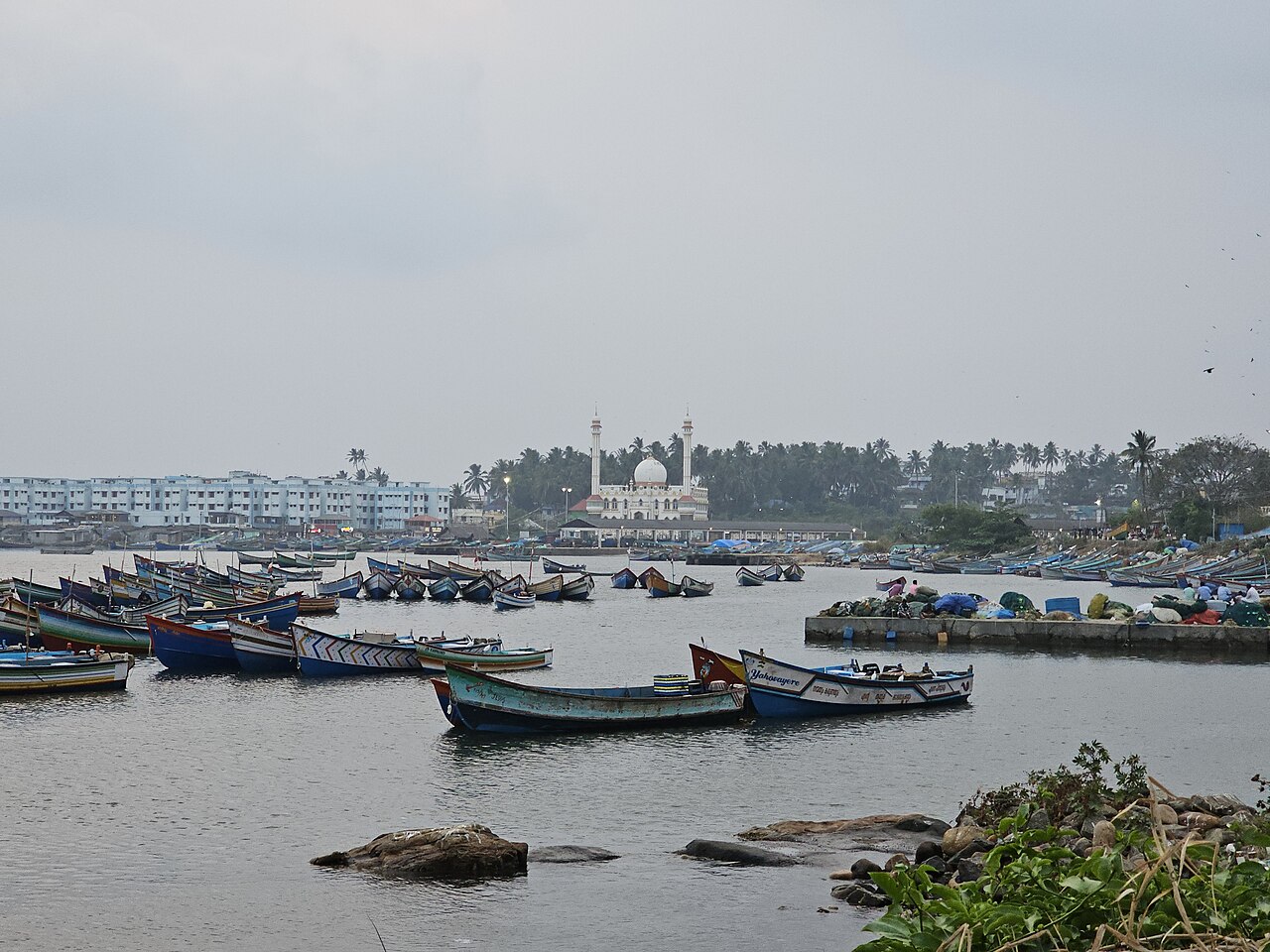
Vizhinjam · Photographed 14 March 2024 (according to Exif data)
Vizhinjam fishing harbour and its modern waterfront

Vizhinjam · Photographed 2007-07-29 03:44
Modern fishing harbour at Vizhinjam
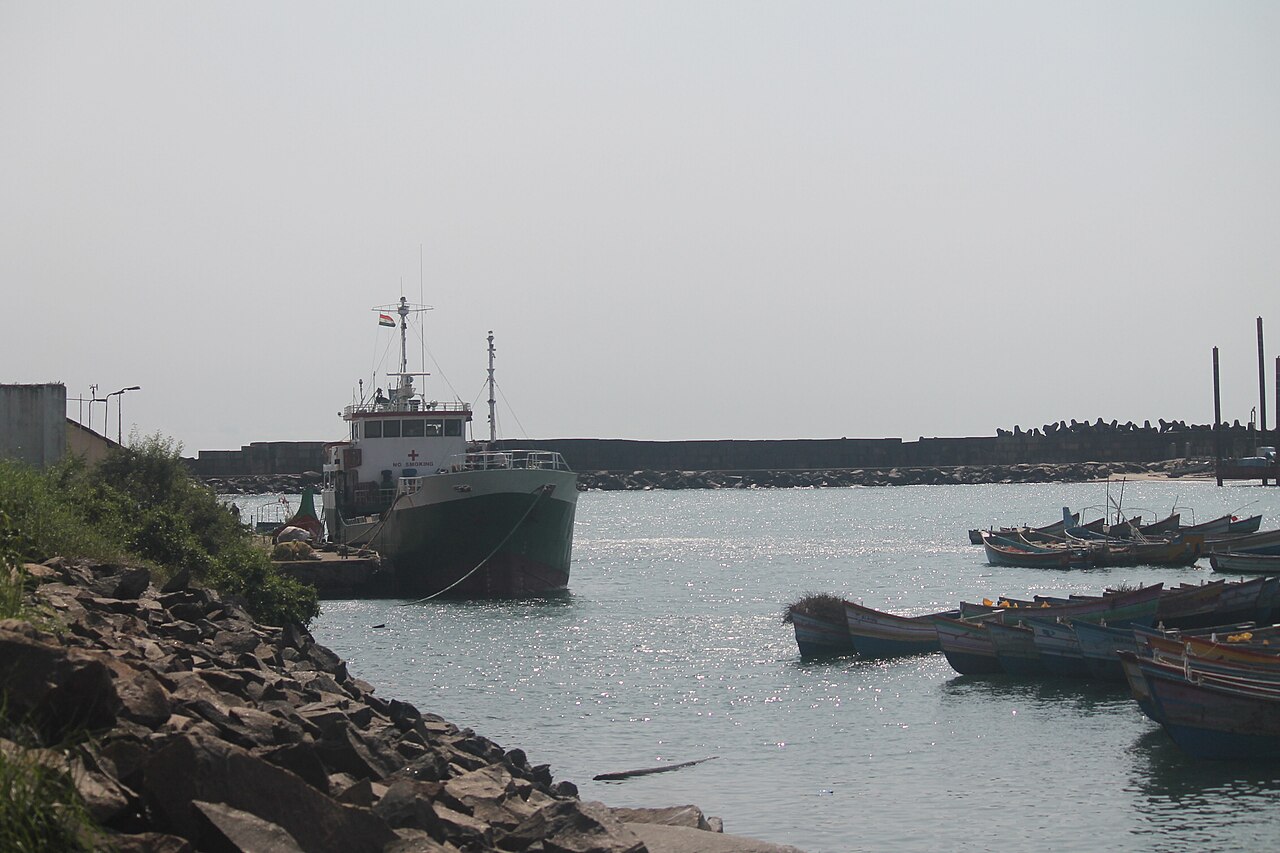
Vizhinjam · Photographed 2015-10-22 15:11:04
Modern harbour entrance at Vizhinjam

Vizhinjam · Photographed 2010-01-05
Fishing boats at Vizhinjam harbour, photographed in 2010
006Where next

Read the Vizhinjam food remains, from a broad period of about 1–800 CE, beside the dated peat, wood and sediments of the Kuttanad wetland. They are different places and kinds of evidence, so neither dates the other.
On the atlasVizhinjam Coastal Fort & Harbour TerraceProtected rock-cut cave monument & harbour terrace
Explore nextTorpedo Jar (West Asian Transport Amphora) (மேற்காசியச் சாடி / പേർഷ്യൻ ഗൾഫ് ഭരണികൾ)All related studies, connected material, books and sources21 · 9
Elsewhere on this site
Excavation Atlas Sites: Vizhinjam Coastal Fort & Harbour Terrace
Multi-Script Glossary Terms: Torpedo Jar (West Asian Transport Amphora) (மேற்காசியச் சாடி / പേർഷ്യൻ ഗൾഫ് ഭരണികൾ) · Turquoise Glazed Pottery (TGP) (நீலப்பச்சை மெருகூட்டிய மேற்காசிய மண்பாண்டம் / ടർക്കോയ്സ് ഗ്ലേസ്ഡ് മൺപാത്രങ്ങൾ (TGP))
Connected material
Photographs, drawings, books, videos and other studies linked to this study. A link helps you explore; it does not prove a historical claim.
- Modern fishing harbour at VizhinjamphotographBackground
- Fishing boats at Vizhinjam harbour, photographed in 2010photographBackground
- Modern harbour entrance at VizhinjamphotographBackground
- Vizhinjam fishing harbour and its modern waterfrontphotographBackground
- A meal survives in pieces: seeds, pots and bonesdiagramThe animal panel’s Vizhinjam note comes from this study: fish are most of the 52 identified Period I fragments.
- Order first. Dates second.diagramThe Vizhinjam bar on the plate, Period I from the 1st century CE to 800 CE, comes from this study.
Books, videos and websites
Outside reading on this topic. These are not part of the study and we have not checked every claim in them. See all books and videos
- The Periplus Maris Erythraei: Text with Introduction, Translation, and Commentary Book · Lionel Casson · 1989 · The standard critical Greek text, English translation, and nautical/commercial commentary on the anonymous 1st-century CE Egyptian Greek merchant manual describing Naura, Tyndis, Muziris, Nelkynda, and Bakare.
007Sources
The study lists the sources it consulted; we have not rechecked them. A working link does not show that a source was read, and a valid identifier does not show that it supports a claim. We do not link to unofficial uploads or copies of publications. Where a study cited one, we show the published citation, or a publisher, DOI or Internet Archive link when we have one. Tracking codes are removed from links, and the sources themselves are not republished here.
Ajit Kumar (2006), Fort at Vizhinjam, Adharam 1
Ajit Kumar, 'History and Archaeology of the Recently Discovered Fort at Vizhinjam [Vilinjam],' Adharam 1 (2006): 25–35.
Online copy not linked · use the published editionSource recordAbhayan et al. (2014), Faunal Remains at Vizhinjam, Heritage 2
G. S. Abhayan, P. P. Joglekar, Ajit Kumar and S. V. Rajesh, 'Utilization of Animal Resources at Vizhinjam, Kerala: A Study Based on Faunal Remains,' Heritage: Journal of Multidisciplinary Studies in Archaeology 2 (2014).
Periplus Maris Erythraei §58 (Casson 1989 print; Schoff 1912 UW text)
Lionel Casson, The Periplus Maris Erythraei (Princeton University Press, 1989), §58; compared with Wilfred H. Schoff, trans., The Periplus of the Erythraean Sea (1912), §58.
Ajit Kumar et al. (2013), Journal of Indian Ocean Archaeology 9
Ajit Kumar, S. V. Rajesh, G. S. Abhayan, V. Vinod and Sujana Stephen, 'Indian Ocean Maritime Trade: Evidences from Vizhinjam, South Kerala, India,' Journal of Indian Ocean Archaeology 9 (2013): 195–201, Pls. 31–33.
Online copy not linked · use the published editionSource recordRoberta Tomber (2007), Antiquity 81(314): 972–988
Roberta Tomber, 'Rome and Mesopotamia – importers into India in the first millennium AD,' Antiquity 81, no. 314 (2007): 972–988.
Antiquity Vol. 81, Issue 314 (Dec 2007)
Antiquity 81, no. 314 (December 2007), issue landing page for Tomber (2007).
Purananuru 1–200 (Vaidehi Herbert translation)
Vaidehi Herbert, trans., 'Ettuthokai – Purananūru 1–200,' Sangam Poems Translated by Vaidehi (poems 127–136).
Purananuru 1–200 (Tamil Virtual Academy, Auvai Turaicami commentary)
Purananuru 1–200 with commentary by Auvai Cu. Turaicāmi Piḷḷai, Tamil Virtual Academy.
Ajit Kumar et al. (2015), Routledge / Manohar chapter DOI
Ajit Kumar, S. V. Rajesh, G. S. Abhayan, V. Vinod and Sujana Stephen, 'International Maritime Trade: Evidences from Vizhinjam Excavations, South India,' in K. S. Mathew, ed., Imperial Rome, Indian Ocean Regions and Muziris (Routledge/Manohar, 2015), pp. 297–306. DOI: 10.4324/9781315276823-17.
Researchers and institutions whose work this study uses: Ajit Kumar, Abhayan G. S., Rajesh S. V., Roberta Tomber, Vaidehi Herbert, Tamil Virtual Academy
How we know The evidence, claims and dates behind this study
What this study draws on
- Ajit Kumar and colleagues' 2013 report (JIOA 9: 195–201) on Indian Ocean trade finds; their 2015 Routledge chapter was not read in full for this study
- G. S. Abhayan and colleagues' 2014 faunal study (Heritage 2), with the 11-trench count, bone totals and c. 1–800 CE phase summary
- Periplus Maris Erythraei §58 in Wilfred Schoff (1912) and Lionel Casson (1989), alongside Roberta Tomber's 2007 Antiquity study of torpedo jars
- Ajit Kumar's 2006 study of the Mathilpuram fort, Madras Museum (Srivaramangalam) plates, and Purananuru 127–136 on Ay Antiran
Dates in this study
| What is dated | Date | How it was dated |
|---|---|---|
| Broad mid-first to third century CE horizon reported for Egyptian Dressel 2–4 amphora sherds at Alagankulam | 50–300 CE | Period assigned by excavators or scholars |
| 378–383 CE minting span of a bronze issue of Valentinian II (Antioch mint) reported from Alagankulam | 378–383 CE | Date from writing, coins or texts |
See these dates on the timeline
The study’s claims
18 claims · 0 source passages · 20 paragraphs
Browse the study paragraph by paragraphUniversity of Kerala excavated eleven Vizhinjam trenches over three seasons in 2011–2013.
Supported in this study
Publication summarizes fieldwork; full trench notebooks not yet consulted directly.
The published chronology defines Period I as about 1–800 CE using seven radiocarbon dates plus artefact dating.
Supported with qualifications
Individual samples, lab codes, raw ages and calibrated ranges absent from the sources consulted.
Some layers were mixed, preventing a clean stratigraphic division.
Supported in this study
Degree of mixing differs by context and is not quantified in the consulted passage.
Rouletted ware and torpedo-jar sherds were reported from the “earliest levels.”
Supported in this study
“Earliest” is relative; no individual radiocarbon association recovered.
Vizhinjam torpedo jars are interpreted as West Asian transport containers broadly of the fourth–seventh centuries CE.
Supported with qualifications
Exact Vizhinjam sample catalogue absent from the sources consulted; seventh century extends beyond core cutoff.
Roman amphora fragments are not securely demonstrated by the detailed read Vizhinjam excavation publications.
Supported with qualifications
Negative inventory finding; torpedo jars are documented instead, while Roman-amphora claims remain unproven here.
The Ptolemy II coin cannot securely date an excavated Vizhinjam level because it was reported from a jeweller’s possession.
Supported in this study
Provenance and find context unknown.
A megalithic phase at Vizhinjam was not established in the consulted excavation publications.
Unresolved in this study
Unresolved negative finding in the 2013 and 2014 reports.
The consulted excavation publication lists generic metal objects but does not establish a dated early iron-implement assemblage.
Supported with qualifications
Full object-by-object metal catalogue not available.
Period I fauna is marine-heavy: 73.08% of the relevant identified assemblage is fish, shell or cuttlefish; the sample is small.
Supported with qualifications
Period I spans c.1–800 CE; 71 fragments only; mixed contexts complicate sub-period attribution.
Domestic equipment and a small structure demonstrate habitation beyond a purely transit “port” function.
Supported with qualifications
Read passage does not securely date these features to pre-600 CE.
Periplus 58 describes Balita as a coastal village with a good harbour and places Komar next in the sequence.
Supported in this study
Ancient text does not identify Balita with modern Vizhinjam.
Vizhinjam = Balita is a plausible modern identification alongside Schoff's Varkala proposal, not an established archaeological identity.
Supported with qualifications
No local inscription or seal confirms Balita; Casson 1989 treats it as not securely identified.
Purananuru preserves poems for Āy Aṇṭiraṉ and poem 128 associates his land with Pothiyil Mountain, but the consulted passages do not name Vizhinjam.
Supported in this study
Literary praise is not direct site documentation; publication wording requires classical-Tamil review.
The clearest Vizhinjam–Ay fort/political evidence belongs mainly to the seventh–ninth centuries and later, outside the core cutoff.
Supported with qualifications
Fort wall itself lacks a recovered direct scientific date in the consulted source.
The popular label 'Southern Ay Outpost' overstates what pre-600 archaeology currently demonstrates.
Supported with qualifications
Avoids merging early coastal settlement with post-600 Ay political history.
Maritime connection is supported, but a second-century-BCE international-port claim is not securely dated by the consulted stratigraphy.
Supported with qualifications
A pottery tradition’s broad range and an unprovenanced coin cannot substitute for a dated deposit.
Later TGP, Chinese and European ceramics document continuing/recurrent maritime connectivity but belong mainly outside 1000 BCE–600 CE.
Supported in this study
Later phases should not be used to date the early settlement.
About this study Status, corrections and how it was made
Status
Draft study, revision 8. No historian, archaeologist, or Tamil or Malayalam specialist has reviewed it yet.
How it was made
Compiled as an editorial synthesis from published scholarship around questions we framed. About this project & workflow
The summary, How sure lines and Two views notes on this page were prepared from this study and cross-checked against its passages. That is an editorial check, not a specialist review.
Corrections and updates
Technical details
Study code R118. The text fingerprint changes whenever the study text changes.
- Table headings decide what each column means. Citation links, sample mentions and dates copied as text are kept apart from checked source passages and calibrated measurements.
See how this study’s records were extracted
Text fingerprint (SHA-256): R118 · 6709f054c85c216f0f0cd0c5… · v8
Evidence tables and technical details are on the web page: https://layersofthesouth.org/read/5975838436