Each period has the same width, so spacing is not to scale.
- Made by hand
Salt was made on the coast and carted inland in early South India
Poems and a first-century BCE inscription show salt made on the coast and carted inland; excavated Malabar salt pans and salt-for-spice trade are unproven.
- This page
- 4,017 words · revision 7
Draft study · Awaiting specialist review · Updated
001Dates and places

No mapped place in this study.
1000–500 BCE
Different beginnings
500–200 BCE
Marks & materials
200 BCE–300 CE
Connected worlds
300–600 CE
Change & continuity
- Early Historic period (3rd century BCE to 5th century CE) seems to be the most active phase of the site.
- ca. 1st century B.C.E.
- Date from writing, coins or texts
- Period assigned by excavators or scholars
Each date belongs to what was dated (a sample, an object, a layer or a text), which is not always the event the study asks about.
Each period has the same width, so spacing is not to scale.
The full table of dates, with their ranges, is under How we know.
- 1 Well supported
- 1 Likely
- 2 Not known
002How sure
In brief
This study tests the idea that salt from Malabar salt pans crossed the Western Ghats and was traded for hill spices. Early Tamil poems describe salt pans, salt merchants with bullock carts, groups on long roads, and salt reaching mountain country. Akanānūṟu 140 and 390 describe salt exchanged for paddy or rice, not spices. An inscription at Alagarmalai, near Madurai, names Viyakan the salt merchant and is dated to about the first century BCE. Excavations at Pattanam in Kerala show a major early port, but the summaries checked report no salt-making installation. A Kerala government page on salt-making at Pattanam is based on literary references, not excavation. The local page on Uppungal gives no early record, and “Uppage” is a Kannada name for a fruit tree. No source checked links a Malabar salt source to a named mountain pass.
Key researchers cited in this study: Vaidehi Herbert (Sangam Poetry Translations & Commentaries) · Iravatham Mahadevan (Tamil-Brāhmī Epigraphy) · George L. Hart (Classical Tamil Literature) · Eva Wilden (Sangam Critical Editions & Manuscriptology) · Full bibliography
How sure
- Well supported
Salt was produced on the coast and carried inland by merchants with carts.
Several poems describe it, and the Alagarmalai inscription independently names a salt merchant.
- Likely
Salt reached mountain country.
Poems describe it, but no route sites or documents have been located.
- Not known
Malabar had early salt pans feeding a fixed caravan road over the Ghats.
No excavated saltern or dated route evidence has been found, so both questions stay open.
- Not known
Salt was bartered for hill spices.
The poems checked pair salt with paddy and rice, not with pepper or cardamom.
Why it matters
Salt was an everyday necessity, and this study shows which parts of its early trade the evidence supports.
003Key findings
What the study concludes
- Akananuru 140 and 390 do contain salt-trade imagery, including carts/long roads and paddy-rice barter.
- Purananuru adds salt wagons, saline/backwater production landscapes and movement toward mountain country.
- Alagarmalai 39 independently attests a salt merchant in an inland Tamil-Brahmi inscription around the first century BCE.
- No excavated Early Historic saltern at the specified Malabar localities was located in this targeted search.
- The salt-for-hill-spices and fixed trans-Ghat components remain unproven.
In the study’s own words. How sure each point is, is shown above.
The summary above is the short read. The full study is the complete text it was drawn from, with its tables and source notes.
What the full study covers
004The study
Overview
What evidence establishes salt production and inland movement in the regional period?
This source-led investigation tests a composite proposition rather than preserving it. The proposition combines several distinct claims – coastal salt production in Malabar, salt merchants identified as umaṇar, movement across the Ghats, and exchange for hill spices – and each component is tested separately. The period studied is 1000 BCE–600 CE, with earlier background, core-period evidence, later reception, and mixed chronology kept distinct. “Parathavar poems show fishers with a stake in salt, not pilots” looks at the coastal fishers, salt-makers and port workers themselves.
Overview: the evidence establishes a regional Early Historic salt economy much more securely than it establishes a specifically Malabar trans-Ghat system. Akanānūṟu 140 describes salt associated with a coastal salt-pan landscape, cart transport through mountain terrain, and salt-for-paddy exchange; Akanānūṟu 390 describes saline-land salt, merchants travelling long dusty roads in groups, and salt-for-rice exchange. ↗1 ↗2 Puranānūṟu independently supplies further literary images of heavy salt-merchants' wagons, salt wagons reaching Pāri's mountain country, saline/backwater salt production, and merchants leaving salt pans toward a mountainous country. ↗3 ↗4
There is also non-literary evidence for specialized inland salt commerce. Alagarmalai inscription 39, in the consulted Mahadevan-derived digital presentation, reads upu-vāṇikaṉ viyakaṉ and identifies Viya(k)kaṉ as a salt merchant; the presentation dates the inscription to about the first century BCE. This is important because it attests a salt-merchant occupational designation in an inland Madurai-region epigraphic context. It does not say where his salt was produced, that he was an umaṇar, or which route he travelled. ↗5
The specifically Malabar archaeological case is much weaker. Pattanam provides securely relevant Early Historic coastal archaeology in Kerala: institutional summaries describe a major settlement, waterfront features, extensive ceramics and industries including metallurgy, lapidary work, weaving and terracotta production. Yet the accessible institutional descriptions read here do not identify an excavated saltern, evaporation pan, or other salt-production installation. ↗6 ↗7 Significantly, a Kerala government heritage page does associate Pattanam and Kodungallur with salt-making, but explicitly labels that presentation a reconstruction from literary references; it therefore cannot be counted as an independent archaeological discovery of salt pans. ↗8
Two place-name leads do not close this gap. Uppungal is securely a present-day waterfront locality in Punnayurkulam, but the official local-government page supplies neither an Early Historic attestation nor a historical salt etymology. ↗9 Uppage was not verified as a salt-pan place-name at all: the FAO material located in this study uses uppage for Garcinia cambogia and its fruit in Kannada-speaking Karnataka. ↗10 The “Uppage” lead may therefore be ambiguous or misidentified.
The strongest defensible conclusion is consequently:
Salt production, specialized salt merchants, cart transport, group travel, coast-to-upland movement, and salt-for-grain exchange are all supported at the scale of Early Historic Tamilakam. What is not yet established is an archaeological chain from salt pans at Kannur, Kozhikode, or the Cochin estuarine zone through a named Western Ghats pass to an inland market where the salt was exchanged specifically for hill spices.
The distinction matters because a current research program in Idukki separately proposes an east-west Vaigai–Periyar corridor and a role for upper-Periyar forest products such as pepper and cardamom in coastal trade, but that ongoing project does not identify the literary salt merchants as operators of that corridor or document salt-for-spice barter. Joining the two propositions would be an inference, not an observed transaction. ↗11
Assumptions and missing details
| Issue | Working treatment |
|---|---|
| “Regional period” | The core period is 1000 BCE–600 CE; modern scholarship, later toponyms, and current projects are used only as evidence history, comparison, or research leads. |
| “Malabar” | Treated as a location-specific proposition requiring Kerala/west-coast evidence, not as an automatic synonym for every landscape represented in classical Tamil poetry. |
| Literary geography | Landscape descriptions are evidence for represented coastal, road, saline, and mountain settings; they are not converted into modern map coordinates without independent identification. |
| Umaṇar versus upu-vāṇikaṉ | Kept distinct. The first is a literary salt-merchant term; the second is an epigraphic occupational expression. Similar economic function does not prove identical social identity. |
| Missing textual control | A full current critical apparatus for Akanānūṟu 140 and 390 was not read. The Wilden critical edition covers poems 1–120 only. ↗12 |
| Missing archaeology | Detailed Kerala coastal feature registers, environmental analyses, and any unpublished saltern evidence were not available in the accessible summaries reviewed. |
| Missing route proof | No single source chain linked a named Malabar salt-production locus, named Ghats pass, demonstrable salt cargo, and spice-exchange destination. |
Questions, scope, and research method
This study was organized around four tests rather than around confirming the composite proposition.
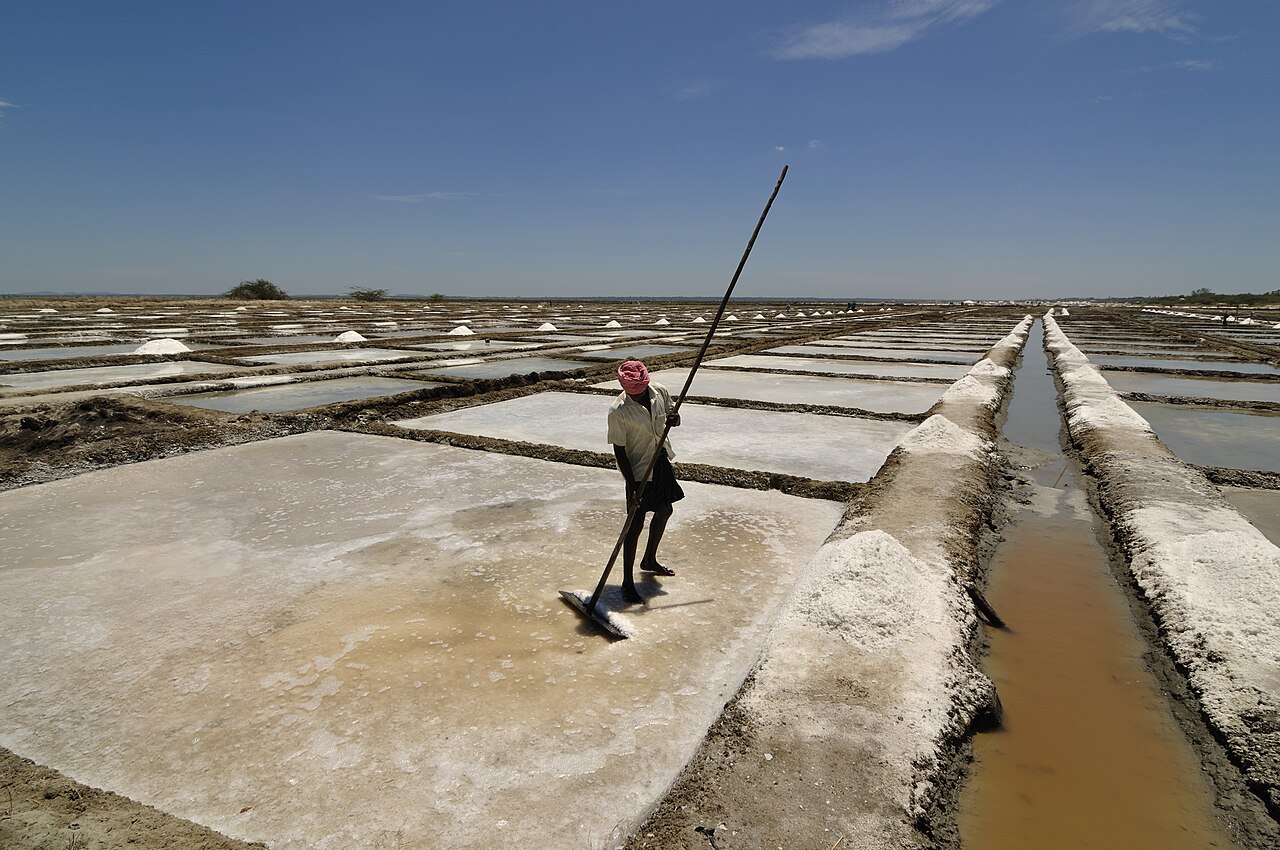
Salt workers of Marakkanam – Modern salt-production landscape
Photographed 2019-05-27
| Test | What had to be established |
|---|---|
| Production | Evidence for actual salt production: literary production language, excavated installations, residues, feature plans, or securely dated documentary evidence. |
| Inland movement | Evidence that salt or identifiable salt merchants travelled inland, preferably with transport mode, destination, or route context. |
| Geography | Whether the named Akanānūṟu passages or associated evidence specifically point to Malabar, the Western Ghats, or the proposed estuarine zones. |
| Exchange | Whether salt was exchanged specifically for hill spices, as opposed to the explicitly attested grain/paddy exchange. |
The search strategy proceeded from the closest available evidence outward. First, the named Akanānūṟu passages were located in full HTML text with Tamil, translation, and notes, rather than relying on quotations in modern histories. Relevant Puranānūṟu passages were then found by searching umaṇar, salt-wagon terminology, production imagery, and mountain contexts. ↗1 ↗2 ↗3 ↗4 Second, epigraphic searches for uppu/upu-vāṇikaṉ identified Alagarmalai 39. ↗5 ↗13 Third, Kerala archaeological and heritage sources were searched for Pattanam, salterns, salt pans, salt production, industrial features, and coastal installations. ↗6 ↗7 ↗8 Finally, the two place-names were tested as modern geographical/lexical leads rather than presumed ancient evidence. ↗9 ↗10
Source hierarchy was deliberately uneven. Ancient poem passages and inscriptions carry the greatest weight for what their texts actually say; excavation reports and analytical studies would carry the greatest weight for physical production installations. Institutional summaries were used where primary excavation documentation was not accessible, but their evidentiary status is stated. Publisher records were used to resolve editions rather than to stand in for unread book contents. Wilden's 2018 Akanānūṟu publication is a genuine critical edition based on eight surviving manuscripts and grammatical quotations, but its published Part 1 covers only poems 1–120, so it does not critically establish the wording of 140 or 390. ↗12 Hart's complete 2015 English translation was identified through the Institut Français de Pondichéry record but was not read in full. ↗14
That textual caution is consequential. Wilden's broader transmission study characterizes the Caṅkam corpus as having oral predecessors and a long, complex history of anthology formation, commentary, manuscripts, rediscovery, and print. The poems can therefore be evidence for early Tamil economic representations without pretending that each surviving modern text is a contemporaneously dated commercial document. ↗15 Exact composition, anthology formation, manuscript-witness date, and modern publication date must remain separate.
The targeted search is equally important. Searches of accessible Kerala/Pattanam institutional material did not yield a reported Early Historic saltern at the proposed Malabar localities. That result means only “not located in this study.” It is not a universal claim that no such evidence exists. Pattanam is especially important as a control because its institutional descriptions are unusually detailed about other industries and installations. ↗6 ↗7
Literary evidence for production, transport, and exchange
The two named Akanānūṟu passages are genuine and relevant, but their evidentiary content is narrower – and in some respects stronger – than the composite proposition implies.
Akanānūṟu 140 is explicitly classified as neytal. Its opening imagery associates white granular salt with a coastal fishing settlement and a kaḻi-related salt-pan environment. The salt merchant moves with a bullock cart through mountains cracked by heat; his daughter goes through a settlement announcing an equal exchange of white salt for paddy. The poem therefore combines a production landscape, wheeled inland movement, difficult terrain, and grain barter in one coherent scene. What it does not provide is a named Kerala coast, named mountain pass, spice commodity, or archaeological installation. ↗1
Akanānūṟu 390, also neytal, describes salt “grown” in saline land and merchants with goads travelling far along dusty long roads in groups. A woman moves settlement to settlement calling for rice in straight exchange for salt. The passage is especially useful for the caravan proposition because collective travel is explicit; nevertheless, neither the route nor its terminal is geographically named. ↗2
Puranānūṟu strengthens the regional model. Poem 102 describes salt merchants' heavily loaded wagons traversing uneven ground and carrying spare axles against failure. ↗3 Poem 116 depicts women in Pāri's mountain landscape counting salt-carrying wagons, demonstrating that the poetic world envisioned such vehicles reaching an upland polity rather than remaining confined to the coast. ↗3 Poem 313 invokes saline land, a salt heap or hill beside backwaters, and salt removed by merchants using wagons. ↗4 Most important for the coast-to-upland proposition, Puranānūṟu 386 juxtaposes the seashore, ships, salt pans, white salt and salt merchants departing toward a country characterized by large mountains. The poem is associated with a Chola king, however, so it cannot simply be reassigned to Malabar. ↗4
Comparative evidence
| Evidence | Direct observation in the text/source | Geography actually established | Supports | Does not establish |
|---|---|---|---|---|
| Akanānūṟu 140 | Coastal salt-pan production, bullock cart, hot mountain terrain, salt ↔ paddy exchange. ↗1 | Generic neytal coast plus mountain travel | Production; cart movement; coast/upland connection; barter | Malabar; named Ghats pass; spices |
| Akanānūṟu 390 | Saline-land salt; merchants travel long dusty roads in groups; salt ↔ rice exchange. ↗2 | Long inland roads and settlements, unnamed | Group mobility; inland trade; grain barter | Named route; Kerala source locality |
| Puranānūṟu 102 | Heavy merchant wagons; spare axles; difficult terrain. ↗3 | Uneven inland road, unnamed | Transport technology and risk | Cargo source/destination |
| Puranānūṟu 116 | Salt wagons counted in Pāri's mountain landscape. ↗3 | Mountain polity in the poem | Salt reaching upland country | Modern pass identification |
| Puranānūṟu 313 | Saline/backwater salt landscape; wagons remove salt. ↗4 | Coastal/backwater setting, unnamed | Production landscape and wheeled removal | Excavated saltern |
| Puranānūṟu 386 | Seashore, salt pans, white salt, merchants leaving for mountainous country. ↗4 | Chola praise context; coast-to-mountain literary geography | Strongest literary coast/upland linkage | Malabar-specific route |
| Alagarmalai 39 | Viya(k)kaṉ called upu-vāṇikaṉ, “salt merchant.” ↗5 | Located inland cave-inscription context near Madurai | Existence of specialized inland salt merchant | Membership in literary umaṇar group; salt source; route |
| Pattanam archaeology | Major Early Historic settlement, waterfront and craft evidence; no saltern identified in read institutional lists. ↗6 ↗7 | Kerala/Periyar delta coastal context | Relevant Malabar comparator | Direct salt-production installation |
| Uppungal / “Uppage” | Uppungal is a modern locality; FAO's uppage is a Kannada plant/fruit term. ↗9 ↗10 | Modern Kerala / Karnataka lexical contexts | Later research leads | Ancient salt pans |
This comparison produces a useful hierarchy. The literary case for salt production and inland distribution is cumulative: no single poem bears the whole reconstruction, but several independent passages within the poetic corpus repeat pans or saline land, wagons, roads, groups, mountains, and grain exchange. The geographical localization is not cumulative in the same way: none of the named Akanānūṟu passages supplies Kannur, Kozhikode, Cochin, or a Western Ghats pass, while Puranānūṟu 386's explicit political context points to a Chola praise setting rather than furnishing Malabar localization. ↗1 ↗2 ↗4
The barter claim also needs correction. Both named Akanānūṟu poems explicitly pair salt with paddy/rice, not with pepper, cardamom, or an undifferentiated category of hill spices. ↗1 ↗2 That does not rule out other exchanges; it does mean that “salt for hill spices” cannot be presented as the content of these passages.
Epigraphy, archaeology, and the place-name test
The Alagarmalai inscription is the most important control on the possibility that the literary salt merchants were purely poetic convention. In inscription 39, the consulted presentation gives the normalized reading upu-vāṇikaṉ viyakaṉ and translates the expression as Viya(k)kaṉ, the salt merchant. Its stated date is approximately the first century BCE. ↗5 This is direct evidence that an occupational identity centered on salt commerce was meaningful in an inland Tamil-Brahmi epigraphic context during the core period.
Marakkanam Salt Pans – Modern salt-production landscape
Photographed 2012-06-07
It does not justify collapsing two terms into one community. Uppu/upu-vāṇikaṉ is an occupational expression in an inscription; umaṇar is the recurring literary designation in the poems read. Demonstrating historical identity between those labels would require lexical, social, and contextual argument beyond simple equivalence of commodity. The inscription is therefore independent corroboration of specialized salt commerce, not a membership card for the poetic caravan group. ↗5 ↗13
Pattanam provides a different test: can Kerala archaeology supply the production installation that the literature cannot? Institutional descriptions place the site's most active Early Historic phase roughly in the third century BCE to fifth century CE and enumerate very large artefact assemblages, architectural features, a waterfront context, and industries including metallurgy, lapidary production, cotton weaving, and terracotta work. ↗6 ↗7 In the material read for this study, however, there is no specifically identified salt pan, crystallization basin, brine-processing installation, or salt-working feature. That negative must remain bounded because these webpages are summaries rather than complete trench registers.
A useful source-critical warning comes from the Kerala government's own heritage interpretation. Its page on “Social Life in Muziris” describes the neytal coast, including Pattanam and Kodungallur, as a world of fishing, salt-making, shell gathering, and related activity, but the page explicitly says the social reconstruction is made from literary references. ↗8 Thus, “a government website says salt was made at Pattanam” cannot legitimately be transformed into “archaeologists excavated Pattanam salt pans.”
The two place-name leads perform even less evidentiary work. The Punnayurkulam panchayat confirms Uppungal Kadavu as a contemporary waterfront locality but gives no ancient documentary chain or salt etymology. ↗9 Without dated inscriptional, manuscript, cadastral, or historical-map attestations, similarity between a modern name and a salt-related word cannot date the name to the Early Historic period.
The “Uppage” lead is more problematic. The FAO case study located through an exact-name search identifies uppage as the common Kannada name of Garcinia cambogia, a forest tree and fruit gathered in parts of Karnataka. ↗10 Searches did not establish “Uppage” as a Malabar salt locality. This should be treated as a likely coordination or identification problem until an exact historical map, gazetteer, inscription, or place record is supplied.
The resulting evidence forms a set of partially connected layers, not one continuous road.
In the literature, coastal pans and saline-land salt connect to carts, groups and long roads, and to salt moving toward mountain country; together with the Alagarmalai inland salt merchant, these support a regional specialized salt commerce. Two steps remain unproven: a specific Malabar production locus, since no saltern is identified in the consulted Pattanam summaries and modern Uppungal or the ambiguous “Uppage” cannot date production; and a fixed Malabar trans-Ghat route, since source, pass and destination are not linked and no archaeological evidence ties a production locus to a route. ↗5 ↗9 ↗1 ↗2 ↗3 ↗4 ↗10 ↗7
Synthesis, chronology, implications, and competing interpretations
The most generous defensible interpretation is that early Tamil society included a specialized distributive salt economy connecting littoral production with inland and upland consumers. The literary corpus repeatedly supplies mutually compatible components: salt-producing coastal/saline landscapes, merchants, bullocks and wagons, technical preparation for road hazards, collective movement, village selling, grain barter, and penetration of mountain country. The Alagarmalai inscription independently demonstrates that “salt merchant” was an epigraphically intelligible inland occupation. ↗5 ↗1 ↗2 ↗3 ↗4
The stronger interpretation is different: it proposes a specific Malabar production-and-barter network with salt made at Kannur, Kozhikode and Cochin estuaries, taken by umaṇar caravans across the Ghats, and exchanged for spices. That proposition requires the independent components to converge spatially and chronologically. They currently do not. The best Kerala coastal archaeological comparator read, Pattanam, does not supply a reported saltern in its accessible institutional summaries; the poems do not name the proposed Malabar locations; and the explicitly described barter is with paddy/rice. ↗1 ↗2 ↗6 ↗7
The spice component is especially susceptible to accidental confirmation by combination. PAMA's ongoing Idukki research describes the upper Periyar region as a probable supplier of forest goods including pepper and cardamom and proposes investigation of an east-west Vaigai–Periyar corridor. ↗11 That is relevant regional context. It does not show a salt merchant receiving pepper for salt, and it does not demonstrate that a merchant starting at Kannur, Kozhikode, or Cochin used that corridor. Economic complementarity is plausible; it is not the same thing as an evidenced barter transaction.
What would discriminate between the interpretations?
| Proposed conclusion | Current status | Decisive evidence still needed |
|---|---|---|
| Salt was produced on South Indian coasts during the represented Early Historic world | Supported textually | Archaeological confirmation would require a securely dated production feature or analytical signature. |
| Specialized merchants moved salt inland by carts | Strongly supported regionally | Further inscriptions could connect occupational labels to particular markets/routes. |
| Salt reached mountain country | Supported literarily | Located route sites or documentary evidence would convert literary geography into mapped history. |
| Malabar itself had Early Historic salterns at the proposed zones | Unresolved | Excavation feature plans, environmental data, production residues, or securely dated documentary evidence at Kannur/Kozhikode/Cochin-zone sites. |
| A fixed Western Ghats caravan road carried this salt | Unresolved | Dated waystations, inscriptions, cargo associations, or distribution evidence tying one production zone to one pass and hinterland. |
| Salt was bartered for hill spices | Not established by read passages | A text, inscription, account, or assemblage directly associating salt transfer with pepper/cardamom or another specified hill product. |
| Uppungal proves an ancient salt pan | Unsupported | A dated historical toponym sequence plus independent production evidence. |
| “Uppage” is a salt toponym | Not verified | Exact intended place and historical source; the usage found in current sources is botanical. |
The evidence and research history can be summarized without pretending that the poems have exact individual dates. Alagarmalai 39 is dated in the consulted presentation to about the first century BCE. The classical Tamil poems belong to the Early Historic period, but their exact dates remain textually complex. In the institutional synthesis, Pattanam's most active archaeological phase falls between the third century BCE and the fifth century CE, and systematic excavation there began in 2007. Wilden published the critical Akanānūṟu Part 1, covering poems 1–120, in 2018. PAMA's Idukki exploration, planned for 2023–2027, investigates an east-west corridor and upper-Periyar resource landscapes.
The Alagarmalai date comes from the consulted inscription presentation; the Pattanam phase and excavation history from Kerala institutional descriptions; Wilden's scope and publication year from EFEO/IFP; and the current Idukki-project framing from PAMA. ↗5 ↗12 ↗6 ↗7 ↗11
The defensible subject is therefore salt production and inland salt trade in Early Historic Tamilakam, with a test of the Malabar evidence. Phrases such as “Coastal Salt Pans of Malabar” and “Trans-Ghat Caravans” would presently imply archaeological and route specificity that the evidence does not supply.
Conclusions, open questions, and source register
The operative question can be answered positively but at a carefully bounded scale. Salt production and inland movement are established as features of the regional historical world. The most direct literary witnesses describe salt made in coastal/saline environments and moved by wheeled merchants over long or difficult roads, including toward mountain country. Multiple poems depict grain exchange. ↗1 ↗2 ↗3 ↗4 The inland Alagarmalai inscription gives independent epigraphic evidence for a specialist salt merchant around the first century BCE. ↗5
What is not established is equally important. This study found no excavated Early Historic saltern installation at the proposed Malabar localities; Pattanam's accessible archaeological summaries list many other features and industries but not salt works. ↗6 ↗7 The named Akanānūṟu poems do not locate their scenes in Kannur, Kozhikode, or Cochin. ↗1 ↗2 Modern Uppungal does not date itself, while “Uppage” did not resolve as the claimed salt toponym. ↗9 ↗10 Finally, the passages read describe paddy/rice barter rather than salt-for-spice exchange. ↗1 ↗2
The highest-value remaining work is therefore specific rather than open-ended:
| Priority source | Why it matters |
|---|---|
| Critical text and apparatus for Akanānūṟu 140 and 390 | Tests consequential readings, variants, commentary history, and whether Herbert's accessible rendering masks any philological ambiguity. |
| Critical Puranānūṟu text/commentary for 102, 116, 313 and 386 | Tests the wagon, saline-land, mountain and salt-pan readings used in the regional synthesis. |
| Mahadevan's full discussion of Alagarmalai 39 | Clarifies palaeographic/date reasoning and his commentary on upu-vāṇikaṉ. |
| Detailed Pattanam trench and feature publications | Tests explicitly for salinity, evaporation surfaces, brine handling, crystallization features, processing vessels and related environmental signatures. |
| Historical attestations of Uppungal | Requires dated maps, land records, inscriptions, gazetteers or manuscripts before etymology can bear historical weight. |
| Exact intended source for “Uppage” | Needed to determine whether “Uppage” is a typo, a homonym, or a genuinely different locality. |
| Route-level archaeology across candidate passes | Needed before drawing a historical caravan line on a public map. |
No missing item requires suppressing the well-supported regional conclusion. Conversely, none should be “filled” by inference from modern names or by combining unrelated spice and salt evidence.
Bibliography and access record
| Work or source | Access note | Stable URL where available |
|---|---|---|
| Central Institute of Classical Tamil, Akanānūṟu digital-library record. | Metadata checked. ↗16 | Official CICT digital-library record located through web search. |
| Vaidehi Herbert, Ettuthokai – Akanānūṟu 121–300. | Full relevant HTML; poem 140 and notes read. ↗1 | https://sangamtranslationsbyvaidehi.com/ettuthokai-akananuru-121-300/ |
| Vaidehi Herbert, Ettuthokai – Akanānūṟu 301–400. | Full relevant HTML; poem 390 and notes read. ↗2 | https://sangamtranslationsbyvaidehi.com/ettuthokai-akananuru-301-400/ |
| Vaidehi Herbert, Ettuthokai – Puranānūṟu 1–200. | Relevant poems 84, 102 and 116 read. ↗3 | https://sangamtranslationsbyvaidehi.com/ettuthokai-purananuru-1-200/ |
| Vaidehi Herbert, Ettuthokai – Puranānūṟu 201–400. | Relevant poems 313 and 386 read. ↗4 | https://sangamtranslationsbyvaidehi.com/ettuthokai-purananuru-201-400/ |
| Eva Wilden, A Critical Edition and an Annotated Translation of the Akanāṉūṟu, Part 1 – Kaḷiṟṟiyāṉainirai. EFEO/IFP, 2018. ISBN 9782855392257. | Publisher record and abstract; edition text not read. ↗12 | https://publications.efeo.fr/en/livres/908_a-critical-edition-and-an-annotated-translation-of-the-akan-u-part-1-ka-i-iy-ainirai |
| Eva Maria Wilden, Manuscript, Print and Memory: Relics of the Cankam in Tamilnadu. De Gruyter, 2014. DOI 10.1515/9783110352764. | University publication description read. ↗15 | https://www.csmc.uni-hamburg.de/publications/smc/smc03.html |
| Alagarmalai 39 Interactive, digital presentation of the Mahadevan reading. | Transcription, translation, locus and stated date read. ↗5 | https://brahmi.mvbhaskar.com/Alagarmalai/Alagarmalai_12_39/Alagarmalai_interactive_12_39.html |
| Iravatham Mahadevan, Early Tamil Epigraphy: From the Earliest Times to the Sixth Century A.D. Harvard Oriental Series 62. Harvard University Press, 2003. ISBN 9780674012271. | Bibliographic metadata only; full book not read. | No stable full-text URL claimed. |
| Muziris Heritage Project / Kerala Tourism, “Pattanam.” | Institutional excavation summary read. ↗7 | https://www.keralatourism.org/muziris/historical-sites/pattanam |
| M.G. University School of Social Sciences, “Early Historic Age Collection.” | Institutional Pattanam chronology and assemblage summary read. ↗6 | https://sss.mgu.ac.in/early-historic-age-collection/ |
| Muziris Heritage Project / Kerala Tourism, “Social Life in Muziris, reconstructed from Literary References.” | Full page read. ↗8 | https://www.keralatourism.org/muziris/history/reference-evidence |
| Punnayurkulam Grama Panchayat, “Uppungal Kadavu.” | Modern locality page read. ↗9 | https://punnayurkulampanchayat.lsgkerala.gov.in/en/gallery/uppungal-kadavu |
| FAO, “Case Study 1 – Uppage Collection.” | Relevant page read. ↗10 | https://www.fao.org/4/x5859e/x5859e03.htm |
| PAMA Research Institute, Pattanam/Idukki exploration project. | Current project description read. ↗11 | https://www.pama.org.in//currentprojects/Pattanam |
| George L. Hart, The Four Hundred Songs of Love: An Anthology of Poems from Classical Tamil: The Akanāṉūṟu. IFP, 2015. ISBN 978-81-8470-213-2. | Publisher metadata only; translation not read. ↗14 | https://www.ifpindia.org/bookstore/rsas7/ |
005Photographs
Photographs of the places and objects this study discusses. Each item carries its creator’s credit, licence and documented source. See all 412 photographs and source images ↗

Photographed 2019-05-27 10:57:25
Salt workers of Marakkanam – Modern salt-production landscape
Salt workers of Marakkanam. Modern salt-production landscape; not an ancient saltworks excavation.
Photographed 2012-06-07 11:31:25
Marakkanam Salt Pans – Modern salt-production landscape
Marakkanam Salt Pans. Modern salt-production landscape; not an ancient saltworks excavation.
006Where next
All related studies, connected material, books and sources47 · 16
Elsewhere on this site
Junior Detective Quests: Dinner 2,000 Years Ago: Hearths, Urns and Poems · The Salt Road: Coast, Carts and Inland Grain · The Translator's Workshop: Why Two Renderings Differ
Multi-Script Glossary Terms: neytal (நெய்தல் / നെയ്തൽ) · kaḻi (கழி / കഴി) · umaṇar (உமணர் / ഉമണർ) · uppu (uppaḷam) (உப்பு / உப்பளம் / ഉപ്പ് / ഉപ്പളം)
Connected material
Photographs, drawings, books, videos and other studies linked to this study. A link helps you explore; it does not prove a historical claim.
- Marakkanam Salt Pans – Modern salt-production landscapephotographBackground
- Salt workers of Marakkanam – Modern salt-production landscapephotographBackground
007Sources
The study lists the sources it consulted; we have not rechecked them. A working link does not show that a source was read, and a valid identifier does not show that it supports a claim. We do not link to unofficial uploads or copies of publications. Where a study cited one, we show the published citation, or a publisher, DOI or Internet Archive link when we have one. Tracking codes are removed from links, and the sources themselves are not republished here.
Central Institute of Classical Tamil, Classical Tamil Digital Library, Akananuru catalogue/etext record.
Print or offline sourceSource recordVaidehi Herbert, Ettuthokai – Akananuru 121–300, online Tamil text with English translation and notes.
Vaidehi Herbert, Ettuthokai – Akananuru 301–400, online Tamil text with English translation and notes.
Vaidehi Herbert, Ettuthokai – Purananuru 1–200, online Tamil text with English translation and notes.
Vaidehi Herbert, Ettuthokai – Purananuru 201–400, online Tamil text with English translation and notes.
Eva Wilden, A Critical Edition and an Annotated Translation of the Akananuru (Part 1 – Kalirriyanainirai), EFEO/IFP, 2018.
Eva Maria Wilden, Manuscript, Print and Memory: Relics of the Cankam in Tamilnadu, De Gruyter, DOI 10.1515/9783110352764.
Alagarmalai 39 Interactive
Alagarmalai inscription 39 interactive transcription, translation and locus, presenting Iravatham Mahadevan's Early Tamil Epigraphy reading.
Iravatham Mahadevan, Early Tamil Epigraphy: From the Earliest Times to the Sixth Century A.D., Harvard Oriental Series 62, Harvard University Press, 2003.
Print or offline sourceSource recordMuziris Heritage Project / Kerala Tourism, Pattanam historical-site page.
Mahatma Gandhi University School of Social Sciences, Early Historic Age Collection: Pattanam.
Muziris Heritage Project / Kerala Tourism, Social Life in Muziris, reconstructed from Literary References.
Punnayurkulam Grama Panchayat, Uppungal Kadavu page.
Chapter 2: Case Study 1 - Uppage Collection
FAO case study, Uppage collection, describing uppage as a Kannada name for Garcinia cambogia in Karnataka.
Pattanam / Idukki Exploration Project
PAMA Research Institute, Pattanam/Idukki Exploration Project page.
George L. Hart, The Four Hundred Songs of Love: An Anthology of Poems from Classical Tamil: The Akananuru, IFP, 2015.
Researchers and institutions whose work this study uses: Vaidehi Herbert, Iravatham Mahadevan, George L. Hart, Eva Wilden
How we know The evidence, claims and dates behind this study
What this study draws on
- Akanānūṟu 140 and 390 and Puranānūṟu 102, 116, 313 and 386, read in an online Tamil and English edition.
- Alagarmalai inscription 39, from a digital presentation of Iravatham Mahadevan's reading.
- Institutional summaries of the Pattanam excavations, checked for any salt-making feature.
- A local-government page and an FAO case study, used to test the place-names Uppungal and Uppage.
Dates in this study
| What is dated | Date | How it was dated |
|---|---|---|
| Early Historic period (3rd century BCE to 5th century CE) seems to be the most active phase of the site. | 300 BCE – 500 CE | Period assigned by excavators or scholars |
| ca. 1st century B.C.E. | 100–1 BCE | Date from writing, coins or texts |
See these dates on the timeline
The study’s claims
18 claims · 15 source passages · 44 paragraphs
Browse the study paragraph by paragraphAkananuru 140 represents coastal salt production in pans, bullock-cart transport through mountain terrain, and an equal salt-for-paddy exchange.
Supported in this study
This is a literary representation; it is not an excavated production installation or a mapped route. The poem does not name Kannur, Kozhikode, Cochin, or a specific Western Ghats pass.
Akananuru 390 represents salt merchants travelling long dusty roads in groups and bartering salt for rice in settlements.
Supported in this study
The geography is generic and does not establish a Malabar-to-Ghats route.
Purananuru 102 represents salt merchants operating heavily loaded wagons over uneven roads and carrying spare axles.
Supported in this study
The image demonstrates expected transport difficulty, not a specific road or origin-destination pair.
Purananuru 116 places salt-carrying wagons within the remembered landscape of Pari's mountain country.
Supported with qualifications
The poem's mountain polity cannot simply be equated with a modern trans-Western-Ghats route without an independent geographical argument.
Purananuru 313 represents salt accumulated in saline/backwater land and removed by salt merchants using wagons.
Supported in this study
The passage is a poetic simile and does not provide an excavated saltern plan.
Purananuru 386 explicitly juxtaposes seashore salt pans and salt merchants departing toward a mountainous country.
Supported in this study
The poem is in a Chola praise context; it is not specific evidence for Malabar. It supports the plausibility of coast-to-upland salt movement within early Tamil literary geography, not a fixed named pass.
A Tamil-Brahmi inscription at Alagarmalai, dated in the consulted Mahadevan-derived presentation to about the first century BCE, identifies Viya(k)kan as an 'upu-vanikan' (salt merchant).
Supported with qualifications
The digital derivative was read; Mahadevan's full printed commentary was not. The inscription establishes an inland person with a salt-merchant occupational label, but not the source of his salt or his route.
Accessible institutional summaries of Pattanam document a major Early Historic coastal settlement and multiple craft/industrial signatures but do not identify an excavated saltern or salt-production installation.
Supported with qualifications
This is a negative finding from the summaries read, not proof that no salt-production evidence exists in unpublished or uninspected excavation documentation.
A Kerala government heritage page that associates Pattanam/Kodungallur with salt-making explicitly presents the claim as a reconstruction from literary references, not as excavated salt-production evidence.
Supported in this study
Government heritage interpretation should not be converted into an archaeological observation.
Uppungal is a real modern waterfront place-name in Punnayurkulam, but the consulted official local source provides no early historic attestation or salt-related etymology.
Supported with qualifications
Modern name survival alone cannot date the name or identify an ancient saltern.
The catalogue lead 'Uppage' was not verified as a salt-pan place-name; in the official FAO result located, uppage is a Kannada vernacular name for Garcinia cambogia and its fruit.
Supported in this study
A different homonymous place could exist, but none was established by the supplied lead or the search for this study.
This study did not locate excavated Early Historic saltern installations at the catalogue's specific Malabar localities of Kannur, Kozhikode, or the Cochin estuarine zone.
Supported with qualifications
This means 'not found in targeted searches', not 'no evidence exists'. Pattanam near the Cochin region was specifically checked as the strongest excavated coastal comparator.
The consulted literary passages support salt-for-paddy/rice exchange, but they do not establish salt exchanged specifically for hill spices.
Supported in this study
Combining salt movement with a separate spice-supply hypothesis would create an unsupported compound claim.
The evidence supports regional inland movement of salt by carts and merchant groups, but not a fixed trans-Western-Ghats caravan route from named Malabar salt pans.
Supported with qualifications
Route geometry, pass identification, source saltern, and destination market remain unlinked by a single evidentiary chain.
The Cankam poetic evidence cannot be treated as a simple contemporary documentary archive: the corpus has a complex oral, anthologizing, manuscript, commentary and print transmission history.
Supported in this study
The consulted transmission summary does not provide an exact date for poems 140 or 390.
The Wilden critical edition located for this study covers Akananuru poems 1–120; therefore it cannot serve as the critical text for catalogue poems 140 and 390.
Supported in this study
Hart's 2015 complete translation was identified bibliographically but not read; a critical apparatus for 140 and 390 was not read for this study.
Neither Akananuru 140 nor 390, as read, names a Kerala locality; their salt geography is literary coastal/saline land, long roads, settlements and mountain terrain.
Supported in this study
Assigning these poems specifically to Malabar requires independent geographical evidence that was not located.
The earlier title overstates the evidence by combining Malabar saltern production, Umanar caravans, fixed trans-Ghat movement and spice barter into one asserted system.
Supported in this study
A neutral replacement should separate regional literary evidence, inland epigraphy, Malabar archaeology and later toponyms.
Trace one claim through the study’s records
Explore the evidenceOther source lists
Numbered citation links from the study
The numbered links in the study text point here.
Ettuthokai – Akanānūru 121-300 | Sangam Poems Translated by Vaidehi
Ettuthokai – Akanānūru 301 – 400 | Sangam Poems Translated by Vaidehi
Ettuthokai – Purananūru 1-200 | Sangam Poems Translated by Vaidehi
Ettuthokai – Purananūru 201-400 | Sangam Poems Translated by Vaidehi
Alagarmalai 39 Interactive
Early Historic Age Collection - MG School of Social Sciences : MG School of Social Sciences
Pattanam | Urban Settlement | Excavations | Muziris heritage project | KCHR
Social life in Muziris | Historical reference | Evidence | Exchange Market | Kottappuram
Uppungal Kadavu | Punnayurkulam Grama Panchayat
CHAPTER 2: CASE STUDY 1 - UPPAGE COLLECTION
PAMA - Bridging the Past, Present and Future.
A Critical Edition and an Annotated Translation of the Akanāṉūṟu (Part 1 - Kaḷiṟṟiyāṉainirai) - École française d'Extrême-Orient
Inscriptional Glossary
The Four Hundred Songs of Love. An Anthology of Poems from Classical Tamil. The Akanāṉūṟu. - French Institute Pondicherry
SMC 3 : CSMC : University of Hamburg
CICT Library | CICT – AI-Powered Digital Library
About this study Status, corrections and how it was made
Status
Draft study, revision 7. No historian, archaeologist, or Tamil or Malayalam specialist has reviewed it yet.
How it was made
Compiled as an editorial synthesis from published scholarship around questions we framed. About this project & workflow
The summary, How sure lines and Two views notes on this page were prepared from this study and cross-checked against its passages. That is an editorial check, not a specialist review.
Technical details
Study code R183. The text fingerprint changes whenever the study text changes.
- The study text is shown as written. Links from its paragraphs to citations help you move around the study; they are not new claims or checked source passages.
See how this study’s records were extracted
Text fingerprint (SHA-256): R183 · 8c5397283d79ee39eb9bf426… · v7
Evidence tables and technical details are on the web page: https://layersofthesouth.org/read/0067037e5d