Places on the atlas that name this study.
- Made by hand
- Nilambur
Colonial records alone document Nilambur gold washing
Nilambur's rivers carry natural gold, and colonial records document gold collecting there from 1800 and in detail from 1831, but no pre-600 CE extraction site is known.
- How sure
- 2 Well supported
- 2 Not known
- This page
- 4,937 words · revision 11
Draft study · Awaiting specialist review · Updated
001Dates and places
Places on the atlas that name this study.
- Nilambur & Chaliyar Basin Gold/Iron Landscapes
Coarse river-basin orientation · Malappuram District
Dates in this study are stated in words only.
- 2 Well supported
- 2 Not known
002How sure
In brief
Gold occurs naturally in the Nilambur valley of Malappuram and in the Chaliyar and Punnapuzha rivers, as state geological surveys show. Geology cannot say when people began to collect it. Direct documentary evidence begins in the colonial record. Francis Buchanan noted in December 1800 that gold dust was collected in the river passing Nilambur under a right farmed to a Nair. The Malabar Collector's report of 10 January 1831 and the papers of an 1832 committee, printed in 1847, describe washing in wooden trays and pit mining by several hundred people in the Nilambur valley; T. J. Newbold's 1843 survey gives Nilambur's yield at second hand. A 1925 Madras High Court judgment recites a commercial gold-washing lease of 14 August 1879. William Logan described people washing river sands for gold in the late nineteenth century. The Nilambur copper plates, an ancient grant issued at Vaijayanti, were found by a man washing for gold. That find dates the panning to when the plates were found, not when they were made. The Collector wrote in 1831 that the right to collect gold had been farmed out for forty or fifty years, which would reach back before Company rule, but no record earlier than 1800 was read. No securely dated ancient panning or gold-working site was located. The stratified early Chera coin from Pattanam is copper, and no analysis links Nilambur gold to any Chera coin.
Key researchers cited in this study: V. Selvakumar (Maritime & Prehistoric Archaeology) · K. P. Shajan (Geoarchaeology & Periyar Palaeochannels) · William Logan (Malabar Manual & Rock-Cut Cave Surveys) · T. A. Gopinatha Rao (Travancore Archaeological Series) · Full bibliography
How sure
- Well supported
Gold occurs naturally in Nilambur's rivers
Official geological surveys and a 1987 peer-reviewed study document the placer gold.
- Well supported
Gold was collected and washed at Nilambur from 1800 and through the nineteenth century
Buchanan's journal for December 1800, the Collector's 1831 report and the 1832 committee papers, the 1879 lease recital and Logan (1887) record it; each was read.
- Not known
People panned gold here between 1000 BCE and 600 CE
No securely dated local panning, mining or gold-working context was located.
- Not known
Nilambur gold went into Chera coins
The dated Chera coin from Pattanam is copper, and no analysis links Nilambur gold to any coin.
Why it matters
It shows that a natural resource, a later practice and an ancient object found through that practice each need their own date.
003Key findings
What the study concludes
- Geology verifies primary and placer gold.
- Direct records of Nilambur gold collecting begin with Buchanan's note of December 1800 and become detailed in the official papers of 1831–32 and the 14 August 1879 lease, not in pre-600 CE antiquity.
- Logan securely documents late nineteenth-century panning but not prehistoric panning.
- The Nilambur plates do not backdate the panning that discovered them.
- Later wooden-pan evidence cannot establish ancient technique.
- No Nilambur-to-specific-Chera-coin metal provenance link was located.
In the study’s own words. How sure each point is, is shown above.
The summary above is the short read. The full study is the complete text it was drawn from, with its tables and source notes.
What the full study covers
004The study
Summary and orientation
Question: What evidence dates gold recovery and working in the Nilambur–Chaliyar region?
Nilambur gold washing is well documented in the colonial period rather than in antiquity. Nilambur–Chaliyar is demonstrably a gold-bearing landscape, but the accessible evidence read here does not securely date local gold recovery or gold working to the site's main period of 1000 BCE–600 CE. Modern geological investigation establishes primary and placer gold in the Nilambur valley, including the Chaliyar and Punnapuzha drainages, but geological occurrence is not a date for human exploitation. Kerala's Department of Mining and Geology reports modern exploration of Chaliyar and Punnapuzha placers, a Maruda primary-gold prospect, and test-pit estimates for the valley placers; a 1987 Chemical Geology paper independently examines the geological formation of Nilambur placers. ↗1
The earliest records read for this study come from the first years of East India Company rule in Malabar, not from antiquity. Francis Buchanan, writing at Angadipuram on 20–21 December 1800, noted that gold dust was collected in the river that passes Nilambur and that a Nair held the exclusive right to collect it in return for a small yearly tribute; he did not visit the place. Buchanan 1807, vol. 2, p. 441 On 10 January 1831 the Collector of Malabar, Mr Sheffield, reported to Government that gold dust was being collected in the Nilambur valley and elsewhere in the district, and described how it was washed in a hollowed wooden tray he calls a pautey. His report was printed in 1847 together with the papers of an official inquiry of 1831–33. “Account of the Gold Mines in the Province of Malabar,” 1847, pp. 154–158 T. J. Newbold's 1843 survey names Nilambur among the most noted gold localities of Malabar and gives its yield from “the late Dr. Ward,” probably the Assistant Surgeon Ward who sat on that inquiry's committee; Newbold does not describe the washing there himself. Newbold 1843, pp. 209–210 A 1925 Madras High Court judgment then records a formal 20-acre commercial lease granted on 14 August 1879 to Mr. Minchin “for gold washing” for 36 years. ↗2
William Logan's Malabar Manual, first published in 1887, then supplies direct nineteenth-century descriptive evidence: he says that auriferous sands occurred in streams descending the Ghats and that people were still washing river sands after the annual floods for a livelihood. Logan also says gold had been known “from the earliest times” and elsewhere describes Wayanad mines as worked in “pre-historic times,” but the consulted passages give no excavation, stratigraphy, dated mining feature, artefact association, or other method that could turn those phrases into an ancient date. They are historical assertions embedded in a nineteenth-century synthesis, not archaeological measurements. ↗3
A particularly important source-critical trap is the Nilambur Plates of Ravivarman. The original Epigraphia Indica publication reports that the plates were found by a man it describes as a Kurumban while he was washing for gold on the Chaliyar near Nilambur. The inscription itself is ancient and is dated by a regnal year, but the act of gold washing belongs to the much later discovery episode. An ancient object exposed by a later panner cannot date the panning to the object's production period. ↗4
Two proposed technological and numismatic links also need correction. A partial twentieth-century technical source describes local panning with a wooden vessel called maravi; the available Chaliyar technical study records maravi rather than verifying “muram” as an ancient Nilambur gold-washing vessel. More importantly, later wooden-pan practice cannot demonstrate an Iron Age or Early Historic technique. Hariharan & Nambiar 2001 The relevant stratified early Chera coin reported from Pattanam by V. Selvakumar and K. P. Shajan is explicitly copper. No consulted analytical study links Nilambur gold to the metal of a specific early Chera coin issue. ↗6
This study keeps three separations throughout: geology from extraction, later technology from ancient practice, and Nilambur gold from Chera coin metal unless analytical evidence links them.
| Proposition | Outcome | Evidential strength |
|---|---|---|
| Gold occurs naturally in Nilambur–Chaliyar placers | Established | Strong modern geological/official evidence |
| Gold was collected and washed at Nilambur from 1800 and through the nineteenth century (Buchanan 1800; the Collector's 1831 report and the 1832 committee papers; the 1879 lease, read in the 1925 judgment; Logan 1887) | Established | Contemporary colonial records, read in scanned or official copies |
| Local panning occurred in Logan's late nineteenth-century setting | Established | Direct contemporary published description |
| Panning was practiced in 1000 BCE–600 CE | Not established | No securely dated local archaeological context located |
| Ancient Nilambur gold metallurgy is demonstrated | Not established | Recovery evidence is not a metallurgical production sequence |
| Wooden “Muram” pans are ancient Nilambur evidence | Not established | Later source instead uses maravi; ancient context absent |
| Nilambur supplied metal for a specific Chera coin issue | Not established | No comparative provenance analysis located |
Scope, chronology, and evidentiary method
The geographical core is Nilambur Valley and the Chaliyar–Punnapuzha drainage in present-day Malappuram, with Wayanad/Nilgiri material admitted only when it is directly relevant to the Nilambur source trail. This distinction matters because nineteenth- and twentieth-century writings often discuss “Wainad/Wynad,” Nilambur, Gudalur, and adjacent gold belts together. A statement about a mine in the wider Wayanad–Nilgiri field cannot automatically be localized to a Chaliyar riverbank panning context. The Kerala government itself speaks of the broader Wayanad–Nilambur gold occurrence while separately identifying Chaliyar and Punnapuzha placer exploration. ↗7
The chronological lanes are deliberately separated:
| Period | Material admitted | Result |
|---|---|---|
| Earlier background | Geological formation of auriferous rocks, laterites, gravels, and placer processes | Establishes why gold can occur; does not date people exploiting it |
| Core period, 1000 BCE–600 CE | Archaeological extraction features, securely contextualized tools, metallurgical debris, workshops, inscriptions directly describing local extraction, or dated samples | No secure Nilambur–Chaliyar gold-recovery or gold-working context located |
| Later reception/comparison | Colonial leases and manuals; twentieth- and twenty-first-century geological, ethnographic, and technical descriptions | Strong evidence for later recovery practices and geology |
| Mixed chronology | Ancient objects recovered during later panning, especially the Nilambur plates | Object date and recovery-event date must remain separate |
The research hierarchy prioritized sources that could actually date an event: legal documents and contemporary descriptions for documentary activity; original epigraphic publication for discovery context; government geological investigation and peer-reviewed geochemistry for natural occurrence; excavation-context numismatics for the Chera comparison. Later syntheses were used chiefly as citation trails. This is why, for example, N. G. K. Nair, M. Santosh, and R. Mahadevan's statement that Nilambur panning had been practiced for “the last few centuries” is not converted into a start date: the accessible article preview provides the statement but no archaeological dating method for that duration. ↗8
A negative result is also bounded rather than universal. Searches specifically combining Nilambur/Chaliyar with archaeology, excavation, gold, slag, furnaces, mining and metallurgy did find other archaeological material near or within Kerala – for example, a reported Middle Palaeolithic tool-manufacturing locality near Nilambur and broader scholarship on Kerala's Iron Age/Early Historic habitation problem – but those results do not provide evidence of gold recovery or working. ↗9 Therefore the correct conclusion is “no securely dated core-period gold-recovery context was located in the records consulted,” not “no ancient gold recovery ever occurred.”
Chaliyar River at Nilambur 05 – Present-day Chaliyar/Nilambur river landscape
Photographed 2023-07-27
The craft question was divided into stages rather than assuming a complete chaîne opératoire:
natural auriferous material → extraction or sediment collection → gravity concentration/panning → recovered gold grains/dust → refining or purification → shaping/alloying → finished object or coin.
The accessible Nilambur evidence directly supports the natural-material stage and, much later, the washing/concentration stage. It does not yet supply a securely dated core-period local chain through refining, fabrication, or coin production.
Geological gold and what it can – and cannot – date
The geology is the strongest part of the evidence base. Kerala's Department of Mining and Geology says that GSI investigations were followed by the UN-assisted Kerala Mineral Exploration and Development Project, which studied gold placers in the Chaliyar and Punnapuzha rivers and primary gold around Maruda. The department reports a modern estimate of about 0.55 million tonnes grading 4 g/t for the Maruda primary prospect and about 2.5 million m³ of placer material averaging 0.1 g/m³ in test-pitted Nilambur valley placers. Those figures are an official modern resource summary; they are not archaeological estimates and should not be recast as ancient output. ↗7
Nair, Santosh and Mahadevan's 1987 Chemical Geology article gives a mechanism for why the placer record is more complicated than simple erosion from a vein. Its abstract reports auriferous quartz veins and reefs in Precambrian gneisses, gold in old terrace gravels and residual laterites, and textural evidence that some gold was dissolved, transported and redeposited during lateritisation. The article therefore supports a geological history in which later weathering can modify and enrich placer gold before fluvial transport. ↗8
That finding has an important archaeological consequence: a gold grain's presence, size, purity, or depositional setting cannot on its own identify the human period in which it was recovered. A placer may be geologically old and exploited yesterday; an old terrace can contain gold without an ancient panning site; a “working” noticed by a twentieth-century geologist can be old relative to that observer yet still colonial rather than prehistoric. Dating human activity requires something attributable to people and tied to a reliable chronology.
The 1987 article also identifies D. Cvetkovic's 1980 KMEDP Technical Report EG-3, Investigation of gold occurrences in Nilambur Valley area in its references. That report is a high priority for further reading because it may contain maps, descriptions of old workings, test pits, and field observations not reproduced in the abstract. Its contents are known here only from that reference, so no claim about its detailed contents is made. ↗8
Likewise, a later Chaliyar sediment study available here only in part cites a chain of GSI and project work and mentions abandoned/old workings around Nilambur. Such wording is useful for source discovery but not yet a date: the relevant Crookshank, Narayanaswami, Mahadevan, Sawarkar, Cvetkovic and related reports must be read to determine whether “old” is geological field terminology, historical inference, or an archaeologically demonstrated chronology. Hariharan & Nambiar 2001
The resulting geological conclusion is firm but limited: the landscape supplied recoverable gold; geology does not tell us when Nilambur communities first recovered it.
Documentary and archaeological chronology
The documentary record divides into what the colonial papers themselves say and what they report about earlier years.
The fullest account is a set of official papers printed in 1847 as “Account of the Gold Mines in the Province of Malabar.” It opens with the Collector's communication of 10 January 1831. Mr Sheffield lists the streams of the Nilambur valley that carried gold and adds that it was also dug from pits on the plains and on raised ground near Mambad. He describes the washing: earth was put into a wooden tray hollowed in the centre, “not unlike a Turtle's shell,” called a pautey, and turned in water until only black sand and gold remained; in streams a wooden trough about four feet long was used, and the gold was gathered with quicksilver. “Account of the Gold Mines,” 1847, pp. 154–157 Lieutenant Woodley Nicolson, sent to explore the gold tracts, wrote on 3 January 1832 from Capul, near Mambad, that he had found “a regular set of mines worked by five or six hundred Moplays,” with shafts ten to fifty feet deep. A committee of the Principal Collector, an engineer and Assistant Surgeon Ward reported on 25 May 1832 that the mines would not repay machinery, and Government abandoned the search in October 1833. “Account of the Gold Mines,” 1847, pp. 159, 166 and 181
The same papers look backwards, and here they are reports of earlier years, not records made at the time. Sheffield wrote in 1831 that Jonathan Duncan, later Governor of Bombay, had asked the authorities in the province for information on the gold in 1793, and that collecting it had been farmed out in Wynaad and the Nilambur valley “for the last forty or fifty years.” The committee thought it “pretty certain” that Tipu Sultan had tried to draw revenue from the mines, quoted an 1829 paper of Sheffield's for a gold farm in Ernad let for about 1,408 rupees in 1801 and a tax on washing troughs from 1803, and cited Buchanan. “Account of the Gold Mines,” 1847, pp. 158 and 170–171 Buchanan's own journal entry of December 1800 confirms that last reference: gold dust collected in the river passing Nilambur, under a Nair's exclusive right, for a small annual tribute. Buchanan 1807, vol. 2, p. 441 A farmed right that already existed in 1800, eight years after Malabar passed to the Company, may well be older than Company rule, but no earlier dated record was read.
One 1984 thesis mirror surfaced a claim that official British-era gold mining or washing in the broader Malabar/Wynad setting began in 1793, and it mentions a Nilambur Tirumulpad offering a gold-washing lease to A. M. Mascelles. The 1793 date agrees with Sheffield's remark about Duncan, but the papers of that year were not read for this study and the thesis is only partly identified, so the lease to Mascelles remains a lead. ↗15
Within commercial lease litigation, a further anchor is the August 14, 1879 lease. In Nilambur Thacharakavil Manavadan Thirumalpad v. Parry and Company, the Madras High Court states that the plaintiff's predecessor had granted Mr. Minchin 20 acres “for gold washing” for a term of 36 years ending August 14, 1915. The judgment also discusses gold-washing works alongside coffee cultivation. This demonstrates that gold washing had become a formally leased economic right at Nilambur by 1879. It does not prove that operations were continuous throughout the full 36-year term, nor does it date the beginning of local artisanal practice. ↗11
Logan's 1887 evidence is independent in genre and highly useful. His geographical description of the Beypore/Chaliyar system says the river drains the Wayanad/Nilgiri side, notes auriferous sands, and describes people washing those sands after annual flooding. This directly supports the existence of local panning in his own period. ↗12 His larger historical language is weaker: “earliest times” is unmeasured, while “pre-historic times” appears in a speculative historical discussion rather than an archaeological report. ↗13
The Nilambur Plates provide a third kind of evidence. Gopinatha Rao and Venkoba Rao report in Epigraphia Indica VIII that the copper plates were discovered by a man whom the publication calls a Kurumban while he was washing for gold on the banks of the Chaliyar adjacent to Nilambur, at a spot locally called Gramam Kadava. The article then separately describes the plates and their inscription. ↗4
The same article shows that the plates are not a Nilambur charter. The inscription dates itself to the fifth regnal year of the Kadamba king Ravivarman, whom later epigraphic chronology places broadly in the late fifth to early sixth century CE. It was issued at Vaijayanti and grants Multagi and Malkavu in the Mogalur district to Govindasvamin. The discoverer passed the plates to the Raja of Nilambur; the original seal had already been lost after the ring was broken in the hope that it contained gold. “Kerala's early Jain sites are not dated before 600 CE” discusses the grant itself. ↗4
This distinction is decisive. Suppose an inscription made centuries earlier lies in river sediment and is exposed by a panner around the turn of the twentieth century. The panner dates the discovery, not the inscription; the inscription dates an ancient documentary act, not the panner. Conflating the two would manufacture continuity where the source itself gives two different events.
Three dates therefore have to be kept apart: when the object was made, when an activity took place, and when the object entered the river deposits. One statement about the plates is secure: a core-period inscribed object eventually reached the Chaliyar/Nilambur alluvium and was recovered much later during gold washing. Three statements are not secure: that the plates were deposited there in their year of issue, that fifth-century people at Nilambur were panning for gold, or that Nilambur was linked administratively to the places named in the grant. The discovery account records no trench, locus, stratigraphic layer, associated occupation finds or scientific dating sample that could establish them. ↗4
The chronology therefore has a substantial blank where an ancient history was expected. That blank is the study's main result.
| Date or period | Observation | What it dates | What it does not date |
|---|---|---|---|
| 1000 BCE–600 CE | No direct local gold-recovery context located | Nothing securely yet | Cannot be filled from later analogy |
| 1793 | The Collector wrote in 1831 that information on the gold was asked for in this year; a later thesis dates official gold washing from it | Official interest, as recalled in 1831 | The papers of 1793 were not read for this study |
| December 1800 | Buchanan notes gold dust collected in the river passing Nilambur under a Nair's exclusive right | Gold collecting under a farmed right | How long the right had existed |
| 1831–1832 | The Collector's report of 10 January 1831; Lieutenant Nicolson's letter of 3 January 1832; committee report of 25 May 1832 | Tray and trough washing, and pit mining by several hundred people in the Nilambur valley | Ancient (1000 BCE–600 CE) extraction |
| 1843 | Newbold repeats Dr Ward's figures for Nilambur | A published notice of the Nilambur workings | An independent observation |
| August 14, 1879 | Lease for gold washing | A documented commercial legal right | Earliest-ever local panning |
| 1887 | Logan describes people washing sands after floods | Late nineteenth-century practice | “Prehistoric” practice |
| 1905–06 publication | Plates reported found during panning | Discovery-period panning | Date when the plates were made |
| 1980s–present | Geological investigation | Deposits, placer processes, modern resources | Ancient human extraction |
Panning technology, metallurgy, and the Chera hypothesis
Discussions of Nilambur gold often combine riverbed panning, wooden pans (sometimes called muram in popular regional accounts), and “indigenous metallurgy,” three elements that need separate testing.
A partial copy of the Chaliyar sediment study describes modern local recovery of placer gold with wooden pans and uses the term maravi. The same work provides a literature trail through Ainslie, Nicolson/Nicholson, Smyth and twentieth-century geological investigations. Only part of that study was read, so its terminology should be checked against the complete thesis and, ideally, Malayalam ethnographic or mining documentation. Hariharan & Nambiar 2001 The oldest description read, the Collector's of 1831, calls the washer's hollowed wooden tray a pautey and the longer stream trough simply a trough; the committee of 1832 writes pauthies. “Account of the Gold Mines,” 1847, pp. 156–157 and 171
Neither the 1831 report nor the part of the Chaliyar study that was read uses the word muram, and nothing read establishes it as a securely documented ancient Nilambur gold-washing vessel. Nor would proving that a nineteenth- or twentieth-century panner used a particular wooden vessel prove that the same tool existed between 1000 BCE and 600 CE. Ethnographic similarity can generate an archaeological hypothesis; it cannot supply the missing date.
The phrase “indigenous metallurgy” is also too broad for the evidence currently available. Placer panning is a physical concentration process. It can produce grains or dust without demonstrating local smelting, refining, cupellation, alloying, casting, hammering, wire-working, die production, or minting. In the sources consulted here, no securely contextualized Nilambur assemblage of crucibles, refractory remains, refining debris, unfinished gold objects, workshop floors, moulds, analytical residues, or other gold-working evidence from the core period was located. The claim must therefore stop at later documented recovery, not extend automatically into ancient metallurgy.
The proposed connection to Chera coinage is weaker still. Selvakumar and Shajan's report of a stratified early Chera coin from Pattanam describes a square copper coin, recovered from a defined excavation layer and bearing the elephant and bow-and-arrow iconography used in their Chera attribution. ↗6 This does not mean no gold circulated in Early Historic Kerala, nor does it settle the entire metallurgical range of Chera-period monetary objects. It does show why the phrase “early Chera gold coinage” should not be assumed as the receiving end of a Nilambur supply chain.
A valid source-provenance claim would need a much stronger analytical bridge: authenticated and securely contextualized coin specimens; reliable characterization of their metallic composition; representative Nilambur primary and placer samples; a method capable of discriminating Nilambur from other South Indian and imported gold sources; and an assessment of refining/recycling, which can erase source signatures. Nothing located in the records consulted provides that chain. Geological proof that Nilambur contains gold and historical proof that Chera-period South India used metals are not sufficient to conclude that Nilambur supplied a specific coin.
The Periplus of the Erythraean Sea (§56; Casson 1989; Schoff translation) adds a related caution. It lists great quantities of coin among the imports into the southern Indian markets, showing that monetary metal could arrive by sea rather than proving Nilambur placer origin: a history of gold circulation is not a history of local gold extraction. [Periplus §56]
The appropriate editorial formulation is therefore:
Nilambur's rivers contain naturally occurring placer gold, and gold collecting and washing are documented there from 1800 and through the nineteenth century. The present evidence does not securely date the practice to the Iron Age or Early Historic period, demonstrate a local ancient gold-working industry, or identify Nilambur as the metal source for a Chera coin issue.
Disagreements, conclusions, and sources still to consult
The strongest disagreement is not between two equally complete archaeological models. It is between old historical language suggesting great antiquity and the much narrower chronology that can presently be demonstrated.
Logan's “earliest times” and “pre-historic times” represent the expansive side of that tradition. ↗3 Nair, Santosh and Mahadevan's 1987 abstract similarly says panning had been practiced for “the last few centuries,” but its accessible scientific argument concerns placer formation, not archaeological dating of the practice. ↗8 The colonial papers read here take the documented practice back to 1800 and, on the word of the Collector in 1831 and the committee in 1832, to a revenue farm of the later eighteenth century. A separate 1984 thesis points to 1793; the papers of that year still need to be read. Hariharan & Nambiar 2001
What would discriminate between “colonial-era evidence only” and a demonstrably older history is very concrete:
| Open issue | Evidence that would materially change the conclusion |
|---|---|
| Recovery before 1800 | The 1792–93 Malabar Joint Commissioners’ papers, Mysore-period revenue records, or any earlier dated record that names the locality |
| Precolonial or core-period panning | Stratified washing feature, tailings, tool assemblage, or mine/worked deposit with independent dating |
| Ancient metallurgy | Secure Nilambur workshop context with gold-related crucibles, residues, unfinished products, refining waste or equivalent analytical evidence |
| “Old workings” | Full GSI/KMEDP field records showing context plus a defensible method for dating the workings |
| Chera source connection | Comparative chemical/isotopic study of authenticated coin metal and Nilambur gold with a provenance-discriminating method |
| Wooden-tool continuity | Dated archaeological wooden tool or proxy/context bridging later ethnography to the ancient period |
The sources still to read are D. Cvetkovic's 1980 KMEDP Technical Report EG-3; the GSI reports cited in later Nilambur literature; Ainslie's Materia Medica of 1813, which the 1832 committee quotes for gold in the river passing Nilambur; and the official papers of 1793. Nair et al.'s reference list confirms the identity of Cvetkovic's report; the report itself was not read for this study. ↗8
The 2025 Malappuram District Survey Report is officially listed, and no conclusion here depends on it. Modern news accounts about renewed panning likewise have no bearing on ancient chronology and were not used to back-project continuity. ↗15
One combined story links Nilambur gold, timber floated down the Chaliyar and an ancient port at Tyndis on the Chaliyar or Kadalundi coast into a single route. The evidence does not support it as a finding. In the late nineteenth century William Logan documents very large timber rafts on Malabar's waterways in general. He also describes the Beypore River (the lower Chaliyar), whose branches unite amid the Nilambur teak plantations and which light-draught boats could ascend as far as Mambat even in the dry season. By then the regional water network already included the Conolly Canal, completed in 1848, so that corridor was partly engineered and cannot stand in for an ancient route. ↗12 Tyndis is securely named in the Periplus, but its modern location is unproven. The combined “gold and timber to Tyndis” route therefore remains a hypothesis. “Tyndis was a real Malabar market, but its site is still unknown” weighs the Tyndis candidates, and “Teak in Indian Ocean trade: no proven Western Ghats source” treats Chaliyar timber movement as a nineteenth-century comparison.
Overall conclusion: this is a source-critical study of a gold-bearing landscape with a well-attested later history but an undemonstrated ancient extraction chronology. Within the evidence read, direct documentation for Nilambur gold collecting begins with Buchanan's note of December 1800 and becomes detailed in the official papers of 1831–32, followed by the 14 August 1879 commercial lease. Logan independently demonstrates late nineteenth-century local panning; the Nilambur plate publication confirms panning around its later discovery context; modern geology establishes the physical resource. None of those observations supplies the missing archaeological bridge into 1000 BCE–600 CE. ↗16
Bibliography and open leads
| Source | Edition / locator | Evidentiary role |
|---|---|---|
| Francis Buchanan, A Journey from Madras through the Countries of Mysore, Canara, and Malabar, vol. 2 (London, 1807) | Chapter XII, p. 441, entry for 20–21 December 1800. Internet Archive scan | Passage read. Gold dust collected in the river passing Nilambur under a Nair's exclusive right; Buchanan did not visit. |
| “Account of the Gold Mines in the Province of Malabar. From official papers communicated by Government” | Madras Journal of Literature and Science 14, no. 32 (1847): 154–181. Internet Archive scan | Read. Prints the Collector Mr Sheffield's communication of 10 January 1831, Lieutenant Nicolson's letters of 1832 and the committee report of 25 May 1832 on gold washing and mining in the Nilambur valley. |
| T. J. Newbold, “Mineral Resources of Southern India. No. 4. Gold Tracts” (Art. XXII), Journal of the Royal Asiatic Society 7, no. 14 (1843): 203–211 | DOI 10.1017/S0035869X00155856; Internet Archive scan, pp. 209–210 | Read. Names Nilambur among the most noted gold localities of Malabar and gives its yield from “the late Dr. Ward”; not a first-hand description. |
| Nilambur Thacharakavil Manavadan Thirumalpad v. Parry and Company, Madras High Court, 6 March 1925 | 90 Ind Cas 729; (1925) 49 MLJ 390; AIR 1925 Mad 1277. Indian Kanoon | Judgment text read; recites the 14 August 1879 commercial gold-washing lease to Mr. Minchin. |
| William Logan, Malabar Manual, Vol. I (Madras, 1887) | Internet Archive OCR | Direct nineteenth-century description of post-flood river sand washing alongside unmeasured “earliest times” phrases. |
| T. A. Gopinatha Rao and G. Venkoba Rao, “No. 13. – Nilambur Plates of Ravivarman,” Epigraphia Indica VIII (1905–06): 146–149 | ASI Epigraphia Indica VIII (1905–06), pp. 146–149; DHARMA INSSiddham01042 | Records discovery of the Kadamba copper plates during Chaliyar gold washing; separates plate date from discovery date. |
| Department of Mining and Geology, Government of Kerala, “Mineral Resources” | Official portal | Modern geological and placer-resource synthesis for Maruda and Chaliyar/Punnapuzha. |
| N. G. K. Nair, M. Santosh, and R. Mahadevan, “Lateritisation as a possible contributor to gold placers in Nilambur Valley, southwest India,” Chemical Geology 60 (1987): 309–315 | DOI 10.1016/0009-2541(87)90137-9 |
Abstract and visible references read; explains supergene/lateritic placer modification. |
| M. Santosh, P. K. Omana, and Masaru Yoshida (1990), Journal of Mineralogy, Petrology and Economic Geology 85.9: 416–423 | DOI 10.2465/ganko.85.416 |
Bibliographic metadata for lateritic gold genesis. |
| D. Cvetkovic, Investigation of Gold Occurrences in Nilambur Valley Area, KMEDP Technical Report EG-3 (1980) | Cited via Nair et al. (1987); report not yet read | Unread geological archive lead for old workings and test pits. |
| Hariharan and Nambiar, Geochemistry and Minerology of Chaliyar River Sediments with Special Reference to the Occurrence of Placer Gold (2001) | Partial accessible copy (notes maravi wooden panning vessel and colonial bibliography) | Used cautiously for maravi terminology and citation trail; full thesis copy required. |
| V. Selvakumar and K. P. Shajan (2009), “A Note on the Coins from Pattanam” | In Gautam Sen Gupta and Enamul Haque, eds., Abhijñān: Studies in South Asian Archaeology and Art History of Artefacts (BAR International Series 1974, Oxford: Archaeopress, 2009) | Stratified copper early Chera coin from Pattanam; shows Chera coinage in Kerala need not derive from Nilambur gold. |
| Anonymous / Casson, Lionel (1989) & Schoff (1912), The Periplus Maris Erythraei, §56 | Princeton UP 1989 (print); Schoff text at University of Washington | Documents maritime coin imports into Malabar ports, separate from local extraction. |
| Early archival leads not yet read (1792–93; 1984 thesis) | Malabar Joint Commissioners’ Report (1792–93); 1984 thesis on Malabar slave labour | Leads for gold collecting and its taxation before 1800. |
005Photographs
Photographs of the places and objects this study discusses. Each item carries its creator’s credit, licence and documented source. See all 412 photographs and source images ↗
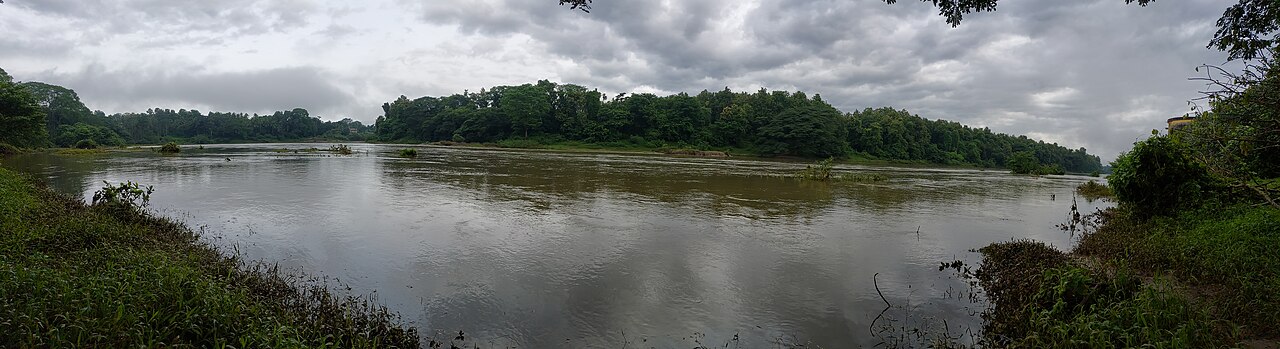
Photographed 2023-07-27 07:42:56
Chaliyar River at Nilambur 05 – Present-day Chaliyar/Nilambur river landscape
Chaliyar River at Nilambur 05. Present-day Chaliyar/Nilambur river landscape; no ancient gold-working or transport claim from scenery.
006Two views
Both views are shown at equal weight; this site does not choose between them.
How old gold washing at Nilambur is
- One view
- William Logan (1887) wrote that the gold had been known "from the earliest times" and that Wayanad mines were worked in "pre-historic times".
- Another view
- Nair, Santosh and Mahadevan (1987) describe local panning over "the last few centuries", and the records read begin in the colonial era (Buchanan 1800, the official papers of 1831–32, and the 1879 lease).
- What would settle it
- A washing feature, tailings or tools with an independent archaeological date, or verified precolonial records naming the locality.
007Where next

The study lists this as related reading.
On the atlasNilambur & Chaliyar Basin Gold/Iron LandscapesCoarse river-basin orientation · Malappuram District
Explore nextCāliyāṟu & Nilampūr (Gold-Bearing River Corridor) (சாலியாறு & நிலம்பூர் / ചാലിയാറും നിലമ്പൂരും)All related studies, connected material, books and sources11 · 12
Elsewhere on this site
Excavation Atlas Sites: Nilambur & Chaliyar Basin Gold/Iron Landscapes
Multi-Script Glossary Terms: Cāliyāṟu & Nilampūr (Gold-Bearing River Corridor) (சாலியாறு & நிலம்பூர் / ചാലിയാറും നിലമ്പൂരും)
Connected material
Photographs, drawings, books, videos and other studies linked to this study. A link helps you explore; it does not prove a historical claim.
- Chaliyar River at Nilambur 05 – Present-day Chaliyar/Nilambur river landscapephotographBackground
- Read the coin, then read its contextdiagramThe copper panel shows the square elephant and bow-and-arrow coin this study cites from a recorded Pattanam layer.
008Sources
The study lists the sources it consulted; we have not rechecked them. A working link does not show that a source was read, and a valid identifier does not show that it supports a claim. We do not link to unofficial uploads or copies of publications. Where a study cited one, we show the published citation, or a publisher, DOI or Internet Archive link when we have one. Tracking codes are removed from links, and the sources themselves are not republished here.
William Logan, Malabar Manual, first published Madras 1887; Internet Archive OCR of a later reprint.
T. A. Gopinatha Rao and G. Venkoba Rao, 'No. 13. – Nilambur Plates of Ravivarman,' Epigraphia Indica VIII (1905–06): 146–149; DHARMA INSSiddham01042.
Online copy not linked · use the published editionSource recordNilambur Thacharakavil Manavadan Thirumalpad v. Parry and Company, Madras High Court, 6 March 1925, 90 Ind Cas 729; (1925) 49 MLJ 390; AIR 1925 Mad 1277.
Department of Mining and Geology, Government of Kerala, 'Mineral Resources,' Gold section.
Print or offline sourceSource recordN. G. K. Nair, M. Santosh and R. Mahadevan, 'Lateritisation as a possible contributor to gold placers in Nilambur Valley, southwest India,' Chemical Geology 60 (1987), 309–315.
Hariharan and Nambiar, 'Geochemistry and Minerology of Chaliyar River Sediments with Special Reference to the Occurrence of Placer Gold,' 2001; partial web mirror.
Print or offline sourceSource recordV. Selvakumar and K. P. Shajan, 'A Note on the Coins from Pattanam,' in Gautam Sen Gupta and Enamul Haque, eds., Abhijñān: Studies in South Asian Archaeology and Art History of Artefacts: Felicitating A.K.M. Zakariah (BAR International Series 1974, Oxford: Archaeopress, 2009).
Print or offline sourceSource recordD. Cvetkovic, 'Investigation of gold occurrences in Nilambur Valley area,' KMEDP Technical Report EG-3 (1980).
Print or offline sourceSource record1984 thesis concerning slave labour in Malabar (citing 1793 colonial archival lead; underlying primary records unread).
Print or offline sourceSource record'Account of the Gold Mines in the Province of Malabar. From official papers communicated by Government.' Madras Journal of Literature and Science 14, no. 32 (1847): 154–181. Prints the Collector Mr Sheffield's communication of 10 January 1831, Lieutenant Woodley Nicolson's letters of 1832 and the committee report of 25 May 1832.
T. J. Newbold, 'Art. XXII. – Mineral Resources of Southern India. No. 4. Gold Tracts,' Journal of the Royal Asiatic Society 7, no. 14 (1843): 203–211 (read 4 June 1842); Nilambur at pp. 209–210.
Francis Buchanan, A Journey from Madras through the Countries of Mysore, Canara, and Malabar, vol. 2 (London: T. Cadell and W. Davies, 1807), ch. XII, p. 441 (entry for 20–21 December 1800).
Researchers and institutions whose work this study uses: V. Selvakumar, K. P. Shajan, William Logan, T. A. Gopinatha Rao
How we know The evidence, claims and dates behind this study
What this study draws on
- Kerala Department of Mining and Geology resource summary and Nair, Santosh & Mahadevan (Chemical Geology 60, 1987) on placer gold
- Francis Buchanan's journal for December 1800 (A Journey from Madras, 1807, vol. 2, p. 441); the Malabar Collector's 1831 report and the 1832 committee papers (Madras Journal of Literature and Science 14, 1847: 154–181); T. J. Newbold's survey (Journal of the Royal Asiatic Society 7, 1843: 203–211); and the 1879 lease recited in a 1925 Madras High Court judgment
- William Logan's Malabar Manual (1887), the 1905–06 Epigraphia Indica VIII edition of the Nilambur plates, and Casson (1989) §56
- Selvakumar and Shajan's report on a stratified copper early Chera coin from Pattanam
Dates in this study
This study has no dates recorded in a form we can chart, so there is no date chart. Any dates it gives are in the full study.
The study’s claims
11 claims · 15 source passages · 52 paragraphs
Browse the study paragraph by paragraphModern geological and government investigations establish primary and placer gold in the Nilambur-Chaliyar/Punnapuzha system.
Supported in this study
Geological occurrence does not date human exploitation.
Geological presence and placer formation do not by themselves date human mining, washing, or metallurgy.
Supported in this study
Human activity requires independently dated archaeological or documentary evidence.
A Madras High Court judgment records a Nilambur-related lease dated 14 August 1879 granting 20 acres for gold washing for 36 years.
Supported in this study
The lease dates a legal right, not necessarily the first-ever local panning.
William Logan's 1887 Malabar Manual directly documents late nineteenth-century local washing of auriferous stream sands after annual floods.
Supported in this study
The passage does not establish when the practice began.
Logan's claims of 'earliest times' or 'pre-historic times' are not independently dated archaeological evidence.
Supported in this study
This does not prove earlier working did not occur.
The Nilambur plates publication reports that the plates were discovered during gold washing on the Chaliyar, but the plate date does not date the later panning episode.
Supported in this study
Ancient object production and later discovery are separate events.
The oldest description read (the Collector's of 1831) calls the washer's wooden tray a 'pautey'; a later study uses 'maravi'; 'muram' remains unverified as an ancient Nilambur gold-washing tool.
Supported with qualifications
Later tool use cannot establish 1000 BCE–600 CE practice.
No securely dated archaeological context for Nilambur-Chaliyar gold extraction, placer washing, or gold working within 1000 BCE–600 CE was located in the sources read.
Supported with qualifications
This is a negative result limited to the sources read, not proof that no such evidence exists. No stratified washing feature, dated mine working, or securely contextualized gold-working assemblage was located.
The stratified early Chera coin described from Pattanam by Selvakumar and Shajan is copper, not gold.
Supported in this study
No analytical or contextual evidence was located linking Nilambur placer gold to the metal of a specific early Chera coin issue.
Supported with qualifications
A defensible link would require authenticated coin samples, comparative Nilambur samples, provenance-discriminating analysis and contextual control.
Within the evidence read, gold collecting at Nilambur is documented from Francis Buchanan's journal entry of December 1800 (a Nair's exclusive right, for tribute), and in detail from the Collector's communication of 10 January 1831 and the 1832 inquiry papers printed in 1847, followed by the 14 August 1879 commercial lease and Logan (1887); Newbold (1843) repeats Dr Ward's figures. None of these dates the practice to 1000 BCE–600 CE.
Supported in this study
The right to collect gold was already farmed out in 1800; how much older it is was not established. The official papers of 1793 were not read for this study.
Trace one claim through the study’s records
Explore the evidenceOther source lists
Numbered citation links from the study
The numbered links in the study text point here.
മിനറല് റിസോഴ്സസ്സ് – Department of Mining and Geology
Print or offline sourceNilambur Thacharakavil Manavedan ... vs Parry And Company on 6 March, 1925
Malabar Manual, Vol. 1
Nilambur Plates of Ravivarman, Epigraphia Indica VIII (1905–06): 146–149; DHARMA INSSiddham01042
Epigraphia Indica Vol 08 - Jain Quantum
Hariharan & Nambiar (2001), Geochemistry and Mineralogy of Chaliyar River Sediments with Special Reference to Placer Gold
Hariharan and Nambiar, Geochemistry and Mineralogy of Chaliyar River Sediments with Special Reference to the Occurrence of Placer Gold (2001; partial copy consulted).
Print or offline sourceSelvakumar & Shajan (2009), Coins from Pattanam, Abhijñān (BAR S1974)
V. Selvakumar and K. P. Shajan, 'A Note on the Coins from Pattanam,' in Abhijñān (Oxford: Archaeopress, 2009).
മിനറല് റിസോഴ്സസ്സ് – Department of Mining and Geology
Print or offline sourceLateritisation as a possible contributor to gold placers in Nilambur Valley, southwest India - ScienceDirect
University of Kerala Department confirms palaeolithic find | Megalithic Portal
1984 Malabar labour thesis archival lead (secondary); see 1925 High Court judgment for 1879 lease
Archival lead on early British Malabar gold washing (to be checked against 1792–93 Joint Commissioners' Report and Buchanan 1807).
Nilambur Thacharakavil Manavedan ... vs Parry And Company on 6 March, 1925
Malabar Manual, Vol. 1
Malabar Manual, Vol. 1
Hariharan & Nambiar (2001), Geochemistry and Mineralogy of Chaliyar River Sediments with Special Reference to Placer Gold
Hariharan and Nambiar, Geochemistry and Mineralogy of Chaliyar River Sediments with Special Reference to the Occurrence of Placer Gold (2001; partial copy consulted).
Print or offline sourceNilambur basin echoes with tumult of colonial-era ‘Malabar Gold Rush’
Nilambur Thacharakavil Manavedan ... vs Parry And Company on 6 March, 1925
Mineral Resources – Department of Mining and Geology
Print or offline sourceNilambur Plates of Ravivarman, Epigraphia Indica VIII (1905–06): 146–149; DHARMA INSSiddham01042
Epigraphia Indica Vol 08 - Jain Quantum
New Light on the Unresolved Problem of Megalithic Habitation Sites in Kerala | Artha Journal of Social Sciences
About this study Status, corrections and how it was made
Status
Draft study, revision 11. No historian, archaeologist, or Tamil or Malayalam specialist has reviewed it yet.
How it was made
Compiled as an editorial synthesis from published scholarship around questions we framed. About this project & workflow
The summary, How sure lines and Two views notes on this page were prepared from this study and cross-checked against its passages. That is an editorial check, not a specialist review.
Technical details
Study code R181. The text fingerprint changes whenever the study text changes.
- The study text is shown as written. Links from its paragraphs to citations help you move around the study; they are not new claims or checked source passages.
See how this study’s records were extracted
Text fingerprint (SHA-256): R181 · 4ddbea415816f4e8f0b2e01a… · v11
Evidence tables and technical details are on the web page: https://layersofthesouth.org/read/f6a19c438d