Photomicrographs of subfossil Calophyllum and Careya wood, with numbered anatomical sections and scale bars
This material does not come from an excavated settlement and is not direct evidence of farming.
- Across the water
Teak in Indian Ocean trade: no proven Western Ghats source
Teak reached Berenike on the Red Sea and appears in the Periplus, but no reviewed source ties it to a Western Ghats forest or shipyard.
- This page
- 4,213 words · revision 4
Draft study · Awaiting specialist review · Updated
001Dates and places

No mapped place in this study.
1000–500 BCE
Different beginnings
500–200 BCE
Marks & materials
200 BCE–300 CE
Connected worlds
300–600 CE
Change & continuity
- later first century CE
- 301–600 CE
- How it was dated is not stated
Each date belongs to what was dated (a sample, an object, a layer or a text), which is not always the event the study asks about.
Each period has the same width, so spacing is not to scale.
The full table of dates, with their ranges, is under How we know.
- 1 Well supported
- 1 Likely
- 2 Not known
002How sure
In brief
Excavations at Egypt's Red Sea ports of Berenike and Myos Hormos recovered teak (Tectona grandis) among imported timbers. At Berenike, Bouchaud, Newton, Van der Veen and Vermeeren (2018) document teak hull planks with nails, cross-laths and pitch, and Sidebotham (2018) records Late Roman teak beams reused from dismantled ships; teak ship timbers are also reported from Myos Hormos (Blue, Whitewright and Thomas 2011; that chapter was not read for this study). Sidebotham (2020) and Seland (2014) both caution that teak timbers do not establish where a vessel was built – ships built elsewhere could be repaired with teak in Indian ports, or built in Egypt from imported wood. After Lionel Casson's 1982 correction, the Periplus still names teak in trade from Barygaza in northwestern India. Because teak grows naturally from India to Indochina, species identification does not locate a Western Ghats forest. At Pattanam in Kerala, teak posts stood beside an anjili canoe, showing local use rather than export; no reviewed core-period source documents Chaliyar rafting or ancient rosewood.
Key researchers cited in this study: Steven E. Sidebotham (Berenike Red Sea Excavations) · Lionel Casson (Periplus Maris Erythraei Philology) · Wilfred H. Schoff (Periplus Translation & Commentary) · Willeke Wendrich (Berenike Project Excavations) · Full bibliography
How sure
- Well supported
Teak reached Berenike and Myos Hormos in the Red Sea trade.
Specialist wood and maritime-finds publications identify teak hull planks and reused beams at both Red Sea ports.
- Likely
The Periplus records teak in trade from Barygaza.
Rests on Casson's reading of a textually tangled passage in §36.
- Not known
Where the ships using Indian teak were built.
Sidebotham (2020) and Seland (2014) leave repair in India, construction in India, and construction in Egypt from imported timber all open.
- Not known
Western Ghats teak was rafted down Kerala rivers before 600 CE.
No core-period source was found; the Nilambur rafting evidence is nineteenth-century.
Why it matters
It separates what the evidence shows about the teak trade from the attractive but unproven idea that Kerala forests supplied Roman-era ships.
003Key findings
What the study concludes
- Archaeological teak at Berenike is evidence of long-distance hardwood circulation.
- Tectona grandis identification does not by itself determine Western Ghats provenance.
- Berenike ship-timber interpretation leaves Indian and Egyptian manufacture scenarios open.
- Core-period Chaliyar rafting and ancient Dalbergia latifolia export were not established by the reviewed evidence.
- Nineteenth-century Nilambur-Chaliyar material is valuable later comparison, not automatic evidence for antiquity.
In the study’s own words. How sure each point is, is shown above.
The summary above is the short read. The full study is the complete text it was drawn from, with its tables and source notes.
What the full study covers
- Question, scope, and orientation
- Evidence ladder: wood species, provenance, manufacture, and route are different claims
- Berenike and Myos Hormos: strong evidence for teak movement, weak evidence for a specific forest or shipyard
- The Periplus and Pliny: timber trade, but not a Western Ghats supply chain
- Western Ghats rafting, rosewood, and later analogies
- Conclusions, discriminating tests, remaining work, and source trail
004The study
Question, scope, and orientation
What evidence establishes hardwood procurement and movement across regional and overseas networks?
This study tests the idea that teak and rosewood from the Western Ghats were rafted down rivers to Indian Ocean shipyards. It treats that idea as a set of propositions to test, not as a result. Botanical identification, geographical origin, manufacture, river transport and overseas movement are examined separately, because Berenike timber or a Periplus cargo list cannot by themselves identify a Western Ghats forest or shipyard.
Orientation. The evidence is strongest for a narrower proposition than that idea. Archaeobotanical and wood studies from Roman- and Late Antique-period Berenike and its associated landscape identify teak (Tectona grandis) among excavated wood, while literary evidence in the Periplus Maris Erythraei supports movement of teak and other timbers through western Indian Ocean trade. Excavator and wood-specialist reports from Berenike document reused ship timbers of Indian teak (Tectona grandis) – including curved planks with nails, cross-laths, and pitch/tar as well as Late Roman architectural beams – while Steven E. Sidebotham (2020) and Eivind Seland (2014) explicitly caution that teak parts cannot establish where a ship was originally built: vessels built elsewhere could be repaired with teak in Indian ports, or built in Egypt from imported timber. ↗1
What does not follow is equally important. Tectona grandis has a native range extending from India to Indo-China, so species identification is not a Western Ghats provenance test. Modern timber-forensics institutions likewise distinguish identifying wood to genus/species from verifying geographical origin. ↗2 The reviewed evidence therefore does not establish a chain from a named Western Ghats forest, down a named Kerala river by raft, into a named Malabar shipyard, and then onward to Berenike. Nor did this study locate secure core-period evidence for Dalbergia latifolia (“Indian rosewood”) in that chain.
Period: mixed. The central evidence belongs mainly to the first centuries CE and Late Antiquity, inside the 1000 BCE–600 CE period that Layers of the South covers. The Periplus is generally dated to the middle of the first century CE (Casson: about 40–70 CE); Casson's geographical discussion distinguishes the northwestern Indian center Barygaza from the southwestern ports Muziris and Nelkynda in Limyrike/Malabar. ↗3 The Nilambur–Chaliyar evidence securely dated in official modern heritage material belongs instead to the nineteenth century: Kerala Tourism dates Conolly's teak plantation to 1846 and locates it between the Chaliyar and Kurinjipuzha. That is useful as a later comparison for a physically plausible timber landscape, not as evidence that the same procurement system existed in antiquity. ↗4
Evidence ladder: wood species, provenance, manufacture, and route are different claims
The central methodological problem is an inference ladder. A wood sample can be identified anatomically; an artefact's fasteners, curvature, joins, pitch, repair traces, or reuse context can inform function; a textual cargo list can document commodities and named ports. None of these observations automatically supplies the missing steps of forest origin, logging district, overland or river movement, workshop, shipyard, or direct voyage.
Modern wood identification makes this distinction explicit. US Forest Service wood-anatomy guidance describes identification through structural characters such as vessels, rays, parenchyma, and other microscopic or macroscopic features. The Thünen Centre of Competence, whose work includes forensic timber identification, separately describes determining wood to genus or species and verifying geographical origin where suitable methods and reference material exist. ↗5 In archaeological terms, an anatomical identification of Tectona grandis can be strong evidence for taxon; it is not, without a provenance-sensitive method and comparative reference set, evidence for Nilambur, the Western Ghats, Kerala, or even a particular part of India.
That distinction is consequential because Kew treats Tectona grandis as an accepted species with a native distribution extending from India into mainland Southeast Asia. ↗6 Even an archaeological interpretation of “Indian” teak is geographically much broader than “Western Ghats teak.” A Western Ghats attribution would require an additional discriminator – for example a validated isotopic, genetic, chemical, dendrological, or other geographical-origin method with appropriate archaeological controls and reference populations. No such provenance analysis for the Berenike teak was located in the sources reviewed here.
The same restraint applies to manufacture. Excavator Steven E. Sidebotham (2020, p. 19) explicitly warns that teak components cannot establish where a vessel was originally constructed, because ships built outside South Asia could receive teak repairs while calling at Indian ports; Eivind Seland's 2014 synthesis likewise leaves open construction or repair in India using Mediterranean mortise-and-tenon practice versus construction in Egypt from imported wood. ↗7 The evidence consequently supports “teak entered a maritime technological context” much more securely than “a Western Ghats shipyard built the vessel.” The location of construction remains underdetermined.
A final distinction concerns “Indian” as a trade-geographic inference versus a botanical measurement. Berenike's excavation record belongs to an Indian Ocean exchange environment connecting the Egyptian Red Sea with India, South Arabia, and other regions; the official UCLA description of the 1999/2000 excavations emphasizes extensive evidence for exchange with India. ↗8 Such context can strengthen an Indian-origin interpretation, but contextual probability is not equivalent to a provenance assay on a piece of wood.
Artocarpus hirsutus-2-JNTBGRI-palode-kerala-India – Modern anjili identification
Photographed 2018-05-15
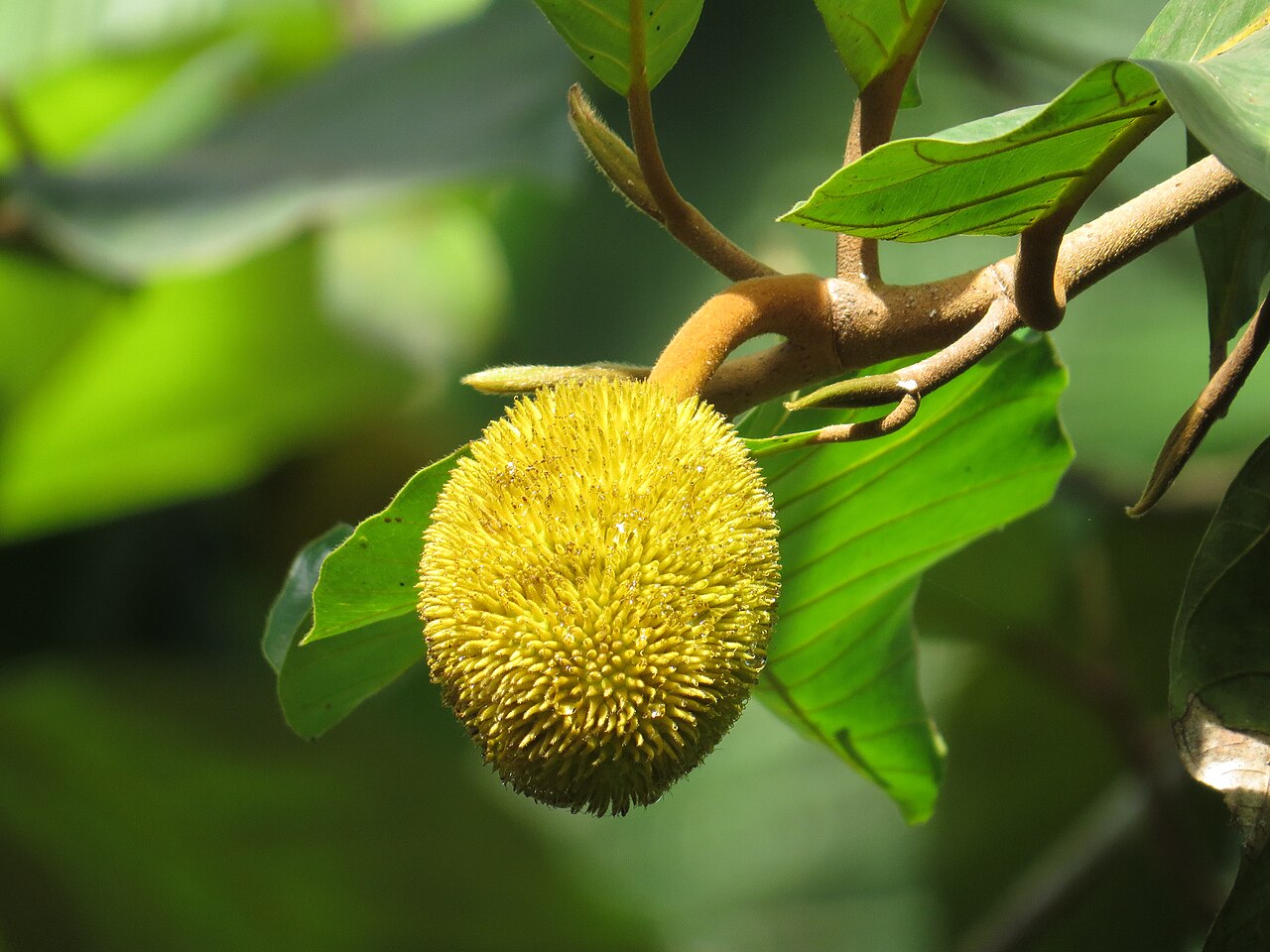
Kerala offers a local example of the gap between naming a species and knowing where the wood came from. At Pattanam in central Kerala, excavators reported a dugout canoe made of Artocarpus hirsutus (anjili) and waterfront posts or bollards made of Tectona grandis (teak) (Cherian et al. 2009, Current Science 97(2): 236–240). These are two species used for two kinds of object, not a single boatbuilding recipe, and neither object shows how ocean-going ships were built. Kew gives anjili a native range of south-western India and western Sri Lanka (Royal Botanic Gardens, Kew, Plants of the World Online: Artocarpus hirsutus Lam.), but a modern range is not proof of where ancient wood was obtained. The Pattanam posts show teak in use at a Kerala waterfront; they are broadly dated and, on their own, are not evidence of teak exports. “Pattanam's radiocarbon dates give no single date for its wharf” covers the canoe and posts, with their radiocarbon ranges, in detail.
Modern wood science explains why species and preparation matter to any woodworker. Wood swells and shrinks by different amounts along and across the grain, and air-drying time depends on species, thickness, weather and how the timber is arranged, so there is no universal drying schedule (Glass and Zelinka 2021, Wood Handbook, ch. 4; Bergman 2021, Wood Handbook, ch. 13). These are modern explanations, not a record of how ancient woodworkers in Kerala worked.
Berenike and Myos Hormos: strong evidence for teak movement, weak evidence for a specific forest or shipyard
The strongest archaeological evidence comes from Egypt's Red Sea ports, above all Berenike. Specialist archaeobotanical synthesis by Charlène Bouchaud, Claire Newton, Marijke Van der Veen, and Caroline Vermeeren (2018, drawing on Vermeeren's foundational Berenike 1997 and 1998 wood chapters) identifies Tectona grandis among Berenike's worked timber and illustrates maritime-associated pieces – including a teak board with an iron nail, a cross-lath feature, and pitch or tar – interpreting curved teak planks with fasteners and pitch as reused boat-hull material while noting that older Berenike wood datasets do not always separate Roman and later phases with uniform precision (Bouchaud et al. 2018). Steven E. Sidebotham's fieldwork overview independently records Late Roman teak beams with dowel holes and pitch or tar reused in religious and secular structures at Berenike, interpreting them as recycled from dismantled ships (Sidebotham 2018). The Institut français d'archéologie orientale worked-wood database additionally indexes Vermeeren's report on Shenshef (Berenike 1997, pp. 427–429), recording teak in a 301–600 CE context. ↗10
Crucially, Sidebotham himself sets the interpretive limit on ship origin: in his 2019–2020 Berenike excavation report (p. 19), he warns that teak timbers cannot establish where a vessel was originally constructed, because ships built outside South Asia could receive teak repairs while calling at Indian ports (Sidebotham 2020). Eivind Seland's 2014 synthesis makes a parallel point, leaving open construction or repair in India versus construction in Egypt from imported timber. ↗11
Myos Hormos (Quseir al-Qadim) is reported in secondary maritime syntheses to supply a parallel Red Sea teak record: according to published summaries of the University of Southampton excavations (Lucy Blue, Julian Whitewright, and Ross Thomas, 2011; that chapter was not read for this study), the site is reported to have yielded reused teak ship timbers and fittings alongside Mediterranean wood. Together, Berenike and Myos Hormos confirm recurring circulation and maritime reuse of teak across Egypt's Red Sea ports without naming its source forest. This prevents an important inferential shortcut: the presence of Indian teak in a ship component does not uniquely locate construction. Wood can move as raw or prepared timber, as part of a completed vessel, during repair, and again through recycling. A reused beam in an Egyptian building therefore potentially represents several distinct stages: tree growth and felling, timber conversion, vessel manufacture or repair, operation, abandonment, and secondary reuse/deposition.
The material evidence accordingly supports a network proposition. Teak reached the Egyptian Red Sea sphere in forms substantial enough to enter maritime material culture and later reuse. Berenike's wider excavation record independently establishes intensive Indian Ocean connections; the official UCLA publication description reports evidence for exchange with India, South Arabia, and sub-Saharan Africa. ↗8 But neither anatomical species identification nor the reuse context names the logging forest. No consulted Berenike source in this study supplied a Chaliyar, Nilambur, Western Ghats, or Beypore provenance, and the accessible scholarly synthesis explicitly leaves manufacture location open. “Tamil writing found on pots at Egypt's Red Sea ports” examines the Berenike and Quseir al-Qadim evidence for South Indian connections, including teak timbers, in more detail.
Further sources could sharpen this finding. The highest-value targets are the full Vermeeren 1996–1998 wood reports and Sidebotham & Wendrich's 1999/2000 excavation report around the cited ship-timber discussion, including specimen/context identifiers, identification criteria, tables, drawings, and photographs. Reinspection could strengthen or narrow claims about reuse and construction technique. It would establish Western Ghats provenance only if those publications contain a geographical-origin method beyond species identification.
The Periplus and Pliny: timber trade, but not a Western Ghats supply chain
Reading Periplus §36 as a mention of “teak beams (dokan)” requires correction. The older Schoff translation of Periplus §36 renders a Barygaza-to-Ommana cargo list including copper, sandalwood, “timbers of teakwood,” blackwood, and ebony. ↗12 Lionel Casson's philological study shows that this traditional identification is textually tangled: the expressions previously interpreted as sandalwood instead refer to teak, whereas the words traditionally treated as teak do not carry that identification. Casson further explains that Schoff's rendering reflects an emended Greek text rather than a simple equivalence between dokan and the botanical taxon teak. ↗13 The equation dokan = teak is therefore too precise.
The correction does not remove teak from the Periplus. Casson's argument relocates the identification within the passage. What changes is the permissible historical claim: the text is evidence for teak as a traded commodity in the Barygaza/Omana commercial world, not evidence that an ancient lexical item meaning “beams” itself means teak, and still less evidence for “teak beams from the Western Ghats.” ↗13
Geography creates a second constraint. Casson distinguishes Barygaza as a northwestern Indian commercial center from Muziris and Nelkynda in the southwestern region described as Limyrike, approximately the Malabar coast. ↗3 A commodity associated with Barygaza should not therefore be reassigned to Kerala merely because teak also grows in southern India. Nor does a cargo list demonstrate a direct end-to-end voyage: intermediary merchants, inland procurement, transshipment, and multiple production zones remain possible. Casson's discussion also records uncertainty over Omana's identification, making a highly precise reconstructed route inappropriate. ↗13
Pliny is even less suitable as direct evidence for a Western Ghats chain. Casson's discussion of Natural History 16.221 and its Theophrastean parallel concerns exceptionally durable shipbuilding wood associated with Tylos/Bahrain. Some scholarship identified that wood as teak, which would imply import because teak is not native to Bahrain; alternative identifications have also been proposed. ↗13 The passage does not name a Western Ghats forest, Kerala river, or Malabar shipyard. Because the relevant Pliny passage was not independently read here in a critical edition, this study uses it only as contextual evidence for ancient discussion of durable Gulf ship timber, not as a provenance record.
The literary evidence therefore establishes commodity movement and maritime demand more securely than procurement geography. Its evidential value increases when considered alongside archaeological teak from Berenike, but convergence on “teak circulated in western Indian Ocean networks” must not be transformed into convergence on “the Western Ghats supplied Berenike.” The second proposition requires an origin link neither the literary vocabulary nor the anatomical identification currently supplies.
Western Ghats rafting, rosewood, and later analogies
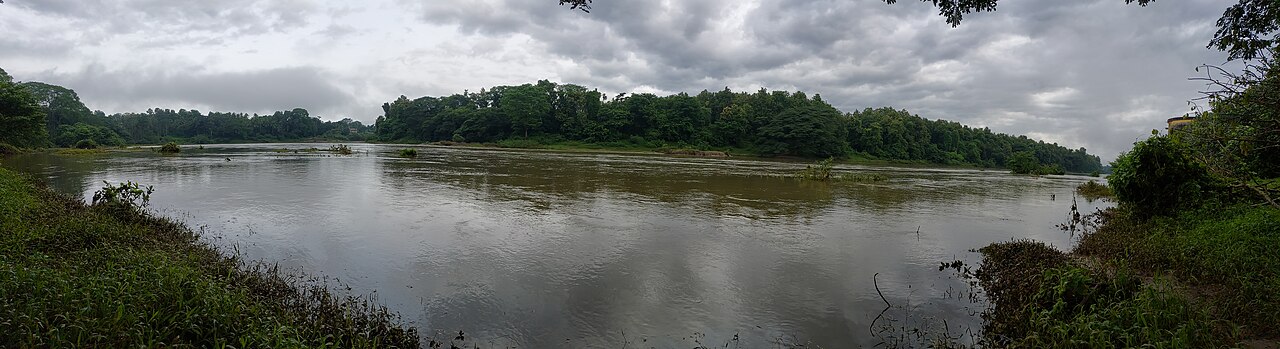
The rafting proposition was tested on its own. In the accessible core-period evidence reviewed here, no source securely documented timber being rafted down the Chaliyar or another named Western Ghats river between 1000 BCE and 600 CE. Targeted English, Malayalam, and Tamil discovery searches were made for combinations of teak, timber rafting, Chaliyar/Nilambur, Sangam material, and shipbuilding. The relevant official material that surfaced for Nilambur instead belongs to a much later chronology: Kerala Tourism dates Conolly's Plot to 1846 and places it on the Chaliyar/Kurinjipuzha river system. ↗14 This is a negative result limited to the sources read from this study, not a universal assertion that no ancient evidence exists.
Tectona grandis from Kerala 01 – Modern teak tree or wood as material context
Photographed 2023-12-23
Later evidence explains why the rafting hypothesis is plausible enough to investigate but unsafe to back-project. Buchanan's 1807 Journey from Madras through the Countries of Mysore, Canara, and Malabar survives in catalogued historical collections and provides an obvious primary source to read next for the early colonial timber economy. ↗15 A modern account drawing on Buchanan describes teak cut in the Ghats, movement by elephants to seasonally usable watercourses, and downstream transport near Vaypura/Baypour around 1800. ↗16 Because the underlying original printed passage was not directly read here, those logistical details are retained only as an acquisition lead. Even after verification they would document a system more than a millennium later than the project's core evidence.
William Logan's Malabar (1887) describes Malabar's rivers, backwaters and canals crowded with produce boats and with very large timber rafts moved slowly downstream to timber depots; the passage is district-wide, not specific to the Chaliyar. His separate description of the Beypore River, his name for the lower Chaliyar, says that it drains a large tract of the Wayanad Ghats and Nilgiri mountains, that its branches unite amid the Nilambur Government teak plantations, and that even in the dry season light-draught boats could ascend as far as Mambat. Logan also records the Conolly Canal, completed in 1848, tying the Ellattur and Kallai waterways into the Beypore River network, so the colonial timber corridor was partly engineered and cannot by itself establish the form or course of a first-millennium route. (William Logan, Malabar, vol. I, Madras: Government Press, 1887, Internet Archive OCR text: https://archive.org/details/malabarmanual0000loga.)
A decisive ancient test would need evidence independent of the colonial timber economy: securely stratified early historic timber-working debris; waterlogged timbers or structural elements with radiocarbon or tree-ring dates where feasible; dated landing places; associated tools and working surfaces; or contemporary texts or inscriptions demonstrably tied to the Chaliyar basin.
The “rosewood” component is weaker still. Kew recognizes Dalbergia latifolia as an accepted species with a range spanning parts of the Indian subcontinent and farther east. ↗17 But a broad ancient commodity label translated as “blackwood” is not by itself a species-level determination of D. latifolia. No consulted archaeological identification of D. latifolia from the Berenike evidence used here supplied the missing link. “Rosewood” should therefore not appear as an established ancient export in the headline finding.
The same caution applies to Beypore or uru continuity narratives. Later shipbuilding importance cannot substitute for a securely dated early historic workshop. This study did not locate an inspectable first-millennium BCE or early-first-millennium CE Beypore shipyard assemblage that could be tied by wood identification, workshop debris, dating, or provenance to the Berenike timbers. That bounded result does not question the importance of later Beypore craftsmanship; it prevents later historical or ethnographic practice from functioning as automatic evidence for Roman-period procurement.
A defensible chronology is consequently:
Core period: teak and other hardwoods circulated in Indian Ocean commercial networks, with Berenike supplying material evidence and the Periplus supplying textual commodity evidence. ↗18
Later comparison: the Nilambur–Chaliyar landscape provides historically documented evidence for an important teak economy and river-connected transport environment, especially from the nineteenth century onward. ↗4
Open historical link: no reviewed evidence yet connects a specific core-period Kerala forest, river-rafting operation, and shipyard to the teak recovered in the Egyptian Red Sea sphere.
Conclusions, discriminating tests, remaining work, and source trail
Conclusions and strongest disagreements. The best-supported conclusion is that hardwood movement across regional and overseas networks is established at the level of commodity and material circulation, but not at the level of a complete Western Ghats procurement chain. Archaeologically identified teak in the Berenike project landscape and the corrected Periplus evidence are mutually compatible with long-distance teak circulation in the western Indian Ocean. ↗18 The evidence does not identify the Western Ghats as the source forest, and no provenance-sensitive assay for the relevant Berenike wood was located. Kew's broad native range for teak and the methodological separation between taxonomic identification and geographical-origin testing make that limitation substantive rather than merely terminological. ↗2
Indian rosewood foliage (Dalbergia latifolia, modern botanical context)
Photographed 2007-06-10
The most important interpretive question concerns where vessels using Indian teak were built or repaired. Both Sidebotham (2020) and Seland (2014) leave open multiple possibilities: repair of foreign vessels in Indian ports, construction in India using Mediterranean-style technology, or construction in Egypt using imported timber. ↗11 Evidence capable of discriminating between them would include securely contextualized hull components, construction and repair sequences, workshop waste, tool and join analyses, or – most decisively for the forest-origin question – a validated geographical-provenance analysis of the wood.
The rafting hypothesis remains open but unproven for the target period. A decisive positive case would require evidence actually connecting a core-period Western Ghats catchment to timber movement: for example dated riverine timber infrastructure, wood assemblages with transport traces, explicit inscriptions or administrative records, or geographically resolvable literary testimony. Nineteenth-century Chaliyar evidence cannot bridge that chronological gap by itself. ↗4
The rosewood proposition should be held. A decisive case would require either analytical identification of an archaeological specimen as Dalbergia latifolia, with method and context reported, or a philologically secure ancient term that can be tied to that taxon rather than a generic class of dark wood. Modern botanical taxonomy defines the candidate species; it does not retroactively identify an ancient commodity term. ↗17
Acquisition and remaining work. The highest-priority sources to read next are the complete Vermeeren wood reports from the Berenike campaigns, especially the 1997 and 1998 “Wood and charcoal” chapters, with their specimen inventories and diagnostic criteria. Next are Sidebotham & Wendrich's 2007 report around the ship-timber discussion and Sidebotham's 2011 synthesis at the relevant pages, so the manufacturing argument can be checked directly rather than solely through a later review. UCLA's official publication record confirms the 2007 excavation monograph and describes it as an open-access publication, although the target pages were not successfully read in this study. ↗8
For Kerala, later comparison and core-period investigation should remain separate. Buchanan's 1807 text should be read at the exact Vaypura/Baypour passage to verify later teak logistics. ↗15 Core-period work should instead target archaeological reports, palaeobotanical and wood-analysis publications, epigraphic indices, and critically edited Malayalam/Tamil-relevant textual corpora for securely dated evidence of teak, Dalbergia, timber working, or river transport. The original-language discovery searches in this study did not reveal a consequential inspectable core-period passage; this is a source-recovery gap, not proof of historical absence.
For scientific provenance, the first practical question is whether relevant Berenike teak specimens survive in accessible curated collections. Only then would minimally destructive geographical-origin work be assessable. Contemporary forensic practice shows why such testing is analytically distinct from anatomical identification, but an archaeological application would require specimen permissions, reference populations, taphonomic controls, and a method validated for Tectona grandis. ↗19
Selected bibliography and source trail
| Work | Evidential role | Access achieved |
|---|---|---|
| Lionel Casson, “Periplus Maris Erythraei 36: Teak, Not Sandalwood,” Classical Quarterly 32.1 (1982), 181–183. DOI 10.1017/S0009838800022989; https://doi.org/10.1017/S0009838800022989 | Corrects the teak/sandalwood lexical history and the older “teakwood timbers” interpretation; also discusses Tylos/Pliny. | Relevant text and notes read. ↗13 |
| Lionel Casson, The Periplus Maris Erythraei: Text with Introduction, Translation, and Commentary (Princeton University Press, 1989). https://www.jstor.org/stable/j.ctt7t6tp | Preferred modern edition and commentary for the Periplus. | Bibliographic record verified; full book was not consulted directly for this study. |
| Wilfred H. Schoff, trans., The Periplus of the Erythraean Sea (1912). | Preserves the influential older English rendering behind the older English rendering. | Relevant §36 digital text read; used only with Casson's correction. ↗21 |
| Charlène Bouchaud, Claire Newton, Marijke Van der Veen, and Caroline Vermeeren, “Fuelwood and Wood Supplies in the Eastern Desert of Egypt during Roman Times,” in The Eastern Desert of Egypt during the Greco-Roman Period: Archaeological Reports (Collège de France / OpenEdition Books, 2018), https://books.openedition.org/cdf/5237?lang=en | Open-access specialist wood synthesis documenting Berenike Tectona grandis hull planks, nails, cross-laths, pitch/tar, and chronological caveats. | Relevant HTML text and figures consulted (see “Tamil writing found on pots at Egypt's Red Sea ports”). |
| Steven E. Sidebotham, “Overview of Fieldwork at Berenike 1994–2015,” in the same OpenEdition volume (2018), https://books.openedition.org/cdf/5250?lang=en | Excavator overview documenting Late Roman reused teak beams recycled from dismantled ships. | Relevant HTML text consulted (see “Tamil writing found on pots at Egypt's Red Sea ports”). |
| Steven E. Sidebotham, “Berenike 2019: Report on the Excavations” (2020, p. 19), | Excavator caution that teak components cannot prove where a ship was built, given repair at Indian ports. | Relevant page consulted (see “Tamil writing found on pots at Egypt's Red Sea ports”). |
| Lucy Blue, Julian Whitewright, and Ross Thomas, “Ships and Ships' Fittings,” ch. 15 in David Peacock and Lucy Blue (eds.), Myos Hormos – Quseir al-Qadim: Roman and Islamic Ports on the Red Sea, Volume 2: Finds from the Excavations 1999–2003, BAR International Series 2286 (Oxford: Archaeopress, 2011). | Primary publication of reused teak ship timbers and maritime fittings at Myos Hormos. | Bibliographic citation; full chapter was not consulted directly for this study. |
| Caroline E. Vermeeren, “Wood and charcoal,” in Sidebotham & Wendrich, eds., Berenike 1997 (Leiden: CNWS, 1999), 307–324. | Foundational specialist wood report synthesized in Bouchaud et al. 2018. | Bibliographic reference; original chapter was not consulted directly for this study. |
| Caroline E. Vermeeren, “Wood and charcoal,” in Sidebotham & Wendrich, eds., Berenike 1998 (Leiden: CNWS, 2000), 311–342. | Foundational specialist wood report for the following campaign. | Citation verified; complete chapter not read. ↗23 |
| Caroline E. Vermeeren, “Wood and charcoal from Shenshef,” in Berenike 1997 (1999), 427–429; IFAO worked-wood database, https://www.ifao.egnet.net/bases/bois/ | Institutional record listing teak and a 301–600 CE date range. | Database record read. ↗10 |
| Caroline E. Vermeeren, “The Use of Imported and Local Wood Species at the Roman Port of Berenike, Red Sea Coast, Egypt,” in Marijke van der Veen, ed., The Exploitation of Plant Resources in Ancient Africa, 199–204. DOI 10.1007/978-1-4757-6730-8_16. | Specialist synthesis of imported and local wood at Berenike. | Bibliographic/abstract-level material checked; full chapter not read. |
| Steven E. Sidebotham and Willeke Wendrich, eds., Berenike 1999/2000 (Cotsen Institute of Archaeology, UCLA, 2007), ISBN 978-1-931745-29-1; https://ioa.ucla.edu/node/808 | Primary excavation publication cited in later ship-timber discussions. | Official metadata and publication description read; relevant internal page not directly read. ↗8 |
| Steven E. Sidebotham, Berenike and the Ancient Maritime Spice Route (University of California Press, 2011). DOI 10.1525/california/9780520244306.001.0001; https://www.ucpress.edu/books/berenike-and-the-ancient-maritime-spice-route/hardcover | Major excavation synthesis and source to read next for the ship-timber interpretation. | Publisher metadata read; target pages not directly read. ↗24 |
| Eivind Heldaas Seland, “Archaeology of Trade in the Western Indian Ocean, 300 BC–AD 700,” Journal of Archaeological Research 22.4 (2014), 367–402. DOI 10.1007/s10814-014-9075-7 | Peer-reviewed synthesis explicitly preserving alternative construction locations for Indian-teak ship timber. | Relevant passage read. ↗7 |
| Royal Botanic Gardens, Kew, Plants of the World Online, Tectona grandis L.f., https://powo.science.kew.org/taxon/urn:lsid:ipni.org:names:864923-1 | Accepted taxon and broad native distribution; key control on provenance inference. | Relevant record read. ↗6 |
| Royal Botanic Gardens, Kew, Plants of the World Online, Dalbergia latifolia Roxb., https://powo.science.kew.org/taxon/urn:lsid:ipni.org:names:490295-1 | Defines the modern “Indian rosewood” candidate taxon; does not identify ancient “blackwood.” | Relevant record read. ↗17 |
| Alex C. Wiedenhoeft, “Basic wood biology – Anatomy for identification” (USDA Forest Service, 2011), https://research.fs.usda.gov/treesearch/42218 | Methodological control for anatomical taxonomic identification. | Official abstract/metadata read. ↗25 |
| Thünen Centre of Competence on the Origin of Timber, https://www.thuenen.de/en/thuenen-institute/compound-structures/thuenen-kompetenzzentrum-holzherkuenfte | Official methodological source distinguishing species identification from geographical-origin verification. | Relevant page read. ↗19 |
| Francis Buchanan, A Journey from Madras through the Countries of Mysore, Canara, and Malabar (London, 1807). | Later-comparison primary source and source to read next for early colonial teak logistics. | Bibliographic/public-domain scan metadata read; relevant original page not directly read. ↗15 |
| Kerala Tourism, “Conolly's Plot” (2024), https://www.keralatourism.org/kerala-article/2024/conollys-plot-nilambur-oldest-teak-plantation-2024/1445 | Official later comparison for the 1846 plantation and its river setting. | Relevant page read. ↗14 |
005Photographs
Photographs of the places and objects this study discusses. Each item carries its creator’s credit, licence and documented source. See all 412 photographs and source images ↗

Photomicrographs of subfossil Calophyllum and Careya wood, with numbered anatomical sections and scale bars
This material does not come from an excavated settlement and is not direct evidence of farming.

Photographed 2018-05-15 16:23:01
Artocarpus hirsutus-2-JNTBGRI-palode-kerala-India – Modern anjili identification
Artocarpus hirsutus-2-JNTBGRI-palode-kerala-India. Modern anjili identification; no ancient woodworking technique inferred from this image.

Photographed 2023-12-23 15:28:38
Tectona grandis from Kerala 01 – Modern teak tree or wood as material context
Tectona grandis from Kerala 01. Modern teak tree or wood as material context.

Photographed 2007-06-10 14:39
Indian rosewood foliage (Dalbergia latifolia, modern botanical context)
Dalbergia latifolia (Indian rosewood) foliage, shown as modern botanical context.

Photographed 2019-11-14 14:27
Indian rosewood specimen (Dalbergia latifolia Roxb., modern botanical context)
Dalbergia latifolia Roxb. (49108122833). Modern Indian rosewood botanical context.
Photographed 2023-07-27 07:42:56
Chaliyar River at Nilambur 05 – Present-day Chaliyar/Nilambur river landscape
Chaliyar River at Nilambur 05. Present-day Chaliyar/Nilambur river landscape; no ancient gold-working or transport claim from scenery.
Photographed 2015-05-01 09:25:37
Artocarpus hirsutus immature fruits from Tuvvur, Kerala, India – Modern anjili identification
Artocarpus hirsutus immature fruits from Tuvvur, Kerala, India. Modern anjili identification; no ancient woodworking technique inferred from this image.
006Two views
Both views are shown at equal weight; this site does not choose between them.
Where the ships made with Indian teak were built
- One view
- One reading in the Berenike excavation literature, summarised by Seland (2014): they were built or repaired in India with Mediterranean joinery.
- Another view
- The other reading, also kept open by Seland: they were built in Egypt from teak imported as timber.
- What would settle it
- Securely dated hull parts, construction and repair sequences, workshop waste, or a tested method for tracing where the wood grew.
007Where next
All related studies, connected material, books and sources10 · 17
Elsewhere on this site
Multi-Script Glossary Terms: āññili / ayini (Artocarpus hirsutus) (அயினி / ஆஞ்சிலி / ആഞ്ഞിലി / അയിനി) · akil (Agarwood) & cantaṉam (Sandalwood) (அகில் & சந்தனம் / അകിലും ചന്ദനവും)
Connected material
Photographs, drawings, books, videos and other studies linked to this study. A link helps you explore; it does not prove a historical claim.
- Photomicrographs of subfossil Calophyllum and Careya wood, with numbered anatomical sections and scale barsscientific photomicrographShows the subject
- Tectona grandis from Kerala 01 – Modern teak tree or wood as material contextphotographBackground
- Artocarpus hirsutus immature fruits from Tuvvur, Kerala, India – Modern anjili identificationphotographBackground
- Artocarpus hirsutus-2-JNTBGRI-palode-kerala-India – Modern anjili identificationphotographBackground
- Indian rosewood specimen (Dalbergia latifolia Roxb., modern botanical context)photographBackground
- Indian rosewood foliage (Dalbergia latifolia, modern botanical context)photographBackground
- Chaliyar River at Nilambur 05 – Present-day Chaliyar/Nilambur river landscapephotographBackground
008Sources
The study lists the sources it consulted; we have not rechecked them. A working link does not show that a source was read, and a valid identifier does not show that it supports a claim. We do not link to unofficial uploads or copies of publications. Where a study cited one, we show the published citation, or a publisher, DOI or Internet Archive link when we have one. Tracking codes are removed from links, and the sources themselves are not republished here.
Lionel Casson, “Periplus Maris Erythraei 36: Teak, Not Sandalwood,” Classical Quarterly 32.1 (1982), 181–183.
Lionel Casson, The Periplus Maris Erythraei: Text with Introduction, Translation, and Commentary. Princeton University Press, 1989.
Print or offline sourceSource recordWilfred H. Schoff, trans., The Periplus of the Erythraean Sea, 1912.
Print or offline sourceSource recordCaroline E. Vermeeren, “Wood and charcoal,” in Steven E. Sidebotham and Willeke Wendrich, eds., Berenike 1997, Leiden: CNWS, 1999, pp. 307–324.
Print or offline sourceSource recordCaroline E. Vermeeren, “Wood and charcoal,” in Steven E. Sidebotham and Willeke Wendrich, eds., Berenike 1998, Leiden: CNWS, 2000, pp. 311–342.
Print or offline sourceSource recordCaroline E. Vermeeren, “Wood and charcoal from Shenshef,” in Berenike 1997, 1999, pp. 427–429; IFAO worked-wood database.
Caroline E. Vermeeren, “The Use of Imported and Local Wood Species at the Roman Port of Berenike, Red Sea Coast, Egypt,” in Marijke van der Veen, ed., The Exploitation of Plant Resources in Ancient Africa, pp. 199–204.
Steven E. Sidebotham and Willeke Wendrich, eds., Berenike 1999/2000, Cotsen Institute of Archaeology, UCLA, 2007.
Steven E. Sidebotham, Berenike and the Ancient Maritime Spice Route, University of California Press, 2011.
Eivind Heldaas Seland, “Archaeology of Trade in the Western Indian Ocean, 300 BC–AD 700,” Journal of Archaeological Research 22.4 (2014), 367–402.
Royal Botanic Gardens, Kew, Plants of the World Online, Tectona grandis L.f.
Royal Botanic Gardens, Kew, Plants of the World Online, Dalbergia latifolia Roxb.
Alex C. Wiedenhoeft, “Basic wood biology – Anatomy for identification,” USDA Forest Service, 2011.
Thünen Centre of Competence on the Origin of Timber, institutional methods page.
Francis Buchanan, A Journey from Madras through the Countries of Mysore, Canara, and Malabar, London, 1807.
Print or offline sourceSource recordKerala Tourism, “Conolly's Plot,” 2024.
Lionel Casson, “Periplus Maris Erythraei 60,” 1987; bibliographic metadata incompletely recovered in this study.
Print or offline sourceSource record
Researchers and institutions whose work this study uses: Steven E. Sidebotham, Lionel Casson, Wilfred H. Schoff, Willeke Wendrich
How we know The evidence, claims and dates behind this study
What this study draws on
- Vermeeren's Berenike wood reports and an IFAO worked-wood database record dated 301–600 CE.
- Casson's 1982 Classical Quarterly note correcting the older translation of Periplus §36.
- Kew species records and timber-origin methods, showing that naming a species does not trace its source.
- Searches in English, Malayalam and Tamil for ancient rafting, which found only nineteenth-century Nilambur evidence.
Dates in this study
| What is dated | Date | How it was dated |
|---|---|---|
| later first century CE | 50–100 CE | How it was dated is not stated |
| 301–600 CE | 301–600 CE | How it was dated is not stated |
See these dates on the timeline
The study’s claims
9 claims · 13 source passages · 41 paragraphs
Browse the study paragraph by paragraphTeak was identified in archaeological wood from the Berenike project landscape at Shenshef, with the institutional database record assigning the relevant material a 301–600 CE range.
Supported in this study
The date range is retained as reported by the institutional database and was not independently recalculated.
An anatomical identification of Tectona grandis does not by itself establish Western Ghats or Kerala provenance.
Supported in this study
A validated provenance-sensitive assay with suitable ancient and modern reference material could alter this conclusion for an individual specimen.
Published synthesis describes reused Berenike ship timbers made from Indian teak but leaves at least two manufacture scenarios open: construction or repair in India, or construction in Egypt from imported timber.
Supported with qualifications
Manufacturing location remains underdetermined. Reuse at Berenike is chronologically and functionally later than tree felling and initial vessel construction.
The catalogue equation of a Periplus expression rendered as 'timbers/beams' with teak is philologically too simple; Casson's correction places the teak identification elsewhere in the passage.
Supported in this study
Casson's correction retains teak as a commodity in the passage; it changes which Greek expression is identified as teak.
The Periplus supports teak movement within a western Indian Ocean commercial network but does not identify a Western Ghats source forest.
Supported in this study
The text does not establish a direct voyage from a Kerala forest to its named overseas destinations. Intermediaries, transshipment, and inland procurement remain possible.
The Pliny/Tylos ship-timber discussion does not establish teak from the Western Ghats; even the botanical identification of the reported durable wood is interpretive.
Supported with qualifications
Used only as contextual evidence concerning shipbuilding wood in the Gulf.
Conolly's Plot at Nilambur is a nineteenth-century teak landscape dated by Kerala Tourism to 1846 and situated by the Chaliyar/Kurinjipuzha system; it is later comparison, not core-period evidence.
Supported in this study
Suitable only for explicitly labelled later comparison.
The investigated evidence does not securely establish Dalbergia latifolia, rather than a generic dark or 'blackwood' commodity, as an ancient export in the proposed Berenike-Western Ghats chain.
Unresolved in this study
A species-level archaeological identification or secure philological identification would change the assessment.
The combined archaeological and textual evidence supports long-distance circulation of teak in western Indian Ocean networks more strongly than it supports a specific Western Ghats-to-Berenike procurement route.
Supported in this study
Convergence is at the level of commodity/material circulation, not complete route reconstruction.
Trace one claim through the study’s records
Explore the evidenceOther source lists
Numbered citation links from the study
The numbered links in the study text point here.
IFAO - Bois travaillé du Ier au XVe sc. | 1st to 15th century worked wood
Tectona grandis L.f. | Plants of the World Online | Kew Science
Periplus Maris Erythraei 60 | The Classical Quarterly
Conolly's Plot: India’s Oldest Teak Plantation in Nilambur, Kerala | Kerala Tourism
Chapter 02: Basic wood biology – Anatomy for identification | US Forest Service Research and Development
Tectona grandis L.f. | Plants of the World Online | Kew Science
Archaeology of Trade in the Western Indian Ocean, 300 BC–AD 700 | Journal of Archaeological Research
Berenike 1999/2000 | UCLA Cotsen Institute of Archaeology
Everyday transactions in transit: Contextualizing coins in the ports of Berenike and Myos Hormos | Journal of Roman Archaeology
IFAO - Bois travaillé du Ier au XVe sc. | 1st to 15th century worked wood
Archaeology of Trade in the Western Indian Ocean, 300 BC–AD 700 | Journal of Archaeological Research
The Voyage around the Erythraean Sea
Periplus Maris Erythraei 36: Teak, Not Sandalwood | The Classical Quarterly
Conolly's Plot: India’s Oldest Teak Plantation in Nilambur, Kerala | Kerala Tourism
A journey from Madras through the countries of Mysore, Canara, and Malabar. Performed under the orders of the most noble the Marquis Wellesley, governor general of India, for the express purpose of investigating the state of agriculture, arts, and commerce; the religion, manners, and customs; the history natural and civil, and antiquities, in the dominions of the rajah of Mysore, and the countries acquired by the Honourable East India company / by Francis Buchanan. Pub. under the authority ... of the Honourable the directors of the East India company. | Wellcome Collection
200 Years Later ...: November 2010
Dalbergia latifolia Roxb. | Plants of the World Online | Kew Science
IFAO - Bois travaillé du Ier au XVe sc. | 1st to 15th century worked wood
en: Thünen Centre of Competence on the Origin of Timber
Lionel Casson, The Periplus Maris Erythraei (Princeton University Press, 1989)
Lionel Casson, The Periplus Maris Erythraei: Text with Introduction, Translation, and Commentary (Princeton: Princeton University Press, 1989).
The Voyage around the Erythraean Sea
Sails from the Roman port at Berenike, Egypt - Wild - 2001 - International Journal of Nautical Archaeology - Wiley Online Library
Everyday transactions in transit: Contextualizing coins in the ports of Berenike and Myos Hormos | Journal of Roman Archaeology
Berenike and the Ancient Maritime Spice Route by Steven Sidebotham - Hardcover - University of California Press
Chapter 02: Basic wood biology – Anatomy for identification | US Forest Service Research and Development
About this study Status, corrections and how it was made
Status
Draft study, revision 4. No historian, archaeologist, or Tamil or Malayalam specialist has reviewed it yet.
How it was made
Compiled as an editorial synthesis from published scholarship around questions we framed. About this project & workflow
The summary, How sure lines and Two views notes on this page were prepared from this study and cross-checked against its passages. That is an editorial check, not a specialist review.
Technical details
Study code R178. The text fingerprint changes whenever the study text changes.
- The study text is shown as written. Links from its paragraphs to citations help you move around the study; they are not new claims or checked source passages.
See how this study’s records were extracted
Text fingerprint (SHA-256): R178 · 9148c0f77be57be182e65c14… · v4
Evidence tables and technical details are on the web page: https://layersofthesouth.org/read/cc7e6dc109