Each period has the same width, so spacing is not to scale.
- Across the water
Malabathrum and cardamom: Kerala hill origins not shown
Malabathrum left from Muziris, but the Periplus places its gathering far east; Kerala's cardamom has no demonstrated ancient export chain yet.
- This page
- 4,263 words · revision 6
Draft study · Awaiting specialist review · Updated
001Dates and places

No mapped place in this study.
1000–500 BCE
Different beginnings
500–200 BCE
Marks & materials
200 BCE–300 CE
Connected worlds
300–600 CE
Change & continuity
- Preliminary Anappara reporting suggested approximately third century BCE to third century CE.
- Pattanam Early Historic phase broadly third century BCE to fifth century CE in the institutional presentation.
- Around the middle of the first century CE; working range c. 40-70 CE.
- First century CE; conventional working interval c. 50-70 CE for Dioscorides.
- Laboratory date
- Date from writing, coins or texts
- Period assigned by excavators or scholars
- How it was dated is not stated
Each date belongs to what was dated (a sample, an object, a layer or a text), which is not always the event the study asks about.
Each period has the same width, so spacing is not to scale.
The full table of dates, with their ranges, is under How we know.
- 1 Well supported
- 2 Possible
- 1 Not known
002How sure
In brief
In the first century CE, the Periplus lists malabathrum, an aromatic leaf product, among exports from Muziris and Nelcynda. The same text places malabathrum in trade through a Ganges-region market and describes leaves gathered and rolled into balls far to the east, near This or Thina. Export from a Kerala port therefore does not show that the leaves grew in the Western Ghats, and which plant malabathrum came from remains unresolved (Cinnamomum tamala and C. malabatrum are both candidates). Green cardamom is a Western Ghats plant, but Pliny describes cardamomum gathered in Arabia and growing in Media. Pattanam's institutions report cardamom among plant remains without published sample details or dates. A 2025 preliminary report on Anappara in Idukki, known here only from a press account and not yet radiocarbon dated, describes what its excavators regard as an Early Historic highland settlement; no cardamom remains were reported, and no ancient cardamom route over the hills has been shown.
Key researchers cited in this study: Lionel Casson (Periplus Maris Erythraei Philology) · Wilfred H. Schoff (Periplus Translation & Commentary) · René Cappers (Berenike Roman Pepper & Archaeobotany) · Kerala Council for Historical Research (KCHR) · Full bibliography
How sure
- Well supported
Malabathrum was exported through Muziris and Nelcynda.
Stated explicitly in the Periplus.
- Possible
Ancient malabathrum was the leaf of Cinnamomum tamala.
A long-standing identification, but no excavated evidence settles it.
- Possible
Early Historic Pattanam yielded cardamom.
Institutional pages report it, but no specimen, context or date is published in the sources used.
- Not known
Cardamom was carried over the Ghats to a Roman export port.
No commodity-specific evidence was found; Anappara shows highland settlement but no cardamom.
Why it matters
It shows that a port's export list records trade, not where a plant was grown.
003Key findings
What the study concludes
- Periplus §56 securely establishes malabathrum export through Muziris and Nelcynda.
- Periplus §§63 and 65 show eastern malabathrum trade and a far-eastern procurement account, undermining automatic Western Ghats sourcing.
- Modern Cinnamomum tamala and Cinnamomum malabatrum are distinct accepted taxa; neither has been proven to equal ancient malabathrum in every context.
- Elettaria cardamomum is genuinely native to south-west India/Western Ghats, but ancient cardamomum is an unstable species label.
- Pattanam's reported cardamom and Anappara's highland archaeology are important leads but do not yet establish a trans-Ghat cardamom export route.
In the study’s own words. How sure each point is, is shown above.
The summary above is the short read. The full study is the complete text it was drawn from, with its tables and source notes.
What the full study covers
004The study
Overview
Question: What can be established about cardamom and aromatic-leaf procurement and export in the period?
This study tests, rather than assumes, the proposition that wild Cinnamomum tamala “malabathrum” and green cardamom (Elettaria cardamomum) were gathered in the Western Ghats, portaged across the mountains, and exported from the Malabar coast to Roman cosmetic and culinary markets.
The result is substantially more asymmetric than that proposition. Malabathrum is securely attested as a commodity exported through the south-west Indian ports of Muziris and Nelcynda in the first-century Periplus Maris Erythraei. But the same work does not say that this malabathrum grew in Kerala or the Western Ghats. Its detailed account of malabathrum procurement places the leaf-gathering and packing operation around a far-eastern border region associated with This/Thina, says the prepared product was brought “into India,” and separately identifies malabathrum at a Ganges-region market. The best-supported conclusion is therefore that Muziris participated in a redistributive trade network whose supply geography need not have been local. A direct far-east → Ganges → Muziris chain is possible, but the Periplus never explicitly joins those passages into a single itinerary, and multiple sources cannot be excluded. ↗1
The traditional equation malabathrum = Cinnamomum tamala should likewise not be promoted from hypothesis to fact. Dioscorides already warns against identifying malabathrum merely by resemblance of scent to another aromatic plant, while modern scholarship has nonetheless often equated ancient malabathrum with C. tamala. ↗2 Modern botanical taxonomy introduces a further complication: Kew accepts C. tamala as a Himalayan-to-Southeast-Asian species, while separately accepting Cinnamomum malabatrum as a western and southern Indian species. Modern distribution is not proof of ancient trade identity, but it is enough to make a one-step “malabathrum = C. tamala = Kerala forest leaf” reconstruction unsafe. ↗3
Cardamom presents the opposite evidential pattern. Modern Elettaria cardamomum is securely a south-west Indian/Western Ghats plant whose fruits contain the familiar aromatic seeds. Kew also records a much later history in which wild Cardamom Hills populations were important sources of supply. Yet Kew itself cautions that it is unclear whether Greek and Roman descriptions correspond to modern “true cardamom.” ↗4 Pliny's cardamomum, for example, is described as a seed-bearing aromatic gathered in Arabia and also growing in Media; this cannot simply be relabelled E. cardamomum from Kerala. ↗5
There is a potentially important archaeological lead at Pattanam: institutional descriptions from the excavating project and Mahatma Gandhi University list “cardamom” among recovered botanical materials, and the Early Historic occupation of the site overlaps the 1000 BCE–600 CE period covered here. However, the accessible institutional descriptions do not expose the specimen identifiers, diagnostic characters, trench/locus, depositional context, direct date, or taxonomic determination needed to turn that statement into secure evidence for Early Historic Elettaria cardamomum. ↗6 It should therefore remain a high-priority candidate observation, not yet a species-level proof of cardamom export.
The proposed “mountain portage” is weakest of all. A 2025 press account of preliminary KCHR excavations at Anappara in Idukki reports what its excavators provisionally regard as an Early Historic highland settlement, with iron-working evidence, ceramics, and glass and carnelian beads. However, absolute radiocarbon dates were still awaited in that press report, and no ancient cardamom remains were reported. Anappara therefore offers a provisional highland lead pending technical publication and radiometric dating; it does not demonstrate a cardamom-foraging route from the hills to Muziris. ↗7
| Proposition | Evidential outcome | Confidence |
|---|---|---|
| Malabathrum was exported at Muziris/Nelcynda | Explicit in Periplus §56 | High ↗1 |
| That malabathrum was gathered in the Western Ghats | Not stated; other Periplus passages point toward eastern procurement/trade | Not established ↗1 |
| Ancient malabathrum was specifically Cinnamomum tamala | Long-standing interpretation, but botanical/textual identity remains uncertain | Low/contested ↗8 |
| Elettaria cardamomum is a Western Ghats plant | Secure modern botanical finding | High as modern botany ↗4 |
| Greek/Latin cardamomum always means E. cardamomum | Contradicted by the geographical and descriptive diversity of the ancient evidence | Not established ↗9 |
| Early Historic Pattanam yielded cardamom | Institutional sources say so; sample-level publication not yet consulted | Promising but unverified at species/context level ↗6 |
| Cardamom was foraged in the highlands and portaged trans-Ghat to a Roman-export port | No direct commodity-specific evidence read | Not established |
| Malabathrum entered Roman perfumery/unguent markets | Explicit in Pliny | High ↗10 |
| A specifically Roman culinary market for Kerala green cardamom is established | Not demonstrated by the reviewed primary passages | No |
The defensible account is consequently not “two Western Ghats aromatics travelled the same mountain-to-port pipeline.” It is a comparison between one well-attested south-west-coast export of uncertain botanical and geographical origin – malabathrum – and one botanically south-west-Indian spice whose precise Early Historic procurement/export chain remains inadequately documented – true cardamom.
Scope, chronology, and method
The study gives priority to the period 1000 BCE–600 CE, while separating later botany and later spice history from evidence that actually falls within the period. The principal literary witnesses are first-century CE texts: the anonymous Periplus Maris Erythraei, Pliny's Natural History, and Dioscorides' De materia medica. The University of Washington text used for passage checking is the older 1912 Wilfred H. Schoff translation, with some Casson variants supplied by the host; the page itself directs readers to Lionel Casson's 1989 critical edition and commentary. ↗1 Casson's book was located, but its full commentary was not read for this study, so wording that depends on fine detail was not checked against it.
For Dioscorides, the accessible online English text derives from older translation traditions. Lily Y. Beck's 2005 scholarly English translation, based on Max Wellmann's Greek edition, was bibliographically identified but not fully read. ↗11 Therefore the Dioscoridean evidence below is used to establish the existence of an ancient identification problem and broad geographical traditions, not to resolve minute Greek philology.
The evidential hierarchy was:
-
explicit ancient commodity statements and geographically structured descriptions;
-
modern authoritative botanical taxonomy for accepted taxa and current/native ranges;
-
published archaeobotanical synthesis;
-
excavation-project and university institutional statements where primary sample reports were unavailable;
-
secondary reporting only for recent excavations whose final technical report was not consulted directly here.
No modern distribution, ethnography, cultivation history or common name is treated as proof that the same taxon was gathered, cultivated or named identically two thousand years ago. Conversely, a Greek or Latin commodity term is not silently converted into a Linnaean taxon.
| Period | Evidence used | What it can establish |
|---|---|---|
| Earlier background | No pre-1000 BCE material is required for the conclusions here | Not used to create an origin narrative |
| Core period | Periplus, Dioscorides, Pliny; Early Historic Pattanam and Anappara contexts | Ancient commodity terminology, port lists, uses, possible archaeological presence |
| Later reception/comparison | Kew botany; later history of wild Cardamom Hills supply | Taxonomic identity, present/native range and ecological plausibility – not ancient procurement |
| Mixed chronology | Pattanam institutional summaries spanning a broad Early Historic phase | Requires context-specific sample dating before commodity history can be fixed |
This distinction is particularly important for cardamom. Kew states that Elettaria cardamomum is native to south-west India and the Western Ghats and reports that wild populations in the Cardamom Hills were historically important before nineteenth-century cultivation expanded elsewhere. That makes ancient wild collection ecologically plausible, but it cannot supply a missing first-century transport record. ↗4
Ancient names, modern taxa, and traded plant parts
The most important preliminary correction is to keep four separate questions separate: what ancient authors called a commodity; what part was traded; what modern species might correspond to it; and where that modern species occurs.
| Term or taxon | Evidence-relevant plant part | Geography actually established | Identification status |
|---|---|---|---|
| Greek/Latin malabathron / malobathrum | Leaves; Periplus describes bundled/formed leaf material, Pliny also describes oil derived from it | Periplus: Muziris/Nelcynda export; Ganges market; far-eastern procurement account. Pliny: “Indian” and other market varieties | Ancient commodity term; species unresolved ↗12 |
| Cinnamomum tamala | Aromatic leaves in modern use | Native range centred on Himalayan/eastern South Asian to mainland Southeast Asian regions, not a specifically south-west Indian range | Accepted modern species; possible historical identification, not proven ancient equation ↗13 |
| Cinnamomum malabatrum | Aromatic Lauraceae leaves | Kew accepts it as a distinct western/southern Indian species | Relevant alternative in taxonomic discussion; not proven ancient malabathrum ↗14 |
| Greek/Latin cardamomum / kardamomon | Pliny describes an aromatic seed commodity | Pliny associates it with Arabia and Media; other ancient traditions are broader | Ancient commodity/drug term; not a secure species name ↗5 |
| Elettaria cardamomum | Fruit capsules containing aromatic seeds | Native to south-west India/Western Ghats in modern botany | Accepted modern “true/green cardamom”; ancient textual mapping uncertain ↗4 |
Malabathrum
Dioscorides is unusually useful because the surviving pharmacological discussion contains its own warning about identification: the accessible translation reports that some people thought malabathrum was simply a leaf of Indian nard because the smells resembled one another, and Dioscorides rejects scent similarity as sufficient reasoning. ↗15 Whatever the exact modern taxon, this is evidence that plant identification was contested even within ancient pharmacognosy.
A modern scholarly tradition nevertheless identifies malabathrum with Cinnamomum tamala. Kokoszko and Rzeźnicka's 2016 study is an example of that identification. ↗16 It remains a useful hypothesis, but the modern botanical geography cautions against making it automatic: Kew's accepted C. tamala range is Himalayan/eastern, whereas C. malabatrum is a separately accepted western/southern Indian species. ↗3 A similar name is not evidence of historical identity, and neither modern species can simply inherit every ancient occurrence of malabathron. “Cinnamon and cassia: what a fragrant name can and cannot identify” discusses how ancient names such as cinnamon, cassia and malabathrum relate to modern species.
Cinnamomum malabatrum in Kadavoor – Modern botanical comparison
Photographed 13 December 2009
Cardamom
Modern Elettaria cardamomum is less problematic botanically. Kew accepts it as a distinct species native to south-west India and describes the fruit as containing chambers of aromatic seeds. ↗4 What is problematic is the reverse move: taking every ancient cardamomum and assigning it to Elettaria.
Pliny's cardamomum is described as having oblong seed material, being gathered in Arabia like amomum, and also growing in Media; he additionally gives grades and prices. ↗5 That is positive evidence that Roman cardamomum functioned as a named aromatic commodity, but negative evidence against treating the word as a stable Linnaean label for Western Ghats green cardamom. Kew's own historical discussion similarly notes uncertainty over whether Greek and Roman “cardamom” descriptions correspond to modern true cardamom. ↗4
The safe order of reasoning therefore runs from the ancient name, to the traded plant part, to a proposed modern species, and only then to that species' modern range.
A common name or modern botanical distribution cannot skip the intermediate steps.
Malabathrum procurement, redistribution, and export
The Periplus supplies the strongest evidence in this study because it distinguishes several places in a connected but not identical commercial geography.
At Muziris and Nelcynda, §56 describes large vessels calling because of the quantity of pepper and malabathrum available and includes malabathrum among exports. The same passage describes it as coming from “places in the interior” in Schoff's English. ↗1 That is strong evidence for port aggregation and export. “Interior,” however, does not by itself mean “adjacent Western Ghats,” nor does it identify a species.
Farther east, §63 lists malabathrum and Gangetic nard among goods brought through a Ganges-region market. ↗1 This makes the commodity visible in the northeastern/eastern part of the author's commercial world as well as at the Malabar ports.
Most revealingly, §65 describes people arriving at the boundary of a land called This/Thina with packs and woven containers holding material compared to green leaves. The material is sorted or layered and formed into three sizes of balls, after which the prepared commodity is said to be brought into India. ↗1 The passage describes the gatherers from an outsider's perspective, and its portrayal of them should not be repeated as factual anthropology. The exact ethnonyms and geography require Casson's critical commentary before fine-grained conclusions, but the broad directional point is difficult to reconcile with a narrative in which this passage describes Kerala hill collectors carrying locally grown leaves down to Muziris.
A cautious reading therefore keeps three things apart: export at Muziris and Nelcynda (§56), trade through a Ganges-region market (§63), and the far-eastern procurement account (§65).
This distinction matters. The Periplus frequently describes transshipment and redistribution elsewhere, so long-distance movement through intermediate markets is wholly compatible with its commercial world. But the text does not say that every leaf exported at Muziris was the product described in §65, nor does it exclude additional supply zones. The evidentially safe conclusion is therefore: the work establishes a geographically extensive malabathrum trade and south-west Indian export, but it does not establish a single botanical source or a single route between the eastern procurement description and Muziris. ↗1
Pliny supplies a different kind of evidence. In Natural History Book 12 he describes malobathrum as a material associated with oils/unguents, discusses Egyptian and “Indian” varieties, and records very high values for superior material and leaves. ↗10 The precise ethnobotanical accuracy of Pliny's description is debatable, but his account securely establishes the commodity's place in the Roman luxury fragrance and unguent economy. It is much stronger evidence for perfumery than for a specifically culinary use.
The evidence revises the common assumption in two ways. First, “Roman cosmetic/culinary markets” should be split: malabathrum → Roman perfumery/unguent consumption is well supported; a specifically culinary role need not be asserted here. Second, “high-altitude gathering … trans-Ghat portage” should not be attached to malabathrum merely because Muziris exported it.
Cardamom, Pattanam, and the mountain-portage hypothesis
For cardamom the literary evidence is weaker geographically but the modern plant geography is stronger. Elettaria cardamomum is genuinely a Western Ghats species. ↗4 This gives the Kerala highland part of the proposition ecological plausibility. Yet three missing links remain: an ancient specimen securely identified as Elettaria; a dated procurement context in the hills; and evidence connecting that material to a port/export assemblage.
The Pattanam lead
The Pattanam Archaeological Research project describes archaeobotanical material from Pattanam as including black pepper, cardamom, frankincense, rice and other plant remains. ↗17 Mahatma Gandhi University's presentation of the site's Early Historic collection similarly lists cardamom and places the particularly active Early Historic occupation broadly between the third century BCE and fifth century CE. ↗18
That is too significant to ignore. If the underlying plant remain has a documented Early Historic context and defensible identification as Elettaria cardamomum, it could become some of the most important evidence in this study.
It is not yet possible to make that upgrade from the accessible pages. They do not provide, for the claimed cardamom remain, the specimen/catalogue number, archaeological feature and layer, recovery method, morphological diagnostic criteria, photographs or measurements, specialist determination, direct radiocarbon result, or a publication in which those details can be audited. A broad phase date for the site cannot substitute for the date of one botanical remain. Consequently the current finding is “Pattanam's institutions report cardamom; exact taxonomic and chronological attribution was not verified,” not “Pattanam proves Roman-period green-cardamom export.” “Western Ghats uplands were settled; forest producers are unnamed” discusses a published Pattanam archaeobotanical article whose abstract reports remains resembling cardamom; its specimen-level details also were not checked.
The same restraint is required for the recurrent identification of Pattanam with ancient Muziris. Pattanam is a major candidate in the Muziris debate, but this study does not merge the two entities. A botanical remain at Pattanam should not acquire a textual identity from Periplus §56 simply because that identification is plausible.
Roman Egypt does not presently close the gap
Archaeobotanical work on Roman Egypt provides a useful check against assuming that a literary trade name must leave frequent botanical evidence at destination sites. Van der Veen and colleagues' synthesis of Roman Eastern Desert food remains states that, despite strong preservation, there was no botanical evidence there for several traded spices including cardamom, while black pepper is a conspicuous exception. ↗19 This does not prove cardamom was absent from Roman commerce: medicines, perfumes and high-value aromatics can be scarce archaeobotanically, and commodity terms need not correspond neatly to recoverable seeds.
There is also a source-level problem that should remain visible. A review of Cappers' Roman Foodprints at Berenike refers to plant products including cardamom, while the later regional synthesis states that Roman-period Eastern Desert botanical evidence does not include cardamom. ↗20 The relevant taxon table and archaeological contexts in Cappers' primary publication need direct inspection before deciding whether this is a chronological-phase difference, a broader common-name classification, or simply a secondary-review imprecision. It cannot responsibly be converted into a second independent Roman cardamom proof.
Highlands and portage
The 2025 press reporting on Anappara is valuable because it points toward preliminary highland archaeology that its excavators provisionally assign to the Early Historic period. Excavation in Idukki produced settlement evidence, ceramics, iron-production traces and a substantial bead assemblage including Indo-Pacific glass and carnelian; investigators interpreted the locality as potentially important for exchange across the uplands. The report also made clear that radiocarbon results were still required to tighten the chronology. ↗7 “Lower Periyar sites show early trade; early farming is unproven” places Anappara within the wider evidence for the lower Periyar and the highlands.
But the commodity-specific link remains absent. No cardamom macroremain, cardamom phytolith/starch/residue determination, harvesting tool assemblage, storage installation, labelled cargo, or ancient text tying Anappara to cardamom was reported in the source read. Even if later absolute dating confirms a third-century-BCE–third-century-CE occupation, that would establish highland participation in Early Historic networks, not a cardamom road.
Accordingly, no measured “trans-Ghat cardamom route” is drawn in this study. A route map would currently risk turning modern geography and scattered evidence into a historical itinerary.
Disagreements and conclusions
Four disagreements or evidential tensions control the interpretation.
Elettaria cardamomum (83242)
Photographed 12 July 2026 (according to Exif data)
It does not show which aromatic an ancient text named.
Botanical identity of malabathrum. One modern scholarly tradition identifies it with Cinnamomum tamala. ↗16 Against treating this as settled are the multiplicity of ancient descriptions, Dioscorides' own warning about aromatic look-alikes, the eastern geography of the Periplus procurement account, and the fact that Kew recognizes both Himalayan/eastern C. tamala and a distinct western/southern Indian C. malabatrum. ↗21 What would discriminate: philologically secure comparison of Greek plant descriptions plus archaeobotanical or chemical evidence tied to a dated malabathrum context.
Identity of ancient cardamomum. Modern Elettaria cardamomum is native to the Western Ghats, but Pliny's Arabian/Median description shows why ancient cardamomum cannot be globally equated with Elettaria. ↗9 What would discriminate: ancient seeds with morphological or biomolecular identification from controlled contexts, and a critical lexical study of καρδάμωμον/cardamomum across the primary texts.
Pattanam's reported cardamom. Institutional sources positively report “cardamom,” but the specimen-level evidential chain is not exposed on those pages. ↗6 What would discriminate: the primary archaeobotanical catalogue/report, including context, recovery method, images/measurements, diagnostic characters and dating.
Mountain portage. Anappara offers a preliminary highland excavation provisionally assigned to the Early Historic period pending radiocarbon dates, with no commodity-specific botanical evidence. ↗7 What would discriminate: final excavation publication and dates, highland plant-remain inventories, intermediate-site evidence, and matched botanical/material evidence at coast and interior.
Supported conclusions
The evidence supports the following statements:
In the first century CE, malabathrum was among the valuable aromatics exported through Muziris and Nelcynda. The Periplus, however, also describes malabathrum procurement far to the east and trade through the Ganges region, so export from a Malabar port does not prove that its leaves were gathered in the Western Ghats. ↗1
Modern green cardamom (Elettaria cardamomum) is native to south-west India and the Western Ghats, but ancient Greek and Latin cardamomum is not a reliable species label: Pliny's own description gives Arabian and Median associations. ↗9
Pattanam institutions report cardamom among excavated botanical remains, making the site an important lead, but sample-level identification and dating must be checked before presenting it as proof of Early Historic green-cardamom export. ↗6
Provisionally, a 2025 press report on preliminary KCHR excavations at Anappara in Idukki describes what its excavators regard as Early Historic highland activity (awaiting radiocarbon dating and technical publication), but no evidence yet demonstrates that cardamom was gathered there and carried over a particular pass to Muziris. ↗7
The following statements are not supported as facts on present evidence:
| Avoid | Why |
|---|---|
| “Roman-era collectors gathered Cinnamomum tamala in Kerala's mountains.” | Neither the species identification nor Kerala procurement is established. |
| “Malabathrum was a Western Ghats forest product.” | Muziris export is evidence of availability at the port, not botanical origin. |
| “Pliny's cardamom was Kerala green cardamom.” | Pliny associates his commodity with Arabia and Media. ↗5 |
| “Pattanam proves Roman-era Elettaria cardamomum export.” | The sources used do not publish sample or context details. |
| “Anappara was a cardamom station on a trans-Ghat route.” | The site supplies network context, not the commodity connection. ↗7 |
| “Roman demand was specifically cosmetic and culinary for both products.” | Perfumery/unguent use is strong for malabathrum; the reviewed sources do not establish that bundled statement for both aromatics. ↗10 |
The most useful interpretive lesson is broader than either plant: ports record exchange, not necessarily production landscapes. A cargo named at Muziris may have crossed a nearby mountain range, moved downriver from a distant interior, arrived coastwise from another Indian region, or passed through a chain of intermediaries. The Periplus evidence for malabathrum is unusually valuable precisely because it reveals that distinction.
Sources still to check, limitations and reading list
The evidence is enough to reject the bundled certainty of the common assumption, but several specific sources could improve it.
First priority is the relevant commentary in Lionel Casson, The Periplus Maris Erythraei (1989), especially §§56, 63 and 65. The accessible Schoff text already establishes the broad pattern, but Casson's Greek text, translation choices and geographical commentary should control the final wording. ↗1
Second is Lily Y. Beck's 2005 translation of Dioscorides, checked against Wellmann where the plant-name argument depends on the Greek. This is necessary to replace dependence on older web translations for malabathron and kardamomon. ↗11
Third, and potentially the most important, is the primary Pattanam archaeobotanical record for the item reported as cardamom: specimen number, excavation context, stratigraphic association, recovery technique, diagnostic basis, photograph or measurement, identifier, and dating evidence. The institutional report is a lead, not a substitute. ↗6
Fourth is the final Anappara technical excavation report, including radiocarbon determinations and any archaeobotanical inventory. The preliminary account cannot establish a chronology precise enough for route reconstruction. ↗7
Fifth is direct inspection of the relevant tables in René Cappers, Roman Foodprints at Berenike to resolve the apparent tension between a review mentioning cardamom and the later Eastern Desert synthesis reporting no Roman botanical cardamom evidence. ↗20
A targeted search of Malayalam- and Tamil-language publications also remains desirable. The sources used here are mostly English-language classical, botanical and archaeological works, so this is not an exhaustive review of regional-language literature.
Prioritized reading list
Anonymous, Periplus Maris Erythraei, §§56, 63, 65. The central primary witness for the geographical problem. The University of Washington page reproduces Wilfred H. Schoff's 1912 translation and notes Casson variants. ↗1 URL: https://depts.washington.edu/silkroad/texts/periplus/periplus.html
Lionel Casson. The Periplus Maris Erythraei: Text with Introduction, Translation, and Commentary. Princeton University Press, 1989. Critical source to read next for the Greek text and geographical interpretation. ↗1
Pliny the Elder, Natural History, Book 12, trans. H. Rackham. Relevant passages distinguish cardamomum and malobathrum and document pricing/perfumery contexts. ↗22 URLs: https://www.attalus.org/pliny/hn12a.html and https://www.attalus.org/pliny/hn12b.html
Dioscorides. De materia medica. Trans. Lily Y. Beck. 2005. Modern English scholarly translation to acquire for detailed lexical work. ↗11 Catalogue record: https://www.nypl.org/research/research-catalog/bib/hb990097794980203941
Royal Botanic Gardens, Kew, Plants of the World Online, Elettaria cardamomum. Authoritative modern taxonomic and range comparison; not evidence by itself of ancient harvesting. ↗4 URL: https://powo.science.kew.org/taxon/urn:lsid:ipni.org:names:796556-1/general-information
Royal Botanic Gardens, Kew, Plants of the World Online, Cinnamomum tamala and Cinnamomum malabatrum. Essential for preventing collapse of two modern taxa into one ancient commodity name. ↗3 URLs: https://powo.science.kew.org/taxon/urn:lsid:ipni.org:names:463718-1 and https://powo.science.kew.org/taxon/urn:lsid:ipni.org:names:77109082-1
Marijke van der Veen, Charlène Bouchaud, René Cappers and Claire Newton. “Roman Life in the Eastern Desert of Egypt: Food, Imperial Power and Geopolitics.” 2018. Key archaeobotanical counter-check on assumed Roman spice presence. ↗19 URL: https://books.openedition.org/cdf/5252 DOI: https://doi.org/10.4000/books.cdf.5252
Pattanam Archaeological Research / PAMA, current-project documentation. Lead for the reported Pattanam cardamom material; must be followed to the specimen publication. ↗17 URL: https://www.pama.org.in/currentprojects/Pattanam
Mahatma Gandhi University School of Social Sciences, Early Historic Age Collection. Institutional context for Pattanam chronology and reported plant assemblage. ↗18 URL: https://sss.mgu.ac.in/early-historic-age-collection/
Maciej Kokoszko and Zofia Rzeźnicka. “Malábathron (μαλάβαθρον). The Selected Aspects of the Role of an Aromatic Substance in Antiquity and Byzantium.” 2016. Useful representative of the C. tamala identification tradition, to be read critically rather than treated as taxonomic closure. ↗16 DOI: https://doi.org/10.18778/1644-857X.15.01.01
Final assessment
The evidence supports revising the common assumption rather than rejecting it. The topic's strength lies in exposing contrasting kinds of evidence:
Malabathrum: strong first-century export evidence + strong Roman perfumery evidence + unresolved botanical/local-source identity.
True cardamom: strong Western Ghats botanical association + promising but insufficiently published Pattanam evidence + no yet-demonstrated ancient procurement/portage chain.
The high-altitude foraging story should therefore wait until sample-level archaeology exists. The more defensible lesson is that a spice sold at Muziris need not have grown beside Muziris.
005Photographs
Photographs of the places and objects this study discusses. Each item carries its creator’s credit, licence and documented source. See all 412 photographs and source images ↗
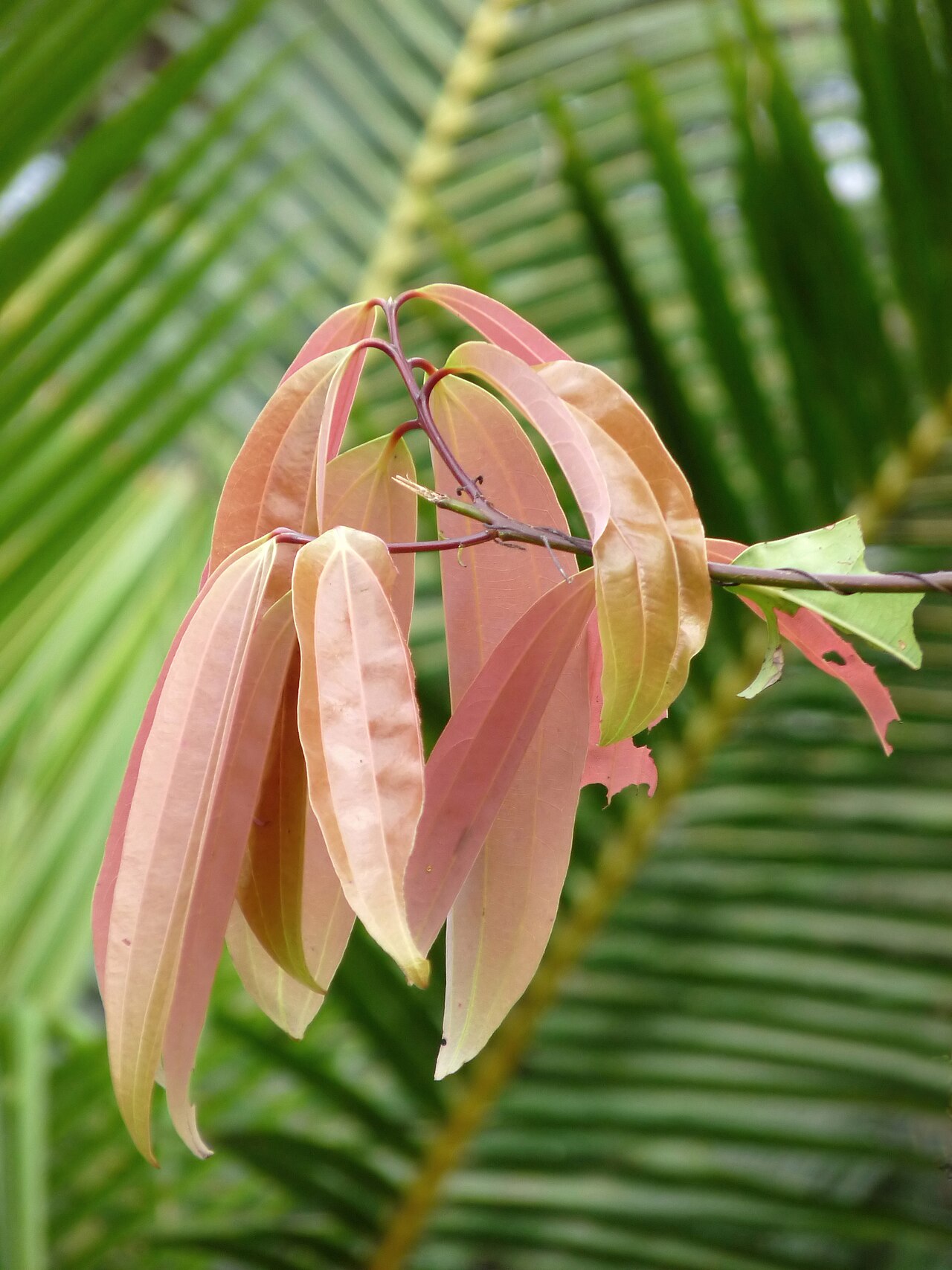
Photographed 13 December 2009
Cinnamomum malabatrum in Kadavoor – Modern botanical comparison
Cinnamomum malabatrum in Kadavoor. Modern botanical comparison; not proof that all ancient malabathrum was this species.
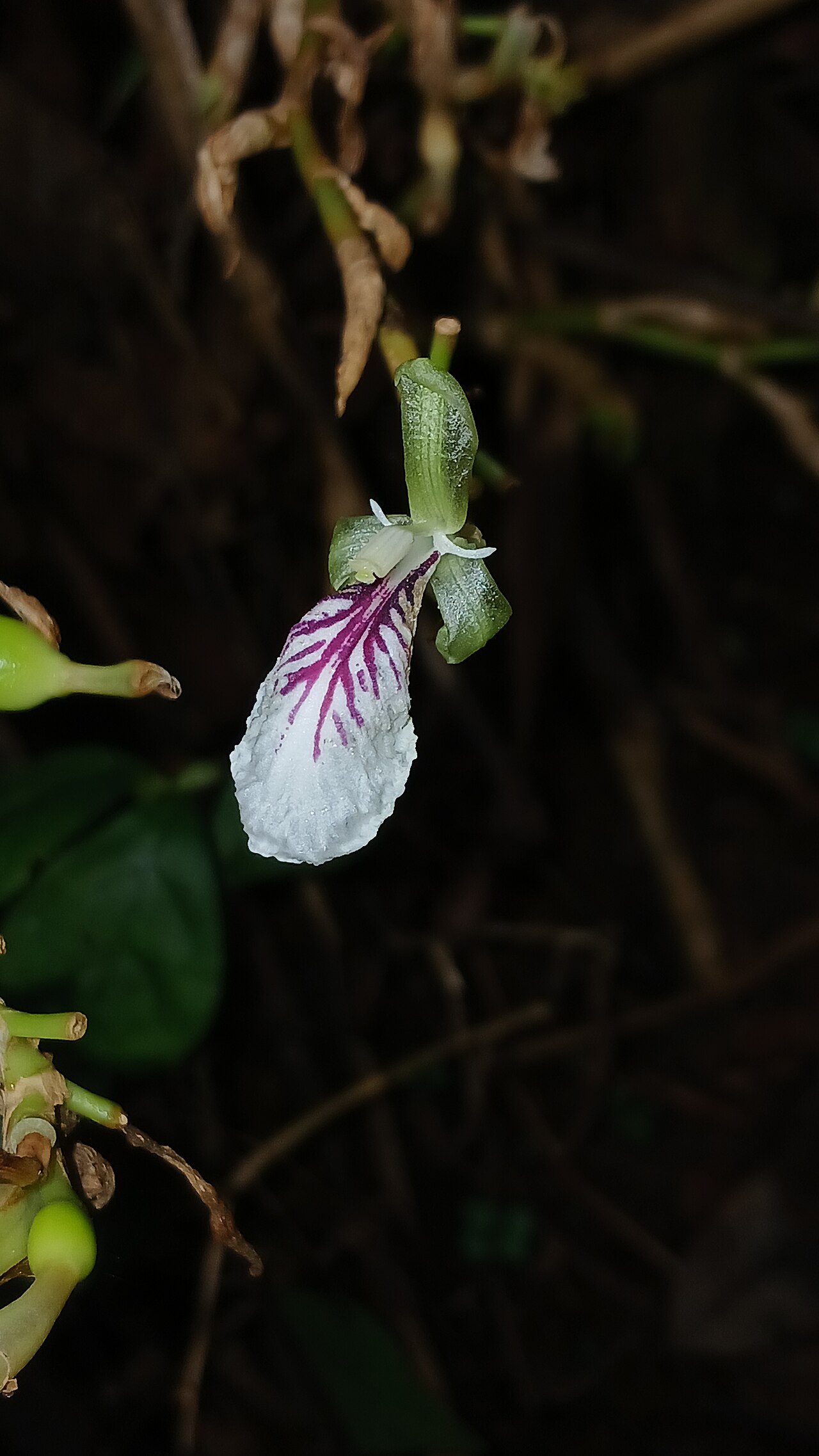
Photographed 12 July 2026 (according to Exif data)
Elettaria cardamomum (83242)
Cardamom (Elettaria cardamomum), a modern botanical photograph.
It does not show which aromatic an ancient text named.
006Two views
Both views are shown at equal weight; this site does not choose between them.
Which plant ancient malabathrum came from
- One view
- Kokoszko and Rzeźnicka (2016) represent a modern scholarly tradition that identifies malabathrum with Cinnamomum tamala.
- Another view
- This study treats that identification as unproven. Dioscorides warned against identifying malabathrum by smell, and the Periplus places its gathering far east. Kew also separates C. tamala from western and southern Indian C. malabatrum.
- What would settle it
- Careful comparison of the Greek plant descriptions, with plant or chemical evidence from a dated malabathrum context.
Whether Roman Berenike yielded botanical cardamom
- One view
- A review of Cappers' Roman Foodprints at Berenike refers to plant products including cardamom.
- Another view
- Van der Veen and colleagues' synthesis of Roman Eastern Desert sites reports no botanical evidence for cardamom.
- What would settle it
- Direct inspection of the taxon tables and contexts in Cappers' original Berenike publication.
007Where next
 Related study
All related studies, connected material, books and sources19 · 16
Elsewhere on this site
Multi-Script Glossary Terms: ēlam (ஏலம் / ഏലം) · iñci & cukku (Ginger – Zingiber officinale) (இஞ்சி & சுக்கு / ഇഞ്ചിയും ചുക്കും) · mañcaḷ (Turmeric – Curcuma longa) (மஞ்சள் / മഞ്ഞൾ) · kaṟuvā (Cinnamon Bark) & tamālapatra (Malabathron Leaf) (கறுவா & தமாலபத்திரம் / കറുവപ്പട്ടയും തമാലപത്രവും (വഴനയില)) · akil (Agarwood) & cantaṉam (Sandalwood) (அகில் & சந்தனம் / അകിലും ചന്ദനവും)
Connected material
Photographs, drawings, books, videos and other studies linked to this study. A link helps you explore; it does not prove a historical claim.
- Elettaria cardamomum (83242)photographBackground
- Cinnamomum malabatrum in Kadavoor – Modern botanical comparisonphotographBackground
008Sources
The study lists the sources it consulted; we have not rechecked them. A working link does not show that a source was read, and a valid identifier does not show that it supports a claim. We do not link to unofficial uploads or copies of publications. Where a study cited one, we show the published citation, or a publisher, DOI or Internet Archive link when we have one. Tracking codes are removed from links, and the sources themselves are not republished here.
The Periplus of the Erythraean Sea: Travel and Trade in the Indian Ocean by a Merchant of the First Century
Anonymous, Periplus Maris Erythraei; Wilfred H. Schoff translation, 1912, digitized by the University of Washington Silk Road Seattle project, with some Casson variants.
Lionel Casson, The Periplus Maris Erythraei: Text with Introduction, Translation, and Commentary, Princeton University Press, 1989.
Print or offline sourceSource recordPliny the Elder, Natural History, Book XII, H. Rackham translation, Loeb Classical Library text reproduced at Attalus.
Dioscorides, De materia medica, Book I, older English translation tradition reproduced on Wikisource.
Print or offline sourceSource recordPedanius Dioscorides of Anazarbus, De materia medica
Dioscorides, Pedanius. De materia medica. Translated by Lily Y. Beck. 2005.
Royal Botanic Gardens, Kew, Plants of the World Online, Elettaria cardamomum (L.) Maton.
Royal Botanic Gardens, Kew, Plants of the World Online, Cinnamomum tamala (Buch.-Ham.) T.Nees & Eberm.
Royal Botanic Gardens, Kew, Plants of the World Online, Cinnamomum malabatrum (Burm.f.) J.Presl.
Marijke van der Veen, Charlène Bouchaud, René Cappers and Claire Newton, Roman Life in the Eastern Desert of Egypt: Food, Imperial Power and Geopolitics, 2018.
PAMA, Pattanam Archaeological Research, current-project page.
Mahatma Gandhi University School of Social Sciences, Early Historic Age Collection.
Times of India, An ancient trade centre thrived in Idukki's Anappara, KCHR confirms, 14 March 2025.
René T. J. Cappers, Roman Foodprints at Berenike: Archaeobotanical Evidence of Subsistence and Trade in the Eastern Desert of Egypt, 2006.
Review of Roman Foodprints at Berenike
Bryn Mawr Classical Review of René Cappers, Roman Foodprints at Berenike.
Marijke van der Veen and Jacob Morales, The Roman and Islamic spice trade: New archaeological evidence, Journal of Ethnopharmacology 167 (2015) 54-63.
Maciej Kokoszko and Zofia Rzeźnicka, Malábathron (μαλάβαθρον). The selected aspects of the role of an aromatic substance in antiquity and Byzantium, 2016.
Researchers and institutions whose work this study uses: Lionel Casson, Wilfred H. Schoff, René Cappers, Kerala Council for Historical Research
How we know The evidence, claims and dates behind this study
What this study draws on
- A close reading of Periplus sections 56, 63 and 65 in Schoff's 1912 translation
- Pliny's Natural History Book 12 and Dioscorides' De materia medica
- Kew's botanical records for Elettaria cardamomum, Cinnamomum tamala and C. malabatrum
- Pattanam project and university web pages, a 2025 news report on Anappara, and Roman Eastern Desert plant studies
Dates in this study
| What is dated | Date | How it was dated |
|---|---|---|
| Preliminary Anappara reporting suggested approximately third century BCE to third century CE. | 300 BCE – 300 CE | Laboratory date |
| Pattanam Early Historic phase broadly third century BCE to fifth century CE in the institutional presentation. | 300 BCE – 500 CE | Period assigned by excavators or scholars |
| Around the middle of the first century CE; working range c. 40-70 CE. | 40–70 CE | Date from writing, coins or texts |
| First century CE; conventional working interval c. 50-70 CE for Dioscorides. | 50–70 CE | How it was dated is not stated |
See these dates on the timeline
The study’s claims
13 claims · 16 source passages · 76 paragraphs
Browse the study paragraph by paragraphThe Periplus explicitly lists malabathrum among goods exported through Muziris and Nelcynda in the first century CE.
Supported in this study
This does not establish that the plant was grown near Muziris.
The Periplus also places malabathrum in trade through a Ganges-region market.
Supported in this study
The Periplus gives a detailed malabathrum procurement and preparation account in far-eastern geography near This/Thina and says the prepared commodity was brought into India.
Supported in this study
A specifically Western Ghats origin for all malabathrum exported at Muziris is not established by the Periplus; redistribution from distant supply zones is a plausible interpretation, while multiple sources remain possible.
Supported with qualifications
Redistribution is an inference from the juxtaposition of passages, not an explicit itinerary. Multiple production areas cannot be excluded.
Pliny treats malobathrum as a high-value aromatic associated with oil and unguent/perfumery use and values Indian material highly.
Supported in this study
Dioscorides' malabathrum discussion itself warns against identifying an aromatic leaf solely from resemblance of smell.
Supported with qualifications
Modern critical translation not fully read.
Modern Cinnamomum tamala is an accepted taxon whose Kew native range is Himalayan/eastern South Asian to mainland Southeast Asian rather than specifically south-west Indian.
Supported in this study
This is a modern botanical comparison.
Ancient malabathrum cannot currently be identified with sufficient confidence as either Cinnamomum tamala or Cinnamomum malabatrum across all relevant passages.
Debated in the sources
The conclusion is non-identity at present evidential resolution, not proof that either candidate is impossible.
Pliny's cardamomum is described as an aromatic seed commodity associated with Arabia and Media, so that passage cannot automatically be mapped to Western Ghats Elettaria cardamomum.
Supported in this study
The equation of every ancient cardamomum/kardamomon occurrence with modern Elettaria cardamomum is not defensible.
Supported with qualifications
Some ancient occurrences may still denote Elettaria; the mapping must be demonstrated case by case.
Preliminary Anappara evidence establishes an Early Historic highland settlement and exchange context in Idukki but not a cardamom procurement station or trans-Ghat cardamom route.
Supported with qualifications
The site is contextual evidence for highland connectivity only.
Roman perfumery or unguent demand for malabathrum is directly evidenced, whereas a specifically Roman culinary market for Western Ghats Elettaria cardamomum is not established by the primary passages reviewed.
Supported with qualifications
The strongest overall reconstruction separates malabathrum, which has secure Muziris export but uncertain botanical/source identity, from true cardamom, which has secure Western Ghats botany but an inadequately documented Early Historic procurement/export chain.
Supported in this study
Trace one claim through the study’s records
Explore the evidenceOther source lists
Numbered citation links from the study
The numbered links in the study text point here.
The Voyage around the Erythraean Sea
De Materia Medica/Book 1 - Wikisource, the free online library
Print or offline sourceCinnamomum tamala (Buch.-Ham.) T.Nees & C.H.Eberm. | Plants of the World Online | Kew Science
Elettaria cardamomum (L.) Maton | Plants of the World Online | Kew Science
Pliny, Natural History, 12 (a)
PAMA - Bridging the Past, Present and Future.
An ancient trade centre thrived in Idukki’s Anappara, KCHR confirms | Thiruvananthapuram News - The Times of India
Malábathron (μαλάβαθρον). Kilka uwag o roli Cinnamomum tamala w medycynie i w kuchni antyku i Bizancjum między I a VII wiekiem | Przegląd Nauk Historycznych
Pliny, Natural History, 12 (a)
Pliny, Natural History, 12 (b)
Lily Y. Beck, trans. De materia medica by Pedanius Dioscorides. Hildesheim, Germany, Olms-Weidmann, 2005. 540 pp. €78.00. | Journal of the History of Medicine and Allied Sciences
The Voyage around the Erythraean Sea
Cinnamomum tamala (Buch.-Ham.) T.Nees & C.H.Eberm. | Plants of the World Online | Kew Science
Cinnamomum malabatrum (Burm.f.) J.Presl | Plants of the World Online | Kew Science
De Materia Medica/Book 1 - Wikisource, the free online library
Print or offline sourceMalábathron (μαλάβαθρον). Kilka uwag o roli Cinnamomum tamala w medycynie i w kuchni antyku i Bizancjum między I a VII wiekiem | Przegląd Nauk Historycznych
PAMA - Bridging the Past, Present and Future.
Early Historic Age Collection - MG School of Social Sciences : MG School of Social Sciences
Food, Imperial Power and Geopolitics - Roman Life in the Eastern Desert of Egypt.
Roman Foodprints at Berenike: Archaeobotanical Evidence of Subsistence and Trade in the Eastern Desert of Egypt – Bryn Mawr Classical Review
De Materia Medica/Book 1 - Wikisource, the free online library
Print or offline sourcePliny, Natural History, 12 (a)
About this study Status, corrections and how it was made
Status
Draft study, revision 6. No historian, archaeologist, or Tamil or Malayalam specialist has reviewed it yet.
How it was made
Compiled as an editorial synthesis from published scholarship around questions we framed. About this project & workflow
The summary, How sure lines and Two views notes on this page were prepared from this study and cross-checked against its passages. That is an editorial check, not a specialist review.
Corrections and updates
Technical details
Study code R180. The text fingerprint changes whenever the study text changes.
- The study text is shown as written. Links from its paragraphs to citations help you move around the study; they are not new claims or checked source passages.
See how this study’s records were extracted
Text fingerprint (SHA-256): R180 · bc7e74c6abe8a705f61088b0… · v6
Evidence tables and technical details are on the web page: https://layersofthesouth.org/read/c5954f7397