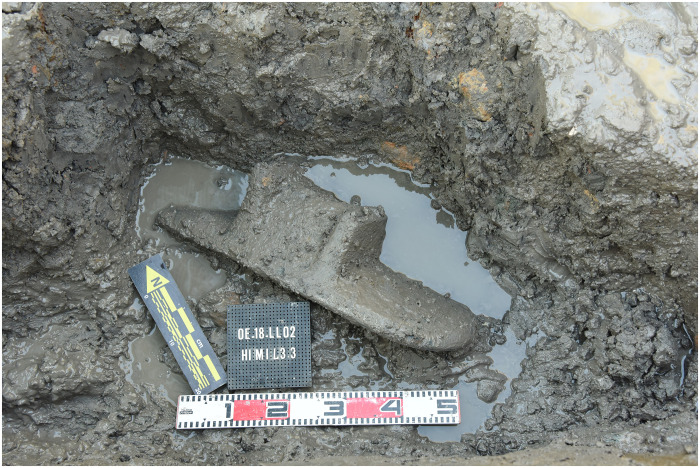
The large footed grinding slab
Oc Eo
Comparative evidence from Vietnam; these are not finds from Kerala or Tamil Nadu.
- Across the water
Cinnamon and cassia: what a fragrant name can and cannot identify
Ancient names like cinnamon and cassia do not map neatly onto modern species, and flask residues identify no route to Kerala.
- How sure
- 1 Likely
- 1 Possible
- 2 Not known
- This page
- 1,700 words · revision 5
Draft study · Awaiting specialist review · Updated
001Dates and places

No mapped place in this study.
Dates in this study are stated in words only.
- 1 Likely
- 1 Possible
- 2 Not known
002How sure
In brief
Cinnamon and cassia were valued for their smell, but an ancient name does not tell us which plant was meant. Kew's current records place Cinnamomum verum in Sri Lanka. They place C. aromaticum, also published as C. cassia, in southeastern China and Vietnam. These modern species cannot simply be read back into ancient words. Pliny rejected stories of cinnamon from birds' nests and cassia guarded by creatures, but his own explanations also need testing. In 2013, Namdar and colleagues reported cinnamaldehyde in ten of 27 early Iron Age Phoenician flasks. The flasks date from the eleventh to mid-ninth centuries BCE by their archaeological setting. The authors' trade reading holds only if the compound came from cinnamon bark. The result establishes neither a route to Kerala nor a voyage by Solomon's fleet. No single plant identification fits every ancient reference to cinnamon or cassia.
Key researchers cited in this study: Wilfred H. Schoff (Periplus Translation & Commentary) · Full bibliography
How sure
- Likely
Cinnamaldehyde was found in ten of 27 early Iron Age flasks.
Published with contamination checks, but the raw measurements have not been independently reanalysed.
- Possible
The flasks held cinnamon bark traded over long distances.
The authors' reading depends on the compound coming from cinnamon bark; they call it a possibility.
- Not known
Each ancient cinnamon or cassia reference matches one modern species.
No single botanical identification is certified for all ancient cinnamon, cassia or malabathrum references.
- Not known
A Levant–Kerala route or a voyage by Solomon's fleet.
The residue study establishes neither a specific route nor a named royal voyage.
Why it matters
It shows why a spice name or a jar residue cannot, on its own, identify a plant, place or voyage.
003Key findings
What the study concludes
- Modern Cinnamomum species and ancient trade names do not match automatically, even when their names sound alike.
- The Periplus distinguishes leaf products and their commercial preparation; this is not a modern botanical description.
- Cinnamaldehyde in early Iron Age flasks supports a carefully qualified research argument, not a named route or proof of Solomon’s ships in India.
In the study’s own words. How sure each point is, is shown above.
The summary above is the short read. The full study is the complete text it was drawn from, with its tables and source notes.
What the full study covers
- Main findings
- Start with the part, not only the name
- Several trees behind familiar labels
- Malabathrum: a leaf product in a trading account
- Two similar names do not settle the leaf’s identity
- Pliny knew that information traveled imperfectly
- What a molecule in a flask can establish
- Follow both material and information
- What remains uncertain
- The next questions
- References and access notes
004The study
Main findings
- Modern Cinnamomum species and ancient trade names do not match automatically, even when their names sound alike.
- The Periplus distinguishes leaf products and their commercial preparation; this is not a modern botanical description.
- Cinnamaldehyde in early Iron Age flasks supports a carefully qualified research argument, not a named route or proof of Solomon’s ships in India.
Start with the part, not only the name
A reader encounters cinnamon as a familiar smell, but the historian must first ask what material a source is describing. Is it bark, a leaf, an oil, a mixture or a name applied by a trader? This study follows three overlapping labels without assuming that a modern spice packet provides the answer to every ancient passage. Its subject is both the movement of fragrant materials and the difficulty of identifying them. We have three particularly useful kinds of evidence: current botanical records, commercial and descriptive texts from antiquity, and an early Iron Age residue study. Each can correct the others’ limitations. None supplies a complete shipment history on its own. Following their differences makes the subject more tangible, rather than reducing it to an argument about terminology.
Several trees behind familiar labels
Kew records Cinnamomum verum as native to Sri Lanka. Its current account of Cinnamomum aromaticum gives a native range in southeastern China and Vietnam and lists botanical authorities that have used C. cassia. The records establish particular modern taxonomic treatments. They do not tell us that every ancient use of a translated word cinnamon or cassia designates one of these species. 12 The distinction matters even before an ancient route is considered. Identifying a commodity as a plant part and identifying the species are separate operations. A bark with a valued smell is not automatically a specimen accompanied by leaves, flowers and collection information. That is why a botanical label should state what a reference actually says, instead of translating a broad historical term directly into a modern scientific name.
Malabathrum: a leaf product in a trading account
The Periplus lists malabathrum among exports at the southwestern ports and describes leaves made up into balls of three sizes: a prepared, graded leaf product, not a botanical description. 3 Its portrayal of the people who prepared the leaves is an outsider’s and should not be repeated as factual anthropology. “Malabathrum and cardamom: Kerala hill origins not shown” examines where the Periplus places the gathering of malabathrum and how it reached the ports.
Two similar names do not settle the leaf’s identity
Kew’s records distinguish Cinnamomum tamala, with a Himalayan-to-eastern distribution, from Cinnamomum malabatrum in western and southern India, and the likeness of the second name to malabathrum is not an identification. 45 “Malabathrum and cardamom: Kerala hill origins not shown” compares these species with the ancient descriptions of malabathrum in detail.
Cinnamomum burmanni leaves photographed in Maui, Hawaii (modern botanical comparison)
Photographed 2011-10-12
Pliny knew that information traveled imperfectly
Pliny rejects stories about cinnamon taken from birds’ nests and cassia guarded by dangerous creatures, but then supplies other geographical explanations that also require testing. His malobathrum passage, also discussed in “Malabathrum and cardamom: Kerala hill origins not shown”, mixes leaves, oils, scent comparisons and reports of marsh growth. Reading him as a compilation makes these inconsistencies useful evidence about knowledge and commerce rather than embarrassing details to remove. 6 The point is not that everything in the work is useless. It is that confidence in one passage cannot substitute for checking the kind of observation behind it. A seller’s category, a traveler’s report and a writer’s explanation of distant production may describe different stages in the movement of information. The geographical provenance of a rumor is not necessarily the biological provenance of the material it names. His reports of tasting, burning and preparing these materials show how the text judged them; they are not tests for readers to try.
What a molecule in a flask can establish
Namdar and colleagues examined 27 early Iron Age flasks from five sites. They reported cinnamaldehyde in ten, considered contamination and used other vessels as comparisons. Two freshly excavated flasks that had not been directly handled yielded comparatively high concentrations. Their interpretation raises the possibility of long-distance exchange, conditional on the compound deriving from cinnamon bark. 7 The dating belongs to the archaeological setting of flasks associated with the eleventh to mid-ninth centuries BCE. The result is not a radiocarbon date on a shipload, a certificate identifying a plantation, or evidence naming the people who transported the contents. The investigators themselves call for further work on the networks and consumption contexts. 8 An archaeological result can make a broad possibility worth investigating without verifying a named royal expedition, such as a voyage by Solomon’s fleet. Inferring an Asian plant source from a compound already requires argument; identifying a king, port, route and transaction adds further steps. Those steps must not disappear behind the phrase scientific proof.
Follow both material and information
We can now outline a useful comparative journey without claiming to have recovered one actual voyage. At production, the question concerns a living plant and the harvested part. In preparation, it concerns sorting or processing. In commerce, a product acquires a description useful to buyers. In writing, that description enters another language and may become attached to a story about its origin. Finally, a researcher tries to reconnect words and material. Each stage can preserve something while losing something else. A text might preserve a distinction in commercial quality that an anonymous residue cannot recover. A chemical analysis might detect a material association that a translated name obscures. These approaches are complementary, but they are not interchangeable votes for one predetermined answer. Their disagreement can show where the next investigation should begin. The most useful outcome is therefore a layered account rather than a neat-looking ancient spice shelf. It should state which material is described, which identification is proposed, what date is supported and what was actually read. With those layers visible, cinnamon and malabathrum become more than luxurious smells. They reveal the skilled work of handling goods – and the imperfect work of knowing where those goods began.
What remains uncertain
- No single botanical identification is certified for all ancient cinnamon, cassia or malabathrum references.
- The residue study’s raw measurements have not been independently reanalysed. Journal issue metadata disagree between its web record and PDF masthead.
- This study establishes neither a specific Levant–Kerala route nor a voyage by Solomon’s fleet.
The next questions
- Compare original-language terms and critical botanical commentaries before assigning each passage a species.
- Review independent studies testing the specificity and archaeological survival of cinnamaldehyde.
- Investigate leaf preparation and grading through securely dated textual and material evidence.
References and access notes
1 Royal Botanic Gardens, Kew (Continuously maintained; checked 2026). Cinnamomum verum J.Presl: taxonomy and plant profile. Native-range and taxonomic description. Current native-range statement and plant profile read. A modern scientific species is not automatically the meaning of every ancient occurrence of cinnamon. Open source: powo.science.kew.org
2 Royal Botanic Gardens, Kew (Continuously maintained; checked 2026). Cinnamomum aromaticum Nees: accepted name, distribution and alternative taxonomy. Accepted name; native range; Publications listing alternative C. cassia usage. Accepted-name, native-range and alternative-taxonomy sections read. The page accepts C. aromaticum and lists publications using C. cassia. The report preserves this naming context; it does not identify an ancient bark by its translated trade name alone. Open source: powo.science.kew.org
Cinnamomum malabatrum in Kadavoor – Modern botanical comparison
Photographed 13 December 2009
3 Anonymous; translated by Wilfred H. Schoff (1912 translation). The Periplus of the Erythraean Sea. Periplus §§56 and 65: export list and three sizes of leaf-ball malabathrum. Relevant numbered sections read. University of Washington transcription of the 1912 translation, with some later editorial glosses. Ancient composition is usually placed around the middle of the first century CE, not the translation date. Schoff’s translation is public domain in the United States; no complete modern translation is reproduced. Open source: depts.washington.edu
4 Royal Botanic Gardens, Kew (Continuously maintained; checked 2026). Cinnamomum tamala (Buch.-Ham.) T.Nees & Eberm.: distribution. Current native-range field. Current taxonomic and native-range record read. Used to distinguish a botanical distribution from the ancient commercial label malabathrum. It is not a genetic provenance analysis of traded leaves. Open source: powo.science.kew.org
5 Royal Botanic Gardens, Kew (Continuously maintained; checked 2026). Cinnamomum malabatrum (Burm.f.) J.Presl: distribution and nomenclature. Native range and nomenclatural publication. Taxonomic and native-range record read. Resemblance between a modern species epithet and an ancient commodity name is not proof that all occurrences refer to this species. Open source: powo.science.kew.org
6 Pliny the Elder; English translation by H. Rackham, presented by Attalus (First century CE; modern English translation). Natural History, Book 12, second part: aromatics. Natural History 12.85–87 and 12.129. Selected passages read in the English presentation; Latin not newly collated. Pliny reports disagreement, hearsay and moral judgments. Modern species identifications in links or translation are not independent ancient botanical evidence. Historical claims about remedies, tasting and smoke are not instructions for readers. Open source: www.attalus.org
Modern references relevant to this study
Comparative evidence from Vietnam; these are not finds from Kerala or Tamil Nadu.
7 Dvory Namdar; Ayelet Gilboa; Ronny Neumann; Israel Finkelstein; Steve Weiner (2013). Cinnamaldehyde in early Iron Age Phoenician flasks raises the possibility of Levantine trade with South East Asia. Abstract; sample-handling discussion and Table 1; §5 Conclusions. Article abstract, selected PDF text, conclusion and sample-handling table read; PDF pages 1 and 3 visually checked. No raw chromatographic data were reanalysed. Bibliographic discrepancy: the web issue record identifies 13(2), while the PDF masthead prints 12(3); both show the 2013 research. The web upload date 2023 is not the study date. Identification of a molecule and the authors’ conditional trade interpretation are kept separate. Open source: www.maajournal.com
8 Dvory Namdar; Ayelet Gilboa; Ronny Neumann; Israel Finkelstein; Steve Weiner (2013). Cinnamaldehyde in early Iron Age Phoenician flasks raises the possibility of Levantine trade with South East Asia. Abstract chronology; discussion immediately before §5 Conclusions. Article abstract, selected PDF text, conclusion and sample-handling table read; PDF pages 1 and 3 visually checked. No raw chromatographic data were reanalysed. Bibliographic discrepancy: the web issue record identifies 13(2), while the PDF masthead prints 12(3); both show the 2013 research. The web upload date 2023 is not the study date. Identification of a molecule and the authors’ conditional trade interpretation are kept separate. Open source: www.maajournal.com
005Photographs
Photographs of the places and objects this study discusses. Each item carries its creator’s credit, licence and documented source. See all 412 photographs and source images ↗
Oc Eo
The large footed grinding slab
A footed sandstone grinding slab, 76 cm long, excavated at Oc Eo in 2018. Starch grains of ginger, cinnamon and nutmeg were identified on its surface.
Comparative evidence from Vietnam; these are not finds from Kerala or Tamil Nadu.
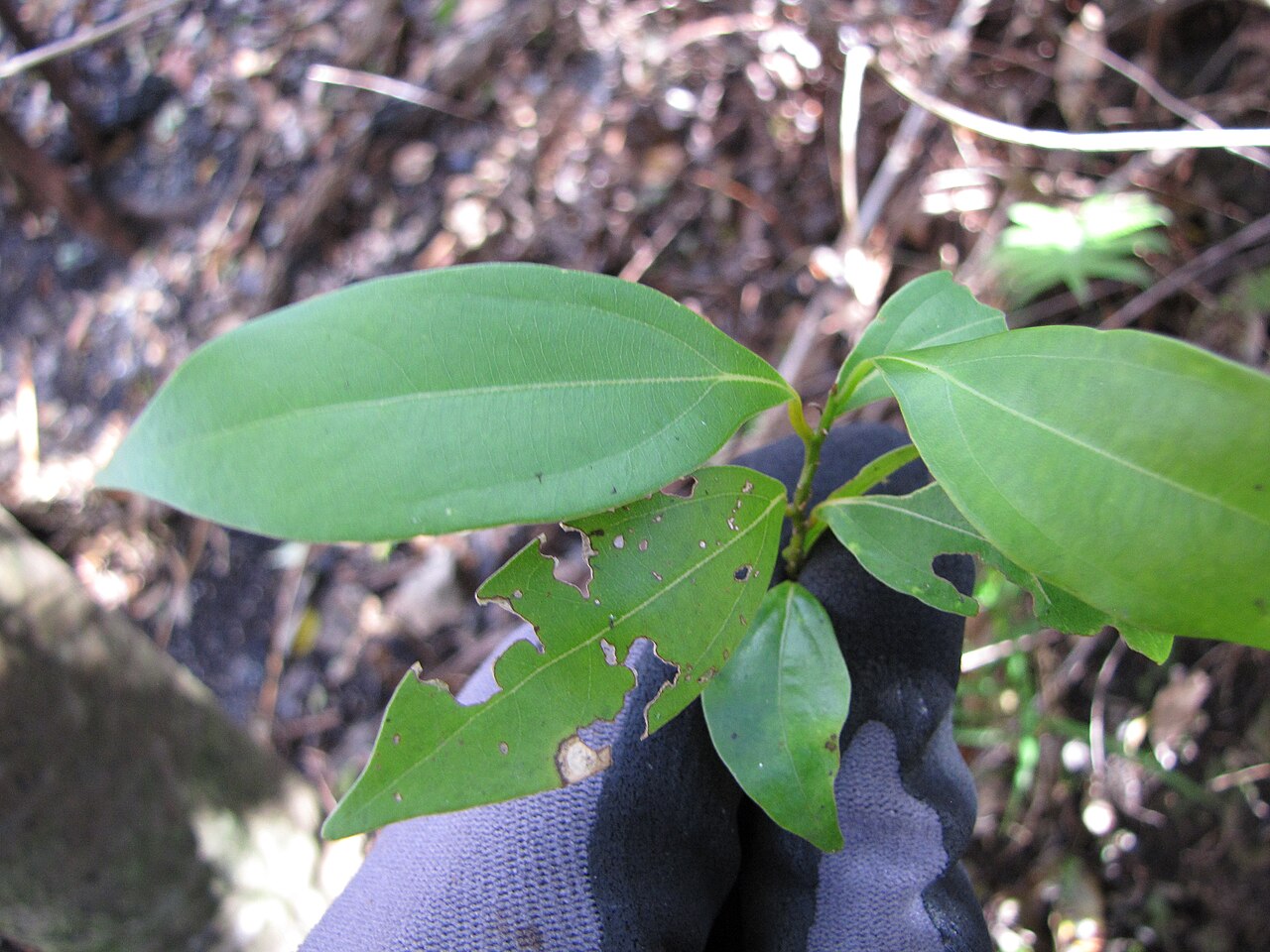
Photographed 2011-10-12 10:22
Cinnamomum burmanni leaves photographed in Maui, Hawaii (modern botanical comparison)
Cinnamomum burmanni leaves photographed in Maui, Hawaii, shown as a modern botanical comparison.
Photographed 13 December 2009
Cinnamomum malabatrum in Kadavoor – Modern botanical comparison
Cinnamomum malabatrum in Kadavoor. Modern botanical comparison; not proof that all ancient malabathrum was this species.
Modern references relevant to this study
Modern reference samples used for comparison in the Oc Eo study: starch grains and other remains of turmeric, ginger, clove, cinnamon, nutmeg and rice.
Comparative evidence from Vietnam; these are not finds from Kerala or Tamil Nadu.
Photographed 2018-02-24 08:22
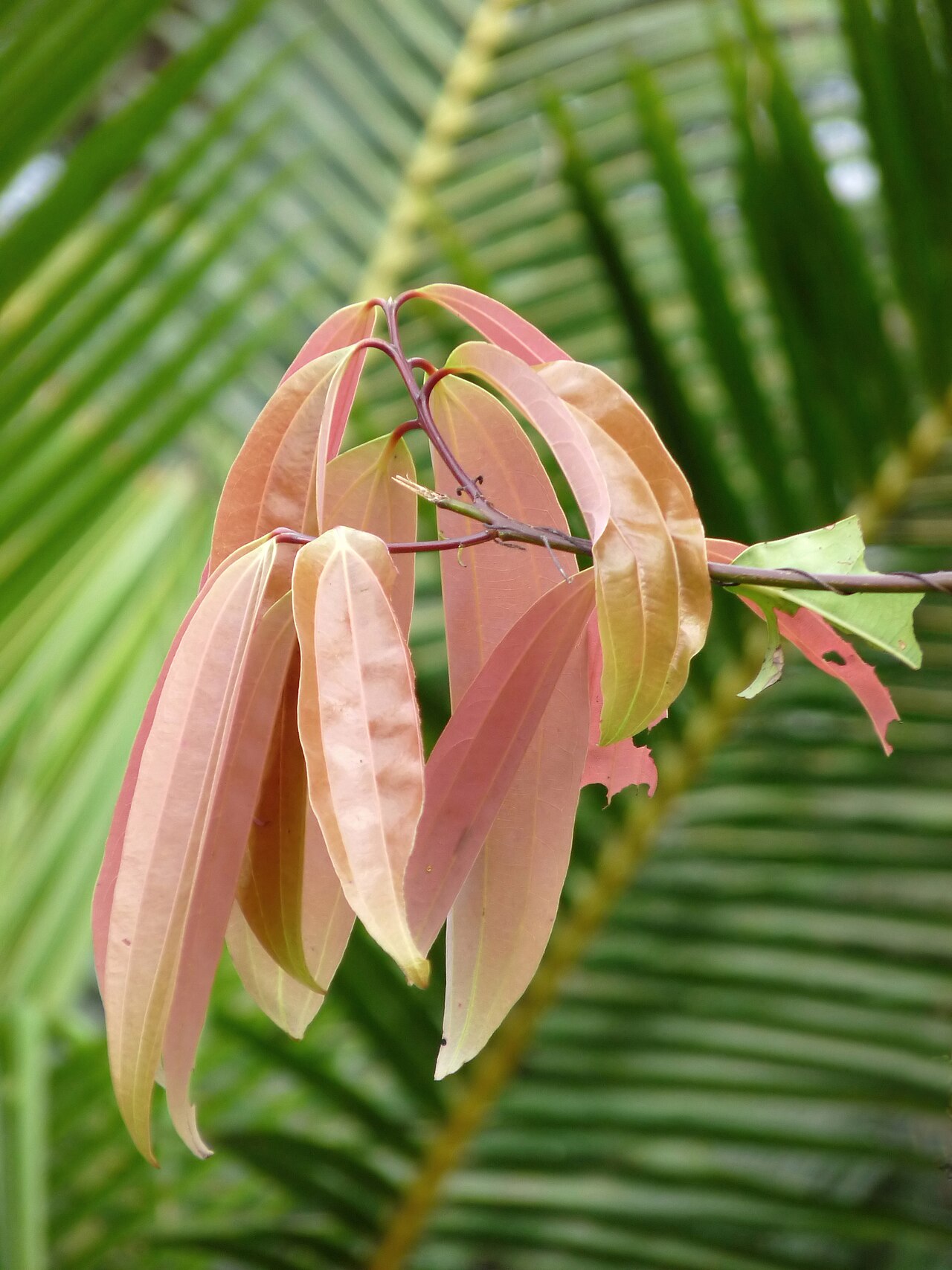
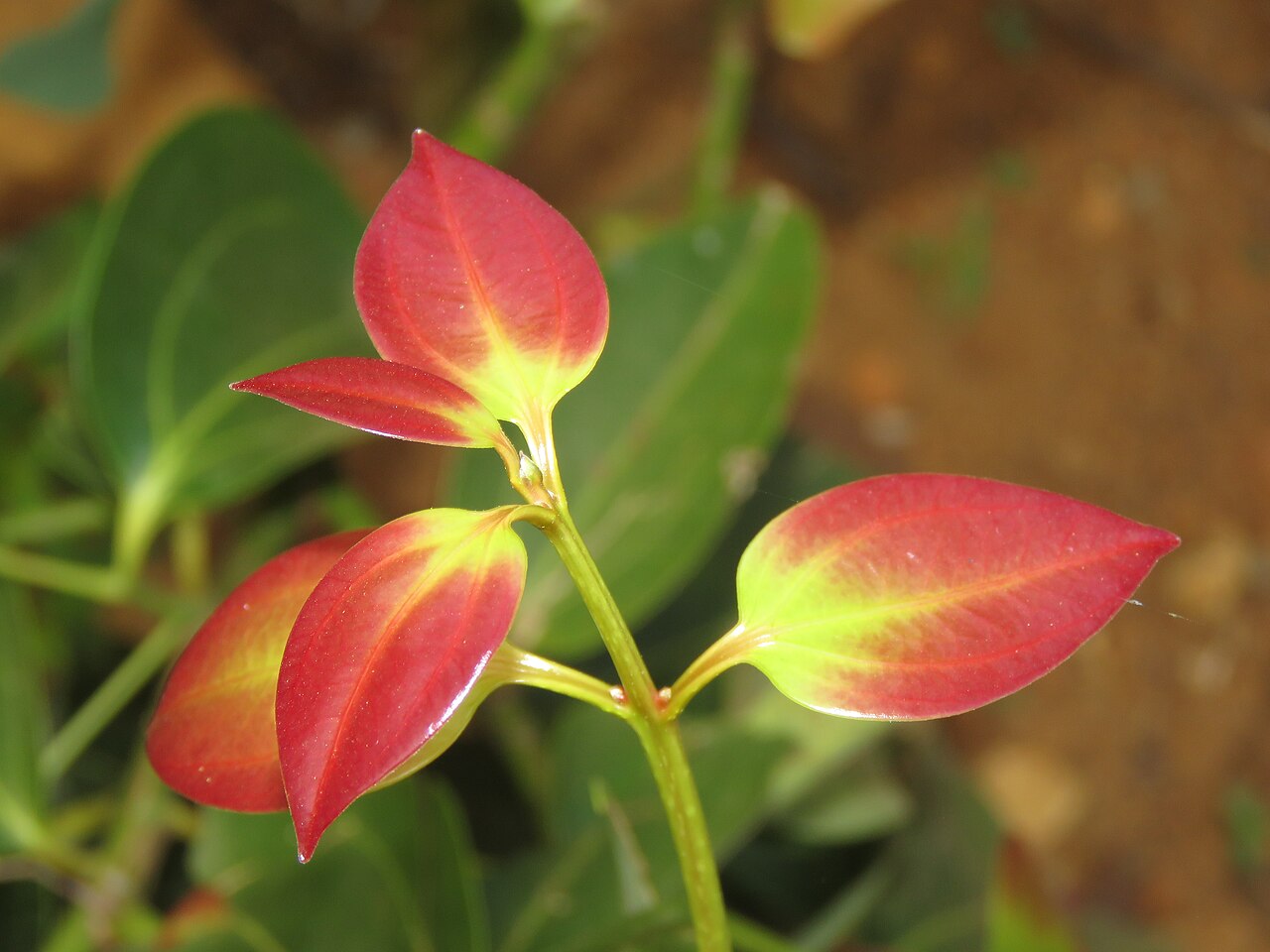
Cinnamomum verum young leaves at Thattekkadu (1)
Cinnamomum verum young leaves at Thattekkadu (1). Modern identified cinnamon plant, distinct from cassia and malabathrum.
Oc Eo
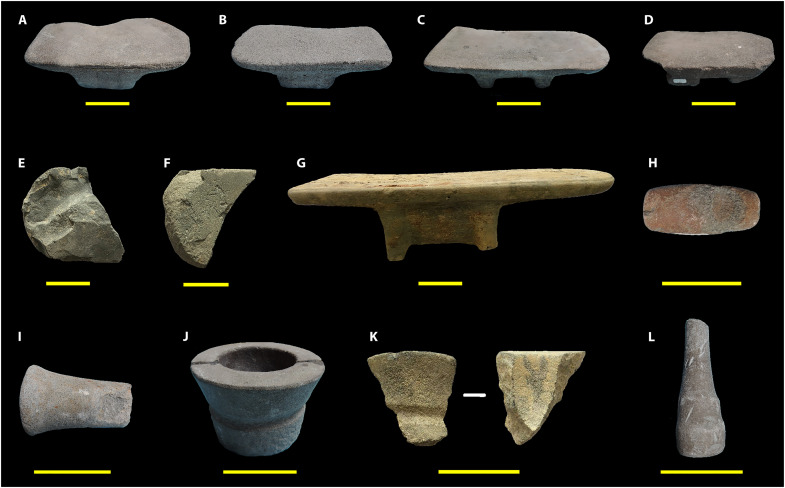
Ancient food-preparation tools from Oc Eo
Food-preparation tools from Oc Eo reported in the published study: footed grinding slabs, mullers or pestles, and mortars. Scale bar 10 cm.
Comparative evidence from Vietnam; these are not finds from Kerala or Tamil Nadu.

Oc Eo
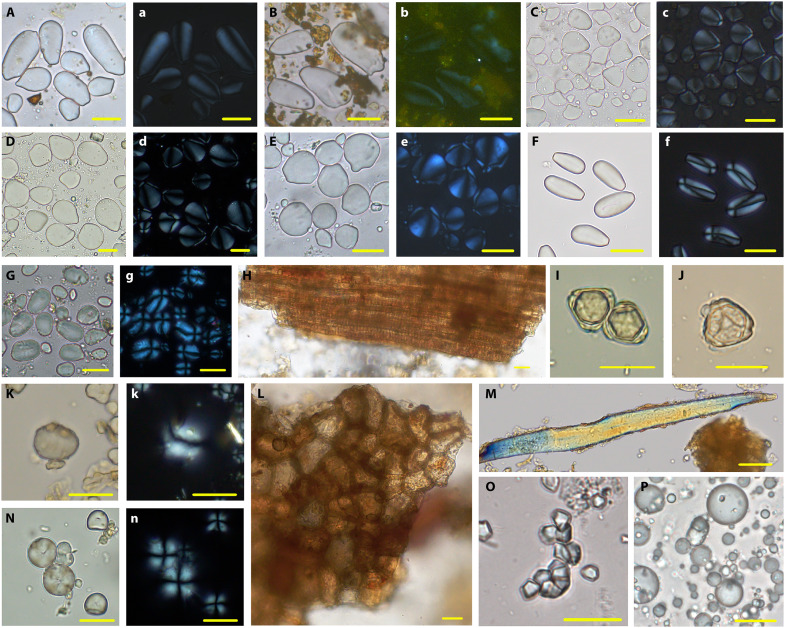
Ancient plant remains recovered from Oc Eo
Starch grains and other plant remains from Oc Eo under the microscope, including turmeric, ginger, galangal, clove, cinnamon, nutmeg and rice.
Comparative evidence from Vietnam; these are not finds from Kerala or Tamil Nadu.
006Where next
All related studies, connected material, books and sources9 · 8
Elsewhere on this site
Multi-Script Glossary Terms: ēlam (ஏலம் / ഏലം) · kaṟuvā (Cinnamon Bark) & tamālapatra (Malabathron Leaf) (கறுவா & தமாலபத்திரம் / കറുവപ്പട്ടയും തമാലപത്രവും (വഴനയില))
Connected material
Photographs, drawings, books, videos and other studies linked to this study. A link helps you explore; it does not prove a historical claim.
- Ancient food-preparation tools from Oc EophotographBackground
- The large footed grinding slabphotographBackground
- Ancient plant remains recovered from Oc Eoscientific photomicrographBackground
- Modern references relevant to this studyphotographBackground
- Cinnamomum verum young leaves at Thattekkadu (1)photographBackground
- Cinnamomum burmanni leaves photographed in Maui, Hawaii (modern botanical comparison)photographBackground
- Cinnamomum malabatrum in Kadavoor – Modern botanical comparisonphotographBackground
007Sources
The study lists the sources it consulted; we have not rechecked them. A working link does not show that a source was read, and a valid identifier does not show that it supports a claim. We do not link to unofficial uploads or copies of publications. Where a study cited one, we show the published citation, or a publisher, DOI or Internet Archive link when we have one. Tracking codes are removed from links, and the sources themselves are not republished here.
Royal Botanic Gardens, Kew (Continuously maintained; checked 2026). Cinnamomum verum J.Presl: taxonomy and plant profile. Native-range and taxonomic description. Current native-range statement and plant profile read. A modern scientific species is not automatically the meaning of every ancient occurrence of cinnamon.
Royal Botanic Gardens, Kew (Continuously maintained; checked 2026). Cinnamomum aromaticum Nees: accepted name, distribution and alternative taxonomy. Accepted name; native range; Publications listing alternative C. cassia usage. Accepted-name, native-range and alternative-taxonomy sections read. The page accepts C. aromaticum and lists publications using C. cassia. The report preserves this naming context; it does not identify an ancient bark by its translated trade name alone.
Anonymous; translated by Wilfred H. Schoff (1912 translation). The Periplus of the Erythraean Sea. Periplus §§56 and 65: export list and three sizes of leaf-ball malabathrum. Relevant numbered sections read. University of Washington transcription of the 1912 translation, with some later editorial glosses. Ancient composition is usually placed around the middle of the first century CE, not the translation date. Schoff’s translation is public domain in the United States; no complete modern translation is reproduced.
Royal Botanic Gardens, Kew (Continuously maintained; checked 2026). Cinnamomum tamala (Buch.-Ham.) T.Nees & Eberm.: distribution. Current native-range field. Current taxonomic and native-range record read. Used to distinguish a botanical distribution from the ancient commercial label malabathrum. It is not a genetic provenance analysis of traded leaves.
Royal Botanic Gardens, Kew (Continuously maintained; checked 2026). Cinnamomum malabatrum (Burm.f.) J.Presl: distribution and nomenclature. Native range and nomenclatural publication. Taxonomic and native-range record read. Resemblance between a modern species epithet and an ancient commodity name is not proof that all occurrences refer to this species.
Pliny the Elder; English translation by H. Rackham, presented by Attalus (First century CE; modern English translation). Natural History, Book 12, second part: aromatics. Natural History 12.85–87 and 12.129. Selected passages read in the English presentation; Latin not newly collated. Pliny reports disagreement, hearsay and moral judgments. Modern species identifications in links or translation are not independent ancient botanical evidence. Historical claims about remedies, tasting and smoke are not instructions for readers.
Dvory Namdar; Ayelet Gilboa; Ronny Neumann; Israel Finkelstein; Steve Weiner (2013). Cinnamaldehyde in early Iron Age Phoenician flasks raises the possibility of Levantine trade with South East Asia. Abstract; sample-handling discussion and Table 1; §5 Conclusions. Article abstract, selected PDF text, conclusion and sample-handling table read; PDF pages 1 and 3 visually checked. No raw chromatographic data were reanalysed. Bibliographic discrepancy: the web issue record identifies 13(2), while the PDF masthead prints 12(3); both show the 2013 research. The web upload date 2023 is not the study date. Identification of a molecule and the authors’ conditional trade interpretation are kept separate.
Dvory Namdar; Ayelet Gilboa; Ronny Neumann; Israel Finkelstein; Steve Weiner (2013). Cinnamaldehyde in early Iron Age Phoenician flasks raises the possibility of Levantine trade with South East Asia. Abstract chronology; discussion immediately before §5 Conclusions. Article abstract, selected PDF text, conclusion and sample-handling table read; PDF pages 1 and 3 visually checked. No raw chromatographic data were reanalysed. Bibliographic discrepancy: the web issue record identifies 13(2), while the PDF masthead prints 12(3); both show the 2013 research. The web upload date 2023 is not the study date. Identification of a molecule and the authors’ conditional trade interpretation are kept separate.
Researchers and institutions whose work this study uses: Wilfred H. Schoff
How we know The evidence, claims and dates behind this study
What this study draws on
- Current Kew botanical records for Cinnamomum verum, C. aromaticum, C. tamala and C. malabatrum
- Pliny's Natural History 12.85–87 and 12.129, read as compiled reports
- The Periplus of the Erythraean Sea, sections 56 and 65, in Schoff's 1912 translation
- Namdar and colleagues' 2013 residue analysis of 27 Phoenician flasks, with its contamination controls
Dates in this study
This study has no dates recorded in a form we can chart, so there is no date chart. Any dates it gives are in the full study.
The study’s claims
0 claims · 0 source passages · 18 paragraphs
Browse the study paragraph by paragraphThis study has no separately listed claims. Its paragraphs can be browsed one by one.
About this study Status, corrections and how it was made
Status
Draft study, revision 5. No historian, archaeologist, or Tamil or Malayalam specialist has reviewed it yet.
How it was made
Compiled as an editorial synthesis from published scholarship around questions we framed. About this project & workflow
The summary, How sure lines and Two views notes on this page were prepared from this study and cross-checked against its passages. That is an editorial check, not a specialist review.
Technical details
Study code R050. The text fingerprint changes whenever the study text changes.
- The study text is shown as written. Links from its paragraphs to citations help you move around the study; they are not new claims or checked source passages.
See how this study’s records were extracted
Text fingerprint (SHA-256): R050 · 749ba6b06fb1f4d608ccb949… · v5
Evidence tables and technical details are on the web page: https://layersofthesouth.org/read/ff73e54f5e