Silkworm cocoons – Modern sericulture material, useful as a physical reference
Photographed 2024-11-10
- Across the water
Silk reached the Kerala ports through intermediaries
The Periplus describes silk reaching the Kerala coast through intermediaries, and no Chinese visitor or voyage to Pattanam is documented in the sources examined.
- How sure
- 2 Well supported
- 1 Not known
- This page
- 1,855 words · revision 5
Draft study · Awaiting specialist review · Updated
001Dates and places

No mapped place in this study.
Dates in this study are stated in words only.
- 2 Well supported
- 1 Not known
002How sure
In brief
Silk passed through the Kerala ports in the first century CE. The Periplus, a merchant's guide, lists silk cloth among the goods exported from Muziris and Nelcynda. It also describes silk coming toward this coast by way of the Ganges region, a route through intermediaries, not a report of Chinese ships. The Chinese history Hou Hanshu, compiled in the fifth century, reports Gan Ying's journey of 97 CE. He turned back before reaching Daqin. The same history reports a claimed mission from Andun in 166 CE, but it names no Kerala stop. A 2022 laboratory study found Indian wild tasar silk in textiles from Palmyra. So silk cannot automatically be assumed to be Chinese. No Chinese visitor or direct voyage to Pattanam is established by these sources.
Key researchers cited in this study: Wilfred H. Schoff (Periplus Translation & Commentary) · Full bibliography
How sure
- Well supported
Silk passed through the Kerala ports in the first century CE.
The Periplus, a first-century merchant's guide, lists silk among the exports of Muziris and Nelcynda.
- Well supported
Indian wild tasar silk was used in some Palmyra textiles.
Identified by protein analysis in five samples from three textiles, published in 2022.
- Not known
A Chinese visitor or ship reached Pattanam.
No source examined records one; the Chinese mission reports name no Kerala stop.
Why it matters
It separates the movement of silk from the movement of people, so a traded cloth is not mistaken for a Chinese visit to Kerala.
003Key findings
What the study concludes
- The Periplus describes mediated paths for silk; it does not establish Chinese ships calling at Pattanam.
- A laboratory identification of wild silk in selected Palmyra samples complicates an automatic equation between silk and Chinese origin.
- An ancient report of an embassy is evidence of the report; its official authorization and route require separate investigation.
In the study’s own words. How sure each point is, is shown above.
The summary above is the short read. The full study is the complete text it was drawn from, with its tables and source notes.
What the full study covers
- Main findings
- Start with the material, not the arrow
- Two routes in an imperfect geographical account
- A history written after the events it records
- When the laboratory changes the label
- Raw material, finished object and transferable skill
- A later witness belongs on its own timeline
- What the evidence supports now
- What remains uncertain
- The next questions
- References and access notes
004The study
Main findings
- The Periplus describes mediated paths for silk; it does not establish Chinese ships calling at Pattanam.
- A laboratory identification of wild silk in selected Palmyra samples complicates an automatic equation between silk and Chinese origin.
- An ancient report of an embassy is evidence of the report; its official authorization and route require separate investigation.
Start with the material, not the arrow
A piece of silk can make distant places feel suddenly adjacent. It is tempting to draw a line from China to the Kerala shore and fill the line with a single ship. This study asks what must be established before making that move. A material can pass through more than one transaction, and the place where an object was used need not identify the origin of everyone who handled it. Those are logical possibilities to investigate, not a substitute itinerary. The approach is to keep three inquiries distinct. A textile study asks what a surviving piece is made from. A written geography asks how a writer understood movement across places. A report of an embassy asks who was said to have come, when, and under what claim. When those inquiries are collapsed, an interesting relationship turns into an unsupported direct encounter. When kept separate, they offer a richer account of how distant societies could become materially connected without every participant knowing the whole chain.
Two routes in an imperfect geographical account
Section 64 of the Periplus describes silk moving through Bactria toward Barygaza and by another path through the Ganges region toward Limyrike. These are mediated connections in the text, not a report of Chinese ships at Muziris. 1 This distinction changes the question a reader should ask of a map. Does its arrow represent an author’s statement, a material provenance result, a proposed route or a particular documented voyage? A line can be useful at one scale and misleading at another. Here the text gives relationships in a commercial geography, not a shipping schedule or an inventory of a particular traveler’s calls. We should preserve its uncertainty instead of replacing unfamiliar ancient names with modern coordinates so confidently that the interpretation disappears. “The Periplus describes linked ports on the southwest Indian coast” notes that Periplus §56 also lists silk cloth among the goods exported from Muziris and Nelcynda, so silk passed through the Kerala ports.
A history written after the events it records
The Hou Hanshu is a fifth-century compilation drawing on earlier material. Hill’s annotated translation makes the transmission and modern identifications visible. Its account of Gan Ying’s mission in 97 CE describes a journey toward Daqin that stopped short after warnings about the sea crossing. It is not an account of his arrival in Rome. 3 The same translation presents a claimed mission from Andun in 166 CE, arriving by the southern frontier and bearing gifts. The report does not independently establish that the Roman emperor commissioned those people, and it does not name a Pattanam stop. 4 Our interpretation is to distinguish a visitor’s claim, an official record’s acceptance or doubt, and modern historical identification. None can be skipped by calling an episode the first direct meeting of two empires. A person might be real while a title is misunderstood; a report might preserve an encounter without documenting how authority was delegated. These are questions prompted by the text, not a declaration that the visitors were frauds. A doubtful detail deserves investigation, not an equally confident counter-story. The translation also needs to be read as a translation. Bracketed identifications can be extremely useful, but their modern form is not a word spoken by an ancient informant. An ancient place-name and its proposed identification are best shown separately. This permits an interpretation to be updated without silently changing the ancient witness and helps readers see why two maps of the same passage might differ.
When the laboratory changes the label
Lee and colleagues analysed five samples from three Palmyra textiles using protein mass spectrometry. Their results identify Indian wild tasar silk, Antheraea mylitta, in the studied material. They also discuss limits in distinguishing some related species with available reference sequences. This is a result concerning selected samples, not all silk used at Palmyra and not every fabric called silk in an ancient text. 5 Their archaeological dating is connected with the tomb contexts over a broad early-imperial span, not a recorded day of weaving. The distinction between sample, textile and assemblage matters: five samples do not mean five complete garments, and three investigated textiles do not establish the proportions of a city’s supply. 6 What changes is the shortcut, not the whole history. The existence of these identifications makes silk equals Chinese manufacture an unsafe automatic rule. It does not prove that no Chinese silk traveled west. Nor does a species attribution identify the spinner, loom, merchant or route. Those are subsequent research questions. An analytical result can sharpen the inquiry while leaving the human chain partly unknown; it need not supply every answer to be valuable.
Raw material, finished object and transferable skill
It helps to track three distinct forms of movement: material, finished objects and knowledge of production, without joining them automatically. Ownership of a cloth does not establish knowledge of rearing an insect, preparing fiber or operating the equipment that produced the cloth. The reverse is also possible in principle: knowledge can circulate without a surviving imported object. These are distinctions for evaluating evidence, not assertions that a particular undocumented transfer occurred. A buyer’s willingness to pay does not establish what that buyer knew about origin. A commodity label, a seller’s account and a modern material identification are different evidence. Their relationship must be established rather than assumed.
A later witness belongs on its own timeline
Cosmas’s sixth-century Book XI associates an eastern silk-producing region with an account of Sri Lanka’s receiving and redistributing role. That belongs to a later description of exchange and cannot supply the missing stages of a first-century route. 7 The proper connection to the earlier evidence is a research question about change and continuity, not a claim that one system lasted unchanged for five centuries. A later description can suggest where to look for intermediate evidence. It cannot provide that evidence by itself. Each witness should therefore keep its own date when periods are compared. “Cosmas names five pepper marts of Malê and a church there” discusses Cosmas’s Book XI and its account of Sri Lanka in detail.
What the evidence supports now
Indirect relationships make China relevant to the history of the Kerala ports. The sources distinguish a described route, a reported diplomatic encounter and an analysed textile far away. The questions are what travelled, who says so, what was measured and which stages remain unknown. Connections need not be direct to be meaningful. The many possible hands between maker and wearer remain unidentified where the evidence is silent. Dated objects and texts should determine the map rather than serve as decoration for a route drawn in advance.
What remains uncertain
- No Chinese visitor or direct Chinese voyage to Pattanam is established by the evidence examined here.
- The Palmyra result concerns five samples from three textiles; a fiber identification is not a manufacturing address or itinerary.
- The Han historical compilation is later than the events reported; modern bracketed identifications are not ancient wording.
The next questions
- Investigate securely provenanced silk finds at specific South Asian sites rather than equating textual silk with a Chinese presence.
- Compare the Han translation with critical Chinese editions and specialist discussions of the alleged 166 CE mission.
- Read silk-production evidence separately from evidence of traded cloth and imported technologies.
References and access notes
1 Anonymous; translated by Wilfred H. Schoff (1912 translation). The Periplus of the Erythraean Sea. Section 64: Thina, silk and the two described intermediary routes; modern identifications require separate caution. Relevant numbered sections read. University of Washington transcription of the 1912 translation, with some later editorial glosses. Ancient composition is usually placed around the middle of the first century CE, not the translation date. Schoff’s translation is public domain in the United States; no complete modern translation is reproduced. Open source: depts.washington.edu
2 Hunan Museum (2019 webpage). Physical Exercise Chart on Silk. Indexed object record: medium, Western Han attribution and Mawangdui Tomb 3 find context. Indexed museum text read; only indexed museum text was consulted. Used for an object’s medium and find context, not present-day therapeutic advice. No medical efficacy claims are adopted, and no artifact photograph or reconstruction is reproduced. Open source: web.hnmuseum.com
3 Fan Ye and earlier sources; translated and annotated by John E. Hill (fifth-century compilation; September 2003 translation). Hou Han Shu: The Western Regions according to the Hou Hanshu. Notes on the Text and section 10: compilation, sources and Gan Ying’s mission in 97 CE. Translation notes and selected sections 10 and 12 read. The compilation postdates the events reported. Bracketed modern place identifications belong to the translator. An attributed mission does not independently establish official Roman authorization or a Kerala stop. Open source: depts.washington.edu
4 Fan Ye and earlier sources; translated and annotated by John E. Hill (fifth-century compilation; September 2003 translation). Hou Han Shu: The Western Regions according to the Hou Hanshu. Section 12: reported Andun mission in 166 CE, its approach and gifts; authorization not independently established. Translation notes and selected sections 10 and 12 read. The compilation postdates the events reported. Bracketed modern place identifications belong to the translator. An attributed mission does not independently establish official Roman authorization or a Kerala stop. Open source: depts.washington.edu
5 Boyoung Lee, Elisabete Pires, A. Mark Pollard and James S. O. McCullagh (2022). Species identification of silks by protein mass spectrometry reveals evidence of wild silk use in antiquity. Methods and Palmyra results: five samples from three textiles, Antheraea mylitta identification and reference-database limits. Full HTML available; sample/method, Palmyra results and method-limit passages read. Selected archaeological samples, not all Palmyra textiles. Species classification is not a direct itinerary. Unrelated speculative early textual chronologies in the discussion are not adopted; tables/images were not independently reanalysed. Open source: pmc.ncbi.nlm.nih.gov
6 Boyoung Lee, Elisabete Pires, A. Mark Pollard and James S. O. McCullagh (2022). Species identification of silks by protein mass spectrometry reveals evidence of wild silk use in antiquity. Archaeological sample description and context dating; scope of the Palmyra subset. Full HTML available; sample/method, Palmyra results and method-limit passages read. Selected archaeological samples, not all Palmyra textiles. Species classification is not a direct itinerary. Unrelated speculative early textual chronologies in the discussion are not adopted; tables/images were not independently reanalysed. Open source: pmc.ncbi.nlm.nih.gov
7 Cosmas Indicopleustes; translated by J. W. McCrindle (sixth-century work; 1897 translation). Christian Topography, Book XI. Book XI, pp. 365–368: eastern products, Tzinista and Sielediba’s redistributing role; sixth-century comparison. Relevant Book XI passages read in the historical English translation. Later comparison, not evidence for a first-century itinerary or community. The text mixes report, anecdote and argument; translator notes and identifications are separate from the ancient voice. Historical religious claims are not website endorsements. Open source: www.tertullian.org
005Photographs
Photographs of the places and objects this study discusses. Each item carries its creator’s credit, licence and documented source. See all 412 photographs and source images ↗
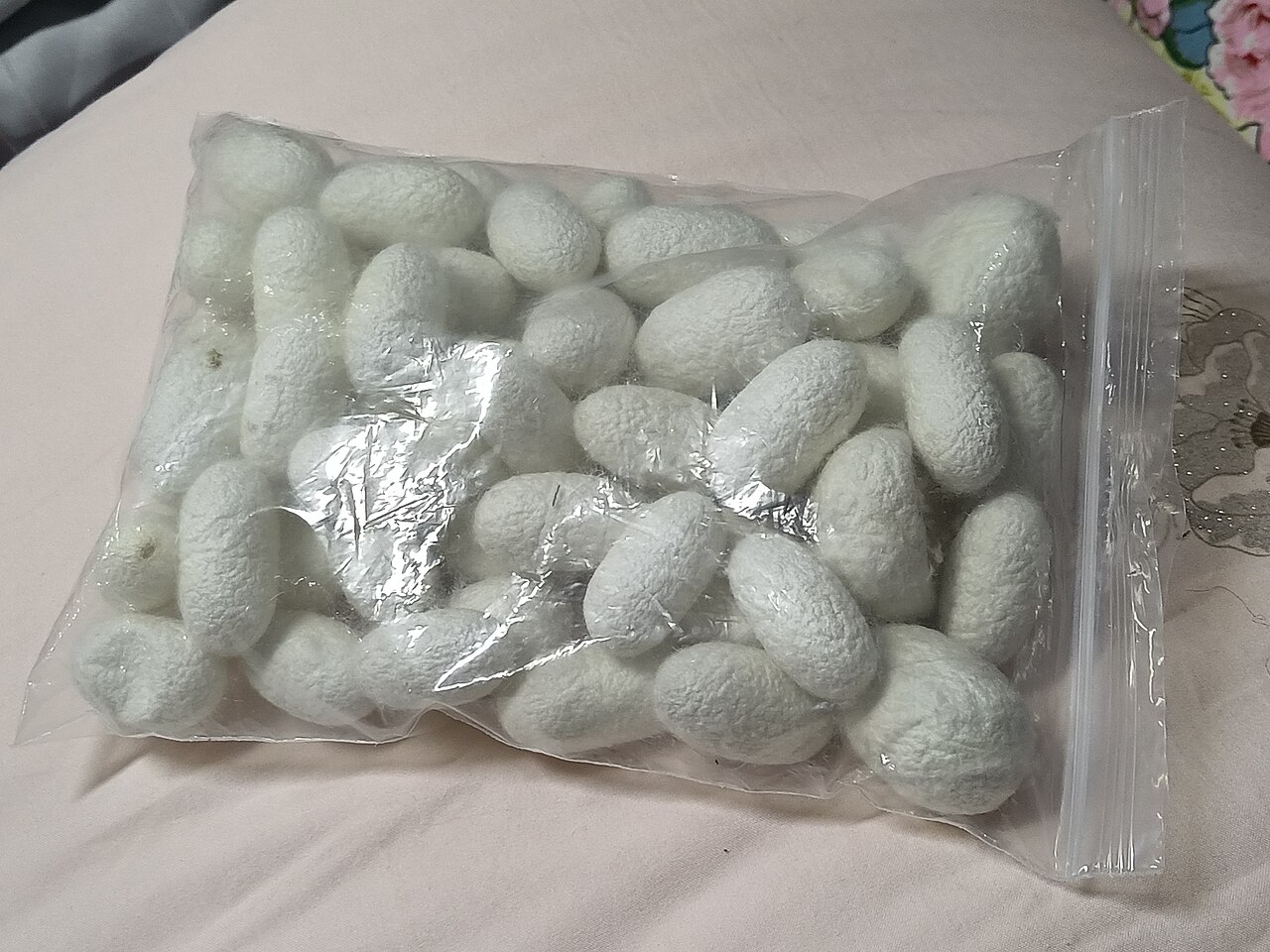
Photographed 2024-11-10 15:48:26
Silkworm cocoons – Modern sericulture material, useful as a physical reference
Silkworm cocoons. Modern sericulture material, useful as a physical reference. It does not establish the origin or makers of ancient traded silk.
006Where next
All related studies, connected material, books and sources9 · 7
Elsewhere on this site
Connected material
Photographs, drawings, books, videos and other studies linked to this study. A link helps you explore; it does not prove a historical claim.
- Silkworm cocoons – Modern sericulture material, useful as a physical referencephotographBackground
007Sources
The study lists the sources it consulted; we have not rechecked them. A working link does not show that a source was read, and a valid identifier does not show that it supports a claim. We do not link to unofficial uploads or copies of publications. Where a study cited one, we show the published citation, or a publisher, DOI or Internet Archive link when we have one. Tracking codes are removed from links, and the sources themselves are not republished here.
Anonymous; translated by Wilfred H. Schoff (1912 translation). The Periplus of the Erythraean Sea. Section 64: Thina, silk and the two described intermediary routes; modern identifications require separate caution. Relevant numbered sections read. University of Washington transcription of the 1912 translation, with some later editorial glosses. Ancient composition is usually placed around the middle of the first century CE, not the translation date. Schoff’s translation is public domain in the United States; no complete modern translation is reproduced.
Hunan Museum (2019 webpage). Physical Exercise Chart on Silk. Indexed object record: medium, Western Han attribution and Mawangdui Tomb 3 find context. Indexed museum text inspecte
Hunan Museum (2019 webpage). Physical Exercise Chart on Silk. Indexed object record: medium, Western Han attribution and Mawangdui Tomb 3 find context. Indexed museum text read; only indexed museum text was consulted. Used for an object’s medium and find context, not present-day therapeutic advice. No medical efficacy claims are adopted, and no artifact photograph or reconstruction is reproduced.
Fan Ye and earlier sources; translated and annotated by John E. Hill (fifth-century compilation; September 2003 translation). Hou Han Shu: The Western Regions according to the Hou Hanshu. Notes on the Text and section 10: compilation, sources and Gan Ying’s mission in 97 CE. Translation notes and selected sections 10 and 12 read. The compilation postdates the events reported. Bracketed modern place identifications belong to the translator. An attributed mission does not independently establish official Roman authorization or a Kerala stop.
Fan Ye and earlier sources; translated and annotated by John E. Hill (fifth-century compilation; September 2003 translation). Hou Han Shu: The Western Regions according to the Hou Hanshu. Section 12: reported Andun mission in 166 CE, its approach and gifts; authorization not independently established. Translation notes and selected sections 10 and 12 read. The compilation postdates the events reported. Bracketed modern place identifications belong to the translator. An attributed mission does not independently establish official Roman authorization or a Kerala stop.
Boyoung Lee, Elisabete Pires, A. Mark Pollard and James S. O. McCullagh (2022). Species identification of silks by protein mass spectrometry reveals evidence of wild silk use in antiquity. Methods and Palmyra results: five samples from three textiles, Antheraea mylitta identification and reference-database limits. Full HTML available; sample/method, Palmyra results and method-limit passages read. Selected archaeological samples, not all Palmyra textiles. Species classification is not a direct itinerary. Unrelated speculative early textual chronologies in the discussion are not adopted; tables/images were not independently reanalysed.
Boyoung Lee, Elisabete Pires, A. Mark Pollard and James S. O. McCullagh (2022). Species identification of silks by protein mass spectrometry reveals evidence of wild silk use in antiquity. Archaeological sample description and context dating; scope of the Palmyra subset. Full HTML available; sample/method, Palmyra results and method-limit passages read. Selected archaeological samples, not all Palmyra textiles. Species classification is not a direct itinerary. Unrelated speculative early textual chronologies in the discussion are not adopted; tables/images were not independently reanalysed.
Cosmas Indicopleustes; translated by J. W. McCrindle (sixth-century work; 1897 translation). Christian Topography, Book XI. Book XI, pp. 365–368: eastern products, Tzinista and Sielediba’s redistributing role; sixth-century comparison. Relevant Book XI passages read in the historical English translation. Later comparison, not evidence for a first-century itinerary or community. The text mixes report, anecdote and argument; translator notes and identifications are separate from the ancient voice. Historical religious claims are not website endorsements.
Researchers and institutions whose work this study uses: Wilfred H. Schoff
How we know The evidence, claims and dates behind this study
What this study draws on
- Periplus section 64 in Schoff's 1912 translation, and section 56 as read in a related study of the Kerala ports.
- The Hou Hanshu in John E. Hill's annotated translation.
- Lee and colleagues (2022): protein mass spectrometry on five silk samples from Palmyra.
- Cosmas Indicopleustes, Book XI, for a sixth-century view of Sri Lanka's role in the silk trade.
Dates in this study
This study has no dates recorded in a form we can chart, so there is no date chart. Any dates it gives are in the full study.
The study’s claims
0 claims · 0 source passages · 17 paragraphs
Browse the study paragraph by paragraphThis study has no separately listed claims. Its paragraphs can be browsed one by one.
About this study Status, corrections and how it was made
Status
Draft study, revision 5. No historian, archaeologist, or Tamil or Malayalam specialist has reviewed it yet.
How it was made
Compiled as an editorial synthesis from published scholarship around questions we framed. About this project & workflow
The summary, How sure lines and Two views notes on this page were prepared from this study and cross-checked against its passages. That is an editorial check, not a specialist review.
Technical details
Study code R044. The text fingerprint changes whenever the study text changes.
- The study text is shown as written. Links from its paragraphs to citations help you move around the study; they are not new claims or checked source passages.
See how this study’s records were extracted
Text fingerprint (SHA-256): R044 · e159d8bb288991620429794d… · v5
Evidence tables and technical details are on the web page: https://layersofthesouth.org/read/5e6061da1c