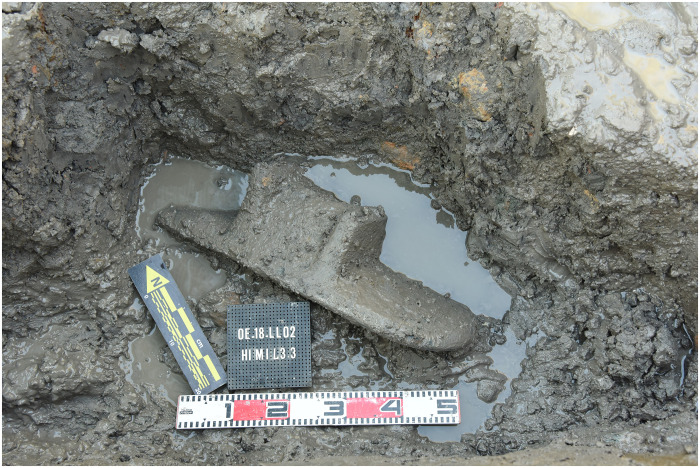
The large footed grinding slab
Oc Eo
Comparative evidence from Vietnam; these are not finds from Kerala or Tamil Nadu.
- Across the water
No secure clove or nutmeg find is known yet from early Pattanam
Pattanam's clove-like specimen is not a secure identification; the dated comparisons for clove and nutmeg come from Vietnam, Sri Lanka and Indonesia.
- This page
- 2,296 words · revision 5
Draft study · Awaiting specialist review · Updated
001Dates and places

No mapped place in this study.
Dates in this study are stated in words only.
- 1 Well supported
- 1 Likely
- 1 Possible
- 1 Not known
002How sure
In brief
This study asks what is known about cloves and nutmeg in early Kerala and Tamil Nadu. At Pattanam, a 2020 study reported a clove-like plant specimen, but its authors say it cannot securely be called clove. Kew's plant records place the native ranges of both spices in Maluku. The best dated comparison comes from Óc Eo in southern Vietnam. There, a nutmeg seed was directly dated to 120–248 CE, and clove and nutmeg traces were found on grinding tools. At Mantai in Sri Lanka, one clove comes from a layer of about 900–1100 CE, far later than the first century. On Pulau Ay in Indonesia, nutmeg residues come from a site first occupied around 3,500 years ago. The sources used here report no directly dated clove or nutmeg from early Pattanam.
Key researchers cited in this study: Dorian Q. Fuller (South Indian Archaeobotany & Crop Origins) · Nicole Boivin (Indian Ocean Biological & Maritime Exchanges) · Full bibliography
How sure
- Well supported
A nutmeg seed at Óc Eo dates to 120–248 CE.
The seed itself was radiocarbon dated and published by Wang and colleagues in 2023.
- Likely
The Mantai clove dates to about 900–1100 CE.
Dated by its layer, not directly, in a disturbed upper sequence from one trench.
- Possible
The clove-like specimen from Pattanam is clove.
Its authors say it only resembles clove in form, which is not enough to identify it.
- Not known
When cloves and nutmeg first reached Kerala.
The sources used here report no directly dated clove or nutmeg from early Pattanam.
Why it matters
Keeping a plant's homeland, a reported find and a dated sample apart stops early Kerala being credited with spices the evidence does not yet show.
003Key findings
What the study concludes
- Kew places the native ranges of the clove and nutmeg species discussed here in Maluku; a destination is not thereby their biological homeland.
- At Óc Eo, a nutmeg seed was directly dated to 120–248 cal CE; charcoal below a grinding slab is a different dated sample.
- The Mantai clove was assigned to a c. 900–1100 CE context in an upper disturbed sequence, not to the port’s earliest occupation.
In the study’s own words. How sure each point is, is shown above.
The summary above is the short read. The full study is the complete text it was drawn from, with its tables and source notes.
What the full study covers
- Main findings
- Start from Pattanam, then the dated cases elsewhere
- The familiar products are different parts of plants
- Nutmeg near its island home
- Óc Eo: ingredients on working surfaces
- Mantai: a port has more than one century
- A homeland is not a shipping label
- What remains uncertain
- The next questions
- References and access notes
004The study
Main findings
- At Pattanam, a clove-like plant specimen has been reported, but its authors say it is not enough to identify clove securely.
- Kew places the native ranges of the clove and nutmeg species discussed here in Maluku; a destination is not thereby their biological homeland.
- At Óc Eo, a nutmeg seed was directly dated to 120–248 cal CE; charcoal below a grinding slab is a different dated sample.
- The Mantai clove was assigned to a c. 900–1100 CE context in an upper disturbed sequence, not to the port’s earliest occupation.
Start from Pattanam, then the dated cases elsewhere
This study asks what is known about cloves and nutmeg in early Kerala and Tamil Nadu. In a 2020 study of plant remains from a peat layer at Pattanam, C. Rithin Varghese and colleagues report a mineralized specimen that only resembles clove in form and state that morphological similarity alone is insufficient to establish clove securely (p. 1104); “Five Tamil landscapes are a poetic code, not a map of economies” discusses their wider archaeobotanical study. 1 A bud or seed can make a large difference to a history of exchange. It may show that a material reached a place where it did not originate, or that people worked with ingredients that a list of imported pottery would never reveal. But a small find also demands precise questions. What was identified, how was it recovered, and what exactly has been dated? Because the sources used here give no directly dated clove or nutmeg from early Pattanam, this study follows cloves and nutmeg through three dated cases elsewhere: an island settlement in the Banda group, grinding tools and plant remains in southern Vietnam, and a clove recovered at Mantai in Sri Lanka. The cases are separated by geography, evidence type and time. Their value is not that they supply one uninterrupted itinerary. It is that they reveal distinct parts of a much larger history while exposing where connections remain to be demonstrated.
The familiar products are different parts of plants
Kew identifies Syzygium aromaticum as native to Maluku and describes cloves as its dried unopened flower buds. The commodity is therefore a particular stage and part of a plant, not a small seed. Recognizing that distinction helps a reader understand what a botanical identification is actually trying to establish. 2 Myristica fragrans supplies a different pair of products: the seed kernel used as nutmeg and its surrounding aril, used as mace. ICAR–IISR describes that distinction, while Kew places the species’ native range in Maluku. These references distinguish living-plant products; they cannot tell us whether a particular ancient packet contained one, the other, or both. 34 Bud, fruit, aril and seed should be labelled separately. That explains botanical form, not a particular ancient meal. Identification of a plant and evidence for its collection and preparation in a given place are different questions.
Nutmeg near its island home
Lape and colleagues report early occupation at Pulau Ay site 1, in the Banda group, and a University of Washington account of the same research describes nutmeg residues on potsherds among the food evidence. 56 Initial activity is placed around 3,500 years ago, with later changes around 3,000 years ago, but the material read gives no direct date on the nutmeg residue itself. The case lies far from Kerala and largely before the period covered here; it shows local use near the plant’s homeland, which is a history in its own right.
Óc Eo: ingredients on working surfaces
Wang and colleagues identified plant microremains on grinding tools at Óc Eo. Their reported spices include clove, nutmeg and Cinnamomum alongside several ginger-family plants. They interpret the assemblage in relation to culinary exchange; it does not preserve the instructions for a complete dish or name its cook. 7 Two dates deserve separate sentences. A nutmeg seed was directly dated to 120–248 calibrated CE, at the reported 94.3 percent probability. Charcoal collected slightly below a large grinding slab dated to 207–326 calibrated CE. The second is not a direct date on every residue found on the slab. 8 The authors leave open whether cloves arrived from their original island range or from trees planted farther west. Movement is supported without one proven direct sailing route. A phrase such as “2,000 years ago” must not replace the individual specimens’ reported dates. 9 The finding invites a practical distinction between a material and a person. Knowledge of how to work with an ingredient can move with people, but objects and ingredients can also pass through several hands. A proposed culinary connection is not a named migration event. What would strengthen a more specific account is evidence linking preparation, local context and the history of the implements, not merely repeating the same interpretation in several popular summaries.
Kungumanga (Myristica fragrans) – Modern nutmeg photograph
Photographed 2011-12-22
Mantai: a port has more than one century
Kingwell-Banham and colleagues report one clove from period 10 at Mantai, assigned to approximately 900–1100 CE. Their account discusses upper disturbed deposits and the limits of a study drawing on one trench. The clove’s contextual assignment is neither a direct measurement of its age nor evidence that cloves were present from the settlement’s beginning. 10 The same paper also discusses pepper at Mantai, as its title shows; this study did not review that find or its date. This matters because the phrase ancient port can absorb many centuries without warning. A person reading about early Roman-connected exchange might assume that every object mentioned in the next paragraph belongs to the same era. The report prevents that compression. The clove remains a significant discovery when kept in its later setting; moving it earlier would weaken, not enhance, its contribution. The study’s earlier claims about cloves elsewhere are references to other investigations, not additional specimens analysed in that excavation. We have not promoted them into verified firsts. In particular, the celebrated Terqa claim requires evaluation of its identification and context, not repetition of an early date from a general history. That remains a separate research task.
A homeland is not a shipping label
Current native-range information and a find far away form the beginning of a historical argument, but not its complete route. A material may pass through intermediate settlements. A plant may also be cultivated outside its earlier distribution before the particular object under study was deposited. The Óc Eo authors explicitly recognize the cultivation alternative, which is why a diagram connecting origin directly to destination would overstate their conclusion. 11 A useful map would draw the botanical origin layer separately from dated finds. A third layer could show proposed connections, labelled according to the evidence supporting them. It should not label a line as a voyage when all that survives is a material at one end. Leaving a route uncertain does not make the find unimportant; it makes the map a tool for inquiry rather than an illustration of a preferred answer.
For early Pattanam, the sources used here give no directly dated clove or nutmeg specimen, and the reported clove-like specimen is not a secure identification. That is a bounded result, not proof that nobody encountered either product there. The wider evidence can be investigated without assigning every material to a local meal. Early textual identifications remain a separate question. The strongest conclusion is therefore a series of particular presences, not an all-purpose claim that every spice circulated everywhere. Local use on Pulau Ay, working surfaces and a dated seed at Óc Eo, and a later contextual find at Mantai illuminate different moments. Holding those moments apart lets the lives behind them become more specific: people preparing food, using tools and receiving unfamiliar materials – not merely dots on an inevitable route to the West.
What remains uncertain
- The Pulau Ay study was read at abstract and institutional-explanation level; its analytical tables were not independently reviewed.
- Óc Eo was consulted through indexed full-text passages and selected author-uploaded text; supplementary tables and microscopic identifications were not independently tested.
- The Mantai clove has contextual dating in an upper disturbed sequence. Early literary identifications and the contested Terqa claim require separate investigation. The Pattanam clove-like specimen is not a secure identification.
The next questions
- Inspect the full Pulau Ay analytical study and associated archaeological contexts.
- Review primary publications of early clove claims at Terqa and Batujaya, including identification and stratigraphy.
- Identify securely dated evidence for introductions and cultivation, separately from traded plant remains.
References and access notes
1 C. Rithin Varghese, K. Mary Mathew, Y. S. Rao, Swapna Sasidharan and A. B. Remashree (2020). “Evidences for Plant Utilization, Spice Trade and Paleo-environment from Peat Formation of Pattanam Archaeological Site.” Proceedings of the Indian National Science Academy 86(2): 1097–1106 (see p. 1104 for the clove-like specimen and the authors' caution that morphological similarity alone does not securely establish clove). DOI: 10.16943/ptinsa/2019/49715. Open source: https://insa.nic.in/writereaddata/UpLoadedFiles/PINSA/PINSA_2019_Art59.pdf
2 Royal Botanic Gardens, Kew (living database). Syzygium aromaticum. Native range; general-information profile describing the flower-bud product, rechecked 10 October 2026. Taxon record read. A living botanical range record does not date ancient trade arrivals. Open source: powo.science.kew.org
3 ICAR–Indian Institute of Spices Research (Undated; checked 2026). Nutmeg and Mace – Myristica fragrans. Opening description: nutmeg kernel and mace aril. Description of the seed kernel and aril, plant habit and origin read. Promotional health claims not used. Current crop morphology and cultivation do not establish first-century presence at Pattanam or the date of introduction into Kerala. Open source: spices.res.in
Clove close up – Modern clove photograph
Photographed 2023-05-22
4 Royal Botanic Gardens, Kew (living database). Myristica fragrans. Current native-range statement. Taxon record read. Do not infer an ancient cargo date from a modern distribution map. Open source: powo.science.kew.org
5 Peter V. Lape; Emily Peterson; Daud Tanudirjo; Chung-Ching Shiung; Gyoung-Ah Lee; Judith Field; Adelle Coster (2018). New data from an open Neolithic site in Eastern Indonesia. Abstract: Pulau Ay site 1 occupation sequence and plant-food evidence. Institutional abstract and bibliographic record read; complete analytical tables not read. The early occupation date and a residue’s depositional context are not a direct radiocarbon date of nutmeg starch. Institutional publicity in S213 concerns this same research, not another independent find. Open source: researchoutput.ncku.edu.tw
6 University of Washington News; report on Peter Lape and colleagues’ research (2018). 3,500-year-old pumpkin spice? Archaeologists find early use of nutmeg as a food. Pulau Ay residues and food-use discussion; headline framing. Institutional article read; headline not used to certify a universal earliest occurrence. The playful headline does not mean an ancient pumpkin-spice recipe was found. Same investigation as another source in this list; not counted as independent corroboration. Open source: www.washington.edu
7 Weiwei Wang; Khanh Trung Kien Nguyen; Chunguang Zhao; Hsiao-chun Hung (2023). Earliest curry in Southeast Asia and the global spice trade 2000 years ago. Abstract; Results; interpretation of culinary ingredients on grinding tools. Abstract and indexed full-text passages on artifacts, results and nutmeg/clove discussion read. Indexed full-text passages and author-uploaded text were cross-checked. Figures and supplementary tables were not independently examined. A nutmeg seed is directly dated to 120–248 cal CE (94.3% probability); charcoal below a grinding slab dates 207–326 cal CE. These are different samples. Curry and movement of cooks are interpretations, not a recovered recipe or named person. Open source: pmc.ncbi.nlm.nih.gov
8 Weiwei Wang; Khanh Trung Kien Nguyen; Chunguang Zhao; Hsiao-chun Hung (2023). Earliest curry in Southeast Asia and the global spice trade 2000 years ago. Results: nutmeg seed Beta-629719; The data analyzed: charcoal PLD-45555 below the large slab. Abstract and indexed full-text passages on artifacts, results and nutmeg/clove discussion read. Indexed full-text passages and author-uploaded text were cross-checked. Figures and supplementary tables were not independently examined. A nutmeg seed is directly dated to 120–248 cal CE (94.3% probability); charcoal below a grinding slab dates 207–326 cal CE. These are different samples. Curry and movement of cooks are interpretations, not a recovered recipe or named person. Open source: pmc.ncbi.nlm.nih.gov
Myristica fragrans by kadavoor – Modern nutmeg photograph
Photographed 2009-11-11
9 Weiwei Wang; Khanh Trung Kien Nguyen; Chunguang Zhao; Hsiao-chun Hung (2023). Earliest curry in Southeast Asia and the global spice trade 2000 years ago. Discussion: Clove; distinction between source plantations and possible early cultivation elsewhere. Abstract and indexed full-text passages on artifacts, results and nutmeg/clove discussion read. Indexed full-text passages and author-uploaded text were cross-checked. Figures and supplementary tables were not independently examined. A nutmeg seed is directly dated to 120–248 cal CE (94.3% probability); charcoal below a grinding slab dates 207–326 cal CE. These are different samples. Curry and movement of cooks are interpretations, not a recovered recipe or named person. Open source: pmc.ncbi.nlm.nih.gov
10 Eleanor Kingwell-Banham; Wijerathne Bohingamuwa; Nimal Perera; Gamini Adikari; Alison Crowther; Dorian Q. Fuller; Nicole Boivin (2018). Spice and rice: pepper, cloves and everyday cereal foods at the ancient port of Mantai, Sri Lanka. Plant foods and cultivation at Mantai: period-10 clove; upper disturbed periods; Conclusion on one-trench scope. Full HTML article read selectively for chronology, clove discussion, disturbance and conclusion. Raw data not independently reanalysed. One clove is assigned to period 10, c. 900–1100 CE. This is contextual dating in the upper disturbed sequence, not a direct date on the clove and not a first-century find. Earlier claims cited by the authors require separate checking. Open source: www.cambridge.org
11 Weiwei Wang; Khanh Trung Kien Nguyen; Chunguang Zhao; Hsiao-chun Hung (2023). Earliest curry in Southeast Asia and the global spice trade 2000 years ago. Discussion: Clove and concluding caution about propagation away from homelands. Abstract and indexed full-text passages on artifacts, results and nutmeg/clove discussion read. Indexed full-text passages and author-uploaded text were cross-checked. Figures and supplementary tables were not independently examined. A nutmeg seed is directly dated to 120–248 cal CE (94.3% probability); charcoal below a grinding slab dates 207–326 cal CE. These are different samples. Curry and movement of cooks are interpretations, not a recovered recipe or named person. Open source: pmc.ncbi.nlm.nih.gov
005Photographs
Photographs of the places and objects this study discusses. Each item carries its creator’s credit, licence and documented source. See all 412 photographs and source images ↗
Oc Eo
The large footed grinding slab
A footed sandstone grinding slab, 76 cm long, excavated at Oc Eo in 2018. Starch grains of ginger, cinnamon and nutmeg were identified on its surface.
Comparative evidence from Vietnam; these are not finds from Kerala or Tamil Nadu.
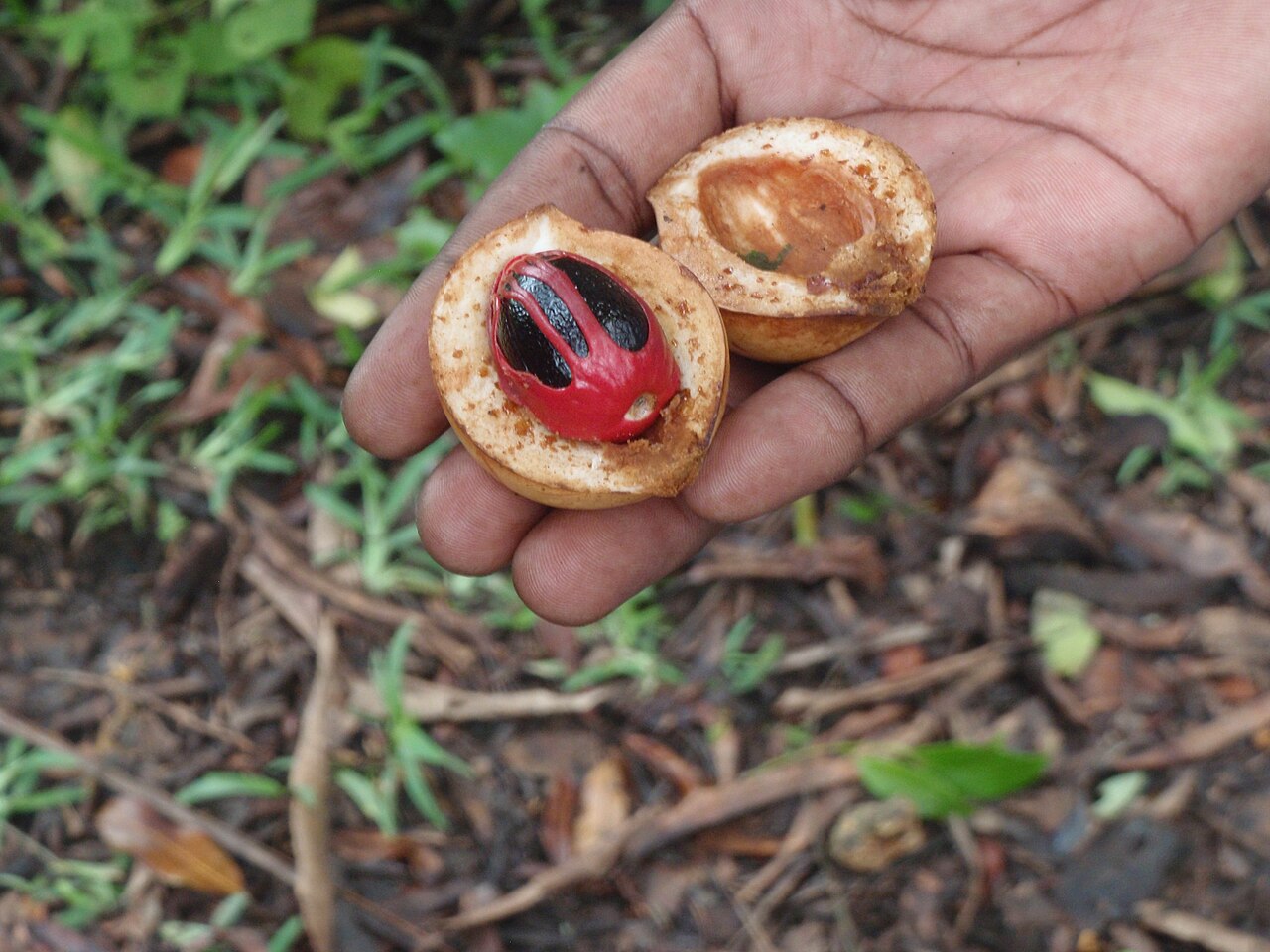
Photographed 2011-12-22 21:48:53
Kungumanga (Myristica fragrans) – Modern nutmeg photograph
Kungumanga (Myristica fragrans). Modern nutmeg photograph; independent evidence is needed for ancient trade chronology.
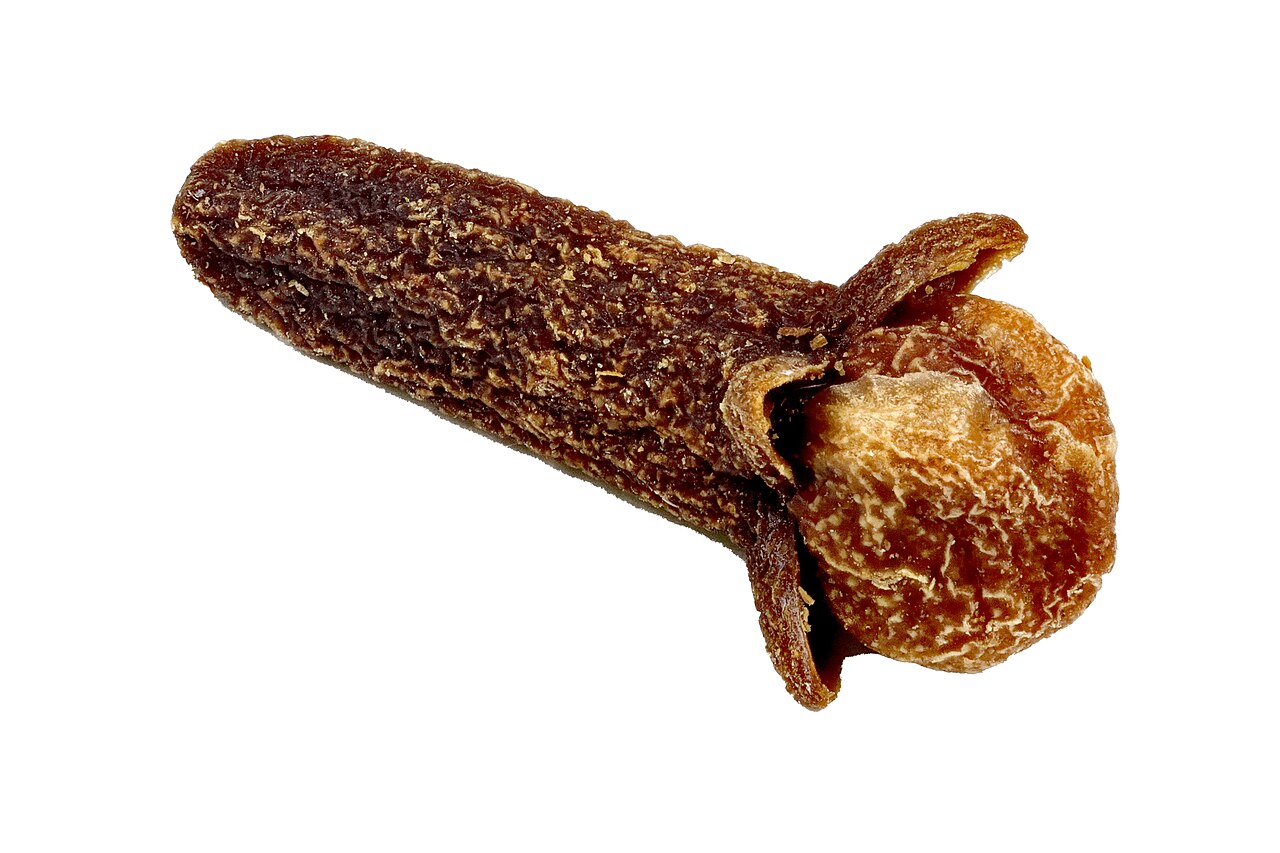
Photographed 2023-05-22 13:52:18
Clove close up – Modern clove photograph
Clove close up. Modern clove photograph; does not establish arrival in ancient Kerala.
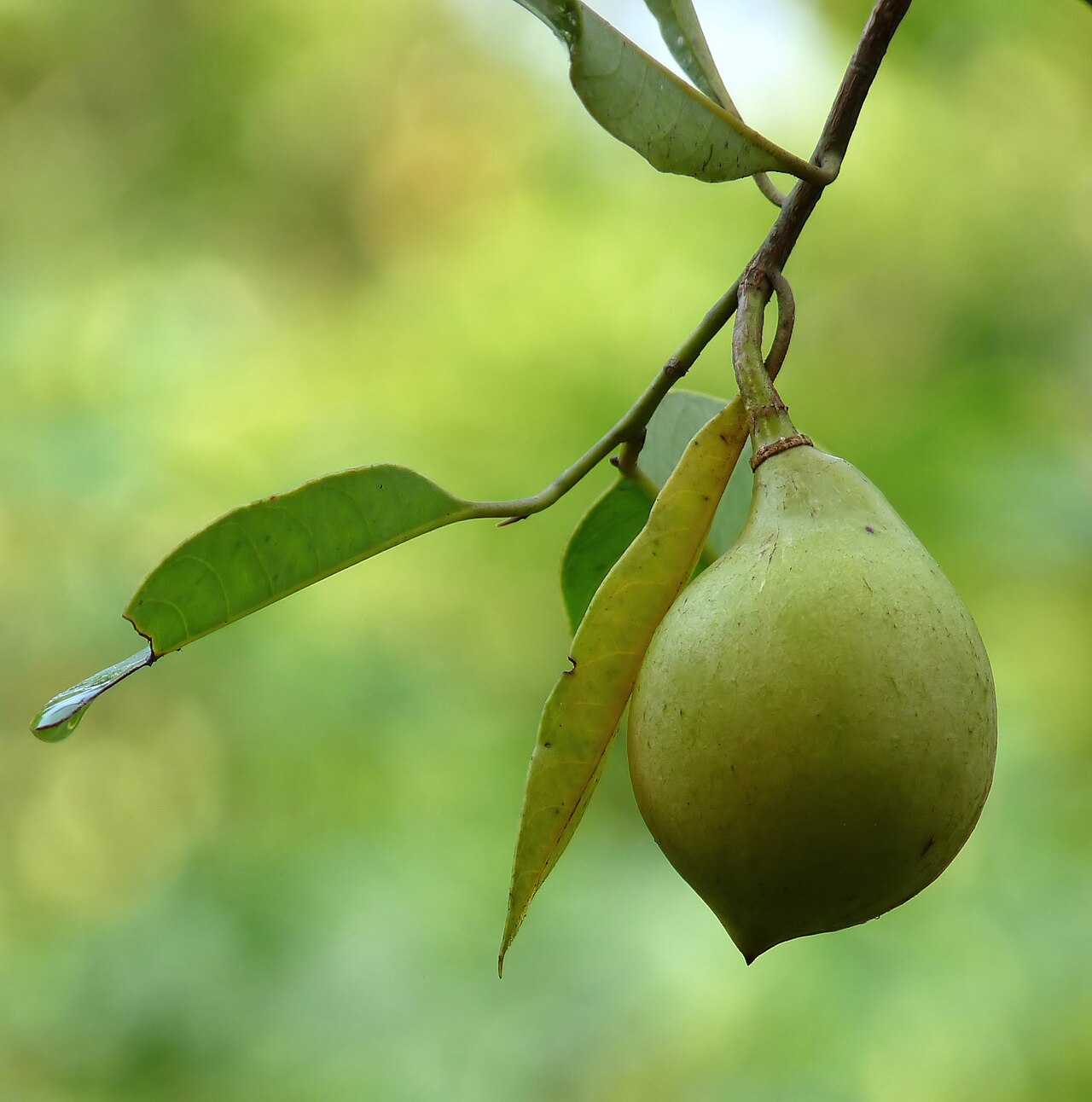
Photographed 2009-11-11
Myristica fragrans by kadavoor – Modern nutmeg photograph
Myristica fragrans by kadavoor. Modern nutmeg photograph; independent evidence is needed for ancient trade chronology.
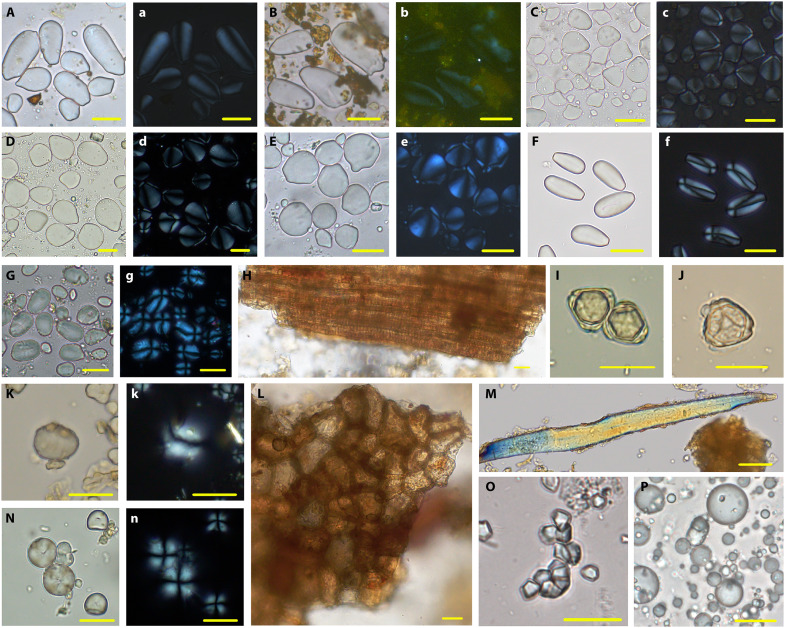
Modern references relevant to this study
Modern reference samples used for comparison in the Oc Eo study: starch grains and other remains of turmeric, ginger, clove, cinnamon, nutmeg and rice.
Comparative evidence from Vietnam; these are not finds from Kerala or Tamil Nadu.
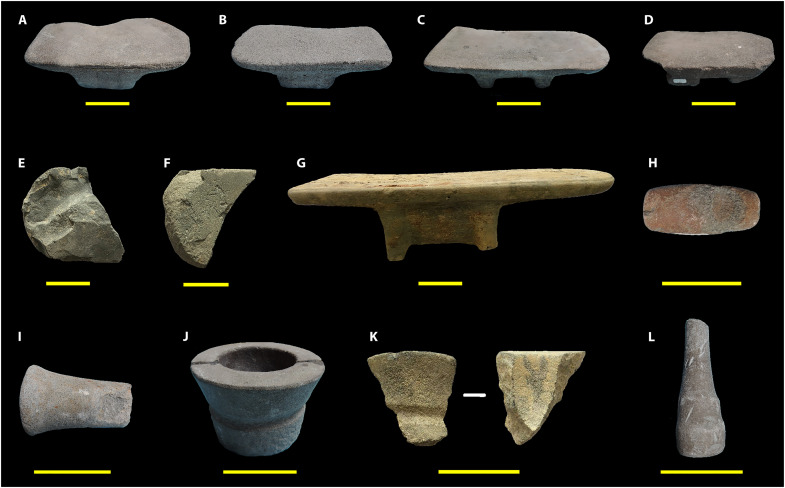
Oc Eo
Ancient food-preparation tools from Oc Eo
Food-preparation tools from Oc Eo reported in the published study: footed grinding slabs, mullers or pestles, and mortars. Scale bar 10 cm.
Comparative evidence from Vietnam; these are not finds from Kerala or Tamil Nadu.

Oc Eo
Ancient plant remains recovered from Oc Eo
Starch grains and other plant remains from Oc Eo under the microscope, including turmeric, ginger, galangal, clove, cinnamon, nutmeg and rice.
Comparative evidence from Vietnam; these are not finds from Kerala or Tamil Nadu.
006Where next

All related studies, connected material, books and sources10 · 11
Elsewhere on this site
Multi-Script Glossary Terms: ēlam (ஏலம் / ഏലം) · kaṟuvā (Cinnamon Bark) & tamālapatra (Malabathron Leaf) (கறுவா & தமாலபத்திரம் / കറുവപ്പട്ടയും തമാലപത്രവും (വഴനയില))
Connected material
Photographs, drawings, books, videos and other studies linked to this study. A link helps you explore; it does not prove a historical claim.
- Ancient food-preparation tools from Oc EophotographBackground
- The large footed grinding slabphotographBackground
- Ancient plant remains recovered from Oc Eoscientific photomicrographBackground
- Modern references relevant to this studyphotographBackground
- Clove close up – Modern clove photographphotographBackground
- Myristica fragrans by kadavoor – Modern nutmeg photographphotographBackground
- Kungumanga (Myristica fragrans) – Modern nutmeg photographphotographBackground
007Sources
The study lists the sources it consulted; we have not rechecked them. A working link does not show that a source was read, and a valid identifier does not show that it supports a claim. We do not link to unofficial uploads or copies of publications. Where a study cited one, we show the published citation, or a publisher, DOI or Internet Archive link when we have one. Tracking codes are removed from links, and the sources themselves are not republished here.
C. Rithin Varghese et al. (2020), 'Evidences for Plant Utilization, Spice Trade and Paleo-environment from Peat Formation of Pattanam Archaeological Site', PINSA 86(2): 1097–1106
C. Rithin Varghese, K. Mary Mathew, Y. S. Rao, Swapna Sasidharan and A. B. Remashree (2020). Evidences for Plant Utilization, Spice Trade and Paleo-environment from Peat Formation of Pattanam Archaeological Site. Proceedings of the Indian National Science Academy 86(2): 1097–1106 (p. 1104). DOI: 10.16943/ptinsa/2019/49715.
Royal Botanic Gardens, Kew (living database). Syzygium aromaticum. Native range; general-information profile describing the flower-bud product, rechecked 10 October 2026. Taxon record read. A living botanical range record does not date ancient trade arrivals.
ICAR–Indian Institute of Spices Research (Undated; checked 2026). Nutmeg and Mace – Myristica fragrans. Opening description: nutmeg kernel and mace aril. Description of the seed kernel and aril, plant habit and origin read. Promotional health claims not used. Current crop morphology and cultivation do not establish first-century presence at Pattanam or the date of introduction into Kerala.
Royal Botanic Gardens, Kew (living database). Myristica fragrans. Current native-range statement. Taxon record read. Do not infer an ancient cargo date from a modern distribution map.
Peter V. Lape; Emily Peterson; Daud Tanudirjo; Chung-Ching Shiung; Gyoung-Ah Lee; Judith Field; Adelle Coster (2018). New data from an open Neolithic site in Eastern Indonesia. Abstract: Pulau Ay site 1 occupation sequence and plant-food evidence. Institutional abstract and bibliographic record read; complete analytical tables not read. The early occupation date and a residue’s depositional context are not a direct radiocarbon date of nutmeg starch. Institutional publicity in S213 concerns this same research, not another independent find.
University of Washington News; report on Peter Lape and colleagues’ research (2018). 3,500-year-old pumpkin spice? Archaeologists find early use of nutmeg as a food. Pulau Ay residues and food-use discussion; headline framing. Institutional article read; headline not used to certify a universal earliest occurrence. The playful headline does not mean an ancient pumpkin-spice recipe was found. Same investigation as another source in this list; not counted as independent corroboration.
Weiwei Wang; Khanh Trung Kien Nguyen; Chunguang Zhao; Hsiao-chun Hung (2023). Earliest curry in Southeast Asia and the global spice trade 2000 years ago. Abstract; Results; interpretation of culinary ingredients on grinding tools. Abstract and indexed full-text passages on artifacts, results and nutmeg/clove discussion read. Direct PMC opening was not accessible in full online; selected author-uploaded text was cross-checked. Figures and supplementary tables were not independently examined. A nutmeg seed is directly dated to 120–248 cal CE (94.3% probability); charcoal below a grinding slab dates 207–326 cal CE. These are different samples. Curry and movement of cooks are interpretations, not a recovered recipe or named person.
Weiwei Wang; Khanh Trung Kien Nguyen; Chunguang Zhao; Hsiao-chun Hung (2023). Earliest curry in Southeast Asia and the global spice trade 2000 years ago. Results: nutmeg seed Beta-629719; The data analyzed: charcoal PLD-45555 below the large slab. Abstract and indexed full-text passages on artifacts, results and nutmeg/clove discussion read. Direct PMC opening was not accessible in full online; selected author-uploaded text was cross- checked. Figures and supplementary tables were not independently examined. A nutmeg seed is directly dated to 120–248 cal CE (94.3% probability); charcoal below a grinding slab dates 207–326 cal CE. These are different samples. Curry and movement of cooks are interpretations, not a recovered recipe or named person.
Weiwei Wang; Khanh Trung Kien Nguyen; Chunguang Zhao; Hsiao-chun Hung (2023). Earliest curry in Southeast Asia and the global spice trade 2000 years ago. Discussion: Clove; distinction between source plantations and possible early cultivation elsewhere. Abstract and indexed full-text passages on artifacts, results and nutmeg/clove discussion read. Direct PMC opening was not accessible in full online; selected author-uploaded text was cross-checked. Figures and supplementary tables were not independently examined. A nutmeg seed is directly dated to 120–248 cal CE (94.3% probability); charcoal below a grinding slab dates 207–326 cal CE. These are different samples. Curry and movement of cooks are interpretations, not a recovered recipe or named person.
Eleanor Kingwell-Banham; Wijerathne Bohingamuwa; Nimal Perera; Gamini Adikari; Alison Crowther; Dorian Q. Fuller; Nicole Boivin (2018). Spice and rice: pepper, cloves and everyday cereal foods at the ancient port of Mantai, Sri Lanka. Plant foods and cultivation at Mantai: period-10 clove; upper disturbed periods; Conclusion on one-trench scope. Full HTML article read selectively for chronology, clove discussion, disturbance and conclusion. Raw data not independently reanalysed. One clove is assigned to period 10, c. 900–1100 CE. This is contextual dating in the upper disturbed sequence, not a direct date on the clove and not a first-century find. Earlier claims cited by the authors require separate checking.
Weiwei Wang; Khanh Trung Kien Nguyen; Chunguang Zhao; Hsiao-chun Hung (2023). Earliest curry in Southeast Asia and the global spice trade 2000 years ago. Discussion: Clove and concluding caution about propagation away from homelands. Abstract and indexed full-text passages on artifacts, results and nutmeg/clove discussion read. Direct PMC opening was not accessible in full online; selected author-uploaded text was cross-checked. Figures and supplementary tables were not independently examined. A nutmeg seed is directly dated to 120–248 cal CE (94.3% probability); charcoal below a grinding slab dates 207–326 cal CE. These are different samples. Curry and movement of cooks are interpretations, not a recovered recipe or named person.
Researchers and institutions whose work this study uses: Dorian Q. Fuller, Nicole Boivin
How we know The evidence, claims and dates behind this study
What this study draws on
- Kew plant records and the Indian Institute of Spices Research for native ranges and plant parts.
- Wang and colleagues (2023): plant traces on Óc Eo grinding tools and a directly dated nutmeg seed.
- Kingwell-Banham and colleagues (2018) on plant remains from one trench at Mantai.
- Varghese and colleagues (2020) on Pattanam's plant remains, as discussed in a related study.
Dates in this study
This study has no dates recorded in a form we can chart, so there is no date chart. Any dates it gives are in the full study.
The study’s claims
0 claims · 0 source passages · 21 paragraphs
Browse the study paragraph by paragraphThis study has no separately listed claims. Its paragraphs can be browsed one by one.
About this study Status, corrections and how it was made
Status
Draft study, revision 5. No historian, archaeologist, or Tamil or Malayalam specialist has reviewed it yet.
How it was made
Compiled as an editorial synthesis from published scholarship around questions we framed. About this project & workflow
The summary, How sure lines and Two views notes on this page were prepared from this study and cross-checked against its passages. That is an editorial check, not a specialist review.
Technical details
Study code R051. The text fingerprint changes whenever the study text changes.
- The study text is shown as written. Links from its paragraphs to citations help you move around the study; they are not new claims or checked source passages.
See how this study’s records were extracted
Text fingerprint (SHA-256): R051 · b65b4a2c836566084ad45ac4… · v5
Evidence tables and technical details are on the web page: https://layersofthesouth.org/read/6ad9051ef0