Rock-cut beds at the Jambai Jain shelter
Jambai
Photographed 2011-12-25
- Land & water
- 200 BCE–300 CE
- 300–600 CE
- Mayiladumparai
Northern Tamil Nadu's firmest Deccan link is the Pallava charters
Burials, digs and inscriptions in northern Tamil Nadu show overlapping networks, not one corridor; early Pallava charters give the clearest Deccan link.
- This page
- 4,497 words · revision 6
Draft study · Awaiting specialist review · Updated
001Dates and places
Places on the atlas that name this study.
- Mayiladumparai Iron Age & Microlithic-to-Early Historic Site
Excavated upland zone · Krishnagiri District
1000–500 BCE
Different beginnings
500–200 BCE
Marks & materials
200 BCE–300 CE
Connected worlds
300–600 CE
Change & continuity
After 600 CE
- Kanchipuram occupation/material discussed as first centuries BCE and CE; late Satavahana finds assigned to second century CE in synthesis.
- Jambai: dedicated state page says 1st century CE; Tamil-Brahmi taxonomy caption says 1st century BCE.
- Vasavasamudram institutional interpretation: 1st-2nd century CE.
- Panayakulam official summary: occupation from 3rd century CE to 13th century CE.
- Mañchikallu inscription: palaeographically second half of third century CE; linguistic comparison suggests near end of third century.
- Mayidavolu and Hirahadagalli: internal regnal years 10 and 8; broadly late third/early fourth century in relative early-Pallava chronology.
- Talagunda pillar inscription: broad fifth- to early-sixth-century scholarly placement; inscription itself not explicitly dated.
- Pallavamedu official summary: Pallava-related occupation from 6th to 9th century CE.
- Date from writing, coins or texts
- Period assigned by excavators or scholars
- How it was dated is not stated
Each date belongs to what was dated (a sample, an object, a layer or a text), which is not always the event the study asks about.
Each period has the same width, so spacing is not to scale.
The full table of dates, with their ranges, is under How we know.
- 1 Well supported
- 2 Likely
- 1 Not known
002How sure
In brief
Northern and northeastern Tamil Nadu, around the Palar and Ponnaiyar rivers, has many megalithic burials but few well-dated excavations. Digs at Kanchipuram found early pottery with Brahmi writing, amphora fragments, late Satavahana coins and coin moulds. Vasavasamudram, dug in 1969–70, yielded amphora material and rouletted ware beside ring wells and a brick-lined tank. These finds show trade and contact, not foreign rule. The firmest link to the Deccan comes from written records. The Mayidavolu plates, a Pallava royal order issued from Kanchipura, address an official at Dhanyakata in the Andhra region. The Jambai inscription, of about the first century CE, names the chief Atiyan Netuman Anci. The study does not examine Kerala, and several key excavation reports remain unread.
Key researchers cited in this study: Iravatham Mahadevan (Tamil-Brāhmī Epigraphy) · R. Nagaswamy (Tamil Epigraphy & Numismatics) · A. Ghosh (Archaeological Survey of India) · Dorian Q. Fuller (South Indian Archaeobotany & Crop Origins) · Full bibliography
How sure
- Well supported
A Pallava ruler at Kanchipuram sent orders to an official in the Andhra region.
The Mayidavolu plates, in a current critical edition, say so directly.
- Likely
Kanchipuram and Vasavasamudram took part in wide exchange around the first centuries CE.
Amphorae, rouletted ware and Satavahana-related coins are reported in excavation summaries.
- Likely
The Jambai inscription dates to about the first century CE.
Mahadevan's palaeographic date; one departmental web caption says first century BCE.
- Not known
Whether Satavahana rulers governed Kanchipuram.
Coins and coin moulds show contact; they do not show who governed the city.
Why it matters
It shows how northern Tamil Nadu connected with the Deccan before 600 CE, keeping traded goods apart from political rule.
003Key findings
What the study concludes
- The strongest pre-600 Deccan links are the early Pallava inscriptional network, not famous post-600 monuments.
- Publication quality is uneven: Kanchipuram and several megalithic sites need context-level recovery before fine-grained reconstruction.
In the study’s own words. How sure each point is, is shown above.
The summary above is the short read. The full study is the complete text it was drawn from, with its tables and source notes.
What the full study covers
004The study
Overview
What dated evidence illuminates the northern and northeastern regional zones and their connections before 600 CE?
This study is a source-led survey of northern and northeastern Tamil Nadu. It does not treat modern administrative boundaries as ancient ones, does not infer routes merely from named river basins, distinguishes objects from movements and political relationships, and treats evidence after 600 CE as later material rather than silently importing it into the core period. It does not examine Kerala: its evidence concerns the northern Tamil country and its documented links to the Deccan.
The strongest conclusion is that there is no securely demonstrated single “northern route” or homogeneous northern region. The evidence is instead a patchwork of burial landscapes, settlement excavations, Tamil-Brahmi inscriptions, coastal exchange assemblages, coins and – most decisively for connections with the Deccan – early Pallava inscriptions whose documentary relationships cross the modern Tamil Nadu–Andhra Pradesh–Karnataka boundaries. Official Archaeological Survey of India inventories show excavations at Sanur, Amirthamangalam, Kunnattur, Kanchipuram and Paiyampalli, while the protected-monument list preserves a considerably denser megalithic landscape in the modern Kanchipuram–Tiruvallur area than a famous-monument-centered history would suggest. ↗1 ↗2
Chronologically, four different lanes need to remain separate. Earlier background is represented especially by Paiyampalli's Neolithic sequence; it matters for long-term occupation but cannot simply be folded into the 1000 BCE–600 CE window covered here. Core-period evidence includes Iron Age/Megalithic landscapes, the c. first-century CE Jambai inscription, early-historic Kanchipuram and Vasavasamudram, and the third- to fifth-century epigraphic network connecting Kanchipuram to parts of the Deccan. Later reception/comparison includes most surviving monumental Pallava architecture and much of Pallavamedu. Mixed chronology characterizes sites such as Andipatti and Panayakulam, where official summaries span both pre- and post-600 phases. ↗1 ↗3 ↗4 ↗5
Jambai Tamil-Brahmi inscription on the rock surface, with modern highlighting visible
Jambai
Photographed 2011-12-25
The most secure direct political-administrative connection is not a coin, amphora or inferred road. The Mayidavolu plates explicitly issue an order from Kanchipura to an official at Dhanyakata and concern a village in Andhrapatha; the Hirahadagalli plates likewise issue a Pallava order from Kanchipura. A damaged Mañchikallu inscription in the Guntur region names a Pallava Simhavarman and was placed by its editors in the later third century CE. Together these records demonstrate a documentary field linking Kanchipuram with the Andhra and Karnataka Deccan, while leaving the exact frontier, road network and dynastic origins unresolved. ↗6 ↗7 ↗8
Scope, chronology and method
The study area used here is deliberately functional rather than political. It comprises the Palar basin and Kanchipuram–Chengalpattu littoral; the Ponnaiyar/South Pennar and adjacent inland zone extending through modern Tiruvannamalai, Villupuram and toward Dharmapuri (“Modur: a Neolithic settlement beneath later Iron Age layers” covers the Modur excavations there, and “Adiyamankottai: an early settlement, a twelfth-century rampart” the Adiyamankottai site); and, only where a dated source creates an explicit relationship, counterpart localities in the lower Krishna/Guntur region and interior Karnataka. Modern districts are therefore bibliographic and geographic locators, not proxies for ancient territorial units.
That definition is preferable to assuming an ancient Palar or Pennar “corridor.” The official excavation record itself is uneven: ASI lists repeated mid-twentieth-century work at Sanur, Amirthamangalam and Kunnattur, a 1962–63 Kanchipuram campaign and Paiyampalli in 1964–65; the Tamil Nadu State Department separately lists Vasavasamudram in 1969–70 and Pallavamedu in 1970–71. ↗1 ↗9 The centrally protected-site inventory, meanwhile, includes numerous megalithic cists, cairns, stone circles and urn burials in modern Tiruvallur and Kanchipuram districts. This demonstrates an archaeological landscape wider than the excavated-site list, but a protected-site listing is not in itself an absolute chronology. ↗2
The evidential hierarchy used here is:
- original or current critical inscription editions and excavation publications;
- official archaeological inventories and institutional catalogues;
- scholarly syntheses used to locate and evaluate the underlying evidence;
- secondary web material only as a discovery lead, not as a substitute where a primary publication could be identified.
The search was targeted rather than formally systematic. It followed Tamil Nadu Archaeology and ASI inventories into site publications; Kanchipuram synthesis into Indian Archaeology – A Review references; and early Pallava material into DHARMA's current digital editions and the original Epigraphia Indica publications. It also checked later scholarship for chronology and looked specifically for contradictory dating and interpretive claims. The current DHARMA editions provide text, apparatus, translations and publication history for the early Pallava charters and identify the earlier Hultzsch/Bühler editions from which the modern edition develops. ↗6 ↗7
Access was materially uneven. The current DHARMA editions and Valérie Gillet's Kanchipuram synthesis were readable in full HTML. ↗6 ↗10 The 1978 Vasavasamudram report by R. Nagaswamy (Tamil Nadu Archaeology Publication no. 50) and Indian Archaeology 1962–63 – A Review were not consulted in full for this study; no page, trench plan, or figure from either volume is treated here as directly read evidence. The Paiyampalli-specific sample tables behind the radiometric literature were likewise not read, even though Fuller, Boivin and Korisettar's 2007 paper confirms a major radiocarbon-based reassessment of South Indian Neolithic chronology. ↗11 ↗12
That distinction matters. A campaign's existence is not a site date; a coin's production date is not automatically its depositional date; a regnal year is not an absolute CE year; palaeography gives a comparative range rather than a laboratory determination; and an object from another region demonstrates circulation more readily than political sovereignty.
Dated evidence across the study frame
The following inventory emphasizes evidence that can be chronologically bounded while explicitly identifying where the underlying context remains inaccessible.
| Evidence locus | Date and basis | What is actually established | Principal limitation |
|---|---|---|---|
| Sanur, Amirthamangalam, Kunnattur and the northeastern megalithic landscape | Core-period candidate, but exact site-by-site ranges unresolved here | ASI records Sanur as a Megalithic excavation in 1950/1952, Amirthamangalam in 1954–55 and Kunnattur in 1955–58; many further cist/cairn sites are protected in modern Kanchipuram/Tiruvallur. ↗1 ↗2 | The inventories do not provide burial-level stratigraphy, absolute dates or sample identifiers. |
| Paiyampalli | Principally earlier background, with transition questions relevant to the target window | ASI records a 1964–65 Neolithic excavation in former North Arcot; South Indian Neolithic chronology has subsequently been reassessed with radiocarbon/Bayesian methods. ↗1 ↗12 | Sample-level Paiyampalli determinations were not read, so no numeric date is repeated here. |
| Jambai | c. first century CE; palaeographic | Tamil-Brahmi text names Atiyan Netuman Anci and Satiyaputo in connection with a pali. Mahadevan's corpus (see “The Jambai inscription ties Aśoka's Satiyaputo to the Atiyan line”) and the dedicated state page date it to about the first century CE; one departmental taxonomy web caption says first century BCE. ↗13 ↗14 | Palaeographic rather than radiometric date; see “The Jambai inscription ties Aśoka's Satiyaputo to the Atiyan line” for full corpus discussion. |
| Kanchipuram | First centuries BCE/CE onward; excavated stratigraphy and artefact typology as reported in synthesis | Small excavations recovered late-Megalithic/early-historic ceramics, Brahmi-inscribed sherds, amphorae, Satavahana-related coins and coin moulds, beads, bone and iron objects. ↗10 | Trench/locus associations and the full 1969–76 publication record remain inadequately checked here. |
| Vasavasamudram | First–second centuries CE in the excavating institution's interpretation | Amphora material, rouletted ware and other ceramics occur with ring wells and a brick-lined tank. ↗15 | The 1978 primary report and fabric/provenance analyses need inspection before specifying vessel origins or functions. |
| Andipatti | Mixed: official summary begins in first century BCE and extends to twelfth century CE | The 2004–05 excavations produced Megalithic and historical ceramics; the state summary treats occupation as beginning within the core period. ↗3 | Long typological range; no locus-by-locus chronology was read. |
| Panayakulam | Mixed: third–thirteenth centuries CE in official summary | Gives an inland Dharmapuri-area habitation anchor beginning within the core period. ↗5 | Some highlighted finds, such as eighth-century figurines, are explicitly post-600 and cannot be back-projected. |
| Modur | Mixed: a Neolithic layer below Megalithic/Iron Age material; no site-specific date recovered | Excavated in 2004–05 as a habitation site on three mounds; secondary reporting places a Neolithic stone-tool deposit below a Megalithic deposit, and a field of more than fifty Megalithic burials lies about 1 km to the southwest. “Modur: a Neolithic settlement beneath later Iron Age layers” covers the site. | Regional dates, such as those from Mayiladumparai, cannot be transferred to Modur; the 2005 excavation report has not been read. |
| Pallavamedu | Sixth–ninth centuries CE | Three occupation periods are summarized as Pallava-related. ↗4 | Mostly outside scope; at most the sixth-century edge can contribute before 600. |
Jambai and inland connection
Jambai is particularly valuable because it is a named-person inscription rather than an archaeological style horizon. The state transcription reads Satiyaputo Atiyan Netuman Anci itta Pali and interprets the record as a hermitage given by Atiyan Netuman Anci, identifying him with the Takatur/Dharmapuri-associated chief known from Tamil literary tradition. ↗13 The inscription therefore provides evidence that this named political personage – or, more cautiously, the authority represented by the inscription – was commemorated in the Jambai/Tirukkoilur region.
What it does not demonstrate is equally important. It does not plot a road from Takatur to Jambai, establish that every intervening district belonged to one territorial state, or turn literary accounts of campaigning into archaeologically observed movement. The safest historical proposition is one of named benefaction/presence across an inland span, not a reconstructed permanent corridor.
Mahadevan's corpus and the dedicated Tamil Nadu Archaeology page both place the Jambai inscription palaeographically around the first century CE (followed in “The Jambai inscription ties Aśoka's Satiyaputo to the Atiyan line”, “Velir chiefs were named local rulers, not one hill-chief system”, and “Pandya and Chola power is well attested, but not as a king list”), though one departmental Tamil-Brāhmī taxonomy web caption says first century BCE. ↗13 ↗14 Mahadevan's revised Early Tamil Epigraphy – 2014, revised and enlarged second edition, volume 1, Central Institute of Classical Tamil, ISBN 9789381744147 – remains the source needed to settle the original-language reading and chronology.
Kanchipuram and Vasavasamudram
Kanchipuram is simultaneously indispensable and methodologically dangerous because the site's later fame can encourage backward projection. Gillet's synthesis reports that the excavations were small and in part motivated by the search for Buddhist remains near the Kamakshi area. The finds nevertheless included material from the first centuries BCE/CE: late-Megalithic pottery, Brahmi-inscribed sherds, amphorae, terracotta figurines, late Satavahana coins and Satavahana-period coin moulds. Circular brick bases were interpreted as stupas, but Gillet explicitly notes the absence of clear-cut Buddhist material associated with them. ↗10
That last point is a useful warning about source genre. A circular brick foundation is an observation; “stupa” is a functional/religious interpretation. Likewise, a Satavahana coin at Kanchipuram is an object with a political/monetary origin or iconographic affiliation; it is not automatically proof that Satavahana officials governed Kanchipuram. The National Mission on Monuments and Antiquities independently indexes a lead “Coin Satavahana” with Kanchipuram provenance under the ASI Chennai Circle, corroborating the presence of this object class at the city, although its direct catalogue entry and excavation context were not checked. ↗16
Vasavasamudram provides a different type of connection. The Tamil Nadu Archaeology page records amphora material, conical jars, rouletted ware and ring wells beside a brick-lined tank and interprets the site as demonstrating Roman trade contacts in the first and second centuries CE. ↗15 The assemblage certainly warrants a long-distance-exchange interpretation, but “Roman trade contact” should not be expanded into a resident Roman community, a named merchant diaspora or a specific Palar-to-Deccan caravan route without additional evidence. Nor should every amphora-like or conical vessel be assumed imported without fabric and compositional work.
Documented connections with the Deccan
The evidence for Deccan connection becomes considerably firmer with the early Pallava inscriptions.
Mayidavolu supplies the clearest inferential chain. The current DHARMA edition identifies the document as the Mayidavolu plates of Śiva-Skandavarman, regnal year 10. Its text begins from Kanchipura, names the Pallava prince and orders his official at Dhaññakaḍa/Dhānyakaṭaka; it then concerns the grant of Viripara in Andhrapatha to two Brahmins. The charter itself supplies a regnal year, not an absolute CE era. ↗6
This permits a much stronger claim than an amphora or coin does: a royal administrative document issued from Kanchipuram explicitly addresses an administrative node in the Andhra region and acts on land described as belonging to Andhrapatha. It still does not provide the geometry of the polity's frontier, the road used to carry the document or a complete explanation of how Pallava rule emerged.
The Hirahadagalli plates, internally dated to Śiva-Skandavarman's regnal year 8, likewise open with an order from Kanchipura. The current DHARMA edition, based on the earlier Bühler edition, describes the charter as confirming a grant to Brahmins and adding land. ↗7 This constitutes a second documentary connection between Kanchipuram and the interior Deccan. It is important not to convert the findspot and grant geography into an automatically continuous territory; nonetheless, the relationship is administrative and textual, not simply inferred from similar material culture.
Modern line tracing of a Pugalur Tamil-Brahmi inscription, credited to Rajesh of Raigad in the 2018 Commons record
Pugalur
Ancient inscription assigned by source to circa 1st–2nd century CE; this tracing was created/uploaded in 2018
The Mañchikallu inscription adds an earlier or approximately contemporary Guntur-region anchor. Sircar and P. Seshadri Sastri describe a damaged five-line stone record identifying Pallava Simhavarman of the Bharadvaja gotra. They judged the characters close to Ikshvaku inscriptions and placed the record palaeographically in the second half of the third century CE; linguistic comparison led them to favor a date around the century's end. ↗8 Because the relevant facsimile was not visually read for this study, the dating remains their palaeographic judgment, not an independent redating performed here.
The resulting sequence is historically consequential without requiring an origin theory:
| Observation | Defensible inference | Inference that is not established |
|---|---|---|
| Mañchikallu names a Pallava Simhavarman in the Guntur/Palnadu region; editors date it to the later third century CE. ↗8 | Pallava epigraphic activity existed in the Andhra region by roughly the later third century. | A precise genealogy linking every early Pallava ruler, or proof that the dynasty “originated” in one modern state. |
| Mayidavolu is issued from Kanchipura to an official at Dhanyakata and concerns Andhrapatha. ↗6 | Direct political-administrative linkage between Kanchipuram and the lower Krishna/Andhra region. | Exact frontier, route alignment or uniform control of every intermediate locality. |
| Hirahadagalli is an early Pallava charter issued from Kanchipura. ↗7 | Pallava documentary authority connected Kanchipuram to an interior Deccan context. | A single unchanging empire whose borders can be drawn from the charter alone. |
| Satavahana-related coins and coin moulds occur at Kanchipuram. ↗16 ↗10 | Monetary, technological or exchange interaction with Deccan-associated material systems. | Satavahana sovereignty over Kanchipuram. |
| Amphora material occurs at Kanchipuram and Vasavasamudram. ↗10 ↗15 | Participation in wider maritime/material circulation. | A Deccan road, Roman colony or identified ethnicity of traders. |
A later, differently constituted connection appears in the Talagunda pillar inscription of the Kadambas. Kielhorn's Epigraphia Indica edition says Mayurasarman went with his teacher to Kanchipura, described as the city of the Pallava lords, to study; the narrative then recounts conflict with Pallava forces, later accommodation and receipt of territory. ↗17 This is powerful evidence that a Kadamba dynastic text conceptualized Kanchipuram and the Pallavas as central to its founder narrative. But the inscription is an eulogistic retrospective record and is itself not explicitly dated by an era. Its narrative should therefore be used as evidence of remembered inter-polity relationship and Kanchi's status, not as a stenographic contemporary record of every episode.
Inscribed faces of the fifth-century Talagunda pillar at the Pranaveshvara temple, Karnataka, photographed in 2012
Talagunda
5th century CE; item title gives 455–460 CE
This distinction also counters one of the most tempting overextensions in early Pallava history. Similar script forms, Satavahana-associated objects and Pallava records in Andhra can support historical succession, interaction and institutional borrowing; they do not, without further evidence, prove a single agreed theory of Pallava ethnic or dynastic origin. The documentary proposition is firmer and narrower: by the late third/early fourth-century epigraphic horizon, Pallava authority connected Kanchipuram to substantial Deccan contexts.
Disagreements, negative results and discriminating tests
Several uncertainties are substantive enough to set out openly.
Jambai's working date is about the first century CE. Both Iravatham Mahadevan's corpus (detailed in “The Jambai inscription ties Aśoka's Satiyaputo to the Atiyan line”) and the dedicated Tamil Nadu Archaeology page date the inscription to approximately the first century CE on palaeographic grounds; a single aggregate departmental web caption says first century BCE without stating a basis. ↗13 ↗14 Direct inspection of the full 2014 corpus entry and high-resolution estampage would allow the palaeographic comparanda to be reviewed directly.
Kanchipuram's excavated sequence is more important than its publication state currently allows this study to show. Gillet can securely establish that the campaigns occurred and summarize the main finds, but a synthesis cannot substitute for trench/locus tables where the argument depends on association. ↗10 For example, whether a Satavahana coin is sealed within a particular early-historic layer, redeposited, stray, or collected away from a controlled trench materially changes the inference. The required discriminating evidence is therefore not another general history of Kanchipuram but the 1962–63 excavation notice, the 1969–76 notices and field records, object registers and any subsequently issued comprehensive University of Madras publication.
The same principle applies to the reported circular brick structures at Kanchipuram. “Circular brick base” is archaeological description; “stupa” is interpretation. Gillet specifically notes that the structures identified as stupas were not accompanied by clear-cut Buddhist material. ↗10 A defensible future reassessment would need the plans, dimensions, construction sequence, associated finds and comparison with securely identified structures – not simply the city's later reputation for Buddhism.
Paiyampalli is an access and sample-resolution gap, not an absence-of-evidence result. ASI's inventory confirms excavation, while Fuller, Boivin and Korisettar demonstrate that radiometric evidence is central to revised South Indian Neolithic chronology. ↗1 ↗12 This study did not inspect the Paiyampalli laboratory codes, sample materials, stratigraphic contexts, rejected determinations, calibration information or probabilities. Consequently, no numerical Paiyampalli radiocarbon date is given here. The exact source to read next is the excavation publication and Paiyampalli entries in the radiometric tables, not a generic request for “more dating.”
Mañchikallu's chronology needs a visual check before its fine palaeography can be relied on. The published text describes the letters and explicitly compares them with Ikshvaku material, assigning the inscription to the later third century. ↗8 Because the conclusion depends on letter form and the plate was not visually read here, this study reports Sircar and Sastri's judgment but does not claim independent verification. An image or estampage of the relevant plate is the precise missing item.
Maritime versus Deccan movement must remain analytically separate. Vasavasamudram's amphora/rouletted-ware assemblage is strong evidence for a site embedded in wider exchange, but it does not tell us which inland direction an imported container took before deposition. ↗15 Conversely, Mayidavolu's explicit Kanchipuram–Dhanyakata administrative relationship is very strong political evidence but tells us little about the volume or commodity composition of trade. ↗6 A single “trade-and-politics corridor” would collapse distinct processes that the evidence allows us to distinguish.
The apparent northeastern documentation gap is partly a publication problem. The protected-site list demonstrates numerous megalithic loci in the Chennai–Kanchipuram hinterland, while the excavation list shows that relatively few have become prominent, well-dated publication anchors. ↗1 ↗2 The correct bounded conclusion is therefore “chronology and publication are sparse in the sources read,” not “the area was empty.”
Finally, post-600 monument visibility is a major selection bias. Pallavamedu's official summary gives a sixth–ninth-century range, and Kanchipuram's famous surviving sandstone temples are principally later than the present cutoff. ↗10 ↗4 These monuments are valuable for later reception and long-term urban history, but they should not be allowed to replace the much thinner pre-600 archaeological record.
Conclusions, limits and sources still needed
Three questions framed this survey, and each can now be answered.
Study area and inventory – answered, with chronological gaps. A defensible study frame can be drawn around the Palar and Ponnaiyar/South Pennar basins, the northeastern littoral and only those Deccan localities connected by actual evidence. The inventory demonstrates substantially more northern archaeology than a Kanchipuram-monuments narrative alone would imply: megalithic excavations and protected burial fields, Paiyampalli, Jambai, Andipatti, Panayakulam, Kanchipuram and Vasavasamudram all contribute different evidence types. ↗1 ↗2 ↗3 ↗13 ↗5 ↗15 Modern districts remain locators rather than ancient territorial units.
Objects and movements versus connections – answered. Amphorae, rouletted ware, Satavahana-related coins and coin moulds establish circulation and interaction but do not identify the political status, ethnicity or precise route of the people responsible. ↗16 ↗10 ↗15 The early Pallava charters are categorically stronger evidence for a political-administrative link because their texts explicitly connect Kanchipuram with Deccan officials and places. ↗6 ↗7 Jambai and Talagunda represent still different genres: a named local benefaction and a retrospective dynastic narrative respectively. ↗17 ↗13
Underdocumentation and post-600 bias – answered. The most important underdocumented problems are not simply blank spots on a map: they are missing context-level chronologies for northern megalithic sites, incomplete access to Kanchipuram field publication, unresolved Paiyampalli samples and incomplete primary access to Vasavasamudram. Pallavamedu and most monumental Pallava architecture are largely later and should remain outside the core evidential backbone. ↗10 ↗4
Overall, the dated pre-600 evidence supports a regional history in successive and overlapping networks, not one permanent corridor. Burial and settlement evidence demonstrates long occupation across northern Tamil Nadu; Jambai reveals a named inland political/social connection around the first century CE; Kanchipuram and Vasavasamudram demonstrate early-historic circulation and exchange; and the later-third/early-fourth-century Pallava inscriptions give the clearest direct evidence of an administrative field extending between Kanchipuram and the Deccan. The fifth-century Kadamba tradition at Talagunda shows that Kanchi-Pallava relationships continued to structure Deccan political memory. ↗6 ↗7 ↗17 ↗8 ↗10 ↗13 ↗15
These missing sources would add the most:
| Priority target | Exact purpose | What could change |
|---|---|---|
| R. Nagaswamy, Vasavasamudram, Tamil Nadu Archaeology Publication 50, 1978 | Inspect trench plans, stratigraphic descriptions, pottery tables, amphora identifications, ring-well/tank association. | Could strengthen, narrow or overturn functional and provenance claims made by the current institutional summary. |
| ASI, Indian Archaeology 1962–63 – A Review, plus 1969–76 Kanchipuram notices and University of Madras records | Recover trench, layer, structure and object contexts; establish whether a comprehensive final publication now exists. | Could resolve the chronology of Satavahana-related objects and the circular brick structures. |
| Iravatham Mahadevan, Early Tamil Epigraphy, revised 2nd ed., vol. 1, 2014 | Inspect exact Jambai and Mamandur entries, readings, photographs and palaeographic arguments. | Could resolve Jambai's BCE/CE discrepancy and determine whether Mamandur supplies another usable northern Tamil-Brahmi anchor. |
| Paiyampalli excavation publication and Fuller–Boivin–Korisettar sample tables | Extract laboratory codes, materials, proveniences, raw ages, errors, calibration and rejected determinations. | Could anchor the late Neolithic/Iron Age transition more securely relative to the 1000 BCE start of the period covered here. |
| Mañchikallu published plate/estampage | Visually inspect characters used for the later-third-century palaeographic argument. | Could raise or lower confidence in fine chronological placement without affecting the existence of the Pallava record itself. |
| Kanchipuram accession and excavation registers, including Satavahana coins/moulds | Distinguish controlled excavation objects from stray/provenanced finds and link each to a phase. | Determines whether circulation arguments can become stratigraphically precise. |
| Ceramic petrography/compositional studies for Kanchipuram and Vasavasamudram | Distinguish imported amphorae/wares from local or regional imitation. | Could materially revise how strongly “Roman,” coastal and inland exchange are characterized. |
Bibliography and access register
The bibliography below distinguishes what was actually read from sources to read next. URLs are included to preserve a durable trail.
| ID | Bibliographic record and stable location | Access note |
|---|---|---|
| S001 | Archaeological Survey of India, Chennai Circle. “Excavations.” https://asichennai.gov.in/excavations.html ↗1 |
Official indexed HTML/table read in part. |
| S002 | Archaeological Survey of India, Chennai Circle. “List of Monuments and Sites.” https://asichennai.gov.in/sites_full_list.html ↗2 |
Official indexed list read in part. |
| S003 | Department of Archaeology, Government of Tamil Nadu. “Archaeological Excavations conducted by the Department of Archaeology.” https://www.tnarch.gov.in/archaeology-excavation ↗9 |
Official indexed excavation inventory read. |
| S004 | Department of Archaeology, Government of Tamil Nadu. “Vasavasamudram.” https://www.tnarch.gov.in/vasavasamudram-0 ↗15 |
Official summary read; not a substitute for excavation monograph. |
| S005 | R. Nagaswamy. Vasavasamudram: A Report on the Excavation Conducted by the Tamilnadu State Department of Archaeology. Publication no. 50. Madras: State Department of Archaeology, Government of Tamilnadu, 1978. | Bibliographic identity resolved through Tamil Digital Library; full monograph not read. |
| S006 | Department of Archaeology, Government of Tamil Nadu. “Brahmi Inscription” [Jambai]. https://www.tnarch.gov.in/brahmi-inscription-0 ↗13 |
Official transcription, translation and stated palaeographic date read. |
| S007 | Department of Archaeology, Government of Tamil Nadu. “Inscriptions in Thamizhi (Tamil-Brahmi) Script.” https://www.tnarch.gov.in/taxonomy/term/99 ↗14 |
Official taxonomy read; source of conflicting Jambai BCE date. |
| S008 | Valérie Gillet. “Kāñcīpuram.” The Encyclopedia of Ancient History: Asia and Africa. First published 13 October 2021. DOI 10.1002/9781119399919.eahaa00368. https://onlinelibrary.wiley.com/doi/full/10.1002/9781119399919.eahaa00368 ↗10 |
Full free HTML read, including excavation discussion and bibliography. |
| S009 | Emmanuel Francis, digital ed. “Mayidavōlu plates, time of Śiva-Skandavarman, year 10.” DHARMA_INSPallava00002, current version 8 October 2026; based principally on E. Hultzsch, “Mayidavolu plates of Sivaskandavarman,” Epigraphia Indica 6 (1900–1901), 84–89. https://dharmalekha.info/texts/INSPallava00002 ↗6 |
Edition, apparatus, translations and bibliography read in full HTML. |
| S010 | Emmanuel Francis, digital ed. “Hīrahaḍagaḷḷi plates, time of Śiva-Skandavarman, year 8.” DHARMA_INSPallava00003, current version 8 October 2026; based on G. Bühler's 1892 Epigraphia Indica edition. https://dharmalekha.info/texts/INSPallava00003 ↗7 |
Digital edition and translation read; original plates not independently visually checked. |
| S011 | D. C. Sircar and P. Seshadri Sastri. “Two Inscriptions from Guntur District,” section “Mañchikallu Inscription of Pallava Simhavarman.” Epigraphia Indica 32. Searchable mirror ↗8 | Published text and dating discussion read; plate not visually read. |
| S012 | F. Kielhorn. “Talagunda Pillar Inscription of Kakusthavarman.” Epigraphia Indica 8 (1905–1906): 24–36. Searchable mirror ↗17 | Text, translation and commentary read; monument/facsimile not visually read. |
| S013 | Dorian Q. Fuller, Nicole Boivin and Ravi Korisettar. “Dating the Neolithic of South India: New Radiometric Evidence for Key Economic, Social and Ritual Transformations.” Antiquity 81.313 (2007): 755–778. DOI 10.1017/S0003598X00095715. ↗11 ↗12 |
Abstract/bibliography read; Paiyampalli sample-level tables not read. |
| S014 | A. Ghosh, ed. Indian Archaeology 1962–63 – A Review. New Delhi: Archaeological Survey of India, Government of India, 1965. DOI mirror 10.5281/zenodo.1408087. |
Bibliographic metadata verified; full PDF was not consulted here. |
| S015 | Iravatham Mahadevan. Early Tamil Epigraphy: From the Earliest Times to the Sixth Century C.E. (Tamil-Brahmi Inscriptions). Revised and enlarged 2nd ed., vol. 1. Chennai: Central Institute of Classical Tamil, 2014. ISBN 9789381744147. |
Bibliographic metadata resolved; exact Jambai/Mamandur entries not read. |
| S016 | Department of Archaeology, Government of Tamil Nadu. “Andipatti.” https://www.tnarch.gov.in/andipatti ↗3 |
Official summary read. |
| S017 | Department of Archaeology, Government of Tamil Nadu. “Panayakulam.” https://www.tnarch.gov.in/panayakulam ↗5 |
Official summary read. |
| S018 | Department of Archaeology, Government of Tamil Nadu. “Pallavamedu.” https://www.tnarch.gov.in/pallavamedu ↗4 |
Official summary read, principally as a chronology/scope control. |
| S019 | National Mission on Monuments and Antiquities, record GM-CHE-TN-1372746, “Coin Satavahana,” lead, Kanchipuram provenance, ASI Chennai Circle. https://nmma.nic.in/nmma/antiqDetail.do?object=15&refId=1372746 ↗16 |
Indexed metadata consulted; direct object record not checked. |
005Photographs
Photographs of the places and objects this study discusses. Each item carries its creator’s credit, licence and documented source. See all 412 photographs and source images ↗

Talagunda · 5th century CE; item title gives 455–460 CE
Inscribed faces of the fifth-century Talagunda pillar at the Pranaveshvara temple, Karnataka, photographed in 2012

Jambai · Photographed 2011-12-25
Rock-cut beds at the Jambai Jain shelter
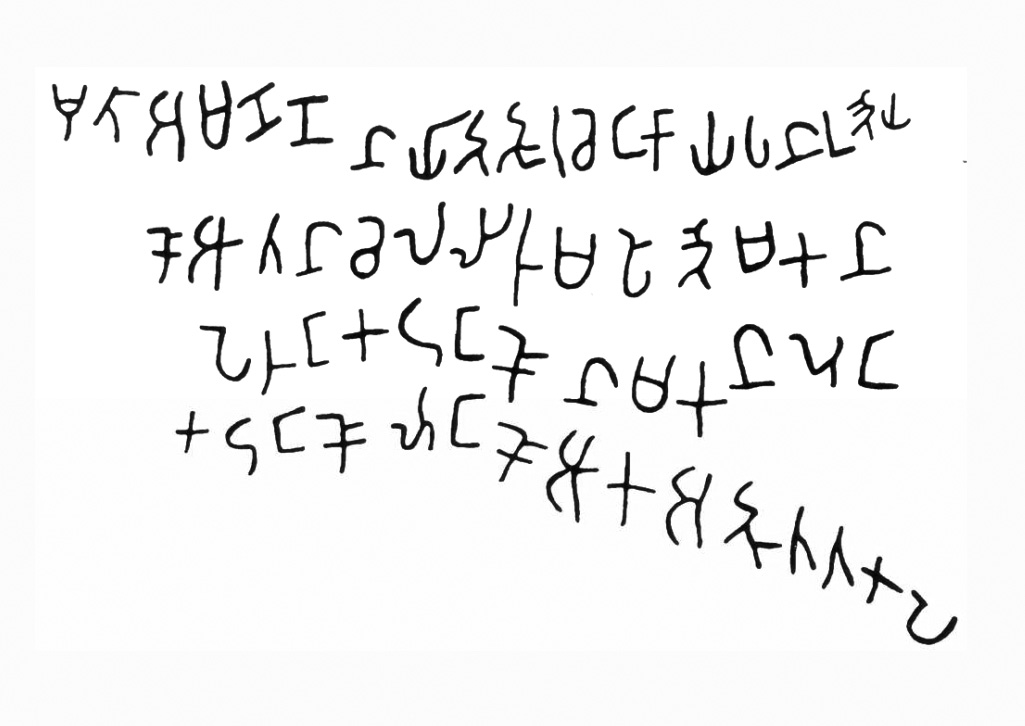
Pugalur · Ancient inscription assigned by source to circa 1st–2nd century CE; this tracing was created/uploaded in 2018
Modern line tracing of a Pugalur Tamil-Brahmi inscription, credited to Rajesh of Raigad in the 2018 Commons record
Modern line tracing of a Pugalur Tamil-Brahmi inscription, credited to Rajesh of Raigad in the 2018 Commons record. This is an epigraphic representation, not a photograph of the inscribed rock.
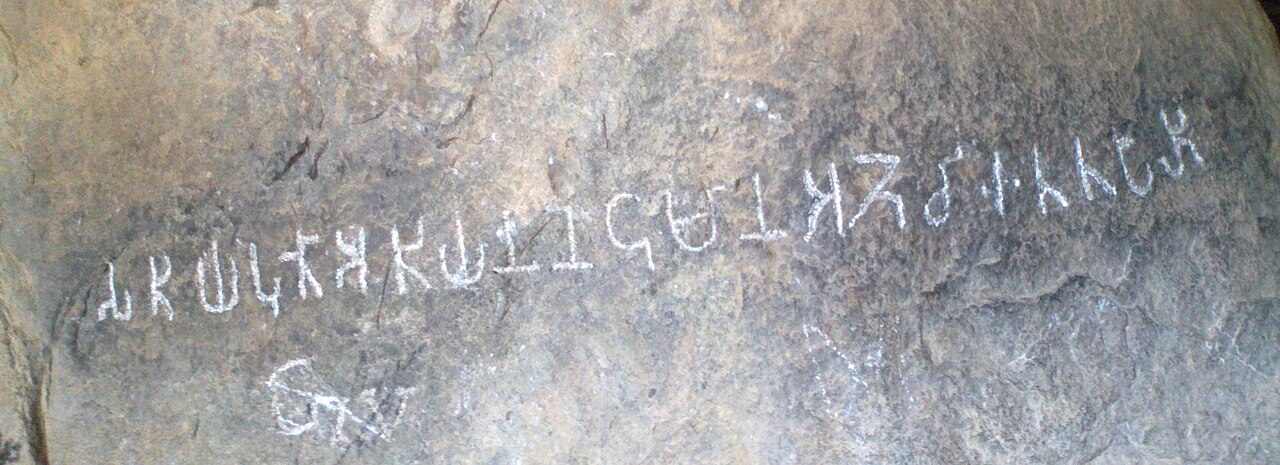
Jambai · Photographed 2011-12-25
Jambai Tamil-Brahmi inscription on the rock surface, with modern highlighting visible

Jambai · Photographed 2011-12-25
Entrance and floor of the Jain rock shelter at Jambaimalai
006Two views
Both views are shown at equal weight; this site does not choose between them.
The date of the Jambai inscription
- One view
- Tamil Nadu's dedicated Jambai page dates it to the first century CE on letter forms.
- Another view
- The same department's Tamil-Brahmi overview labels it first century BCE.
- What would settle it
- Mahadevan's 2014 corpus entry, its letter-form comparisons and clear images of the inscription.
Whether Kanchipuram's circular brick bases were stupas
- One view
- The excavators interpreted the circular brick bases as Buddhist stupas.
- Another view
- Gillet notes that no clear Buddhist material was found with them.
- What would settle it
- Plans, dimensions, building sequence and associated finds, compared with securely identified stupas.
007Where next
Compare northern institutional clauses with social questions, preserving geography, document date and retrospective narration.
On the atlasMayiladumparai Iron Age & Microlithic-to-Early Historic SiteExcavated upland zone · Krishnagiri District
Explore nextJambai Tamil-Brahmi inscription on the rock surface, with modern highlighting visibleAll related studies, connected material, books and sources29 · 19
Elsewhere on this site
Excavation Atlas Sites: Mayiladumparai Iron Age & Microlithic-to-Early Historic Site
Connected material
Photographs, drawings, books, videos and other studies linked to this study. A link helps you explore; it does not prove a historical claim.
- Jambai Tamil-Brahmi inscription on the rock surface, with modern highlighting visiblephotographShows the subject
- Rock-cut beds at the Jambai Jain shelterphotographShows the subject
- Entrance and floor of the Jain rock shelter at JambaimalaiphotographShows the subject
- Inscribed faces of the fifth-century Talagunda pillar at the Pranaveshvara temple, Karnataka, photographed in 2012photographShows the subject
- Modern line tracing of a Pugalur Tamil-Brahmi inscription, credited to Rajesh of Raigad in the 2018 Commons recordmodern epigraphic tracingBackground
Books, videos and websites
Outside reading on this topic. These are not part of the study and we have not checked every claim in them. See all books and videos
- Iron Age Culture of North Tamil Nadu | Dr Satyabhama Bhadreenath | ASC IITGN Video · Satyabhama Bhadreenath · Former Joint Director General, Archaeological Survey of India · 1:04:37 · Presentation on Iron Age North Tamil Nadu and human–landscape relationships, with special reference to Siruthavur. Brings a senior ASI researcher and a northern regional case into a collection otherwise dominated by major southern sites. Siruthavur is comparative coverage. Environmental interpretations still need the underlying dated evidence.
008Sources
The study lists the sources it consulted; we have not rechecked them. A working link does not show that a source was read, and a valid identifier does not show that it supports a claim. We do not link to unofficial uploads or copies of publications. Where a study cited one, we show the published citation, or a publisher, DOI or Internet Archive link when we have one. Tracking codes are removed from links, and the sources themselves are not republished here.
Excavations : Archaeological Survey of India, Chennai Circle
Archaeological Survey of India, Chennai Circle. 'Excavations: Archaeological Survey of India, Chennai Circle.'
List of Monuments and Sites : Archaeological Survey of India, Chennai Circle
Archaeological Survey of India, Chennai Circle. 'List of Monuments and Sites.'
Department of Archaeology, Government of Tamil Nadu. 'Archaeological Excavations conducted by the Department of Archaeology.'
Department of Archaeology, Government of Tamil Nadu. 'Vasavasamudram.'
R. Nagaswamy. Vasavasamudram: A report on the excavation conducted by the Tamilnadu State Department of Archaeology. Publication no. 50. Madras: State Department of Archaeology, Government of Tamilnadu, 1978.
Print or offline sourceSource recordDepartment of Archaeology, Government of Tamil Nadu. 'Brahmi Inscription' (Jambai).
Department of Archaeology, Government of Tamil Nadu. 'Inscriptions in Thamizhi (Tamil-Brahmi) Script.'
Valérie Gillet. 'Kāñcīpuram.' The Encyclopedia of Ancient History: Asia and Africa. First published 13 October 2021. DOI 10.1002/9781119399919.eahaa00368.
Emmanuel Francis, digital ed. 'Mayidavōlu plates, time of Śiva-Skandavarman, year 10.' DHARMA_INSPallava00002, version 2026-10-08; revised from Hultzsch, Epigraphia Indica 6 (1900-1901), 84-89.
Emmanuel Francis, digital ed. 'Hīrahaḍagaḷḷi plates, time of Śiva-Skandavarman, year 8.' DHARMA_INSPallava00003, version 2026-10-08; revised from G. Bühler, Epigraphia Indica 1 (1892).
D. C. Sircar and P. Seshadri Sastri. 'Two Inscriptions from Guntur District,' section 2: 'Mañchikallu Inscription of Pallava Simhavarman.' Epigraphia Indica 32.
Online copy not linked · use the published editionSource recordF. Kielhorn. 'Talagunda Pillar Inscription of Kakusthavarman.' Epigraphia Indica 8 (1905-1906): 24-36.
Online copy not linked · use the published editionSource recordDorian Q. Fuller, Nicole Boivin, and Ravi Korisettar. 'Dating the Neolithic of South India: new radiometric evidence for key economic, social and ritual transformations.' Antiquity 81.313 (2007): 755-778. DOI 10.1017/S0003598X00095715.
A. Ghosh, ed. Indian Archaeology 1962-63 – A Review. New Delhi: Archaeological Survey of India, Government of India, 1965.
Iravatham Mahadevan. Early Tamil Epigraphy: From the Earliest Times to the Sixth Century C.E. (Tamil-Brahmi Inscriptions). Revised and enlarged 2nd ed., vol. 1. Chennai: Central Institute of Classical Tamil, 2014. ISBN 9789381744147.
Print or offline sourceSource recordDepartment of Archaeology, Government of Tamil Nadu. 'Andipatti.'
Department of Archaeology, Government of Tamil Nadu. 'Panayakulam.'
Department of Archaeology, Government of Tamil Nadu. 'Pallavamedu.'
Coin Satavahana (GM-CHE-TN-1372746)
National Mission on Monuments and Antiquities. Antiquity detail GM-CHE-TN-1372746: 'Coin Satavahana,' lead, provenance Kanchipuram, ASI Chennai Circle.
Researchers and institutions whose work this study uses: Iravatham Mahadevan, R. Nagaswamy, A. Ghosh, Dorian Q. Fuller, Nicole Boivin, Archaeological Survey of India
How we know The evidence, claims and dates behind this study
What this study draws on
- Current DHARMA editions of the Mayidavolu and Hirahadagalli plates; Epigraphia Indica editions of Mañchikallu and Talagunda.
- Archaeological Survey of India and Tamil Nadu excavation and protected-monument lists for the region.
- Valérie Gillet's 2021 synthesis of the Kanchipuram excavations.
- Tamil Nadu archaeology summaries for Jambai, Vasavasamudram, Andipatti, Panayakulam and Pallavamedu.
Dates in this study
| What is dated | Date | How it was dated |
|---|---|---|
| Kanchipuram occupation/material discussed as first centuries BCE and CE; late Satavahana finds assigned to second century CE in synthesis. | 200 BCE – 200 CE | Period assigned by excavators or scholars |
| Jambai: dedicated state page says 1st century CE; Tamil-Brahmi taxonomy caption says 1st century BCE. | 100 BCE – 100 CE | Date from writing, coins or texts |
| Vasavasamudram institutional interpretation: 1st-2nd century CE. | 1–200 CE | Period assigned by excavators or scholars |
| Panayakulam official summary: occupation from 3rd century CE to 13th century CE. | 200–1300 CE | How it was dated is not stated |
| Mañchikallu inscription: palaeographically second half of third century CE; linguistic comparison suggests near end of third century. | 250–300 CE | Date from writing, coins or texts |
| Mayidavolu and Hirahadagalli: internal regnal years 10 and 8; broadly late third/early fourth century in relative early-Pallava chronology. | 275–325 CE | Date from writing, coins or texts |
| Talagunda pillar inscription: broad fifth- to early-sixth-century scholarly placement; inscription itself not explicitly dated. | 400–550 CE | Date from writing, coins or texts |
| Pallavamedu official summary: Pallava-related occupation from 6th to 9th century CE. | 500–900 CE | How it was dated is not stated |
See these dates on the timeline
The study’s claims
15 claims · 15 source passages · 47 paragraphs
Browse the study paragraph by paragraphFor this study, northern and northeastern Tamil Nadu is an analytical survey frame centered on the Palar and Ponnaiyar/South Pennar basins, the Kanchipuram-Chengalpattu littoral, and directly evidenced Deccan counterpart localities; it is not asserted as an ancient bounded region.
Supported in this study
Modern district names are used only as locators.
The evidence is spatially patchy rather than a demonstrated continuous corridor: official inventories show clusters of excavated and protected sites, while several intervening zones lack equally accessible dated publications.
Supported with qualifications
This is a bounded conclusion from read inventories, not a claim of archaeological absence.
Sanur, Amirthamangalam, Kunnattur and Paiyampalli are important northern-zone excavation anchors, but the accessible official inventory alone does not provide the stratigraphic and absolute-dating detail needed to assign each securely within 1000 BCE-600 CE.
Supported with qualifications
No numerical Paiyampalli sample value is repeated in this study.
The Jambai Tamil-Brahmi inscription names Atiyan Netuman Anci and the title Satiyaputo in connection with a pali or hermitage gift, but its official web dating is inconsistent between first century BCE and first century CE.
Supported with qualifications
Original-language reading and fine palaeographic date require critical-corpus review.
Jambai is evidence for a named Takatur-associated chief's benefaction or presence in the eastern Ponnaiyar zone; it does not by itself map a permanent territorial corridor between Dharmapuri and Jambai.
Supported with qualifications
Territorial and route inferences are deliberately withheld.
Kanchipuram excavations recovered early-historic material including Brahmi-inscribed sherds, amphorae and Satavahana-related coins or coin moulds, supporting occupation and interregional material circulation in the first centuries BCE/CE.
Supported with qualifications
Exact locus associations for the 1969-76 campaigns remain unresolved.
Satavahana-related coins and coin moulds at Kanchipuram are evidence of monetary or object circulation and interaction; they are insufficient on their own to prove Satavahana political sovereignty over Kanchipuram.
Supported in this study
Political control requires separate administrative or epigraphic evidence.
Vasavasamudram provides first- to second-century CE coastal evidence for long-distance exchange through amphora material and rouletted ware alongside settlement or water-management features, but the assemblage does not demonstrate a resident Roman community or a specific inland Deccan route.
Supported with qualifications
The institution's stronger 'proves trade contacts with Rome' wording is treated as an attributed interpretation.
The Mayidavolu charter gives direct documentary evidence of an early Pallava administrative connection from Kanchipura to Dhanyakata and Andhrapatha: it is issued from Kanchipura, addresses an official at Dhanyakata and grants a village in Andhrapatha.
Supported in this study
The document internally supplies regnal year 10, not an absolute era.
The Hirahadagalli plates provide another direct early Pallava documentary link from Kanchipura to an interior Deccan context, with an order issued from Kanchipura in regnal year 8 concerning grants to Brahmins.
Supported in this study
The Mañchikallu inscription places a Pallava Simhavarman in the Guntur/Palnadu zone by the later third century CE according to its editors' palaeographic and linguistic assessment.
Supported with qualifications
The editors' date is reported, not independently redated.
Taken together, Mayidavolu, Hirahadagalli and Mañchikallu support an early Pallava political-administrative field connecting Kanchipuram with parts of the Andhra and Karnataka Deccan, but they do not establish a continuous fixed frontier or resolve Pallava dynastic origins.
Supported in this study
Administrative reach and dynastic origin are distinct questions.
The Talagunda pillar inscription is evidence that a Kadamba dynastic narrative remembered Kanchipura as a Pallava center and framed Mayurasarman's career through conflict and accommodation with the Pallavas; as a later eulogistic and itself undated narrative, it should not be read as an unfiltered contemporary chronicle.
Supported with qualifications
Strongest for remembered inter-polity relationship and Kanchi's standing, weaker for exact event chronology.
Andipatti and Panayakulam show inland northern Tamil Nadu habitation evidence extending into the core window, but both official summaries span long later chronologies and lack the context-level dating detail needed for fine-grained pre-600 reconstruction.
Supported with qualifications
Post-600 artefacts are not imported into the core-period argument.
Pallavamedu should not be used as a principal pre-600 anchor: the state excavation summary places its Pallava-related occupation in the sixth-ninth centuries CE, so most of its evidence is later than the editorial cutoff.
Supported in this study
Trace one claim through the study’s records
Explore the evidenceOther source lists
Numbered citation links from the study
The numbered links in the study text point here.
Excavations :Archaeological Survey of India, Chennai Circle
List of Monuments and Sites :Archaeological Survey of India, Chennai Circle
Andipatti | Department Of Archaeology
Pallavamedu | Department Of Archaeology
Panayakulam | Department Of Archaeology
Mayidavōlu plates, time of Śiva-Skandavarman, year 10 - DHARMA
Hīrahaḍagaḷḷi plates, time of Śiva-Skandavarman, year 8 - DHARMA
Epigraphia Indica Vol 32 - Jain Quantum
Online copy not linked · use the published editionArchaeological Excavations conducted by the Department of Archaeology | Department Of Archaeology
Kāñcīpuram - Gillet - Major Reference Works - Wiley Online Library
Dating the Neolithic of South India: new radiometric evidence for key economic, social and ritual transformations | Antiquity Journal
Dating the Neolithic of South India: new radiometric evidence for key economic, social and ritual transformations | Antiquity
Brahmi Inscription | Department Of Archaeology
Inscriptions in Thamizhi (Tamil- Brahmi) Script | Department Of Archaeology
Vasavasamudram | Department Of Archaeology
National Mission on Monuments and Antiquities
Epigraphia Indica Vol 08 - Jain Quantum
Online copy not linked · use the published edition
About this study Status, corrections and how it was made
Status
Draft study, revision 6. No historian, archaeologist, or Tamil or Malayalam specialist has reviewed it yet.
How it was made
Compiled as an editorial synthesis from published scholarship around questions we framed. About this project & workflow
The summary, How sure lines and Two views notes on this page were prepared from this study and cross-checked against its passages. That is an editorial check, not a specialist review.
Corrections and updates
Technical details
Study code LTS-SUP08. The text fingerprint changes whenever the study text changes.
- The study text is shown as written. Links from its paragraphs to citations help you move around the study; they are not new claims or checked source passages.
See how this study’s records were extracted
Text fingerprint (SHA-256): LTS-SUP08 · fa73656c6bbb0a5d220b738b… · v6
Evidence tables and technical details are on the web page: https://layersofthesouth.org/read/c0c6f6899a