A piece of iron slag displayed at Pattanam Museum
Pattanam
Photographed 2018-01-21
- Everyday lives
- 500–200 BCE
- Adichanallur
- Mayiladumparai
Iron weapons predate 600 CE, but Kalaripayattu came much later
Archaeology documents iron weapons in South India before 600 CE, including evidence of skilled steel working. That does not establish the much later martial tradition of Kalaripayattu. Object types, dating and publication quality differ between sites; each weapon and proposed historical connection needs its own evidence.
- This page
- 4,364 words · revision 8
Draft study · Awaiting specialist review · Updated
001Dates and places
Places on the atlas that name this study.
- Adichanallur Urn Field & Habitation Mound
Protected ASI monument & on-site museum · Thoothukudi District
- Mayiladumparai Iron Age & Microlithic-to-Early Historic Site
Excavated upland zone · Krishnagiri District
1000–500 BCE
Different beginnings
500–200 BCE
Marks & materials
200 BCE–300 CE
Connected worlds
300–600 CE
Change & continuity
- Adichanallur Urn 105 paddy sample reported calibrated interval
- Kodumanal dated cultural deposit discussed by K. Rajan
- Laboratory date
- Date from writing, coins or texts
Each date belongs to what was dated (a sample, an object, a layer or a text), which is not always the event the study asks about.
Each period has the same width, so spacing is not to scale.
The full table of dates, with their ranges, is under How we know.
- 2 Well supported
- 1 Likely
- 1 Not known
002How sure
In brief
Iron swords, daggers, spearheads and arrowheads were buried at Adichanallur in Tamil Nadu. An Archaeological Survey of India report on the 2004–05 excavation (published 2020) is reported to list 86 iron objects there. At Kodumanal, metallurgists found a dagger with a hard, high-carbon edge joined to a softer core. A 1948 urn burial at Porkalam in Kerala held only “three iron implements”, not identified as weapons. Early Tamil poems name the spear (vēl), the sword (vāḷ) and the battlefield (kaḷam). Purananuru 312 lists the duties of mother, father, smith, ruler and young warrior. Tamil-Brahmi hero stones at Pulimankombai remember a man killed in a cattle raid. None of this shows a training school, set drills or teacher lineages. Phillip Zarrilli traces Kalaripayattu from at least the twelfth century CE. How warriors learned to fight before 600 CE is almost entirely unknown.
Key researchers cited in this study: K. Rajan (Kodumanal & Porunthal Excavations / Epigraphy) · Y. Subbarayalu (Historical Geography & Epigraphy) · Rajan Gurukkal (Early South Indian Social & Economic History) · K. N. Ganesh (Historical Geography of Kerala) · Full bibliography
How sure
- Well supported
Iron weapons were buried in Iron Age and Early Historic graves
Rea's 1915 catalogue and the 2020 ASI report list swords, spearheads, daggers and arrowheads at Adichanallur.
- Well supported
A Kodumanal dagger had a hard high-carbon edge on a softer core
Metallography measured about 0.8 percent carbon at the edge, which was much harder than the centre.
- Likely
Kalaripayattu's schools and drills can be traced back only to about the twelfth century, long after 600 CE.
Zarrilli traces the institution to at least the twelfth century; no source before 600 CE shows its schools or drills.
- Not known
How warriors trained before 600 CE
Teachers, drills, settings and ways of passing on skill are almost entirely unrecovered.
Why it matters
It corrects the popular claim that Kalaripayattu goes back to Sangam times, while showing what early martial life did leave behind.
003Key findings
What the study concludes
- Adichanallur securely documents an iron weapon assemblage including swords, daggers, spearheads and arrowheads, with the later ASI excavation recording multiple examples or fragments of these broad classes.
- A Kodumanal dagger fragment had a relatively hard high-carbon cutting edge apparently forge-welded to a softer centre, demonstrating technically sophisticated manufacture of an edged weapon.
- The consulted source for Porkalam securely identifies three iron implements in the 1948 urn burial but does not securely identify those objects as particular weapon classes.
- Recent secondary reporting describes iron swords and a dagger in Konthagai burial contexts, but detailed typology and object-specific dating require the final primary excavation publication.
In the study’s own words. How sure each point is, is shown above.
The summary above is the short read. The full study is the complete text it was drawn from, with its tables and source notes.
What the full study covers
004The study
Answer in Brief
The evidence securely establishes a deep pre-600 CE martial material culture in southern India, but not pre-600 CE Kalaripayattu as a historically demonstrable institution. Iron swords, daggers or knives, spearheads, and arrowheads occur in Iron Age and Early Historic mortuary or settlement contexts in Tamil Nadu and Kerala; iron and steel production was technically sophisticated at sites such as Kodumanal; early Tamil poetry makes the spear (vēl), sword (vāḷ), battlefield (kaḷam), cattle-raiding combat, heroic death, and memorialization intelligible components of public life. What these sources do not establish is the medieval/early-modern Keralan package now called Kalaripayattu: a purpose-built kalari, named sequences of bodily and weapons training, guru lineages, a standardized curriculum, and an integrated martial-medical or marma discipline. ↗1
The four archaeological sites examined here are also not evidentially equivalent. At Adichanallur, Alexander Rea explicitly listed iron swords, daggers, spearheads and arrowheads ↗2, while the 2020 Archaeological Survey of India report on the 2004–05 excavation is reported in secondary summaries to list 86 iron objects (not checked page by page in the ASI volume here). At Kodumanal, metallographic study of a sword fragment and dagger fragment from the habitation area is especially important: the dagger had a hard, high-carbon cutting edge apparently forge-welded to a softer core, demonstrating sophisticated fabrication rather than merely the possession of iron blades. ↗3 At Porkalam, by contrast, the consulted archaeological synthesis reports only “three iron implements” from the 1948 urn burial and does not identify them as swords, spears or daggers; assigning weapon types to Porkalam without checking B. K. Thapar’s original excavation report would therefore exceed the evidence. ↗4 Recent reporting from Konthagai describes iron swords and a dagger in urn-burial contexts, but the accessible sources read here are journalistic reports rather than the final excavation catalogue, so object-level chronology and morphology remain less secure than at Adichanallur. ↗5
Iron implements from Adichanallur, plate V in Alexander Rea's 1915 catalogue
Adichanallur
Detailed typological labels require similar restraint. Spearheads are documented, but “socketed” versus “tanged” cannot consistently be assigned to specimens from the four sites on the basis of the consulted publications. Swords occur, but “double-edged” is not safely generalizable. Adichanallur arrowheads include triangular and elongated forms, but a specifically barbed type was not securely demonstrated in the consulted report. No shield boss was securely identified at any of the four sites in the sources used here. These are negative findings about the available evidence, not claims that such forms never existed. The broader Kerala megalithic corpus does contain swords, daggers, long spear-like implements and arrowheads at sites such as Naduvil, Kadanad, Cheramangad and Anakkara, while a double-edged dagger is reported at Perambra; these parallels should not be silently transferred to Porkalam or the Tamil sites. ↗6
The linguistic distinction is equally consequential. In extant early Tamil poetry, kaḷam can plainly be a battlefield: Purananuru 87 warns enemies about entering the kaḷam, while other poems use the word in battle contexts. Traditional Tamil usage also allows broader senses such as field, threshing floor or arena. Polysemy of kaḷam therefore does not make every kaḷam a martial academy, much less a medieval Keralan kalari. ↗7 No Sangam passage read for this study securely attests a purpose-built kaḷari with the institutional features of later Kalaripayattu.
The chronological break matters. Phillip B. Zarrilli’s historical-ethnographic study treats Kalarippayattu as demonstrable from at least the twelfth century CE, many centuries after the 1000 BCE–600 CE period this site covers; the early-sixteenth-century Portuguese evidence associated with Duarte Barbosa belongs to a still later and far better documented martial environment. Zarrilli also emphasizes that the written history of the compound kalarippayattu itself is later and more complicated than popular claims of an unchanged multi-millennial system imply. ↗8 Thus the defensible formulation is not “Sangam Kalaripayattu,” but pre-600 southern Indian martial cultures that supplied weapons, warrior ideals and spatial vocabulary to a region in which much later martial institutions developed.
Scope & Chronological Control
This study centres on 1000 BCE–600 CE. That interval crosses archaeological labels – Iron Age, “megalithic,” and Early Historic – that should not be treated as simple, mutually exclusive chronological boxes. K. Rajan explicitly cautions that megalithic burial practices continued into periods carrying writing and other Early Historic traits, and that black-and-red ware, iron and sepulchral monuments possess partly independent histories. At Kodumanal, for example, occupation and burial evidence, Tamil-Brahmi sherds and radiometric sequences complicate any equation of monumental burial with a single “Megalithic Age.” ↗9
Physical/Textual Observation. Adichanallur is an urn-burial complex with major iron assemblages documented first by Rea and later by ASI. Kodumanal is a habitation-industrial-burial complex with abundant evidence for iron-working and craft production. Porkalam is represented in the consulted Kerala synthesis by a 1948 urn burial. Konthagai is a cemetery within the wider Keezhadi (Keeladi) archaeological landscape and has yielded urn burials with iron objects according to recent excavation reporting. ↗10
Iron weapons and implements from Adichanallur, plate III in Alexander Rea's 1915 catalogue
Adichanallur
Scholarly Interpretation. Rajan’s treatment of the Iron Age–Early Historic transition is preferable here to an undifferentiated “Sangam Age” label because it keeps archaeological phases, mortuary practice and literary history analytically separate. His Kodumanal discussion stresses that the same burial traditions can continue within an increasingly literate Early Historic society. ↗9 K. N. Ganesh’s study of “lived spaces” in the Sangam corpus is likewise methodologically useful: historical geography is reconstructed from context-dependent literary spaces, rather than by assigning modern institutions to every ancient spatial term. The Ganesh article was available here through bibliographic/abstract-level access, so it is used as methodological orientation rather than as primary evidence for a particular martial term. ↗11
Rajan Gurukkal’s work on early South Indian social formations and agro-pastoral heroism (Social Formations of Early South India, Oxford University Press, 2010; cited bibliographically as interpretive framing) provides a second useful framework: cattle, kin groups, chiefs, warfare and memorial practice can be examined as parts of changing political economies rather than as proof of a timeless “warrior caste” or unchanging martial school. This study does not treat Gurukkal’s model as an archaeological observation in itself.
Unresolved/Debated. Absolute chronology remains uneven at the object level. The 2020 ASI Adichanallur report includes radiocarbon determinations from selected burial samples, but those dates cannot automatically be attached to every weapon recovered elsewhere across the cemetery. The report (Sathyabhama Badhreenath, Excavations at Adichchanallur, ASI, 2020) emphasizes shortcomings in Rea’s spatial documentation and the difficulty of reconstructing the exact provenience of many early finds. Kodumanal has stronger stratigraphic and radiometric sequences for its occupational deposits, but a dated deposit is not identical to a direct date on every sword, dagger or spear from the site. Rajan’s published sequence places several samples from the dated occupation between approximately the fifth and second centuries BCE while acknowledging the larger chronological problem. ↗9
Literary chronology is also not archaeological chronology. Puṟanāṉūṟu is a transmitted anthology whose poems have debated dates (see “Sangam poems, mostly first centuries CE, survive through later layers”); it is evidence for early Tamil poetic culture, not a dated military archive. ↗7 Likewise, the Pulimankombai memorial inscriptions are immensely important because they move heroic memorialization into epigraphic evidence, but their palaeographic dating remains a scholarly question rather than a laboratory date attached to a battlefield event. Rajan himself uses the inscribed memorial stones as part of a larger chronological argument, not as a radiocarbon series. ↗15
The medieval and early-modern material is included only as a controlled comparator. It falls outside the principal 1000 BCE–600 CE period and is introduced to establish what must not be projected back into it.
Primary Archaeological & Textual Evidence
The excavated weapon corpus
| Site / corpus | Physical or textual observation | Typological confidence | What it establishes | What it does not establish |
|---|---|---|---|---|
| Adichanallur (“Adichanallur cemetery: varied burials over a long span of time”) | Rea listed iron swords, daggers, spearheads and arrowheads ↗16; the 2020 ASI report is reported to list 86 iron objects (not checked in the ASI volume here). | High for broad weapon classes; lower for mounting/edge morphology | Repeated deposition of iron arms in a major mortuary landscape | A standardized fighting style; universal socketed spearheads; double-edged swords; barbed arrowheads |
| Kodumanal (“Kodumanal made stone beads and smelted iron on site”) | Habitation, industrial and burial contexts occur together; metallography examined a sword fragment and dagger fragment from the habitation area. ↗17 | Very high for the two metallographically examined fragments | Skilled fabrication and a high-performance dagger edge | The training system of the weapon user; a named martial school |
| Porkalam (“Porkalam 1948: one urn burial that became a reference point”) | Read synthesis records a 1948 urn burial with “three iron implements,” citing Thapar. ↗4 | Low for weapon type | Iron grave goods | Any particular sword, spear, dagger or arrowhead until the primary catalogue is read |
| Konthagai (“Konthagai's urn graves beside Keezhadi await direct dates and DNA”) | Archaeological reporting describes five iron swords among burial finds; a separate report describes a rusted dagger from an urn with skeletal remains. ↗5 | Moderate for broad classes; lower for detailed morphology and object-specific dating | Iron edged weapons were deposited in cemetery contexts | Exact blade typology, metallography, or a martial curriculum |
| Broader Kerala megalithic corpus | Published synthesis lists arrowheads at Cheramangad; swords/daggers at Naduvil; sword, dagger/knife and long spear-like implements at Kadanad; dagger, sword and arrowheads at Anakkara; a double-edged dagger at Perambra. ↗18 | Moderate to high at class level, depending on original report | A regional repertoire of projectile, thrusting and edged iron arms | That each form occurs at Porkalam |
At Adichanallur, Rea’s catalogue is unusually explicit for an early excavation publication. He described the iron corpus as including swords, daggers, spearheads and arrowheads and observed that weapons or implements associated with burials had apparently been planted with their points downward. He also remarked that, in his assemblage, weapons and implements were iron rather than bronze. ↗19 The modern ASI report provides finer counts and contextual observations but also underlines severe corrosion. It distinguishes long and short arrowheads and records triangular and elongated examples (Badhreenath, Excavations at Adichchanallur, ASI, 2020); this is substantially more precise than simply saying “arrows,” but it still does not justify calling them all barbed.
Nor should “sword” automatically become double-edged sword. A heavily corroded or fragmentary blade can establish that an edged weapon existed without preserving or publishing sufficient section and edge geometry to determine whether one or both margins were sharpened. The same applies to spear hafting: unless a catalogue explicitly preserves and identifies a socket or tang, “spearhead” is the correct evidence-bound class. Vēl is an early Tamil weapon word; it is not itself an archaeological statement about socket construction.
Kodumanal supplies a different kind of evidence. Sasisekaran and Rao’s metallographic study examined a sword fragment and dagger fragment from the habitation area. The dagger’s cutting edge was about 1 mm thick, contained roughly 0.8 percent carbon, and appeared to have been forge-welded to a softer central piece; hardness testing found the edge substantially harder than the center. ↗21 This is direct material evidence for differential construction of a cutting weapon. The authors’ discussion of the sword fragment’s unusual graphite microstructure is more tentative: they explicitly left open whether the metallurgical outcome was deliberate or accidental. ↗3 The distinction matters: measured microstructure is observation; intentional production strategy is interpretation.
The same paper places those objects inside a settlement with substantial iron/steel working, furnaces, slag and tuyères, while the KCHR field report independently characterizes Kodumanal as an Iron Age/Early Historic habitation-industrial-burial site. ↗22 Y. Subbarayalu is part of this archaeological evidence chain: Sasisekaran and Rao acknowledge him for providing the Kodumanal iron samples, and Rajan separately cites Subbarayalu’s work in discussing inscribed burial contexts at Kodumanal. ↗3 This is stronger evidence for Subbarayalu’s relevance to the site’s archaeology and epigraphy than invoking him to authenticate a speculative Sangam-age Kalaripayattu lineage.
Poetry, battlefields and warrior obligation
The literary corpus converges with archaeology at the level of weapon classes and warrior social imagery. Purananuru 312 (attributed to Poṉmuṭiyār; see Project Madurai Tamil text and George L. Hart and Hank Heifetz, The Four Hundred Songs of War and Wisdom, Columbia University Press, 1999) gives a compact chain of duties: the mother bears and raises the son, the father forms him, the smith forges his vēl, the ruler guides conduct, and the young warrior enters difficult battle with a shining vāḷ and confronts war elephants. ↗24 The poem is valuable because spear, sword, smith and warrior appear within one normative social composition.
This is textual observation, not proof that every young man underwent a uniform military syllabus. The poem is heroic poetry: it formulates what a martial social role ought to look like. Its “duties” are evidence for ideals of valor, social obligation, weapon provision and political authority, not a recovered military law code. Consequently, “Sangam battlefield convention” is safest when used for recurrent poetic conventions – valor, cattle conflict, victory, wounds, death, remembrance and elite patronage – rather than for formal rules of engagement.
Kaḷam is directly martial in several poems. Purananuru 87 uses the expression of entering the kaḷam in a warning to enemies; poem 62 similarly uses kaḷam in an unmistakable battle context. ↗25 Yet traditional Tamil usage is broader: the University of Madras Tamil Lexicon (s.v. kaḷam and kaḷari) documents threshing floor, open space, assembly area, and battlefield senses alongside later arena/training-place senses. ↗26 The semantic inference is therefore one-way only: context can make a particular kaḷam a battlefield, but the word by itself does not prove a specialized martial-training institution.
Hero stones and cattle-raiding violence
Heroic memorialization supplies the strongest bridge between poetry and inscription. Rajan notes that early Tamil literature associates local chiefs and their followers with cattle raising, cattle raiding and cattle recovery, and specifically cites Akananuru and Purananuru passages in which memorial stones are raised for those killed in such fighting. ↗27
The Pulimankombai Tamil-Brahmi memorial stones (discovered and published by K. Rajan's team and included in Iravatham Mahadevan's 2014 revised Early Tamil Epigraphy; see also “Tamil-Brahmi comes from Brahmi; when it began is still disputed” and “Early Tamil hero stones record names and a cattle raid”) give this literary world an epigraphic counterpart: one stone (inscription 93) is read as the memorial of Tīyaṉ Antavaṉ, who died (peṭu) in a cattle raid (ākōḷ) at Kūṭalūr, and companion stones preserve personal names in similarly terse commemorative formulas. ↗15 Rajan treats the Pulimankombai and Thathappatti memorials as significant chronological evidence in the Iron Age–Early Historic transition. ↗15
What the stones establish is significant but limited: named individuals could be commemorated in writing for violent death connected with cattle conflict. They do not tell us how the deceased trained, whether he belonged to a permanent military school, whether a specific combat technique killed him, or whether his community possessed a kalari in the later Keralan sense.
Iron artifacts displayed in the Iron Age to Early Historic section of Pattanam Museum
Pattanam
Photographed 2019-01-05
Analytical Comparison & Competing Interpretations
The evidence can be organized into three chronological layers rather than one continuous “ancient martial art.”
| Historical layer | Secure evidence | Appropriate inference | Inference to avoid |
|---|---|---|---|
| Iron Age / Early Historic, before 600 CE | Iron arms, steel-working, vēl, vāḷ, kaḷam as battlefield, cattle-raiding heroism, memorial stones | Martial technologies and warrior cultures existed | “Kalaripayattu already existed in its later form” |
| Medieval Kerala, especially from c. twelfth century onward | Historical reconstruction of kalari martial institutions and Kalarippayattu traditions | Organized regional martial-training traditions become historically traceable | That every element is unchanged from Sangam antiquity |
| Early modern and modern periods | Fuller descriptions, lineages, named curricula, medical/massage practice, revival literature | Increasingly detailed documentation of the recognizable system | Projecting modern technical terminology backward without evidence |
Zarrilli’s central chronological caution is decisive. His major study describes Kalarippayattu as a martial and medical practice with evidence extending at least to the twelfth century CE, not to the Iron Age. ↗29 A secondary rendering of Zarrilli’s historical discussion reports that he places the combination of kalari and payattu in or after the medieval period and notes an unexpectedly late written attestation of the compound itself. ↗30 The latter claim should be handled as selected-text evidence because the directly read Google Books record supplies the broader “at least twelfth century” dating but not the full page-level argument about the compound.
This does not mean martial practice suddenly appeared in twelfth-century Kerala. The pre-600 evidence proves the opposite: weapons, fighting and heroic ideologies were already old. What changes is the level of historical specificity. An iron spear plus a poem about battle establishes a spear-using martial culture; it does not establish meypayattu, named weapon-training stages, ritual architecture, a gurukkal lineage, or marma pedagogy.
The same distinction applies to the word kalari. Linguistic resemblance or semantic continuity is not institutional continuity. A term meaning field, arena, battleground, practice-place or school can shift meaning over centuries. Ganesh’s attention to historically produced “lived spaces” in Sangam texts reinforces the need to read ancient spatial vocabulary in its own social landscape rather than through later institutional categories. ↗11
Historians such as Rajan Gurukkal have argued that cattle raiding and hero memorials belong to particular early political economies (not consulted in full for this page). Its most economical explanation is not a transhistorical martial academy but a society in which armed action could be structurally important to livestock, prestige, territory and political following.
The archaeological and literary records nevertheless genuinely converge in several places. Spears and swords occur both materially and poetically. Smithing is materially central at Kodumanal and socially explicit in Purananuru 312, where the blacksmith’s duty is to forge the warrior’s spear. ↗32 Mortuary commemoration appears archaeologically in weapon-bearing burials and textually/epigraphically in heroic memorial practice, although a grave weapon and a hero stone are distinct kinds of commemoration and must not be collapsed into one custom. ↗33
The evidence is weakest precisely where popular narratives are strongest. Nothing read for this study securely places the later Kalaripayattu curriculum before 600 CE. Nothing securely associates a Sangam kaḷam with the characteristic ritual and pedagogical organization of a later kalari. Nothing in the weapon corpus demonstrates marma striking or healing knowledge. Even a technologically sophisticated dagger proves expertise in metallurgy and weapon manufacture, not a particular embodied training lineage.
A fair summary is therefore “continuity of martial problems and material repertoires, discontinuity or non-demonstration of institutions.” People before 600 CE had to learn to use spears, bows and swords somehow; the archaeological and poetic evidence makes practical martial knowledge inevitable as a commonsense inference. But the form, setting, duration, teachers, drills and transmission mechanisms of that learning are almost entirely unrecovered. Calling those unknown mechanisms “Kalaripayattu” substitutes a later answer for an ancient question.
Evidential Limits & Common Misconceptions
Misconception: every excavated spearhead can be labelled vēl and classified as socketed or tanged. Vēl is an appropriate early Tamil literary term for a spear or lance, but archaeological taxonomy depends on preserved construction. The Adichanallur excavation material (Rea 1915; Badhreenath 2020) confirms spearheads; it does not provide a secure socket/tang assignment for every specimen. Site reports should therefore retain their published morphological terminology.
Misconception: the named corpus contains securely identified “double-edged swords, barbed arrows and shield bosses.” That formulation is too strong. A double-edged dagger is reported at Perambra in the broader Kerala corpus; Adichanallur has sword fragments and triangular/elongated arrowheads, but the consulted catalogue does not justify universal double-edged or barbed classifications. No secure shield boss was identified for Adichanallur, Kodumanal, Porkalam or Konthagai in the consulted sources. ↗35 Absence from the sources used here means “not verified,” not “never existed.”
Misconception: Porkalam has a documented weapon assemblage equivalent to Adichanallur. The 2021–22 Heritage archaeological synthesis says only “three iron implements” for the 1948 Porkalam urn burial, citing B. K. Thapar (“Porkalam 1948: Excavation of a Megalithic Urn-burial,” Ancient India 8, 1952: 3–16). Until Thapar’s original report is consulted directly, converting those implements into named weapon classes would go beyond the evidence verified here. ↗4
Misconception: Konthagai’s reported swords automatically carry the date of the entire Keeladi cultural sequence. The reports establish iron swords and a dagger in cemetery contexts, but individual objects require their own stratigraphic associations and published dating controls. ↗5 The absence of a consulted final Konthagai artefact catalogue is a significant qualification.
Misconception: kaḷam equals kalari, therefore Sangam poetry documents Kalaripayattu. The inference is linguistically and historically invalid. Early poetry demonstrably uses kaḷam for battlefields, while the word has other spatial senses as well. ↗7 A battlefield is not automatically a training school. No consulted pre-600 text supplies the institutional package needed to identify a medieval-style kalari.
Misconception: weapon continuity proves martial-art continuity. Spears, swords, bows and daggers are broad technologies. Their persistence across centuries does not by itself demonstrate continuity of named techniques, drill sequences or teacher lineages. Zarrilli’s history locates historically recognizable Kalarippayattu many centuries later than the principal evidence examined here. ↗29
Misconception: Sangam “warrior ethics” were a codified chivalric law. The sources more securely reveal a poetics of martial obligation and remembrance. Purananuru 312 constructs obligations among mother, father, smith, ruler and warrior; cattle-raiding poems and memorial traditions valorize particular deaths. ↗24 These are powerful historical witnesses to ideals, but poetry cannot be assumed to record universal battlefield behavior.
The strongest unresolved questions are consequently archaeological rather than romantic: full publication of the Konthagai weapon catalogue; direct reinspection of Thapar’s Porkalam report; conservation drawings and X-radiography capable of distinguishing sockets, tangs, edges and possible barbs; metallography of additional securely provenanced weapons; and a corpus-level search of pre-600 Tamil inscriptions and texts for kaḷari rather than kaḷam. Those procedures could test continuity claims. Repetition of later origin legends cannot.
Bibliography & Source Register
The register distinguishes material actually read from works available only through selected text, metadata, or indirect citation.
| Source and consulted use | Access / qualification |
|---|---|
| Alexander Rea, Catalogue of the Prehistoric Antiquities from Adichanallur and Perumbair (1915). Weapon classes, burial deposition observations. ↗37 | full text; digitized scan |
| Sathyabhama Badhreenath, Excavations at Adichchanallur (New Delhi: Archaeological Survey of India, 2020). Iron-object counts, catalogue descriptions and chronology discussion. | Secondary digital copy consulted; official ASI-printed/hosted edition was not verified for exact page numbers of iron-object counts |
| B. Sasisekaran and B. R. Rao, “Technology of Iron and Steel in Kodumanal – An Ancient Industrial Centre in Tamilnadu,” Indian Journal of History of Science 34 (1999). ↗39 | full text, INSA-hosted PDF; metallographic pages read visually |
| Rachel A. Varghese, “Archaeological and Ethnographic Field Visit to the Kongu Region,” KCHR, 2012. Kodumanal site character and excavation history. ↗40 | full text, PDF |
| “Historical Archaeology of Iron Age and Early Historic Kerala,” Heritage: Journal of Multidisciplinary Studies in Archaeology 9 (2021–22). Kerala megalithic iron-object synthesis. ↗41 | full text, PDF; summary table read visually |
| K. Rajan, Iron Age–Early Historical Transition in South India: An Appraisal, Amalananda Ghosh Memorial Lecture, 2014. Chronology, Kodumanal, memorial stones, cattle-raiding social formations. ↗42 | full text, PDF |
Puṟanāṉūṟu 312 (Poṉmuṭiyār), Tamil text via Project Madurai (https://www.projectmadurai.org/pm_etexts/utf8/pmuni0057.html), alongside standard published translation George L. Hart and Hank Heifetz, The Four Hundred Songs of War and Wisdom (New York: Columbia University Press, 1999; print edition was not consulted directly for this study). |
Tamil e-text consulted; standard Columbia UP translation cited bibliographically |
| Online Tamil/English presentation of Purananuru 1–200, including battlefield uses of kaḷam. ↗25 | selected passages; independent translation site, not a critical edition |
| K. Rajan (2007; 2014 Amalananda Ghosh Memorial Lecture, S006) and Iravatham Mahadevan, Early Tamil Epigraphy, 2nd ed., vol. I (Chennai: Central Institute of Classical Tamil, 2014), on the Pulimankombai Tamil-Brāhmī hero stones (see also “Tamil-Brahmi comes from Brahmi; when it began is still disputed”, “Early Tamil hero stones record names and a cattle raid”). | Rajan 2014 PDF consulted; Mahadevan 2014 print corpus entry cited bibliographically |
| Phillip B. Zarrilli, When the Body Becomes All Eyes: Paradigms, Discourses and Practices of Power in Kalarippayattu, a South Indian Martial Art (New Delhi: Oxford University Press, 1998; historical survey in ch. 2). ↗8 | Publisher metadata and searchable extracts consulted; full ch. 2 pages were not checked directly |
| K. N. Ganesh, “Lived Spaces in History: A Study in Human Geography in the Context of Sangam Texts,” Studies in History 25. ↗11 | abstract / metadata; used only for methodological framing |
Rajan Gurukkal, Social Formations of Early South India (New Delhi: Oxford University Press, 2010; ISBN 9780198064329). Also see University of Madras, Tamil Lexicon (1924–1936), s.v. kaḷam and kaḷari (https://dsal.uchicago.edu/dictionaries/tamil-lex/), and B. K. Thapar, “Porkalam 1948: Excavation of a Megalithic Urn-burial,” Ancient India 8 (1952): 3–16. |
Gurukkal 2010 and Thapar 1952 cited bibliographically (full texts were not consulted directly for this study); Tamil Lexicon online consulted for lexical senses |
| Y. Subbarayalu, 2008 contribution cited by K. Rajan for inscribed burial evidence; Subbarayalu also acknowledged in the Kodumanal metallurgical study for providing samples. ↗44 | indirect / selected passages; exact 2008 title was not independently verified and is therefore not invented here |
| Archaeological reporting on Konthagai cemetery iron swords. ↗45 | selected passages / secondary reporting; final excavation catalogue not read |
| Smithsonian reporting on an iron dagger recovered in a Konthagai burial urn. ↗46 | selected passages / secondary reporting; based on excavation news rather than final monograph |
Research conclusion. The evidence supports a history of iron-armed martial societies before 600 CE, including technically sophisticated blade production, poetic valorization of spears and swords, battlefield vocabulary, cattle-related armed conflict and hero memorialization. It supports no equally early claim for Kalaripayattu as a named, institutionalized, curriculum-bearing art. The historically responsible relationship between the two is therefore neither total discontinuity nor an asserted unbroken lineage: it is a later Keralan martial institution arising in a region with much older weapon technologies, warrior practices and martial vocabularies, with the precise mechanisms of continuity unresolved. ↗47
005Photographs
Photographs of the places and objects this study discusses. Each item carries its creator’s credit, licence and documented source. See all 412 photographs and source images ↗
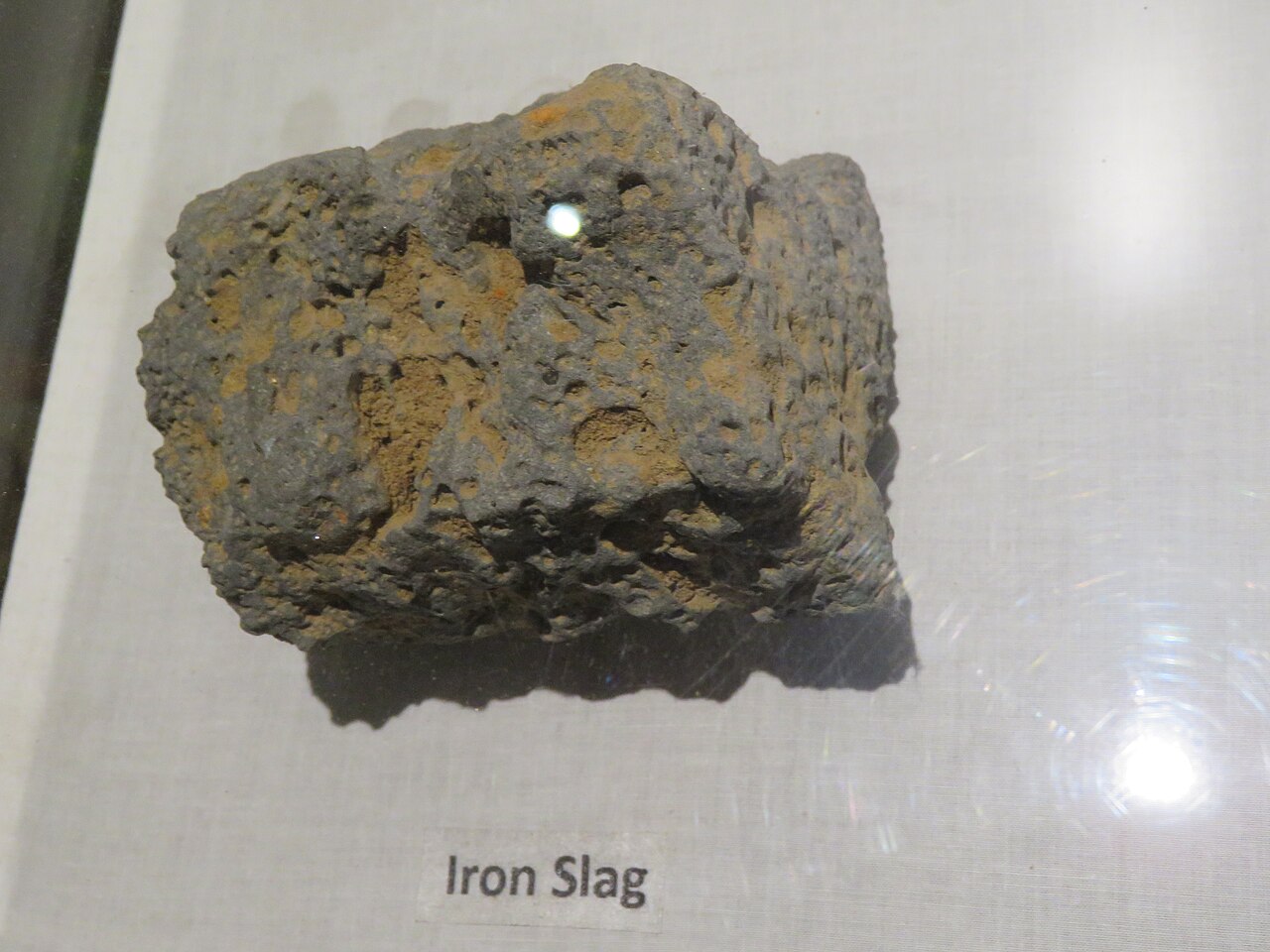
Pattanam · Photographed 2018-01-21 00:42
A piece of iron slag displayed at Pattanam Museum

Adichanallur
Iron implements from Adichanallur, plate V in Alexander Rea's 1915 catalogue
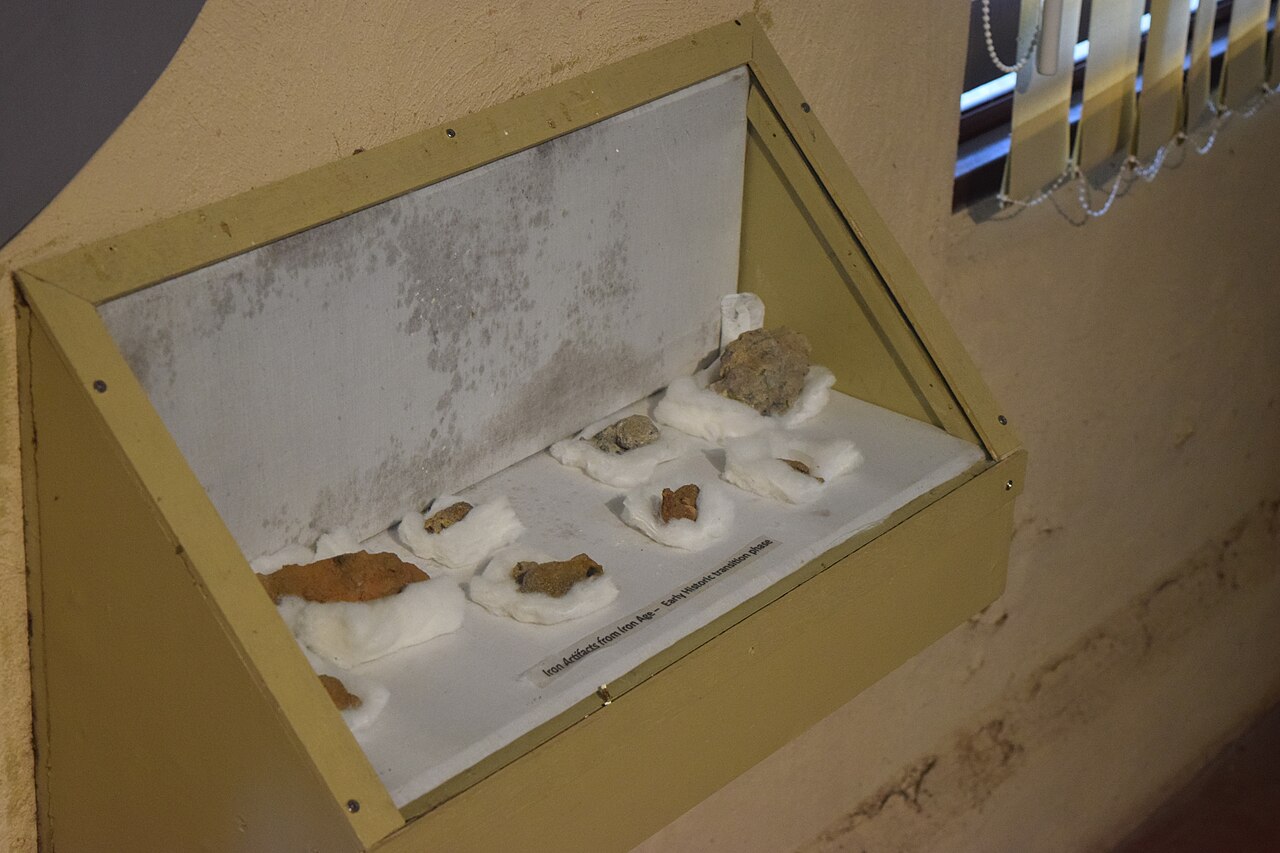
Pattanam · Photographed 2019-01-05 16:27:39
Iron artifacts displayed in the Iron Age to Early Historic section of Pattanam Museum

Adichanallur
Iron weapons and implements from Adichanallur, plate III in Alexander Rea's 1915 catalogue
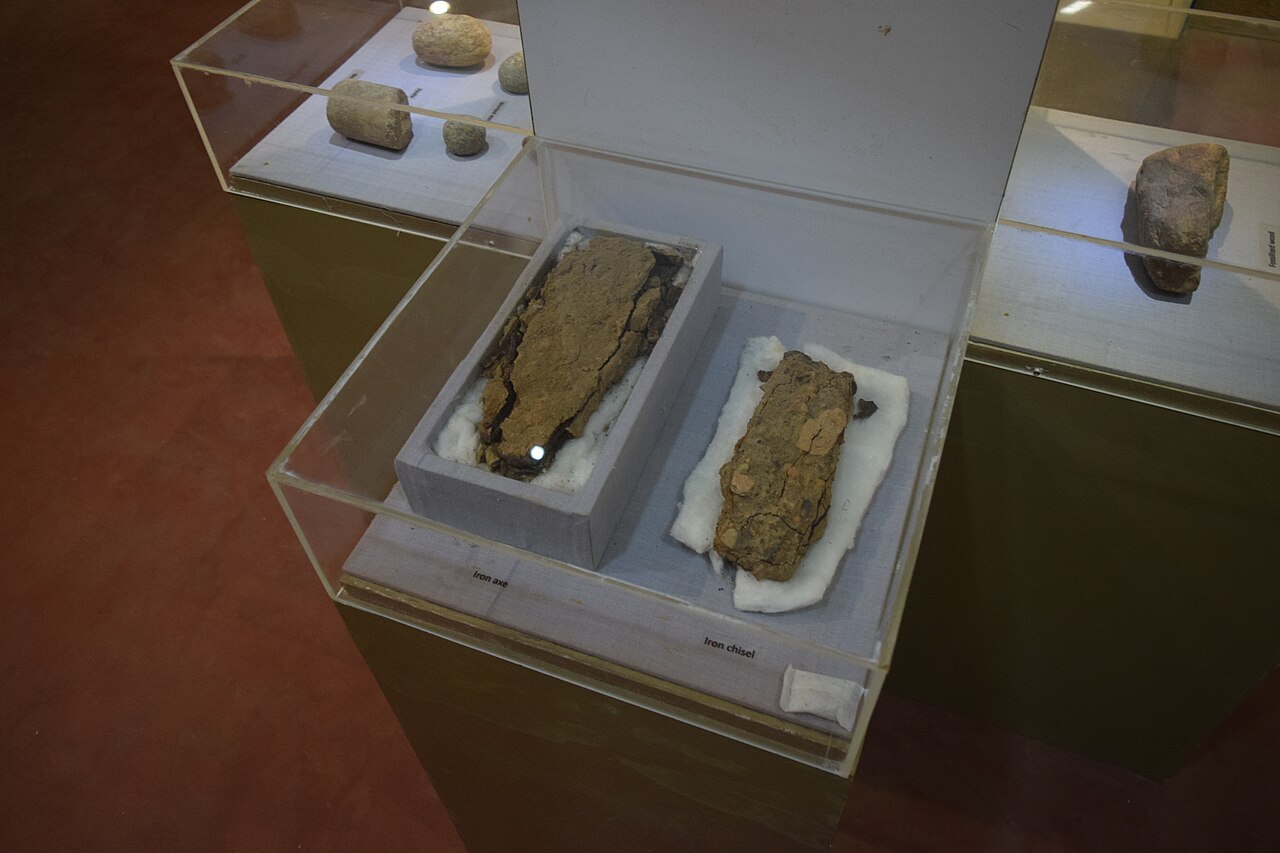
Pattanam · Photographed 2019-01-05 16:42:23
Iron axe and chisel displayed at Pattanam Museum

Adichanallur
Iron tools and weapons from Adichanallur, plate IV in Alexander Rea's 1915 catalogue
006Where next
Compare the iron weapons known from burials and poems with the evidence for how early smiths made high-carbon steel.
On the atlasAdichanallur Urn Field & Habitation MoundProtected ASI monument & on-site museum · Thoothukudi District
Explore nextThe Bead Workshop: Waste Shows Where Beads Were MadeAll related studies, connected material, books and sources30 · 16
Elsewhere on this site
Excavation Atlas Sites: Adichanallur Urn Field & Habitation Mound · Mayiladumparai Iron Age & Microlithic-to-Early Historic Site
Junior Detective Quests: The Bead Workshop: Waste Shows Where Beads Were Made
Classroom Lesson Plans: Module 5 · Iron, Stone Monuments & Everyday Craft: Technology in Early South India
Multi-Script Glossary Terms: urukku / eḵku (Kannada/Telugu ukku) (உருக்கு / எஃகு / ഉരുക്ക്) · veṇkalam (bronze / bell-metal & high-tin beta-bronze) (வெண்கலம் / വെങ്കലം / ഓട്) · turutti (துருத்தி / തുരുത്തി)
Connected material
Photographs, drawings, books, videos and other studies linked to this study. A link helps you explore; it does not prove a historical claim.
- Iron axe and chisel displayed at Pattanam MuseumphotographBackground
- Iron artifacts displayed in the Iron Age to Early Historic section of Pattanam MuseumphotographBackground
- A piece of iron slag displayed at Pattanam MuseumphotographBackground
- Iron weapons and implements from Adichanallur, plate III in Alexander Rea's 1915 cataloguehistorical printed plateShows the subject
- Iron tools and weapons from Adichanallur, plate IV in Alexander Rea's 1915 cataloguehistorical printed plateShows the subject
- Iron implements from Adichanallur, plate V in Alexander Rea's 1915 cataloguehistorical printed plateShows the subject
007Sources
The study lists the sources it consulted; we have not rechecked them. A working link does not show that a source was read, and a valid identifier does not show that it supports a claim. We do not link to unofficial uploads or copies of publications. Where a study cited one, we show the published citation, or a publisher, DOI or Internet Archive link when we have one. Tracking codes are removed from links, and the sources themselves are not republished here.
Rea, Alexander. Catalogue of the Prehistoric Antiquities from Adichanallur and Perumbair. 1915.
Badhreenath, Sathyabhama. Excavations at Adichchanallur. New Delhi: Archaeological Survey of India, 2020.
Print or offline sourceSource recordSasisekaran, B., and B. R. Rao. "Technology of Iron and Steel in Kodumanal – An Ancient Industrial Centre in Tamilnadu." Indian Journal of History of Science 34 (1999).
Varghese, Rachel A. Archaeological and Ethnographic Field Visit to the Kongu Region. Kerala Council for Historical Research, 2012.
Historical Archaeology of Iron Age and Early Historic Kerala. Heritage: Journal of Multidisciplinary Studies in Archaeology 9 (2021–22), pp. 507–540.
Rajan, K. Iron Age–Early Historical Transition in South India: An Appraisal. Padmashri Amalananda Ghosh Memorial Lecture, 2014.
Ponmudiyar, Purananuru 312; Tamil text with modern English translation, Project Madurai / Hart & Heifetz (1999).
Purananuru 1–200 translation corpus
Purananuru 1–200, Tamil text and English meanings, Sangam Translations by Vaidehi.
Print or offline sourceSource recordPulimankombai Tamil-Brahmi memorial-stone reporting
Reporting on the Pulimankombai Tamil-Brahmi memorial stones discovered by K. Rajan and team, including the reading of a memorial to Tiyan Antavan associated with an akol cattle-raiding episode.
Print or offline sourceSource recordZarrilli, Phillip B. When the Body Becomes All Eyes: Paradigms, Discourses and Practices of Power in Kalarippayattu, a South Indian Martial Art. Oxford University Press, 1998.
When the Body Becomes All Eyes: selected searchable text
Zarrilli, Phillip B. When the Body Becomes All Eyes. Selected-text copy indexed through ResearchGate.
Ganesh, K. N. "Lived Spaces in History: A Study in Human Geography in the Context of Sangam Texts." Studies in History 25.
Rajan Gurukkal scholarship on early South Indian social formations
Gurukkal, Rajan. Social-formational scholarship on early South India, including agro-pastoral heroism.
Print or offline sourceSource recordY. Subbarayalu contribution cited in K. Rajan's discussion of inscribed burial contexts
Subbarayalu, Y. 2008 contribution, pp. 209–249, as cited by K. Rajan in Iron Age–Early Historical Transition in South India: An Appraisal.
Print or offline sourceSource recordKonthagai cemetery iron-sword excavation reporting
Archaeology Magazine reporting on excavations at Konthagai, including iron swords, chisels and an axe recovered from burials.
Print or offline sourceSource recordKonthagai burial-urn dagger reporting
Smithsonian Magazine reporting on an iron dagger excavated from a Konthagai burial urn with skeletal remains.
Print or offline sourceSource record
Researchers and institutions whose work this study uses: K. Rajan, Y. Subbarayalu, Rajan Gurukkal, K. N. Ganesh, B. Sasisekaran, Archaeological Survey of India, Kerala Council for Historical Research
How we know The evidence, claims and dates behind this study
What this study draws on
- Rea's 1915 Adichanallur catalogue and the 2020 ASI excavation report (86 iron objects)
- Sasisekaran and Rao's metallography of a Kodumanal sword fragment and dagger fragment
- Purananuru poems 62, 87 and 312, and published readings of the Pulimankombai hero stones
- Zarrilli's 1998 history of Kalarippayattu, seen in selected text
Dates in this study
| What is dated | Date | How it was dated |
|---|---|---|
| Adichanallur Urn 105 paddy sample reported calibrated interval | 905–806 BCE | Laboratory date |
| Kodumanal dated cultural deposit discussed by K. Rajan | 480–200 BCE | Date from writing, coins or texts |
See these dates on the timeline
The study’s claims
9 claims · 14 source passages · 43 paragraphs
Browse the study paragraph by paragraphAdichanallur securely documents an iron weapon assemblage including swords, daggers, spearheads and arrowheads, with the later ASI excavation recording multiple examples or fragments of these broad classes.
Supported in this study
Early Rea proveniences are less precise than modern excavation contexts. Heavy corrosion limits some morphological classification. The evidence does not justify classifying every spearhead as socketed/tanged, every sword as double-edged, or every arrowhead as barbed.
A Kodumanal dagger fragment had a relatively hard high-carbon cutting edge apparently forge-welded to a softer centre, demonstrating technically sophisticated manufacture of an edged weapon.
Supported in this study
The analysed fragment came from the habitation area. The metallographic result establishes fabrication technology, not a particular fighting style or training institution.
The consulted source for Porkalam securely identifies three iron implements in the 1948 urn burial but does not securely identify those objects as particular weapon classes.
Supported in this study
This finding rests on a later archaeological synthesis citing B. K. Thapar's original excavation. Thapar's full 1952 report was not read for this study. Weapon-specific claims for Porkalam remain open.
Recent secondary reporting describes iron swords and a dagger in Konthagai burial contexts, but detailed typology and object-specific dating require the final primary excavation publication.
Supported with qualifications
The consulted sources are archaeological journalism rather than the final artefact catalogue. No precise blade-edge, hafting or metallographic classification is assigned here. No individual weapon is assigned a laboratory date in this study. Supplied assessment: supported_with_qualification
Purananuru 312 textually associates the vel and val with a normative chain of obligations linking household, blacksmith, ruler and warrior.
Supported in this study
The poem expresses a heroic normative ideal and is not treated as a statutory military code. Modern translations are aids to interpretation rather than archaeological evidence.
Early Tamil puram poetry securely uses kalam in battlefield contexts, but the consulted pre-600 corpus does not establish a specialized kalari training institution comparable to medieval Keralan martial schools.
Supported with qualifications
Kalam is polysemous and can have non-martial spatial meanings. The negative finding is bounded to the sources read for this study and is not a claim that no undiscovered or uninspected occurrence exists. Supplied assessment: supported_with_qualification
Early Tamil literary and Tamil-Brahmi memorial evidence converges on the commemoration of men killed in cattle-related armed conflict.
Supported in this study
Epigraphic memorials and literary poems are independent evidence classes and are not presumed to describe the same individual events. Palaeographic chronology should not be represented as a radiocarbon date.
Historically recognizable Kalarippayattu belongs to a much later documentary horizon, with Zarrilli describing the martial-medical practice as demonstrable from at least the twelfth century CE; it should not be back-projected as an institution into the pre-600 evidence.
Supported in this study
Later dating of the recognizable institution does not imply that martial training itself was absent earlier. The medieval/early-modern comparator lies outside the principal Layers of the South target window.
The consulted evidence does not securely establish shield bosses, universally socketed or tanged spearheads, universally double-edged swords, or specifically barbed arrowheads for the four named sites.
Supported with qualifications
This is a finding about the consulted source corpus, not proof that these forms were absent from ancient South India. A double-edged dagger is reported at Perambra in the broader Kerala corpus, which must not be transferred to the named sites. Supplied assessment: supported_as_negative_source_finding
Trace one claim through the study’s records
Explore the evidenceOther source lists
Numbered citation links from the study
The numbered links in the study text point here.
Catalogue of the prehistoric antiquities from adichanallur and Perumbair
Catalogue of the prehistoric antiquities from adichanallur and Perumbair
insa.nic.in
heritageuniversityofkerala.com
News - Sangam-Era Cemetery Excavated in Southern India
heritageuniversityofkerala.com
Ettuthokai – Purananūru 1-200
When the Body Becomes All Eyes: Paradigms, Discourses ...
K. Rajan (2014), Early Historic Transition in South India
Catalogue of the prehistoric antiquities from adichanallur and Perumbair
Lived Spaces in History - K.N. Ganesh, 2009
Rajan Gurukkal, Social Formations of Early South India (Oxford University Press, 2010)
Rajan Gurukkal, Social Formations of Early South India (New Delhi: Oxford University Press, 2010; ISBN 9780198064329).
Print or offline sourceSathyabhama Badhreenath, Excavations at Adichchanallur (ASI, 2020)
Sathyabhama Badhreenath, Excavations at Adichchanallur (New Delhi: Archaeological Survey of India, 2020).
Print or offline sourceK. Rajan (2014), Early Historic Transition in South India
Catalogue of the prehistoric antiquities from adichanallur and Perumbair
kchr.ac.in
heritageuniversityofkerala.com
Catalogue of the prehistoric antiquities from adichanallur and Perumbair
Sathyabhama Badhreenath, Excavations at Adichchanallur (ASI, 2020)
Sathyabhama Badhreenath, Excavations at Adichchanallur (New Delhi: Archaeological Survey of India, 2020).
Print or offline sourceinsa.nic.in
insa.nic.in
B. Sasisekaran and B. R. Rao, 'Technology of Iron and Steel in Kodumanal', IJHS 34 (1999)
B. Sasisekaran and B. R. Rao, 'Technology of Iron and Steel in Kodumanal – An Ancient Industrial Centre in Tamilnadu', Indian Journal of History of Science 34 (1999).
Purananuru 312 (Project Madurai Tamil text; Hart & Heifetz 1999)
Purananuru 312 (Ponmudiyar), Project Madurai Tamil text; standard translation in George L. Hart and Hank Heifetz, The Four Hundred Songs of War and Wisdom (Columbia UP, 1999).
Ettuthokai – Purananūru 1-200
University of Madras, Tamil Lexicon (1924–1936), s.v. kalam and kalari
University of Madras, Tamil Lexicon (1924–1936), Digital Dictionaries of South Asia, s.v. kaḷam and kaḷari.
K. Rajan (2014), Early Historic Transition in South India
K. Rajan (2014) and Iravatham Mahadevan (2014) on the Pulimankombai Tamil-Brahmi hero stones
K. Rajan, Iron Age–Early Historical Transition in South India: An Appraisal (2014); Iravatham Mahadevan, Early Tamil Epigraphy, 2nd ed., vol. I (CICT, 2014).
When the Body Becomes All Eyes: Paradigms, Discourses ...
When the Body becomes All Eyes: Paradigms, Discourses ...
Rajan Gurukkal, Social Formations of Early South India (Oxford University Press, 2010)
Rajan Gurukkal, Social Formations of Early South India (New Delhi: Oxford University Press, 2010; ISBN 9780198064329).
Print or offline sourceinsa.nic.in
Catalogue of the prehistoric antiquities from adichanallur and Perumbair
Sathyabhama Badhreenath, Excavations at Adichchanallur (ASI, 2020)
Sathyabhama Badhreenath, Excavations at Adichchanallur (New Delhi: Archaeological Survey of India, 2020).
Print or offline sourceheritageuniversityofkerala.com
Purananuru 312 (Project Madurai Tamil text; Hart & Heifetz 1999)
Purananuru 312 (Ponmudiyar), Project Madurai Tamil text; standard translation in George L. Hart and Hank Heifetz, The Four Hundred Songs of War and Wisdom (Columbia UP, 1999).
Catalogue of the prehistoric antiquities from adichanallur and Perumbair : Rea, Alexander : Free Download, Borrow, and Streaming : Internet Archive
Sathyabhama Badhreenath, Excavations at Adichchanallur (ASI, 2020)
Sathyabhama Badhreenath, Excavations at Adichchanallur (New Delhi: Archaeological Survey of India, 2020).
Print or offline sourceTechnology of Iron and Steel in Kodumal – An Ancient Industrial Centre in Tamil Nadu
kchr.ac.in
heritageuniversityofkerala.com
K. Rajan (2014), Early Historic Transition in South India
K. Rajan (2014) and Iravatham Mahadevan (2014) on the Pulimankombai Tamil-Brahmi hero stones
K. Rajan, Iron Age–Early Historical Transition in South India: An Appraisal (2014); Iravatham Mahadevan, Early Tamil Epigraphy, 2nd ed., vol. I (CICT, 2014).
K. Rajan (2014), Early Historic Transition in South India
News - Sangam-Era Cemetery Excavated in Southern India
Archaeologists Unearth Ancient Dagger Linked to ...
insa.nic.in
About this study Status, corrections and how it was made
Status
Draft study, revision 8. No historian, archaeologist, or Tamil or Malayalam specialist has reviewed it yet.
The study itself says more research is needed before its question can be settled.
How it was made
Compiled as an editorial synthesis from published scholarship around questions we framed. About this project & workflow
The summary, How sure lines and Two views notes on this page were prepared from this study and cross-checked against its passages. That is an editorial check, not a specialist review.
Technical details
Study code R248. The text fingerprint changes whenever the study text changes.
- The study text is shown as written. Links from its paragraphs to citations help you move around the study; they are not new claims or checked source passages.
See how this study’s records were extracted
Text fingerprint (SHA-256): R248 · bd3b627abf314f49c22106f4… · v8
Evidence tables and technical details are on the web page: https://layersofthesouth.org/read/0a4971282f