Places on the atlas that name this study.
- Belief & memory
- Porkalam
Porkalam 1948: one urn burial that became a reference point
In 1948 B. K. Thapar opened a single urn burial at Porkalam; its pots and beads later became a comparison set, not a dated sequence.
- This page
- 5,312 words · revision 5
Draft study · Awaiting specialist review · Updated
001Dates and places
Places on the atlas that name this study.
- Porkalam Megalithic Urn & Cist Site
Protected ASI monument · Kunnamkulam area, Thrissur
Dates in this study are stated in words only.
- 1 Well supported
- 2 Possible
- 1 Not known
002How sure
In brief
Porkalam, in Thrissur district, has rock-cut caves, cists and urn burials. In early 1948 B. K. Thapar opened just one burial there before leaving for Sisupalgarh. His 1952 report describes a laterite circle, a granite capstone and a large pear-shaped urn in a cut pit. Inside lay seven pots, crushed bone, three iron objects and 48 beads, 41 of them etched carnelian. At least 18 more pots sat above the urn’s lid. The so-called legged sarcophagi are four-legged vases, and Thapar lists no tripod, chisel or sickle from this urn. Thapar dated the burial to about the third century BCE–first century CE by comparison, not by laboratory dating. A 2019 study placed the pottery in a sequence it called hypothetical.
Key researchers cited in this study: B. K. Thapar (Porkalam & Maski Megalithic Excavations) · Full bibliography
How sure
- Well supported
Thapar’s published excavation was a single urn burial
Thapar’s own 1952 report says he opened only one burial.
- Possible
The burial dates to about the third century BCE–first century CE
Thapar called it provisional; it rests on comparisons with pottery and beads elsewhere.
- Possible
Porkalam’s pottery comes after Kuttikol and Niramakulam in a regional sequence
Uesugi and colleagues call their 2019 sequence hypothetical and not conclusive.
- Not known
The exact calendar date of the Porkalam urn burial
No laboratory radiocarbon or luminescence date has been published from Porkalam itself.
Why it matters
It shows how one briefly excavated burial became a long-used reference for dating Kerala’s megaliths.
003Key findings
What the study concludes
- Thapar's published Porkalam excavation is an urn-burial, not a rock-cut cave excavation.
- The deposit was internally organized: seven pots, bone, three iron objects and 48 beads were inside the urn; at least eighteen further vessels lay above the lid.
- The supposed “multi-legged sarcophagi” are four-legged vases in Thapar's catalogue.
- Porkalam's original date is a provisional cross-date rather than a laboratory determination.
- Later scholars use Porkalam as a comparative ceramic assemblage, but the read 2019 sequence remains explicitly hypothetical.
In the study’s own words. How sure each point is, is shown above.
The summary above is the short read. The full study is the complete text it was drawn from, with its tables and source notes.
What the full study covers
004The study
Question and scope
What did the published Porkalam excavation record, and how has it informed subsequent interpretation?
Region: Porkalam in present-day Thrissur district, Kerala, with comparison to south Indian megalithic / Iron Age–Early Historic evidence where the cited authors themselves made that comparison. The Kerala State Archaeology Department currently describes Porkalam as a site with urn burials, rock-cut chambers and dolmenoid cists. ↗1
Period: The burial discussed by B. K. Thapar was provisionally assigned by him to roughly the third century BCE through the first century CE, within 1000 BCE–600 CE, the collection's main period; the excavation took place in 1948, its substantial publication appeared in 1952, and reassessment continued into the twenty-first century. ↗2 ↗3
The investigation distinguishes four things that are easily collapsed into one: the multi-monument archaeological site at Porkalam; the single urn-burial that Thapar says he excavated in 1948; other Porkalam monuments, including rock-cut caves and cists; and later attempts to use the published pottery and beads in regional chronology. The first correction concerns the excavation's title and is bibliographic and archaeological at once: Thapar's article is titled “Porkalam 1948: Excavation of a Megalithic Urn-burial”, and its introduction explicitly says the article describes an urn-burial surrounded by a laterite circle and covered by a granite capstone. ↗4 ↗3
Orientation
Porkalam matters because a very short excavation acquired a long afterlife. Thapar says that in early 1948 he opened only one burial before being required to leave for the Sisupalgarh excavations. His eventual 1952 publication described a laterite stone circle, granite capstone, cut pit, large urn, pottery groups, fragmentary bone, etched carnelian beads and three iron objects. He also attempted to date the burial, but called the dating of such monuments provisional and noted that no nearby habitation site allowed Porkalam's burial material to be correlated with a stratified settlement culture. ↗3
The later historiography therefore calls for precision. Porkalam became a comparative typological reference for Kerala burial ceramics, but the consulted evidence does not support calling Thapar's excavation a “stratigraphic benchmark” in the strict archaeological sense. A 2019 study explicitly describes its Kerala ceramic chronology as hypothetical or tentative, states that burial ceramics lack stratigraphic context for the chronological purpose at issue, and uses radiocarbon evidence from Kuttikol and Niramakulam to give chronological traction to comparisons that include Porkalam. ↗2
Accessible explanation
Porkalam was not an intact town mound but a damaged burial landscape with several classes of monument. Thapar lists rock-cut caves, dolmens, port-holed cists within stone circles and urns. He says that much of the site had suffered quarrying and disturbance, and that other available monument types had either been disturbed or already excavated. His team therefore “made a beginning” with an urn type that could also be compared with burials elsewhere in southern India. ↗3
That distinction is central to this study. Thapar's 1952 report does not describe a rock-cut cave excavation with legged sarcophagi, iron tripods, chisels, and sickles at Porkalam. Although rock-cut caves also existed at Porkalam, the 1952 publication is about one urn-burial. ↗3
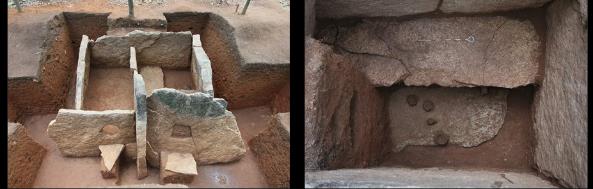
The excavated burial was a deliberately constructed package. A circle of dressed laterite blocks surrounded a granite capstone set flush with ground level. Beneath it was a roughly cylindrical pit, cut farther into the hard laterite at the bottom, with a rough step or shallow ramp on the southeastern side. A large pear-shaped, or pyriform, urn stood in the bottom portion. Inside the urn Thapar recorded seven pots, badly crushed bone fragments, three iron objects and forty-eight beads. The urn was closed by a lid. Above that lid, but still inside the burial pit, was a second group of at least eighteen pots. Loose gravelly earth filled the rest of the pit beneath the capstone. ↗3
That arrangement gives the archaeologist valuable contextual information – an inner-urn deposit and an upper pottery deposit – but it is not equivalent to a long, superimposed settlement stratigraphy demonstrating successive historical periods. Thapar himself says no nearby habitation site could be used for correlation. ↗3
The pottery helps explain why Porkalam remained important. Thapar described a large proportion as black-and-red ware, together with all-black and red-slipped vessels. He regarded most vessels as wheel-made, while the large burial urn and the lower portions and legs of two four-legged red vessels were hand-modelled. Ring-stands, bowls, lids, jars and vases were catalogued individually. He compared ceramic technique and fabric with Brahmagiri and other southern megalithic sites while also emphasizing considerable differences in vessel shape. ↗3
Two claims attached to this excavation do not survive inspection. First, the four-legged ceramics in Thapar's catalogue are vases, not multi-legged terracotta sarcophagi. His types 17 and 18 are explicitly four-legged red-ware vases, whereas his large burial urn is a distinct vessel. ↗3 A near-contemporary regional typology by V. D. Krishnaswami associated legged terracotta sarcophagi particularly with the Chingleput group and stated that this feature was not known in the other two surveyed regions, including Cochin; Cochin's cave and cist types were treated separately. ↗5
Second, Thapar explicitly says only three iron objects were recovered from this monument: a tanged knife or dagger, an indeterminate object probably a blade, and another probably a spike. His catalogue does not contain an iron tripod, chisel or sickle. ↗3 Later educational literature reports a sickle and nails from a rock-cut cave at Porkalam, citing Y. D. Sharma's 1956 cave study, while identifying an iron tripod in an Anakkara cave. Those are different archaeological contexts and cannot be moved into Thapar's urn-burial assemblage. ↗6
The beads are both valuable evidence and a warning about dating. Of forty-eight beads, Thapar identified forty-one as etched carnelian; one was terracotta and six were of an indeterminate metal. He specifically notes that the metal specimens had previously been called glass but had not been analysed. He compared etched designs with examples at several other Indian sites and thought the collection's chronological centre lay around the first century CE. Yet in the same discussion he acknowledged that available evidence did not allow individual bead types or designs to be dated with convincing precision. ↗3
This is cross-dating: estimating chronology through comparison with supposedly better-dated material elsewhere. Thapar's final range was approximately the third century BCE to the first century CE. He arrived at it by combining ceramic comparison with Brahmagiri, bead analogies, and indirect coin-related evidence from other megalithic contexts; it was not a radiocarbon date on Porkalam. ↗3
Modern work has not transformed Porkalam into an independently dated stratigraphic sequence. Uesugi and colleagues in 2019 compared radiocarbon-dated Kuttikol and Niramakulam ceramics with Porkalam and other Kerala assemblages. They tentatively placed Porkalam after Niramakulam in a sequence, but repeatedly called the model hypothetical, stressed the small evidence base and stated that burial ceramics themselves lack stratigraphic context adequate to establish the chronology unaided. ↗2
The best concise conclusion is therefore: Porkalam is an important early published reference assemblage for central Kerala, not the excavation that by itself established a stratigraphic Iron Age ceramic sequence.
Main investigation
Campaign, publication and research history
The field campaign and the publication have different dates. Thapar's article appeared in Ancient India no. 8 in 1952, while the excavation itself was carried out in 1948. Internet Archive copies of the issue identify it as Ancient India 8, and the searchable text gives the article at pp. 3–16. ↗4 ↗3
Thapar says he was deputed “in the early part” of 1948 to excavate some of the burials, but shortly had to proceed to Sisupalgarh; consequently he “could not therefore open up more than one burial.” He names the Cochin State Archaeology Department as a collaborator and N. R. Banerji as assisting. A measurement in his monument description is explicitly labelled March 1948, independently locating field activity in that month. ↗3
There was earlier work. Thapar says P. Anujan Achan, State Archaeologist to the Cochin Government, had conducted digging after the site's discovery. He characterizes it as a “summary digging” largely aimed at collecting finds. Thapar also says an account of his own short excavation had already been published, but its description was “in many ways incorrect”; one purpose of the 1952 paper was to present the result systematically and correctly. ↗3
This warning matters for anyone reading later accounts. A later source that repeats an early Cochin report is not automatically independent evidence for the 1948 context, because Thapar expressly says that account required correction. The earlier Cochin annual report therefore remains a high-priority source to inspect directly rather than a text to reconstruct from later quotations.
What was excavated
Thapar's “Scope of the Work” is explicit. Porkalam possessed rock-cut caves, dolmens, port-holed cists within stone circles and urns. Instead of choosing one of the monument classes regarded by him as especially characteristic of Kerala, the team selected a form common to Kerala and Tamil regions so that comparison would be possible. Because the other available Porkalam monument types were disturbed or already excavated, he writes that “a beginning was made with the urn-type.” ↗3
The publication title, scope and monument description therefore converge. The published 1948 excavation was an urn-burial. Calling the 1952 article a cave excavation is not a harmless title variant: it changes the excavated context and can lead directly to the wrong assemblage being attached to it. ↗3
Krishnaswami's 1949 survey also helps explain how the confusion can arise. His regional classification discusses underground rock-cut caves as characteristic western-coast/Cochin monuments, and separately records Porkalam cists, hood-stones and cave features. In the same broader south Indian typology, legged terracotta sarcophagi are associated with the Chingleput group, not treated as a defining Cochin find. ↗5
Thus “Porkalam” in a later table can mean the site, a particular monument, or finds assembled from several excavations. Those are not interchangeable units of evidence.
Monument construction and mortuary deposition
Thapar reported a circle of dressed laterite blocks averaging approximately 16 ft in external diameter. In its centre was a granite capstone flush with the surface. Beneath this the excavation revealed a roughly cylindrical pit averaging about 3 ft across and 4½ ft deep, with a further conical cutting into hard laterite. A shallow step or ramp occurred on the southeastern side. ↗3
At the bottom stood the pyriform urn, approximately 3 ft 2 in high in Thapar's measurements. The urn's contents were not simply a loose accumulation. Seven ceramic vessels were present. Fragmentary bones were badly crushed; Thapar believed they had probably originally been placed in a central lidded vessel, but the publication does not provide an osteological determination that would justify reconstructing the deceased's age, sex, biography or number of individuals. Three iron objects and forty-eight beads were also recovered from inside the urn. ↗3
After the urn had been lidded, the excavators found another group of not fewer than eighteen pots arranged above it. Loose gravelly earth then filled the pit up to ground level and the capstone. ↗3
For public interpretation, this is more informative than turning the burial into a generic “grave.” It points to documented activities: cutting laterite; obtaining or moving a granite capstone; manufacturing and handling a very large ceramic urn; arranging many smaller vessels; placing fragmentary human remains, beads and iron; closing the urn; adding another vessel group; backfilling and sealing the monument. Those actions are grounded in archaeological arrangement even though the motives behind each action remain unknown. ↗3
Thapar also says that no occupation preceded the monument “on the site.” Given the very restricted excavation he describes, that sentence should be read conservatively: no earlier occupation evidence was recognized in the excavated monument area. It should not be enlarged into a proposition that the whole Porkalam landscape lacked previous settlement. ↗3
Pottery and the supposed ceramic benchmark
The ceramic publication is detailed enough to have continuing comparative value. Thapar says the vessel range was mostly wheel-made, apparently on what he interpreted as a slow wheel. He excepted the large pyriform urn and the lower portions and legs of four-legged vases, which were hand-modelled. The larger portion belonged to black-and-red ware, with six examples of all-black ware and a smaller red-slipped group. ↗3
His firing and surface interpretations need different evidential weight from the observed color and form. For example, he attributed crackling on burnished surfaces “presumably” to salt-glazing. That is an analytical interpretation from 1952, not a modern compositional result, and should not be published as established ceramic chemistry without renewed analysis. ↗3
The firmer point is morphological. Thapar compared Porkalam's pottery technique and fabric with Brahmagiri and other southern megalithic material, but said correspondence in individual vessel types was limited beyond basic shapes. Ring-stands had wider parallels, while the four-legged vases differed from the three-legged forms he noted at Brahmagiri. ↗3
This combination – shared technological traits and visibly local vessel forms – is precisely what made Porkalam useful to subsequent ceramic studies.
Uesugi and colleagues' 2019 analysis redrew and compared ceramics from Kuttikol, Niramakulam, Porkalam, Machad, Pazhayannur and Mangadu. They observed that Porkalam added forms, including shallow bowls and medium-sized pots, absent from the comparison sets at Kuttikol and Niramakulam. Morphologically, Porkalam appeared closer to Niramakulam than to Kuttikol. They therefore proposed the relative sequence Kuttikol → Niramakulam → Porkalam, with Machad–Pazhayannur following in their broader hypothesis. ↗2
But the qualifiers are indispensable. Their figures themselves are labelled a “Hypothetical ceramic chronology.” Their conclusions say the sequence can “hypothetically” be proposed, that additional ceramic and chronometric evidence is required, that burial ceramics have no stratigraphic context of the sort needed to solve the chronology independently, and that their chronology is “not conclusive.” ↗2
Porkalam therefore did not “establish the Iron Age ceramic sequence for central Kerala.” A more defensible history is that Thapar produced an unusually usable early ceramic assemblage; later researchers then incorporated that assemblage into evolving regional chronological models.
Four-legged vases are not terracotta sarcophagi
Thapar's catalogue also clarifies the four-legged vessels sometimes mistaken for terracotta sarcophagi.
Thapar's catalogue calls two objects vases of red ware. Both have four solid legs at the bottom, and the legs are described as hand-modelled. Immediately afterward he describes the lid and the large pyriform jar separately. There is no basis in this catalogue for renaming those four-legged vases “sarcophagi.” ↗3
Krishnaswami's earlier regional survey reinforces the distinction. In the Chingleput group he associated dolmenoid cists with terracotta legged sarcophagi and remarked that this feature was not known in the other two regions surveyed, which included Cochin. His Cochin discussion instead emphasizes monument types such as hood-stones and laterite rock-cut caves. ↗5
This does not establish that a terracotta sarcophagus was never found anywhere in later Kerala archaeology. It establishes a narrower point: a multi-legged sarcophagus is not part of the documented assemblage of Thapar's one Porkalam urn-burial, and “sarcophagus” is the wrong object classification for his four-legged vases.
Iron finds and probable source conflation
The iron evidence is unusually unambiguous. Thapar's iron section begins by saying only three iron objects were recovered from the monument and that all three were inside the pyriform urn. His catalogue identifies:
- one tanged knife or dagger;
- one object of indeterminate use, probably a blade;
- one object of indeterminate use, probably a spike. ↗3
There is no tripod, chisel or sickle in this list.
One likely source of the mix-up appears in later syntheses. Sahapedia's overview of Kerala megaliths says that a rock-cut cave at Porkalam yielded a sickle and nails and cites Y. D. Sharma's 1956 “Rock Cut Caves in Cochin.” In the same discussion, it reports an iron tripod among objects from an Anakkara rock-cut cave. ↗6
The Sharma article itself was not consulted directly for this study, so the Porkalam cave sickle/nails statement remains secondary here. Its value is source-critical: it shows why monument context must be kept. A find at “Porkalam” is not automatically a find from “Thapar's 1948 urn-burial.”
A chisel does not appear in the consulted Thapar record either. Later Kerala literature lists chisels, sickles, tripods and other iron objects across multiple sites and monument classes, making assemblage drift particularly easy if bibliography notes are assembled without contexts. A recent paper, for example, discusses sickle blades, daggers and chisels from entirely different disturbed contexts while using Porkalam only comparatively; such regional resemblance is not contextual attribution. ↗7
Beads, comparison and chronological uncertainty
Thapar's burial yielded forty-eight beads. Forty-one were carnelian, all etched with white designs on the red stone. One further bead was terracotta and six were of an indeterminate metal. Thapar specifically states that the latter had been erroneously described as glass in the earlier Cochin report and that their material had not then been analysed. ↗3
Nine etched-design groups were recognized. Thapar sought parallels at sites including Maski, Kausambi and Bhir Mound at Taxila. His comparative discussion led him to think roughly the first century CE represented a central chronological point for the assemblage, but he also admitted that available information made precise dating of any individual design difficult. ↗3
The chronology section reveals the larger reasoning chain. Thapar thought Porkalam's pottery fabric closely comparable to the megalithic ware of Brahmagiri, where the relevant phase had been dated approximately between 200 BCE and the middle of the first century CE. For an earlier limit he drew indirectly on Sulur, where etched carnelian beads occurred in association with a coin assigned to the third or second century BCE, while some Porkalam bead designs also had rough northern parallels. He accordingly concluded that the Porkalam urn-burials seemed to fall between about the third century BCE and the first century CE. ↗3
The evidential verbs matter: “provisional,” “cross-check,” analogies and “seem.” Thapar did not possess a Porkalam radiocarbon result.
Uesugi and colleagues' later reassessment explicitly raises the problem. Their 2019 paper says stone beads used for indirect cross-dating of south Indian megalithic material are themselves not always well dated and could remain in circulation for long periods; therefore they are not good stand-alone chronological indicators. ↗2
This does not make Thapar's dating attempt worthless. It changes what sort of date it is: an historically important comparative estimate, not an absolute measurement.
Early reception did not make Porkalam the stratigraphic anchor
Srinivasan and Banerjee's 1953 “Survey of South Indian Megaliths,” published immediately after Thapar's paper, provides an especially valuable check on Porkalam's early scholarly role.
Their summary says the Brahmagiri excavation was followed by excavation of a single monument at Porkalam in 1948, yielding an urn-burial in a pit beneath a granite capstone and within a laterite circle. They mention fragmentary skeletal remains inside the urn. ↗8
When the 1953 authors subsequently divide archaeological dating evidence into coins, pottery, beads and stratigraphy, however, Porkalam is not the central stratigraphic example. The stratigraphy subsection instead discusses urn burials beneath a stupa at Amaravati and the dated megalithic sequence at Brahmagiri. Thapar's Porkalam study is invoked specifically for the evidence of etched beads. ↗8
This is important historiographically. Within a year of Thapar's publication, Porkalam was already a recognized comparative reference, but the major synthesis distinguished it from the actual stratigraphic chronological anchors then available elsewhere.
That makes calling Porkalam “the stratigraphic benchmark” problematic even in hindsight. “Benchmark” can be used informally for an often-cited reference assemblage. “Stratigraphic” is the element the source record does not support.
Later radiocarbon dating changed the framework, not the date of Porkalam itself
Uesugi and colleagues' 2019 study starts from a continuing problem: Kerala's megalithic chronology remained difficult because detailed excavation publications, systematic ceramic comparison and chronometric evidence were limited. Their solution was not to proclaim Porkalam an absolute anchor, but to combine ceramic morphology with scientific dates obtained at other sites. ↗2
COMPARE WITH ANOTHER STUDY
Two studies print one Kuttikol date one year apart
Both studies cite the radiocarbon date (a lab measurement of age) on charred wood from Burial 2, a rock-cut burial at Kuttikol in Kerala. The study of umbrella stones and rock-cut tombs gives the measured age as 2526 ± 20 radiocarbon years; the Porkalam study gives 2525 ± 20. Both give the same three calendar ranges, between 792 and 551 BCE. The laboratory number is PLD-31833. Only the original table or laboratory report can show which figure is right; this note does not choose one.
Read the other study: Umbrella stones and rock-cut tombs: distinctive but not unique
At Kuttikol Burial 2, sample PLD-31833 / KTL-4, carbonized wood associated with the chamber floor area, gave two-sigma calibrated intervals of 792–744 BCE, 686–665 BCE and 644–551 BCE; a fuller Kuttikol publication states that calibration used OxCal 4.2 and IntCal13. “Umbrella stones and rock-cut tombs: distinctive but not unique” sets out the Kuttikol dates in full. ↗2 ↗9
At Niramakulam, Beta-377787 / NKM-12-1, reported from inside the cist, gave a conventional age of 2190 ± 30 BP and a two-sigma interval of 360–170 BCE. The accessible later AMS report distinguishes this interior sample from a second sample collected outside the cist. ↗10 ↗11
Neither sample dates Porkalam.
Their role is comparative: if the ceramic forms from Kuttikol and Niramakulam are securely associated with those dated contexts, they can help organize morphological changes that are then compared to the undated Porkalam assemblage. Uesugi and colleagues themselves caution that the origins and association of charcoal are not always straightforward, and their conclusions remain tentative. ↗2
The later role of Porkalam is consequently precise: an old but detailed assemblage becomes one relative stage in a newer model whose absolute leverage comes from other sites.
What the investigation supports
The most defensible summary is:
Thapar's Porkalam urn-burial is an early, comparatively well-described reference assemblage for central Kerala whose pottery and etched beads have repeatedly been used in cross-site chronological comparison.
It is not, on the consulted record, a stratified habitation deposit; no Porkalam laboratory date appears in Thapar's article; and the later ceramic model that incorporates it is explicitly hypothetical. ↗2 ↗3
This narrower conclusion does not diminish Porkalam. It makes the site's significance more historically intelligible. The publication preserves evidence of mortuary work – laterite cutting, movement of a granite capstone, large-scale pottery production, deliberate placement of vessels, beads, iron and fragmentary human remains – and also preserves a chapter in the history of archaeology itself: evidence excavated in 1948 and published in 1952 could still be re-analysed typologically nearly seven decades later when better chronometric comparators became available. ↗2 ↗3
Interpretations, disagreements and limits
Thapar's interpretation. Thapar saw Porkalam as part of a broader southern megalithic cultural complex because of shared iron use and similarities in ceramic technique and fabric, while emphasizing variations in monument and pottery form. His chronological argument was explicitly comparative and provisional. ↗3
Later interpretation. Uesugi and colleagues shifted the analytical emphasis toward ceramic morphology combined with radiocarbon evidence from excavated comparator sites. Porkalam becomes one stylistic stage in that model rather than its scientific anchor. They also explicitly reduce the evidential weight that can safely be placed on long-lived stone-bead parallels. ↗2
Later summary divergence. Later web summaries describe the 1948 activity more broadly or assign much earlier dates than Thapar's published 1952 report, which states that he opened no more than one burial, chose the urn type, and proposed provisionally the third century BCE through first century CE. In the absence of a verifiable source and evidential basis for earlier claims, Thapar's primary publication controls what the 1948 excavation established. ↗3
What the evidence cannot establish. The fragmentary bones do not support a personal biography, sex, age or social identity from the consulted publication. Iron objects cannot by themselves establish the deceased's occupation. Carnelian does not by itself prove that a buried individual travelled to a quarry or workshop. Similar vessels or bead designs do not prove direct contact between Porkalam and the comparison site. These are methodological limits arising from what the excavated associations and comparative sources actually document. ↗2 ↗3
What would most reduce uncertainty. The highest-value source work is direct facsimile inspection of all Thapar plates; inspection of P. Anujan Achan's 1949 Cochin annual report; inspection of Y. D. Sharma's 1956 cave article; recovery of museum accession records connecting surviving objects to individual Porkalam contexts; and any modern compositional, metallographic, osteological or direct-dating studies tied to demonstrably secure Porkalam provenience.
Source register
** – principal excavation publication.**
B. K. Thapar, “Porkalam 1948: Excavation of a Megalithic Urn-burial,” Ancient India 8 (1952), 3–16. English. Excavation report / research article. Stable scan item: https://archive.org/details/in.ernet.dli.2015.462056. The searchable issue confirms the title and content. ↗4 ↗3
Source use: Consulted via Internet Archive searchable text of Ancient India 8; drawn plates were not checked against page images.
Claims: C001–C011, C015.
Independence: original substantial excavation publication, although it explicitly corrects an earlier report.
** – near-contemporary regional typology.**
V. D. Krishnaswami, “Megalithic Types of South India,” Ancient India 5 (1949), 35–45. English. Research article based on regional survey. Stable item: https://archive.org/details/in.ernet.dli.2015.537388. The parsed text distinguishes Chingleput sarcophagus traditions from Cochin monument types. ↗5
Source use: Consulted via Internet Archive searchable text of Ancient India 5; page images were not checked directly.
Claims: C007; contextual support for C003.
** – early reception and synthesis.**
K. R. Srinivasan and N. R. Banerjee, “Survey of South Indian Megaliths,” Ancient India 9 (1953), 103–115. English. Stable item: https://archive.org/details/in.ernet.dli.2015.529669. ↗8
How it was read: partial_text, through Internet Archive full-text OCR at the Porkalam and chronology sections.
Claims: C012, C015.
Dependence: explicitly cites Thapar for Porkalam and etched-bead evidence.
** – later ceramic reassessment.**
Akinori Uesugi, Ajit Kumar, G. S. Abhayan, S. V. Rajesh and Yasuji Shimizu, “A Study on the Ceramic Sequence in the Megalithic Culture of Kerala,” Man and Environment XLIV(1) (2019), 21–32. English. ↗2 ↗13
How it was read: partial_text, including the Porkalam comparison, radiocarbon tables and conclusions.
Claims: C013–C016.
Dependence: uses Thapar's published Porkalam ceramics and separately generated comparator dates.
** – current institutional site summary.**
Kerala State Archaeology Department, “Porkalam Megalithic Site.” English; page date not stated in the consulted result. URL: https://www.archaeology.kerala.gov.in/pages/porkalam-megalithic-site/228. The page identifies the site as excavated by Thapar in 1948 and lists urn burials, rock-cut chambers and dolmenoid cists. ↗1
How it was read: full text of the short page.
Use: modern site context, not controlling evidence for the exact 1948 assemblage.
** – modern departmental summary note (unverified URL).**
A Kerala State Archaeology Department history webpage has been cited for a much broader chronology, but its exact URL and evidential basis were not recovered and verified; it is therefore not used here against Thapar's published 1952 report.
** – secondary synthesis used to separate monument contexts.**
“Megaliths of Kerala: Commemorating Death through Monuments in Stone,” Sahapedia. English. URL: https://www.sahapedia.org/megaliths-kerala-commemorating-death-through-monuments-stone. It reports a sickle and nails from a Porkalam rock-cut cave and a tripod from Anakkara, citing Sharma's cave study. ↗6
How it was read: partial text.
Use: context/challenge only, not a replacement for Sharma 1956.
** – comparator dating publication.**
Akinori Uesugi and collaborators, “Excavations of Rock Cut Burials at Kuttikol, Kerala,” in The Archaeology of Burials: Examples from Indian Subcontinent, vol. II, pp. 396–418; later bibliography dates the volume to 2020. The accessible text specifies sample PLD-31833 and reports OxCal 4.2 / IntCal13 calibration. ↗9
How it was read: partial text focused on sample data and calibration method.
** – unresolved earlier report lead; not used as direct evidence.**
P. Anujan Achan, Annual Report of the Archaeological Department, Cochin State, for the Year 1123 M.E. (1947–1948 A.D.) (Ernakulam: Cochin Government Press, 1949), apparently Appendix G and/or pp. 14–16 according to Thapar and later citations. Thapar cites the Cochin report and says the earlier published description was “in many ways incorrect.” ↗3
How it was read: citation_only.
Priority: direct recovery is essential for reconstructing exactly what the 1952 article corrected.
** – unresolved cave report.**
Y. D. Sharma, “Rock-cut Caves in Cochin,” Ancient India 12 (1956), with later bibliographic sources giving approximately pp. 93–115 and some page-range variation. ↗14 ↗6
How it was read: metadata only.
Use: unresolved original behind the secondary Porkalam cave sickle/nails statement.
** – comparator AMS report.**
“Report on the AMS dates of charcoal samples unearthed from the cist burial site at Niramakulam, Pamba river basin, South Kerala,” Journal of Emerging Technologies and Innovative Research 8(5), May 2021. The accessible table documents Beta-377787 and Beta-377788 and clarifies the sampled contexts. ↗11
How it was read: partial text. Creator metadata was not securely recovered and remains unfilled rather than guessed.
Targeted Malayalam and Tamil searches returned general archaeology, news, tourism, social-media and unrelated material, but no Porkalam-specific scholarly publication in either language. This means none was found, not that relevant Malayalam or Tamil scholarship does not exist. ↗15 ↗16 ↗17
Key points, glossary and open questions
Key points
- Thapar's published Porkalam excavation is an urn-burial, not a rock-cut cave excavation. ↗3
- The deposit was internally organized: seven pots, bone, three iron objects and 48 beads were inside the urn; at least eighteen further vessels lay above the lid. ↗3
- The supposed “multi-legged sarcophagi” are four-legged vases in Thapar's catalogue. ↗5 ↗3
- Porkalam's original date is a provisional cross-date rather than a laboratory determination. ↗3
- Later scholars use Porkalam as a comparative ceramic assemblage, but the read 2019 sequence remains explicitly hypothetical. ↗2
Glossary
Black-and-red ware (BRW): an archaeological pottery category in which vessel surfaces have contrasting black and red zones associated with controlled firing conditions. It is a ceramic classification, not an ethnic label. Thapar identifies it as the largest ware group at Porkalam. ↗3
Pyriform: pear-shaped; Thapar's term for the large burial urn. ↗3
Ring-stand: a ceramic support on which a vessel with a rounded base can rest; several appear in the Porkalam catalogue. ↗3
Urn-burial: a burial in which a large ceramic vessel forms a principal container for remains or mortuary deposits. The exact arrangement varies by site.
Sarcophagus: in the south Indian megalithic literature discussed here, a coffin-like terracotta container that can stand on legs. It should not be used as a synonym for every legged ceramic vessel. Krishnaswami's regional classification and Thapar's vessel catalogue make the distinction important for Porkalam. ↗5 ↗3
Cross-dating: estimating chronology by comparison with objects or contexts believed to be better dated elsewhere. Porkalam's beads are a clear example. ↗3
Stratigraphy: the study of the relative sequence and relationships of archaeological deposits and features. Porkalam has a documented depositional arrangement, but the later Kerala ceramic study explicitly notes the absence of burial ceramic stratigraphy suitable for establishing the proposed chronology. ↗2
topi-kal / topee-kal; kudai-kal / kuda-kal: historical English scholarly transliterations for particular Kerala monument forms. ↗5 ↗3
Still open
Which Porkalam finds survive in museums with accession records that can securely reconnect them to Thapar's urn rather than another Porkalam monument? Can secure organic material or human bone from that burial be directly dated? What exactly does Sharma 1956 report for the Porkalam cave? Can petrography or chemical analysis test Thapar's ceramic fabric and presumed “salt-glazing” interpretations? How does Porkalam compare with securely stratified Iron Age–Early Historic settlement ceramics in Kerala?
Evidence challenge
Question: Because an etched carnelian bead at Porkalam resembles one found at Taxila or another distant site, does that prove a person at Porkalam traded directly with that place?
Answer: No. Similarity can support typological comparison and, cautiously, cross-dating. It does not identify geological source, workshop, route, trader, number of intermediaries or movement of the buried person. Thapar himself found individual bead designs difficult to date precisely, and the later ceramic study warns that stone beads could remain in circulation for long periods. ↗2 ↗3
What is secure and what is not
Supported by the sources used: the correction of the publication title and monument type; the distinction between 1948 fieldwork and 1952 publication; architecture and two-part ceramic deposition; the 48-bead total and 41 etched carnelian count; the exact three-object iron list; separation of four-legged vases from sarcophagi; the provisional nature of Thapar's chronology; the distinction between Porkalam's reference role and genuine stratigraphic anchoring; and the explicitly hypothetical status of the 2019 Kerala ceramic sequence. ↗2 ↗3
Needs further study: figure and plate verification; Achan 1949; Sharma 1956; museum accessions and present object locations; native-language terminology; and the source behind the Kerala Department's divergent tenth-century-BCE chronology.
Not supported as historical fact: the rock-cut-cave title; “multi-legged terracotta sarcophagi” as a find from Thapar's burial; tripod, chisel or sickle as elements of that urn assemblage; any assertion that Porkalam itself received a radiocarbon date in the consulted literature; any claim that the 1948 excavation independently established a stratigraphic ceramic sequence for central Kerala; and Thapar's “salt-glazing” explanation if phrased as scientifically confirmed ceramic technology.
005Photographs
We have no rights-cleared photograph of this study’s own site or objects yet.
006Two views
Both views are shown at equal weight; this site does not choose between them.
How old the Porkalam urn burial is
- One view
- Thapar (1952) provisionally dated it to about the third century BCE–first century CE by cross-dating.
- Another view
- A Kerala State Archaeology history page gives a pottery range from the tenth century BCE to the first century CE.
- What would settle it
- A laboratory date on secure organic material or bone from the burial, or the evidence behind the government page.
007Where next
 Related studyKerala's Iron Age graves are many; only a handful are dated
Thapar dated the Porkalam urn burial by its etched carnelian beads. The Niramakulam cist has a charcoal date of about 360–170 BCE.
On the atlasPorkalam Megalithic Urn & Cist SiteProtected ASI monument · Kunnamkulam area, Thrissur
Explore nextStones Have Different Stories: Shape Alone Cannot Date a MonumentAll related studies, connected material, books and sources10 · 17
Elsewhere on this site
Excavation Atlas Sites: Porkalam Megalithic Urn & Cist Site
Junior Detective Quests: Stones Have Different Stories: Shape Alone Cannot Date a Monument
Multi-Script Glossary Terms: mutumakkaḷ tāḻi (முதுமக்கள் தாழி / നന്നങ്ങാടി / മുതുമക്കൾ താഴി) · kal-vaṭṭam (Stone Circle & Cist) (கல்வட்டம் / കൽവട്ടം) · karuppu-civappu pāṉai (Black-and-Red Ware) (கருப்பு சிவப்பு பானை / കറുപ്പും ചുവപ്പും മൺപാത്രങ്ങൾ) · tuḷaiyuṭaiya kaṟpatukkai (Porthole Slab Cist) (துளையுடைய கற்பதுக்கை / പഴുതുള്ള കല്ലറ (പോർട്ട്ഹോൾ സിസ്റ്റ്)) · īmattoṭṭi (Legged Terracotta Sarcophagus) (ஈமத்தொட்டி / ഈമത്തൊട്ടി (കളിമൺ ശവമഞ്ചം)) · irumpu īmapporuṭkaḷ (Megalithic Iron Hoards) (இரும்பு ஈமப்பொருட்கள் / മഹാശിലായുഗ ഇരുമ്പായുധങ്ങൾ)
Connected material
Photographs, drawings, books, videos and other studies linked to this study. A link helps you explore; it does not prove a historical claim.
- Four ways of making a burial placediagramThis study’s summary of Thapar’s Porkalam report lists port-holed cists within stone circles among the site’s monuments.
- Stone, cut and builtillustrationThapar’s Porkalam report, summarised in this study, lists port-holed cists within stone circles among the site’s monuments.
Books, videos and websites
Outside reading on this topic. These are not part of the study and we have not checked every claim in them. See all books and videos
- Porkalam 1948: Excavation of a Megalithic Urn-Burial (Ancient India No. 8) Book · B. K. Thapar (Archaeological Survey of India) · 1952 · The classic stratigraphic report on the excavation of a laterite-circle pyriform urn burial at Porkalam (Thrissur district, Kerala), documenting 48 etched carnelian beads, iron implements, and four-legged Black-and-Red Ware bowls.
- ASI – Archaeological Survey of India (Thrissur & Chennai Circles / IAR Archive) Website · National heritage authority responsible for protected monuments across Kerala (Ariyannur, Cheramanangad, Porkalam, Kattakampal, Bekal, Vizhinjam) and Tamil Nadu/Puducherry (Arikamedu, Adichanallur, Sittanavasal, Puhar) and publisher of Indian Archaeology: A Review.
- Internet Archive – Ancient India Bulletins (Archaeological Survey of India) Website · Full-text open-access scans of the historic ASI bulletin Ancient India, including Mortimer Wheeler's 'Arikamedu: An Indo-Roman Trading-Station' (No. 2, 1946), B. K. Thapar's 'Porkalam 1948' (No. 8, 1952), and V. D. Krishnaswami's megalithic typologies.
008Sources
The study lists the sources it consulted; we have not rechecked them. A working link does not show that a source was read, and a valid identifier does not show that it supports a claim. We do not link to unofficial uploads or copies of publications. Where a study cited one, we show the published citation, or a publisher, DOI or Internet Archive link when we have one. Tracking codes are removed from links, and the sources themselves are not republished here.
Porkalam Megalithic Site - Ancient Burial Practices in Kerala
Unofficial online copy (link not shown)
A Study on the Ceramic Sequence in the Megalithic Culture of Kerala (source link 2)
Online copy not linked · use the published editionSource recordB. K. Thapar (1952), Porkalam 1948: Excavation of a Megalithic Urn-burial, Ancient India 8: 3–16 (Internet Archive)
B. K. Thapar, 'Porkalam 1948: Excavation of a Megalithic Urn-burial,' Ancient India 8 (1952): 3–16.
ia600607.us.archive.org · 2015.462056.Ancient India.pdf
Ancient India Vol.5
Megaliths of Kerala: Commemorating Death through ...
INVESTIGATING THE THOPPIKKALLU BURIALS OF ...
Ancient India Vol.ix
Unofficial online copy (link not shown)
Excavations of Rock Cut Burials at Kuttikol Kerala (source link 9)
Online copy not linked · use the published editionSource recordUnofficial online copy (link not shown)
The Archaeology of Burials Examples from Indian Subcontinent Volume II (source link 10)
Online copy not linked · use the published editionSource recordReport on the AMS dates of charcoal samples unearthed ...
Online copy not linked · use the published editionSource recordThe Kochi Archaeology Department | Department of Archaeology | Govt of Kerala
A Study on the Ceramic Sequence in the Megalithic ...
archive.org · in.ernet.dli.2015.532755
Web page (facebook.com)
ഈ പുരാവസ്തു ശേഖരം പറയുന്നത് 200 വർഷത്തെ ...
Web page (keralatourism.org)
Researchers and institutions whose work this study uses: B. K. Thapar
How we know The evidence, claims and dates behind this study
What this study draws on
- B. K. Thapar’s 1952 report in Ancient India 8, read as searchable text; its plates were not seen
- V. D. Krishnaswami’s 1949 survey of South Indian megalith types
- Srinivasan and Banerjee’s 1953 survey, showing how Porkalam was first used
- Uesugi and colleagues’ 2019 pottery study, with radiocarbon dates from Kuttikol and Niramakulam
Dates in this study
This study has no dates recorded in a form we can chart, so there is no date chart. Any dates it gives are in the full study.
The study’s claims
18 claims · 0 source passages · 97 paragraphs
Browse the study paragraph by paragraphThapar's 1952 publication reports an urn-burial, not a rock-cut cave excavation.
Supported in this study
Caves also existed at Porkalam; claim concerns this publication.
Thapar says he was deputed in early 1948 and opened only one burial before leaving for Sisupalgarh.
Supported in this study
Does not exclude work by other excavators.
The site contained urns, rock-cut caves, dolmens and port-holed cists; Thapar selected an urn because other available types were disturbed or already excavated.
Supported in this study
Site repertoire ≠ one assemblage.
The excavated monument had a laterite circle, granite capstone, pit and pyriform urn.
Supported in this study
Plate images were not successfully rendered for this study.
Seven pots, crushed bones, three iron objects and 48 beads were inside the urn; at least 18 pots lay above its lid.
Supported in this study
No reliable individual count or osteobiography follows.
Pottery was predominantly black-and-red ware; most was described as wheel-made, with the large urn and portions of four-legged vessels hand-modelled.
Supported with qualifications
“Slow wheel” and “salt-glazing” require modern analytical caution.
The four-legged ceramics are vases, not sarcophagi.
Supported in this study
Krishnaswami 1949 page plates were not verified directly.
41 of 48 beads were etched carnelian; one was terracotta and six were indeterminate metal.
Supported in this study
No modern material analysis recovered for six metal beads.
Thapar reports only three iron objects: tanged knife/dagger, probable blade and probable spike.
Supported in this study
Specific to this urn-burial.
Tripod, chisel and sickle are not part of Thapar's urn assemblage.
Supported in this study
A sickle is separately reported from a Porkalam cave.
Thapar's ca. third-century-BCE–first-century-CE range is provisional cross-dating rather than direct scientific dating.
Supported with qualifications
No Porkalam laboratory sample reported.
The 1953 synthesis treated Porkalam as a single urn-burial while drawing explicit stratigraphic chronology from Amaravati and Brahmagiri.
Supported in this study
S003 depends on Thapar for Porkalam.
The 2019 study places Porkalam after Kuttikol and Niramakulam in a hypothetical ceramic sequence.
Supported in this study
Explicitly tentative.
The 2019 study says burial ceramics lack stratigraphic context and its chronology is not conclusive.
Supported in this study
Does not mean burial deposits lack all contextual information.
Porkalam is better described as a comparative typological reference than a strict stratigraphic benchmark.
Supported with qualifications
“Benchmark” is informal; “stratigraphic” is the unsupported part.
Later ceramic chronology uses scientific dates from comparator sites, not a scientific date from Porkalam.
Supported in this study
Samples date carbon and still require archaeological association.
The current Kerala Archaeology page describes Porkalam as a multi-type site.
Supported with qualifications
Does not merge all finds into one context.
A modern departmental history gives a broader account and substantially earlier lower chronology than Thapar's publication.
Debated in the sources
Underlying basis of modern claim absent from the sources consulted.
About this study Status, corrections and how it was made
Status
Draft study, revision 5. No historian, archaeologist, or Tamil or Malayalam specialist has reviewed it yet.
How it was made
Compiled as an editorial synthesis from published scholarship around questions we framed. About this project & workflow
The summary, How sure lines and Two views notes on this page were prepared from this study and cross-checked against its passages. That is an editorial check, not a specialist review.
Corrections and updates
Technical details
Study code R136. The text fingerprint changes whenever the study text changes.
- Table headings decide what each column means. Citation links, sample mentions and dates copied as text are kept apart from checked source passages and calibrated measurements.
See how this study’s records were extracted
Text fingerprint (SHA-256): R136 · 89f2a8c6ffe81cc554c8cc83… · v5
Evidence tables and technical details are on the web page: https://layersofthesouth.org/read/a902b27dad