Side view of an umbrella-stone monument at Kudakkallu Parambu, Cheramanangad
Cheramanangad
Photographed 2016-09-18
- Belief & memory
- Cheramanangad
Cheramanangad’s stone markers do not predict what lies beneath
At Cheramanangad, the ASI opened five monument types in 1990–91: two held no burial; the richest metal finds came from one stone circle.
- This page
- 4,581 words · revision 8
Draft study · Awaiting specialist review · Updated
001Dates and places
Places on the atlas that name this study.
- Cheramanangad
Protected ASI monument park · Thrissur District
Dates in this study are stated in words only.
- 1 Well supported
- 1 Possible
- 2 Not known
002How sure
In brief
Kudakkallu Parambu at Cheramanangad, in Thrissur district, is a protected field of 69 megalithic monuments. In 1990–91 the Archaeological Survey of India opened one example of five surface types. Two of them, including a classic umbrella stone on four shaped supports, held no burial. A hood-stone and a granite-capped monument each covered an urn with bone and pottery. A laterite stone circle held three separate pits, each with iron objects and a copper bowl. The site reports used here record no dagger. A 2020 study of 32 surviving vessels found soot on three, so some pots may have been used before burial. The figure of 69 is today’s protected count, not the cemetery’s original size. A 2024 breakdown by type accounts for only 63. No laboratory date for the site was found.
Key researchers cited in this study: Archaeological Survey of India (ASI) · Full bibliography
How sure
- Well supported
Two of the five excavated monument forms held no burial
The ASI excavation report records no interment in Megaliths II and III.
- Possible
The empty monuments were symbolic burials
This is the excavators’ interpretation; an empty pit alone cannot show its purpose.
- Not known
How many monuments the cemetery originally had
69 is today’s protected count, and monuments also lie outside the fence.
- Not known
The site’s exact date
No laboratory date was found; only a broad regional Iron Age–Early Historic attribution.
Why it matters
It shows with a real excavation why the stone on the surface does not tell you what the grave holds.
003Key findings
What the study concludes
- Cheramanangad is a mixed monument field, not a group of identical umbrella-stone burials.
- Surface form and underground contents do not map one-to-one: two excavated forms had no interment.
- The most richly itemised metal assemblages belong to the three pits of Megalith V, and must stay context-specific.
- Some burial pottery preserves evidence of fire contact or previous use, although the activity itself cannot yet be reconstructed.
- The figure 69 is a modern site/protected inventory, not a proven original cemetery count.
- Cheramanangad’s exact absolute date remains unresolved in the consulted evidence.
In the study’s own words. How sure each point is, is shown above.
The summary above is the short read. The full study is the complete text it was drawn from, with its tables and source notes.
What the full study covers
- Question, orientation and accessible explanation
- Main investigation
- Evidence and passage ledger; chronology and scientific-sample ledger; interpretations, disagreements and limits
- Source register; entities and proposed connections
- Key points, glossary and open questions
- Claims checked and open work
- What is secure and what is not
004The study
Question, orientation and accessible explanation
Question. What is documented about the monument inventory, construction and burial contexts at Cheramanangad?
The four-slab umbrella stone, a monument that clusters in central and northern Kerala. A model for a paper cut-out, not a drawing of one monument.
The four-slab umbrella form that this study reports from Cheramanangad.
Layers of the South editorial illustration
This study examines the protected megalithic complex usually called Kudakkallu/Kudakkal Parambu at Cheramanangad (also spelled Cheramangad, Cheramanangadu, and Cherumangad) in Thrissur district, Kerala. Because later publications use monument labels such as kudakkal, topikkal, and hood-stone inconsistently, excavated contexts here are keyed to the Archaeological Survey of India’s numbered “Megalith I–V” wherever possible rather than silently normalising the terminology. The site’s material is conventionally placed within Kerala’s Iron Age–Early Historic megalithic tradition (1000 BCE–600 CE), but no site-specific laboratory date for Cheramanangad appears in the literature consulted. ↗1 ↗2 ↗3
A low rounded stone arrangement at Kudakkallu Parambu, Cheramanangad
Cheramanangad
Photographed 2016-09-18
Period: Cheramanangad falls within 1000 BCE–600 CE by regional typological attribution; exact Cheramanangad manufacture and deposition dates are unresolved. The excavation seasons, publications, conservation work and modern reception are later research history rather than ancient chronology. ↗4 ↗2
Orientation. Cheramanangad is valuable precisely because its visible stones do not provide a simple key to what lies underground. In 1990–91, the ASI deliberately opened one example of five different monument forms. Some contained urn burials with bone, pottery and metal objects; two tested structures produced no interment at all. A later 2002–03 season reportedly opened two more monuments; the original Indian Archaeology 2002–03 – A Review pages were not read directly for this study, so the details of that season currently rest on secondary summaries. The widely repeated figure of 69 monuments is best understood as a modern protected-site or surviving inventory – not as a reconstruction of the cemetery’s original ancient size. A recent conservation paper identifies 9 Kudakkal, 21 Topikkal and 33 multiple hood-stone monuments, which account for only 63 of the 69; its consulted prose does not explicitly allocate the remaining six. ↗4 ↗5 ↗3
Accessible explanation. Kudakkallu Parambu is not one giant group of identical “umbrella-stone tombs.” It is a compact field containing several kinds of stone monument. A clinostat in these reports is a sloping support stone. In the classic umbrella-shaped form, four shaped laterite clinostats narrow toward the top and support a rounded capstone. Other monuments use several hood-like stones, a single surface capstone or a circle of stones. Laterite – the iron-rich weathered stone characteristic of much of Kerala – is the principal architectural material, while granite appears selectively as lids, slabs, rubble and at least one large surface capstone. ↗4 ↗1 ↗3
The 1990–91 excavation provides the clearest context-by-context evidence. Megalith I, marked by a hood-stone, contained a red-ware urn in a pit about 1.05 m deep. Inside were badly disintegrated bone, a red-ware vase and a russet-coated white-painted bowl. Outside the urn but within the burial context were another red-ware vase, three black-and-red ware bowls and an unidentified iron object. The urn was closed by a granite slab, the pit backfilled, and the burial sealed by a dressed semi-hemispherical laterite hood-stone about 1.55 m in diameter. ↗3
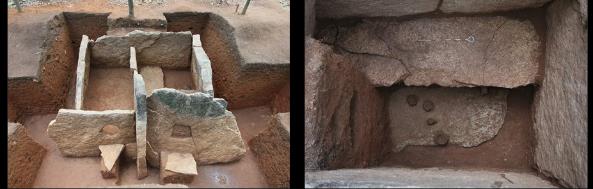
Megalith II was a multiple hood-stone structure consisting of eight clinostats, only two of which had been visible above ground. Excavation to 1.95 m found no interment; importantly, the supports themselves had been placed in a pit dug specifically to receive them. Megalith III, which the ASI report called a “topikal or Umbrella-stone,” had four quadrantal clinostats meeting in a square at the base and bevelled inward so as to support a hemispherical capstone. It too yielded no interment before natural soil was reached at about 0.70 m. ↗3
Megalith IV was marked by a granite capstone approximately 1.75 × 1.50 m. Beneath it was an urn in a pit; the urn contained eleven pots, mostly red ware, together with bone fragments. The ASI specifically reported that no iron implement was recovered from this burial. ↗3
Megalith V was markedly different. A laterite stone circle about 4.5 m in diameter enclosed three separate pit burials, conventionally labelled A, B and C. Pit A had a large red-ware urn with a triangular granite lid, four iron arrowheads, two hooked lamps, two tripod stands, a hook, knife, sickle and rod, plus a copper bowl. Pit B contained iron rods, ring stands, arrowheads, hooked lamps and a sickle, again with a copper bowl. Pit C contained two tripod stands, a knife, handled lamp and carved iron rod, again accompanied by a copper bowl. The pits also differed in details such as rubble, granite slabs, urn size and the circular depressions or holes on their covering laterite stones. These associations matter: the rich iron and copper inventory belongs specifically to these three stone-circle pits, not generically to every monument at Cheramanangad. ↗3
A tilted capstone and its supports at Kudakkallu Parambu, Cheramanangad
Cheramanangad
Photographed 2016-09-18
Later accounts report that two additional monuments were found beside the protected boundary during work in 2002–03. Each reportedly covered an urn set in a pit, with ceramics including russet-coated painted ware, red-slipped ware and black-and-red ware, and iron objects including ladles, tripod stands and knives. Because the original 2002–03 Indian Archaeology – A Review pages were not read directly for this study, those details are treated as qualified secondary reporting. ↗1 ↗5
This evidence narrows two claims about the site. First, it is inaccurate to say that burial urns simply lie “under the kudakkallu” as a general rule: the excavated umbrella-shaped Megalith III had no interment. Peter’s later study of Kerala’s umbrella stones likewise warns against equating umbrella-stone form automatically with an urn burial. Second, although Cheramanangad securely produced numerous iron objects, the site-specific passages read here do not document a dagger. Knives, sickles, arrowheads, rods, lamps, tripods, ring stands, a hook and an unidentified iron object are secure; “dagger” appears in descriptions of other Kerala megalithic sites and should not be imported into Cheramanangad without an explicit source. ↗6 ↗7 ↗3
Main investigation
The monument inventory: what “69” means. Jaseera C.M.’s 2020 study describes the ASI-protected area as containing 69 monuments of several types, while the 2024 conservation study likewise speaks of 69 monuments concentrated in the protected site. Sahapedia adds an essential qualification: monuments occur partly outside the fence, and the 2002–03 discoveries beside the protected limit indicate that the archaeological distribution was not perfectly bounded by today’s protected enclosure. The number 69 should therefore be presented as a modern protected-site/surviving inventory. No consulted excavation or survey reconstructed an original ancient total for the cemetery. ↗4 ↗1 ↗5
Schematic sections of five monument forms, drawn from the descriptions in the studies. Not to scale. Not one real monument. What is drawn under each form is one thing that has been found under such forms, not a rule.
Umbrella stone and companion monument forms reported at Cheramanangad, showing that surface form does not predict subsurface contents.
Layers of the South editorial illustration
The most detailed count recovered is Rahul P. and Vinuraj B.’s conservation inventory. Its prose states that 9 of the 69 are Kudakkal, 21 are Topikkal, and 33 are multiple hood-stone monuments. Those figures total 63. Stone circles are also discussed, but the six remaining monuments are not transparently enumerated by type in the consulted text. It would therefore be an unsupported editorial reconstruction to write “six stone circles.” The article includes a site plan credited to the ASI Thrissur Circle; a keyed or higher-resolution inventory version of that plan is a priority source for resolving the discrepancy. ↗4
The count question can consequently be separated into four different quantities:
| Quantity | Evidence-based answer |
|---|---|
| Modern protected/site inventory | 69 monuments. ↗4 ↗1 |
| Published partial type breakdown | 9 Kudakkal + 21 Topikkal + 33 multiple hood-stone = 63; six not explicitly assigned in the consulted prose. ↗4 |
| Excavated sample | Five monuments in 1990–91 and two reported in 2002–03: seven excavated monuments across the two seasons. ↗5 ↗3 |
| Reconstructed original number | Unknown. Present boundaries do not demonstrably encompass the whole ancient distribution. ↗5 |
So 69 should not be described as “the original number of burials.”
Construction: deliberate architecture above and below ground. The excavated monuments required several distinct operations rather than the mere placement of natural stones. Megalith III’s four laterite clinostats were shaped so that they met as a square toward the base and bevelled inward to support the rounded capstone. Megalith II’s eight clinostats were sunk into a specially dug construction pit. Megalith I’s closure stone was neatly dressed laterite. Megalith V combined an outer circle of irregular laterite blocks with separately cut burial pits, urns, lids and internal stone deposits. The archaeological sequence therefore includes extraction or acquisition of stone, dressing, pit excavation, erection of supports, deposition of urns and objects where appropriate, backfilling, and final surface marking. The exact sequence need not have been identical for every monument. ↗3
The recent conservation study independently describes the Kudakkal form as four quadrant-shaped clinostats forming a square at the base and narrowing upward to carry the rounded capstone. It reports nine such monuments and records large standing examples, including one approximately 270 cm high and another approximately 210 cm high above ground. Those measurements concern surviving monuments in a modern conservation inventory and should not be misreported as dimensions of the excavated 1990–91 Megalith III unless individual identities are demonstrated. ↗4
The construction material was predominantly laterite, but granite had several specific roles. In Megalith I it served as the urn lid; Megalith IV itself was marked by a granite capstone; the stone-circle pits included granite lids, slabs and rubble. Jaseera’s general description that laterite dominates the surface architecture is therefore useful, but the excavation report should control any detailed reconstruction of which stone served which function. ↗1 ↗3
Surface form did not determine burial content. This is arguably the most important archaeological result. In the five 1990–91 tests, the combinations varied dramatically:
| Excavated context | Surface/construction | Below ground | Securely reported associated material |
|---|---|---|---|
| Megalith I | Hood-stone; dressed laterite closure | One urn in pit | Bone, red ware, russet-coated white-painted bowl, 3 BRW bowls outside urn, unidentified iron object. ↗3 |
| Megalith II | Multiple hood-stone, 8 clinostats | No interment found to 1.95 m | No burial assemblage reported. ↗3 |
| Megalith III | Four-clinostat “topikal or Umbrella-stone” | No interment found before natural soil at 0.70 m | No burial assemblage reported. ↗3 |
| Megalith IV | Granite capstone | One urn in pit | Eleven pots, mostly red ware; bone fragments; no iron implement reported. ↗3 |
| Megalith V | 4.5 m laterite stone circle | Three separate urn pits | Pit-specific iron objects, pottery and one copper bowl in each pit. ↗3 |
The ASI interpreted the two empty tested forms as “probably symbolic burials.” That wording should remain attributed to the excavators. Excavation demonstrates that no interment was found in those tested contexts; it does not by itself distinguish cenotaph, memorial, dismantled burial, construction experiment or some other ancient function. Peter’s later synthesis similarly emphasises that umbrella-stone architecture cannot be treated as a guaranteed indicator of an urn beneath it. ↗6 ↗3
The stone circle shows why finds must be kept by pit. Megalith V was not one undifferentiated “rich burial.” It was a collective surface monument containing three distinct pit deposits. Pit A had the triangular granite urn lid and a heap of granite rubble at one corner; Pit B instead had three granite slabs; Pit C’s urn was larger. Their iron inventories also differed. Even though all three contained a copper bowl, the other objects cannot safely be collapsed into a generic list. A museum label or educational graphic should say, for example, “Pit A: four arrowheads…” rather than “Cheramanangad burials contained four arrowheads.” ↗3
Uncovered stone supports at Kudakkallu Parambu, Cheramanangad
Cheramanangad
Photographed 2016-09-18
Pottery: funerary deposition and traces of prior use. Red ware occurs repeatedly in the excavated graves, as does black-and-red ware; russet-coated painted material is also reported. Jaseera’s study examined a surviving collection of 32 complete or broken vessels plus some sherds in the ASI Thrissur Circle Interpretation Center. She notes a serious provenience problem: the pottery from the first excavation season was not available to her with sufficient context information to reconstruct vessel frequency by individual burial, whereas the 2002–03 material was individually marked by context. ↗8
One detail in that article requires correction rather than harmonisation: a paragraph refers to five burials excavated in “1992–93,” even though the same article elsewhere explicitly identifies the first excavation as 1990–91, as does the ASI report. There is no good evidence in the consulted material for a separate five-burial 1992–93 season. The safest interpretation is an internal typographical error, which should be flagged rather than silently repeated. ↗1 ↗3
Jaseera also observes soot and other surface alteration on selected vessels, including soot on three examples, and cautiously raises the possibility that some pottery had practical use before being placed in the graves. This is valuable for seeing ordinary activities behind funerary assemblages: a burial pot need not have been made solely for burial. But soot establishes contact with fire, not a particular recipe, meal, household or ritual, and the paper itself calls for further scientific analysis. ↗8
Iron and copper: a context-specific inventory. The 1990–91 report, rather than listing “iron blades and daggers,” specifically names arrowheads, hooked lamps, tripod stands, rods, ring stands, a hook, knives and sickles in the stone-circle pits, plus one unidentified iron object in Megalith I. Copper bowls occurred in all three stone-circle urns. No iron implement was reported from Megalith IV. ↗3
K.P. Rajesh’s 2024 review is instructive because its table compresses Cheramanangad to black-and-red ware, red ware, russet-coated white-painted ware, bone fragments, copper objects and an iron object, while the same broader review gives daggers and blades for other Kerala burial sites. That separation reinforces the conclusion that a “dagger” should not be assigned to Cheramanangad merely because it is a familiar Kerala megalithic grave-good type. ↗7 ↗2
The 2002–03 season remains evidence-limited. Rachel A. Varghese's Sahapedia essay reports that two topikkals were encountered while clearing a pathway beside the protected limits, each covering an urn in a pit with russet-coated painted ware, red-slipped ware, black-and-red ware, and iron ladles, tripods, and knives. Jaseera C.M. (2020) likewise notes that two monuments were opened in the second season and that little information is published beyond the brief IAR report. ↗1 ↗5
The official ASI archive indexes Indian Archaeology 2002–03 – A Review (published 2009), whose Cheramanangad pages were not read directly for this study; accordingly, no exact second-season monument dimensions, pit measurements, or object counts are given. ↗9
Chronology: regional periodisation is not a Cheramanangad laboratory result. Rajesh’s recent review and a Tamil Virtual Academy entry for குடைக்கல் (which names Cheramanangad among Kerala examples) place Kerala megaliths and the umbrella-stone type broadly in about 1000 BCE–500 CE; neither is a date measured from a Cheramanangad burial. ↗2 ↗10 None of the reports and studies used here gives a radiocarbon, thermoluminescence or other laboratory date for Cheramanangad, so the site belongs to Kerala’s Iron Age–Early Historic megalithic tradition, but its excavated contexts have no recovered site-specific absolute date. “Umbrella stones and rock-cut tombs: distinctive but not unique” explains how Kerala’s megalith types are dated more broadly. ↗6 ↗4 ↗1 ↗3
Dates of “2000 BCE” or “4,000 years old” for the monuments should consequently not be repeated unless a defensible site-specific dating source is produced. Public summaries repeat such early dates, but the stronger archaeological literature read for this study does not supply the needed Cheramanangad laboratory evidence.
Research history and present condition. Cheramanangad was already being archaeologically protected before the 1990s excavations: the 1957–58 Indian Archaeology – A Review records erection of barbed-wire fencing along part of Kudakalluparambu to prevent cattle damage. Recent work documents scientific conservation and restoration of the laterite monuments. The present site is therefore both an ancient archaeological landscape and a managed heritage property. Visitors should not assume that every visible support, joint, setting or repaired surface remains exactly as first constructed in antiquity. ↗4 ↗13
Evidence and passage ledger; chronology and scientific-sample ledger; interpretations, disagreements and limits
Chronology and scientific-sample ledger. A blank scientific field here means not documented in the sources consulted, not archaeologically absent.
| Original wording | Role | Source/passages | Normalised value | Qualification |
|---|---|---|---|---|
| “1990–91” | Excavation | S002/P001–P004; S004/P006 | 1990–1991 CE | Research season, not ancient chronology. ↗1 ↗3 |
| “1995” | Publication | S002 bibliographic metadata | 1995 CE | Later bibliographies give 1995 for IAR 1990–91 publication. |
| “2002–03” | Excavation | S004/P006; S006/P012 | 2002–2003 CE | Original excavation report passage uninspected. ↗1 ↗5 |
| “2009” | Publication | S006 bibliography | 2009 CE | Publication date given for IAR 2002–03 in later bibliography. |
| “2020” | Publication | S004 | 2020 CE | ResearchGate’s later upload date is not the article publication date. ↗1 |
| “2023–24 (2024)” | Publication | S007/S009 | 2024 CE | Journal issue wording. ↗14 ↗2 |
| “Iron Age and Early Historic (c.1000 BCE–500 CE)” | Other: regional periodisation | S009/P016; S010/P017 | Broad Iron Age–Early Historic window | Regional framework, not direct dating of Cheramanangad. ↗2 ↗10 |
Scientific dating samples: none. No responsibly attributable Cheramanangad laboratory code, dated material, raw measurement, standard error, calibration curve/software or calibrated interval was recovered. This means no sample documented in the consulted evidence, not that the archaeological site has never been sampled. ↗4 ↗1 ↗3
Interpretations, disagreements and limits. The most serious interpretive problem is terminology. The 1990–91 ASI calls Megalith III “topikal or Umbrella-stone.” Later Kerala-oriented descriptions normally distinguish topikkal from kudakkal, and Jaseera explicitly says non-standard terminology has made comparisons difficult. Her own summary list of monument numbers/types is not perfectly aligned with the detailed sequence that follows and with the ASI account. A publication should therefore identify excavated examples by number plus physical construction – “Megalith III, the four-clinostat umbrella form” – rather than trusting a modern type word on its own. ↗8 ↗3 “Umbrella stones and rock-cut tombs: distinctive but not unique” discusses these monument terms across Kerala, including the umbrella stones of neighbouring Ariyannur.
The second interpretive limit concerns negative evidence. Two tested monuments contained no interment, but that does not establish that every monument of those surface types was non-funerary. Nor does the rich stone-circle assemblage prove that every monument at the site contained grave goods. The excavation sampled a small part of the 69-monument protected inventory. ↗4 ↗3
The third limit is chronological. An absolute date would require a securely provenanced archaeological sample and published analytical metadata. A short-lived organic sample securely tied to a sealed deposition would be particularly useful; human bone might also be informative where preservation, permissions and method permit. No such Cheramanangad analysis was recovered here, so regional dating should remain visibly separate from direct site chronology. ↗2
Source register; entities and proposed connections
Source register. Inspection level is what was actually read for this study, not a judgement on the inherent scholarly quality of the publication.
| Full reference / type | Language and date | Actual inspection level | Durable access and dependence |
|---|---|---|---|
| Archaeological Survey of India, Indian Archaeology – A Review online publications index. Institutional catalogue. | English; live | Full relevant web catalogue | Official ASI index confirming annual volumes including 1990–91 and 2002–03. ↗9 |
| Archaeological Survey of India; S. K. Mahapatra, ed., Indian Archaeology 1990–91 – A Review (New Delhi: ASI, 1995), “Excavation at Cheramangad, District Trichur,” pp. 32–34. | English; excavation 1990–91 (pub. 1995) | Partial text read in an unofficial online copy of the printed volume; not checked against an ASI print or facsimile | Closest primary excavation account; core evidence for C004–C011, C015–C019. ↗3 |
| Archaeological Survey of India, Indian Archaeology 2002–03 – A Review (New Delhi: ASI, 2009). | English; excavation 2002–03 (pub. 2009) | Bibliographic record | Official volume indexed; relevant Cheramanangad pages were not read directly for this study. ↗9 ↗5 |
| Jaseera C.M., “Revisiting Cheramanangadu: A Study on Pottery Assemblage,” Social Orbit 6 (2020): 83–102, ISSN 2395-7719. | English; 2020 | Relevant partial text plus read page facsimiles, pp.83–100 | https://farookcollege.ac.in/imgserver/uploads/attachments/social-orbit-2020_8eeb2f65-311e-4178-a0e4-2fae8a7aa901_0.pdf. Independent pottery/collection study, though excavation history depends on IAR. ↗8 |
| Jenny Peter, “A Study of the Umbrella Stones in Kerala,” Heritage: Journal of Multidisciplinary Studies in Archaeology 3 (2015): 283–294. | English; 2015 | Relevant partial text and page facsimiles, especially pp.287–291 | https://heritageuniversityofkerala.com/JournalPDF/Volume3/15.pdf. Secondary analytical study relying partly on earlier excavation reports. ↗6 |
| Rachel A. Varghese, “Megalithic Sites of Thrissur, Kerala: Appreciation through Site Visit,” Sahapedia. | English; undated web essay | Full relevant web section | https://www.sahapedia.org/megalithic-sites-thrissur-kerala-appreciation-through-site-visit. Valuable for boundary/site-visit observations and 2002–03 summary; excavation specifics ultimately depend on IAR. ↗5 |
| Rahul P. and Vinuraj B., “The Scientific Conservation and Restoration of Megalithic Burial Monuments at Kudakalluparambu, Cheramanangadu in Thrissur District, Kerala,” Heritage 11.2 (2023–24 [2024]): 324–338. | English; 2024 | Full public HTML text; publisher volume metadata checked; journal PDF facsimile absent from the sources consulted | https://www.researchgate.net/publication/387750201_The_Scientific_Conservation_and_Restoration_of_Megalithic_Burial_Monuments_at_Kudakalluparambu_Cheramanangadu_in_Thrissur_District_Kerala. Independent conservation evidence; excavation summary depends on earlier reports. ↗14 ↗4 |
| Department of Archaeology, Government of Kerala, “Explorations and Excavations.” Institutional web summary. | English; live | Full relevant web paragraph | Official modern summary, but its excavation attribution/context mapping does not align cleanly with the ASI primary account; used only as cautionary comparison rather than controlling evidence. ↗15 |
| K. P. Rajesh, “200 Years of Babington’s Pandoo Coolies: A Critique of the Megalithic Studies in Kerala,” Heritage: Journal of Multidisciplinary Studies in Archaeology 11.2 (2023–24 [2024]): 301–323. | English; 2024 | Partial text read in an unofficial online copy; journal volume details checked on the publisher's site | Later critical synthesis; useful for regional chronology and distinguishing site inventories. ↗7 ↗2 |
| Tamil Virtual Academy, “குடைக்கல்” (Kudaikkal). | Tamil; date absent from the sources consulted | Full short web entry | https://www.tamilvu.org/tdb/titles_cont/inscription/html/kutai_kal.htm. Original-language contextual source, not a Cheramanangad excavation report. ↗10 |
| Archaeological Survey of India, Indian Archaeology 1957–58 – A Review, conservation notice for Kudakalluparambu, Cheramanangad, District Trichur. | English; 1957–58 | Citation/partial indexed text only | Establishes early modern protection/fencing history, not ancient construction. ↗13 |
The Malayalam name കുടക്കല്ല് പറമ്പ് (kuṭakkallu paṟampu) is used locally, while the Tamil Virtual Academy uses குடைக்கல் for the umbrella-stone category. Ordinary words, transliterations and specialist type names do not align perfectly across the languages. ↗10
The principal historical connection modelled here is architectural/depositional, not ethnic: surface monument form is connected to – but does not reliably determine – the subterranean arrangement of pit, urn, bone and grave goods. Nothing in this evidence alone proves a specific ethnic identity, migration, trade route or unchanged social group. ↗3
Key points, glossary and open questions
Key points.
- Cheramanangad is a mixed monument field, not a group of identical umbrella-stone burials. ↗4 ↗3
- Surface form and underground contents do not map one-to-one: two excavated forms had no interment. ↗3
- The most richly itemised metal assemblages belong to the three pits of Megalith V, and must stay context-specific. ↗3
- Some burial pottery preserves evidence of fire contact or previous use, although the activity itself cannot yet be reconstructed. ↗8
- The figure 69 is a modern site/protected inventory, not a proven original cemetery count. ↗4 ↗5
- Cheramanangad’s exact absolute date remains unresolved in the consulted evidence. ↗2
Glossary. Kudakkal/kudaikkal usually denotes an “umbrella stone”; topikkal a hat- or cap-like stone; pathikkal and “multiple hood-stone” are used for hood-like arrangements, although terminology is unstable; clinostat is a sloping supporting slab; black-and-red ware (BRW) is pottery whose controlled firing creates contrasting black and red surfaces; russet-coated painted ware is a ceramic category with a russet surface treatment and painted decoration. The Tamil form குடைக்கல் is directly attested in the Tamil Virtual Academy source. ↗8 ↗10
Still open: What exactly do the original ASI 2002–03 context sheets and drawings say? Can an ASI plan enumerate every one of the 69 surviving monuments and identify the six unaccounted for in the 2024 prose breakdown? Do accession records restore first-season pottery to its individual monument or pit? Were human remains retained or analysed? Are any scientific dating results unpublished or buried in conservation/administrative files? Which present stones have been reset or otherwise materially treated during conservation?
Evidence challenge: “Because a kudakkal looks like a grave marker, does every kudakkal have an urn directly underneath it?” No. The excavated evidence cannot establish that. The ASI’s four-clinostat Megalith III had no interment before natural soil was reached, while other surface forms at the same site did contain urns. ↗6 ↗3
Claims checked and open work
| Claim or question checked | Status | Result |
|---|---|---|
| “Monumental Umbrella Stone (Kudakkallu) necropolis” | Qualified | Cheramanangad is a mixed megalithic burial/commemorative field containing several monument forms. Not every tested monument contained an interment. ↗3 |
| “Dressed laterite clinostats and capstones” | Supported | Deliberately shaped laterite supports/caps are securely documented; granite also served specific structural/closure functions. ↗4 ↗3 |
| “Burial urns embedded underneath” | Contested as a generalisation | Urns occur in several excavated contexts, but Megaliths II and III had no interment. ↗3 |
| “Iron blades, daggers” | Qualified; dagger unresolved | Numerous iron objects are secure, including knives, sickles and arrowheads. No Cheramanangad dagger was found in the consulted site-specific passage. ↗7 ↗3 |
| “Black-and-red ware pottery recovered” | Supported | BRW is securely documented, including three bowls outside the Megalith I urn. ↗3 |
| Which finds belong to which monument? | Substantially resolved for 1990–91; incomplete for 2002–03 | The first season has monument/pit-level associations. Second-season detail remains dependent on secondary summaries. ↗5 ↗3 |
| Surviving versus original monument numbers | Resolved in principle | 69 is the modern protected/site inventory; ancient original total unknown. Full 69-type breakdown remains unresolved. ↗4 ↗5 |
| ASI excavation reports | Partly consulted | IAR 1990–91 relevant text read; IAR 2002–03 verified bibliographically but not yet consulted directly in relevant original passage. ↗9 ↗3 |
What would settle the open points. The highest priority is the original IAR 2002–03 Cheramanangad passage and associated plans/context sheets. Next is a complete keyed ASI site inventory accounting for all 69 monuments. Third is the Thrissur Circle accession documentation for the retained pottery and any surviving skeletal/metal records. A further reconciliation is needed for the Kerala Department of Archaeology web summary, whose compressed account does not align cleanly with the ASI’s original context sequence; it should not be used to overwrite the primary excavation record. ↗15 ↗3
“Not found” in this study means not documented in the sources read. It does not mean archaeologically absent. “Not reported” means the consulted source did not state it. “Not investigated” is used where a test was not shown to have been performed. “Reported absent” is reserved for cases such as the explicit statement that no iron implement came from Megalith IV or that no interment was found in Megaliths II and III. ↗3
What is secure and what is not
Supported by the sources used: the 1990–91 monument-by-monument reconstruction; the distinction between 69 surviving/protected monuments and an unknown ancient total; the 9/21/33 partial inventory; the four-clinostat and multiple-clinostat construction evidence; the three-pit stone-circle assemblages; the pottery-context limitations; and the narrowed formulation of the iron finds. ↗8 ↗4 ↗3
Needs further study: the original 2002–03 IAR pages; a complete keyed inventory of all 69 monuments; accession/context records for the first-season pottery; any osteological or scientific-dating documentation; and monument-specific conservation histories.
Not supported as established fact: that all kudakkal contain burial urns; that daggers were recovered at Cheramanangad; that the site has an established absolute date of 2000 BCE or is simply “4,000 years old”; that 69 is the cemetery’s original total; that the unexplained six monuments can be assigned to a type without the keyed inventory; or that “symbolic burial” is a demonstrated ancient function rather than the ASI excavators’ interpretation. ↗7 ↗3
005Photographs
Photographs of the places and objects this study discusses. Each item carries its creator’s credit, licence and documented source. See all 412 photographs and source images ↗

Cheramanangad · Photographed 2016-09-18 11:26:26
Side view of an umbrella-stone monument at Kudakkallu Parambu, Cheramanangad

Photographed 2008-05-07
Laterite quarry, Malappuram, Kerala
Laterite quarry, Malappuram, Kerala. Modern geological and material context; not an ancient quarry or excavation photograph.

Photographed created 1969
Laterite quarry, Angadipuram, photographed in 1969
Laterite quarry, Angadipuram, photographed in 1969. Modern geological and material context; not an ancient quarry or excavation photograph.

Cheramanangad · Photographed 2016-09-18 11:27:07
A low rounded stone arrangement at Kudakkallu Parambu, Cheramanangad

Cheramanangad · Photographed 2016-09-18 11:26:39
A tilted capstone and its supports at Kudakkallu Parambu, Cheramanangad

Cheramanangad · Photographed 2016-09-18 11:26:46
Uncovered stone supports at Kudakkallu Parambu, Cheramanangad

Cheramanangad · Photographed 2016-09-18 11:27:20
A cluster of low monuments at Kudakkallu Parambu, Cheramanangad

Cheramanangad · Photographed 2016-09-18 11:23:52
Exposed upright stones at Kudakkallu Parambu, Cheramanangad
Show 2 more photographs and source images ↓

Cheramanangad · Photographed 2016-09-18 11:23:01
An umbrella-stone monument at Kudakkallu Parambu, Cheramanangad

Cheramanangad · Photographed 2016-09-18 11:23:43
A low capstone at Kudakkallu Parambu, Cheramanangad
006Where next
 Related studyKerala's Iron Age graves are many; only a handful are dated
Cheramangad holds umbrella stones, hat stones and hood stones side by side. Its excavated hood stone covered an urn with black-and-red ware.
On the atlasCheramanangadProtected ASI monument park · Thrissur District
Explore nextStones Have Different Stories: Shape Alone Cannot Date a MonumentAll related studies, connected material, books and sources14 · 13
Elsewhere on this site
Excavation Atlas Sites: Cheramanangad (Kudakkallu Parambu)
Junior Detective Quests: Stones Have Different Stories: Shape Alone Cannot Date a Monument
Multi-Script Glossary Terms: kuṭakkallu (குடைக்கல் / കുടക്കല്ല്) · toppikkallu (தொப்பிக்கல் / തൊപ്പിക്കല്ല്) · ceṅkal (ML) / veṭṭukal (Laterite Bedrock Architecture) (செம்புறைக்கல் / செம்பாறை / வெட்டுக்கல் / ചെങ്കല്ല് / വെട്ടുകല്ല്)
Connected material
Photographs, drawings, books, videos and other studies linked to this study. A link helps you explore; it does not prove a historical claim.
- An umbrella-stone monument at Kudakkallu Parambu, CheramanangadphotographShows the subject
- A low capstone at Kudakkallu Parambu, CheramanangadphotographShows the subject
- Exposed upright stones at Kudakkallu Parambu, CheramanangadphotographShows the subject
- Side view of an umbrella-stone monument at Kudakkallu Parambu, CheramanangadphotographShows the subject
- A tilted capstone and its supports at Kudakkallu Parambu, CheramanangadphotographShows the subject
- Uncovered stone supports at Kudakkallu Parambu, CheramanangadphotographShows the subject
- A low rounded stone arrangement at Kudakkallu Parambu, CheramanangadphotographShows the subject
- A cluster of low monuments at Kudakkallu Parambu, CheramanangadphotographShows the subject
- Laterite quarry, Angadipuram, photographed in 1969photographBackground
- Laterite quarry, Malappuram, KeralaphotographBackground
- Four ways of making a burial placediagramThe empty pit beneath the umbrella stone and the hood stone over an urn come from the Cheramanangad excavations in this study.
- An umbrella stonediagramThe four-slab umbrella form that this study reports from Cheramanangad.
- Five ways the dead were markeddiagramUmbrella stone and companion monument forms reported at Cheramanangad, showing that surface form does not predict subsurface contents.
007Sources
The study lists the sources it consulted; we have not rechecked them. A working link does not show that a source was read, and a valid identifier does not show that it supports a claim. We do not link to unofficial uploads or copies of publications. Where a study cited one, we show the published citation, or a publisher, DOI or Internet Archive link when we have one. Tracking codes are removed from links, and the sources themselves are not republished here.
researchgate.net · 400075892 Revisiting Cheramanangadu A Study on Pottery Assem
K. P. Rajesh (2024), 200 Years of Babington's Pandoo Coolies, Heritage 11.2: 301–323
K. P. Rajesh, '200 Years of Babington's Pandoo Coolies: A Critique of the Megalithic Studies in Kerala,' Heritage: Journal of Multidisciplinary Studies in Archaeology 11.2 (2023–24 [2024]): 301–323.
Print or offline sourceSource recordASI / S. K. Mahapatra, ed. (1995), Indian Archaeology 1990–91 – A Review, pp. 32–34 (Cheramangad)
Archaeological Survey of India (S. K. Mahapatra, ed.), Indian Archaeology 1990–91 – A Review (New Delhi: ASI, 1995), 'Excavation at Cheramangad, District Trichur,' pp. 32–34.
Print or offline sourceSource recordresearchgate.net · 387750201 The Scientific Conservation and Restoration of Meg
sahapedia.org · megalithic sites thrissur kerala appreciation through site v
heritageuniversityofkerala.com · 15.pdf
K. P. Rajesh (2024), 200 Years of Babington's Pandoo Coolies, Heritage 11.2: 301–323
K. P. Rajesh, '200 Years of Babington's Pandoo Coolies: A Critique of the Megalithic Studies in Kerala,' Heritage: Journal of Multidisciplinary Studies in Archaeology 11.2 (2023–24 [2024]): 301–323.
Print or offline sourceSource recordSOCIAL ORBIT
Indian Archaeology A Review Reports
tamilvu.org · kutai kal.htm
Indian Archaeology 1957-58 A Review | PDF | Stairs
Print or offline sourceSource recordArchaeology - Volume Details
Explorations and Excavations | Department of Archaeology | Govt of Kerala
Researchers and institutions whose work this study uses: Archaeological Survey of India
How we know The evidence, claims and dates behind this study
What this study draws on
- The ASI excavation report in Indian Archaeology 1990–91, pages 32–34, read through a public text copy
- Jaseera C. M.’s 2020 study of the surviving pottery held by the ASI Thrissur Circle
- The 2024 conservation inventory by Rahul P. and Vinuraj B.
- Later summaries of the 2002–03 season, whose original report pages were not seen
Dates in this study
This study has no dates recorded in a form we can chart, so there is no date chart. Any dates it gives are in the full study.
The study’s claims
19 claims · 0 source passages · 54 paragraphs
Browse the study paragraph by paragraphThe protected/site inventory is reported as 69 monuments, but 69 is not established as the original cemetery total.
Supported with qualifications
Modern protected/surviving count, not ancient reconstruction.
The 2024 inventory specifies 9 Kudakkal, 21 Topikkal and 33 multiple hood-stones; these total 63, leaving six unallocated in the consulted prose.
Supported with qualifications
Remaining six must not be guessed.
The archaeological distribution extended beyond the current protected boundary.
Supported with qualifications
Original perimeter and total remain unknown.
ASI opened one example of five surface types in 1990–91.
Supported in this study
Relevant report text read through public text mirror, not ASI facsimile.
Megalith I had an urn, bones, red ware, russet-coated painted ware, BRW and an unidentified iron object; granite and dressed laterite closed the context.
Supported in this study
Applies only to Megalith I.
Megalith II had eight clinostats in a construction pit and no interment to 1.95 m.
Supported in this study
One excavated example cannot define all multiple hood-stones.
Megalith III was the four-clinostat umbrella form and yielded no interment before natural soil at 0.70 m.
Supported in this study
Later typological labels vary.
Megalith IV had a granite capstone, urn, eleven mostly red-ware pots and bone; no iron implement.
Supported in this study
Does not establish biological profile of buried individual(s).
Megalith V was a 4.5 m circle over three urn pits with differing iron inventories and one copper bowl in each.
Supported in this study
Keep finds assigned to individual pits.
Two 2002–03 monuments reportedly each contained an urn pit with ceramics and iron implements.
Supported with qualifications
Original 2002–03 passage uninspected.
Construction used deliberately shaped laterite supports/caps and selectively granite lids, caps, rubble and slabs.
Supported in this study
Exact construction sequence partly inferred from relationships.
Jaseera studied 32 retained vessels plus sherds; first-season context information was deficient, while 2002–03 vessels were individually context-marked.
Supported with qualifications
“1992–93” in one sentence is internally inconsistent and treated as a likely error.
Soot/use alteration may indicate some vessels were used before funerary deposition.
Supported with qualifications
Does not identify food or ceremony.
No site-specific absolute scientific date was recovered; chronology is presently a broad regional cultural attribution.
Supported with qualifications
Unpublished dating may exist.
“Urns beneath umbrella stones” is invalid as a blanket statement at Cheramanangad.
Debated in the sources
Other monument forms did contain urns.
A dagger is not documented in the consulted Cheramanangad-specific passages; other iron objects are secure.
Supported with qualifications
“Not found” is not proof of archaeological absence.
Typological terminology and monument-number/type mapping vary in later literature.
Supported in this study
Numbered excavation contexts should control.
“Symbolic burial” is the excavators’ interpretation of non-interment monuments, not an independently demonstrated function.
Supported with qualifications
Absence of interment alone cannot establish function.
The site has a modern protection and conservation history.
Supported in this study
Present fabric may incorporate intervention.
About this study Status, corrections and how it was made
Status
Draft study, revision 8. No historian, archaeologist, or Tamil or Malayalam specialist has reviewed it yet.
How it was made
Compiled as an editorial synthesis from published scholarship around questions we framed. About this project & workflow
The summary, How sure lines and Two views notes on this page were prepared from this study and cross-checked against its passages. That is an editorial check, not a specialist review.
Technical details
Study code R135. The text fingerprint changes whenever the study text changes.
- Table headings decide what each column means. Citation links, sample mentions and dates copied as text are kept apart from checked source passages and calibrated measurements.
See how this study’s records were extracted
Text fingerprint (SHA-256): R135 · c2e6aa54e982d00a1ca1676e… · v8
Evidence tables and technical details are on the web page: https://layersofthesouth.org/read/a29577691f