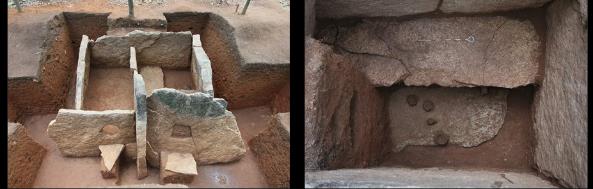
The cut approach to Eyyal’s burial cave
Eyyal
Photographed 2016-09-18
- Belief & memory
- Eyyal
Eyyal's burial cave: two chambers, studied apart from its coins
Eyyal's laterite burial cave has a pillared main chamber and a smaller side chamber, and the nearby Roman coin hoard cannot date it.
- This page
- 5,158 words · revision 5
Draft study · Awaiting specialist review · Updated
001Dates and places
002How sure
In brief
Eyyal, in Thrissur district, has a burial cave cut into laterite. A common outer court leads to a larger east-facing chamber with a central pillar and a smaller south-facing chamber without one. V. D. Krishnaswami described these chambers in 1949, and the National Monuments Authority's 2025 by-laws record their measurements and benches. Pottery is reported repeatedly, while bone and iron implements rest on weaker reports. No catalogue consulted shows an 'iron weapon assemblage', and no cist has been shown to belong to the cave. A Roman coin hoard was found near the site in 1945 during farm work, but nothing places it inside the cave. So the hoard cannot date the tomb, and the sources used give no laboratory date for the cave. Sharma's 1956 study and the original excavation records were not consulted directly for this study.
Key researchers cited in this study: Archaeological Survey of India (ASI) · Full bibliography
How sure
- Well supported
Eyyal has a double-chambered rock-cut burial cave with a pillared main chamber.
Krishnaswami's 1949 account and the 2025 National Monuments Authority description agree.
- Possible
Iron implements were found in the chambers.
Reported by the National Monuments Authority without a catalogue; another summary assigns iron to Perambra.
- Not known
Eyyal had an iron weapon assemblage.
No consulted catalogue identifies any weapon; 'implements' is the reported word.
- Not known
The Roman coin hoard was part of the burial.
Coins were found 'near the site' during farm work, and the find's context is rated poor.
Why it matters
It shows why objects found near a monument cannot date it without a recorded link.
The summary above is the short read. The full study is the complete text it was drawn from, with its tables and source notes.
What the full study covers
003The study
Scope and orientation
Question and scope
What evidence documents Eyyal’s burial complex independently of its coin-hoard history?
Region: Eyyal, Thrissur district, Kerala, with wider Kerala evidence used only where necessary to understand monument types and research history. The National Monuments Authority’s current protected-monument list records the site as “Burial Cave of Eyyal” (printed without space as “Caveof” in the official list), Eyyal, Thrissur, under the Thrissur circle. ↗1 ↗2
Period classification: mixed. The monument belongs to Kerala’s Iron Age/Early Historic mortuary discussion, but no direct scientific date for the Eyyal cave was recovered. The study also covers twentieth-century discovery, survey and protection history and twenty-first-century heritage documentation.
Time span: the 1000 BCE–600 CE period covered by this site is not used as a date for Eyyal.
Scope decision: This study treats the protected double-chambered rock-cut cave as the securely documented subject and tests those wider claims alongside the pottery, bone, iron, and coin records.
Interior of Eyyal’s burial cave, showing its central support and standing water
Eyyal
Photographed 2019-04-19
Orientation
Eyyal does not need its famous Roman-coin hoard in order to be archaeologically important. An early archaeological typology by V. D. Krishnaswami and the much fuller 2025 National Monuments Authority heritage dossier independently document a carefully cut, two-chambered burial cave: a common court serves a larger main chamber and a smaller side chamber, with a central pillar in the main chamber but not the smaller one. Krishnaswami’s 1949 article already described distinctive Eyyal chamber arrangements; the modern heritage dossier supplies dimensions and preservation details. ↗3 ↗4 ↗5
The uncertainty begins with the grave goods and the larger “complex.” Pottery is repeatedly reported, bone appears in later scholarship, and the 2025 government dossier says iron implements were recovered from the underground chambers. Yet no consulted excavation catalogue establishes an iron weapon assemblage. Nor did a consulted site-specific source demonstrate a cist physically associated with the protected cave. Meanwhile the coin hoard has a separately documented agricultural discovery history, in a jar on cultivated land, with its archaeological context rated poor. ↗6 ↗7 ↗8 ↗5
Explanation and investigation
Accessible explanation
Begin with the monument itself rather than with the coins. Eyyal’s strongest surviving evidence is architectural. The burial place was cut into laterite, the iron-rich rock that forms extensive parts of Kerala’s landscape. Instead of building a chamber from separate stone slabs, its makers excavated chambers from the rock mass. The protected monument has two connected rooms reached from a common outer court. The larger main chamber faces east; the smaller side chamber faces south. A central pillar remains in the main room, while the smaller room has no equivalent pillar. Benches were cut along the chamber walls. The 2025 official description also records damage to part of the roof and flat blocks whose original function is uncertain. ↗5
A chamber entrance and floor recess at the Eyyal burial cave
Eyyal
Photographed 2018-09-30
This description is not solely a modern invention. In 1949 V. D. Krishnaswami’s archaeological classification of South Indian megalithic monuments referred specifically to Eyyal. On printed page 40 he discussed Eyyal chambers with and without central pillars; on page 41 he described a common court giving access to the main and smaller chambers. ↗3 ↗4 This agreement between an early archaeological account and modern monument documentation makes the basic architectural description substantially firmer than many of the claims about objects once found there.
What was deposited in the cave is harder to reconstruct. The 2025 heritage dossier says pottery and iron implements were recovered from underground chambers. Elsewhere it calls the iron finds “ritualistic iron implements.” That phrase should not be silently converted into “weapons”: the consulted document does not provide a typological catalogue, object drawings, measurements, accession numbers or use-wear evidence demonstrating swords, spearheads, arrowheads or another diagnostic weapon category. ↗5 A later review by Vinod V. and A. R. Pillai says that “bones and pottery” were found at Eyyal while referring iron objects and a bronze vessel to Perambra. Their Eyyal statement depends in turn on Jenee Peter’s 2002 dissertation, whose relevant page was not consulted directly for this study. ↗6 These reports are not necessarily contradictory: the NMA may be drawing on material unavailable to the later review. But until an excavation register or museum catalogue is located, “iron implements reported at Eyyal” is the responsible wording.
A similar distinction is necessary for the word cist. A cist is a box-like burial chamber constructed with slabs rather than hollowed directly out of bedrock. Krishnaswami discusses associations between rock-cut caves and cists as part of a broader typology, but that particular statement is not a site-specific observation that an Eyyal cist stands beside the protected cave. ↗3 ↗4 Vinod and Pillai do report cap-stone or topikkallu monuments at Eyyal, so the village may preserve a wider mortuary landscape. Yet no consulted plan connected those reported monuments spatially or stratigraphically to the protected double chamber. ↗6 The label “Cave & Cist Complex” is therefore too definite.
Two openings beside the rock pillar at the Eyyal burial cave
Eyyal
Photographed 2016-09-18
The coin hoard is clearer precisely because it can be separated. It was found in 1945 during farm work, and its recorded context is poor. ↗7 ↗8 The 2025 Eyyal heritage dossier itself says Roman coins were found near the site, rather than presenting them as a sealed deposit inside one of the chambers. ↗5 “Near” is not enough to establish that the coins accompanied a burial, that they date construction of the cave, or even that the two deposits were made in the same period.
The result is less spectacular than the “cave and cist complex” label but archaeologically stronger: Eyyal is securely a double-chambered rock-cut burial monument; pottery, bone and iron are reported with unequal evidentiary strength; a cist association remains unresolved; and the coin hoard must remain a separate archaeological record unless new contextual evidence joins them.
Main investigation
The site-specific architectural record
The most useful early read source is V. D. Krishnaswami’s “Megalithic Types of South India,” published in Ancient India 5 in 1949. This was a typological study rather than a dedicated excavation monograph. Nevertheless, Eyyal appears in its site-specific discussion of Cochin State rock-cut caves. Printed page 40 distinguishes Eyyal examples in relation to the presence or absence of a central pillar; printed page 41 states that at Eyyal a common court leads to the principal chamber and, on the right, to a smaller chamber. ↗3 ↗4 “Kattakampal's burial cave: four chambers and no central pillar” examines the Kattakampal cave, which Krishnaswami lists without a central pillar, and “Porkalam 1948: one urn burial that became a reference point” the Porkalam excavation.
The 2025 National Monuments Authority Heritage Bye-Laws provide the fullest read physical description. On printed page 31/PDF page index 37, the protected monument is identified as a double-chambered megalithic burial cave excavated in laterite. A common outer court leads into the chambers. The main chamber faces east and the smaller side chamber south. The principal room is reported at roughly 2.23 m in one dimension, reaching about 2.62 m on the farther side, with other sides around 1.61 m; its maximum height is given as about 1.2 m. The smaller chamber is lower, around 0.91 m high. A bench approximately 0.24 m high runs around much of the main chamber except at its entrance; the central pillar’s pedestal merges with the western bench. The smaller chamber also has a bench but no central pillar. Flat blocks recorded toward its southwest/western part are tentatively associated by the document with supporting vessels or other objects. Part of the roof above or beside the smaller chamber is missing. ↗5
Those are valuable observations because they allow ordinary work to enter the historical interpretation. Whatever social meanings the cave once carried, somebody had to select a workable laterite exposure, remove rock, control roof and wall thickness, leave a pillar rather than quarrying it away, cut benches and organize two spaces around one court. That is evidence of planned labor and practical knowledge of the local rock. It is not, by itself, evidence for a named ethnic population, a ruler, a specific religious doctrine, or the rank of the buried people. The 2025 document’s suggestions about symbolism and status therefore belong to interpretation, not to the basic architectural observation. ↗5
Protection history and the problem of singular versus plural
A 1951 government notification reproduced in the NMA dossier schedules “Burial caves of Eyyal” in the plural. The contemporary national protected-monument list, however, uses the singular title “Burial Cave of Eyyal” (printed “Caveof” in the official list). ↗1 ↗2 ↗5 That change in administrative wording cannot safely be converted into an archaeological conclusion. The plural could reflect historical inventory practice, multiple known openings, or terminology subsequently rationalized into one protected-monument title. The modern physical description focuses on one two-chambered cave. Without the original protection survey and plan, the 1951 plural is documentary evidence about nomenclature, not proof of two separately excavated tombs.
The NMA records that the Eyyal Heritage Bye-Laws were laid in Parliament on 11 December 2025. ↗9 ↗10 This modern regulatory event is important for source history but has no bearing on when the burial was cut or used.
Pottery, bone and iron
Pottery is the most consistently recurring class of reported grave material. The NMA document reports pottery from the underground chambers. ↗5 Rachel A. Varghese’s Sahapedia account goes further, mentioning turreted lids, painted pottery and Red Ware from Eyyal; critically, it cites K. M. George’s 1975 unpublished dissertation for these details rather than presenting them as newly excavated finds. ↗11 Because George’s underlying pages were not consulted directly for this study, those specific ceramic descriptions should be retained as secondary reports awaiting primary verification, not elevated to catalogue-level evidence.
Vinod and Pillai report both bone and pottery at Eyyal and cite Jenee Peter’s 2002 dissertation. The same sentence associates iron objects and a bronze vessel with Perambra, not Eyyal. ↗6 This makes their summary particularly useful for resisting accidental conflation of neighboring Kerala megalithic assemblages.
The NMA’s Eyyal-specific report nevertheless says pottery and iron implements were recovered from the underground chambers and, in its heritage-value discussion, describes “ritualistic iron implements” as having been found during excavation of the protected area. ↗5 The underlying footnote is effectively to the Archaeological Survey of India, Thrissur Circle; no excavation season, trench/context number, object list or accession catalogue is supplied in the consulted passage. Consequently:
“Iron implements are reported from Eyyal” is supportable. “Eyyal had an iron weapon assemblage” is not presently supportable.
The difference matters. An “implement” could be a tool, fitting, indeterminate fragment, weapon or ritual object; “weapon” is a functional classification requiring morphology or contextual reasoning. “Ritualistic” is likewise a modern interpretation unless supported by find position, repeated depositional pattern, wear, associated material or another demonstrable criterion.
Testing the proposed cist complex
The other vulnerable word in the “cave and cist complex” label is “cist.” Krishnaswami’s page 41 discussion says underground caves as a class may occur with cists and umbrella-type monuments. ↗3 ↗4 The grammar and placement of the statement do not demonstrate “Eyyal has a cist next to its cave.” Treating a typological generalization as a site plan would collapse two different kinds of evidence.
Vinod and Pillai separately list Eyyal among Kerala localities where cap stones, topikkallu, have been reported. ↗6 This is worthwhile evidence that “Eyyal” may refer to a broader cluster of mortuary remains, not merely the legally protected opening. But a cap-stone monument is not automatically a cist, and a village-level occurrence is not automatically part of the same archaeological context as the protected cave. The missing evidence is straightforward: a mapped site plan, excavation report or survey catalogue demonstrating position, morphology and relationship.
Therefore the safer description is “Eyyal double-chambered burial cave and associated/unresolved mortuary evidence”, not “Double-Chambered Cave & Cist Complex.”
Keeping the coin hoard separate
The Eyyal heritage dossier’s own wording is that Roman coins were unearthed near the site. None of the consulted sources places the hoard in the main chamber, the smaller chamber, a bench deposit, the common court or a sealed burial layer. ↗5 Proximity is not archaeological association, so the hoard cannot be used to date the construction or use of the cave. “Eyyal's 1945 hoard held Roman coins and punch-marked silver” covers the hoard’s contents, recovery history and evidential limits.
Research history and missing originals
Kerala State Archaeology’s institutional history says that V. D. Krishnaswami, then associated with the Archaeological Survey of India, prepared an inventory of Cochin State megalithic monuments in 1946 with departmental assistance. ↗13 His 1949 publication is therefore relatively close to the period of early formal documentation.
Y. D. Sharma’s “Rock-cut Caves in Cochin,” Ancient India 12 (1956), pp. 93–115 – the ASI's primary architectural report on the Cochin caves – was not read directly for this study for its Eyyal entry here (“Kattakampal's burial cave: four chambers and no central pillar” examines Sharma's Kattakampal plan); until then, the finds summary below rests on Krishnaswami (1949), the 2025 NMA by-laws, and secondary surveys. ↗14
A lead to the Cochin State annual report also proved genuine: the recoverable citation is Anujan P. Achan, Annual Report of the Archaeological Department: Cochin State for the Year 1122 M.E. (1946–1947 A.D.), Ernakulam: Cochin Government Press, 1948. Its bibliographic existence was found in modern scholarship, but the report itself was not consulted directly for this study. ↗15 It therefore remains one of the most important unresolved original-source leads.
Peter’s 2002 dissertation and George’s 1975 dissertation likewise remain bibliographic/secondary dependencies rather than fully read sources. Claims derived from later authors who cite them are linked to the later source actually read, not falsely to unseen original pages.
Chronology
No Eyyal-specific laboratory date was recovered: the NMA’s ranges, “1000 BCE to the 3rd century CE” and up to about 500 CE, are regional, and dates from other Kerala sites cannot date Eyyal, as “Umbrella stones and rock-cut tombs: distinctive but not unique” explains for Kerala’s monuments generally. ↗5 ↗6
The correct chronological statement is therefore: Eyyal belongs morphologically and historiographically within Kerala’s Iron Age/Early Historic megalithic mortuary tradition, but the consulted corpus did not provide a direct scientific date for the Eyyal cave or a securely associated burial deposit.
Evidence and chronology
The ledger below separates direct site description, later textual reporting, interpretation and contextual comparison. “Supported” means supported at the stated level – not that every underlying excavation record has been recovered.
| Independently assessable statement | Evidence basis and assessment | Passages / precise locator | Stance, attribution and limitation |
|---|---|---|---|
| The protected Eyyal monument is a double-chambered rock-cut burial cave excavated in laterite. | Observation; supported. | P003 = NMA 2025, printed p.31; P010 = Valsa, “H. EYYAL.” | Supports. NMA supplies the clearest site description; Valsa is later scholarly corroboration. ↗5 ↗16 |
| A common court serves a larger east-facing principal chamber and a smaller side chamber facing south; the main has a central pillar, the smaller does not. | Observation; supported. | P001 = Krishnaswami 1949 p.40; P002 = p.41; P003 = NMA p.31/PDF 37. | Supports. The early and modern accounts converge on the architecture. ↗3 ↗4 ↗5 |
| The NMA records chamber measurements, benches, roof loss and flat blocks whose possible support function is interpretive. | Observation with interpretive qualification; supported. | P003, NMA p.31/PDF 37. | Supports measurements; function of blocks remains tentative. ↗5 |
| The 1951 schedule says “Burial caves of Eyyal”; the current national list uses singular “Burial Cave of Eyyal” (printed “Caveof” in the official list). | Textual statement; supported. | P006 = reproduced 1951 notification, printed p.50/PDF 56; current list row 1447. | Supports protection/naming history; plural is not proof of multiple separate excavated tombs. ↗1 ↗2 ↗5 |
| NMA reports pottery and iron implements from the underground chambers and elsewhere “ritualistic iron implements.” | Textual statement; qualified. | P004 = p.31/PDF 37; P005 = p.38/PDF 44; P008 challenges overconfidence. | Supports reported iron; lacks object catalogue. Vinod/Pillai’s summary gives Eyyal bones/pottery but Perambra iron. ↗6 ↗5 |
| Bone and pottery are reported at Eyyal; particular ceramic types are reported secondarily. | Textual statement; qualified. | P008 = Vinod/Pillai p.103/PDF 5; P011 = Sahapedia “Eyyal Cave.” | Supports as secondary reporting. Peter 2002 and George 1975 underlying pages remain uninspected. ↗6 ↗11 |
| An “iron weapon assemblage” is not established in the consulted corpus. | Interpretation of evidence coverage; supported. | P004, P005, P008. | NMA says implements; no consulted diagnostic weapon catalogue. This is not evidence that weapons were archaeologically absent. ↗6 ↗5 |
| No consulted site-specific source demonstrates a cist physically associated with the protected double-chamber cave. | Interpretation; qualified. | P002 = Krishnaswami p.41; P003 = NMA p.31. | Krishnaswami’s cist association is class-level; NMA’s Eyyal description does not document one. “Not demonstrated” is not “never existed.” ↗3 ↗4 ↗5 |
| Cap-stone/topikkallu monuments are reported at Eyyal, but their relationship to the protected cave is unresolved. | Textual statement; qualified. | P009 = Vinod/Pillai p.103/PDF 5. | Supports a wider Eyyal mortuary record; no consulted site plan joins the contexts. ↗6 |
| The coin hoard was found on 29 October 1945 during agricultural work on cultivated hillside land, in a jar; CHRE rates context/findspot poor. | Textual/database statement; supported. | P013 = CHRE hoard 18400, “Information / Archaeological context.” | Supports a separate discovery context. ↗7 ↗8 |
| The 2025 dossier places Roman coins “near” the site rather than in a documented chamber deposit. | Textual statement; supported. | P004 = NMA p.31/PDF 37; P013 = CHRE. | Together these challenge any automatic burial association. ↗7 ↗8 ↗5 |
| No direct scientific date for Eyyal was identified in the consulted sources. | Corpus-level interpretation; supported with scope qualification. | P016 = NMA p.31; P017 = NMA p.38; P018 = Vinod/Pillai p.107/PDF 9. | Available ranges are regional/contextual; other-site dates cannot date Eyyal. ↗6 ↗5 |
| Kerala Archaeology reports a 1946 Krishnaswami inventory of Cochin megalithic monuments. | Textual statement; supported. | P012, Kerala Archaeology institutional history. | Modern retrospective; original inventory not yet consulted directly. ↗13 |
| The 1946–47 Cochin archaeological annual report is a verified bibliographic lead but was not consulted directly for this study. | Bibliographic statement; qualified. | S014; no evidentiary passage assigned. | Context only. It cannot presently support finds or excavation claims. ↗15 |
| Site-specific evidence documents a double-chambered rock-cut cave rather than a demonstrated cist complex. | Interpretation; supported. | P002, P003, P009. | Cave secure; wider cap-stone evidence exists; cist relationship unresolved. ↗6 ↗3 ↗4 ↗5 |
| The cave documents deliberate laterite-working: chambers, benches and a pillar were left/cut as parts of a planned space. | Observation; supported. | P003, NMA p.31/PDF 37. | Supports labor/material practice, not ethnicity, social status or named beliefs. ↗5 |
| NMA’s claims about symbolic orientation/status are interpretation, not direct observations. | Interpretation; qualified. | P005, NMA p.38/PDF 44. | Attribute to NMA rather than presenting as established ancient intention. ↗5 |
No laboratory date has been published for Eyyal in the sources consulted. No laboratory code, sampled material, raw measurement, standard error, calibration curve/software, reservoir correction or calibrated probability interval was located for Eyyal; accordingly none has been invented.
Interpretations and sources
Interpretations, disagreements and limits
The central disagreement is not a dramatic scholarly controversy but an uneven source record.
The architecture is the strongest layer. Krishnaswami’s early typological account and the NMA’s modern site description agree on a multi-room Eyyal rock-cut cave reached through a common court and distinguish a pillared main space from a smaller unpillared chamber. ↗3 ↗4 ↗5 This part of the description stands with relatively high confidence.
The reported assemblage is less secure. The NMA says iron implements and pottery came from the underground chambers, while Vinod and Pillai’s summary identifies bone and pottery at Eyyal and gives iron objects and bronze to Perambra. ↗6 ↗5 The two accounts need not be mutually exclusive; they may draw on different excavations or documentation. But the discrepancy means that a combined “pottery + bones + iron weapons” assemblage should not be presented as if one read field register documented everything together.
Likewise, calling the iron objects “ritualistic” is an NMA interpretation; calling them “weapons” goes further than the consulted evidence. ↗5 A catalogue with object type, measurements, photographs/drawings, accession number and chamber/context would resolve much of the uncertainty.
The proposed cist association is still weaker. Regional typology demonstrates that rock-cut caves, cists and umbrella/cap-stone monuments belong within related South Indian mortuary traditions, and cap stones have been reported at Eyyal. ↗6 ↗3 ↗4 What is missing is the site-specific middle step: evidence that a particular cist belongs spatially or stratigraphically to the protected Eyyal cave. A measured survey or original field plan would resolve this.
The coin relationship should remain deliberately conservative. CHRE’s agricultural discovery record and NMA’s wording “near the site” allow proximity; they do not supply association. ↗7 ↗8 ↗5 A contemporaneous findspot plan, original discovery report locating the jar in relation to the protected monument, or a demonstrable stratigraphic connection would be required before arguing that the hoard formed part of Eyyal’s funerary practice.
Finally, there is no direct Eyyal scientific chronology in the consulted corpus. Regional period labels are suitable for orientation but should not be rewritten as “Eyyal dates to 1000 BCE–500 CE.” ↗6 ↗5
Source register
| Reference and durable location | Language / type | Actual inspection | Independence and use |
|---|---|---|---|
V. D. Krishnaswami, “Megalithic Types of South India,” Ancient India 5 (1949): 35–45. https://www.lkouniv.ac.in/site/writereaddata/siteContent/202004080628301734anil_kumar_Megalithic_Types_of_South_India.pdf |
English; archaeological research article. | Facsimile, relevant pp.40–41 and plates read. | Foundational early typology; site-specific architecture C002 and contextual evidence for C008. ↗3 ↗4 |
National Monuments Authority, Heritage Bye-Laws for Burial Caves of Eyyal, District Thrissur, Kerala (2025). https://www.nma.gov.in/showfile.php?lang=1&level=2&lid=2025&ls_id=1635&nma_type=0 |
English; official heritage dossier. | Facsimile, relevant printed pp.29, 31, 38, 50, 52 and associated page images read. | Best read modern site description; supports C001–C005, C011–C012, C016–C017. It is official documentation, not independent confirmation of every interpretation. ↗5 |
| Government of Travancore-Cochin notification, 11 Dec 1951, schedule reproduced in NMA Annexure II. Same NMA PDF. | English; government record. | Facsimile reproduction read. | Original-source wording for protection history C004; standalone original gazette issue not separately retrieved. ↗5 |
Vinod V. and A. R. Pillai, “Iron Age in Kerala: A Short Summary” (2016), read PDF pp.101, 103, 107. https://asc.iitgn.ac.in/assets/publications/research_papers/Iron_Age_in_Kerala_Vinod_V_AR_Pillai_2016.pdf |
English; research article. | Facsimile of relevant pages. | Later synthesis; important for bones/pottery, cap stones and chronology. It depends on earlier scholarship including Peter. ↗6 |
| M. A. Valsa, “Megalithic Monuments in Thrissur in Historical Perspective,” Rural South Asian Studies 1(1) (2015): 60–65. (consulted via text copy; journal print pagination pp. 60–65) | English; research article. | Full rendered text, not a verified page-image facsimile. | Later architectural synthesis; likely dependent on established site typology. ↗16 |
Rachel A. Varghese, “Megalithic Sites of Thrissur, Kerala: Appreciation through Site Visit,” Sahapedia. https://www.sahapedia.org/megalithic-sites-thrissur-kerala-appreciation-through-site-visit |
English; public scholarly synthesis. | Full web text. | Useful for specific reported ceramic categories but explicitly dependent on George 1975; not independent excavation evidence. ↗11 |
Department of Archaeology, Government of Kerala, “The Kochi Archaeology Department.” https://www.archaeology.kerala.gov.in/pages/the-kochi-archaeology-department/27 |
English; institutional history. | Full web text. | Research-history evidence for hoard discovery and Krishnaswami’s 1946 inventory; a retrospective, not the original field notebook. ↗13 |
National Monuments Authority, List of Centrally Protected Monuments (ASI), row 1447. https://www.nma.gov.in/showfile.php?lang=1&level=1&lid=1276&ls_id=965&nma_type=0 |
English; institutional list. | Facsimile around the Thrissur entries. | Administrative corroboration of present protected-site title/location. ↗1 ↗2 |
Coin Hoards of the Roman Empire, hoard 18400, “IYYAL.” https://chre.ashmus.ox.ac.uk/hoard/18400 |
English; scholarly dataset. | Full database record read. | Best read source for reconstructed coin-hoard discovery context; intentionally not treated as a burial-cave excavation report. ↗7 ↗8 |
Department of Archaeology, Government of Kerala, “Numismatics: Kerala’s Coin Heritage and History.” https://www.archaeology.kerala.gov.in/pages/numismatics/32 |
English; institutional catalogue/overview. | Full web text. | Context for categorizing Iyyal among hoard/chance coin discoveries; no tomb association inferred. ↗12 |
Y. D. Sharma, “Rock-cut Caves in Cochin,” Ancient India 12 (1956): 93–115. AGORHA record: https://agorha.inha.fr/ark:/54721/c9014ec1-a324-40d3-8a2b-25c8629cbfd9 |
English; research article. | Bibliographic record. | High-priority primary ASI report; Eyyal pages were not read directly for this study. ↗14 |
Jenee Peter, Dimensions of Megalithic Culture of Kerala in Relation to Peninsular India: An Interdisciplinary Approach, PhD dissertation, Maharaja Sayajirao University of Baroda, 2002. Semantic Scholar bibliographic record: https://www.semanticscholar.org/paper/351433e73cb91c5edaef6b376ba82186feabf18a |
English; dissertation. | Metadata only. | Vinod/Pillai cite Peter p.50 for Eyyal bone/pottery. That page was not consulted directly for this study. |
| K. M. George, Archaeology of Kerala up to 1500 AD, unpublished PhD dissertation, M.S. University Baroda, 1975. | English; dissertation. | Citation only. | Sahapedia depends on George for detailed Eyyal pottery categories; those underlying pages remain uninspected. ↗11 |
| Anujan P. Achan, Annual Report of the Archaeological Department: Cochin State for the Year 1122 M.E. (1946–1947 A.D.). Ernakulam: Cochin Government Press, 1948. | English; departmental annual report. | Bibliographic record. | Early Cochin departmental report; full text was not consulted directly for this study. ↗15 |
Language discovery. Searches also tested Malayalam and Tamil routes. No accessible site-specific Malayalam or Tamil primary publication added independent Eyyal observations strong enough for the evidence register.
Learning points and claims tested
Learning points
The most defensible takeaways are:
| Takeaway | Evidence basis |
|---|---|
| Eyyal’s burial identity does not depend on the coin hoard: the rock-cut tomb architecture is independently documented. | C001–C002. ↗3 ↗4 ↗5 |
| Its two chambers are deliberately differentiated by size, orientation and pillar treatment, while benches are reported in both. | C002–C003. ↗5 |
| Pottery is repeatedly reported, but some fine-grained ceramic identifications still depend on an uninspected dissertation. | C005–C006. ↗5 ↗11 |
| Iron implements are reported, but the consulted record does not justify advertising an “iron weapon assemblage.” | C005–C007. ↗6 ↗5 |
| Eyyal has reported wider mortuary remains, including cap stones, but an associated cist has not yet been demonstrated for the protected cave. | C008–C009. ↗6 |
| The 1945 coin hoard was found in a separately documented agricultural context and should not be used to date the cave. | C010–C012. ↗7 ↗8 |
Small glossary
Laterite: iron-rich weathered rock widespread in tropical landscapes; at Eyyal it is the material into which the chambers were cut. ↗5
Rock-cut cave / burial cave: here, a mortuary chamber excavated from the rock mass rather than assembled entirely from separate structural slabs.
Cist: a box-like stone burial chamber constructed from slabs. The term is important comparatively, but this study does not establish a cist attached to the protected Eyyal cave.
Cap stone: a covering stone forming part of a burial monument. Vinod and Pillai report such monuments at Eyyal. ↗6
Topikkallu: the transliterated form used in the consulted English scholarship for a cap-stone monument.
Assemblage: objects or remains considered together because their archaeological contexts show that they belong together. Mere recovery from the same village is not enough.
Useful next questions include: Where are the Eyyal pottery, bone and iron finds curated? Does an accession register identify their chamber/context? Can the 1946–47 Cochin annual report and Krishnaswami’s original inventory be recovered? Does Sharma 1956 contain an Eyyal plan? Is any cist or cap-stone monument mapped close enough – and with enough contextual evidence – to define a true complex? Has secure material from a burial deposit ever been radiometrically dated?
Evidence challenge: A jar of Roman coins was found near the Eyyal burial cave. Does that prove the burial contained Roman coins?
Answer: No. The coin record describes agricultural discovery on cultivated hillside land with poor contextual resolution, and the monument dossier says only that coins were found “near” the site. Neither establishes a sealed chamber deposit, stratigraphic association or contemporaneity. ↗7 ↗8 ↗5
Claims tested
| Claim | Status | Research result |
|---|---|---|
| Eyyal has a double-chambered underground burial monument. | Supported | Krishnaswami 1949 and NMA 2025 document a common court and differentiated chambers. ↗3 ↗4 ↗5 |
| It is a rock-cut/laterite cave. | Supported | Explicit in modern site description. ↗5 |
| The main and smaller chambers can be described site-specifically. | Supported | Orientation, pillar arrangement, benches and measurements are documented. ↗5 |
| Eyyal forms a “Cave & Cist Complex.” | Unresolved / title requires qualification | Cists occur in the broader typology, and cap stones are reported at Eyyal, but no consulted source joins a cist to the protected cave. ↗6 ↗3 ↗4 |
| Funerary pottery is associated with Eyyal. | Supported at report level; details qualified | NMA reports pottery; later sources add specific types through an unseen dissertation. ↗5 ↗11 |
| Bone is reported at Eyyal. | Qualified | Vinod/Pillai report it through Peter 2002; primary context not yet consulted directly. ↗6 |
| Iron implements occur at Eyyal. | Qualified | NMA says they do; no consulted catalogue or primary field report was recovered. ↗5 |
| Eyyal has an iron weapon assemblage. | Unsupported in read corpus; withhold | “Implements” cannot be silently converted to “weapons.” |
| The Roman coin hoard belongs to the tomb assemblage. | Unsupported; keep separate | CHRE gives a separate agricultural find context; NMA says coins were found near the site. ↗7 ↗8 ↗5 |
| The coin hoard dates the cave. | Unsupported; withhold | No demonstrated archaeological association. |
| The cave has a direct scientific date. | Not found | Broad regional chronology only; no Eyyal sample metadata recovered. ↗6 |
| ASI excavation documentation is available in the consulted corpus. | Partly unresolved | NMA invokes ASI/Thrissur Circle records, but an underlying excavation register/catalogue is absent from the sources consulted. |
| Cochin State annual report is a genuine lead. | Bibliographically supported, text uninspected | Achan 1948 citation recovered; content not yet consulted directly. ↗15 |
“Not found” above means the search did not recover the relevant evidence. “Not reported” refers to a consulted source that simply does not report it. “Unresolved” means competing or incomplete reporting prevents a stronger conclusion. Nothing in this study uses silence in an accessible source as proof of archaeological absence.
Highest-priority unresolved work is recovery of Sharma 1956 in full; the Achan/Cochin annual report; Peter 2002 p.50 and surrounding discussion; George 1975’s Eyyal pages; ASI Thrissur Circle excavation/object registers; and museum accession information for the pottery, bones and iron. Those are research gaps, not completed evidence.
The study’s conclusion is narrower than the “cave and cist complex” label: Eyyal is securely documented as a distinctive double-chambered rock-cut burial cave whose architecture, pottery reports and probable mortuary use stand independently of the famous coin hoard. Bone and iron are reported but need their primary contexts recovered; an iron weapon assemblage is not demonstrated; and neither a cist association nor a funerary relationship with the coin hoard should be asserted until site-specific evidence establishes it.
004Photographs
Photographs of the places and objects this study discusses. Each item carries its creator’s credit, licence and documented source. See all 412 photographs and source images ↗

Eyyal · Photographed 2016-09-18 11:50:14
The cut approach to Eyyal’s burial cave

Eyyal · Photographed 2019-04-19 16:49:44
Interior of Eyyal’s burial cave, showing its central support and standing water

Eyyal · Photographed 2018-09-30 12:08:23
A chamber entrance and floor recess at the Eyyal burial cave

Eyyal · Photographed 2016-09-18 11:50:24
Two openings beside the rock pillar at the Eyyal burial cave

Eyyal · Photographed 2018-09-30 12:08:23
A raised bench inside the Eyyal burial cave

Eyyal · Photographed 2016-09-18 11:50:41
Oblique view of the Eyyal burial-cave entrance

Eyyal · Photographed 2018-09-30 12:08:23
The pillar and floor inside the Eyyal burial cave
005Two views
Both views are shown at equal weight; this site does not choose between them.
What was found in the Eyyal cave
- One view
- The National Monuments Authority (2025) reports pottery and iron implements from the underground chambers.
- Another view
- Vinod and Pillai (2016), citing Peter's 2002 thesis, report bone and pottery at Eyyal and place iron objects and a bronze vessel at Perambra.
- What would settle it
- An excavation register or museum catalogue listing each object with its chamber and context.
006Where next
 Related study
All related studies, connected material, books and sources15 · 16
Elsewhere on this site
Excavation Atlas Sites: Eyyal (Iyyal) Hoard & Burial Landscape
Connected material
Photographs, drawings, books, videos and other studies linked to this study. A link helps you explore; it does not prove a historical claim.
- The cut approach to Eyyal’s burial cavephotographShows the subject
- Two openings beside the rock pillar at the Eyyal burial cavephotographShows the subject
- Oblique view of the Eyyal burial-cave entrancephotographShows the subject
- A chamber entrance and floor recess at the Eyyal burial cavephotographShows the subject
- A raised bench inside the Eyyal burial cavephotographShows the subject
- The pillar and floor inside the Eyyal burial cavephotographShows the subject
- Interior of Eyyal’s burial cave, showing its central support and standing waterphotographShows the subject
- Coins have more than one historyillustrationThe banner keeps the Eyyal coin find separate from the burial cave, as this study recommends.
- Stone, cut and builtillustrationThe Eyyal plan, with its pillar, benches and shared court, is drawn from the National Monuments Authority’s 2025 description summarised in this study.
Books, videos and websites
Outside reading on this topic. These are not part of the study and we have not checked every claim in them. See all books and videos
- Roman Coins from India Book · Paula J. Turner · 1989 · Hoard-by-hoard catalogue and die-analysis of Roman gold and silver coin finds across peninsular India – including Kottayam, Eyyal, Pudukkottai, Vellalur, and Karur – examining Julio-Claudian issue concentrations, chisel slashes, and countermarks.
- The Early Coins from Kerala Book · Parmeshwari Lal Gupta · 1965 · Primary numismatic monograph on the 1945 Eyyal hoard (Thrissur district) and early punch-marked silver and Roman imperial coins curated by the Kerala State Archaeology Department.
007Sources
The study lists the sources it consulted; we have not rechecked them. A working link does not show that a source was read, and a valid identifier does not show that it supports a claim. We do not link to unofficial uploads or copies of publications. Where a study cited one, we show the published citation, or a publisher, DOI or Internet Archive link when we have one. Tracking codes are removed from links, and the sources themselves are not republished here.
nma.gov.in · showfile.php
List of Centrally Protected Monuments (ASI)
lkouniv.ac.in · 202004080628301734anil kumar Megalithic Types of South India
MEGALITHIC TYPES OF SOUTH INDIA
nma.gov.in · showfile.php
asc.iitgn.ac.in
Web page (chre.ashmus.ox.ac.uk)
Web page (chre.ashmus.ox.ac.uk)
nma.gov.in · show content.php
Monuments whose bye laws have been Laid in Parliament
Megalithic Sites of Thrissur, Kerala: Appreciation through ...
Numismatics: Kerala's Coin Heritage and History | Department of Archaeology | Govt of Kerala
The Kochi Archaeology Department | Department of Archaeology | Govt of Kerala
Sharma, Y. D., Rock-cut Caves in Cochin, <i>Ancient India</i>, New Delhi 1956 -
Archaeology in Kerala: A Critical Appraisal - Ala / അല
M. A. Valsa (2015), Megalithic Monuments in Thrissur in Historical Perspective, Rural South Asian Studies 1(1): 60–65
M. A. Valsa, 'Megalithic Monuments in Thrissur in Historical Perspective,' Rural South Asian Studies 1(1) (2015): 60–65.
Print or offline sourceSource record
Researchers and institutions whose work this study uses: Archaeological Survey of India
How we know The evidence, claims and dates behind this study
What this study draws on
- Krishnaswami's 1949 survey report, pages 40–41
- The National Monuments Authority's 2025 heritage by-laws, including the reproduced 1951 protection schedule
- Vinod and Pillai's 2016 summary and a Sahapedia account, checked for reliance on older theses
- The Coin Hoards of the Roman Empire record for the 1945 find
Dates in this study
This study has no dates recorded in a form we can chart, so there is no date chart. Any dates it gives are in the full study.
The study’s claims
17 claims · 0 source passages · 71 paragraphs
Browse the study paragraph by paragraphThe protected Eyyal monument is a double-chambered rock-cut burial cave excavated in laterite.
Supported in this study
Supports. NMA supplies the clearest site description; Valsa is later scholarly corroboration.
A common court serves a larger east-facing principal chamber and a smaller side chamber facing south; the main has a central pillar, the smaller does not.
Supported in this study
Supports. The early and modern accounts converge on the architecture.
The NMA records chamber measurements, benches, roof loss and flat blocks whose possible support function is interpretive.
Supported with qualifications
Supports measurements; function of blocks remains tentative.
The 1951 schedule says “Burial caves of Eyyal”; the current national list uses singular “Burial Caveof Eyyal.”
Supported in this study
Supports protection/naming history; plural is not proof of multiple separate excavated tombs.
NMA reports pottery and iron implements from the underground chambers and elsewhere “ritualistic iron implements.”
Supported with qualifications
Supports reported iron; lacks object catalogue. Vinod/Pillai’s summary gives Eyyal bones/pottery but Perambra iron.
Bone and pottery are reported at Eyyal; particular ceramic types are reported secondarily.
Supported with qualifications
Supports as secondary reporting. Peter 2002 and George 1975 underlying pages remain uninspected.
An “iron weapon assemblage” is not established in the consulted corpus.
Supported in this study
NMA says implements; no consulted diagnostic weapon catalogue. This is not evidence that weapons were archaeologically absent.
No consulted site-specific source demonstrates a cist physically associated with the protected double-chamber cave.
Supported with qualifications
Krishnaswami’s cist association is class-level; NMA’s Eyyal description does not document one. “Not demonstrated” is not “never existed.”
Cap-stone/topikkallu monuments are reported at Eyyal, but their relationship to the protected cave is unresolved.
Supported with qualifications
Supports a wider Eyyal mortuary record; no consulted site plan joins the contexts.
The coin hoard was found on 29 October 1945 during agricultural work on cultivated hillside land, in a jar; CHRE rates context/findspot poor.
Supported in this study
Supports a separate discovery context.
The 2025 dossier places Roman coins “near” the site rather than in a documented chamber deposit.
Supported in this study
Together these challenge any automatic burial association.
No direct scientific date for Eyyal was identified in the consulted sources.
Supported with qualifications
Available ranges are regional/contextual; other-site dates cannot date Eyyal.
Kerala Archaeology reports a 1946 Krishnaswami inventory of Cochin megalithic monuments.
Supported in this study
Modern retrospective; original inventory not yet consulted directly.
The 1946–47 Cochin archaeological annual report is a verified bibliographic lead but was not consulted directly for this study.
Supported with qualifications
Context only. It cannot presently support finds or excavation claims.
The earlier title should be narrowed by removing an asserted cist complex unless new site-specific evidence is produced.
Supported in this study
Cave secure; wider cap-stone evidence exists; cist relationship unresolved.
The cave documents deliberate laterite-working: chambers, benches and a pillar were left/cut as parts of a planned space.
Supported in this study
Supports labor/material practice, not ethnicity, social status or named beliefs.
NMA’s claims about symbolic orientation/status are interpretation, not direct observations.
Supported with qualifications
Attribute to NMA rather than presenting as established ancient intention.
About this study Status, corrections and how it was made
Status
Draft study, revision 5. No historian, archaeologist, or Tamil or Malayalam specialist has reviewed it yet.
How it was made
Compiled as an editorial synthesis from published scholarship around questions we framed. About this project & workflow
The summary, How sure lines and Two views notes on this page were prepared from this study and cross-checked against its passages. That is an editorial check, not a specialist review.
Technical details
Study code R139. The text fingerprint changes whenever the study text changes.
- Table headings decide what each column means. Citation links, sample mentions and dates copied as text are kept apart from checked source passages and calibrated measurements.
See how this study’s records were extracted
Text fingerprint (SHA-256): R139 · 8c9b6455aa6fd466ca372453… · v5
Evidence tables and technical details are on the web page: https://layersofthesouth.org/read/8a8c15f3f0