Marks on Roman coins found in South India: a slash across the portrait, and two holes. The marks are clear; why the portraits were slashed is not known.
- Across the water
- 200 BCE–300 CE
- 300–600 CE
- Eyyal
- Valluvally
Roman coins in South India were slashed, pierced and copied
Roman coins found in South India were sometimes slashed, pierced or copied. Portrait slashing is especially common in the Pudukkottai material, but varies greatly between hoards. The physical changes are clear; the motives behind them cannot be read directly from the marks.
- This page
- 4,894 words · revision 6
Draft study · Awaiting specialist review · Updated
001Dates and places
Places on the atlas that name this study.
1000–500 BCE
Different beginnings
500–200 BCE
Marks & materials
200 BCE–300 CE
Connected worlds
300–600 CE
Change & continuity
- Neronian reform reference point
- Pudukkottai latest reported coin issue
- Eyyal latest Roman issue
- Proposed principal period of plugged/weight-regulated Roman gold in India
- Kottayam latest documented Caracallan issues
- Date from writing, coins or texts
- Period assigned by excavators or scholars
- How it was dated is not stated
Each date belongs to what was dated (a sample, an object, a layer or a text), which is not always the event the study asks about.
Each period has the same width, so spacing is not to scale.
The full table of dates, with their ranges, is under How we know.
- 1 Well supported
- 2 Likely
- 1 Not known
002How sure
In brief
Many Roman coins found in South India were altered after they were struck. In the Pudukkottai hoard of about 500 gold coins, roughly 90 percent have chisel cuts, usually across the emperor's head. Silver coins from Akkenpalle in Andhra were cut too, and some carry tiny local punch-marks. Pairs of holes suggest that some coins were worn or sewn on. Emilia Smagur studied 44 coins whose holes were later plugged with gold. She argues that the plugs brought them back toward a heavier, older weight, probably centuries after Nero. Local workshops also struck copies of Roman coins, some mixing designs that never belonged together. The slashes may have tested for plated fakes or cancelled the emperor's image; the studies used report no laboratory test of either. Indian finds strongly favour coins minted before Nero's reform of about 64 CE.
Key researchers cited in this study: Wilfred H. Schoff (Periplus Translation & Commentary) · T. S. Sridhar (TNSDA Epigraphy & Excavation Reports) · R. Krishnamurthy (Sangam-Age Chera, Chola & Pandya Numismatics) · Full bibliography
How sure
- Well supported
Most Pudukkottai gold coins were slashed across the portrait
Oxford's hoard database describes about 90 percent of 501 aurei as slashed; the Chennai museum lists 461.
- Likely
Double-pierced coins were worn or attached as ornaments
Two holes keep a coin facing forward when strung or sewn; no intact early necklace survives.
- Likely
Gold plugs restored coins toward a heavier weight standard
Smagur's weight analysis of 44 plugged pieces supports it; the practice is mostly later than the slashes.
- Not known
Why the portraits were slashed
Assay and cancellation both fit; no study used here has analysed the metal inside the cuts.
Why it matters
It shows that Roman coins in India were reused as metal, money and jewellery, not simply left as markers of Roman presence.
003Key findings
What the study concludes
- The Pudukkottai/Karukkakurichi aureus group is the strongest documented South Indian concentration of deliberate portrait slashing, with 461 slashed pieces listed by the Government Museum and the CHRE record describing approximately ninety percent of 501 aurei as slashed.
- Akkenpalle and related Andhra silver finds demonstrate that portrait slashing was not confined to gold and could coexist with multiple chisel cuts, small secondary marks and local imitations.
- Small punch-marks on Roman coins found in India form a materially distinct category from deep portrait slashes and from normal Roman official countermarks; proposed functions include authentication, ownership and banking/accounting.
- Indian craftsmen locally reproduced Roman coin forms: many imitations were die-struck, possible die-links are documented or proposed, and gold copies sometimes combine Roman types that never occurred together on official issues.
In the study’s own words. How sure each point is, is shown above.
The summary above is the short read. The full study is the complete text it was drawn from, with its tables and source notes.
What the full study covers
004The study
Answer in Brief
The evidence does not support a single explanation for all modified Roman coins found in South India. Chisel slashes, tiny punch-marks, suspension holes, plugged holes, and locally made imitations are materially different interventions, and the strongest explanation is that Roman precious-metal coins moved through several regimes of value after reaching the subcontinent: as recognizable foreign coins, as weighed gold or silver, as locally validated or regulated monetary objects, as models for indigenous copies, as stores of wealth, and as ornaments. The same object could pass through more than one of those roles before deposition. ↗1
Physical / Textual Observation. The clearest concentration of portrait slashing is the Pudukkottai material. The Government Museum, Chennai tabulation lists 461 slashed pieces from Karukkakurichi in Pudukkottai district; the Oxford Coin Hoards of the Roman Empire database records the Pudukottai hoard as 501 aurei and describes about 90 percent as slashed. The cuts characteristically strike the emperor's head or bust; where portraits occur on both faces, both could be attacked. Yet slashing is not universal across Indian Roman-coin finds: the same museum survey lists only three slashed coins at Soriyapattu and much smaller totals at several other Tamil Nadu sites. ↗2
Silver shows related but not identical treatment. Radhakrishnan identifies Akkenpalle and Nasthullapur as especially important defaced-denarius groups and records examples with multiple chisel cuts; Akkenpalle contained 1,531 denarii and a substantial group of imitations. Tiny secondary marks constitute another category altogether: Indian examples can carry dots, circles, crescents, lines, triangles, letters, and more elaborate devices, sometimes partly obliterated by later slashes. The Government Museum explicitly warns that minute countermarks can be hard to distinguish from ordinary abrasion. ↗3
Indian imitations are equally significant. The earliest silver copies concentrate on two exceptionally common Roman prototypes: Augustan Gaius-and-Lucius CAESARES denarii and Tiberian PONTIF MAXIM denarii. Gold imitations can combine obverse and reverse types that never belonged together on official Roman issues and can replace meaningful Latin legends with pseudo-lettering. Government Museum researchers report that many were die-struck, while some were cast; Berghaus explicitly published evidence for die-links between Roman coins and Indian imitations, and a possible die-link has been proposed within the Gumada material. ↗4
Double piercing supplies the strongest physical evidence for adornment. Smagur's catalogue of plugged Roman gold coins and imitations records 44 known specimens in her dataset, many double-pierced; she accepts that the perforations are compatible with jewellery use while arguing that the conspicuous gold plugs themselves served an additional function – bringing underweight pieces back toward a preferred weight. Her distribution is chronologically important: hoards containing only pre-reform aurei do not produce these plugged pieces, and she argues that plugging probably became significant centuries after Nero, with some such coins remaining in circulation or hoards into the sixth century. ↗5
Scholarly Interpretation. For portrait slashes, the most viable functional hypothesis is some form of validation or assay: a cut opened the metal beneath the relief to test whether a nominally gold or silver coin was plated or otherwise fraudulent. Radhakrishnan has developed this interpretation most explicitly. But it remains a hypothesis rather than a demonstrated metallurgical result: no consulted study here reports microscopic sequencing or compositional analysis of metal exposed in the South Indian slash grooves sufficient to prove that assay was their purpose. ↗42
The older “political cancellation” or demonetization hypothesis fits one conspicuous fact – the emperor's portrait is disproportionately targeted – but lacks a documented Indian authority ordering such cancellation. If “demonetization” is used at all, the most coherent version is not “destroy the value of the gold,” but cancel or disregard Roman monetary authority while retaining the metal's local exchange value. That would explain why mutilated pieces could nevertheless remain worth hoarding. Government Museum authors report this cancellation interpretation as widespread in earlier scholarship, while themselves conceding that the reason for the slash remains unresolved. ↗7
A generalized religious or ritual iconoclasm hypothesis is weaker. The Government Museum survey notes earlier suggestions of Buddhist or even Muslim iconoclasm but judges such explanations unconvincing. The Muslim variant is particularly unusable as an explanation for an Early Historic modification unless one first demonstrated that the cuts were made many centuries after the coins entered India. Roman coins certainly occur in some South Asian religious contexts, but ritual deposition does not establish ritual portrait destruction. ↗8
The Neronian reform of approximately 64 CE is crucial, but mainly as a monetary selection boundary, not as a proven universal cause of slash marks. Nero reduced the weight standard of the aureus and altered the denarius standard; Indian assemblages show an extraordinary preference for older issues. De Romanis counted 5,728 reliably recorded Indian denarii in his study – dominated by Augustus and Tiberius – and found pre-reform aurei overwhelmingly dominant within the early imperial gold sample. Smagur later showed that plugged pieces behave differently: their added gold is consistent with attempts to approximate an older, heavier aureus standard. Thus the reform helps explain which Roman coins Indians selected and, later, how some gold pieces were weight-regulated; it does not by itself prove that a chisel slash was a reaction to Nero's reform. ↗9
Roman gold coin pierced for suspension, shown in a Polish numismatic video
Photographed 2021-03-31
Unresolved / Debated Question. The best synthesis is therefore plural rather than monocausal. Slashes most likely belong to local processes of acceptance, testing, or status-cancellation; tiny punches more plausibly belong to authentication, ownership, accounting, or other secondary marking; holes often indicate suspension; plugged holes can additionally encode weight regulation; and locally struck imitations show that recognizable Roman types were sufficiently valued to reproduce. No presently read evidence allows every modified Julio-Claudian coin to be assigned confidently to one of those purposes.
Scope & Chronological Control
This study concerns Kerala, Tamil Nadu, adjoining peninsular India, and the connected western Indian Ocean exchange system between 1000 BCE and 600 CE. Gujarat and Andhra evidence is included where it bears directly on the movement, valuation, or transformation of coins reaching Kerala and Tamil Nadu. Barygaza is therefore relevant as a documented exchange node, while Akkenpalle and Gumada provide indispensable comparative evidence for silver defacement and imitation. “Kerala's Roman coin hoards show inland movement, not motive” surveys the Kerala Roman-coin hoards themselves.
A fundamental chronological distinction must be maintained: the date on which a Roman coin was struck is not the date on which it reached India, was slashed, pierced, countermarked, copied, or buried. Indian hoards repeatedly contain old coins beside much later issues. Turner emphasized the inadequacy and dispersal of many nineteenth- and twentieth-century discovery records, and Radhakrishnan likewise cautioned that early Roman coins could have reached India well after their mint dates. ↗10
| Find or evidence group | Secure observation from read sources | Chronological control | Qualification |
|---|---|---|---|
| Pudukkottai / Karukkakurichi | 501 aurei in CHRE; approximately 90% described as slashed. Government Museum table lists 461 slashed pieces. | Latest reported issues are Vespasianic, around 71 CE. | Find context is much poorer than the numismatic record; modification date is unknown. ↗11 |
| Eyyal, Kerala | Aurei and denarii occurred together with Indian punch-marked coins; CHRE records 83 Roman coins. S. Suresh (2010) tabulates seven slashed Roman coins from Eyyal overall (an unverified secondary notice mentions three defaced aurei specifically; metal-by-metal verification awaits Gupta 1965 and Sathyamurthy; see “Kerala's Roman coin hoards show inland movement, not motive” and “Eyyal's 1945 hoard held Roman coins and punch-marked silver”). | Latest Roman coin is Trajanic, 98–99 CE. | A coin terminus is not a burial date; some denarii were already broken. “Eyyal's 1945 hoard held Roman coins and punch-marked silver” examines the hoard’s contents and recovery history. ↗12 |
| Soriyapattu, Tamil Nadu | More than 193 Roman coins reported; slashed and ornamentally altered pieces and imitations are recorded. | Range Tiberius to Caracalla. | The assemblage has never been adequately published and may overlap with what is called the Tirukoilur hoard. Any coin-level reconstruction is provisional. ↗13 |
| Kottayam, Kerala | CHRE gives a record total of 74 aurei for a discovery originally described as much larger; “Kottayam's Roman gold hoard came from North Malabar, near Kannur” explains why 74 is not a count of all surviving coins. | CHRE closes the series with Caracalla, 211–217 CE, but whether that coin belonged to the original find is doubted (“Kottayam's Roman gold hoard came from North Malabar, near Kannur”). | It is a major gold-flow datum, but read evidence does not justify treating it as a Pudukkottai-scale slash assemblage. ↗14 |
| Akkenpalle, Andhra region | 1,531 denarii; numerous Augustan/Tiberian pieces, imitations, and heavily cut silver reported. | Predominantly early imperial issues. | Legacy publication and later summaries supply much of the evidence; precise alteration sequencing is unavailable. ↗42 |
| Plugged/double-pierced gold group | Gold plugs, secondary countermarks and frequent double perforations occur on genuine and imitation pieces. | Smagur argues the practice probably becomes important in the third–fourth centuries and survives at least into sixth-century circulation contexts. | This later phenomenon should not simply be projected backward onto first-century portrait slashes. ↗15 |
The Neronian reform supplies a further chronological control. De Romanis's aggregate data show striking selectivity. Of 5,728 recorded denarii in the dataset he analyzed, roughly 39 percent were Augustan and 54 percent Tiberian, with only a very small share from subsequent Julio-Claudian reigns; among early imperial gold from India, pre-reform aurei are disproportionately abundant. Whatever mechanisms produced the final hoards, this is not the profile expected from indiscriminate export of whatever Roman cash happened to be current. ↗16
The textual evidence points in the same direction without proving coin circulation in the modern sense. Periplus Maris Erythraei §49 lists gold and silver coin among imports at Barygaza and says there was “a profit when exchanged for the money of the country.” That wording implies conversion between monetary systems rather than automatic Indian acceptance at Roman face value. ↗17 Pliny's Natural History 6.85 preserves the famous Taprobane story in which Roman denarii attracted attention because coins with different imperial portraits nevertheless had equal weight. De Romanis rightly treats that anecdote as relevant to the reputation of Roman silver for weight consistency, while its Sri Lankan setting prevents treating it as direct evidence for a Tamil transaction. ↗18
Primary Archaeological & Textual Evidence
Physical / Textual Observation
The physical grammar of the modifications matters. A slash removes or parts metal; a punch or countermark displaces the surface while adding a symbol; a perforation creates a suspension point; a plug adds new metal after perforation; an imitation requires production of an entirely new object. Collapsing all five into “defacement” conceals the strongest evidence for their differing purposes. ↗19
At Pudukkottai, portrait targeting is exceptionally systematic. The Government Museum survey describes the cuts as made by knife, chisel, or file and generally around 1–2 mm long, and its catalogue discussion notes that chisel cuts often strike the obverse head. Radhakrishnan adds the significant exception that three Vespasian aurei in the hoard were also slashed. This matters because a theory tying slashing rigidly to rejection of Julio-Claudian or exclusively pre-reform gold has to explain post-Julio-Claudian victims. ↗20
The silver evidence is less uniform. Akkenpalle, Nasthullapur and related Andhra finds include denarii with one or several cuts, and some combine larger cuts with much smaller local marks. That superimposition is potentially important because it implies a sequence of separate acts, even when the order cannot always be established macroscopically. ↗21
Indian secondary marks differ from official Roman countermarking. European imperial countermarks commonly use short Latin legends and belong to recognizable administrative practices. In the Indian corpus, the Government Museum instead emphasizes dots, crescents, circles, lines, triangles and other geometric forms, as well as occasional letters; it therefore regards their application in India as likely. The same authors reject a universal metal-test explanation for the more elaborate marks and suggest bankers' or ownership marks, although that remains interpretive rather than demonstrated. ↗22
Imitations offer more direct evidence for local agency. Radhakrishnan's catalogue notes that first-century silver copies reproduce especially the Augustan Gaius/Lucius and Tiberian PONTIF MAXIM types. The Government Museum describes early imitation denarii as close to originals in module, weight and metal appearance while displaying poorer engraving and defective legends. Gold copies are often freer: they can create hybrids between unrelated rulers and reverse designs. ↗23
The production evidence is stronger than stylistic resemblance alone. The Government Museum states that many Indian copies appear die-struck and notes a proposed die-link among Gumada imitations. Berghaus devoted a 2004 study specifically to “Evidence of Die-Links of Roman Coins and Their Indian Imitations Found in India,” followed by work on mould links in the Tirukkoilur material. Krishnamurthy's 1998 study likewise addressed imitation Roman gold coins from the Tirukoilur hoard. These publications establish local replication as a substantive numismatic problem, although the accessible version of Krishnamurthy's article in this study was bibliographic rather than full text. ↗24
Indian imitation of a Roman imperial coin, photographed at the British Museum
Photographed 2007
It is not linked to any specific Kerala hoard.
Piercing introduces another function. Radhakrishnan records Gumada imitation gold pieces with two holes, while Smagur's broader catalogue shows that double piercing is common among plugged aurei and imitations. Double perforation is mechanically well suited to keeping a coin facing forward when sewn or strung and is therefore persuasive evidence for ornament or attachment. It is not, however, proof that every such ancient object belonged to a necklace of the later South Indian kācu-mālai / kasu-mala form. No consulted early textual source calls these Roman pieces by that name, and no intact Early Historic necklace from the named hoards establishes that exact arrangement. “Kācu-mālai” is consequently safest as an ethnographic comparison, not an excavated first-century label. ↗25
Smagur's plugs complicate a purely ornamental reading. The hole was filled with a comparatively large piece of gold hammered into place, and some plugs were themselves countermarked. Her weight comparisons show later plugged aurei clustering toward a heavier target, particularly when the plug bears an apparent validation mark. Because plugging requires labor and added gold, she argues that it was not merely repair of a jewellery hole but regulation of a monetary object to an accepted weight. ↗26
Textual Observation
The Periplus is unusually valuable because its Barygaza passage makes exchange explicit: Roman gold and silver coin could yield a premium when converted into local money. This is direct evidence against treating Roman coin in India as simply “Roman legal tender abroad”; coin, bullion, and exchange commodity could overlap. ↗17
Pliny's Taprobane anecdote supplies another ancient perception: different imperial images were compatible with a stable weight. The story cannot establish an Indian assay procedure, but it demonstrates that ancient observers themselves could distinguish image from metallic/ponderal reliability. That distinction is precisely what later South Asian treatment of Roman coins appears materially to negotiate. ↗18
Analytical Comparison & Competing Interpretations
Scholarly Interpretation
| Hypothesis / scholar | What it explains well | What tests against it | Assessment |
|---|---|---|---|
| Assay / plating test – developed strongly by P.V. Radhakrishnan | A deep cut exposes interior metal. Placement on the thick, raised portrait could test a deceptive core beneath the most substantial relief. Repeated cuts are intelligible as repeated checking. ↗42 | Portrait targeting can also be symbolic. No consulted metallographic study demonstrates plated cores systematically exposed by the slash grooves. Many genuine pieces were cut despite their purity. | Plausible, not proven; strongest direct functional explanation for deep chisel cuts. |
| Cancellation / demonetization – older literature summarized by Government Museum | Explains why the imperial portrait itself was attacked, including both portraits on two-sided portrait types. It could transform a foreign ruler's coin into locally valued metal without destroying bullion value. ↗7 | No Indian edict, inscription, mint regulation or authority has been connected to the practice. Continued hoarding and imitation show that alteration did not make the object economically worthless. | Possible as cancellation of authority/image; weak if “demonetization” means destruction of value. |
| Ritual or iconoclastic defacement | Portrait damage can look deliberately iconoclastic; some Roman coins occur in South Asian sacred contexts. ↗8 | Slash hoards are not securely ritual assemblages; religious identification is absent. A Muslim explanation would require much later modification and cannot be presumed. | Poor generalized explanation. |
| Turner's distributional/group hypothesis | Turner's 1989 study established slashed gold and defaced silver as distinct categories. Later literature summarizes her as considering whether much slashed gold belonged to a treated group subsequently dispersed. ↗27 | Distribution does not itself explain the purpose of each cut and later discoveries show the broader persistence of modified coins. | Important for provenance and grouping, not a complete functional explanation. |
| MacDowall Hellings: caution over Indian attribution | As summarized by Radhakrishnan, Tara C. L. MacDowall Hellings stressed that a cut cannot automatically be assumed to have been applied in India and cited a defaced post-reform Neronian aureus from the Roman Civil War context. ↗42 | The concentration and distinctive treatment of Indian finds still demand local explanation for many examples. | Essential methodological caution: location of discovery ≠ location of modification. |
| Berghaus: pierced-and-plugged coin as tested object | A perforation could expose a plated core; plugging could restore the piece for further use. Smagur presents this as Berghaus's explanation of the conspicuous filled holes. ↗29 | Large plugs and weight patterns are more elaborate than necessary simply to close a test hole; double perforation also signals ornament. | Possible for some specimens but superseded in explanatory power by quantitative weight analysis. |
| Smagur: weight regulation | Explains why gold was added, why later/lighter coins need larger additions, and why countermarked plugs cluster nearer an older aureus weight. ↗30 | Her own chronology suggests plugging is largely later than the first-century slash phenomenon. It therefore cannot explain Pudukkottai-style portrait cuts wholesale. | Strong for plugged gold; not a general slash theory. |
| De Romanis: selective monetary value, not bullion alone | Indian finds strongly privilege particular old types and standards; imitations and exchange premiums are difficult to reconcile with indiscriminate melting. ↗31 | Selectivity establishes preference, not the exact act responsible for a particular slash. | Strong macroeconomic framework; mechanism of individual defacement remains open. |
| Krishnamurthy / Berghaus: local imitation manufacture | Tirukoilur imitations, die studies and impossible hybrids demonstrate indigenous production around Roman models. ↗32 | Local imitation can reflect currency needs, prestige, jewellery or all three; purpose cannot be inferred from copying alone. | Secure evidence of appropriation of Roman coin-form, uncertain single function. |
The Neronian reform is the best test case for separating correlation from causation. Radhakrishnan argues that Indians preferred the heavier and purer pre-reform monetary stock and interprets portrait slashing as a quality-control procedure. De Romanis's large-scale counts independently support selection for older money. But three facts prevent turning that observation into “Nero debased the coinage, therefore Indians slashed portraits.” First, Pudukottai includes slashed Vespasianic aurei. Second, MacDowall Hellings's objection reminds us that some cuts may predate arrival in India. Third, Smagur's weight-regulated plugs appear to represent a later response to declining aureus weights rather than the original first-century slash practice. ↗33
De Romanis also exposes the weakness of an undifferentiated “bullion import” model. If Roman coin mattered only as anonymous precious metal, persistent preference for a narrow range of Augustan and Tiberian types, local imitation of those same types, and ancient testimony to favorable coin exchange become harder to explain. That does not mean denarii and aurei circulated in Tamilakam exactly as they did in Italy. It implies that the struck object could carry an added package of recognizability, trusted weight, metallic expectation, and perhaps iconographic prestige beyond the intrinsic metal alone. ↗31
The imitation evidence strengthens this conclusion. An Indian engraver who painstakingly reproduces the emperor, reverse type, flan, and approximate weight is doing something economically different from melting the original into an ingot. Even pseudo-legends preserve the appearance of Roman writing when the text itself is not understood. That behavior is consistent with what might be called monetary branding: a recognizable Roman-looking object had value as a class even when its formal Roman legal authority was irrelevant. This is an inference from the material pattern, not an ancient written statement. ↗34
The same logic helps reconcile “money” and “jewellery.” A double-pierced aureus did not cease to be gold; a plugged pendant-like coin could later be weighed; an imitation could be both display object and store of wealth. Smagur's dataset is especially important because it shows objects bearing traces of multiple interventions – perforation, added gold, countermarking, wear – rather than a single irreversible conversion from currency to ornament. ↗26
This is the central historical point. Roman coins were not inert markers proving “Roman presence.” They were portable objects whose meanings were renegotiated along the Indian Ocean network. The emperor's portrait could be tested, cancelled, copied, pierced, displayed, or ignored; the metal and weight could remain valuable even when Roman political authority did not. The modifications are therefore evidence for connection and localization at the same time.
Evidential Limits & Common Misconceptions
Unresolved / Debated Questions
The biggest unresolved issue is the sequence of modification. A coin found in a South Indian hoard with a slash does not tell us, by itself, whether the cut was applied in Rome, during Red Sea transit, at an Indian port, by an inland merchant, by a money changer, by a goldsmith, or shortly before burial. MacDowall Hellings's objection is therefore methodologically important even where a predominantly Indian setting remains likely for the corpus as a whole. ↗42
British Museum display: Tiberius silver denarius found in India, Indian imitation, and Kushan coin of Kujula Kadphises
Photographed 2009
This British Museum display is not linked to a specific Kerala hoard.
Second, there is no securely demonstrated one-to-one relationship between a slash and a failed purity test. The Radhakrishnan model is experimentally plausible, but it needs modern microscopy and compositional work targeted specifically at cut surfaces: tool-mark analysis, elemental mapping of exposed cores, comparison of slashed and unslashed coins from the same hoard, and sequencing of countermark versus cut. Until such work exists, “assay slash” should remain a qualified interpretation rather than a catalogue fact.
Third, portrait targeting is genuinely ambiguous. It supports a symbolic cancellation interpretation, but it can also be technically rational if the thickest relief is the preferred point for detecting plating. The observation therefore discriminates poorly between two leading hypotheses unless combined with metallurgy or securely contextualized analogues. ↗23
Fourth, tiny Indian marks should not be casually called official “Roman countermarks.” Their shape repertoire and metal distribution differ from normal imperial administrative countermarking. Some may be bankers', owners', money-changers', workshop or weight-control marks; others may simply be damage. The Government Museum's explicit warning about confusing microscopic lines and dots with abrasion is particularly important for digital cataloguing. ↗36
Fifth, “pierced = necklace” is too simple. Double piercing strongly supports suspension or sewing, but Smagur demonstrates that perforation can coexist with deliberate addition of gold and later validation marks. Nor is there sufficient evidence to state that first-century Roman aurei were specifically worn in a named kācu-mālai tradition. A responsible caption should say “double-pierced, probably used for suspension or ornament,” adding the later coin-necklace analogy separately. ↗37
Sixth, not every named hoard is equally good evidence for every phenomenon. Pudukkottai is exceptionally strong for slashing; Akkenpalle is critical for cut and imitative silver; Soriyapattu/Tirukoilur is important for modified gold and imitations but poorly published; Eyyal is exceptional for mixing Roman gold and silver with Indian punch-marked coinage; Kottayam is crucial for the scale and longevity of Roman gold accumulation but, on the consulted evidence, should not be represented as another Pudukkottai-style mass-slash deposit. ↗38
Finally, the old opposition between “currency” and “bullion” is itself misleading. The Periplus describes Roman precious-metal coin being profitably exchanged into local money, while imitations preserve coin shape and imagery and plugged pieces preserve or restore weight. These are precisely the behaviors expected in a system where a coin could be simultaneously a measured quantity of precious metal, a trusted recognizable object, a transferable store of wealth, and occasionally an ornament. ↗39
Research verdict. The evidence presently favors a multi-stage valuation model. Deep portrait slashes were probably acts of validation, assay, or cancellation within an Indian Ocean precious-metal economy, with purity testing somewhat better grounded materially than ritual iconoclasm but still unproven. Small punches are a different local authentication/ownership problem. Double holes provide strong evidence for suspension, whereas gold plugs and their weights reveal later regulation to ponderal standards. Local die-struck imitations decisively show that South Asian users did not merely melt Roman money: they reproduced its recognizable forms. Nero's reform matters because South Asian selection strongly favored older standards and because later regulators seem to have used a heavier aureus benchmark, but the reform should not be presented as a demonstrated single cause of the slash across the emperor's face. ↗40
Bibliography & Source Register
| Source | How consulted | Evidential use |
|---|---|---|
| Turner, Paula J. Roman Coins from India. Royal Numismatic Society, 1989. | Publisher preview, contents, and introductory/find catalogue portions; full slash chapter not yet checked. | Foundational hoard corpus; distinct chapters on slashed gold, defaced silver and imitations; provenance cautions. ↗41 |
| Radhakrishnan, P. V. Roman Gold & Silver Coins from India. IIRNS Publications, 1999. | Author-posted digital full text. | Specific descriptions of slash location, Akkenpalle/Nasthullapur, imitation types, Gumada piercings, and hybrid gold copies. ↗42 |
| Hill, G. F. “Roman Aurei from Pudukota, South India.” Numismatic Chronicle (1898), 304–320. | Bibliographic record and opening text. | Earliest detailed publication of the Pudukkottai aurei; later databases depend on it. ↗43 |
| Sridhar, T. S., and N. Sundararajan. Foreign Coins in the Collection of Government Museum, Chennai: Chinese, Roman & Venetian Coins. Bulletin of the Government Museum, Chennai, New Series, General Section I, 2011. | Full text PDF read, especially pp. 40–44 of the Roman section. | Slash distribution, countermarks, distinction from Roman official marks, imitation manufacture and possible die-links. ↗44 |
| Coin Hoards of the Roman Empire, Oxford/Ashmolean: Pudukottai, Eyyal, Soriyapattu and Kottayam records. | Full database records. | Hoard sizes, termini, discovery/context ratings and bibliographic cross-checks. ↗38 |
| Smagur, Emilia. “Regulated Roman Coins and Their Imitations from India: Did Roman Coins Circulate as Money in the Subcontinent?” Notae Numismaticae – Zapiski Numizmatyczne XV (2020), 179–210. | selected/full extracted text, including catalogue and weight discussion. | Forty-four plugged pieces; double piercing; weight regulation; chronology; critique of simple bullion model. ↗45 |
| De Romanis, Federico. “Julio-Claudian Denarii and Aurei in Campania and India.” Annali dell'Istituto Italiano di Numismatica 58 (2012), 161–192. | Selected pages via scholarly repository. | Quantitative comparison of Indian denarii/aurei; dominance of pre-reform money; critique of bullion-only explanations. ↗16 |
| De Romanis, Federico. “Notes on Barygaza's Trade: Commodities and Coins at an Asian Crossroads” (2025). | full PDF text read; bibliographic venue metadata not completely reconstructed here. | Barygaza route, Pliny's equal-weight anecdote, Indian preference for Tiberian types, Akkenpalle in western-route discussion. ↗46 |
| MacDowall Hellings, Tara C. L. “The Defacement of Roman Aurei Exported to India.” In Ex Moneta: Essays on Numismatics, History and Archaeology in Honour of Dr David W. MacDowall, vol. 1, 1998, 129–144. | Secondary citation / bibliography; original article was not read in full for this study. | Important objection to automatically locating defacement in India; post-reform Neronian comparator, as summarized by Radhakrishnan. ↗42 |
| MacDowall, D. W. “Indian Imports of Roman Silver Coins.” In Coinage, Trade and Economy, 1991, 145–163. | Cited via secondary scholarship. | Early quantitative framework for the selective Indian denarius corpus used by later studies. |
| Berghaus, Peter. “Gestopfte Löcher auf römischen Goldmünzen aus indischen Funden.” In XII. Internationaler Numismatischer Kongress Berlin 1997: Akten, vol. I, 2000, 499–502. | secondary_citation, with argument summarized in Smagur. | Pierced-and-refilled gold; earlier plating-test explanation for plugged pieces. ↗45 |
| Berghaus, Peter. “Evidence of Die-Links of Roman Coins and Their Indian Imitations Found in India.” In Foreign Coins Found in the Indian Sub-Continent, 2004, 53–54. | Bibliographic record and selected excerpts. | Direct specialist evidence that local imitation study includes die-link analysis. ↗50 |
| Krishnamurthy, R. “Imitation Roman Gold Coins from Tirukoilur Hoard, Tamilnadu.” In Ex Moneta, 1998. | Bibliographic record only. CHRE gives vol. 2, pp. 145–151; another later bibliography gives differing volume/pagination, so the discrepancy is retained rather than silently normalized. | Establishes Krishnamurthy's direct study of the Tirukoilur imitation group; no unsupported slash theory has been attributed to him here. ↗51 |
| Gupta, P. L. Roman Coins from Andhra Pradesh. Hyderabad, 1965. | Cited via secondary scholarship. | Legacy source for Akkenpalle and other Andhra denarius assemblages. ↗52 |
| Anonymous. Periplus Maris Erythraei, §49, trans. W. H. Schoff (1912), digital transcription, Fordham Ancient History Sourcebook. | Full text. | Explicit Barygaza testimony that imported gold and silver coin returned a profit when exchanged into local money. ↗17 |
| Pliny the Elder, Natural History 6.85. | Selected excerpts, cross-checked through web translation and modern scholarly discussion. | Taprobane anecdote about equal-weight denarii bearing different imperial images. ↗53 |
| Butcher, Kevin, and Matthew Ponting. The Metallurgy of Roman Silver Coinage: From the Reform of Nero to the Reform of Trajan. Cambridge University Press, 2014. | abstract/Selected excerpts for the reform chapter. | Metallurgical and metrological framework for Nero's reform; used only for the qualitative reform statement here. ↗54 |
005Photographs
Photographs of the places and objects this study discusses. Each item carries its creator’s credit, licence and documented source. See all 412 photographs and source images ↗
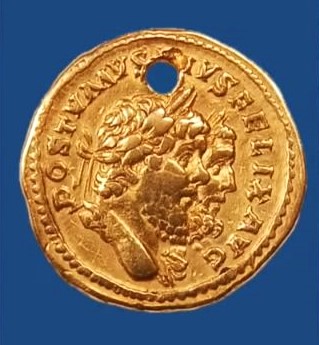
Photographed 2021-03-31
Roman gold coin pierced for suspension, shown in a Polish numismatic video
Roman gold coin pierced for suspension, shown in a Polish numismatic video; comparative evidence for secondary use of coins.

Photographed 2007
Indian imitation of a Roman imperial coin, photographed at the British Museum
Indian imitation of a Roman imperial coin, photographed at the British Museum; the source description identifies the prototype as Tiberius.
It is not linked to any specific Kerala hoard.
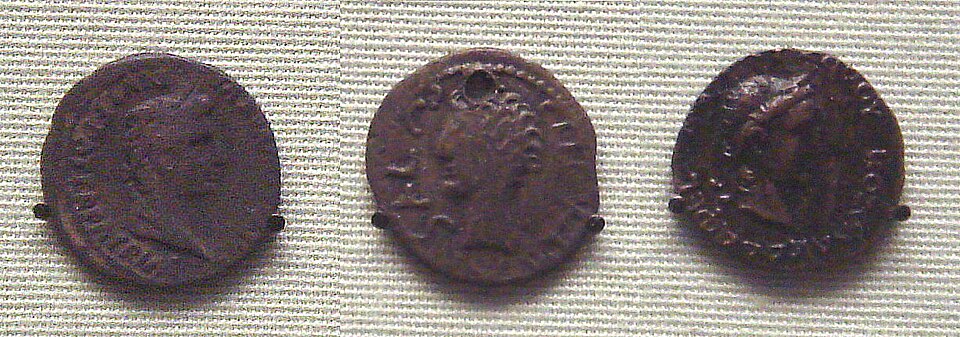
Photographed 2009
British Museum display: Tiberius silver denarius found in India, Indian imitation, and Kushan coin of Kujula Kadphises
British Museum display of a Tiberius denarius found in India, an Indian imitation, and a Kushan coin of Kujula Kadphises copying an Augustan type.
This British Museum display is not linked to a specific Kerala hoard.
006Two views
Both views are shown at equal weight; this site does not choose between them.
Why Roman coin portraits were slashed
- One view
- P. V. Radhakrishnan: an assay cut, opening the metal under the thick portrait to detect plated fakes.
- Another view
- Earlier scholarship, summarised by the Government Museum, Chennai: cancelling the emperor's authority while keeping the gold's value.
- What would settle it
- Microscopy and element mapping of cut surfaces, comparing slashed and unslashed coins from one hoard.
Where the cuts were made
- One view
- P. V. Radhakrishnan treats the slashes as Indian quality control; the study judges a mainly Indian setting likely overall.
- Another view
- Tara MacDowall Hellings warned that a cut cannot be assumed Indian, citing a defaced aureus from the Roman civil war.
- What would settle it
- Systematic sequencing of marks across many coins, such as cuts lying over Indian punch-marks.
007Where next
All related studies, connected material, books and sources14 · 20
Elsewhere on this site
Excavation Atlas Sites: Eyyal (Iyyal) Hoard & Burial Landscape · Kottayam (North Malabar) & Valluvally (Periyar) Roman Gold Hoards
Classroom Lesson Plans: Module 2 · The Monsoon Engine: How Winds, Rivers & Boats Connected the Indian Ocean
Multi-Script Glossary Terms: Vañci (Karūr / Kodungallur Debate) (வஞ்சி / கரூர் / വഞ്ചി / കരൂർ) · kācu (காசு / കാശ്) · Cēral / Kēraḷaputra (சேரல் / சேரர் / ചേരൻ / കേരളപുത്ര)
Connected material
Photographs, drawings, books, videos and other studies linked to this study. A link helps you explore; it does not prove a historical claim.
- Indian imitation of a Roman imperial coin, photographed at the British MuseumphotographBackground
- Roman gold coin pierced for suspension, shown in a Polish numismatic videophotographBackground
- British Museum display: Tiberius silver denarius found in India, Indian imitation, and Kushan coin of Kujula KadphisesphotographBackground
- Three materials, different tracesdiagramThe slashed, pierced and plugged coins follow this study of how Roman coins were changed in South India.
- Coins have more than one historyillustrationThe short portrait cut and the double-pierced copy follow this study on how Roman coins were changed after reaching South India.
- Two gold coins: one cut, one pierceddiagramThe two kinds of mark this study describes on Roman coins: a slash across the portrait and two holes.
Books, videos and websites
Outside reading on this topic. These are not part of the study and we have not checked every claim in them. See all books and videos
- A History of India Through Coins. Dr Sanjay Garg. THT Monthly Heritage Talk. January 1, 2022 Video · Sanjay Garg · Numismatist and historian; formerly National Archives of India · 1:37:05 · A broad research-oriented introduction to the historical questions that coinage can illuminate. A qualified numismatist’s explanation can support the site’s more specific coin studies. The promotional description calls coins unbiased; that wording is too strong. Coins also express authority and require provenance, context and comparison. Not an exact Kerala-hoard lecture.
008Sources
The study lists the sources it consulted; we have not rechecked them. A working link does not show that a source was read, and a valid identifier does not show that it supports a claim. We do not link to unofficial uploads or copies of publications. Where a study cited one, we show the published citation, or a publisher, DOI or Internet Archive link when we have one. Tracking codes are removed from links, and the sources themselves are not republished here.
Turner, Paula J. Roman Coins from India. London: Royal Numismatic Society, 1989.
Radhakrishnan, P. V. Roman Gold & Silver Coins from India. IIRNS Publications, 1999.
Print or offline sourceSource recordHill, G. F. 'Roman Aurei from Pudukota, South India.' Numismatic Chronicle, 1898, pp. 304–320.
PUDUKOTTAI
Coin Hoards of the Roman Empire, Ashmolean Museum / University of Oxford, hoard 18651.
IYYAL
Coin Hoards of the Roman Empire, Ashmolean Museum / University of Oxford, hoard 18400.
SORIYAPATTU
Coin Hoards of the Roman Empire, Ashmolean Museum / University of Oxford, hoard 18510.
KOTTAYAM 1847
Coin Hoards of the Roman Empire, Ashmolean Museum / University of Oxford, hoard 18598.
Sridhar, T. S., and N. Sundararajan. Foreign Coins in the Collection of Government Museum, Chennai: Chinese, Roman & Venetian Coins. Bulletin of the Government Museum, Chennai, New Series, General Section, Vol. I. Chennai: Department of Museums, 2011.
Smagur, Emilia. 'Regulated Roman Coins and Their Imitations from India: Did Roman Coins Circulate as Money in the Subcontinent?' Notae Numismaticae – Zapiski Numizmatyczne 15 (2020): 179–210. DOI 10.52800/ajst.1.a.11.
Print or offline sourceSource recordDe Romanis, Federico. 'Julio-Claudian Denarii and Aurei in Campania and India.' Annali dell'Istituto Italiano di Numismatica 58 (2012): 161–192.
Print or offline sourceSource recordDe Romanis, Federico. 'Notes on Barygaza's Trade: Commodities and Coins at an Asian Crossroads.' 2025.
Print or offline sourceSource recordMacDowall Hellings, Tara C. L. 'The Defacement of Roman Aurei Exported to India.' In Ex Moneta: Essays on Numismatics, History and Archaeology in Honour of Dr David W. MacDowall, vol. 1, 1998, pp. 129–144.
Print or offline sourceSource recordMacDowall, D. W. 'Indian Imports of Roman Silver Coins.' In Coinage, Trade and Economy, 1991, pp. 145–163.
Print or offline sourceSource recordBerghaus, Peter. 'Gestopfte Löcher auf römischen Goldmünzen aus indischen Funden.' In XII. Internationaler Numismatischer Kongress Berlin 1997: Akten, vol. I, 2000, pp. 499–502.
Print or offline sourceSource recordBerghaus, Peter. 'Evidence of Die-Links of Roman Coins and Their Indian Imitations Found in India.' In Foreign Coins Found in the Indian Sub-Continent, 2004, pp. 53–54.
Krishnamurthy, R. 'Imitation Roman Gold Coins from Tirukoilur Hoard, Tamilnadu.' In Ex Moneta: Essays on Numismatics, History and Archaeology in Honour of Dr David W. MacDowall, 1998.
Gupta, P. L. Roman Coins from Andhra Pradesh. Hyderabad, 1965.
Print or offline sourceSource recordAnonymous, Periplus Maris Erythraei, §49. English translation by W. H. Schoff, 1912; digital transcription, Internet History Sourcebooks Project.
Natural History, Book VI
Pliny the Elder. Naturalis Historia, Book 6, especially §85.
Butcher, Kevin, and Matthew Ponting. The Metallurgy of Roman Silver Coinage: From the Reform of Nero to the Reform of Trajan. Cambridge: Cambridge University Press, 2014.
Print or offline sourceSource record
Researchers and institutions whose work this study uses: Wilfred H. Schoff, T. S. Sridhar, R. Krishnamurthy
How we know The evidence, claims and dates behind this study
What this study draws on
- The Government Museum, Chennai survey of foreign coins (2011) and Radhakrishnan's 1999 catalogue
- Oxford's Coin Hoards of the Roman Empire records for Pudukkottai, Eyyal, Soriyapattu and Kottayam
- Smagur's 2020 catalogue and weight study of plugged coins, and De Romanis's count of 5,728 Indian denarii
- Periplus §49 on coin exchanged at a profit at Barygaza, and Pliny 6.85 on equal-weight denarii
Dates in this study
| What is dated | Date | How it was dated |
|---|---|---|
| Neronian reform reference point | 64 CE | How it was dated is not stated |
| Pudukkottai latest reported coin issue | 71 CE | Date from writing, coins or texts |
| Eyyal latest Roman issue | 98–99 CE | Date from writing, coins or texts |
| Proposed principal period of plugged/weight-regulated Roman gold in India | 200–600 CE | Period assigned by excavators or scholars |
| Kottayam latest documented Caracallan issues | 211–217 CE | Date from writing, coins or texts |
See these dates on the timeline
The study’s claims
12 claims · 14 source passages · 40 paragraphs
Browse the study paragraph by paragraphThe Pudukkottai/Karukkakurichi aureus group is the strongest documented South Indian concentration of deliberate portrait slashing, with 461 slashed pieces listed by the Government Museum and the CHRE record describing approximately ninety percent of 501 aurei as slashed.
Supported in this study
Legacy find circumstances are poorly controlled archaeologically. Coin issue dates do not date the slashing event.
Akkenpalle and related Andhra silver finds demonstrate that portrait slashing was not confined to gold and could coexist with multiple chisel cuts, small secondary marks and local imitations.
Supported with qualifications
Much of the Akkenpalle documentation derives from legacy numismatic publication rather than modern stratigraphic excavation. The sequence among cuts and smaller marks is not securely established for every coin. Supplied assessment: supported_with_qualifications
Small punch-marks on Roman coins found in India form a materially distinct category from deep portrait slashes and from normal Roman official countermarks; proposed functions include authentication, ownership and banking/accounting.
Supported with qualifications
Purpose remains unresolved. Minute damage can be difficult to distinguish from intentional marking. Supplied assessment: supported_with_qualifications
Indian craftsmen locally reproduced Roman coin forms: many imitations were die-struck, possible die-links are documented or proposed, and gold copies sometimes combine Roman types that never occurred together on official issues.
Supported in this study
Not every imitation was die-struck; casting is also documented. The economic function of individual imitations may have varied.
Frequent double piercing provides strong evidence that some genuine and imitation Roman gold coins were suspended or attached as ornaments, while plugged examples show that ornament-compatible perforation could coexist with later weight regulation.
Supported with qualifications
Double piercing does not prove a specific necklace arrangement. Some holes may have participated in testing or regulation as well as suspension. Supplied assessment: supported_with_qualifications
The Neronian reform is best treated as a monetary selection and weight-standard reference point rather than as a demonstrated universal cause of portrait slashing in India.
Supported with qualifications
Indian hoard aggregates strongly favor older issues. Slashed Vespasian aurei and uncertain locations of modification prevent a simple causal equation between the reform and every slash. Supplied assessment: supported_with_qualifications
Roman precious-metal coins in Indian Ocean exchange retained value beyond anonymous bullion: the Periplus records profitable conversion of gold and silver coin at Barygaza, while local imitation preserved recognizable Roman coin forms.
Supported with qualifications
Barygaza is a western Indian port and is used as connected-network evidence, not as a direct Tamil or Kerala transaction record. The Periplus does not prove Roman face-value legal tender in India. Supplied assessment: supported_with_qualifications
Eyyal demonstrates that Roman gold and silver could be deposited together with Indian punch-marked coinage, materially connecting multiple monetary traditions within one South Indian assemblage.
Supported in this study
Association in a hoard does not by itself establish identical transactional functions for all denominations.
No single causal model adequately explains all South Indian Roman-coin modifications; the best-supported synthesis distinguishes assay or cancellation slashes, local secondary marks, suspension, later ponderal regulation and local imitation as partly independent practices.
Supported with qualifications
The precise purpose of individual slash marks remains debated. The synthesis is an inference from multiple independent material patterns rather than an ancient textual statement. Supplied assessment: interpretive_synthesis
The specific identification of ancient double-pierced Roman coins as elements of a kacu-malai or kasu-mala necklace is not established by the consulted Early Historic evidence; the secure claim is suspension or ornamental attachment.
Supported with qualifications
Later South Indian coin-necklace traditions provide an analogy but not proof of ancient terminology or arrangement. Supplied assessment: supported_as_caution
Soriyapattu is important for modified and imitation Roman gold but cannot support fine-grained quantitative claims until its unpublished or overlapping relationship with the Tirukoilur assemblage is resolved.
Supported in this study
Coin-level counts for alteration categories should be treated provisionally.
Kottayam is a major datum for the accumulation and persistence of Roman gold in Kerala, but the consulted evidence does not support presenting it as another mass-slashing assemblage equivalent to Pudukkottai.
Supported with qualifications
Only 74 aurei are documented from a discovery reported as substantially larger. Original context and subsequent dispersal are poor. Supplied assessment: supported_as_caution
Trace one claim through the study’s records
Explore the evidenceOther source lists
Numbered citation links from the study
The numbered links in the study text point here.
ROMAN GOLD & SILVER COINS FROM INDIA
govtmuseumchennai.org
ROMAN GOLD & SILVER COINS FROM INDIA
ROMAN GOLD & SILVER COINS FROM INDIA
Regulated Roman Coins and Their Imitations from India: Did Roman Coins Circulate as Money in the Subcontinent? (2021) | Academia.edu
Online copy not linked · use the published edition4 note on the solitary roman gold coin in sri venkateswara ...
Online copy not linked · use the published editiongovtmuseumchennai.org
govtmuseumchennai.org
Julio-Claudian denarii and aurei in Campania and India ...
Online copy not linked · use the published editionROMAN COINS FROM INDIA
pudukottai
Hoard Details 18400
Hoard Details 18510
kottayam 1847
Regulated Roman Coins and Their Imitations from India: Did Roman Coins Circulate as Money in the Subcontinent? (2021) | Academia.edu
Online copy not linked · use the published editionJulio-Claudian denarii and aurei in Campania and India ...
Online copy not linked · use the published editionInternet History Sourcebooks Project: Ancient History
ancientportsantiques.com
Online copy not linked · use the published editiongovtmuseumchennai.org
govtmuseumchennai.org
ROMAN GOLD & SILVER COINS FROM INDIA
govtmuseumchennai.org
ROMAN GOLD & SILVER COINS FROM INDIA
govtmuseumchennai.org
ROMAN GOLD & SILVER COINS FROM INDIA
Regulated Roman Coins and Their Imitations from India: Did Roman Coins Circulate as Money in the Subcontinent? (2021) | Academia.edu
Online copy not linked · use the published editionROMAN COINS FROM INDIA
4 note on the solitary roman gold coin in sri venkateswara ...
Online copy not linked · use the published editionRegulated Roman Coins and Their Imitations from India
Online copy not linked · use the published editionRegulated Roman Coins and Their Imitations from India: Did Roman Coins Circulate as Money in the Subcontinent? (2021) | Academia.edu
Online copy not linked · use the published editionJulio-Claudian denarii and aurei in Campania and India ...
Online copy not linked · use the published editionReference Details 6818
ROMAN GOLD & SILVER COINS FROM INDIA
govtmuseumchennai.org
4 note on the solitary roman gold coin in sri venkateswara ...
Online copy not linked · use the published editiongovtmuseumchennai.org
Regulated Roman Coins and Their Imitations from India: Did Roman Coins Circulate as Money in the Subcontinent? (2021) | Academia.edu
Online copy not linked · use the published editionpudukottai
Internet History Sourcebooks Project: Ancient History
Julio-Claudian denarii and aurei in Campania and India ...
Online copy not linked · use the published editionROMAN COINS FROM INDIA
ROMAN GOLD & SILVER COINS FROM INDIA
ROMAN AUREI FROM PUDUKOTA, SOUTH INDIA
govtmuseumchennai.org
Regulated Roman Coins and Their Imitations from India: Did Roman Coins Circulate as Money in the Subcontinent? (2021) | Academia.edu
Online copy not linked · use the published editionancientportsantiques.com
Online copy not linked · use the published editionancientportsantiques.com
Online copy not linked · use the published editione-PG Pathshala / INFLIBNET module: Roman Coins and Trade in India (bibliographic summary)
Print or offline sourceroman coins in andhra in the early historical period
Online copy not linked · use the published editionPeter Berghaus, Schriftenverzeichnis
Reference Details 6818
govtmuseumchennai.org
The Sixth Booke of Plinies Naturall History
The reforms of Nero, AD 64–68 (Chapter 9)
About this study Status, corrections and how it was made
Status
Draft study, revision 6. No historian, archaeologist, or Tamil or Malayalam specialist has reviewed it yet.
The study itself says more research is needed before its question can be settled.
How it was made
Compiled as an editorial synthesis from published scholarship around questions we framed. About this project & workflow
The summary, How sure lines and Two views notes on this page were prepared from this study and cross-checked against its passages. That is an editorial check, not a specialist review.
Technical details
Study code R251. The text fingerprint changes whenever the study text changes.
- The study text is shown as written. Links from its paragraphs to citations help you move around the study; they are not new claims or checked source passages.
See how this study’s records were extracted
Text fingerprint (SHA-256): R251 · b29e5fa30cea433ce5a57797… · v6
Evidence tables and technical details are on the web page: https://layersofthesouth.org/read/3254c1424a