Each period has the same width, so spacing is not to scale.
- Across the water
- 200 BCE–300 CE
- Berenike
- Khor Rori / Sumhuram & Quseir al-Qadim
India-trade cargo crossed Egypt by camel, warehouse and Nile boat
India-trade cargo crossed Egypt through desert transport, storage and Nile shipping. Different documents reveal different parts of that system. The Nicanor receipts mainly record freight moving from Coptos toward Red Sea ports; they should not be treated as direct records of incoming Indian pepper or ivory travelling the opposite way.
- This page
- 4,874 words · revision 5
Draft study · Awaiting specialist review · Updated
001Dates and places
Places on the atlas that name this study.
- Berenike
Connected overseas port · Shown in Western Indian Ocean Inset
outside this map
- Khor Rori / Sumhuram & Quseir al-Qadim
Connected overseas port · Shown in Western Indian Ocean Inset
outside this map
1000–500 BCE
Different beginnings
500–200 BCE
Marks & materials
200 BCE–300 CE
Connected worlds
300–600 CE
Change & continuity
- Nicanor dossier in Kruse's 95-ostracon definition
- Broader Nicanor/O.Petr.Mus. 112–206 chronological grouping reported by Ast
- Vespasianic Berenike-road praesidium construction inscriptions
- Koptos Tariff inscription
- Muziris Papyrus, palaeographically dated to the middle of the second century CE; encoded conservatively as the second century rather than assigning invented narrower endpoints
- Date from writing, coins or texts
Each date belongs to what was dated (a sample, an object, a layer or a text), which is not always the event the study asks about.
Each period has the same width, so spacing is not to scale.
The full table of dates, with their ranges, is under How we know.
- 2 Well supported
- 1 Possible
- 1 Not known
002How sure
In brief
Cargo from Muziris on the Kerala coast reached Egypt's Red Sea ports by ship. It then had to cross the Eastern Desert and travel down the Nile. Four kinds of evidence describe parts of that route. The receipts of Nicanor's camel-transport firm, dated about 18 BCE to 62 CE, mostly record wheat and wine carried from Coptos toward the Red Sea. They do not record Indian goods coming back. Pliny gives twelve days for the crossing from Coptos to Berenike, travelling mostly by night. The Koptos Tariff of 90 CE lists fixed road and pass fees, not the 25 percent quarter-tax. The Muziris Papyrus, of the mid-second century CE, sends cargo to a sealed public warehouse at Coptos. From there a Nile boat takes it to the quarter-tax warehouse at Alexandria. No document follows one cargo all the way, and the papyrus has lost its arrival port's name.
Key researchers cited in this study: Roberta Tomber (Indo-Roman Ceramic Analysis) · Federico De Romanis (The Indo-Roman Pepper Trade & Muziris Papyrus) · Dominic Rathbone (Muziris Papyrus & Indo-Roman Trade Finance) · Full bibliography
How sure
- Well supported
A regulated camel-and-river corridor linked the Red Sea ports with Alexandria
Receipts, the tariff, Pliny and the papyrus agree.
- Well supported
The Koptos Tariff charged road and pass fees, not the 25 percent quarter-tax
Its surviving charges are fixed sums in drachmas and obols, not a share of cargo value.
- Possible
Later desert forts show how Nicanor-era caravans were organised
Most dated forts belong to 76–77 CE or later, after most of Nicanor's activity.
- Not known
The Muziris cargo's arrival port, camel numbers and travel time
The papyrus has lost the port name and gives no camel count or timetable.
Why it matters
It shows how goods from Kerala's Muziris trade were moved, stored and taxed once they reached Roman Egypt.
003Key findings
What the study concludes
- The Nicanor receipts directly document freight loaded at Coptos and acknowledged at Berenike or Myos Hormos; they therefore document the desert transport business exceptionally well but do not themselves constitute receipts for Indian imports moving westward from the ports to Coptos.
- The Nicanor archive's year-round grain carriage and lack of a strong July–September peak favor port provisioning for at least part of the grain traffic rather than treating all such shipments as India-bound export cargo.
- Pliny describes the Coptos-to-Berenike camel route as 257 Roman miles and twelve days, with most movement at night and daytime stops at watering stations; this twelve-day figure is literary evidence for that direction and cannot be assigned as an exact recorded duration to a specific inbound Muziris cargo or to the Myos Hormos route.
- Excavated caravan-route praesidia show that control of wells, cistern storage and watering of animals were fundamental to Roman road logistics, but the characteristic fortified network is archaeologically secure mainly from Vespasian onward and should not be projected unchanged into the earlier Nicanor period.
In the study’s own words. How sure each point is, is shown above.
The summary above is the short read. The full study is the complete text it was drawn from, with its tables and source notes.
What the full study covers
004The study
Answer in Brief
For Kerala readers, this is the Egyptian leg of the Muziris trade: the overland and river route that cargo followed after Indian Ocean ships reached Egypt. “A route has three layers: places, carriers and owners” looks at overland transport more generally, “Texts link pepper to inland Cottonara, not a whole route” follows pepper from inland Kerala to the coast, and “Muziris Papyrus records credit, cargo values and a quarter tax” examines the Muziris Papyrus for credit and cargo valuation. The four evidence sets do not preserve one continuous shipping manifest or itinerary from Kerala/Tamil Nadu to Alexandria. Rather, they document different, partly overlapping segments of a logistics system across roughly two centuries. The most defensible reconstruction is therefore a cross-source chain, not the biography of a single cargo: Indian Ocean ships reached Egypt's Red Sea ports; cargo was transferred to camel transport; caravans moved through controlled water stations toward Coptos; imported goods entered public fiscal storage there under seals; they were loaded onto a Nile vessel; and they were carried downstream to an Alexandrian customs warehouse where the tetarte, the quarter-tax, figured in the fiscal settlement. The Nicanor receipts document the organization of camel carriage particularly well, while the Muziris Papyrus documents the Coptos-to-Alexandria legal and fiscal handoff with exceptional precision. ↗1
Three major corrections are necessary to the usual simplified narrative.
First, the Nicanor Archive is overwhelmingly evidence for freight moving from Coptos toward Berenike and Myos Hormos, not for Indian imports coming westward from those ports to Coptos. Thomas Kruse describes the receipts as acknowledgments issued when freight consigned at Coptos reached the Red Sea ports; only one receipt in his discussion was issued at an intermediate station, Apollonos Hydreuma. The archive consequently illuminates the organization, personnel, loads, and commercial paperwork of the desert-haulage industry, but it does not itself document a pepper or ivory caravan from an arriving Indian ship to the Nile. ↗2
Second, the celebrated twelve-day crossing belongs to Pliny's literary itinerary from Coptos to Berenike. Pliny says camels departed Coptos, moved largely at night because of the heat, spent days at watering stations, and covered the 257 Roman miles to Berenike in twelve days. That is not a timestamp from a Nicanor receipt, nor does Pliny give the same twelve-day figure for Myos Hormos. Applying exactly twelve days to a particular inbound Berenike-to-Coptos cargo is therefore a reasonable model of the route's order of magnitude, but not a direct observation of that shipment. ↗3
Third, the Koptos Tariff of 90 CE is not the 25 percent tetarte on Indian merchandise. Its inscription records charges connected with the apostolion at Coptos: fees on persons and maritime occupations, a one-obol camel ticket, two obols for sealing that ticket, and further road/pass charges. Steven Sidebotham explicitly distinguishes this tariff from commodity-tax schedules, interpreting it as charges levied for use of a road from Coptos toward the Red Sea. The tetarte appears independently in the Muziris Papyrus's customs machinery. ↗4
The evidence can therefore be summarized as follows:
| Link in the logistics chain | Physical / textual observation | Scholarly interpretation | Evidential limit |
|---|---|---|---|
| India → Egyptian Red Sea | The Muziris Papyrus refers to loan contracts for a voyage to Muziris and inventories Indian cargo including Gangetic nard and ivory; Pliny independently names Muziris in his India route. ↗5 | The papyrus concerns a commercial venture linking Muziris with Roman Egypt. | The surviving papyrus has lost the name of the Egyptian Red Sea port at which its goods arrived. The Austrian National Library explicitly notes this loss. ↗6 |
| Red Sea → Coptos | Muziris contract language requires conveyance through the desert under protection to public tax-receiving warehouses at Coptos. ↗7 | Camel transport is implied by the surviving reference to a cameleer; parallels from Nicanor show how private camel contractors operated. | The Muziris Papyrus does not preserve the cameleer's identity or a day-by-day itinerary. |
| Water and staging | Pliny lists successive hydreumata and says the Coptos–Berenike journey took twelve days, chiefly by night. Later excavated praesidia contain wells, cisterns and animal-watering arrangements. ↗8 | Roman administration progressively formalized the water-and-control network. | Most archaeologically well-dated fortified praesidia belong to Vespasian or later and cannot simply be projected backward onto every Nicanor-era journey. ↗9 |
| Coptos fiscal/warehouse handoff | The Muziris contract places goods in public tax-receiving warehouses under the creditor's or agents' authority and seal until river loading. ↗7 | This is effectively controlled or bonded storage, though “bonded warehouse” is a modern analogy. | The detailed sequence of assessments and any first-stage customs charge at Coptos remains debated. |
| Coptos → Alexandria | The contract requires loading “at the required time” onto a safe Nile ship and downstream conveyance to Alexandria. ↗7 | A specialist Nile carrier could therefore be a distinct logistical contractor from the desert cameleer. | No exact downstream voyage duration or sailing schedule survives in the papyrus. |
| Alexandria tetarte | The cargo enters an Alexandrian warehouse for the quarter-tax; the default clause contemplates payment of the quarter and movement of the remaining three parts. ↗7 | The standard reading identifies a 25 percent fiscal burden on the relevant imported cargo. | Federico De Romanis reconstructs a more elaborate, multi-stage customs regime; this should be labeled interpretation rather than primary textual observation. ↗10 |
The strongest conclusion is consequently not that one document gives the “exact route,” but that the combined evidence exposes the interfaces of an intermodal supply chain: ship → port agent/customs personnel → cameleer → desert stations → Coptos warehouse/seal → Nile ship → Alexandrian customs warehouse. Those interfaces are unusually concrete. The timing, ownership, and fiscal details between them are much less complete.
Scope & Chronological Control
This study lies inside the 1000 BCE–600 CE period covered by this site, but its principal evidence clusters in the first and second centuries CE. The sources are not contemporary with one another, which matters whenever they are combined into an apparently seamless reconstruction.
| Evidence complex | Date actually supported by read source | What the date controls |
|---|---|---|
| Nicanor dossier, Kruse's definition | 18 BCE–62 CE | Kruse's 95-ostracon transport dossier; Nicanor himself active for at least about 45 years, sons continuing the firm to 62 CE. ↗11 |
| Broader O.Petr.Mus. 112–206 grouping in Ast | 6 BCE–68 CE | Ast's broader chronological description of texts conventionally grouped as the Nicanor archive. ↗12 |
| Pliny, Natural History route description | First century CE | Literary description of Nile and Coptos–Berenike travel, hydreumata, navigation seasons, and Muziris. ↗3 |
| Vespasianic Berenike-road praesidia | 76–77 CE | Foundation/road-station phase associated with L. Julius Ursus. ↗9 |
| Koptos Tariff | 90 CE | Tariff/pass system at Coptos under the prefect Mett(i)us Rufus. ↗13 |
| Muziris Papyrus, P.Vindob. G 40822 / SB XVIII 13167 | mid-second century CE, palaeographic | India-trade loan/security arrangement, Coptos storage and Nile conveyance, Alexandrian tetarte accounting. The original exact date is lost. ↗14 |
The apparent discrepancy between “6 BCE–68 CE” and “18 BCE–62 CE” for the Nicanor material should not be silently harmonized. Ast calls O.Petr.Mus. 112–206 the Nicanor archive and reports dates from 6 BCE to 68 CE; Kruse's analysis of the 95-ostracon dossier gives 18 BCE–62 CE and explains that the earliest pieces contain freight carriers whose relationship to Nicanor is unclear, while Nicanor's son Miresis is last attested in 62. The difference therefore reflects, at least in part, choices about the boundaries of the archive and attribution of associated ostraca rather than a single secure life span for the firm. ↗15
This chronological separation is crucial for the fortified road system. Archaeology does not currently show that the characteristic approximately 50–60 m square praesidia with central wells already lined the routes in their later form throughout Nicanor's career. Michel Reddé states that caravan-road fortlets of this archaeological type are not known before Vespasian; inscriptions dated 76–77 establish a major Berenike-road phase under Julius Ursus. Bagnall, Bülow-Jacobsen, and Cuvigny interpret this as the filling-in and upgrading of an older, more widely spaced system of hydreumata known from Pliny. ↗9
Accordingly, this study uses later excavated praesidia to establish how Roman desert infrastructure worked physically, but it does not assert that every excavated wall, cistern, or station was already present when Nicanor hauled freight under Tiberius or Claudius.
A similar constraint applies at the Indian end. Pliny explicitly describes Muziris as an Indian trading port reached by monsoon sailing, while the Muziris Papyrus refers to contracts for a trip to Muziris. This directly anchors the subject in the Kerala-connected trade. Pliny separately describes the pepper-producing Cottonara region and the southern Indian political geography around Muziris/Becare and Madura, demonstrating Roman-era knowledge of the southwest and far south Indian commercial zone. ↗3 What the Egyptian documents do not demonstrate is that every Nicanor customer or every cargo arriving at Berenike/Myos Hormos originated specifically in Kerala or Tamil Nadu.
Primary Archaeological & Textual Evidence
The Nicanor transport archive. The archive is fundamentally a set of freight receipts. A recipient at Berenike or Myos Hormos acknowledges that a transporter has delivered goods sent from Coptos. Kruse interprets the return of these receipts to Coptos as part of the carrier's proof of performance and probably the basis for payment, while Coptos was likely the firm's operational headquarters. Nicanor son of Panes initially operated with Peteasmephis, later with brothers Philostratos and Apollos and sons Peteharpochrates and Miresis; Nicanor is once styled kamelites, which Kruse argues should mean not merely someone sitting on a camel but a caravan conductor in this business context. ↗11
That structure is important: the documentation reveals a contractual chain, not a state camel corps carrying all international trade. Private transporters served both private merchants and government/army customers. Kruse counts private clients in 85 of the 95 ostraca, while official receipts include grain, barley, and straw delivered to public granaries or military recipients. A particularly informative receipt was issued at Apollonos Hydreuma to acknowledge public wheat supplied to a soldier, demonstrating that the firm's operations could terminate at an intermediate desert station rather than only at a port. ↗11
Roman, possibly Cypriot, terracotta amphora with painted Greek letters on its shoulder
ca. 3rd century CE
The commodities likewise caution against equating “Nicanor” with “Indian imports.” Kruse finds wheat in 45 of 95 receipts (47.3 percent), wine in 25 (26.3 percent), barley in nine, bread in five, and pharmakon in six; other attested goods include mats, dishes, hides, silver and timber. Six artabas of wheat constituted one gomos, which Kruse estimates at roughly 180 kg for a full camel load. The meaning of pharmakon is unresolved: the term is generic, and proposals include liquid or semiliquid substances used medicinally, industrially, or as a dye/mordant. ↗16
Rodney Ast's examination supplies named commercial examples. An ostracon of 43 CE records at Berenike an agent associated with Marcus Julius Alexander acknowledging seven linden-wood beams received from Nicanor; another receipt of 29 CE records Haryothes at Berenike acknowledging twenty-four artabas of wheat for the Coptite elite Paminis and Paniskos. Ast emphasizes that Nicanor and his family delivered to port agents representing both major international merchants and leading Coptite families. ↗17
Kruse further identifies clients bearing Egyptian names, Roman tria nomina, and Greek cognomina. He cites Gaius Canius Ialysonnieios, Tiberius Claudius Sarapion, Publius Mamilius Ambrosios, Aulus Cossutius Actiacus and Aulus Cossutius Popularis. The Cossutii's interests were represented at Coptos by the slave Chareis, with subordinate agents receiving deliveries at Myos Hormos. Marcus Julius Alexander's freight was similarly received by agents or slaves in the ports. ↗18
On the question of Indian or resident agents, caution is essential. In the consulted Nicanor editions and specialist syntheses, the highlighted named principals and agents are characterized through Egyptian, Greek/Egyptian, Roman-citizen or servile relationships; the editors do not securely identify one of these Nicanor agents as a South Indian individual. Indian presence at the Red Sea ports is archaeologically plausible and independently documented in the broader Berenike record, but assigning an Indian identity to a named Nicanor agent would go beyond the receipts read here. Ast's phrase “international traders” is not equivalent to “Indian traders.” ↗15
The archive's seasonality is equally revealing. Kruse notes that grain transport occurred throughout the year without a strong peak in the July–September departure season for eastbound Red Sea shipping. That pattern favors provisioning of the port settlements for at least a substantial share of the grain. Wine could more plausibly include export cargo, but Kruse concludes that the receipts cannot decide globally whether the goods were local supplies or overseas exports. ↗19 This is a significant negative finding: the Nicanor Archive cannot simply be treated as a manifest of goods being loaded onto India-bound ships.
The desert road and its water system. Pliny supplies the clearest first-century itinerary. He gives 309 miles and twelve days for the upstream Nile journey from the Alexandria region to Coptos under midsummer winds. From Coptos, he describes travel by camel toward Berenike: an initial Hydreuma after 22 miles, additional mountain and watering stages, Apollo's Hydreuma at 184 miles, New Hydreuma at 230 miles, an Old/Trogodytic hydreuma seven miles farther on, and Berenike at 257 miles. Travel was chiefly at night; daylight was spent at stations; total Coptos-to-Berenike travel was twelve days. ↗3
Excavation reveals the physical logic behind such a system. Reddé's comparative table includes, on the Myos Hormos road, Krokodilo, Bi'r al-Hammamat, Maximianon, al-Hamra, al-Dawwi and Qusur al-Banat, and on the Berenike road Didymoi, Bi'r Bayza, Dios/Iovis, Xeron Pelagos and probably Phalakron. Most characteristic caravan-route forts are roughly 50–60 m across and center on a well. At Didymoi, successive rebuilding increased cistern capacity from about 120 m³ to more than 380 m³; at Didymoi and Dios, pipes conducted water through the rampart to exterior troughs for animals. ↗20
These are not primarily giant frontier castles. Their comparatively low walls and especially the systematic central wells point to control of water and traffic, accommodation of personnel, and provisioning of travelers and animals. Written passes and receipts complement that physical infrastructure. ↗21
The Koptos Tariff. The inscription orders charges under the authority of the prefect of Egypt Mett(i)us Rufus and the Berenike-desert prefect Lucius Antistius Asiaticus. Among its fees are eight drachmas for a Red Sea helmsman, ten for a prow-officer, ten for a guard, five for a sailor, one obol for a camel ticket and two obols to seal it. For an outgoing journey it imposes further charges on a man, women, a donkey and a wagon, among other persons or objects. ↗22
This is unusually concrete evidence for paperwork at the caravan interface: camel ticket → sealing → authorized outgoing movement. It also helps explain why later Berenike ostraca contain instructions to gate officials to let named carriers pass with specified goods. Ast interprets those port passes as likely evidence that obligations at Coptos had been satisfied, although the exact identity of the issuing officials is not always certain. Some passes explicitly say Mediterranean wine was for ship outfitting/loading, giving much firmer evidence for export than the ordinary Nicanor grain receipts. ↗23
But the tariff must not be misidentified as the tetarte. Sidebotham's reading is explicit: OGIS 674 is a road-use/pass tariff, not a table giving ad valorem customs rates on eastern merchandise. (Sidebotham, Roman Economic Policy in the Erythra Thalassa: 30 B.C.–A.D. 217, Leiden: Brill, 1986; read in an unofficial digital copy, publisher edition not checked)
The Muziris Papyrus. Here the logistics reverse direction. The surviving contract stipulates movement of the goods through the desert under guard/protection to public tax-receiving warehouses at Coptos. There they are to remain under the authority and seal of the creditor or his representatives until river loading. At the required time the borrower must load them on a safe Nile vessel, transport them downstream, and put them into the Alexandrian warehouse associated with collection of the quarter-tax. Desert freight, river-porters' carrying charges, and incidental expenses are assigned contractually. ↗7
This is the clearest surviving primary text for the intermodal handoff:
Red Sea cargo → cameleer/desert security → Coptos public warehouse → seal/control → Nile vessel → Alexandrian tetarte warehouse.
The default clause reinforces the fiscal mechanics: if the debtor fails to repay, the creditor can act against the security, pay the quarter-tax, and move or dispose of the remaining three parts. The verso contains customs-oriented valuation calculations for Indian cargo, including Gangetic nard and ivory. ↗7
Yet the most tempting “exact” detail is missing. The Austrian National Library, which holds P.Vindob. G 40822, states that the lost portion would have named the Red Sea port from which this Egyptian land journey began. Consequently, “the Hermapollon landed at Berenike” is not a physical/textual observation from the preserved papyrus. Berenike has been favored in scholarly reconstructions, but the manuscript itself does not settle Berenike versus Myos Hormos. ↗6
Analytical Comparison & Competing Interpretations
The evidence becomes most useful when its different administrative layers are kept distinct.
Physical / Textual Observation: the Nicanor receipts show private carriers and their agents, consignments, loads, destinations and acknowledgments. Pliny supplies a staged camel itinerary and travel rhythm. The Koptos stele supplies ticket and sealing charges. Excavated praesidia supply wells, cisterns, barracks and animal-watering installations. The Muziris contract supplies guarded desert conveyance, public storage at Coptos, sealing, Nile transshipment and delivery to an Alexandrian quarter-tax warehouse. ↗25
Scholarly Interpretation: combining those observations yields a system in which privately organized camel transport operated inside a strongly regulated state infrastructure. “Private” and “state-controlled” are therefore not alternatives. Nicanor's family enterprise could carry both merchant freight and government supplies; army/state authorities developed wells and stations; fiscal contractors or officials controlled passes and seals; merchants or financiers retained agents at several nodes. ↗26
The same distinction resolves the question of caravan size. Ordinary Nicanor receipts usually concern modest shipments. The surviving evidence does not show Nicanor commanding the thousands of animals sometimes reconstructed for huge Indian cargoes. Later scholarship has consequently debated whether the enormous cargo calculated from the Muziris Papyrus would have required exceptional mobilization or state assistance. The papyrus itself does not preserve a camel count. Any figure for the number of camels transporting the Hermapollon cargo is a reconstruction, not a manuscript fact. ↗27
The ports' material culture likewise discourages a simplistic “archaeological trail of pepper” across the desert. Roberta Tomber notes that Indian cooking wares fall off sharply outside the Red Sea ports. Black pepper is abundant in numerous contexts at Berenike and occurs in smaller quantities at Myos Hormos, but archaeobotanical pepper has not been recovered along the two principal port-to-Coptos roads in the pattern one might expect from dropped cargo. Four Didymoi ostraca nevertheless show that pepper was requested and consumed there. ↗28 This means archaeological absence along the road cannot be used to deny pepper transport – but neither can the port concentrations map an individual caravan's path.
Roman terracotta jug in Cnidian relief ware, made at Cnidus in southwestern Anatolia
2nd–3rd century CE
A similar interpretive division surrounds customs.
The minimum secure reading of the Muziris text is that Coptos possessed public tax-receiving storage; goods were kept under seal until river shipment; Alexandria possessed a quarter-tax warehouse; and payment of a quarter left three parts. ↗7 Federico De Romanis has developed a more elaborate reconstruction in which the lender is closely connected with the Red Sea customs administration and multiple fiscal assessments operated at different points, potentially producing a larger combined nominal burden than a single 25 percent levy. This is a sophisticated scholarly model, not language that can simply be read verbatim from the surviving papyrus. ↗10
Likewise, calling the Coptos storage a “bonded warehouse” is analytically useful but anachronistic if left unqualified. The text actually establishes public tax-receiving storage plus control by seal and a prohibition on uncontrolled disposition before the next stage. That is functionally comparable to bonded transit, but it should not imply modern customs law.
The most secure end-to-end crosswalk is therefore:
| Stage | What can be said with high confidence |
|---|---|
| South India → Red Sea | Muziris was a Roman-Egyptian trading destination; Pliny gives its monsoon route and the Muziris Papyrus concerns a Muziris venture. ↗29 |
| Red Sea landing | Berenike and Myos Hormos were the principal Egyptian Red Sea termini represented in the transport documentation, but the specific arrival port of the Muziris cargo is lost. ↗30 |
| Port administration | Berenike texts attest gate passes; inscriptions also attest a paralemptes and a spice-storage official, showing a developed administrative/storage environment. Their exact relationship to the tetarte collector remains debated. ↗31 |
| Desert loading | Camel haulage was performed by professional/family firms and organized drivers; tickets and seals were part of the controlled movement system. ↗32 |
| Crossing | On the Berenike road, Pliny's model is twelve days from Coptos, predominantly night travel and daytime station stops. No equivalent exact duration from the consulted primary sources can be assigned to Myos Hormos. ↗3 |
| Water/control | Older hydreumata preceded a denser, fortified Vespasianic-and-later praesidium system. Wells, cisterns and outside troughs materially document caravan provisioning. ↗33 |
| Coptos | Imported goods in the Muziris contract enter public tax-receiving storage and remain under creditor/agent seal until river shipment. ↗7 |
| Nile | A safe river vessel is required to take the shipment downstream at the prescribed time; handling and river-worker expenses are contractual costs. No exact downstream duration survives. ↗7 |
| Alexandria | Goods enter the quarter-tax warehouse and the tetarte is incorporated into settlement of the secured transaction. ↗7 |
The evidence is therefore strongest precisely at the handoff points: consignor/carrier, carrier/port agent, road/ticket authority, caravan/water station, cargo/warehouse seal, desert carrier/Nile ship, Nile ship/customs warehouse.
Evidential Limits & Common Misconceptions
The first common misconception is that the Nicanor ostraca directly record caravans of Indian pepper, ivory and nard traveling from Berenike to Coptos. They do not. In the receipts analyzed by Kruse, freight is loaded at Coptos and acknowledged at Berenike or Myos Hormos. The archive demonstrates the transport industry's existence and working procedures, but its documented direction is predominantly the reverse of the inbound Muziris cargo. ↗11
The second is that all Nicanor goods were intended for India-bound ships. Wheat dominates the archive, grain moved throughout the year rather than peaking with India-sailing departures, and scholars have long disagreed over provisioning versus export. Some wine and ship-related materials could certainly be export-oriented, and later Berenike passes explicitly identify wine for ship outfitting, but the purpose of each Nicanor consignment cannot be assumed. ↗34
The third is that “twelve days” is an archaeological measurement of the inbound India-trade caravan. It is Pliny's literary figure for Coptos to Berenike. Moreover, the well-spaced hydreumata he describes were later supplemented by a denser system of praesidia. The best-dated monumental phase on the Berenike route belongs to 76–77 CE, later than most of Nicanor's activity. ↗35
The fourth is that every hydreuma and praesidium was the same institution. Archaeology instead reveals changing infrastructure. Bagnall, Bülow-Jacobsen and Cuvigny distinguish the earlier hydreumata from the Vespasianic system that inserted stations into previous gaps; Reddé likewise warns that characteristic trade-route fortlets are not archaeologically known before Vespasian. ↗36
The fifth is that the Koptos Tariff proves a 25 percent duty was collected from each camel cargo at the beginning of the desert road. The tariff's surviving amounts are fixed charges for categories of travelers, transport personnel, animals, documents and equipment. A camel ticket and its sealing cost obols, not a percentage of cargo value. Sidebotham accordingly separates it from commodity customs schedules. ↗4
The sixth is that the Muziris Papyrus names Berenike as the Hermapollon's Egyptian port. It does not: the decisive section is lost. Any preference for Berenike is a reconstruction. ↗6
The seventh is that the papyrus gives an exact Nile timetable. It says the cargo must be loaded at the required time onto a safe river ship and conveyed downstream; it supplies no number of days. Pliny's separate twelve-day Nile figure describes the opposite, upstream direction from Alexandria toward Coptos under midsummer winds. ↗5
Finally, this study found no basis for identifying a named Nicanor agent as definitively Kerala- or Tamil-origin. That absence must not be confused with an absence of Indians from Roman Red Sea ports. It means only that the evidentiary bridge between identifiable South Indian residents and the named personnel in this particular transport archive has not been demonstrated by the sources read here. Archaeological evidence for Indian materials at Berenike (examined in “Tamil writing found on pots at Egypt's Red Sea ports”) and the Muziris connection establishes the wider network; it does not license ethnic assignment by name alone. ↗37
No radiocarbon determination is required to establish the principal chronology in this study. The controlling dates derive from regnal/consular documentary dating, epigraphy, palaeography and archaeologically contextualized inscriptions.
The resulting confidence assessment is: high for the existence of a regulated camel-and-river intermodal corridor; high for the Muziris Papyrus's Coptos warehouse/seal/Nile/Alexandria sequence; high that the Koptos Tariff is distinct from the tetarte; moderate for reconstructing later praesidium organization as analogous to earlier Nicanor-era logistics; and low to moderate for assigning an exact Egyptian port, exact camel fleet, exact inbound transit time, or named Indian agents to the Muziris shipment.
Bibliography & Source Register
– Ast, Rodney, “Berenike in Light of Inscriptions, Ostraca, and Papyri,” in The Eastern Desert of Egypt during the Greco-Roman Period: Archaeological Reports. Access: full text. Read sections cover the Nicanor archive's chronology and functions, O.Petr.Mus. examples involving Paminis and Marcus Julius Alexander, Berenike gate passes, the paralemptes, and the spice magazine. This is a specialist synthesis anchored in published ostraca and inscriptions. ↗38
Copper-alloy weight, 305 BCE–364 CE
305 BCE–364 CE
– Kruse, Thomas, “The Transport of Goods through the Eastern Desert of Egypt: The Archive of the ‘Camel Driver’ Nikanor,” in Infrastructure and Distribution in Ancient Economies, pp. 369–380. Access: selected passages through the accessible scholarly-hosted copy. Read discussion includes archive definition and dates, firm personnel, receipt structure, public/private customers, camel loads, commodity frequencies, agents, seasonality and the export-versus-provisioning debate. ↗39
– OGIS 674 = I.Portes 67 = IGRR I 1183 = SB V 8904, Koptos Tariff inscription. Access: full text, PHI Greek Inscriptions. Read inscription includes authorizing officials and fixed charges for Red Sea personnel, camel tickets, sealing, travelers, animals and transport equipment. ↗22
– P.Vindob. G 40822 = SB XVIII 13167, “Muziris Papyrus,” Rathbone translation reproduced in Select Papyri 1.187A. Access: full translation of preserved passages. Read recto covers desert transport, Coptos public fiscal storage, sealing, Nile loading, Alexandria and quarter-tax; verso includes Indian cargo valuation. ↗7
– Austrian National Library, Papyrus Collection, “Der Muziris-Papyrus,” Bernhard Palme. Access: full text. Read for palaeographic dating, physical incompleteness of the document, explicit warning that the Egyptian Red Sea arrival port is lost, and the Library's cargo summary. ↗6
– Reddé, Michel, “The Fortlets of the Eastern Desert of Egypt,” in The Eastern Desert of Egypt during the Greco-Roman Period: Archaeological Reports. Access: full text. Read sections cover chronology of caravan-road fortlets, comparative plans/dimensions, wells, cisterns and exterior animal troughs. ↗40
– Bagnall, Roger S.; Adam Bülow-Jacobsen; Hélène Cuvigny, “Security and Water on Egypt's Desert Roads: The Prefect Iulius Ursus and the Construction of Praesidia under Vespasian,” Journal of Roman Archaeology 14 (2001). Access: full text PDF; relevant pages visually read. The consulted pages distinguish the older hydreumata from the later praesidium network and connect the expansion to Julius Ursus. ↗41
– Tomber, Roberta, “Quarries, Ports and Praesidia: Supply and Exchange in the Eastern Desert,” in The Eastern Desert of Egypt during the Greco-Roman Period: Archaeological Reports. Access: full text. Read discussion covers Indian ceramics and pepper distribution, port/desert supply networks, passes/receipts and separation of provisioning from import-export flows. ↗28
– Pliny the Elder, Natural History 6.102–106, modern English translation at Attalus. Access: full text of relevant ancient passage. Read for Alexandria–Coptos Nile timing, hydreumata, Coptos–Berenike distance and twelve-day crossing, night travel, navigation season and Muziris. ↗3
– Pantalacci, Laure, “Coptos, Gate to the Eastern Desert,” in The Eastern Desert of Egypt during the Greco-Roman Period: Archaeological Reports. Access: full text. Read for Augustan urban access between eastern caravan approaches and the Nile/canal side of Coptos, Nicanor-era Coptite commercial participation and later administrative status. ↗42
– De Romanis, Federico, The Indo-Roman Pepper Trade and the Muziris Papyrus. Oxford University Press, 2020. Access: abstract and selected passages, not treated here as fully read. Used only for identifying the existence and outline of De Romanis's distinctive customs/loan reconstruction; those propositions are marked interpretation rather than primary observation. ↗10
– Sidebotham, Steven E., Roman Economic Policy in the Erythra Thalassa: 30 B.C.–A.D. 217 (Leiden: Brill, 1986; ISBN 978-90-04-32826-6). Access: selected passages. Consulted passage distinguishes the Koptos Tariff from a commodity-tax schedule and interprets it as road-related charges.
Taken together, these sources support a tightly constrained reconstruction: the archaeological and documentary record reveals a sophisticated multimodal corridor but does not preserve one continuously traceable Kerala/Tamil Nadu cargo from shipboard at Berenike/Myos Hormos to an Alexandria warehouse. The best reconstruction is therefore a source-layered logistics model whose joints are explicit and whose gaps remain visible.
005Photographs
Photographs of the places and objects this study discusses. Each item carries its creator’s credit, licence and documented source. See all 412 photographs and source images ↗
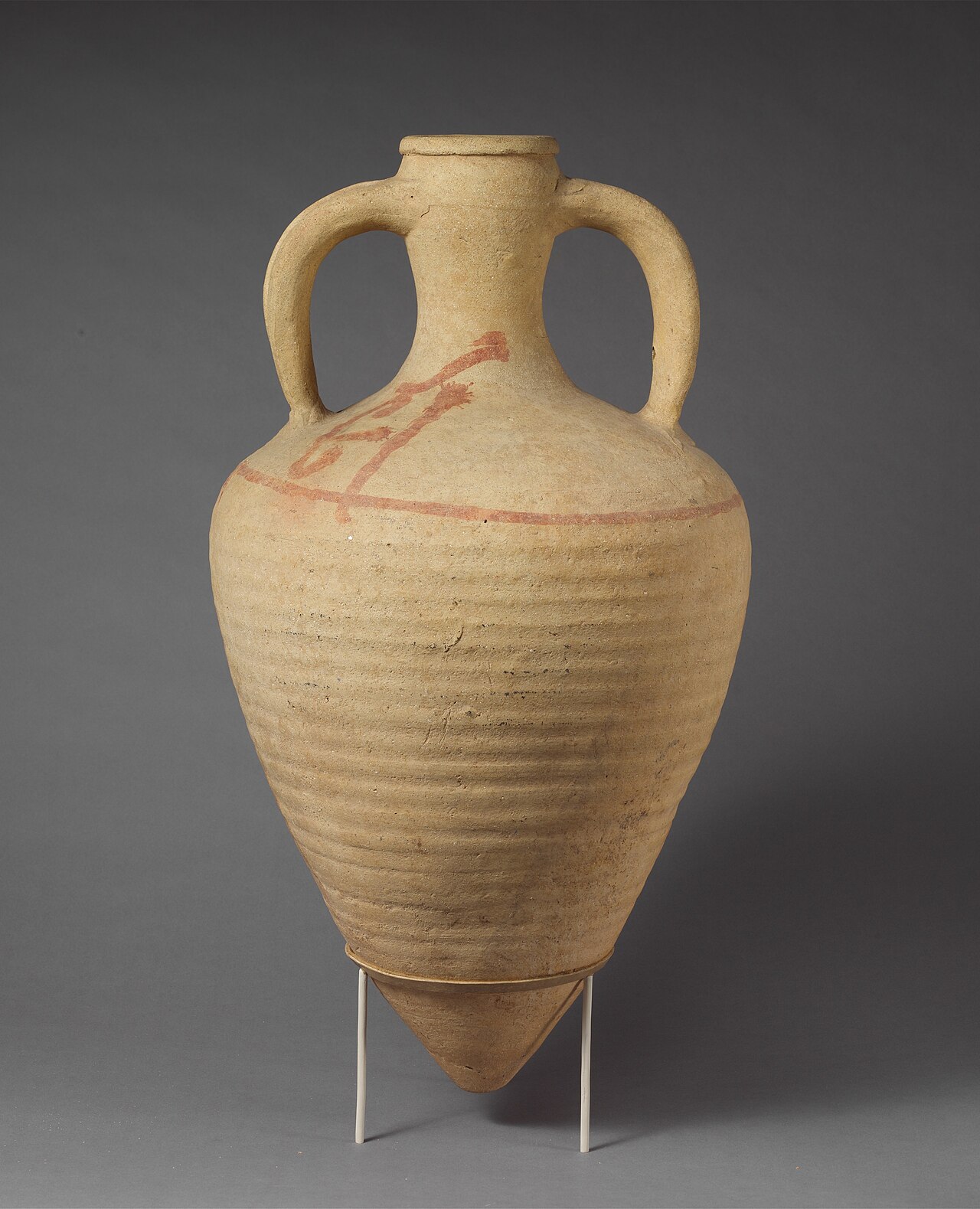
ca. 3rd century CE
Roman, possibly Cypriot, terracotta amphora with painted Greek letters on its shoulder
Roman, possibly Cypriot, terracotta amphora with painted Greek letters on its shoulder. Metropolitan Museum of Art, 74.51.2434.
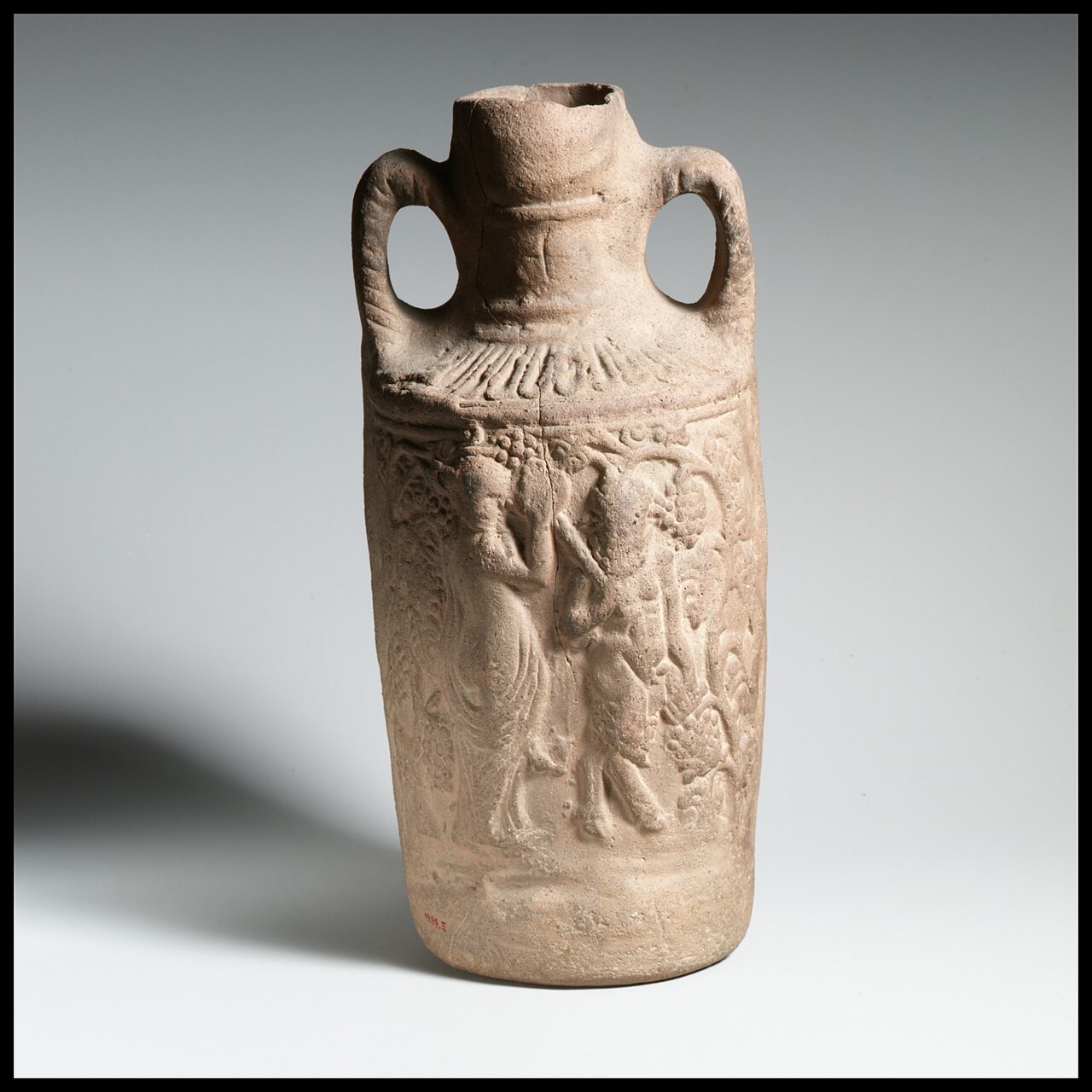
2nd–3rd century CE
Roman terracotta jug in Cnidian relief ware, made at Cnidus in southwestern Anatolia
Roman terracotta jug in Cnidian relief ware, made at Cnidus in southwestern Anatolia. Metropolitan Museum of Art, 49.94.5.
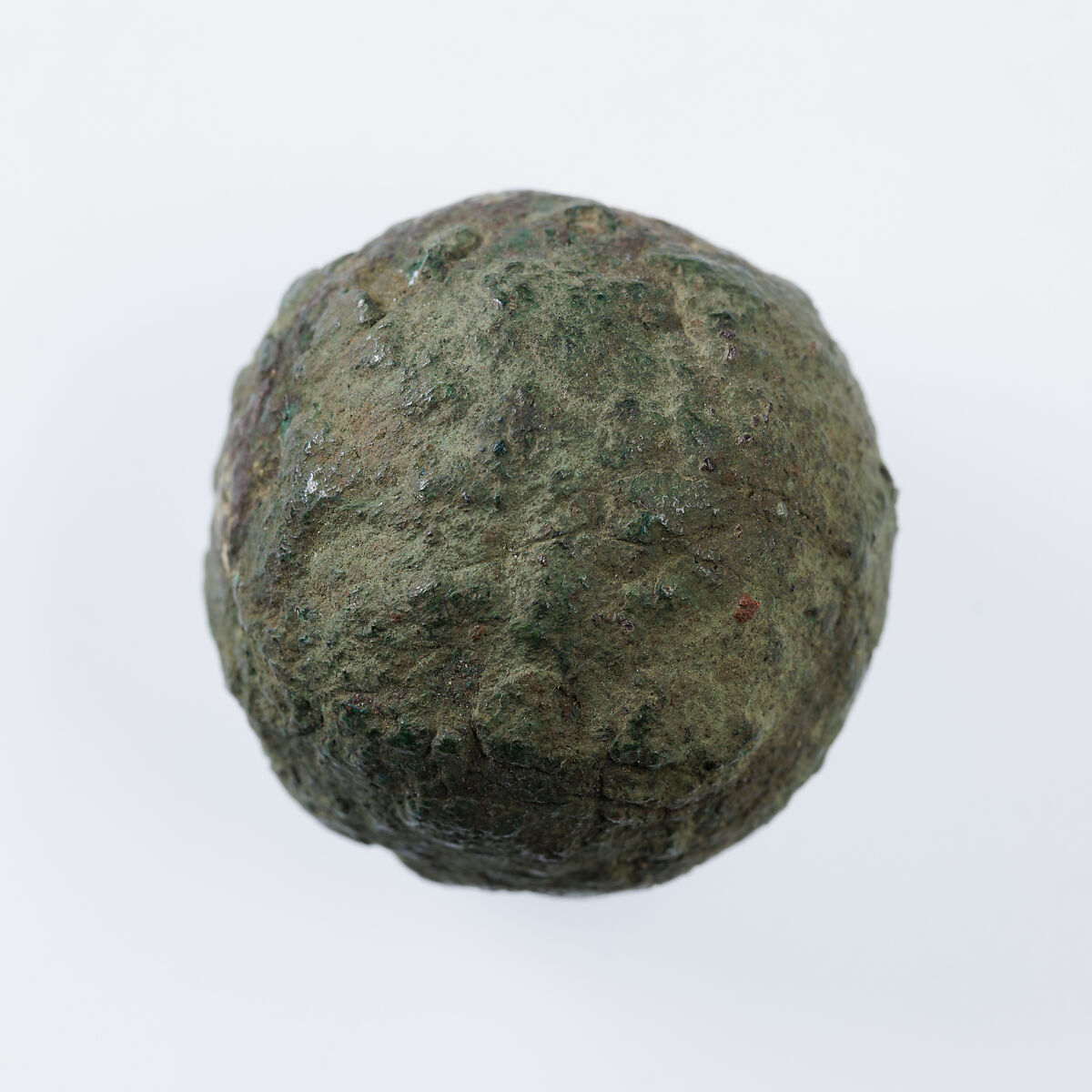
305 BCE–364 CE
Copper-alloy weight, 305 BCE–364 CE
Copper-alloy weight, 305 BCE–364 CE. From Meidum, Egypt, Cardwell excavations 1885–1890. Comparative weight, not a demonstrated Kerala weight standard.

1855
Pliny: Coptos, Berenice and the voyage toward India,1855 edition
Book VI, chapter 26, p 64 of the 1855 Bostock–Riley translation of Pliny, describing the desert route to Berenice and the sea voyage toward India.
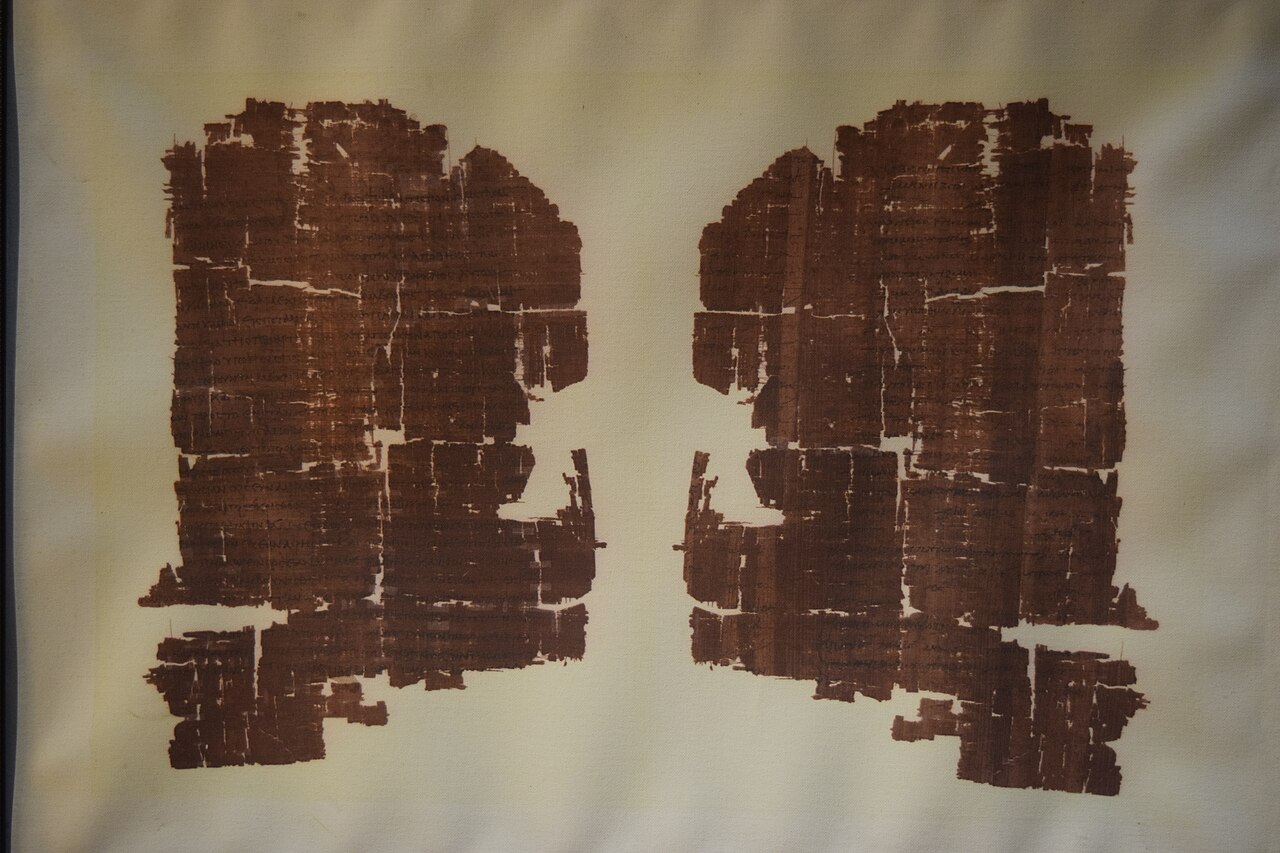
Original text: mid-2nd century CE; pictured display/facsimile modern
Photograph of the Muziris Papyrus facsimile displayed at the Pattanam Museum, taken by KannanVM in 2019

Quseir modern harbour (regional context) · Photographed 2026-10-10 12:15:54
Modern Quseir harbour and waterfront vegetation, Egypt, photographed in October 2026
The online file categories mention Myos Hormos, but the photograph shows the modern Quseir waterfront, not the excavated ancient port.

Quseir modern harbour (regional context) · Photographed 10 October 2026, 12:07 (according to Exif data)
Modern wooden fishing boat at the Quseir harbour, Egypt, photographed in October 2026
The online file categories mention Myos Hormos, but the photograph shows the modern Quseir harbour and fishing boats, not the excavated ancient port.
006Two views
Both views are shown at equal weight; this site does not choose between them.
How imported cargo was taxed on its way to Alexandria
- One view
- The standard reading sees one 25 percent quarter-tax (tetarte), settled at the Alexandrian warehouse, as the papyrus states.
- Another view
- Federico De Romanis reconstructs several assessments at different points, tied to the Red Sea customs administration, possibly adding up to more.
- What would settle it
- More of the papyrus, or another customs document, showing which charges fell on one cargo at each stage.
Whether Nicanor's desert freight supplied the ports or ships bound for India
- One view
- Provisioning: wheat dominates and moved all year, without a peak in the July–September India sailing season (Kruse).
- Another view
- Export: some wine and ship-related goods could be cargo, and later Berenike passes name wine for outfitting ships.
- What would settle it
- Receipts or passes that state the purpose of individual consignments.
007Where next
All related studies, connected material, books and sources16 · 12
Elsewhere on this site
Excavation Atlas Sites: Berenike (Red Sea Port, Egypt) · Khor Rori / Sumhuram & Quseir al-Qadim
Junior Detective Quests: Pepper Jar: Two Objects, Two Stories
Classroom Lesson Plans: Module 2 · The Monsoon Engine: How Winds, Rivers & Boats Connected the Indian Ocean
Multi-Script Glossary Terms: Tamiḻi (Tamil-Brāhmī) (தமிழி (தமிழ் பிராமி) / തമിഴി (തമിഴ് ബ്രാഹ്മി))
Connected material
Photographs, drawings, books, videos and other studies linked to this study. A link helps you explore; it does not prove a historical claim.
- Pliny: Coptos, Berenice and the voyage toward India,1855 editionhistorical printed pageBackground
- Modern wooden fishing boat at the Quseir harbour, Egypt, photographed in October 2026photographBackground
- Modern Quseir harbour and waterfront vegetation, Egypt, photographed in October 2026photographBackground
- Roman, possibly Cypriot, terracotta amphora with painted Greek letters on its shoulderphotographBackground
- Photograph of the Muziris Papyrus facsimile displayed at the Pattanam Museum, taken by KannanVM in 2019photograph of museum facsimileBackground
- Roman terracotta jug in Cnidian relief ware, made at Cnidus in southwestern AnatoliaphotographBackground
- Copper-alloy weight, 305 BCE–364 CEphotographBackground
008Sources
The study lists the sources it consulted; we have not rechecked them. A working link does not show that a source was read, and a valid identifier does not show that it supports a claim. We do not link to unofficial uploads or copies of publications. Where a study cited one, we show the published citation, or a publisher, DOI or Internet Archive link when we have one. Tracking codes are removed from links, and the sources themselves are not republished here.
Rodney Ast, “Berenike in Light of Inscriptions, Ostraca, and Papyri,” in The Eastern Desert of Egypt during the Greco-Roman Period: Archaeological Reports, Collège de France.
The Transport of Goods through the Eastern Desert of Egypt: The Archive of the 'Camel Driver' Nikanor
Thomas Kruse, “The Transport of Goods through the Eastern Desert of Egypt: The Archive of the ‘Camel Driver’ Nikanor,” in Infrastructure and Distribution in Ancient Economies, pp. 369–380.
Online copy not linked · use the published editionSource recordKoptos Tariff Inscription (OGIS 674)
OGIS 674 = I.Portes 67 = IGRR I 1183 = SB V 8904, Koptos, 90 CE, PHI Greek Inscriptions.
Muziris Papyrus / P.Vindob. G 40822 / SB XVIII 13167
P.Vindob. G 40822 = SB XVIII 13167; English translation by Dominic Rathbone, reproduced as Select Papyri 1.187A.
Bernhard Palme, Austrian National Library, Papyrus Collection, “Der Muziris-Papyrus.”
Michel Reddé, “The Fortlets of the Eastern Desert of Egypt,” in The Eastern Desert of Egypt during the Greco-Roman Period: Archaeological Reports, Collège de France.
Roger S. Bagnall, Adam Bülow-Jacobsen and Hélène Cuvigny, “Security and Water on Egypt's Desert Roads: The Prefect Iulius Ursus and the Construction of Praesidia under Vespasian,” Journal of Roman Archaeology 14 (2001).
Roberta Tomber, “Quarries, Ports and Praesidia: Supply and Exchange in the Eastern Desert,” in The Eastern Desert of Egypt during the Greco-Roman Period: Archaeological Reports, Collège de France.
Pliny the Elder, Natural History 6.102–106
Pliny the Elder, Natural History, book 6, sections 102–106, modern English translation reproduced at Attalus.
Laure Pantalacci, “Coptos, Gate to the Eastern Desert,” in The Eastern Desert of Egypt during the Greco-Roman Period: Archaeological Reports, Collège de France.
Federico De Romanis, The Indo-Roman Pepper Trade and the Muziris Papyrus, Oxford University Press, 2020.
Sidebotham, Steven E., Roman Economic Policy in the Erythra Thalassa: 30 B.C.–A.D. 217 (Leiden: Brill, 1986; ISBN 978-90-04-32826-6).
Print or offline sourceSource record
Researchers and institutions whose work this study uses: Roberta Tomber, Federico De Romanis, Dominic Rathbone
How we know The evidence, claims and dates behind this study
What this study draws on
- Kruse's study of 95 Nicanor receipts (wheat in 45, wine in 25) and Ast's study of Berenike ostraca
- The Koptos Tariff inscription (OGIS 674) and Pliny, Natural History 6.102–106
- The Muziris Papyrus in Rathbone's translation, with the Austrian National Library's notes on what is lost
- Excavated desert forts, wells and cisterns studied by Reddé and by Bagnall, Bülow-Jacobsen and Cuvigny
Dates in this study
| What is dated | Date | How it was dated |
|---|---|---|
| Nicanor dossier in Kruse's 95-ostracon definition | 18 BCE – 62 CE | Date from writing, coins or texts |
| Broader Nicanor/O.Petr.Mus. 112–206 chronological grouping reported by Ast | 6 BCE – 68 CE | Date from writing, coins or texts |
| Vespasianic Berenike-road praesidium construction inscriptions | 76–77 CE | Date from writing, coins or texts |
| Koptos Tariff inscription | 90 CE | Date from writing, coins or texts |
| Muziris Papyrus, palaeographically dated to the middle of the second century CE; encoded conservatively as the second century rather than assigning invented narrower endpoints | 101–200 CE | Date from writing, coins or texts |
See these dates on the timeline
The study’s claims
10 claims · 12 source passages · 66 paragraphs
Browse the study paragraph by paragraphThe Nicanor receipts directly document freight loaded at Coptos and acknowledged at Berenike or Myos Hormos; they therefore document the desert transport business exceptionally well but do not themselves constitute receipts for Indian imports moving westward from the ports to Coptos.
Supported in this study
One discussed receipt terminates at Apollonos Hydreuma rather than a port. The conclusion concerns the preserved Nicanor receipt corpus, not all freight carried by the enterprise.
The Nicanor archive's year-round grain carriage and lack of a strong July–September peak favor port provisioning for at least part of the grain traffic rather than treating all such shipments as India-bound export cargo.
Supported in this study
This is Kruse's interpretation of the seasonal distribution. Wine and other goods may have included overseas export freight. The receipts cannot determine the destination of every consignment.
Pliny describes the Coptos-to-Berenike camel route as 257 Roman miles and twelve days, with most movement at night and daytime stops at watering stations; this twelve-day figure is literary evidence for that direction and cannot be assigned as an exact recorded duration to a specific inbound Muziris cargo or to the Myos Hormos route.
Supported in this study
The itinerary is Pliny's account, not a Nicanor receipt. Reverse-direction equivalence is an inference. No identical twelve-day duration is established here for Myos Hormos.
Excavated caravan-route praesidia show that control of wells, cistern storage and watering of animals were fundamental to Roman road logistics, but the characteristic fortified network is archaeologically secure mainly from Vespasian onward and should not be projected unchanged into the earlier Nicanor period.
Supported in this study
Older hydreumata and military water infrastructure predated the Vespasianic fortlets. Station plans and capacities vary by site and phase.
The 90 CE Koptos Tariff documents ticketing, sealing and fixed road/pass charges, including a one-obol camel ticket and two-obol sealing fee; it is distinct from the 25 percent tetarte on Indian merchandise.
Supported in this study
The inscription contains additional charges on persons, occupations, animals and equipment. Its precise administrative terminology remains subject to specialist interpretation, but it is not an ad valorem quarter-tax schedule.
The Muziris Papyrus directly documents guarded desert conveyance to public tax-receiving warehouses at Coptos, custody under seal until river loading, subsequent transport on a safe Nile vessel, and delivery to an Alexandrian warehouse associated with the quarter-tax.
Supported in this study
The modern term 'bonded warehouse' is functional analogy rather than the papyrus's terminology. The exact sequence of fiscal assessments at Coptos and Alexandria remains debated.
The surviving Muziris Papyrus does not preserve the identity of the Egyptian Red Sea port at which its Indian cargo arrived, so assigning the Hermapollon specifically to Berenike is a scholarly reconstruction rather than a direct textual observation.
Supported in this study
Berenike remains a plausible scholarly reconstruction. The evidence read here does not eliminate Myos Hormos solely from the preserved wording.
The Muziris Papyrus requires Nile loading at the required time and downstream conveyance to Alexandria but preserves no exact downstream transit duration; Pliny's twelve-day Nile figure concerns the opposite, upstream Alexandria-to-Coptos journey.
Supported in this study
No downstream barge schedule should be invented from the upstream Plinian figure.
The consulted Nicanor scholarship does not securely identify a named Nicanor principal or port agent as South Indian; Indian presence in the wider Berenike record must therefore be kept distinct from ethnic identification of individuals in this transport archive.
Supported with qualifications
This is an evidence-bounded statement about the consulted Nicanor material, not a claim that Indians were absent from Berenike. Names alone are insufficient for secure ethnic assignment. Supplied assessment: supported_with_qualification
No single read source documents an uninterrupted Kerala/Tamil Nadu-to-Alexandria shipment; the defensible logistics model is a cross-source synthesis linking Indian Ocean evidence, Red Sea ports, camel transport, controlled desert water stations, Coptos fiscal storage, Nile carriage and Alexandrian customs.
Supported with qualifications
The evidence complexes are chronologically separated. Each segment must retain its individual evidentiary status. The model must not be presented as the itinerary of one continuously documented cargo. Supplied assessment: supported_with_qualification
Trace one claim through the study’s records
Explore the evidenceOther source lists
Numbered citation links from the study
The numbered links in the study text point here.
The Eastern Desert of Egypt during the Greco-Roman Period: Archaeological Reports - Berenike in Light of Inscriptions, Ostraca, and Papyri - Collège de France
The Transport of Goods through the Eastern Desert of Egypt. The Archive of the ‘camel driver’ Nikanor
Online copy not linked · use the published editionPliny, Natural History, 6 (b)
OGIS 674 - PHI Greek Inscriptions
Select Papyri, 1.187A
Der Muziris-Papyrus
Select Papyri, 1.187A
Pliny, Natural History, 6 (b)
The Eastern Desert of Egypt during the Greco-Roman Period: Archaeological Reports - The Fortlets of the Eastern Desert of Egypt - Collège de France
The Indo-Roman Pepper Trade and the Muziris Papyrus
The Transport of Goods through the Eastern Desert of Egypt. The Archive of the ‘camel driver’ Nikanor
Online copy not linked · use the published editionThe Eastern Desert of Egypt during the Greco-Roman Period: Archaeological Reports - Berenike in Light of Inscriptions, Ostraca, and Papyri - Collège de France
OGIS 674 - PHI Greek Inscriptions
Select Papyri, 1.187A
The Eastern Desert of Egypt during the Greco-Roman Period: Archaeological Reports - Berenike in Light of Inscriptions, Ostraca, and Papyri - Collège de France
The Transport of Goods through the Eastern Desert of Egypt. The Archive of the ‘camel driver’ Nikanor
Online copy not linked · use the published editionThe Eastern Desert of Egypt during the Greco-Roman Period: Archaeological Reports - Berenike in Light of Inscriptions, Ostraca, and Papyri - Collège de France
The Transport of Goods through the Eastern Desert of Egypt. The Archive of the ‘camel driver’ Nikanor
Online copy not linked · use the published editionThe Transport of Goods through the Eastern Desert of Egypt. The Archive of the ‘camel driver’ Nikanor
Online copy not linked · use the published editionThe Eastern Desert of Egypt during the Greco-Roman Period: Archaeological Reports - The Fortlets of the Eastern Desert of Egypt - Collège de France
The Eastern Desert of Egypt during the Greco-Roman Period: Archaeological Reports - The Fortlets of the Eastern Desert of Egypt - Collège de France
OGIS 674 - PHI Greek Inscriptions
The Transport of Goods through the Eastern Desert of Egypt. The Archive of the ‘camel driver’ Nikanor
Online copy not linked · use the published editionSidebotham, Steven E., Roman Economic Policy in the Erythra Thalassa: 30 B.C.–A.D. 217 (Leiden: Brill, 1986)
Print or offline sourceThe Transport of Goods through the Eastern Desert of Egypt. The Archive of the ‘camel driver’ Nikanor
Online copy not linked · use the published editionThe Transport of Goods through the Eastern Desert of Egypt. The Archive of the ‘camel driver’ Nikanor
Online copy not linked · use the published editionfreidok.uni-freiburg.de
The Eastern Desert of Egypt during the Greco-Roman Period: Archaeological Reports - Quarries, Ports and Praesidia: Supply and Exchange in the Eastern Desert - Collège de France
Pliny, Natural History, 6 (b)
The Eastern Desert of Egypt during the Greco-Roman Period: Archaeological Reports - Berenike in Light of Inscriptions, Ostraca, and Papyri - Collège de France
The Eastern Desert of Egypt during the Greco-Roman Period: Archaeological Reports - Berenike in Light of Inscriptions, Ostraca, and Papyri - Collège de France
The Transport of Goods through the Eastern Desert of Egypt. The Archive of the ‘camel driver’ Nikanor
Online copy not linked · use the published editionarchive.nyu.edu
The Transport of Goods through the Eastern Desert of Egypt. The Archive of the ‘camel driver’ Nikanor
Online copy not linked · use the published editionPliny, Natural History, 6 (b)
archive.nyu.edu
The Eastern Desert of Egypt during the Greco-Roman Period: Archaeological Reports - Quarries, Ports and Praesidia: Supply and Exchange in the Eastern Desert - Collège de France
The Eastern Desert of Egypt during the Greco-Roman Period: Archaeological Reports - Berenike in Light of Inscriptions, Ostraca, and Papyri - Collège de France
The Transport of Goods through the Eastern Desert of Egypt. The Archive of the ‘camel driver’ Nikanor
Online copy not linked · use the published editionThe Eastern Desert of Egypt during the Greco-Roman Period: Archaeological Reports - The Fortlets of the Eastern Desert of Egypt - Collège de France
archive.nyu.edu
The Eastern Desert of Egypt during the Greco-Roman Period: Archaeological Reports - Coptos, Gate to the Eastern Desert - Collège de France
About this study Status, corrections and how it was made
Status
Draft study, revision 5. No historian, archaeologist, or Tamil or Malayalam specialist has reviewed it yet.
The study itself says more research is needed before its question can be settled.
How it was made
Compiled as an editorial synthesis from published scholarship around questions we framed. About this project & workflow
The summary, How sure lines and Two views notes on this page were prepared from this study and cross-checked against its passages. That is an editorial check, not a specialist review.
Technical details
Study code R244. The text fingerprint changes whenever the study text changes.
- The study text is shown as written. Links from its paragraphs to citations help you move around the study; they are not new claims or checked source passages.
See how this study’s records were extracted
Text fingerprint (SHA-256): R244 · 55981ce0a7ec6a5e657c1dcd… · v5
Evidence tables and technical details are on the web page: https://layersofthesouth.org/read/aa0afe6ee6