Each period has the same width, so spacing is not to scale.
- Belief & memory
Machad’s 1974 excavation found a granite-capped urn and a cist
In 1974 excavators at Machad, Thrissur, opened a cist-circle and a granite-capped urn burial; the report pages read show no granite capstones on laterite supports.
- This page
- 4,109 words · revision 11
Draft study · Awaiting specialist review · Updated
001Dates and places

No mapped place in this study.
1000–500 BCE
Different beginnings
500–200 BCE
Marks & materials
200 BCE–300 CE
Connected worlds
300–600 CE
Change & continuity
- circa second century BC to second century AD
- How it was dated is not stated
Each date belongs to what was dated (a sample, an object, a layer or a text), which is not always the event the study asks about.
Each period has the same width, so spacing is not to scale.
The full table of dates, with their ranges, is under How we know.
- 2 Well supported
- 1 Possible
- 1 Not known
002How sure
In brief
Machad lies in Thrissur district, Kerala. K. M. George's 1972–73 survey located 47 new megalithic sites by the excavation report's count (a later overview says 41), with about 500 monuments. In April–May 1974, a team from M. S. University of Baroda under R. N. Mehta and George excavated at Machad and Pazhayannur. Machad had four cist-circles and one urn burial on level ground beside a paddy field. The urn sat in a pit under a granite capstone 1.65 m across inside a small granite ring. The excavated cist, a slab chamber with a porthole, lacked its capstone and sat in a pit about 6.15 m across and 2.4 m deep. The pages read show no granite capstones on laterite supports and no hillside engineering. No laboratory date exists. George's 1975 thesis says Kerala's megaliths gave no evidence for a specific time limit and places them, by comparison with dated sites elsewhere, at about the second century BCE to the third century CE; a 2024 review gives the second century BCE to the second century CE for Machad and Pazhayannur. George's thesis also counts five cist-circles at Machad where the 1978 report counts four.
Key researchers cited in this study: V. Selvakumar (Maritime & Prehistoric Archaeology) · B. K. Thapar (Porkalam & Maski Megalithic Excavations) · Archaeological Survey of India (ASI) · Full bibliography
How sure
- Well supported
Machad had four or five cist-circles and one urn burial
Mehta and George’s 1978 report counts four cist-circles and George’s 1975 thesis five; both record one urn burial.
- Well supported
A granite capstone covered the excavated urn
The 1978 report describes a granite capstone 1.65 m across over the urn, and the ASI review of 1979 calls it a huge granite capstone.
- Possible
Machad’s burials date to about the second century BCE to the second or third century CE
A comparative bracket only: the excavator's 1975 thesis applies the general south Indian megalithic chronology and a 2024 review gives a similar range; the 1978 report's dating pages were not read for this study and no laboratory date exists.
- Not known
What stone the cist’s upright slabs were made of
The pages read do not say; the plan and section figure were not seen.
Why it matters
Machad’s excavation records different monument forms and stone materials in one place, so no single description fits every burial.
003Key findings
What the study concludes
- Machad had four cist-circles and one urn-burial by the 1978 report's count; the excavator's 1975 thesis counts five cist-circles.
- Granite is securely documented for the excavated urn's small ring and capstone.
- Laterite is securely documented for the general Machad circle-stone description, not for a demonstrated capstone-support system.
- The excavated foundation pit is substantial construction evidence but not proof of hillside engineering.
- No date has been measured at Machad; the brackets on offer are comparative.
In the study’s own words. How sure each point is, is shown above.
The summary above is the short read. The full study is the complete text it was drawn from, with its tables and source notes.
What the full study covers
- Orientation and summary
- Scope, chronology, and source method
- Survey geography, monument inventory, and excavation history
- Excavated construction and material evidence
- Granite, laterite, “clinostats,” and the terrain hypothesis
- Chronology, implications, and strongest uncertainties
- Sources still needed, and bibliography
004The study
Orientation and summary
What is actually documented about megalithic monuments in the Machad region?
Secondary accounts describe Machad as having granite capstones resting on laterite supports (“clinostats”) and terrain engineering for a hillside setting; each component must be checked against the excavation reports. It defines the survey geography, separates monuments that were only located from those actually excavated, checks the claimed pairing of granite capstones and laterite supports, and accepts a “terrain adaptation” reading only if measurements support it.
The strongest source located is R. N. Mehta and K. M. George’s 1978 excavation report, Megaliths at Machad and Pazhayannur, Talppally Taluka, Trichur District, Kerala State, M.S. University Archaeology Series no. 15. Its opening account says that George’s 1972–73 explorations located 47 new megalithic sites containing about 500 monuments (a later overview by Rachel Varghese gives 41) and that Machad and Pazhayannur were then selected for excavation in April–May 1974. At Machad itself the report records five monuments: four cist-circles and one urn-burial. The place is described not as a monument built on a steep hillside but as fairly level ground beside a paddy field, with a hill to the south. Mehta & George 1978
The material claim needs to be split apart. On the primary pages read, Machad’s circle stones are generally described as undressed laterite blocks, but the excavated urn-burial is an important exception: its small ring consisted of irregular granite pieces and the urn was covered by a large circular granite capstone, about 1.65 m in diameter and 0.15 m thick. Meanwhile, the Archaeological Survey of India annual-review account says that the capstone of the excavated Machad cist was missing. Thus “granite capstone at Machad” is demonstrable for the urn-burial, not as a blanket description of the cists. “Laterite supports” is not demonstrated by the consulted evidence at all: laterite is explicitly identified for perimeter/circle stones, while the lithology of the excavated cist orthostats remains unresolved in the accessible primary pages. Mehta & George 1978
The word clinostat is also problematic in this setting. A modern overview of Kerala megaliths uses the term for the slanting supports of a kudakkal, an umbrella-shaped laterite monument; the same overview treats cists and dolmens principally as slab-built forms. No consulted Machad primary passage calls the cist orthostats “clinostats.” The most economical explanation is therefore that the description combines features belonging to distinct descriptive categories: a granite capstone securely documented on the Machad urn, laterite perimeter stones documented elsewhere at the Machad complex, and “clinostats” used in secondary Kerala typology for kudakkal construction. That is an inference from the source comparison, not proof of how the wording originated. ↗3
Nor does the excavation establish a special hillside engineering adaptation. It does reveal substantial construction: the report describes a circular foundation pit at Machad about 6.15 m across and 2.40 m deep, layered earth fill, and a probable separate trench for the stone circle. Those observations are legitimate evidence for monument construction. They do not, without a measured slope, retaining arrangement, cut-and-fill analysis, or stratigraphic argument linking the work to hillside instability, demonstrate adaptation to rocky or steep terrain. Mehta & George 1978
The result is more conservative but better supported:
| Claim checked | Outcome | Evidential strength |
|---|---|---|
| Machad contains megalithic monuments | Verified | Primary excavation report |
| Four cist-circles and one urn-burial occurred at the reported Machad locality | Verified | Primary report |
| A granite capstone occurred at Machad | Verified for the excavated urn-burial | Primary report |
| Machad cists had granite capstones | Not established; excavated cist capstone reported missing | ASI annual-review text plus primary context |
| Laterite formed “supports/clinostats” under granite capstones | Not verified | No consulted primary passage says this |
| Laterite occurred at Machad | Verified for circle stones in the general site description | Primary report |
| “Clinostat” is a Machad cist term | Not verified | Secondary usage instead associates it with kudakkal |
| The excavated monument demonstrates hillside engineering | Not supported | Site described as fairly level; no slope-engineering measurements |
| Machad falls approximately in the later Iron Age/early historic centuries | Plausible; a comparative bracket only | The excavator’s 1975 thesis gives a general Kerala bracket and a 2024 review a similar one; no Machad laboratory sample |
Scope, chronology, and source method
This study treats “Machad” first as an archaeological locality in the excavation literature and only secondarily as a wider modern regional name. The core archaeological evidence concerns the locality called Machad in Manalithara village in the 1978 report. Historical spellings in that title and text include Wadakkencherry, Talppally, and Trichur; current official usage includes Wadakkanchery/Wadakanchery, Thalappilly, and Thrissur. Modern Kerala government material places Thekkumkara in Thrissur District and Thalappilly Taluk, while local institutional usage continues to employ “Machad.” These modern records help normalize the geography but are not evidence for the ancient limits of a “Machad Valley.” Mehta & George 1978
Exact archaeological coordinates printed in the older report are deliberately not reproduced here. Generalized geography is sufficient to answer the historical question and avoids amplifying a precise location for vulnerable funerary remains. The primary description – Manalithara, near the Wadakkencherry road network, beside agricultural land – is enough to distinguish the excavated locality from the much larger Machad hill/range landscape. Mehta & George 1978
The source hierarchy was deliberately uneven. The 1978 monograph received the greatest weight; selected pages and illustrations of it were read as facsimile scans. The ASI annual review supplies a near-contemporary institutional summary, read in a scan of the printed volume (entry 42, p. 21). K. M. George’s 1975 doctoral thesis, the first full account of the excavation, was read in a scanned copy for its excavation pages (pp. 193–199) and its remarks on chronology (pp. 292 and 376–378). Later synthetic sources were used chiefly for terminology, regional chronology, and citation discovery rather than to overwrite primary observations. Mehta & George 1978
| Source | Date | Access level | Evidential role |
|---|---|---|---|
| Mehta & George, Megaliths at Machad and Pazhayannur | 1978 | Selected pages and plate facsimiles read | Principal excavation/survey evidence |
| Indian Archaeology 1974–75: A Review | 1979 | Entry 42, p. 21, read in a scan of the printed volume | Near-contemporary institutional excavation summary |
| K. M. George, Archaeology of Kerala (upto 1500 A.D.), text volume | 1975 | Excavation account (pp. 193–199) and chronology remarks (pp. 292, 376–378) read in a scanned copy | The excavator’s first account of the dig; his general chronology for Kerala megaliths |
| Rachel A. Varghese, “Megaliths of Kerala” | modern | Full web article | Secondary terminology and historiography |
| R. K. Mohanty & V. Selvakumar, “The Archaeology of the Megaliths in India: 1947–1997” | 2002 | Full author-uploaded text located | Regional chronological caution/comparison |
| Kerala government administrative pages | current | Web text | Modern place-name normalization only |
| Cochin Archaeological Department annual-report tradition | early–mid twentieth century | Representative metadata located; no Machad-specific passage verified | Lead requiring targeted archival check |
This hierarchy matters because one secondary article says George identified 41 new sites, whereas the 1978 excavation report itself says 47 newly discovered sites and approximately 500 megaliths in the 1972–73 exploration. There may be a difference of survey phase or counting convention, but the discrepancy cannot responsibly be harmonized without George’s thesis or underlying survey list. For the specific statement about the exploration that led to the 1974 excavations, the first-party 1978 number – 47 – has priority. Mehta & George 1978
Chronologically, the evidence falls within 1000 BCE–600 CE, the collection’s main period, but no date has been measured at Machad. George’s 1975 thesis says that for Kerala’s megaliths “there is no stratigraphical or other evidences to put them in a specific time limit,” and that the chronology worked out for megaliths elsewhere in south India has to be applied to them; in another chapter he gives the megalithic period in Kerala as about the second century BCE to the third century CE. George 1975, pp. 292 and 376–377 A later review gives about the second century BCE to the second century CE for the excavated Machad and Pazhayannur burials. Rajesh 2024, Heritage 11.2: 301–323 Both are comparative brackets, not measurements. The chronology pages of the 1978 report were not read for this study, and no Machad laboratory code, radiocarbon determination, thermoluminescence measurement, or other absolute-dating sample was found.
Survey geography, monument inventory, and excavation history
The fieldwork sequence is reasonably clear. George undertook extensive exploration in 1972 and 1973; Machad and Pazhayannur were selected from that regional survey; and excavations were conducted from 18 April to 12 May 1974 under the M.S. University of Baroda programme associated with R. N. Mehta and K. M. George. George submitted his doctoral work in 1975, the dedicated excavation report appeared in 1978, and the relevant ASI annual review appeared in 1979. Mehta & George 1978
The 1978 report states that five monuments were present at Machad: four cist-circles and one urn-burial. George’s 1975 thesis counts five cist-circles and one urn-burial within about 200 metres, the circles ranging from 4.5 to 9 metres across; the difference of one cist-circle between his two accounts is not explained in the pages read. George 1975, p. 193 The accessible evidence does not supply secure individual names or numbers for all four cists. It does, however, allow a distinction between the site inventory and the excavated context. The ASI summary describes a transepted cist-circle excavated at Machad and a comparable one at Pazhayannur, while the dedicated report describes the Machad urn at the north-west corner of the excavated cist. Thus the responsible inventory is one excavated Machad cist-circle with its adjacent urn-burial, plus three further cist-circles known from the site survey but not demonstrated in the pages read here to have been excavated. Mehta & George 1978
| Machad feature | Surveyed/present | Excavation status supported here | Material observation supported here |
|---|---|---|---|
| Transepted cist-circle | Yes | Excavated | Circle stones described generally as laterite; cist slab lithology unresolved; capstone reported missing |
| Adjacent urn-burial | Yes | Excavated | Small ring specifically granite; circular granite capstone documented |
| Three additional cist-circles | Yes | No excavation established from read pages | Laterite-circle statement may apply generally, but individual construction data unavailable |
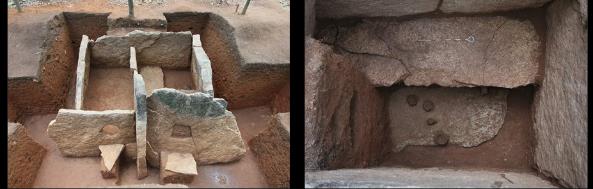
The ASI account gives useful architectural dimensions for the excavated cist-circle: the Machad stone circle is reported at approximately 9 m externally and 8.5 m internally; the cist was north–south oriented, with an antechamber projecting eastward, a porthole in the eastern orthostat, an internal dividing slab, and a bench-like slab arrangement in the southern half. These are meaningful architectural observations. Plate XIX B of the review, which shows the exposed Machad cist, was not examined. IAR 1974–75, p. 21
The modern administrative boundary should not be projected backward onto the archaeological survey. “Machad” can now denote a broader hill-region/locality, and government descriptions of the wider Wadakanchery block include hills, forest, slopes and plains. That does not mean the excavated megalith stood on a slope. The excavation report’s micro-topographic observation is more relevant: the monument locality itself was on fairly level ground beside a paddy field, with a hill to the south. ↗13
Excavated construction and material evidence
The excavated urn-burial is the strongest answer to the capstone question. The dedicated report describes a small stone circle around the urn, approximately 2.60 m in outer diameter and 2.40 m internally. Unlike the general Machad description of laterite circle blocks, these stones are specifically characterized as small irregular granite pieces. Beneath the surface lay a circular granite cover/capstone, about 1.65 m in diameter and 0.15 m thick, already broken into three pieces. The ASI review likewise says the urn-burial “was covered by a huge granite capstone.” Below it a small vessel stood on a slab sealing the mouth of the larger burial urn. The large urn is reported at roughly 0.50 m high, with a mouth about 0.25 m across, inside a tapering circular pit. Mehta & George 1978
This is why the unqualified plural “granite capstones” is misleading. A granite capstone is directly documented for this urn-burial. By contrast, the ASI annual-review account says the capstone was present on the cist at Pazhayannur but missing at Machad. The 1978 site description also notes that erosion had exposed cover stones and upper portions of orthostats on two Machad cist monuments, but the consulted passage does not identify those stones as granite. The safest wording is therefore monument-specific rather than site-wide. Mehta & George 1978
The report provides unusually useful evidence for below-ground construction. At Machad the excavators recognized a circular foundation pit roughly 6.15 m in diameter and 2.40 m deep. They inferred a separate trench associated with the surrounding stone circle and described successive earth fills within the construction pit, including coarser and finer deposits and a lower compact/clayey layer. These observations show that construction involved substantial cutting and refilling rather than simply setting exposed slabs on the contemporary ground surface. Mehta & George 1978
That evidence needs to be kept separate from later interpretation:
| Evidential level | What can be said |
|---|---|
| Observed/reported excavation feature | A deep circular foundation pit, probable circle trench, layered fill, cist construction and adjacent urn pit were recorded. |
| Excavator interpretation | The cut and fills relate to construction of the megalithic monument and its surrounding circle. |
| Reasonable synthesis | Construction demanded substantial earth removal and deliberate placement/filling. |
| Not established | That the pit was an engineering response to a hillside, unstable slope, exposed bedrock, drainage hazard, or “rocky terrain.” |
One published plate labelled “Megalith at Machad” was visually read in the accessible facsimile. It helps establish the report’s photographic documentation, but the image is not sufficiently diagnostic to identify the lithology of concealed cist supports or to derive a measured structural sequence. The contents also identify a plan-and-section figure for Machad; that figure is still to be seen clearly, so it remains a priority source to obtain. Mehta & George 1978
Excavated grave goods. The ASI review lists what the two excavations produced: Black-and-red Ware, red ware and black ware; iron objects, namely four chisels, two daggers, two hooks and two nails; and 179 beads, 121 of them etched, made of agate, carnelian, felspar, jasper and crystal. Most of the objects lay on the floor slab in the three cells of each cist. IAR 1974–75, p. 21 The review gives no date for the burials and does not mention russet-coated painted ware.
Granite, laterite, “clinostats,” and the terrain hypothesis
The description can now be tested feature by feature. On printed page 3, the 1978 report describes the Machad circle stones as irregular, undressed laterite blocks. This is a statement about the ring around monuments. It is not a statement that laterite blocks sat underneath a granite capstone, supported a capstone, or functioned as inclined structural members. The distinction is crucial because “circle stone,” “orthostat,” “cover stone,” and “support” describe different architectural positions. Mehta & George 1978
The urn on printed page 8 creates an additional reason not to generalize: its own small circle is specifically described as granite, as is its capstone. Accordingly, the source preserves at least two material statements at Machad that should not be collapsed: a general description of laterite stones in the site’s monument circles and a specific description of granite in the excavated urn’s ring and cover. This is not necessarily a contradiction; the report may be describing different monument components. Mehta & George 1978
“Clinostat” presents a different problem. Varghese’s overview of Kerala megaliths describes the kudakkal as an umbrella-like laterite monument whose upper stone is carried by inclined stones termed clinostats, and distinguishes that architectural form from cists and other types. Whatever the term’s broader archaeological history, this shows a plausible route by which “laterite clinostats” could enter a Kerala megalithic description without being a description of the excavated Machad cist. No consulted Mehta–George passage uses “clinostat” for the Machad cist supports. ↗19 George’s own thesis uses the word in the same way as Varghese: hat stones, he writes, are built on four “clinostatic stones” joined at the base. He does not apply it to cists. George 1975, p. 376
The description’s most specific proposition – granite capstones resting on laterite clinostats – therefore fails as a verified Machad statement. The evidence instead separates three observations: laterite circle stones in the general Machad description; a granite ring and granite capstone on the excavated urn-burial; and “clinostats” as a secondary Kerala term for the inclined supports of a kudakkal. They should not be combined into a single hypothetical structure.
The hillside component is similarly weak. The broader Machad landscape certainly contains hills, and modern descriptions of the block include slopes and uplands. But the excavated site is described as fairly level ground at the side of a paddy field. A hill lying to the south is landscape context, not proof that the monument stood on that hill. The foundation pit may demonstrate demanding construction, but without a section tied to slope angle or exposed bedrock it cannot demonstrate a special hill-slope solution. Mehta & George 1978
The defensible correction is therefore to drop the compound “granite capstones on laterite clinostats.” A better description of the subject would be: “Machad megaliths: cist-circles and an excavated urn-burial, with laterite and granite used in different documented components.” That formulation preserves the genuinely interesting material contrast without inventing a support system.
Chronology, implications, and strongest uncertainties
The Machad material fits the collection’s main period, 1000 BCE–600 CE, in the sense that later scholarship places it in the southern Indian Iron Age/early historic megalithic horizon. A later review assigns the excavated Machad and Pazhayannur burials approximately to the second century BCE–second century CE. Rajesh 2024, Heritage 11.2: 301–323 George’s thesis offers no date specific to the site: it applies the general south Indian megalithic chronology to Kerala, citing Wheeler for megalithic burials from about 300 BCE to the first century CE and noting that some radiocarbon dates elsewhere reach back to about 1000 BCE. George 1975, pp. 376–378 How the 1978 report words its own dating will stay unknown until its chronology pages are read.
Regional synthesis supports caution. Mohanty and Selvakumar emphasize that megalithic chronology across peninsular India is heterogeneous and that relatively few burial monuments themselves have direct scientific dates; habitation dates are often used in wider chronological discussion. Their regional framework can show that a late-first-millennium-BCE/early-CE placement is not anomalous, but it cannot convert a typological attribution at Machad into an absolute measurement. ↗22
No consequential dating sample can therefore be populated for Machad from the consulted evidence. There is no verified laboratory code, sample material, conventional radiocarbon age, calibration curve, calibrated probability distribution, or equivalent result. This is a missing primary-data problem, not evidence that scientific dating was impossible or has never subsequently been undertaken.
These results also alter how the site should be discussed comparatively. Machad is valuable precisely because the excavation report records different monument forms and different material observations within one locality: cist-circles; an urn burial; general laterite circle stones; a specifically granite-ringed and granite-covered urn; and substantial subsurface construction. The evidence does not require turning those observations into one standardized architectural recipe. Mehta & George 1978
The principal disagreements or unresolved points, and the evidence that would discriminate among them, are:
| Issue | Present conclusion | What would materially resolve it |
|---|---|---|
| 47 versus 41 newly identified sites | Prefer the primary report’s 47 for the exploration summarized there | George’s thesis survey catalogue and definitions/counting criteria |
| Lithology of Machad cist orthostats | Unknown | Full monument description, plan/section captions, petrological description, or diagnostic photographs |
| Cist capstone material | Excavated cist capstone reported missing; other exposed cover stones not lithologically identified | Full descriptions of each of the four cists |
| “Clinostats” at Machad | Unverified | A primary Machad publication explicitly applying the term to identified stones |
| Site date | Comparative brackets only: about 2nd century BCE–3rd century CE for Kerala megaliths (George 1975); 2nd century BCE–2nd century CE (Rajesh 2024) | The 1978 report’s chronology pages; any later absolute dates |
| Hillside engineering | Unsupported | Surveyed slope measurements, section drawings tied to topography, bedrock observations, or an excavator’s explicit engineering argument |
| Cochin Archaeological Survey relevance | Not verified for Machad | Exact annual-report volume/page or indexed Cochin record naming Machad |
| “Kerala Archaeological Series” relevance | No exact Machad title identified | Full bibliographic citation establishing a Machad item in that series |
Sources still needed, and bibliography
The missing sources are few, but any stronger architectural reconstruction depends on them. The most valuable is a complete copy of Mehta and George 1978, especially the chronology and structure pages, Figure 2 (“Megalith at Machad – Plan and Section”), and the urn-related plate. The next are Plate XIX B of Indian Archaeology 1974–75: A Review and the plates volume and survey catalogue of George’s 1975 thesis, which would show the excavated cist and settle the count of sites. Finally, archival indexes should be checked for an exact Machad entry in the Cochin Archaeological Department reports and for the “Kerala Archaeological Series” citation, for which no exact Machad title has been identified. Mehta & George 1978
The conclusions here do not depend on a new field visit. If heritage authorities later undertake documentation, the useful measurements would be monument-by-monument lithology, preserved slab dimensions, local slope and datum, construction-pit geometry, disturbance/restoration history, and controlled mapping of the four cist-circles and urn context. Public presentation should continue to generalize the exact findspot.
Bibliography
Mehta, Ramanlal Nagarji, and K. M. George. Megaliths at Machad and Pazhayannur, Talppally Taluka, Trichur District, Kerala State: A Report of the Excavations Conducted from 18th April to 12th May 1974. M.S. University Archaeology Series no. 15. Vadodara: Department of Archaeology & Ancient History, Faculty of Arts, M.S. University of Baroda, 1978. 34 pp. WorldCat OCLC 6917650. Bibliographic confirmation: https://search.worldcat.org/title/6917650. The WorldCat and Google Books records independently confirm the 1978 edition, authorship, publisher and 34-page extent. ↗25
George, K. M. Archaeology of Kerala (upto 1500 A.D.). PhD thesis, The Maharaja Sayajirao University of Baroda, March 1975; guide R. N. Mehta. Text volume read in a scanned copy: https://archive.org/details/archaeology-of-kerala-upto-1500-ad-by-r.-n.-mehta (Machad and Pazhayannur excavations, pp. 193–199; megalithic period in Kerala, p. 292; chronology of megaliths, pp. 376–378). NDLI/Shodhganga metadata record: https://ndl.iitkgp.ac.in/result?q=%7B%22t%22:%22search%22,%22k%22:%22Archaeology%20of%20Kerala%20upto%201500%20A%20D%20Volume%202%22%7D. ↗26
Archaeological Survey of India. Indian Archaeology 1974–75: A Review. Edited by B. K. Thapar. New Delhi: Archaeological Survey of India, 1979. Relevant entry: 42, “Excavation at Machad and Pazhayannur, District Trichur,” p. 21. IAR 1974–75
Varghese, Rachel A. “Megaliths of Kerala: Commemorating Death through Monuments in Stone.” Sahapedia. https://www.sahapedia.org/megaliths-kerala-commemorating-death-through-monuments-stone. Used as secondary typological and historiographic context; it should not override monument-specific excavation descriptions. ↗19
Mohanty, R. K., and V. Selvakumar. “The Archaeology of the Megaliths in India: 1947–1997.” In S. Settar and Ravi Korisettar, eds., Indian Archaeology in Retrospect, Vol. I: Prehistory (New Delhi: ICHR / Manohar, 2002), pp. 313–351. An author-uploaded full text was consulted for broad chronological context; its role here is comparative rather than site-specific. ↗22
Government of Kerala, Revenue Department. “Thekkumkara Village Office.” https://landrevenue.kerala.gov.in/core/Office_websites/contactus.php?nm=166Thekkumkaravillageoffice. Used only for present administrative geography. ↗27
Wadakanchery Block Panchayat. “At a glance.” https://wadakancheryblockpanchayat.lsgkerala.gov.in/en/node/10. Used only for modern regional landscape and administrative context, not ancient topography. ↗28
Cochin Archaeological Department. A representative bibliographic lead identified during source discovery is P. A. Achan, Annual Report of the Archaeological Department Cochin State for the Year 1122 M.E. (1946–1947 A.D.) (Cochin Government Press, 1948). No Machad-specific passage from this study was established here. It is noted only as historical background on earlier Cochin State surveys, not as evidence for the 1974 Machad excavation.
Rajesh, K. P. “200 Years of Babington’s Pandoo Coolies: A Critique of the Megalithic Studies in Kerala.” Heritage: Journal of Multidisciplinary Studies in Archaeology 11.2 (2023–24 [2024]): 301–323. Cited for its date of about the second century BCE to the second century CE for the Machad and Pazhayannur burials; the page was not confirmed.
Archaeological Survey of India (1979). “Excavation at Machad and Pazhayannur, District Trichur.” Indian Archaeology 1974–75: A Review (ed. B. K. Thapar), New Delhi: Archaeological Survey of India, entry 42, p. 21. Scan of the printed volume; ASI IAR portal.
005Photographs
We have no rights-cleared photograph of this study’s own site or objects yet.
006Where next
 Related study
All related studies, connected material, books and sources10 · 10
Elsewhere on this site
007Sources
The study lists the sources it consulted; we have not rechecked them. A working link does not show that a source was read, and a valid identifier does not show that it supports a claim. We do not link to unofficial uploads or copies of publications. Where a study cited one, we show the published citation, or a publisher, DOI or Internet Archive link when we have one. Tracking codes are removed from links, and the sources themselves are not republished here.
R. N. Mehta and K. M. George, Megaliths at Machad and Pazhayannur, Talppally Taluka, Trichur District, Kerala State: A Report of the Excavations Conducted from 18th April to 12th May 1974, M.S. University Archaeology Series No. 15, 1978.
K. M. George, Archaeology of Kerala (upto 1500 A.D.), PhD thesis (text volume), The Maharaja Sayajirao University of Baroda, March 1975; guide R. N. Mehta.
Indian Archaeology 1974–75: A Review, edited by B. K. Thapar (New Delhi: Archaeological Survey of India, 1979), entry 42, 'Excavation at Machad and Pazhayannur, District Trichur', p. 21.
Archaeological Survey of India, Indian Archaeology 1974-75: A Review, published 1979; section 42 concerns Machad and Pazhayannur.
Print or offline sourceSource recordRachel A. Varghese, Megaliths of Kerala: Commemorating Death through Monuments in Stone, Sahapedia.
R. K. Mohanty and V. Selvakumar, The Archaeology of the Megaliths in India: 1947-1997, 2002.
Government of Kerala Revenue Department, Thekkumkara Village Office.
Wadakanchery Block Panchayat, At a glance.
K. P. Rajesh, '200 Years of Babington’s Pandoo Coolies: A Critique of the Megalithic Studies in Kerala,' Heritage: Journal of Multidisciplinary Studies in Archaeology 11.2 (2023–24 [2024]): 301–323.
Print or offline sourceSource recordP. A. Achan, Annual Report of the Archaeological Department Cochin State for the Year 1122 M.E. (1946-1947 A.D.), Cochin Government Press, 1948; retained as a representative archival-series lead, not as Machad evidence.
Print or offline sourceSource record
Researchers and institutions whose work this study uses: V. Selvakumar, B. K. Thapar, Archaeological Survey of India
How we know The evidence, claims and dates behind this study
What this study draws on
- R. N. Mehta and K. M. George's 1978 excavation report (M.S. University Archaeology Series 15), consulted via partial page reproductions
- K. M. George's 1975 doctoral thesis, Archaeology of Kerala (upto 1500 A.D.), for the excavation account (pp. 193–199) and its remarks on chronology (pp. 292, 376–378)
- The ASI summary in Indian Archaeology 1974–75 – A Review (1979), entry 42, p. 21
- K. P. Rajesh (2024, '200 Years of Babington's Pandoo Coolies') and Rachel A. Varghese's overview of Kerala megaliths
- R. K. Mohanty and V. Selvakumar (2002, Indian Archaeology in Retrospect I: 313–351) on Indian megalith chronology
Dates in this study
| What is dated | Date | How it was dated |
|---|---|---|
| circa second century BC to second century AD | 200 BCE – 200 CE | How it was dated is not stated |
See these dates on the timeline
The study’s claims
13 claims · 19 source passages · 50 paragraphs
Browse the study paragraph by paragraphThe exploration programme leading to the Machad excavation is reported by Mehta and George as having identified 47 new megalithic sites containing about 500 megaliths in 1972-1973.
Supported in this study
The secondary literature contains a conflicting count of 41; primary 1978 wording is preferred for this campaign pending inspection of George's thesis.
The 1978 report records five monuments at the Machad locality, four cist-circles and one urn-burial; George's 1975 thesis counts five cist-circles and one urn-burial.
Supported with qualifications
The excavated Machad locality is described as fairly level ground beside a paddy field, with a hill to the south; the primary description does not establish that the monument itself occupied a hillside.
Supported in this study
The broader Machad landscape includes hills; this claim concerns the excavated micro-location.
The ASI annual review (p. 21) and George's 1975 thesis (p. 194) both report that the capstone of the excavated Machad cist was missing; the review says the urn-burial was covered by a huge granite capstone.
Supported in this study
This does not determine the material of cover stones visible at other Machad cists.
The lithology of the excavated Machad cist orthostats or supposed capstone supports is not established by the primary passages read here.
Unresolved in this study
Unknown is not equivalent to granite, laterite, or another stone. A complete facsimile could resolve this.
In the secondary Kerala typology consulted, and in George's own 1975 thesis, the term clinostat is applied to the supports of hat or umbrella stones; no Machad primary passage read applies it to the Machad cist.
Supported with qualifications
Where the word “clinostat” came from cannot be proved from this correspondence alone.
The Machad excavation report describes a circular construction/foundation pit about 6.15 m in diameter and 2.40 m deep, probable separate circle trenching, and layered fills.
Supported in this study
The accessible record supports excavation of one Machad transepted cist-circle and its adjacent urn-burial; the other three cist-circles are reported in the site inventory but are not demonstrated in the consulted pages to have been excavated.
Supported with qualifications
This is a bounded reconstruction of excavation extent from the sources read, not a claim that no later or unpublished intervention occurred.
The dedicated Machad excavation publication is M.S. University Archaeology Series No. 15, published by the Department of Archaeology and Ancient History of M.S. University of Baroda in 1978.
Supported in this study
The inherited catalogue's unspecified 'Kerala Archaeological Series' lead was not established as the identity of this excavation publication.
No date specific to Machad was found. George's 1975 thesis says Kerala megaliths offer no evidence for a specific time limit and gives the megalithic period in Kerala as about the second century BCE to the third century CE; a later review (Rajesh 2024) gives about the second century BCE to the second century CE for the Machad and Pazhayannur burials. The chronology pages of the 1978 report were not read for this study.
Supported with qualifications
Comparative brackets, not measurements. The Rajesh page number is not established and the article was not re-read.
No Machad-specific laboratory dating sample or absolute-date determination was verified in the consulted evidence.
Supported with qualifications
The conclusion is 'not verified,' not 'no scientific date exists anywhere.'
The catalogue phrase 'granite capstones on laterite clinostats' is not supported as a single Machad architectural configuration by the consulted evidence.
Supported in this study
This does not deny that granite and laterite both occur at Machad; it rejects their unsupported combination into one specified support system.
The excavated foundation-pit evidence demonstrates substantial monument construction but does not by itself establish adaptation to hillside or rocky terrain.
Supported in this study
The broader Machad landscape is hilly; the conclusion concerns the causal engineering interpretation of the excavated monument.
Trace one claim through the study’s records
Explore the evidenceOther source lists
Numbered citation links from the study
The numbered links in the study text point here.
Mehta & George (1978), Megaliths at Machad and Pazhayannur (WorldCat OCLC 6917650)
R. N. Mehta and K. M. George, Megaliths at Machad and Pazhayannur (Vadodara: MS University, 1978).
Mehta & George (1978), Megaliths at Machad and Pazhayannur (WorldCat OCLC 6917650)
R. N. Mehta and K. M. George, Megaliths at Machad and Pazhayannur (Vadodara: MS University, 1978).
Megaliths of Kerala: Commemorating Death through Monuments in Stone | Sahapedia
Mehta & George (1978), Megaliths at Machad and Pazhayannur (WorldCat OCLC 6917650)
R. N. Mehta and K. M. George, Megaliths at Machad and Pazhayannur (Vadodara: MS University, 1978).
Mehta & George (1978), Megaliths at Machad and Pazhayannur (WorldCat OCLC 6917650)
R. N. Mehta and K. M. George, Megaliths at Machad and Pazhayannur (Vadodara: MS University, 1978).
Mehta & George (1978), Megaliths at Machad and Pazhayannur (WorldCat OCLC 6917650)
R. N. Mehta and K. M. George, Megaliths at Machad and Pazhayannur (Vadodara: MS University, 1978).
Mehta & George (1978), Megaliths at Machad and Pazhayannur (WorldCat OCLC 6917650)
R. N. Mehta and K. M. George, Megaliths at Machad and Pazhayannur (Vadodara: MS University, 1978).
Mehta & George (1978), Megaliths at Machad and Pazhayannur (WorldCat OCLC 6917650)
R. N. Mehta and K. M. George, Megaliths at Machad and Pazhayannur (Vadodara: MS University, 1978).
K. P. Rajesh (2024), 200 Years of Babington’s Pandoo Coolies, Heritage 11.2: 301–323
K. P. Rajesh, '200 Years of Babington’s Pandoo Coolies: A Critique of the Megalithic Studies in Kerala,' Heritage 11.2 (2024): 301–323.
Mehta & George (1978), Megaliths at Machad and Pazhayannur (WorldCat OCLC 6917650)
R. N. Mehta and K. M. George, Megaliths at Machad and Pazhayannur (Vadodara: MS University, 1978).
Mehta & George (1978), Megaliths at Machad and Pazhayannur (WorldCat OCLC 6917650)
R. N. Mehta and K. M. George, Megaliths at Machad and Pazhayannur (Vadodara: MS University, 1978).
Indian Archaeology 1974–75: A Review (ASI, 1979)
Archaeological Survey of India, Indian Archaeology 1974–75: A Review (1979), section 42.
At a glance | Wadakanchery Block Panchayat
Mehta & George (1978), Megaliths at Machad and Pazhayannur (WorldCat OCLC 6917650)
R. N. Mehta and K. M. George, Megaliths at Machad and Pazhayannur (Vadodara: MS University, 1978).
Mehta & George (1978), Megaliths at Machad and Pazhayannur (WorldCat OCLC 6917650)
R. N. Mehta and K. M. George, Megaliths at Machad and Pazhayannur (Vadodara: MS University, 1978).
Mehta & George (1978), Megaliths at Machad and Pazhayannur (WorldCat OCLC 6917650)
R. N. Mehta and K. M. George, Megaliths at Machad and Pazhayannur (Vadodara: MS University, 1978).
Mehta & George (1978), Megaliths at Machad and Pazhayannur (WorldCat OCLC 6917650)
R. N. Mehta and K. M. George, Megaliths at Machad and Pazhayannur (Vadodara: MS University, 1978).
Mehta & George (1978), Megaliths at Machad and Pazhayannur (WorldCat OCLC 6917650)
R. N. Mehta and K. M. George, Megaliths at Machad and Pazhayannur (Vadodara: MS University, 1978).
Megaliths of Kerala: Commemorating Death through Monuments in Stone | Sahapedia
Mehta & George (1978), Megaliths at Machad and Pazhayannur (WorldCat OCLC 6917650)
R. N. Mehta and K. M. George, Megaliths at Machad and Pazhayannur (Vadodara: MS University, 1978).
K. P. Rajesh (2024), 200 Years of Babington’s Pandoo Coolies, Heritage 11.2: 301–323
K. P. Rajesh, '200 Years of Babington’s Pandoo Coolies: A Critique of the Megalithic Studies in Kerala,' Heritage 11.2 (2024): 301–323.
The archaeology of the megaliths in India: 1947-1997
Mehta & George (1978), Megaliths at Machad and Pazhayannur (WorldCat OCLC 6917650)
R. N. Mehta and K. M. George, Megaliths at Machad and Pazhayannur (Vadodara: MS University, 1978).
Mehta & George (1978), Megaliths at Machad and Pazhayannur (WorldCat OCLC 6917650)
R. N. Mehta and K. M. George, Megaliths at Machad and Pazhayannur (Vadodara: MS University, 1978).
Megaliths at Machad and Pazhayannur, Talppally Taluka, Trichur District, Kerala State : a report of the excavations conducted from 18th April to 12th May 1974 | WorldCat.org
NDLI: Archaeology of Kerala upto 1500 A D Volume 2
Revenue Portal
At a glance | Wadakanchery Block Panchayat
About this study Status, corrections and how it was made
Status
Draft study, revision 11. No historian, archaeologist, or Tamil or Malayalam specialist has reviewed it yet.
How it was made
Compiled as an editorial synthesis from published scholarship around questions we framed. About this project & workflow
The summary, How sure lines and Two views notes on this page were prepared from this study and cross-checked against its passages. That is an editorial check, not a specialist review.
Technical details
Study code R143. The text fingerprint changes whenever the study text changes.
- The study text is shown as written. Links from its paragraphs to citations help you move around the study; they are not new claims or checked source passages.
See how this study’s records were extracted
Text fingerprint (SHA-256): R143 · c29672976b7bd7eec742a5c2… · v11
Evidence tables and technical details are on the web page: https://layersofthesouth.org/read/957dbde2d5