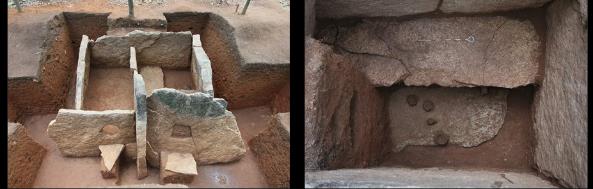
Excavated cist burial at Enadimangalam, Figure 1, published page 568
Enadimangalam
- Belief & memory
Tamil mourning poems and a Kerala stone burial, read side by side
Early Tamil poems voice grief to an urn-maker; a Kerala stone tomb may have been reused. Neither kind of evidence can replace the other.
- This page
- 1,225 words · revision 5
Draft study · Awaiting specialist review · Updated
001Dates and places

No mapped place in this study.
Dates in this study are stated in words only.
- 1 Well supported
- 2 Possible
- 1 Not known
002How sure
In brief
Several poems in the Purananuru, an early Tamil anthology, speak of death and burial. In poem 228 a speaker asks a potter for an urn big enough for a great king. In poem 255 a woman cannot easily move her dead companion's body. In poem 256 a widow asks the potter to make room for her too. Poem 232, attributed to Avvaiyar, instead recalls offerings at a ruler's memorial stone. These are poems, not burial records, so they do not show how often couples were buried together. In Kerala, a 2019 excavation at Enadimangalam uncovered a double-chambered stone cist with a slab bench. Its excavators argue from floor vessels and later fill that the tomb was used more than once. This study read only the journal abstract and the excavators' own public account, so trench plans and radiocarbon dates are not covered.
Key researchers cited in this study: Abhayan G. S. (University of Kerala Archaeology) · Rajesh S. V. (University of Kerala Archaeology) · Vaidehi Herbert (Sangam Poetry Translations & Commentaries) · Preeta Nayar (KCHR Pattanam Stone & Glass Bead Studies) · Full bibliography
How sure
- Well supported
Enadimangalam in Kerala has an excavated double-chambered stone cist with a slab bench.
Described in the published 2021 excavation report; this study read its abstract.
- Possible
The Enadimangalam tomb was reused for later burials.
The excavators argue it from floor vessels and later fill; the study treats it as their interpretation.
- Possible
In eastern Kerala, habitation evidence has been reported in association with burials.
Reported in a 2013 study whose abstract alone was read.
- Not known
How often couples were buried together, or whether widows were expected to die.
Poem 256 voices a wish; a wish in a poem is not proof that it was carried out.
Why it matters
Reading poems and graves together shows what each kind of evidence can and cannot tell us about death in early South India.
003Key findings
What the study concludes
- Purananuru 228, 255, and 256 voice distinct moments of mourning and appeals to burial-urn potters without prescribing a single standardized funeral procedure.
- Research on megalithic habitation sites in eastern Kerala challenges older assumptions that Iron Age burial builders left no traceable settlement remains.
In the study’s own words. How sure each point is, is shown above.
The summary above is the short read. The full study is the complete text it was drawn from, with its tables and source notes.
What the full study covers
004The study
An urn large enough for a life
In Purananuru 228, the address to the potter expands the task of making an urn to an impossible scale appropriate to a king's greatness. In poem 255, a woman speaks to a dead companion whose broad body she cannot easily move; fear, imagined movement, and the wish for response coexist. In poem 256, a woman asks the potter to make room for her as well as the dead man, recalling the closeness of their shared journey. These are distinct poetic situations, not three descriptions of a standardized burial procedure. 1 The impossible scale in the first poem should not be corrected into a practical ceramic measurement. Its excess is part of its work. Similarly, the request for room in the third is not, by itself, a statistical record of joint interment or proof of a universal rule requiring a widow's death: the force of a wish in a poem is not proof that it was carried out. The second poem draws attention to a different limit: grief does not cancel the body's weight. A close reading can attend to that coexistence without pretending the poem is an excavation report. Love wants an answer; the physical task remains resistant. That resistance can make the scene more powerful than a generalized statement of sorrow. These poems also caution against making all mourners speak in one philosophical register.
Purananuru 232, attributed to Avvaiyar, offers a contrast to these urn appeals. It addresses a remembered ruler and evokes offerings at a memorial stone. Where poem 256 voices unbearable separation, poem 232 brings remembrance into relation with a particular honoured life. 1 An offering in a poem does not tell us the complete routine at every memorial. “Velir chiefs were named local rulers, not one hill-chief system” reads poem 232 within its study of Atiyaman and Avvaiyar, and “Early Tamil hero stones record names and a cattle raid” discusses early memorial and hero stones.
Stone construction is another kind of testimony
Kerala's burial record includes rock-cut caves as well as cists: “Northern Kerala's rock-cut burial caves vary widely in form” surveys those of northern Kerala and explains that the Malayalam term nannangadi (Mudhumakkal Thazhi) refers to urn burials, and “Umbrella stones and rock-cut tombs: distinctive but not unique” classifies Kerala's umbrella stones, hood stones and rock-cut burial monuments. The abstract of the 2021 study of the Enadimangalam excavation describes a double-chambered cist burial investigated in Kerala in 2019. It identifies an internal cot- or bench-like feature made from stone slabs and discusses possible changes and repeated use in the Iron Age–Early Historic context.
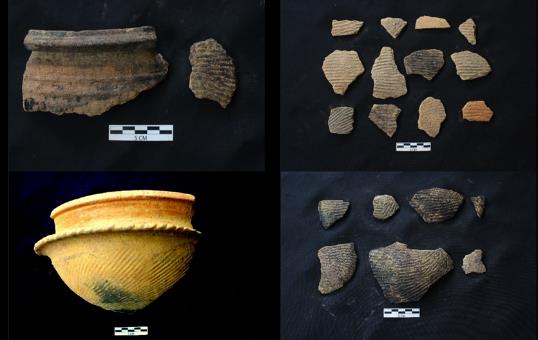
Ceramics from the Enadimangalam study area, Figure 3, published page 569
Enadimangalam
Those possibilities are the researchers' interpretations of material evidence. This study draws on the article's published abstract; the full article was not read. 2 The excavators’ own public account adds a distinction between vessels at floor level and sherds within the later filling. They use their distribution to argue for repeated burial activity. They also identify some wedge marks as later interventions rather than original construction marks. These are reported observations and interpretations by the excavation team, not a complete independent reassessment of the site. Their account makes clear why the sequence of activity matters. 3 The archaeological evidence contributes a particular built arrangement that the poems cannot provide. It does not identify mourners’ words or establish that a poem’s scene occurred there. “Human remains give site-level findings, not a regional history” and “Ordinary settlements beyond the ports are known but hard to count” discuss the Enadimangalam excavation in wider reviews of human-remains and settlement evidence. A separate 2013 research abstract by N. Nikhil Das, P. P. Joglekar, and R. K. Mohanty reports habitation evidence associated with burials in eastern Kerala. It challenges a simple picture in which burial evidence has no discoverable relationship to settlements. Only the abstract and publication record were consulted for this study. 4 The two studies point toward a productive research direction: connect mortuary structures to the places and activities of the living, while maintaining the distinction between a demonstrated association and a proposed one. That work means examining plans, context, dating, and deposition – not searching for a dramatic poem to fill every unrecorded action.
Finding and limits
The sources examined here connect two rich lines of South Indian evidence: the mourning voices of Purananuru (poems 228, 232, 255, and 256) and the material archaeology of Kerala’s Iron Age–Early Historic burials and habitation landscapes (including the Enadimangalam double-chambered cist excavation). Poetic lament and megalithic stone or urn construction answer complementary questions – one preserving the emotional address of survivors, the other documenting the physical labor, chamber design, and reuse of commemorative monuments.
What remains uncertain
- Only the abstracts of the Enadimangalam and eastern Kerala journal articles were read, alongside the excavators' full public account in Ala; detailed trench plans and radiocarbon tables are not covered here.
- Poetic wishes in Purananuru lament verses do not establish a compulsory demographic rule, a count of joint burials or a literal blueprint for every excavated Kerala cist or urn burial.
The next questions
- Integrate full plan drawings and ceramic phase sequences from the Enadimangalam cist excavation and eastern Kerala habitation surveys.
- Compare urn-burial and memorial-stone imagery in Purananuru with excavated Iron Age–Early Historic urn, cist and memorial sites across Kerala and Tamil Nadu.
References and access notes
1 Vaidehi Herbert, Sangam Poems Translated by Vaidehi. Purananuru 201–400: poems 228, 255 and 256. Source type: primary poetry in modern translation with commentary. Where in the source: 228: urn and royal greatness; 255: immovable body; 256: request for space. How much was read: Selected poems and accompanying notes read. Limits: Poetic appeals are not a burial blueprint, proof of compulsory widow death, or a dated funeral record. Access date: 2026-10-10. Open source: sangamtranslationsbyvaidehi.com
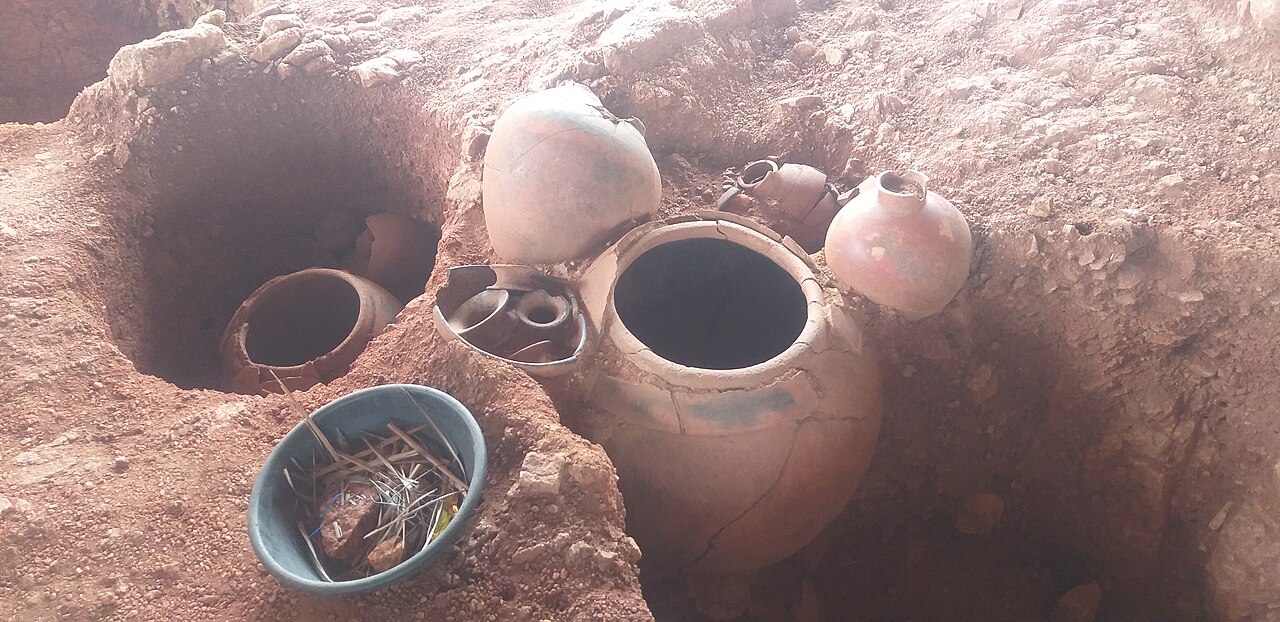
Excavated burial urns and trenches at Sivagalai (Sivakalai)
Sivagalai
Photographed 2025-10-10
2 G. S. Abhayan, S. V. Rajesh, Akinori Uesugi, Preeta Nayar et al.; Archaeological Research in Asia 27 (September 2021), 100293. Megalithic cist burial excavation at Enadimangalam in Kerala and its implications in cist burial architecture and burial practices. Source type: original excavation study, abstract/preview. Where in the source: 2019 excavation; double chamber, stone cot/bench and possible repeated use. How much was read: Publisher metadata/preview and reproduced abstract consulted; full article not read. Limits: No precise site radiocarbon date, body sequence or construction plan inferred from abstract. Access date: 2026-10-10. Open source: www.sciencedirect.com
3 Abhayan G. S. and Rajesh S. V.; Ala, Issue 36, 31 August 2021. Kerala during the “Age of Iron”: Findings from a Recent Excavation. Source type: first-person excavation account. Where in the source: Floor vessels versus fill sherds; later wedge marks; excavation method. How much was read: Full public article read; no reuse of photographs. Limits: Same excavation and authors as another source in this list, not independent confirmation. Broad settlement-absence claim not adopted; S38 reports habitation evidence. Access date: 2026-10-10. Open source: alablog.in
4 N. Nikhil Das, P. P. Joglekar and R. K. Mohanty; Artha Journal of Social Sciences 12(3), 1 July 2013. New Light on the Unresolved Problem of Megalithic Habitation Sites in Kerala. Source type: original archaeology study, abstract. Where in the source: Abstract on eastern Kerala habitation evidence associated with burials. How much was read: Publisher abstract and metadata read; full PDF not read. Limits: Does not establish the detailed context of any single settlement from the abstract alone. Access date: 2026-10-10. Open source: journals.christuniversity.in
005Photographs
Photographs of the places and objects this study discusses. Each item carries its creator’s credit, licence and documented source. See all 412 photographs and source images ↗
Enadimangalam
Excavated cist burial at Enadimangalam, Figure 1, published page 568

Sivagalai · Photographed 2025-10-10 10:07:32
Excavated burial urns and trenches at Sivagalai (Sivakalai)
Adichanallur · Photographed 4 September 2023 (according to Exif data)
Excavated burial urns and associated pottery at Adichanallur
Perumbair
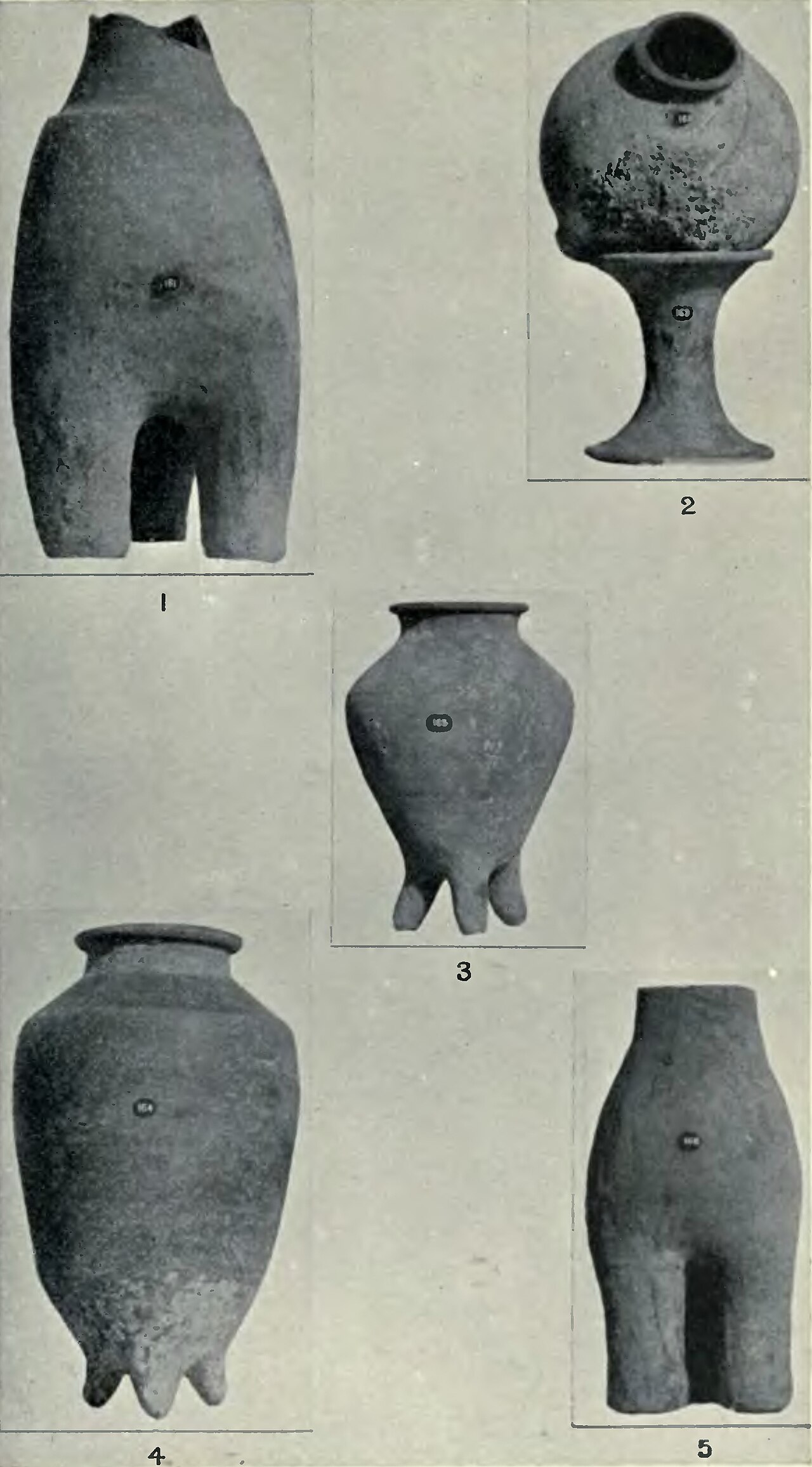
Legged pottery vessels from Perumbair, plate XII in Alexander Rea's 1915 catalogue

Ariyannur · Photographed 2016-09-18 13:36:41
Overview of umbrella stones and an open monument at Ariyannur

Eyyal · Photographed 2016-09-18 11:50:41
Oblique view of the Eyyal burial-cave entrance

Pilicode · Photographed 2018-09-27 09:45:33
Circular roof opening at Pilicode rock-cut burial cave

Chowannur · Photographed 2016-09-18 13:08:40
Chowannur burial cave, showing the approach and chamber entrance
Show 12 more photographs and source images ↓
Marayoor · Photographed 2024-04-09 15:06
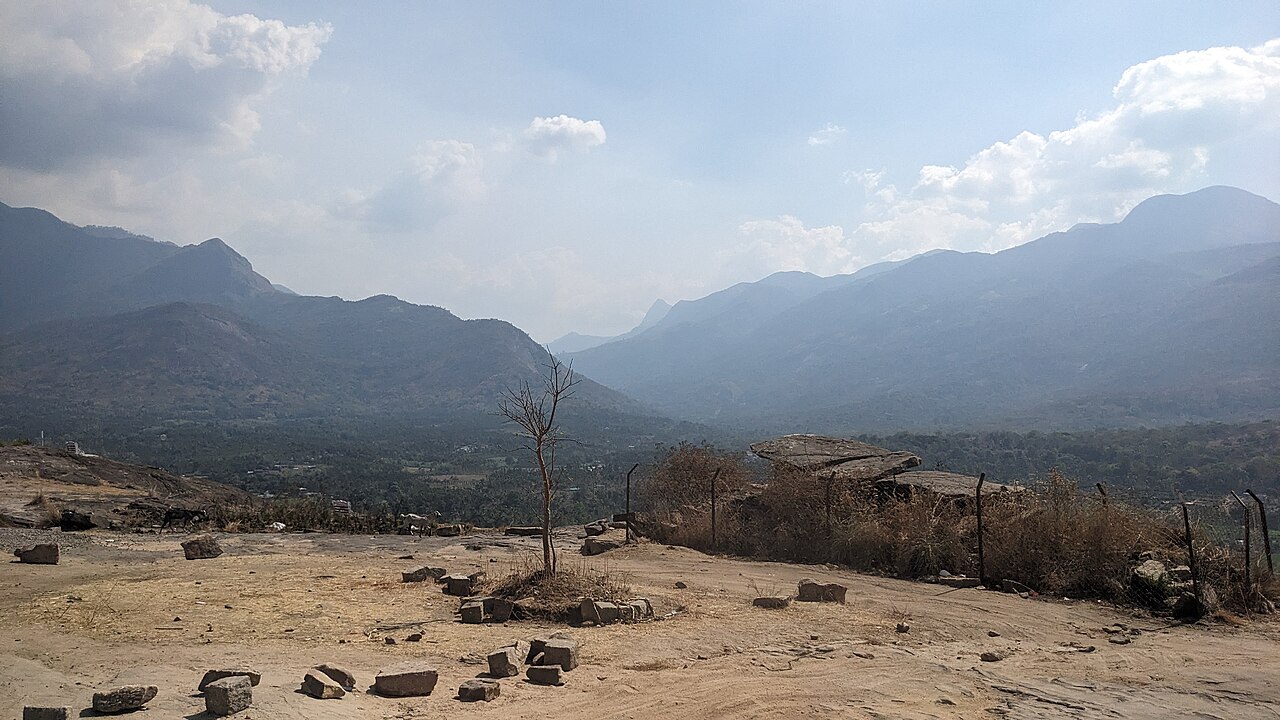
The present dolmen setting at Marayoor, with mountains beyond

Kattakampal · Photographed 2018-09-30 16:31:58
Two chamber openings at the Kattakampal burial cave

Cheramanangad · Photographed 2016-09-18 11:23:01
An umbrella-stone monument at Kudakkallu Parambu, Cheramanangad

Kakkad · Photographed 2018-09-30 15:54:58
Circular opening in the roof of Kakkad burial cave

Kandanassery · Photographed 2012-10-22 01:15:52
Steps and the chamber doorway at Kandanassery burial cave
Enadimangalam
Ceramics from the Enadimangalam study area, Figure 3, published page 569

Sivagalai · Photographed 2025-10-10 10:08:45
Excavated burial urns and trenches at Sivagalai (Sivakalai)

Adichanallur · Photographed 2025-10-10 09:07:41
Excavated burial urns and associated pottery at Adichanallur
Perumbair
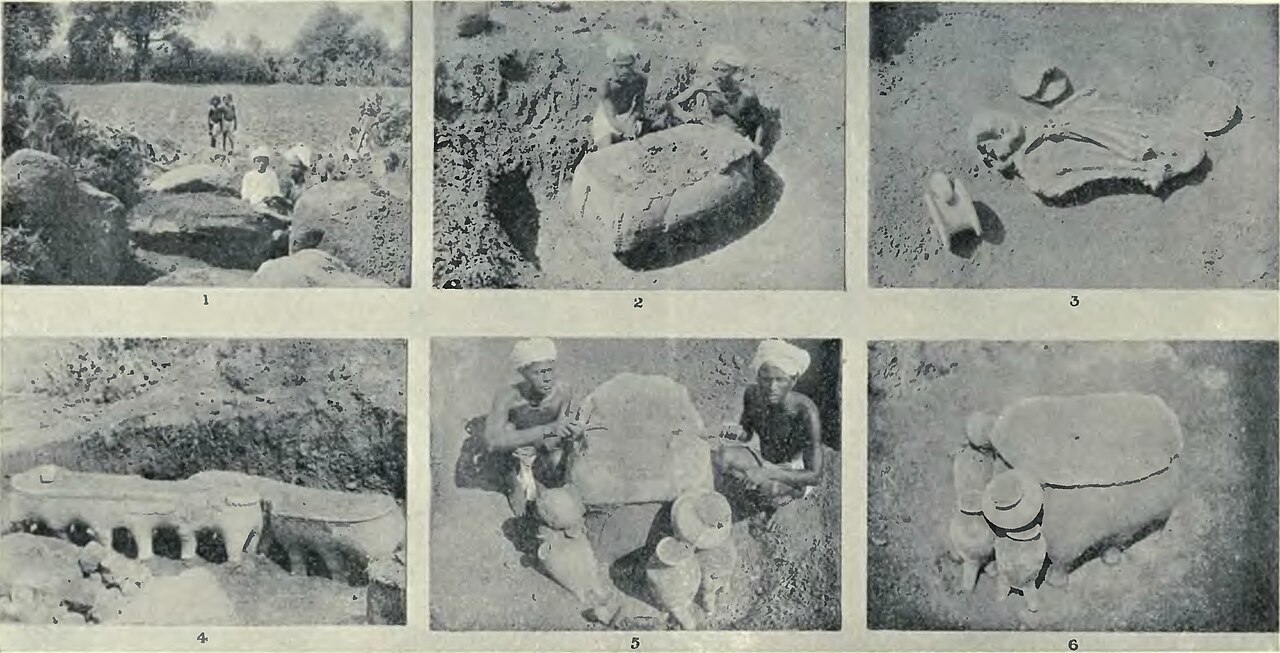
Sarcophagi and their contents from Perumbair, plate XIII in Alexander Rea's 1915 catalogue

Ariyannur · Photographed 2016-09-18 13:36:32
Ariyannur’s monuments in their present tree-covered setting

Eyyal · Photographed 2018-09-30 12:08:23
The pillar and floor inside the Eyyal burial cave

Pilicode · Photographed 2018-09-27 09:51:40
Pilicode burial-cave entrance and the protected area above it
006Where next

All related studies, connected material, books and sources21 · 4
Elsewhere on this site
Read this study with a guided path: Read a Tamil poem
Connected material
Photographs, drawings, books, videos and other studies linked to this study. A link helps you explore; it does not prove a historical claim.
- An umbrella-stone monument at Kudakkallu Parambu, CheramanangadphotographBackground
- A low capstone at Kudakkallu Parambu, CheramanangadphotographBackground
- Exposed upright stones at Kudakkallu Parambu, CheramanangadphotographBackground
- Side view of an umbrella-stone monument at Kudakkallu Parambu, CheramanangadphotographBackground
- A tilted capstone and its supports at Kudakkallu Parambu, CheramanangadphotographBackground
- Uncovered stone supports at Kudakkallu Parambu, CheramanangadphotographBackground
- A low rounded stone arrangement at Kudakkallu Parambu, CheramanangadphotographBackground
- A cluster of low monuments at Kudakkallu Parambu, CheramanangadphotographBackground
- The sunken approach to Kattakampal’s rock-cut burial cave, photographed in 2018photographBackground
- Two chamber openings at the Kattakampal burial cavephotographBackground
- View down into the multi-chambered Kattakampal burial cavephotographBackground
- Steps cut into laterite at the Kattakampal burial cavephotographBackground
- A chamber entrance at the Kattakampal burial cavephotographBackground
- A rock-cut bench inside a Kattakampal chamberphotographBackground
- Umbrella stones and exposed supports at AriyannurphotographBackground
- An umbrella stone at Ariyannur, viewed from the frontphotographBackground
- Close view of an Ariyannur umbrella-stone capstone and supportsphotographBackground
- The upright supports of an uncovered Ariyannur monumentphotographBackground
- Ariyannur’s monuments in their present tree-covered settingphotographBackground
- Overview of umbrella stones and an open monument at AriyannurphotographBackground
- The cut approach to Eyyal’s burial cavephotographBackground
- Two openings beside the rock pillar at the Eyyal burial cavephotographBackground
- Oblique view of the Eyyal burial-cave entrancephotographBackground
- A chamber entrance and floor recess at the Eyyal burial cavephotographBackground
- A raised bench inside the Eyyal burial cavephotographBackground
- The pillar and floor inside the Eyyal burial cavephotographBackground
- Interior of Eyyal’s burial cave, showing its central support and standing waterphotographBackground
- A dolmen with a front opening in the Marayoor landscapephotographBackground
- A Marayoor dolmen seen against the surrounding hillsphotographBackground
- A low dolmen partly obscured by grass at MarayoorphotographBackground
- Side view of a dolmen’s capstone and supporting slabs at MarayoorphotographBackground
- Exposed upright slabs in the Marayoor dolmen landscapephotographBackground
- The present dolmen setting at Marayoor, with mountains beyondphotographBackground
- Side view of the sunken approach and circular opening at Kandanassery burial cavephotographBackground
- Kandanassery burial cave, showing the approach and small chamber doorwayphotographBackground
- Steps and the chamber doorway at Kandanassery burial cavephotographBackground
- Ground-level view of the openings at Kandanassery burial cavephotographBackground
- Kandanassery burial cave viewed from the circular-opening sidephotographBackground
- The circular opening of Kandanassery burial cave, viewed from abovephotographBackground
- The rock-cut burial cave at Kakkad, seen from one cornerphotographBackground
- Overview of the exposed laterite outcrop containing Kakkad burial cavephotographBackground
- Chamber doorway below ground level at Kakkad burial cavephotographBackground
- The sunken approach and circular opening at Kakkad burial cavephotographBackground
- The floor and raised edge inside Kakkad burial cavephotographBackground
- Circular opening in the roof of Kakkad burial cavephotographBackground
- Steps descending into the rock-cut burial cave at ChowannurphotographBackground
- Chowannur burial cave, showing the approach and chamber entrancephotographBackground
- Detail of the chamber doorway at Chowannur burial cavephotographBackground
- The side and floor of the sunken approach at Chowannur burial cavephotographBackground
- Pilicode rock-cut burial cave in its present roadside settingphotographBackground
- The entrance to Pilicode rock-cut burial cavephotographBackground
- Circular roof opening at Pilicode rock-cut burial cavephotographBackground
- Pilicode burial-cave entrance and the protected area above itphotographBackground
- Oblique view of Pilicode burial cave and its roof openingphotographBackground
- Excavated cist burial at Enadimangalam, Figure 1, published page 568photographic figureShows the subject
- Unexcavated cist burials in the Enadimangalam study area, Figure 2, published page 568photographic figureShows the subject
- Ceramics from the Enadimangalam study area, Figure 3, published page 569photographic figureShows the subject
- Gold ornaments from Adichanallur, plate I in Alexander Rea's 1915 cataloguehistorical printed plateBackground
- Bronze vessels, ornaments and small objects from Adichanallur, plate II in Alexander Rea's 1915 cataloguehistorical printed plateBackground
- Iron weapons and implements from Adichanallur, plate III in Alexander Rea's 1915 cataloguehistorical printed plateBackground
- Iron tools and weapons from Adichanallur, plate IV in Alexander Rea's 1915 cataloguehistorical printed plateBackground
- Iron implements from Adichanallur, plate V in Alexander Rea's 1915 cataloguehistorical printed plateBackground
- Bowls and small pottery vessels from Adichanallur, plate VI in Alexander Rea's 1915 cataloguehistorical printed plateBackground
- Pottery vessels and stands from Adichanallur, plate VII in Alexander Rea's 1915 cataloguehistorical printed plateBackground
- Pottery vessels from Adichanallur, plate VIII in Alexander Rea's 1915 cataloguehistorical printed plateBackground
- Three large burial urns from Adichanallur, plate IX in Alexander Rea's 1915 cataloguehistorical printed plateBackground
- Pottery vessels from Perumbair, plate X in Alexander Rea's 1915 cataloguehistorical printed plateBackground
- Pottery, stone objects and other small finds from Perumbair, plate XI in Alexander Rea's 1915 cataloguehistorical printed plateBackground
- Legged pottery vessels from Perumbair, plate XII in Alexander Rea's 1915 cataloguehistorical printed plateBackground
- Sarcophagi and their contents from Perumbair, plate XIII in Alexander Rea's 1915 cataloguehistorical printed plateBackground
- Excavated burial urns and associated pottery at AdichanallurphotographBackground
- Excavated burial urns and associated pottery at AdichanallurphotographBackground
- Excavated burial urns and associated pottery at AdichanallurphotographBackground
- Excavated burial urns and associated pottery at AdichanallurphotographBackground
- Excavated burial urns and associated pottery at AdichanallurphotographBackground
- Excavated burial urns and associated pottery at AdichanallurphotographBackground
- Excavated burial urns and associated pottery at AdichanallurphotographBackground
- Archaeological pottery from Adichanallur displayed at the Government Museum, ChennaiphotographBackground
- Archaeological pottery from Adichanallur displayed at the Government Museum, ChennaiphotographBackground
- Archaeological pottery from Adichanallur displayed at the Government Museum, ChennaiphotographBackground
- Archaeological pottery from Adichanallur displayed at the Government Museum, ChennaiphotographBackground
- Archaeological pottery from Adichanallur displayed at the Government Museum, ChennaiphotographBackground
- Archaeological pottery from Adichanallur displayed at the Government Museum, ChennaiphotographBackground
- Excavated burial urns and trenches at Sivagalai (Sivakalai)photographBackground
- Excavated burial urns and trenches at Sivagalai (Sivakalai)photographBackground
- Excavated burial urns and trenches at Sivagalai (Sivakalai)photographBackground
- Excavated burial urns and trenches at Sivagalai (Sivakalai)photographBackground
- Excavated burial urns and trenches at Sivagalai (Sivakalai)photographBackground
- Excavated burial urns and trenches at Sivagalai (Sivakalai)photographBackground
- Excavated burial urns and trenches at Sivagalai (Sivakalai)photographBackground
- Archaeological features exposed inside a Sivagalai (Sivakalai) excavation trenchphotographBackground
- Overview of protected excavation trenches at Sivagalai (Sivakalai)photographBackground
- Excavated pit and stratified deposits at Sivagalai (Sivakalai)photographBackground
Books, videos and websites
Outside reading on this topic. These are not part of the study and we have not checked every claim in them. See all books and videos
- Iron Age in Kerala: An Overview and Recent Research | Dr Abhayan GS | ASC IITGN Video · G. S. Abhayan · Department of Archaeology, University of Kerala; host: Archaeological Sciences Centre, IIT Gandhinagar. · 55:53 · A research lecture on the varied burial monuments and recent investigations of Kerala’s Iron Age. A particularly strong match to the request to credit the people who carried out the research. Regional overview. It discusses Kerala burial types in general, so it does not fully cover any single site. Chronologies and grave interpretations still require the cited excavation reports.
007Sources
The study lists the sources it consulted; we have not rechecked them. A working link does not show that a source was read, and a valid identifier does not show that it supports a claim. We do not link to unofficial uploads or copies of publications. Where a study cited one, we show the published citation, or a publisher, DOI or Internet Archive link when we have one. Tracking codes are removed from links, and the sources themselves are not republished here.
Vaidehi Herbert, Sangam Poems Translated by Vaidehi. Purananuru 201–400: poems 228, 255 and 256. Source type: primary poetry in modern translation with commentary. Where in the source: 228: urn and royal greatness; 255: immovable body; 256: request for space. How much was read: Selected poems and accompanying notes read. Limits: Poetic appeals are not a burial blueprint, proof of compulsory widow death, or a dated funeral record. Access date: 2026-10-10.
G. S. Abhayan, S. V. Rajesh, Akinori Uesugi, Preeta Nayar et al.; Archaeological Research in Asia 27 (September 2021), 100293. Megalithic cist burial excavation at Enadimangalam in Kerala and its implications in cist burial architecture and burial practices. Source type: original excavation study, abstract/preview. Where in the source: 2019 excavation; double chamber, stone cot/bench and possible repeated use. How much was read: Publisher metadata/preview and reproduced abstract consulted; full article not read. Limits: No precise site radiocarbon date, body sequence or construction plan inferred from abstract. Access date: 2026-10-10.
Abhayan G. S. and Rajesh S. V.; Ala, Issue 36, 31 August 2021. Kerala during the “Age of Iron”: Findings from a Recent Excavation. Source type: first-person excavation account. Loc
Abhayan G. S. and Rajesh S. V.; Ala, Issue 36, 31 August 2021. Kerala during the “Age of Iron”: Findings from a Recent Excavation. Source type: first-person excavation account. Where in the source: Floor vessels versus fill sherds; later wedge marks; excavation method. How much was read: Full public article read; no reuse of photographs. Limits: Same excavation and authors as another source in this list, not independent confirmation. Broad settlement-absence claim not adopted; S38 reports habitation evidence. Access date: 2026-10-10.
N. Nikhil Das, P. P. Joglekar and R. K. Mohanty; Artha Journal of Social Sciences 12(3), 1 July 2013. New Light on the Unresolved Problem of Megalithic Habitation Sites in Kerala. Source type: original archaeology study, abstract. Where in the source: Abstract on eastern Kerala habitation evidence associated with burials. How much was read: Publisher abstract and metadata read; full PDF not read. Limits: Does not establish the detailed context of any single settlement from the abstract alone. Access date: 2026-10-10.
Researchers and institutions whose work this study uses: Abhayan G. S., Rajesh S. V., Vaidehi Herbert, Preeta Nayar
How we know The evidence, claims and dates behind this study
What this study draws on
- Close reading of Purananuru 228, 232, 255 and 256 in Vaidehi Herbert's modern English translation and notes.
- The published abstract of the 2021 Enadimangalam excavation report in Archaeological Research in Asia 27.
- The excavators' own first-person account in Ala (August 2021), labelled as their interpretation.
- The abstract of a 2013 Artha Journal of Social Sciences study of habitation sites in eastern Kerala.
Dates in this study
This study has no dates recorded in a form we can chart, so there is no date chart. Any dates it gives are in the full study.
The study’s claims
0 claims · 0 source passages · 11 paragraphs
Browse the study paragraph by paragraphThis study has no separately listed claims. Its paragraphs can be browsed one by one.
About this study Status, corrections and how it was made
Status
Draft study, revision 5. No historian, archaeologist, or Tamil or Malayalam specialist has reviewed it yet.
How it was made
Compiled as an editorial synthesis from published scholarship around questions we framed. About this project & workflow
The summary, How sure lines and Two views notes on this page were prepared from this study and cross-checked against its passages. That is an editorial check, not a specialist review.
Technical details
Study code R099. The text fingerprint changes whenever the study text changes.
- The study text is shown as written. Links from its paragraphs to citations help you move around the study; they are not new claims or checked source passages.
See how this study’s records were extracted
Text fingerprint (SHA-256): R099 · a62843f489f6ff5160abed7e… · v5
Evidence tables and technical details are on the web page: https://layersofthesouth.org/read/3883602f14