Exposed brick foundations identified in the source record as the Buddhist monastery at Poompuhar
Poompuhar
Photographed 2011-12-01
- Belief & memory
- 200 BCE–300 CE
- 300–600 CE
Early Tamil poems name many gods; dated shrines come later
Old Tamil poems name Murukan, Mayon, Shiva, Indra and a war goddess; datable shrines and devotional hymns appear only towards 600 CE.
- This page
- 6,808 words · revision 4
Draft study · Awaiting specialist review · Updated
001Dates and places

No mapped place in this study.
1000–500 BCE
Different beginnings
500–200 BCE
Marks & materials
200 BCE–300 CE
Connected worlds
300–600 CE
Change & continuity
After 600 CE
- between the second century BC and the first century AD (2005 press report)
- first and second centuries A.D. (Hart's date for the anthologies)
- r. c. 152 - 192 CE (Huvishka)
- A.D. 321-427 (charcoal, sand layer S2, Trench 1)
- Roman coin of Arcadius (395 - 400 CE)
- A.D. 405-564 (charcoal, corresponding deposit in nearby trench)
- Written in the 6th or 7th century (Karaikkal Ammaiyar)
- between the sixth and eighth centuries A.D. (Tēvāram poets)
- Phase II: Pallava period c. 6th - 8th century CE
- sixth to the tenth century ce (Vaishnava Prabandham)
- Mahendravarman I (c 600 - 630 CE)
- Between the years 650 and 940 (twelve Āḻvārs)
- Laboratory date
- Date from writing, coins or texts
- How it was dated is not stated
Each date belongs to what was dated (a sample, an object, a layer or a text), which is not always the event the study asks about.
Each period has the same width, so spacing is not to scale.
The full table of dates, with their ranges, is under How we know.
- 1 Well supported
- 1 Likely
- 1 Possible
- 1 Not known
002How sure
In brief
Poets writing in Old Tamil named Murukan of the hills, Mayon or Tirumal of the pastures, Shiva, Balarama, Indra and a fierce mountain goddess. Their poems are generally dated to the early centuries CE, though one scholar argues for the eighth or ninth. They describe a possession rite for Murukan and offerings at heroes' memorial stones. Poems from the Chera, Chola and Pandya kingdoms mention Vedic fires and gifts to Brahmins. Two epics describe an Indra festival at the port of Puhar. Inscriptions and excavation add far less before 600 CE. The one excavated shrine claimed as very early, at Saluvankuppam near Mamallapuram, was placed in the early Pallava period by its own final report. The earliest dated stone shrine in these sources, at Mandagappattu, belongs to about 600–630 CE. Poets of personal devotion such as Karaikkal Ammaiyar are placed in roughly the sixth and seventh centuries.
Key researchers cited in this study: Vaidehi Herbert (Sangam Poetry Translations & Commentaries) · R. Champakalakshmi (Trade, Ideology & Urbanization) · Kamil Zvelebil (Classical Tamil Philology) · George L. Hart (Classical Tamil Literature) · Full bibliography
How sure
- Well supported
The early poems name Murukan, Mayon/Tirumal, Shiva, Balarama, Indra and a war goddess, and describe Vedic and local rites.
The Tamil texts say so directly; what is disputed is when they were composed.
- Likely
Saluvankuppam's first brick building dates to the early Pallava period, before about 600 CE.
The ASI's final report says so, from a late Roman coin, brick size and two radiocarbon dates. None dates the building itself, and the dated sand layer lies above its ruins.
- Possible
A separate Tamil Murukan existed before he merged with the northern god Skanda.
It depends on an early date for the anthologies, and even core poems already mix in northern stories.
- Not known
How often kings performed Vedic sacrifices or held the Indra festival.
Poems and epics praise and describe these rites; no inscription or excavation read for this study mentions them.
Why it matters
Claims about the age of Tamil gods and temples in Tamil Nadu and Kerala often rest on these poems, so their dates and limits matter.
003Key findings
What the study concludes
- The early anthologies name Murukan, Mayon/Tirumal, Shiva, Balarama, Indra and a war goddess, sometimes in one poem.
- The Tolkāppiyam's landscape gods are a rule for poets, not a census of local cults.
- Poems from the Chera, Chola and Pandya kingdoms mention Vedic fire rites and gifts to Brahmins.
- The Tirumurukāṟṟuppaṭai's Murukan is already a composite of Tamil and northern elements.
- Saluvankuppam's first brick phase is early Pallava by its final report, not of the second century BCE as reported in 2005; Mandagappattu (c. 600–630 CE) is the earliest dated stone shrine in these sources.
In the study’s own words. How sure each point is, is shown above.
The summary above is the short read. The full study is the complete text it was drawn from, with its tables and source notes.
What the full study covers
- In brief
- Main findings
- What the sources are, and how far they can be dated
- Gods of the landscapes: the Tolkāppiyam rule
- Murukan: from the hill rite to the six-faced lord
- Mayon, Tirumal and Balarama
- Shiva in the poems
- Goddesses: Korravai and the deity of Ayirai
- Festivals: Indra at Puhar and Ōṇam at Madurai
- Vedic sacrifice and the Brahmins of the poems
- Offerings at memorial stones
- Shrines on the ground: Saluvankuppam and the first stone shrine
- The first devotional poets around 600 CE
- Two views on contested questions
- What remains uncertain
- Sources
004The study
In brief
Tamil Nadu and Kerala · c. 200 BCE–600 CE · poems, inscriptions and one excavated shrine
Poets writing in Old Tamil named Murukan of the hills, Mayon or Tirumal of the pastures, Shiva, Balarama, Indra and a fierce mountain goddess. They described possession rites, offerings at memorial stones, Vedic fire sacrifices and a city festival for Indra. Inscriptions and excavation add far less. The one excavated shrine claimed as very early, at Saluvankuppam near Mamallapuram, was placed in the early Pallava period by its own final report.
Why it matters. Claims about the age of Tamil gods, festivals and temples often rest on these poems, so their dates and limits decide what can be said.
How sure. The gods and rites named in the texts: Established. Their exact dates, and how far the poems describe real practice: from Likely to Not known, as set out below.
This page dates historical records, not living faith. This study keeps apart what a text or excavation report says, how specialists interpret it, and what remains unsettled. Devotional material is treated only as historical evidence. English renderings follow Vaidehi Herbert's translations unless stated.
Main findings
- Many gods, one literary world. The early anthologies name Murukan, Mayon/Tirumal, Shiva, Balarama, Indra and a war goddess, and sometimes set them side by side in one poem. How sure: Established.
- A grammar's map of gods and landscapes. The Tolkāppiyam pairs Māyōṉ with the forest-pasture, Cēyōṉ with the dark mountain, Vēntaṉ with the watered plain and Varuṇaṉ with the shore. It is a rule for poets, not a census of local cults. How sure: Established for the rule; Possible as a description of regional worship.
- Vedic sacrifice appears in poems from all three kingdoms. Poems from the Chera, Chola and Pandya kingdoms mention fire rites, the four Vedas and gifts to Brahmins. A Pallava king's Prakrit charter calls him an offerer of Vedic sacrifices. How sure: Established for the statements; Not known for how often such rites took place.
- The Murukan of the longer devotional poems is already a composite figure. The Tirumurukāṟṟuppaṭai gives him six faces, six mothers, Shiva and Parvati as parents, Korravai as mother and the praise of Brahmins. Whether a purely local hill god came first is argued, not settled. How sure: Established for the texts; Possible for an earlier separate god.
- The Indra festival of Puhar is a literary description. Two epics describe a drum procession, a ritual bath of Indra, temples of five gods and Vedic fire rites. No inscription or excavation read here documents it. How sure: Established as text; Possible as a record of a real festival.
- Excavated shrine evidence before 600 CE is thin. Saluvankuppam's final report puts its first brick phase in the early Pallava period, not the second century BCE reported in 2005. Its dating of that phase is indirect. The earliest dated stone shrine in the sources read here is Mahendravarman I's rock-cut cave at Mandagappattu, c. 600–630 CE. How sure: Likely that Saluvankuppam's first building predates c. 600 CE; Not known how much earlier it was built; Established for Mandagappattu.
- The first devotional poets belong to roughly the sixth and seventh centuries. Specialists place Karaikkal Ammaiyar, the first Alvars, Appar and Campantar there, with ranges differing by a century or more. How sure: Likely.
What the sources are, and how far they can be dated
The early Tamil sources come in layers, and each layer needs its own date. The first is the eight anthologies and ten long poems, on love (akam) and on war, kings and gifts (puṟam). George Hart dated this poetry to the first and second centuries CE. He read it as the record of a culture that continued the megalithic culture of the Deccan before significant Sanskrit influence from the north. ↗2 Herman Tieken argued that the poems describe an imagined past, borrow north Indian kāvya genres, and belong with the Pandya court of the eighth or ninth century. ↗3 Fred Clothey's encyclopedia survey follows the early dating for the poets and places the Tolkāppiyam around the start of the Common Era. ↗5 Tieken's late date has not displaced the early one in the scholarship read here, but the dating rests on argument, not on a dated inscription. Study “Sangam poems: early verse in later anthologies, dates debated” sets out that dating debate.
Some pieces inside the anthologies are clearly later than the poems. Invocation verses by Peruntēvaṉār head several anthologies; the translator notes they were written many centuries after the poems. ↗6 The epilogues (patikam) of the Patiṟṟuppattu, the Chera anthology, were also composed many centuries later. ↗12 The headings that name poet, patron and situation stand outside the poems, and their date is not known. A title or ritual detail found only in a heading or epilogue is therefore weaker evidence than the poem's own words.
The Paripāṭal and the Tirumurukāṟṟuppaṭai form a second layer. Kamil Zvelebil described them as two early devotional texts that stand apart from the rest of the corpus. ↗17 Their dates are disputed. Dikshitar recorded, and rejected, an astronomical argument for a seventh-century Paripāṭal. ↗4 Study “Star lore in early Tamil poems does not give exact dates” explains why sky passages cannot fix such dates. The final Saluvankuppam excavation report linked the "canonization" of Subrahmanya in the Tirumurukāṟṟuppaṭai to the Pallava period, around the seventh century. ↗21
The epics Cilappatikāram and Maṇimēkalai form a third layer; Dikshitar called them twin epics. ↗4 For the Cilappatikāram, recent scholarly placements fall in the fifth or sixth century CE (“Korravai resembles Kerala's Bhadrakali; no dated line joins them”, “Star lore in early Tamil poems does not give exact dates”), while Dikshitar argued for the second century. ↗4 This study assumes a similar range for the Maṇimēkalai, as an assumption rather than a finding. The Tolkāppiyam is the hardest text to date, and “Korravai resembles Kerala's Bhadrakali; no dated line joins them” declines to give it a single date.
Inscriptions form the last layer. Early Tamil-Brahmi cave inscriptions record gifts of rock beds to ascetics; at Sittanavasal the bed was made for a woman the commentary takes to be a Jain nun (“Sittanavasal's rock beds and cave temple come from different eras”). Inscribed memorial stones in the same script are known from Pulimankombai (“Early Tamil hero stones record names and a cattle raid”). The Pulankurichi rock inscription of the third to fifth centuries names temple-like foundations (devakulam) (“Pulankurichi rock texts record land rights, officers and temples”). Pallava charters bring the record to 600 CE.
Rock-cut bed and inscription at Ezhadippattam, Sittanavasal
Sittanavasal
Photographed Taken on 16 May 2012,
Not every bed and inscription visible here dates from the time of the early Tamil-Brāhmī inscription.
Gods of the landscapes: the Tolkāppiyam rule
The best-known statement about early Tamil gods is one rule in the Tolkāppiyam (Poruḷatikāram, Akattiṇaiyiyal, sūtra 5): māyōṉ mēya kāṭuṟai ulakamum / cēyōṉ mēya maivarai ulakamum / vēntaṉ mēya tīmpuṉal ulakamum / varuṇaṉ mēya perumaṇal ulakamum. The next line names these worlds, in order, mullai, kuṟiñci, marutam and neytal. ↗1 The following close gloss was drafted for this study with AI help and has not yet been checked by a Tamil specialist. It reads: the forest world loved by the Dark One, the dark-mountain world loved by the Red One, the sweet-water world loved by the King, and the wide-sand world loved by Varuṇaṉ.
Each name needs care. Dikshitar identified Cēyōṉ with Murukan and Māyōṉ with Krishna, "the Black God". ↗4 Hardy lists Māyōṉ and Tirumāl as names of Māl, the god of the later Vaishnava poets. ↗19 Vēntaṉ simply means "king", and the sūtra does not say which divine king is meant. An identification with Indra fits the mention of Indra's festival in a marutam poem, Aiṅkuṟunūṟu 62, but it is an inference. ↗9 Clothey's survey assigns Vēntaṉ to the pastoral region and rain, which does not match the sūtra's order. ↗5 ↗1 Varuṇaṉ carries a Vedic god's name. The dry pālai landscape has no god in this rule; the war goddess appears in another chapter, as koṟṟavai nilai among cattle-raid themes (“Korravai resembles Kerala's Bhadrakali; no dated line joins them”). ↗1
The rule can be read two ways. Dikshitar noted a view that these gods belonged to particular regions, but held that they were also Vedic and Puranic gods, so the two cultures had blended long before. ↗4 Clothey's survey reads the landscape gods as indigenous deities venerated in field and hill, reflecting the people of each zone. ↗5 The rule itself supports a narrower claim. It assigns gods to poetic landscapes so that poets can place a love scene. “Korravai resembles Kerala's Bhadrakali; no dated line joins them” makes the same point about the grammar's mention of Korravai: it is a rule of poetic classification, not an account of a cult. The grammar does not show that each landscape's people worshipped its god.
Murukan: from the hill rite to the six-faced lord
Evidence in the anthologies. In Akanāṉūṟu 59, a poem of separation, a friend recalls the springs of Parankundram, "the place of Murukan" who killed Sūr and his clan. ↗8 In Puṟanāṉūṟu 56, Nakkīrar praises a Pandya king by placing him among four gods, one of them Murukan with a peacock banner. The god's mount, piṇimukam, is rendered as a peacock; a commentary notes that some take the word to mean an elephant. ↗6 Studies “Sangam love poems let a friend dispute the velan's diagnosis” and “Early Tamil poems place the sacred in songs, rivers and gestures” read love poems in which a ritual specialist, the vēlaṉ, blames Murukan for a girl's distress while her friend disputes it.
Evidence in the Tirumurukāṟṟuppaṭai. This 317-line poem, attributed to Nakkīrar, guides a seeker to Murukan at six places: Tirupparankundram, Tiruccīralaivāy, Tiruvāviṉaṉkuṭi, Tiruvērakam, the hills where he dances (kuṉṟutōṟāṭal) and Paḻamutircōlai. It was later included in the eleventh book of the Shaiva canon. ↗10 The poem combines several strands. Lines 90–103 give him six faces, one attending to the Vedic rites of Brahmins and one delighting in Valli, daughter of a hill dweller. Lines 177–182 describe the "twice-born" at Ērakam, keepers of three sacred fires, chanting at the proper hour. Lines 190–197 show a garlanded vēlaṉ while hill hunters dance the kuravai circle dance. Lines 227–244 describe a woman of the hills who sets up a flag, ties red thread and scatters puffed rice. To call the god she offers white rice mixed with a goat's blood and spreads red millet mixed with blood. ↗10 The praises at lines 255–263 call him son of six mothers, son of Shiva under the banyan, son of the mountain king's daughter, son of Korravai, child of the ancient forest goddess and wealth of Brahmins. ↗10
Evidence in the Paripāṭal. Of the twenty-two poems in the main Paripāṭal collection, eight are for Murukan, six for Tirumāl and eight for the Vaiyai river. ↗11 Paripāṭal 8 describes the road from Kūṭal (Madurai) to Tirupparankundram, crowded with people carrying lamps, incense, drums, bells and images of peacocks, axes and elephants as offerings. Paripāṭal 19 shows the Pandya king and his ministers climbing the hill and walking around it, and recalls Murukan's marriage to Valli. ↗11
Evidence from outside the Tamil country. A second-century CE gold coin of the Kushan king Huvishka, now in the Harvard Art Museums, names SKANDO KUMARA VISHAKHA beside two standing figures. ↗18 Clothey describes the Skanda of north Indian epic as a son of Rudra-Shiva or Agni, a warrior god patronised by the Śakas, Ikṣvākus and Guptas. ↗16 A northern Skanda therefore existed in the centuries to which Hart and Clothey assign the early Tamil poems.
Interpretation. Clothey describes the earliest southern Murukan as a god of hill and hunt, worshipped from at least the third or second century BCE, whose southern and northern attributes merged by the eighth century CE. ↗16 Zvelebil rooted Murukan in the prehistoric culture of South India and Sri Lanka, quoting K. A. Nilakanta Sastri's description of him as an indigenous Tamil deity. He judged that the Paripāṭal and Tirumurukāṟṟuppaṭai already present a composite god. ↗17 Dikshitar read even the earliest Tamil mentions as signs of an old Sanskrit-Tamil synthesis. ↗4 If Tieken's late dating were accepted, the anthologies could not serve as a window on a pre-Sanskrit god at all. ↗3
Limits. No inscription read for this study names Murukan before 600 CE, and Clothey's early estimate is stated without its evidence. ↗16 At Saluvankuppam the dedication to Subrahmanya rests on the Phase II stone spear and on inscriptions of the eighth century and later. The earliest dated record there, of 743 CE, funds the Kārttikai festival at "the temple at Tiruvilichil"; in the report's summaries the god is first named in a record of 888 CE (pp. 27, 93). ↗21
Mayon, Tirumal and Balarama
Evidence. Mayon, "the Dark One", is the god of the forest-pasture in the Tolkāppiyam rule. ↗1 In Puṟanāṉūṟu 56 he is Tirumāl, sapphire-coloured, with a bird on his banner, beside Balarama, white as a conch, with a plough and a palmyra banner. ↗6 Puṟanāṉūṟu 58 compares allied Chola and Pandya kings to Balarama and Tirumāl. ↗6 Akanāṉūṟu 59 compares an elephant breaking a branch to Māl stepping on a kuruntam branch by the northern Yamuna to give leaf garments to herders' daughters. ↗8 That simile, inside a core anthology, expects its audience to know a Krishna story set in north India.
The Paripāṭal gives Tirumāl six hymns. ↗11 Patiṟṟuppattu 31, a poem for a Chera king, describes devotees who ring bells, keep fasting vows, bathe and pray together to Tirumāl with his discus and basil garlands. ↗12 The Maduraikkāñci (lines 590–599) names the Ōṇam day of Māyōṉ, "who defeated the Avuṇar", when rival warrior groups in Madurai staged elephant fights and spectators drank. ↗13 The passage is set in the Pandya capital and does not mention Mahābali. In the Cilappatikāram, Puhar has temples of Vāliyōṉ, the white Balarama, and Neṭiyōṉ, the dark Vishnu. ↗14 Dikshitar noted that the cults of Balarama and Indra later died out. ↗4
Interpretation. The dark god with a white brother, the bird banner and the Yamuna episode match Krishna and Balarama stories known in Sanskrit. Hardy describes the Māl of the later Alvars as combining attributes of the Krishna of the Bhagavadgītā and the earlier Purāṇas with those of Vishnu and Nārāyaṇa. ↗19 The early Tamil evidence fits a cult in which such stories were already familiar. It does not show when they arrived, or whether a local pastoral god came first.
Shiva in the poems
Evidence. Puṟanāṉūṟu 56 describes Shiva with a bull banner, flame-like matted hair, an axe and a sapphire-blue neck. ↗6 Puṟanāṉūṟu 6, read in “Early Tamil poems place the sacred in songs, rivers and gestures”, asks a Pandya king to bow his umbrella in circumambulation of the three-eyed god and to bend his head before Vedic specialists. The invocation that opens the Puṟanāṉūṟu gives the fullest early portrait: a koṉṟai garland, a white bull, a poison-stained throat, a body half female and a crescent moon. It belongs to the later layer of invocations. ↗6 The Cilappatikāram's festival canto lists first the temple of "the great one whose body was never born" (piṟavā yākkaip periyōṉ), which Dikshitar translates as Shiva. ↗14 ↗4 The Maṇimēkalai's festival announcement orders rites "from the lord with the eye in his forehead" down to the god of the crossroads. ↗15
Interpretation and limits. Shiva is present in the anthologies, but the fullest portrait comes from a later invocation. Among the inscriptions read here, the first that calls a king a worshipper of Shiva's liṅga is Mahendravarman I's at Tiruchirappalli, at the end of the period. The texts do not establish how widely Shiva was worshipped before then.
Goddesses: Korravai and the deity of Ayirai
Study “Korravai resembles Kerala's Bhadrakali; no dated line joins them” examines the war goddess Korravai (Koṟṟavai). It finds koṟṟavai nilai among cattle-raid themes in the Tolkāppiyam, a richer martial portrait in the Cilappatikāram's hunters' song, and no documented line from her to the later Kerala goddess Bhadrakali. This study adds two points.
First, the Tirumurukāṟṟuppaṭai calls Murukan "son of Korravai, victorious in war" (veṟṟi velpōrk koṟṟavai ciṟuva, line 258) and "child of the ancient one" (paḻaiyōḷ kuḻavi, line 259). The translator notes that the Perumpāṇāṟṟuppaṭai (lines 456–458) also makes the goddess mother of the Red One. ↗10 Here a war goddess and the hill god are already mother and son.
Second, the Chera anthology knows a fierce goddess on the mountain of Ayirai. Patiṟṟuppattu 79 wishes that a king's fame stay unblemished like Ayirai, where the goddess accepts only the blood of fallen warriors. Patiṟṟuppattu 88 recalls the king's ancestors heaping rice mixed with enemy blood on Ayirai. In Patiṟṟuppattu 90 the king's line worships Ayirai "by fearsome tradition" (urukeḻu marapiṉ ayirai paraviyum). ↗12 The Tamil of poem 79 calls her "the deity of Ayirai" (kaṭavuḷ ayirai). The name Korravai, used in the English translation, is supplied from commentary and does not occur in the Tamil of these passages. ↗12 The epilogue to the third decade says the king worshipped the Ayirai goddess with water brought from two seas. The epilogue to the fifth decade says Ceṅkuṭṭuvaṉ fetched a stone for a "goddess-wife" (kaṭavuḷ pattiṉi), which the translator renders as the Pattini goddess. ↗12 Both statements come from the later epilogues. The Pattini story is discussed in “Silappadikaram shows city work and justice, not a real itinerary” and “Korravai resembles Kerala's Bhadrakali; no dated line joins them”.
Festivals: Indra at Puhar and Ōṇam at Madurai
Evidence. A love poem, Aiṅkuṟunūṟu 62, compares a peahen's small head to "the flowers of the Indra festival", so the festival was familiar enough to serve as a simile. ↗9 The full descriptions come from the epics. In canto 5 of the Cilappatikāram, a drum is carried from the Vajra shrine at Puhar, the Chola port, on an elephant's neck (lines 141–144). Councillors, princes and merchants gather, and a thousand and eight kings bathe "the lord of the celestials" with Kaveri water from gold pots (lines 157–168). Rites follow at the temples of Shiva, Murukan, Balarama, Vishnu and Indra, with Vedic fire rites in one quarter (lines 169–175). The "halls of the virtuous" (aṟavōr paḷḷi) also take part (lines 179–181); Dikshitar renders them as Jaina temples, while noting they could be Buddhist or orthodox institutions. ↗14 ↗4
Rocky hillside and vegetation at Tirupparankunram
Tirupparankunram
Photographed 2018-08-31
The first canto of the Maṇimēkalai announces the same festival. At the urging of the sage of the Malaya hills, a Chola king asks the king of the gods to stay in the city for twenty-eight days (nāl ēḻ nāḷ). A drum from the Vajra shrine is mounted on an elephant. The crier orders the streets decorated, rites performed for every deity, and debaters of every creed to argue in the debating hall without hostility. ↗15 Dikshitar described an annual festival beginning at the full moon of Cittirai, linked it with the Sanskrit Indra-banner festival, and called the Tamil form of Indra worship "a puzzle". ↗4
Interpretation and limits. The two epics agree in outline. Both are literary works set in a heroic past. They show what their authors thought a festival at a great port should contain: royal patronage, many gods, Vedic rites and public debate. No inscription or excavation read for this study documents an Indra festival at Puhar; the archaeology of Kaveripattinam is discussed in “Silappadikaram shows city work and justice, not a real itinerary”.
The Maduraikkāñci's Ōṇam day of Māyōṉ at Madurai, described above, is a second named festival. ↗13 Its relation to the later Kerala festival lies outside this study's period and needs its own dated register of evidence.
Vedic sacrifice and the Brahmins of the poems
Evidence in the poems. Puṟanāṉūṟu 15 asks a Pandya king whether his defeated enemies outnumber the fields where he planted sacrificial posts after rites of the four Vedas, with abundant ghee. ↗6 His epithet Palyākacālai ("of many sacrificial halls") appears only in the heading, not in the poem. ↗6 Puṟanāṉūṟu 166 addresses a Brahmin of Pūñcāṟṟūr in the Chola country. He is heir to men who performed twenty-one rituals and upheld an ancient work of "four divisions and six sections"; he wears a deer skin over his sacred thread and pours "more ghee than water". ↗6 Puṟanāṉūṟu 2, for a Chera king, wishes him to stand firm even if the four Vedas should swerve. It pictures deer sleeping by the Brahmins' three fires, and credits the king with feeding the warring "five" and "hundred", whom the commentary identifies with the Pandavas and Kauravas. ↗6 Study “Peruñcōṟu, royal food-giving in Tamil poems, had several meanings” shows that this epic identification comes from the commentary, not from the poem's wording. In Puṟanāṉūṟu 367, Auvaiyar urges the Chola, Chera and Pandya kings to give flowers and gold to Brahmins, pouring water as they give. The Chola king's title "who performed the rājasūya" is only in the heading. ↗7 Study “The Patiṟṟuppattu is layered Chera praise poetry, not an archive” reads Patiṟṟuppattu 64, where a completed vēḷvi (sacrifice) is followed by gifts to Brahmins, and the seventh-decade epilogue credits the king with renowned rituals. ↗12 The Tirumurukāṟṟuppaṭai's twice-born at Ērakam and the Cilappatikāram's festival fire rites carry the theme into the later layers. ↗10 ↗14
Evidence in inscriptions. The Hīrahaḍagaḷḷi copper plates of the Pallava king Śivaskandavarman, issued from Kāñcīpuram in his eighth regnal year in Prakrit with Sanskrit portions, call him an offerer of the Agniṣṭoma, Vājapeya and Aśvamedha sacrifices. They confirm a garden grant to twenty-four Brahmins. ↗20 Such Prakrit charters precede the Sanskrit Pallava plates of the fourth to sixth centuries (“Pulankurichi rock texts record land rights, officers and temples”, “South India around 600 CE: change in stages, not one break”). Brahmin settlements (brahmadeya) appear in a Tamil record at Pulankurichi (“Pulankurichi rock texts record land rights, officers and temples”). The eighth-century Vēḷvikkuṭi grant remembers a Pandya king's sacrifice as the origin of a land grant (“Velvikkudi plates: an eighth-century memory of the Kalabhras”).
Interpretation. Clothey's survey has Brahmins influenced by Vedic and epic traditions entering the Tamil landscape around the third century CE, employed by chieftains whose status their rites enhanced. ↗5 Hart stressed instead a poetry that describes a culture before significant Sanskrit influence. ↗2 Champakalakshmi treats the later dominance of the Brahmanical tradition as a historical process, and her collection questions an assumed continuity between Vedic and modern Hinduism. ↗29
Limits. The poems show that poets praised kings for Vedic rites and treated Brahmins as honoured recipients of gifts. They do not show how often such rites were performed, where or by whom. Epithets found only in headings, such as Palyākacālai and the rājasūya title, are weaker evidence than the poems themselves.
Offerings at memorial stones
Some rites in the poems address no named god. Puṟanāṉūṟu 232, Auvaiyar's lament for Atiyamāṉ, describes his memorial stone adorned with peacock feathers, with liquor poured before it. ↗7 Puṟanāṉūṟu 329 describes a town where each morning the memorial stones are given offerings, washed and lit with ghee lamps. ↗7 The fragmentary Puṟanāṉūṟu 335 says there is no god other than the memorial stone of a hero who held back enemies. ↗7 Inscribed memorial stones in Tamil-Brahmi are known from Pulimankombai in the Vaigai basin (“Early Tamil hero stones record names and a cattle raid”), and the later hero stones of northern Tamil Nadu are studied in “Chengam hero stones: no simple sequence of weapons or scripts”. Of the rites in the poems, this is the one that archaeology matches most closely with dated objects.
Hero stone in the Chengam area with present-day ritual pigments
Chengam
Photographed 2021-04-14
Shrines on the ground: Saluvankuppam and the first stone shrine
What the texts describe. The Tirumurukāṟṟuppaṭai's mountain rite takes place in the god's "fierce, wide temple" (urukeḻu viyal nakar). ↗10 The Cilappatikāram names five temples (kōyil) at Puhar. ↗14 The Pulankurichi inscription records two devakulam foundations and a shrine of Vāsudeva whose religious identity is debated (“Pulankurichi rock texts record land rights, officers and temples”). None of these texts tells us what such places looked like or how old they were.
What was excavated at Saluvankuppam. The December 2004 tsunami exposed new lines of a boulder inscription of the Rashtrakuta king Krishna III (939–967 CE) at Saluvankuppam, just north of Mamallapuram. Beside it is a known inscription of the Chola king Kulottunga III (1178–1218 CE). Both mention a temple of Subrahmanya. ↗21 The Archaeological Survey of India (ASI) excavated a nearby mound in 2005 under T. Satyamurthy and in 2006–07 under Sathyabhama Badhreenath. ↗21
In September 2005 the Associated Press reported that the temple, dedicated to Muruga, appeared to have been built between the second century BCE and the first century CE. The excavation leader, T. Satyamurthy, called it the earliest temple found in the region and said its stucco figurines, terracotta lamps, beads and roofing tiles were typical of the early first millennium. ↗22 The ASI's final report, Memoir 107 (2015), gives a different picture. ↗21
- It divides the site into three phases (p. 22). Phase I is early Pallava, before the sixth century CE. Phase II is Pallava, c. sixth to eighth century, with a late Pallava sub-phase to the tenth. Phase III is Chola, c. tenth to thirteenth century.
- Phase I was a modest rectangular brick building, about 7.5 by 8 metres, on a dressed laterite foundation, entered from the north. The report says it "did not exhibit any of the customary features usually associated with a temple". It treats the identification as a temple as a surmise from later inscriptions, and says a north-facing entrance does not by itself show an early date (pp. 22–26).
- The report dates Phase I indirectly. A late Roman copper coin, identified as one of the emperor Arcadius (around 400 CE), lay just outside the building at the level of the top of its laterite foundation. With the large bricks, it led the excavators to a date before the sixth century. A Pallava coin bearing a title of Mahendravarman I strengthened their view that the building already stood in the early seventh century (pp. 22–25, 71, 116).
- A stone spear (vēl), 1.60 metres high, stands on a brick platform where a flagstaff would usually be. It belongs to Phase II, as do a brick offering platform and two ring wells. Two mid-eighth-century inscriptions linked with this phase record gifts of gold for the Kārttikai festival (p. 27).
- A geological study in the report dated charcoal from a thin sand layer, read as a sea-surge deposit, to AD 321–427 and AD 405–564. That layer lies above the ruins of the Phase I building (p. 109). The conclusion matches the later range with Phase I (p. 118).
- The conclusion notes the continued absence of ritual elements in the sanctum and asks whether the building was a temple. It then infers a popular temple from many terracotta lamps and the inscriptions (p. 117). It compares the lime plaster with that of Rajasimha's Shore Temple and calls the complex "primarily Pallava in its origin and development" (p. 118).
Interpretation and limits. The 2005 press date is not supported by the excavators' final publication, which is the stronger source. None of the report's evidence dates the building's construction directly. A coin shows only that the layer around it formed after the coin was struck. The radiocarbon results date charcoal in a sand layer that formed after the Phase I building was already in ruins, and such charcoal can be older than the layer. Together they suggest that the first brick building stood by about the fifth or sixth century CE; how much earlier it was built is not known. It may have been a shrine, but its dedication to Murukan rests on eighth-century and later inscriptions and the Phase II spear. How sure: Likely that the first brick building predates c. 600 CE; Not known how much earlier it was built; Possible that it was already a Murukan shrine.
The earliest dated stone shrine in these sources. A pillar inscription in the rock-cut cave at Mandagappattu, Villupuram district, records a shrine for Brahmā, Īśvara (Shiva) and Vishnu. King Vicitracitta made it without bricks, timber, metal or mortar. The editors identify Vicitracitta with the Pallava Mahendravarman I, who bore that title. ↗23 The ASI memoir dates him c. 600–630 CE (p. 2), and its foreword infers from this inscription and the Sangam classics that earlier temples were built of perishable materials. ↗21 At Tiruchirappalli, a cave inscription calls King Guṇabhara a worshipper of the liṅga, in E. Hultzsch's 1890 translation. ↗24 The editors of the other inscriptions in the same upper cave identify Guṇabhara with Mahendravarman I. ↗30 “South India around 600 CE: change in stages, not one break” treats Mandagappattu as boundary evidence at 600 CE.
What has not been found. The Tamil Nadu archaeology department reported in 2019 that no worship-related objects had so far been found at Keezhadi (“Keezhadi (Keeladi)'s excavations reveal a substantial brick settlement”). That study explains why the absence does not show a "secular" town. In Kerala, the excavated temple localities around Kodungallur are dominated by ninth-century and later occupation (“Kodungallur digs found medieval layers, Pattanam much older ones”). The sources read here report no excavated Kerala shrine from before 600 CE.
The first devotional poets around 600 CE
Towards the end of the period a new kind of poetry appears: first-person hymns of love and longing to Shiva or Vishnu, often naming particular shrines. Each poet's date rests on scholarly argument, not on an inscription.
Karaikkal Ammaiyar. Her surviving works are 143 verses in the eleventh book of the Shaiva canon: two hymns on Tiruvālaṅkāṭu, the Tiru-iraṭṭai-maṇimālai and the Aṟputat-tiruvantāti. ↗25 In the Tiruvālaṅkāṭu hymns she signs herself the ghoul (pēy) of Kāraikkāl, and Shiva dances in the cremation ground among ghouls. ↗25 The publisher's description of Elaine Craddock's study dates her poetry to the sixth or seventh century. It describes her as believed to be the first to write devotional poetry to Shiva in Tamil. ↗26 Clothey calls her probably the earliest Nāyaṉār and places her in the seventh century. ↗5 Her life story survives in later hagiography, not used here as evidence for her date.
The first three Alvars. Poykai, Pūtam and Pēy are each credited with a hundred-verse antāti in the Vaishnava canon. Each opens with a lamp or a vision. For Poykai the world is the lamp, the sea the ghee and the sun the flame. For Pūtam love is the lamp and longing the ghee. Pēy begins "I saw Tiru, I saw the golden form". ↗27 Their dates are uncertain. Hardy judged the sixth to tenth centuries the most likely period for the Vaishnava canon as a whole. ↗19 Clothey places the twelve Alvars between 650 and 940. ↗5 The Saluvankuppam report gives Pūtattāḻvār a fifth- or sixth-century date and notes that he names Mallai (Mamallapuram) as a centre of Vishnu worship (p. 13). ↗21
Appar, Campantar and Cuntarar. The Tēvāram, the core of Tamil Shaiva scripture, was composed, in its publisher's words, by three poet-saints "between the sixth and eighth centuries". Peterson presents it as part of one of the first popular large-scale devotional movements within Hinduism. ↗28 That range overlaps the reign of Mahendravarman I.
Continuity and change. Zvelebil traced the beginnings of devotional attitudes to the Paripāṭal and Tirumurukāṟṟuppaṭai, and the Paripāṭal's translator makes the same point. ↗17 ↗11 The book that preserves Karaikkal Ammaiyar's verses also includes the Tirumurukāṟṟuppaṭai and verses credited to Nakkīrar, Kapilar and Paraṇar, names borne by anthology poets. ↗25 ↗10 That shows later Shaiva tradition claiming the older poets, not that the same individuals wrote both kinds of verse. Kerala's own devotional geography lies after 600 CE: Nammāḻvār's hymns naming Tirunāvāy are placed in the eighth or ninth century (“Mamankam at Thirunavaya is not attested before 600 CE”).
Two views on contested questions
Was Murukan originally a Tamil god?
- View A. Zvelebil and Clothey treat the early southern Murukan as an indigenous god, later merged with or identified as the northern Skanda. ↗17 ↗16 Zvelebil roots him in South Indian prehistory; Clothey contrasts the anthologies' god of hill and hunt with the Skanda of northern epic myth. ↗17 ↗16 A Kushan coin naming Skanda shows that the northern god existed by the second century CE. ↗18
- View B. Dikshitar held that the gods of even the earliest Tamil poems were already Vedic and Puranic. ↗4 Tieken's late dating implies that the poems cannot reveal a pre-Sanskrit god at all. ↗3 Akanāṉūṟu 59, a core-anthology poem about Murukan's Parankundram, also alludes to a Krishna story set by the Yamuna, which is consistent with this view. ↗8
- What would settle it. Securely dated inscriptions or cult objects naming Murukan before the composite imagery appears, and an agreed chronology for the anthology layers.
How far was early Tamil religion shaped by Sanskrit traditions?
- View A. Hart read the anthologies as describing a culture that continued the megalithic culture of the Deccan before significant Sanskrit influence. ↗2 Clothey dates the arrival of Vedic Brahmins as a social force to around the third century CE. ↗5
- View B. Poems from the Chera, Chola and Pandya kingdoms name the four Vedas, sacrificial posts and Brahmins' fires, and assume knowledge of Krishna stories. ↗6 ↗8 The commentary also reads a Mahābhārata allusion into Puṟanāṉūṟu 2. ↗6 Dikshitar took this as evidence of an early blend. ↗4 Champakalakshmi treats the dominance of the Brahmanical tradition as a later historical process and questions an assumed continuity between Vedic and modern Hinduism. ↗29
- What would settle it. Independent dates for individual poems, especially those with Vedic and epic content, and more dated early inscriptions recording religious gifts.
How old is the Saluvankuppam shrine?
- View A. In 2005, while the excavation was under way, the Associated Press reported a date of the second century BCE to first century CE. The excavation leader called the finds typical of the early first millennium. ↗22
- View B. The ASI's 2015 final report assigns the first phase to the early Pallava period, before the sixth century CE. It relies on a late Roman coin, brick size and two radiocarbon dates, and calls the complex primarily Pallava. ↗21
- What would settle it. Direct dates on the building, such as luminescence dates on bricks or radiocarbon dates on charcoal sealed beneath the foundation.
What remains uncertain
- The dates of the poems. The anthologies, devotional hymns and epics each have a disputed date range, and a rite in a poem cannot be dated more closely than the poem.
- How far poetry reflects practice. The poems follow conventions of landscape and praise. They show what could be said to a patron or audience, not how often a rite occurred.
- Later layers inside early collections. Invocations and the Patiṟṟuppattu epilogues are later than the poems, and the headings are of unknown date. The rājasūya title and the Pattini stone come only from these layers.
- The identity of the gods named. Vēntaṉ as Indra, piṇimukam as peacock or elephant, and the name Korravai for the Ayirai goddess all depend on commentary or translation.
- Material evidence before 600 CE. The sources read here report no inscription naming Murukan or Mayon before 600 CE and one excavated candidate shrine, whose first phase lacks direct dates and ritual objects.
- The first devotional poets. Karaikkal Ammaiyar, the first Alvars, Appar and Campantar are dated by argument. Estimates run from the fifth century to the eighth, and later still for the Vaishnava canon as a whole.
- Kerala. The Chera anthology is the nearest the early poems come to Kerala, though its kings are also hailed as lords of the Kongu country, now in Tamil Nadu. ↗12 It shows Tirumāl worship and a fierce mountain goddess, but the sources read report no Kerala shrine, and no Kerala inscription naming a god or a shrine, from before 600 CE.
Sources
- Tolkāppiyar (attributed). Tolkāppiyam, Poruḷatikāram. Project Madurai e-text (K. Kalyanasundaram, N. D. Logasundaram), 1998–2024. https://projectmadurai.org/pm_etexts/utf8/pmuni0100.html. Supports: the landscape-gods sūtra (Akattiṇaiyiyal 5); koṟṟavai nilai.
- George L. Hart III. 1973. "Woman and the Sacred in Ancient Tamilnad." The Journal of Asian Studies 32 (2): 233–250. https://doi.org/10.2307/2052342. Abstract read. Supports: early dating and pre-Sanskrit reading of the anthologies.
- Herman Tieken. 2003. "Old Tamil Caṅkam Literature and the So-called Caṅkam Period." The Indian Economic and Social History Review 40 (3): 247–278. https://doi.org/10.1177/001946460304000301. Abstract read. Supports: the late-dating view.
- V. R. Ramachandra Dikshitar, trans. 1939. The Silappadikaram. Oxford University Press; Digital Library of India scan. https://archive.org/details/in.ernet.dli.2015.201802. Supports: canto 5 translation; his views on early Tamil gods, the Indra festival and Balarama; the Paripāṭal dating note.
- Fred W. Clothey. 1987. "Tamil Religions." Encyclopedia of Religion, via Encyclopedia.com. https://www.encyclopedia.com/environment/encyclopedias-almanacs-transcripts-and-maps/tamil-religions. Supports: Clothey's dates and his reading of the landscape gods and Brahmins.
- Vaidehi Herbert, trans. Undated web edition. "Ettuthokai – Purananuru 1–200." Sangam Poems Translated by Vaidehi. https://sangamtranslationsbyvaidehi.com/ettuthokai-purananuru-1-200/. Supports: Puṟanāṉūṟu 1, 2, 15, 56, 58 and 166 with Tamil text, colophons and notes.
- Vaidehi Herbert, trans. Undated web edition. "Ettuthokai – Purananuru 201–400." https://sangamtranslationsbyvaidehi.com/ettuthokai-purananuru-201-400/. Supports: Puṟanāṉūṟu 232, 329, 335 and 367.
- Vaidehi Herbert, trans. Undated web edition. "Ettuthokai – Akananuru 1–120." https://sangamtranslationsbyvaidehi.com/ettuthokai-akananuru-1-100/. Supports: Akanāṉūṟu 59.
- Vaidehi Herbert, trans. Undated web edition. "Ettuthokai – Ainkurunuru." https://sangamtranslationsbyvaidehi.com/ettuthokai-ainkurunuru/. Supports: Aiṅkuṟunūṟu 62.
- Vaidehi Herbert, trans. Undated web edition. "Pathuppattu – Thirumurukatruppadai." https://sangamtranslationsbyvaidehi.com/pathuppattu-thirumurukatruppadai/. Supports: the six places, faces, Ērakam Brahmins, vēlaṉ, hill woman's rite and epithets.
- Vaidehi Herbert, trans. Undated web edition. "Ettuthokai – Paripadal." https://sangamtranslationsbyvaidehi.com/ettuthokai-paripadal/. Supports: topics of the 22 poems; Paripāṭal 8 and 19; translator's view of early devotional poetry.
- Vaidehi Herbert, trans. Undated web edition. "Ettuthokai – Pathitruppathu." https://sangamtranslationsbyvaidehi.com/pathitruppathu/. Supports: Patiṟṟuppattu 31, 64, 79, 88, 90; epilogues of decades 3, 5 and 7; lateness of the epilogues.
- Vaidehi Herbert, trans. Undated web edition. "Pathuppattu – Mathuraikkanji." https://sangamtranslationsbyvaidehi.com/pathuppattu-mathuraikkanji-1/. Supports: Maduraikkāñci 590–599.
- Iḷaṅkō Aṭikaḷ (attributed). Cilappatikāram, Puhārkkāṇṭam. Project Madurai e-text. https://www.projectmadurai.org/pm_etexts/utf8/pmuni0046.html. Supports: canto 5, lines 141–190.
- Cīttalaic Cāttaṉār (attributed). Maṇimēkalai. Project Madurai e-text. https://www.projectmadurai.org/pm_etexts/utf8/pmuni0141.html. Supports: canto 1, lines 1–72.
- Fred W. Clothey. 1987 (revised 2005). "Murukaṉ." Encyclopedia of Religion, via Encyclopedia.com. https://www.encyclopedia.com/environment/encyclopedias-almanacs-transcripts-and-maps/murukan. Supports: Murukan as god of hill and hunt; northern Skanda; merger by the eighth century.
- Kamil V. Zvelebil. 1991. Tamil Traditions on Subrahmanya-Murugan, introduction. Madras: Institute of Asian Studies; reproduced at murugan.org. https://www.murugan.org/research/zvelebil-tamil_traditions-intro.htm. Supports: Murukan rooted in South Indian prehistory (with Nilakanta Sastri's "indigenous"); the two early devotional texts and their composite god.
- Harvard Art Museums. "Coin of Huvishka." Object 1.1965.2729. https://harvardartmuseums.org/collections/object/169831. Supports: Kushan coin naming SKANDO KUMARA VISHAKHA; second century CE (the record gives the reign as c. 152–192 CE and the object date as 111–129 CE).
- Friedhelm E. Hardy. 1987 (revised bibliography). "Āḻvārs." Encyclopedia of Religion, via Encyclopedia.com. https://www.encyclopedia.com/environment/encyclopedias-almanacs-transcripts-and-maps/alvars. Supports: sixth to tenth centuries for the Vaishnava canon; Māl, Tirumāl and Māyōṉ as one god.
- Emmanuel Francis, ed. 2019–2026. "Hīrahaḍagaḷḷi plates, time of Śiva-Skandavarman, year 8." DHARMA, after J. G. Bühler, Epigraphia Indica 1 (1892). https://dharmalekha.info/texts/INSPallava00003. Supports: Pallava king as offerer of Vedic sacrifices; grant to 24 Brahmins.
- Sathyabhama Badhreenath. 2015. Śāḷuvāṉkuppam Excavations 2005–07. Memoirs of the Archaeological Survey of India 107. New Delhi: ASI. https://archive.org/details/saluvankuppamexc00badh. Supports: excavation history, phases, coins, inscriptions, radiocarbon results and conclusions.
- Associated Press. 2005. "Did an ancient tsunami ruin temple?" Taipei Times, 23 September 2005, p. 4. https://www.taipeitimes.com/News/world/archives/2005/09/23/2003272813. Supports: the 2005 early date for Saluvankuppam and T. Satyamurthy's statements.
- Emmanuel Francis, ed., after V. Venkatasubba Ayyar. 2019–2026. "SII 12.12: Maṇḍagappaṭṭu pillar inscription." DHARMA. https://dharmalekha.info/texts/INSSIIv12p0i0012. Supports: Vicitracitta's shrine for Brahmā, Īśvara and Vishnu without brick, timber, metal or mortar.
- Emmanuel Francis, ed., after E. Hultzsch (1890). 2019–2026. "SII 1.33: Trichinopoly cave inscription." DHARMA. https://dharmalekha.info/texts/INSSIIv01p0i0033. Supports: Guṇabhara as worshipper of the liṅga (Hultzsch's translation).
- Kāraikkāl Ammaiyār and others. Patiṉōrām Tirumuṟai, part 1. Project Madurai e-text. https://www.projectmadurai.org/pm_etexts/utf8/pmuni0126.html. Supports: Karaikkal Ammaiyar's 143 verses and signature; contents of the eleventh book.
- Elaine Craddock. 2010. Śiva's Demon Devotee: Kāraikkāl Ammaiyār. Albany: SUNY Press. https://muse.jhu.edu/book/523. Publisher description read. Supports: sixth- or seventh-century date; first Tamil devotional poet of Shiva.
- Poykai, Pūtam and Pēy Āḻvārs. Mutal, Iraṇṭām and Mūṉṟām Tiruvantāti. Project Madurai e-text. https://www.projectmadurai.org/pm_etexts/utf8/pmuni0007.html. Supports: opening verses of the three poems.
- Indira Viswanathan Peterson. 1989. Poems to Siva: The Hymns of the Tamil Saints. Princeton University Press. https://press.princeton.edu/isbn/9780691609263. Publisher description read. Supports: Tēvāram poets between the sixth and eighth centuries.
- R. Champakalakshmi. 2011. Religion, Tradition, and Ideology: Pre-colonial South India. New Delhi: Oxford University Press. https://www.india.oup.com/product/religion-tradition-and-ideology-9780198070597. Publisher description read. Supports: the rise of the Brahmanical tradition as a process; doubts about Vedic-to-modern continuity.
- Emmanuel Francis, ed., after V. Venkatasubba Ayyar (1943). 2019–2026. "SII 12.8: Trichinopoly, upper cave inscriptions." DHARMA. https://dharmalekha.info/texts/INSSIIv12p0i0008. English summary read. Supports: the upper cave made by Guṇabhara, identified with Mahendravarman I.
005Photographs
Photographs of the places and objects this study discusses. Each item carries its creator’s credit, licence and documented source. See all 412 photographs and source images ↗
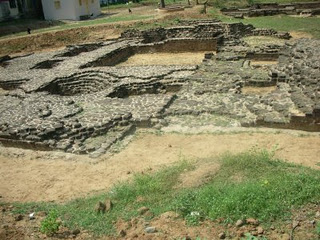
Poompuhar · Photographed 2011-12-01
Exposed brick foundations identified in the source record as the Buddhist monastery at Poompuhar

Sittanavasal · Photographed Taken on 16 May 2012, 18:03:51
Rock-cut bed and inscription at Ezhadippattam, Sittanavasal
Not every bed and inscription visible here dates from the time of the early Tamil-Brāhmī inscription.

Tirupparankunram · Photographed 2018-08-31 15:49:59
Rocky hillside and vegetation at Tirupparankunram

Chengam · Photographed 2021-04-14 16:00:07
Hero stone in the Chengam area with present-day ritual pigments
Hero stone from Chengam Lake (attributed by the uploader to the 10th century CE) with present-day ritual pigments.

Poompuhar · Photographed 2015-12-12 15:59:25
Present-day coastal and river-mouth landscape at Poompuhar, viewed from the lighthouse

Tirupparankunram · Photographed 2006-06-07
Palms and the granite hill at Tirupparankunram
006Two views
Both views are shown at equal weight; this site does not choose between them.
Whether Murukan was originally a Tamil god
- One view
- Kamil Zvelebil roots Murukan in South Indian prehistory. Fred Clothey contrasts the anthologies' god of hill and hunt with the northern Skanda of epic myth.
- Another view
- V. R. R. Dikshitar held that even the earliest Tamil gods were already Vedic and Puranic. Herman Tieken's late dating of the poems means they cannot show a pre-Sanskrit god at all.
- What would settle it
- Securely dated inscriptions or cult objects naming Murukan before the composite imagery appears, and an agreed chronology for the anthology layers.
How far early Tamil religion was shaped by Sanskrit traditions
- One view
- George Hart read the anthologies as describing a culture that continued the megalithic culture of the Deccan before significant Sanskrit influence. Clothey dates Vedic Brahmins as a social force to around the third century CE.
- Another view
- Poems from all three kingdoms name the four Vedas, sacrificial posts and Brahmins' fires, and assume Krishna stories. Dikshitar took this as an early blend. R. Champakalakshmi treats Brahmanical dominance as a later historical process.
- What would settle it
- Independent dates for individual poems with Vedic and epic content, and more dated early inscriptions recording religious gifts.
How old the Saluvankuppam shrine is
- One view
- In 2005, during the dig, an Associated Press report dated the temple to the second century BCE to first century CE. The excavation leader called its finds typical of the early first millennium.
- Another view
- The ASI's 2015 final report, by Sathyabhama Badhreenath, places the first phase in the early Pallava period before the sixth century CE. It cites a late Roman coin, brick size and radiocarbon dates, and calls the complex primarily Pallava.
- What would settle it
- Direct dates on the building, such as luminescence dates on the bricks or radiocarbon dates on charcoal sealed beneath the foundation.
007Where next
Puṟanāṉūṟu 6 asks a Pandya king to bow before the three-eyed god. Love poems show a ritual specialist blaming Murukan for a girl's distress.
On the timelineDates in this studySee these dates on the timeline
Explore nextExposed brick foundations identified in the source record as the Buddhist monastery at PoompuharAll related studies, connected material, books and sources41 · 30
Elsewhere on this site
Connected material
Photographs, drawings, books, videos and other studies linked to this study. A link helps you explore; it does not prove a historical claim.
- Exposed brick foundations identified in the source record as the Buddhist monastery at PoompuharphotographBackground
- Present-day coastal and river-mouth landscape at Poompuhar, viewed from the lighthousephotographBackground
- Rock-cut bed and inscription at Ezhadippattam, SittanavasalphotographBackground
- Rocky hillside and vegetation at TirupparankunramphotographBackground
- Palms and the granite hill at TirupparankunramphotographBackground
- Hero stone in the Chengam area with present-day ritual pigmentsphotographBackground
008Sources
The study lists the sources it consulted; we have not rechecked them. A working link does not show that a source was read, and a valid identifier does not show that it supports a claim. We do not link to unofficial uploads or copies of publications. Where a study cited one, we show the published citation, or a publisher, DOI or Internet Archive link when we have one. Tracking codes are removed from links, and the sources themselves are not republished here.
Tolkāppiyar (attributed), K. Kalyanasundaram (e-text), N. D. Logasundaram (e-text). 1998-2024. Tolkāppiyam, Poruḷatikāram. Project Madurai electronic texts. Project Madurai. https://projectmadurai.org/pm_etexts/utf8/pmuni0100.html.
George L. Hart III. 1973. Woman and the Sacred in Ancient Tamilnad. The Journal of Asian Studies 32 (2): 233–250. Association for Asian Studies (now Duke University Press). https://doi.org/10.2307/2052342.
Herman Tieken. 2003. Old Tamil Caṅkam Literature and the So-called Caṅkam Period. The Indian Economic and Social History Review 40 (3): 247–278. SAGE. https://doi.org/10.1177/001946460304000301.
V. R. Ramachandra Dikshitar (translator). 1939. The Silappadikaram. Oxford University Press (Digital Library of India scan, Internet Archive). https://archive.org/details/in.ernet.dli.2015.201802.
Fred W. Clothey. 1987. Tamil Religions. Encyclopedia of Religion (via Encyclopedia.com). Macmillan Reference / Gale. https://www.encyclopedia.com/environment/encyclopedias-almanacs-transcripts-and-maps/tamil-religions.
Vaidehi Herbert (translator). undated web edition. Ettuthokai – Purananuru 1–200. Sangam Poems Translated by Vaidehi. https://sangamtranslationsbyvaidehi.com/ettuthokai-purananuru-1-200/.
Vaidehi Herbert (translator). undated web edition. Ettuthokai – Purananuru 201–400. Sangam Poems Translated by Vaidehi. https://sangamtranslationsbyvaidehi.com/ettuthokai-purananuru-201-400/.
Vaidehi Herbert (translator). undated web edition. Ettuthokai – Akananuru 1–120. Sangam Poems Translated by Vaidehi. https://sangamtranslationsbyvaidehi.com/ettuthokai-akananuru-1-100/.
Vaidehi Herbert (translator). undated web edition. Ettuthokai – Ainkurunuru. Sangam Poems Translated by Vaidehi. https://sangamtranslationsbyvaidehi.com/ettuthokai-ainkurunuru/.
Vaidehi Herbert (translator). undated web edition. Pathuppattu – Thirumurukatruppadai. Sangam Poems Translated by Vaidehi. https://sangamtranslationsbyvaidehi.com/pathuppattu-thirumurukatruppadai/.
Vaidehi Herbert (translator). undated web edition. Ettuthokai – Paripadal. Sangam Poems Translated by Vaidehi. https://sangamtranslationsbyvaidehi.com/ettuthokai-paripadal/.
Vaidehi Herbert (translator). undated web edition. Ettuthokai – Pathitruppathu. Sangam Poems Translated by Vaidehi. https://sangamtranslationsbyvaidehi.com/pathitruppathu/.
Vaidehi Herbert (translator). undated web edition. Pathuppattu – Mathuraikkanji. Sangam Poems Translated by Vaidehi. https://sangamtranslationsbyvaidehi.com/pathuppattu-mathuraikkanji-1/.
Iḷaṅkō Aṭikaḷ (attributed). Project Madurai e-text. Cilappatikāram, Puhārkkāṇṭam. Project Madurai electronic texts. Project Madurai. https://www.projectmadurai.org/pm_etexts/utf8/pmuni0046.html.
Cīttalaic Cāttaṉār (attributed). Project Madurai e-text. Maṇimēkalai. Project Madurai electronic texts. Project Madurai. https://www.projectmadurai.org/pm_etexts/utf8/pmuni0141.html.
Fred W. Clothey. 1987 (revised 2005). Murukaṉ. Encyclopedia of Religion (via Encyclopedia.com). Macmillan Reference / Gale. https://www.encyclopedia.com/environment/encyclopedias-almanacs-transcripts-and-maps/murukan.
Kamil V. Zvelebil. 1991. Tamil Traditions on Subrahmanya-Murugan (introduction). Institute of Asian Studies, Madras; reproduced at murugan.org. https://www.murugan.org/research/zvelebil-tamil_traditions-intro.htm.
Harvard Art Museums. accessed 2026. Coin of Huvishka (object 1.1965.2729). Harvard Art Museums collections online. Harvard Art Museums. https://harvardartmuseums.org/collections/object/169831.
Friedhelm E. Hardy. 1987 (revised bibliography). Āḻvārs. Encyclopedia of Religion (via Encyclopedia.com). Macmillan Reference / Gale. https://www.encyclopedia.com/environment/encyclopedias-almanacs-transcripts-and-maps/alvars.
Emmanuel Francis (editor), J. G. Bühler (editio princeps). 2019-2026. Hīrahaḍagaḷḷi plates, time of Śiva-Skandavarman, year 8. DHARMA (DHARMA_INSPallava00003). DHARMA project, CEIAS Paris. https://dharmalekha.info/texts/INSPallava00003.
Sathyabhama Badhreenath, C. P. Rajendran and colleagues (technical report). 2015. Śāḷuvāṉkuppam Excavations 2005–07. Memoirs of the Archaeological Survey of India 107. Archaeological Survey of India, New Delhi. https://archive.org/details/saluvankuppamexc00badh.
Associated Press. 2005. Did an ancient tsunami ruin temple?. Taipei Times, 23 September 2005, p. 4. Taipei Times. https://www.taipeitimes.com/News/world/archives/2005/09/23/2003272813.
Emmanuel Francis (editor), V. Venkatasubba Ayyar (original edition). 2019-2026. SII 12.12: Maṇḍagappaṭṭu pillar inscription. DHARMA (INSSIIv12p0i0012). DHARMA project, CEIAS Paris. https://dharmalekha.info/texts/INSSIIv12p0i0012.
Emmanuel Francis (editor), E. Hultzsch (original edition). 2019-2026. SII 1.33: Trichinopoly cave inscription (left pillar). DHARMA (INSSIIv01p0i0033). DHARMA project, CEIAS Paris. https://dharmalekha.info/texts/INSSIIv01p0i0033.
Kāraikkāl Ammaiyār and others, K. Kalyanasundaram (e-text). 2001 e-text. Patiṉōrām Tirumuṟai (eleventh Shaiva book), part 1, verses 1–825. Project Madurai electronic texts. Project Madurai. https://www.projectmadurai.org/pm_etexts/utf8/pmuni0126.html.
Elaine Craddock. 2010. Śiva's Demon Devotee: Kāraikkāl Ammaiyār. State University of New York Press. https://muse.jhu.edu/book/523.
Poykai Āḻvār, Pūtattāḻvār, Pēyāḻvār. Project Madurai e-text. Mutal, Iraṇṭām and Mūṉṟām Tiruvantāti (Nālāyira Tivya Pirapantam 2082–2381). Project Madurai electronic texts. Project Madurai. https://www.projectmadurai.org/pm_etexts/utf8/pmuni0007.html.
Indira Viswanathan Peterson. 1989. Poems to Siva: The Hymns of the Tamil Saints. Princeton University Press. https://press.princeton.edu/isbn/9780691609263.
R. Champakalakshmi. 2011. Religion, Tradition, and Ideology: Pre-colonial South India. Oxford University Press, New Delhi. https://www.india.oup.com/product/religion-tradition-and-ideology-9780198070597.
Emmanuel Francis (editor), V. Venkatasubba Ayyar (original edition). 2019-2026. SII 12.8: Trichinopoly, upper cave inscriptions. DHARMA (INSSIIv12p0i0008). DHARMA project, CEIAS Paris. https://dharmalekha.info/texts/INSSIIv12p0i0008.
Researchers and institutions whose work this study uses: Vaidehi Herbert, R. Champakalakshmi, Kamil Zvelebil, George L. Hart, P. Rajendran, V. R. Ramachandra Dikshitar, E. Hultzsch, Archaeological Survey of India
How we know The evidence, claims and dates behind this study
What this study draws on
- We read the Tamil texts of the poems, the Tolkāppiyam and the two epics in Project Madurai e-texts, with Vaidehi Herbert's English translations and Dikshitar's 1939 translation of the Cilappatikāram.
- We read the ASI's 2015 final report on Saluvankuppam (Memoir 107), including its coin finds and radiocarbon results, and compared it with the 2005 press report.
- We read four Pallava inscription records in the DHARMA digital editions: the Hīrahaḍagaḷḷi plates, the Mandagappattu pillar and two records from the Tiruchirappalli upper cave.
- Scholarly views come from work by Hart, Tieken, Dikshitar, Clothey, Zvelebil and Hardy. Hart's and Tieken's articles were read only in abstract, three books only through publisher descriptions, and no specialist has reviewed this study.
Dates in this study
| What is dated | Date | How it was dated |
|---|---|---|
| between the second century BC and the first century AD (2005 press report) | 200 BCE – 100 CE | How it was dated is not stated |
| first and second centuries A.D. (Hart's date for the anthologies) | 1–200 CE | Date from writing, coins or texts |
| r. c. 152 - 192 CE (Huvishka) | 152–192 CE | Date from writing, coins or texts |
| A.D. 321-427 (charcoal, sand layer S2, Trench 1) | 321–427 CE | Laboratory date |
| Roman coin of Arcadius (395 - 400 CE) | 395–400 CE | Date from writing, coins or texts |
| A.D. 405-564 (charcoal, corresponding deposit in nearby trench) | 405–564 CE | Laboratory date |
| Written in the 6th or 7th century (Karaikkal Ammaiyar) | 501–700 CE | Date from writing, coins or texts |
| between the sixth and eighth centuries A.D. (Tēvāram poets) | 501–800 CE | Date from writing, coins or texts |
| Phase II: Pallava period c. 6th - 8th century CE | 501–800 CE | Date from writing, coins or texts |
| sixth to the tenth century ce (Vaishnava Prabandham) | 501–1000 CE | Date from writing, coins or texts |
| Mahendravarman I (c 600 - 630 CE) | 600–630 CE | Date from writing, coins or texts |
| Between the years 650 and 940 (twelve Āḻvārs) | 650–940 CE | Date from writing, coins or texts |
| eighth or ninth century (Tieken's date for Caṅkam poetry) | 701–900 CE | Date from writing, coins or texts |
| middle of the eighth century (inscriptions on Kārttikai festival gifts) | 726–775 CE | Date from writing, coins or texts |
| Kampavarman, 17th regnal year (888 CE): temple of Subrahmanya at Tiruvilichil | 888 CE | Date from writing, coins or texts |
| Phase III: Chola period c. 10th - 13th century CE | 901–1300 CE | Date from writing, coins or texts |
| Krishna III (939 - 967 CE) | 939–967 CE | Date from writing, coins or texts |
| Kulottunga III (1178 - 1218 CE) | 1178–1218 CE | Date from writing, coins or texts |
See these dates on the timeline
The study’s claims
21 claims · 44 source passages · 57 paragraphs
Browse the study paragraph by paragraphThe Tolkāppiyam's sūtra on landscapes pairs Māyōṉ with mullai, Cēyōṉ with kuṟiñci, Vēntaṉ with marutam and Varuṇaṉ with neytal.
Supported in this study
The identification of Vēntaṉ with Indra is an inference, not stated in the sūtra.
The landscape rule is a classification for poets and does not by itself show that the people of each landscape worshipped its god.
Supported with qualifications
Dikshitar and Clothey read the landscape gods as real deities (Vedic-Puranic or indigenous respectively).
Core anthology poems name Shiva, Balarama, Tirumāl and Murukan together and compare kings to them.
Supported in this study
Dates of the poems are disputed (see the dating claim).
Akanāṉūṟu 59, a core anthology poem, alludes to Krishna's Yamuna episode and to Murukan's killing of Sūr.
Supported in this study
The Tirumurukāṟṟuppaṭai presents a composite Murukan: six faces, six mothers, son of Shiva, of Parvati and of Korravai, honoured by Brahmins and by a hill woman's blood offering.
Supported in this study
The poem's own date is disputed; the ASI report links its 'canonization' of Subrahmanya to the seventh century.
Whether Murukan was first a separate indigenous Tamil god who later merged with the northern Skanda is contested.
Debated in the sources
No inscription read for this study names Murukan before 600 CE.
Poems from the Chera, Chola and Pandya kingdoms mention Vedic fire rites, the four Vedas and gifts to Brahmins.
Supported in this study
The poems do not show how often such rites took place.
Several royal ritual titles (Palyākacālai; 'who performed the rājasūya') and some ritual details occur only in headings or epilogues, outside the poems themselves.
Supported with qualifications
The date of the headings is not established by the sources read; they are treated as weaker evidence, not as proven late.
A Pallava Prakrit charter of Śivaskandavarman describes the king as an offerer of the Agniṣṭoma, Vājapeya and Aśvamedha sacrifices.
Supported in this study
Absolute date not given on the edition page read; placed before the Sanskrit Pallava plates of the 4th–6th centuries per studies “Pulankurichi rock texts record land rights, officers and temples” and “South India around 600 CE: change in stages, not one break”.
The Indra festival at Puhar is described in the Cilappatikāram and Maṇimēkalai; no inscription or excavation read for this study documents it.
Supported with qualifications
The epics are literary works set in a heroic past.
The Maduraikkāñci names an Ōṇam day of Māyōṉ at Madurai without any mention of Mahābali.
Supported in this study
Its relation to the later Kerala festival is outside this study.
The Chera anthology names a fierce deity of Ayirai; the name Korravai is supplied by the English translation and does not occur in the Tamil of the passages read.
Supported with qualifications
The Pattini stone appears only in the fifth-decade epilogue.
Puṟanāṉūṟu poems describe offerings, lamps and liquor at memorial stones, and one says there is no god other than the hero's stone.
Supported in this study
The ASI's final report assigns Saluvankuppam's first brick phase to the early Pallava period before the sixth century CE, not to the second-century-BCE date reported in 2005.
Supported with qualifications
The radiocarbon dates charcoal in a sand layer lying above the Phase I ruins, not the bricks. The coin gives only the earliest date of the layer it lay in. How much earlier than c. 600 CE the building was built is not known. Phase I lacked customary temple features.
Saluvankuppam's dedication to Subrahmanya rests on the Phase II stone spear and on inscriptions of the mid-eighth century and later; the god is first named, in the report's summaries, in a record of 888 CE.
Supported in this study
A Murukan dedication for Phase I is possible but not shown. The 743 CE record funds the Kārttikai festival at 'the temple at Tiruvilichil' without naming the god in the report's summary.
The Mandagappattu cave of Vicitracitta (Mahendravarman I, c. 600–630 CE) is the earliest dated stone shrine in the sources read for this study and states that it was made without brick, timber, metal or mortar.
Supported in this study
'Earliest dated' is relative to the sources read for this study; the date depends on identifying Vicitracitta with Mahendravarman I.
Mahendravarman I, as Guṇabhara, is described at Tiruchirappalli as a worshipper of the liṅga.
Supported in this study
The reading 'worshipper of the liṅga' is Hultzsch's 1890 translation. The identification of Guṇabhara with Mahendravarman I comes from the SII 12 summary of the same cave's inscriptions.
Karaikkal Ammaiyar, the first three Alvars and the Tēvāram poets are dated by scholarly argument to roughly the sixth and seventh centuries, with ranges from the fifth to the eighth century.
Supported with qualifications
Craddock and Peterson were read only through publisher descriptions.
The date of the anthologies is contested between an early dating (first–second centuries CE) and a late dating (eighth–ninth centuries).
Debated in the sources
No dated manuscript or inscription fixes the poems' date.
The Paripāṭal's main collection gives eight poems to Murukan, six to Tirumāl and eight to the Vaiyai, and describes royal and popular worship at Tirupparankundram.
Supported in this study
A Chera poem, Patiṟṟuppattu 31, describes communal worship of Tirumāl with bells, fasting vows and bathing.
Supported in this study
Trace one claim through the study’s records
Explore the evidenceOther source lists
Numbered citation links from the study
The numbered links in the study text point here.
Tolkāppiyar (attributed), K. Kalyanasundaram (e-text), N. D. Logasundaram (e-text). 1998-2024. Tolkāppiyam, Poruḷatikāram. Project Madurai electronic texts. Project Madurai. https://projectmadurai.org/pm_etexts/utf8/pmuni0100.html.
George L. Hart III. 1973. Woman and the Sacred in Ancient Tamilnad. The Journal of Asian Studies 32 (2): 233–250. Association for Asian Studies (now Duke University Press). https://doi.org/10.2307/2052342.
Herman Tieken. 2003. Old Tamil Caṅkam Literature and the So-called Caṅkam Period. The Indian Economic and Social History Review 40 (3): 247–278. SAGE. https://doi.org/10.1177/001946460304000301.
V. R. Ramachandra Dikshitar (translator). 1939. The Silappadikaram. Oxford University Press (Digital Library of India scan, Internet Archive). https://archive.org/details/in.ernet.dli.2015.201802.
Fred W. Clothey. 1987. Tamil Religions. Encyclopedia of Religion (via Encyclopedia.com). Macmillan Reference / Gale. https://www.encyclopedia.com/environment/encyclopedias-almanacs-transcripts-and-maps/tamil-religions.
Vaidehi Herbert (translator). undated web edition. Ettuthokai – Purananuru 1–200. Sangam Poems Translated by Vaidehi. https://sangamtranslationsbyvaidehi.com/ettuthokai-purananuru-1-200/.
Vaidehi Herbert (translator). undated web edition. Ettuthokai – Purananuru 201–400. Sangam Poems Translated by Vaidehi. https://sangamtranslationsbyvaidehi.com/ettuthokai-purananuru-201-400/.
Vaidehi Herbert (translator). undated web edition. Ettuthokai – Akananuru 1–120. Sangam Poems Translated by Vaidehi. https://sangamtranslationsbyvaidehi.com/ettuthokai-akananuru-1-100/.
Vaidehi Herbert (translator). undated web edition. Ettuthokai – Ainkurunuru. Sangam Poems Translated by Vaidehi. https://sangamtranslationsbyvaidehi.com/ettuthokai-ainkurunuru/.
Vaidehi Herbert (translator). undated web edition. Pathuppattu – Thirumurukatruppadai. Sangam Poems Translated by Vaidehi. https://sangamtranslationsbyvaidehi.com/pathuppattu-thirumurukatruppadai/.
Vaidehi Herbert (translator). undated web edition. Ettuthokai – Paripadal. Sangam Poems Translated by Vaidehi. https://sangamtranslationsbyvaidehi.com/ettuthokai-paripadal/.
Vaidehi Herbert (translator). undated web edition. Ettuthokai – Pathitruppathu. Sangam Poems Translated by Vaidehi. https://sangamtranslationsbyvaidehi.com/pathitruppathu/.
Vaidehi Herbert (translator). undated web edition. Pathuppattu – Mathuraikkanji. Sangam Poems Translated by Vaidehi. https://sangamtranslationsbyvaidehi.com/pathuppattu-mathuraikkanji-1/.
Iḷaṅkō Aṭikaḷ (attributed). Project Madurai e-text. Cilappatikāram, Puhārkkāṇṭam. Project Madurai electronic texts. Project Madurai. https://www.projectmadurai.org/pm_etexts/utf8/pmuni0046.html.
Cīttalaic Cāttaṉār (attributed). Project Madurai e-text. Maṇimēkalai. Project Madurai electronic texts. Project Madurai. https://www.projectmadurai.org/pm_etexts/utf8/pmuni0141.html.
Fred W. Clothey. 1987 (revised 2005). Murukaṉ. Encyclopedia of Religion (via Encyclopedia.com). Macmillan Reference / Gale. https://www.encyclopedia.com/environment/encyclopedias-almanacs-transcripts-and-maps/murukan.
Kamil V. Zvelebil. 1991. Tamil Traditions on Subrahmanya-Murugan (introduction). Institute of Asian Studies, Madras; reproduced at murugan.org. https://www.murugan.org/research/zvelebil-tamil_traditions-intro.htm.
Harvard Art Museums. accessed 2026. Coin of Huvishka (object 1.1965.2729). Harvard Art Museums collections online. Harvard Art Museums. https://harvardartmuseums.org/collections/object/169831.
Friedhelm E. Hardy. 1987 (revised bibliography). Āḻvārs. Encyclopedia of Religion (via Encyclopedia.com). Macmillan Reference / Gale. https://www.encyclopedia.com/environment/encyclopedias-almanacs-transcripts-and-maps/alvars.
Emmanuel Francis (editor), J. G. Bühler (editio princeps). 2019-2026. Hīrahaḍagaḷḷi plates, time of Śiva-Skandavarman, year 8. DHARMA (DHARMA_INSPallava00003). DHARMA project, CEIAS Paris. https://dharmalekha.info/texts/INSPallava00003.
Sathyabhama Badhreenath, C. P. Rajendran and colleagues (technical report). 2015. Śāḷuvāṉkuppam Excavations 2005–07. Memoirs of the Archaeological Survey of India 107. Archaeological Survey of India, New Delhi. https://archive.org/details/saluvankuppamexc00badh.
Associated Press. 2005. Did an ancient tsunami ruin temple?. Taipei Times, 23 September 2005, p. 4. Taipei Times. https://www.taipeitimes.com/News/world/archives/2005/09/23/2003272813.
Emmanuel Francis (editor), V. Venkatasubba Ayyar (original edition). 2019-2026. SII 12.12: Maṇḍagappaṭṭu pillar inscription. DHARMA (INSSIIv12p0i0012). DHARMA project, CEIAS Paris. https://dharmalekha.info/texts/INSSIIv12p0i0012.
Emmanuel Francis (editor), E. Hultzsch (original edition). 2019-2026. SII 1.33: Trichinopoly cave inscription (left pillar). DHARMA (INSSIIv01p0i0033). DHARMA project, CEIAS Paris. https://dharmalekha.info/texts/INSSIIv01p0i0033.
Kāraikkāl Ammaiyār and others, K. Kalyanasundaram (e-text). 2001 e-text. Patiṉōrām Tirumuṟai (eleventh Shaiva book), part 1, verses 1–825. Project Madurai electronic texts. Project Madurai. https://www.projectmadurai.org/pm_etexts/utf8/pmuni0126.html.
Elaine Craddock. 2010. Śiva's Demon Devotee: Kāraikkāl Ammaiyār. State University of New York Press. https://muse.jhu.edu/book/523.
Poykai Āḻvār, Pūtattāḻvār, Pēyāḻvār. Project Madurai e-text. Mutal, Iraṇṭām and Mūṉṟām Tiruvantāti (Nālāyira Tivya Pirapantam 2082–2381). Project Madurai electronic texts. Project Madurai. https://www.projectmadurai.org/pm_etexts/utf8/pmuni0007.html.
Indira Viswanathan Peterson. 1989. Poems to Siva: The Hymns of the Tamil Saints. Princeton University Press. https://press.princeton.edu/isbn/9780691609263.
R. Champakalakshmi. 2011. Religion, Tradition, and Ideology: Pre-colonial South India. Oxford University Press, New Delhi. https://www.india.oup.com/product/religion-tradition-and-ideology-9780198070597.
Emmanuel Francis (editor), V. Venkatasubba Ayyar (original edition). 2019-2026. SII 12.8: Trichinopoly, upper cave inscriptions. DHARMA (INSSIIv12p0i0008). DHARMA project, CEIAS Paris. https://dharmalekha.info/texts/INSSIIv12p0i0008.
About this study Status, corrections and how it was made
Status
Draft study, revision 4. No historian, archaeologist, or Tamil or Malayalam specialist has reviewed it yet.
How it was made
Compiled as an editorial synthesis from published scholarship around questions we framed. About this project & workflow
The summary, How sure lines and Two views notes on this page were prepared from this study and cross-checked against its passages. That is an editorial check, not a specialist review.
Technical details
Study code R256. The text fingerprint changes whenever the study text changes.
- The study text is shown as written. Links from its paragraphs to citations help you move around the study; they are not new claims or checked source passages.
See how this study’s records were extracted
Text fingerprint (SHA-256): R256 · 6043863391e5b56cc90c87f1… · v4
Evidence tables and technical details are on the web page: https://layersofthesouth.org/read/b45f1a7898