Leaves of a medical manuscript identified by the source as a thirteenth-century Cikitsa-sara-sangraha witness
13th century, as identified in the source record
- Everyday lives
Sangam love poems let a friend dispute the velan's diagnosis
In early Tamil love poems, a friend challenges the velan's claim that the god Murukan caused a young woman's illness.
- How sure
- 1 Likely
- 2 Not known
- This page
- 1,467 words · revision 4
Draft study · Awaiting specialist review · Updated
001Dates and places

No mapped place in this study.
Dates in this study are stated in words only.
- 1 Likely
- 2 Not known
002How sure
In brief
Some early Tamil love poems stage an argument inside a household about why a young woman is ill. This study reads four of them in Vaidehi Herbert's translations with Tamil text. In Kuruntokai 111, a mother trusts a velan, a ritual specialist, who links the illness to the god Murukan. The woman's friend challenges him and points to a relationship the household has not acknowledged. Natrinai 34 makes a similar challenge, but commentators disagree on whether it rebukes the god or the velan. In Ainkurunuru 243 and 244, the friend names a mountain linked both with divine ritual and with the lover. The study finds that doubt about a ritual explanation arises inside the poems themselves. The poems cannot support a modern medical diagnosis. They do not show how often, where or how the ritual was performed. Speaker framing and disputed readings still need critical-edition review.
Key researchers cited in this study: Vaidehi Herbert (Sangam Poetry Translations & Commentaries) · Full bibliography
How sure
- Likely
In these poems, a friend disputes the velan's ritual explanation of the illness.
Clear in the Tamil text and translations, but the speaker labels come from commentary awaiting critical-edition review.
- Not known
Whom Natrinai 34 rebukes: the god or the velan.
The commentary records disagreement, and the study keeps both readings open.
- Not known
What illness, if any, the young woman had.
Poetic distress cannot support a retrospective medical or psychiatric diagnosis.
Why it matters
It shows that doubt about a ritual explanation of illness was voiced inside early Tamil poems, not only by modern readers.
The summary above is the short read. The full study is the complete text it was drawn from, with its tables and source notes.
What the full study covers
003The study
Main findings
- The poems allow disagreement over an explanation of distress; that disagreement is not a retrospective diagnosis.
- Concern for a person does not give every interpreter complete authority over that person's experience.
A household may agree that a young woman is suffering while disagreeing about what has happened to her. An explanation can sound persuasive because it comes from a recognized specialist, because a parent needs something actionable, or because admitting a different cause would expose a concealed relationship. The person most closely involved may not control the account that others accept. Several early Tamil poems make this disagreement visible. Their interest is not exhausted by a list of ritual objects or the name of a deity. They stage competing knowledge within a household: a mother's concern, a friend's intervention, a lover's responsibility, and a ritual explanation that may not fit what one of those people knows. The following readings use selected poems in modern translations presented with Tamil text. They are literary witnesses, not transcripts of clinical encounters or a statistical survey of religious practice. The commentary headings that identify speakers and listeners must also be distinguished from the poem's own wording.
A friend who will not endorse the explanation
In Kuruntokai 111, the mother trusts a velan's account connecting the young woman's wasting condition with Murukan. The friend challenges that interpretation and invites the lover to see what is being done. In the translation and its framing, the lover's opportunity to hear the speech is part of the scene's force. The friend knows something that the household's explanation leaves out. 1 The poem need not be read as a modern diagnosis winning a contest with primitive medicine. Its alternative explanation concerns a human relationship. The mother's response may be mistaken without her concern being insincere. The friend may be perceptive without possessing complete medical knowledge. The ritual practitioner may be challenged in this poem without becoming a representative of every practitioner. The friend’s speech is a conflict over what can be said, not a lesson with a predetermined winner. She must make another person understand without necessarily being free to disclose everything directly. Assigning every speaker a fixed ideological role would conceal that difficulty. The lover, too, should not disappear into the background. An explanation centered on divine causation can leave the person whose absence matters outside the immediate demands of the household. The friend's speech can be understood as an attempt to bring him back into responsibility. That is a reading of the dramatic arrangement, not a claim that every love poem follows the same mechanism.
An accusation with more than one possible addressee
Natrinai 34 sharpens the dispute. The friend's speech associates the young woman's condition with her attachment to the man rather than with divine action. Its address to Murukan is pointed. Yet the accompanying commentary records disagreement over whether the rebuke is directed at the god or at the velan in a ritual identification with the god. This is an interpretive uncertainty, not a detail to erase in an English summary. 2 The difference affects what kind of scene we think we are reading. A rebuke to a deity, a rebuke to a person speaking in a deity's role, and a speech designed for a lover to overhear do not have identical implications. The poem may accommodate more than one pressure at once. It is therefore poor evidence for a simple declaration that the speaker rejects religion.
Manimekalai: opening text in the 1898 Swaminatha Iyer edition – A later printed witness to an older work, not an ancient manuscript
1898
Naming the mountain
In the sequence represented by Ainkurunuru 243–244, the friend's objections again connect the young woman's distress with her relationship to the man of a particular mountain landscape. The proposed ritual cure is not accepted at face value. Naming the relevant mountain matters to the friend's account, because a place associated with divine ritual is also a place associated with the lover. 3 The overlap is important. The poems do not require the human and religious worlds to be neatly separated into modern compartments. A word can carry a geographical attachment, a poetic convention, and a religious association. A friend may exploit that overlap to speak about something the household has not openly acknowledged. A better approach than asking whether the poem is “religious or secular” is to ask who can recognize the allusion, what can be said in front of a mother, and what the absent or overhearing man now has to understand. These questions follow the text's distribution of knowledge rather than imposing a binary category on it.
Concern does not confer complete authority
An original ethical reading emerges from these cases: caring about someone is not identical with knowing what has happened to her. A parent may possess responsibility and experience but lack relevant information. A friend may know the concealed attachment but underestimate other dangers. The young woman may want relief without wanting every part of her life disclosed. This is not a historical claim that the poems articulate a modern doctrine of patient autonomy. It is a way to analyze the tensions they make available. It also reveals why the person's body should not become a convenient noticeboard on which everybody else writes an explanation. Ask what the affected person actually says or does after others offer an explanation. An answer, refusal, request or silence must be read in its literary context. Agency should not be inferred from a diagnosis or supplied through a modern vocabulary absent from the passage. An interpreter’s concern does not confer complete knowledge. A friend, mother or outsider may attend to different aspects of distress. The source must establish what each understands; the reader should not assume that one perspective automatically supersedes local knowledge.
What cannot be diagnosed from these poems
The reviewed passages do not warrant a retrospective diagnosis of a specific psychiatric or infectious condition. Terms such as “hysteria,” or an assumption that every physical sign is simply lovesickness, would replace one overconfident explanation with another. Nor do these selected poems demonstrate how often the ritual occurred, which social groups used it, or precisely how the ceremony was conducted in any particular place or century. An anthology’s broad association with early Tamil literature is not a date for each poem, its dramatic setting or every custom identified by an editor. A named ritual, precise formula or performance sequence requires focused philological and historical review before being assigned to a particular century. The present result is narrower and stronger: the literary record contains internal disagreement. A friend can question a ritual interpretation from within the poem's own social and poetic world. Criticism need not arrive from an imported modern voice.
Finding and connection
“Omens and dreams in Sangam poems are acts of interpretation” asks who interprets omens, overheard words and dreams in these poems; here the stakes are higher, because an interpretation can determine what a household does to or for a person. The consequences are not only intellectual. A misnamed cause can direct attention away from the relationship that needs to be addressed. Read this way, the poems are not lessons that expose foolish belief. Several people care, several people know different things, and the person whose distress has brought them together remains more than their disagreement. “Early Tamil poems place the sacred in songs, rivers and gestures” reads a related scene in Kuruntokai 362, where the friend puts a pointed question to the velan while the foster mother listens.
What remains uncertain
- Speaker framing and disputed interpretation, including Natrinai 34, require critical-edition review.
- Literary distress does not establish a modern medical or psychiatric condition or a universal ritual practice.
References and access notes
1 Vaidehi Herbert, Sangam Poems Translated by Vaidehi. Kuruntokai 1–200: poem 111. Source type: primary poetry in modern translation with commentary. Where in the source: Kuruntokai 111; Tamil, translation and speaker framing. How much was read: Selected poem and associated notes read, not the whole anthology critically collated. Limits: Poem and modern editorial framing are distinguished; no medical diagnosis or prevalence estimate. Access date: 2026-10-10. Open source: sangamtranslationsbyvaidehi.com
2 Vaidehi Herbert, Sangam Poems Translated by Vaidehi. Natrinai 1–200: poems 34 and 142. Source type: primary poetry in modern translation with commentary. Where in the source: Natrinai 34, including alternative reading of addressee; Natrinai 142. How much was read: Selected poems and notes read. Limits: 34 has an interpretive disagreement; 142 is a male speaker’s praise, not a census of domestic labor. Access date: 2026-10-10. Open source: sangamtranslationsbyvaidehi.com
3 Vaidehi Herbert, Sangam Poems Translated by Vaidehi. Ainkurunuru: poems 243–244. Source type: primary poetry in modern translation with commentary. Where in the source: Kapilar sequence, poems 243–244. How much was read: Selected poems and notes read. Limits: Literary voices and landscape associations; exact first-century ritual sequence not established. Access date: 2026-10-10. Open source: sangamtranslationsbyvaidehi.com
004Photographs
Photographs of the places and objects this study discusses. Each item carries its creator’s credit, licence and documented source. See all 412 photographs and source images ↗
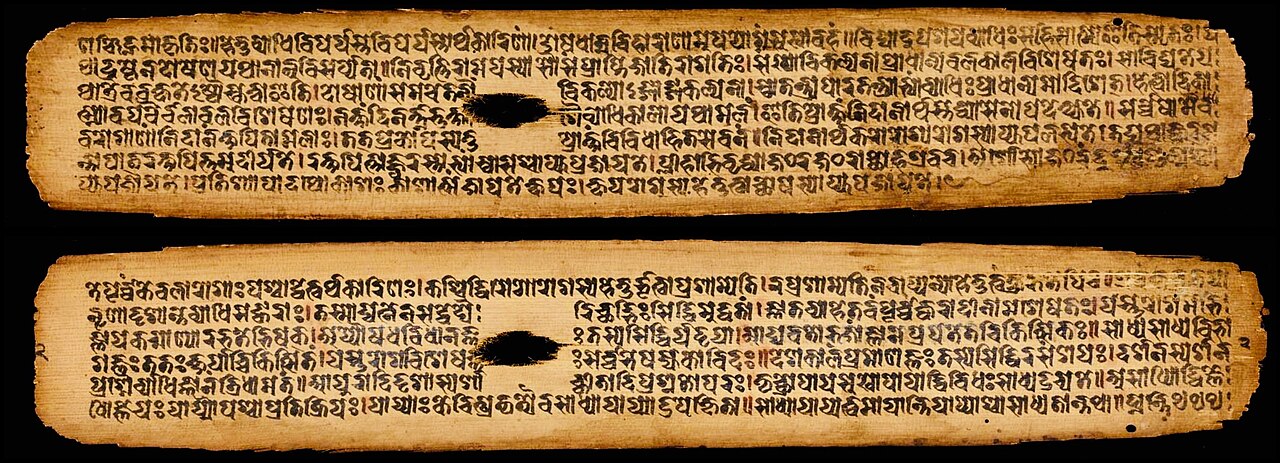
13th century, as identified in the source record
Leaves of a medical manuscript identified by the source as a thirteenth-century Cikitsa-sara-sangraha witness
Leaves of a thirteenth-century Nepalese palm-leaf manuscript (Cambridge MS Add.1707) of Vangasena’s eleventh-century Bengali Ayurvedic compendium Cikitsasarasangraha.

1898
Manimekalai: opening text in the 1898 Swaminatha Iyer edition – A later printed witness to an older work, not an ancient manuscript
Manimekalai: opening text in the 1898 Swaminatha Iyer edition. A later printed witness to an older work, not an ancient manuscript.
005Two views
Both views are shown at equal weight; this site does not choose between them.
Whom the friend rebukes in Natrinai 34
- One view
- One commentary reading: the rebuke is aimed at the god Murukan himself.
- Another view
- Another commentary reading: it is aimed at the velan, who ritually takes the god's role.
- What would settle it
- Closer study of the Tamil wording and the commentary tradition in a critical edition.
006Where next
In love poems a ritual specialist, the vēlaṉ, blames Murukan for a girl's distress while her friend disputes it.
On the shelfEveryday livesBrowse studies on this theme.
Explore nextManimekalai: opening text in the 1898 Swaminatha Iyer edition – A later printed witness to an older work, not an ancient manuscriptAll related studies, connected material, books and sources10 · 3
Elsewhere on this site
Connected material
Photographs, drawings, books, videos and other studies linked to this study. A link helps you explore; it does not prove a historical claim.
- Manimekalai: opening text in the 1898 Swaminatha Iyer edition – A later printed witness to an older work, not an ancient manuscripthistorical printed textBackground
- Leaves of a medical manuscript identified by the source as a thirteenth-century Cikitsa-sara-sangraha witnesshistorical documentBackground
007Sources
The study lists the sources it consulted; we have not rechecked them. A working link does not show that a source was read, and a valid identifier does not show that it supports a claim. We do not link to unofficial uploads or copies of publications. Where a study cited one, we show the published citation, or a publisher, DOI or Internet Archive link when we have one. Tracking codes are removed from links, and the sources themselves are not republished here.
Vaidehi Herbert, Sangam Poems Translated by Vaidehi. Kuruntokai 1–200: poem 111. Source type: primary poetry in modern translation with commentary. Where in the source: Kuruntokai 111; Tamil, translation and speaker framing. How much was read: Selected poem and associated notes read, not the whole anthology critically collated. Limits: Poem and modern editorial framing are distinguished; no medical diagnosis or prevalence estimate. Access date: 2026-10-10.
Vaidehi Herbert, Sangam Poems Translated by Vaidehi. Natrinai 1–200: poems 34 and 142. Source type: primary poetry in modern translation with commentary. Where in the source: Natrinai 34, including alternative reading of addressee; Natrinai 142. How much was read: Selected poems and notes read. Limits: 34 has an interpretive disagreement; 142 is a male speaker’s praise, not a census of domestic labor. Access date: 2026-10-10.
Vaidehi Herbert, Sangam Poems Translated by Vaidehi. Ainkurunuru: poems 243–244. Source type: primary poetry in modern translation with commentary. Where in the source: Kapilar sequence, poems 243–244. How much was read: Selected poems and notes read. Limits: Literary voices and landscape associations; exact first-century ritual sequence not established. Access date: 2026-10-10.
Researchers and institutions whose work this study uses: Vaidehi Herbert
How we know The evidence, claims and dates behind this study
What this study draws on
- Tamil text, translation and notes by Vaidehi Herbert for Kuruntokai 111, Natrinai 34 and Ainkurunuru 243 and 244
- Commentary notes recording the disagreement over Natrinai 34
- Selected poems and notes only; the anthologies were not critically collated
Dates in this study
This study has no dates recorded in a form we can chart, so there is no date chart. Any dates it gives are in the full study.
The study’s claims
0 claims · 0 source passages · 12 paragraphs
Browse the study paragraph by paragraphThis study has no separately listed claims. Its paragraphs can be browsed one by one.
About this study Status, corrections and how it was made
Status
Draft study, revision 4. No historian, archaeologist, or Tamil or Malayalam specialist has reviewed it yet.
How it was made
Compiled as an editorial synthesis from published scholarship around questions we framed. About this project & workflow
The summary, How sure lines and Two views notes on this page were prepared from this study and cross-checked against its passages. That is an editorial check, not a specialist review.
Technical details
Study code R095. The text fingerprint changes whenever the study text changes.
- The study text is shown as written. Links from its paragraphs to citations help you move around the study; they are not new claims or checked source passages.
See how this study’s records were extracted
Text fingerprint (SHA-256): R095 · 0c2fb1f665d73df6ac52eaba… · v4
Evidence tables and technical details are on the web page: https://layersofthesouth.org/read/c0a35a13dd