Each period has the same width, so spacing is not to scale.
- Belief & memory
Korravai resembles Kerala's Bhadrakali; no dated line joins them
Early Tamil texts show Korravai as a war goddess; Kerala's Bhadrakali traditions are documented much later, and no dated chain links them.
- This page
- 4,043 words · revision 7
Draft study · Awaiting specialist review · Updated
001Dates and places

No mapped place in this study.
1000–500 BCE
Different beginnings
500–200 BCE
Marks & materials
200 BCE–300 CE
Connected worlds
300–600 CE
Change & continuity
After 600 CE
- fifth century CE
- 10th century CE
- sixteenth century
- Period assigned by excavators or scholars
- How it was dated is not stated
Each date belongs to what was dated (a sample, an object, a layer or a text), which is not always the event the study asks about.
Each period has the same width, so spacing is not to scale.
The full table of dates, with their ranges, is under How we know.
- 2 Well supported
- 1 Possible
- 1 Not known
002How sure
In brief
Korravai is a goddess of early Tamil literature. The Tolkāppiyam places her among rules for cattle-raiding and war poems rather than simply as a hill goddess, and the Cilappatikāram's hunters' song depicts her with weapons, a blackbuck mount and possession rites (other early anthology poems are also cited for her in secondary scholarship, not checked here). Cilappatikāram 20 distinguishes Kannaki from Koṟṟavai, from Kāḷi of the forest, and from the goddess who tore open Dāruka's chest. As reported by Marianne Pasty-Abdul Wahid, Chelnat Achyuta Menon (1943, not read directly here) and later writers link Koṟṟavai to Kerala's Bhadrakāḷi. In Kerala, the Dārika myth is first securely documented in the sixteenth-century Bhadrakāḷīmāhātmya; earlier medieval inscriptions and poems that may mention goddess shrines were not checked for this study. No pre-600 evidence ties Kodungallur or Chottanikkara to Koṟṟavai, and a layered history fits the evidence better than direct descent.
Key researchers cited in this study: K. N. Ganesh (Historical Geography of Kerala) · Full bibliography
How sure
- Well supported
Early Tamil literature presents Korravai as a goddess of war and cattle raids.
The Tolkāppiyam and the Cilappatikāram's hunters' song both place her in martial settings.
- Well supported
Kodungallur's goddess combines Bhadrakali, Sri Kurumba and Kannaki traditions.
Pasty-Abdul Wahid's ethnographic study documents these combined identities.
- Possible
Korravai fed into Kerala goddess traditions through gradual religious synthesis.
Consistent with composite goddess imagery and medieval Kerala shrines, though transmission steps are not documented.
- Not known
Kerala's Bhadrakali descends in a direct line from Korravai.
No dated shrines, inscriptions or manuscripts establish direct institutional continuity across the intervening centuries.
Why it matters
It shows why shared traits such as weapons, blood offerings and possession do not by themselves make two goddesses one.
003Key findings
What the study concludes
- Korravai is explicitly attested in an early Tamil martial-poetic complex.
- The Cilappatikāram's Korravai is already represented through a composite religious vocabulary.
- Later Kerala Bhadrakali traditions are historically comparable to Korravai but direct descent is not established.
- Kodungallur preserves powerful Kannaki/Bhadrakali/Sri Kurumba associations, but ancient-foundation tradition and archaeological proof must be separated.
- Chottanikkara is a later-reception case and demonstrates substantial modern ritual change.
In the study’s own words. How sure each point is, is shown above.
The summary above is the short read. The full study is the complete text it was drawn from, with its tables and source notes.
What the full study covers
- Synthesis & Core Assessment
- Scope, research questions, and method
- Early witnesses: what Korravai is, and is not, in the consulted texts
- The later Kerala bridge and the Kodungallur case
- Chottanikkara and evidence for institutional change
- Comparative analysis, conclusions, and risks
- Further research and references
004The study
Synthesis & Core Assessment
How do the witnesses to Kotravai and later Kerala goddess traditions relate, and where are the gaps?
This page dates historical records, not living faith.
This study tests, rather than assumes, the popular claim that the early Tamil goddess Koṟṟavai/Korravai developed linearly into Kerala Bhagavathy, Kali, or Bhadrakali traditions. It follows three rules: early terminology must be read in context, Kodungallur and Chottanikkara must be dated independently, and similarity of function or iconography cannot by itself prove continuous cult or direct transformation.
The result is substantially more cautious than the popular picture of Korravai as “the hill goddess” at the root of Kerala Bhagavathy and Kali worship. In the consulted Tolkāppiyam, Poruḷatikāram, Koṟṟavai occurs in the Puṟattiṇaiyiyal in connection with veṭci, the martial/cattle-raiding puṟam counterpart to kuṟiñci. The significant phrase is koṟṟavai nilai (“the state/situation of Korravai,” provisionally); the passage does not simply define her as “the hill goddess.” Because the Tolkāppiyam is a work of grammar and poetics, its categories are literary-cultural classifications rather than an unmediated ethnographic inventory. ↗1
The Cilappatikāram's Vēṭṭuva Vari is much richer. It places a martial goddess among Eyinar/hunter imagery: possession of a clan maiden, weapons, animal ornaments, a blackbuck mount, debt and offering, cattle-raiding, victory, and explicitly the name Koṟṟavai. Yet this goddess is already represented through a composite vocabulary containing names and attributes recognizable from wider Śaiva, Devī, and Vaiṣṇava mythologies. Elsewhere (Cilappatikāram 20, Vaḻakkurai kātai), the epic distinguishes Kannaki from Koṟṟavai, from Kāḷi of the forest, and from a goddess who tore open Dāruka's chest (secondary scholarship takes the last as Durgā; commentary was not collated here). Other early Tamil poems are also cited for Koṟṟavai in secondary literature (such as R. Mahalakshmi's 2011 study, not read for this study). Thus even within early Tamil literature, Koṟṟavai, Kāḷi, Durgā, and Kannaki are not simply interchangeable names. ↗2
A fifth-century CE date is one published scholarly placement for the Cilappatikāram, which would put it before 600 CE, although questions of composition, textual formation, and dating remain debated. ↗3 The Tolkāppiyam is even harder to assign to a single date; accordingly, this study does not manufacture a precise chronology for its Korravai verse. Ganesh's analysis of the Poruḷatikāram reinforces the need to read its categories as historically mediated literary/social classifications. ↗4 “Silappadikaram shows city work and justice, not a real itinerary” discusses the Cilappatikāram's disputed date and its use as historical evidence more broadly.
For Kerala, the evidence changes character and date. Medieval Kerala inscriptions (ninth–twelfth centuries) and fourteenth–fifteenth-century message poems are cited by scholars for goddess shrines, though the specific records were not checked for this study; the Dārika myth is first securely documented in Kerala in the sixteenth-century Bhadrakāḷīmāhātmya. As reported by Marianne Pasty-Abdul Wahid, Chelnat Achyuta Menon (1943) and later writers relate Kerala Bhadrakāḷi to ancient Tamil Koṟṟavai. That proposition is historically important as a scholarly genealogy, but it does not supply the missing institutional chain between early Tamil textual Korravai and identifiable Kerala temples. Pasty also gives the exact reference for Menon's substantial work: Kēraḷattile kāḷisēva (Kāḷi-Worship in Kerala), University of Madras Malayalam Series no. 8, first published in 1943; a second edition appeared in 1959. It is modern scholarship/source collection, not an ancient “primary source.” ↗5
The most secure model is therefore layering, synthesis, and later assimilation rather than a demonstrated single transformation. Martial functions, blood-offering imagery, victory, possession, fierce motherhood, and weapons make Korravai and Kerala Bhadrakali traditions historically meaningful comparanda. But the currently read evidence does not establish an unbroken Korravai → Bhadrakali/Bhagavathy institution, priesthood, shrine, ritual system, or divine identity across the intervening centuries. ↗6
Scope, research questions, and method
This study separates four chronological layers. Core-period evidence comprises early Tamil textual witnesses plausibly falling within or intersecting 1000 BCE–600 CE. Mixed chronology applies where a text such as the Tolkāppiyam has disputed formation/redaction history. Later reception covers medieval and modern Kerala texts, shrines, ritual systems, institutional administration, and scholarly interpretations. “Earlier background” was not independently demonstrated for this study and therefore is not retrojected from later sources.
The research questions were:
| Question | Outcome |
|---|---|
| What does early Tamil evidence actually say about Korravai? | Answered: the consulted Tolkāppiyam places koṟṟavai nilai in a martial veṭci/puṟam classification; the Cilappatikāram gives a richer hunter/martial representation. ↗7 |
| Does the early evidence identify Korravai with Kali, Bhagavathy, or Bhadrakali? | No simple identity is demonstrated. Cilappatikāram 20 distinguishes Kannaki from Koṟṟavai, from Kāḷi of the forest, and from a goddess who tore open Dāruka's chest (reported in secondary scholarship as Durgā). ↗8 |
| Can a continuous Korravai-to-Kerala-Bhadrakali line be documented? | Not from the consulted evidence. Modern scholarship proposes kinship or prototype relationships, but the chronological/institutional bridge remains incomplete. ↗6 |
| How early are the Kodungallur and Chottanikkara cases? | Kodungallur has strong ancient-foundation traditions but no consulted pre-600 material proof; Chottanikkara's official heritage page itself places the temple in the tenth century CE, outside the core window. ↗9 |
| Is institutional change visible? | Yes, especially at Chottanikkara: published ethnographic work documents a major increase in the frequency and sponsorship of guruti rites, while the Cochin Devaswom Board belongs to a statutory twentieth-century administrative horizon. ↗10 |
Methodologically, relevant Tamil passages were read through Project Madurai's electronic Tamil texts; peer-reviewed articles were used to test chronology, later traditions, and scholarly genealogy; official Kerala heritage and Devaswom sources were treated as evidence for present institutional claims and memory, not automatically as ancient historical proof; and metadata records were used to identify inaccessible or uninspected books without pretending those books had been read. Project Madurai is useful for locating and reading the wording, but it is not substituted for a modern critical edition with full textual apparatus. ↗11
Consequential translation is therefore deliberately conservative. The Tamil wording is treated through short analytical glosses rather than a claim to a new authoritative translation. An English translation of the Tolkāppiyam Poruḷatikāram by E. S. Varadaraja Iyer is bibliographically identifiable, with a second edition from Annamalai University in 1987, but it was not read directly for this study. ↗12 R. Parthasarathy's English translation of the Cilappatikāram, The Tale of an Anklet, was published by Columbia University Press in 1994, but the present passage analysis was based on the accessible Tamil electronic text rather than assuming Parthasarathy's wording. ↗13
Early witnesses: what Korravai is, and is not, in the consulted texts
The crucial Tolkāppiyam passage occurs in the Poruḷatikāram, Puṟattiṇaiyiyal. The chapter first states that veṭci is the external/puṟam counterpart of kuṟiñci, and its ensuing categories concern cattle seizure and martial action. Within that classificatory sequence comes koṟṟavai nilai. This gives Korravai an unmistakable association with a martial semantic field, but the logic of the passage is important: it is a rule of poetic classification, not a prose account of a temple cult, mythic biography, priestly institution, or territorial goddess system. ↗14
The popular phrase “hill goddess” is consequently too compressed. There is an indirect structural connection to kuṟiñci because veṭci is paired with it, but the actual Korravai reference occurs in the puṟam/veṭci classification. Calling her simply a “mountain goddess” suppresses the distinction between landscape poetics and the explicit martial context. Conversely, calling her merely a “desert goddess” would be equally reductive. The source is better described as attesting Koṟṟavai in an early Tamil martial-poetic complex. ↗1
Several anthology poems are also cited in the secondary literature for Koṟṟavai – for example Tirumurukāṟṟuppaṭai 258–259, where Murukaṉ is said to be called 'son of Koṟṟavai', discussed in studies such as R. Mahalakshmi (2011); neither Mahalakshmi's book nor critical editions of those anthology passages were read for this study.
The Cilappatikāram supplies a far fuller representation. In the Vēṭṭuva Vari, the woman Sālinī becomes possessed, and the Eyinar are told that prosperity and victory require settlement of an old obligation to the goddess. A maiden is dressed as the goddess with a snake-like cord, boar-tusk crescent, tiger-tooth ornament, animal skin, bow and blackbuck mount; offerings and performance accompany the representation. The text then explicitly names Korravai amid a cluster of goddess epithets and martial imagery. ↗15
Cattle-raiding and victory remain central. Korravai's standard is imagined as preceding the raiding force, while ritual debt is expressed with deliberately violent blood imagery. This makes the passage highly relevant to later fierce-goddess comparison. Yet it is evidence first for literary representation: one cannot infer automatically that every image corresponds to a uniform historical rite performed everywhere in Tamilakam. ↗16
Just as significant is the passage's theological hybridity. The goddess carries a crescent, third eye, dark/poison-marked throat, serpent and trident, and is represented in elephant/tiger skins; surrounding names and allusions overlap with wider Śaiva and Devī vocabularies, while other mythic references reach into Vaiṣṇava material. The appropriate conclusion is not that Korravai had become “nothing but” a Sanskritic goddess, but that the surviving epic witness already presents her within an interpenetrating religious vocabulary. It cannot safely serve as a fossil of a completely isolated pre-Brahmanical cult. ↗17
The epic itself supplies the strongest warning against retrospective identity collapse. During the Madurai court sequence (Cilappatikāram 20, Vaḻakkurai kātai), Kannaki is rhetorically distinguished from Koṟṟavai with the victorious spear, from Kāḷi who delights in the fearsome forest, and from the goddess who tore open Dāruka’s broad chest (reported in secondary accounts as Durgā; Parthasarathy 1993 and the commentary were not checked here). That literary distinction matters because later Kerala traditions weave Kannaki, Bhadrakāḷi, Śrī Kuṟumpa, and Dārika traditions much more closely together. The Cilappatikāram shows proximity among these figures, not equivalence. ↗8
One recent scholarly treatment describes the Cilappatikāram as a fifth-century CE work, a chronology that makes this testimony especially relevant to the centuries just before 600 CE. ↗3 The Tolkāppiyam, by contrast, has a more contested history of composition and redaction; this study accordingly leaves its exact production interval unresolved rather than assigning an artificial early date.
The later Kerala bridge and the Kodungallur case
Medieval Kerala inscriptions (ninth–twelfth centuries) and fourteenth–fifteenth-century message poems may narrow the post-600 documentary gap; scholars cite them for goddess shrines, but the specific records were not checked for this study. As reported by Pasty-Abdul Wahid, Chelnat Achyuta Menon (1943) and later writers interpreted Kerala Bhadrakāḷi as related to, or having a prototype in, Tamil Koṟṟavai – an influential modern scholarly argument rather than a dated institutional chain. ↗18
For the Dārika myth specifically, the earliest securely dated Kerala witness consulted here is the sixteenth-century Bhadrakāḷīmāhātmya, examined by Noor van Brussel as a regional Kerala purāṇa centred on Bhadrakāḷi’s slaying of Dārika. ↗19 Because the Cilappatikāram already knows a goddess who kills Dāruka, the two texts bear on long-term circulation of mythic motifs, while their chronological separation prevents treating them as proof of one unbroken local shrine tradition. ↗20
At Kodungallur, later identities are genuinely entangled. Pasty describes the goddess there in terms involving both Bhadrakali and Śrī Kuṟumpa, with the latter associated with Kannaki, and notes traditions in which these narratives can combine. This is strong evidence for later fusion and reinterpretation. It is not necessary to deny that fusion in order to reject the stronger claim that one can read backward from it to an unchanged Sangam-age cult. ↗21
The official Muziris/ Kerala Tourism account presents a much stronger ancient-foundation narrative: it treats Kodungallur as a major Kali shrine and records beliefs connecting it with Kannaki, the Chera ruler Ceṅkuṭṭuvan, an approximately 1,800-year-old image, and later Śaṅkara traditions. The wording itself is largely that of belief and supposition; as an official heritage page it documents an important present tradition but does not provide an excavation report or contemporary inscription establishing those events. ↗22
That distinction is not merely methodological caution. A public-history treatment of Kodungallur explicitly observes that archaeological evidence does not establish the present temple as the shrine supposedly built by Ceṅkuṭṭuvan. ↗23 In the source set read for this study, no pre-600 inscription, stratified excavation context, architectural phase report, or securely dated object was located that identifies the present Kodungallur Bhagavathy temple with Korravai or establishes Ceṅkuṭṭuvan's construction of it. This negative result is limited: it means such evidence was not found in this study, not that no relevant evidence can exist.
There is firmer documentation for Kodungallur in much later historical periods. A recent peer-reviewed study of the temple's politics and ritual history cites William Logan's Malabar Manual of 1887 regarding the prominence of the Bharani festival and discusses subsequent changes in caste access and the production of sacred space. That gives the festival a clear colonial-period documentary horizon, but it does not automatically date every element of the festival to antiquity. ↗24
The Kodungallur case therefore supports three conclusions at different confidence levels: high confidence that later Bhadrakali/Sri Kurumba/Kannaki traditions interact there; high confidence that ancient-foundation narratives are important parts of the site's living historical memory; and low confidence, on the evidence read here, in an archaeologically demonstrated direct line from the early textual Korravai to the present shrine. ↗25
Chottanikkara and evidence for institutional change
Chottanikkara provides an even clearer chronological warning. Kerala Tourism's current heritage account dates the Chottanikkara Bhagavathy Temple to the tenth century CE and describes the temple's differentiated goddess worship. Because the webpage does not cite the inscription, architectural study, or excavation on which the tenth-century date rests, the date should be treated as an official heritage attribution pending primary-source verification. Even if accepted, however, it is four centuries after 600 CE. ↗26
Chottanikkara Temple – Present-day Chottanikkara temple context
Chottanikkara Bhagavathy Temple
Photographed 2010-07-05
This makes Chottanikkara valuable not as proof of Sangam-period continuity, but as a case of later religious differentiation and transformation. Pasty's ethnographic-historical discussion distinguishes the more placid Bhagavati of the principal sanctuary from the powerful Bhadrakali of the Keezhkavu and follows changes in the blood-coloured guruti offering. According to that study, the rite had once been much less frequent, was being performed about eight times monthly in the 1990s, and had become daily by the period of the author's fieldwork, with expanded private sponsorship and pilgrimage contributing to its increased prominence. ↗27
That sequence is crucial to the larger research question. It demonstrates empirically that a goddess institution can change the frequency, sponsorship, publicity and ritual centrality of a practice within only decades. A modern observer who treated today's ritual schedule as immemorial would therefore generate a false continuity. The same methodological restraint must be applied when moving across a millennium or more from Korravai literature to medieval and modern Kerala. ↗27
Administrative institutions also have datable histories. The Cochin Devaswom Board states that it was constituted under the Travancore–Cochin Hindu Religious Institutions Act, 1950 for administration and control of the Devaswoms under its jurisdiction. This does not date the underlying shrines, but it provides a clear twentieth-century institutional horizon relevant to questions about who manages temples and how “continuity” should be disaggregated into deity, ritual, property, personnel, patronage and administration. ↗28
Chottanikkara thus weighs against using a generalized term such as “Kerala Bhagavathy worship” as though it denoted one timeless system. Its own evidence shows differentiated goddess forms and historically changing ritual regimes. ↗29
Comparative analysis, conclusions, and risks
The main witnesses are best understood as a sequence of differently constituted evidence, not as consecutive links already proven to belong to one chain.
| Witness or tradition | Period | What is actually evidenced | Value for Korravai–Kerala question | Principal limit |
|---|---|---|---|---|
| Tolkāppiyam, Puṟattiṇaiyiyal | Mixed chronology / early Tamil | koṟṟavai nilai within martial veṭci/puṟam poetics | Strong evidence that Korravai belonged to an early martial semantic complex | Not a temple history; exact textual dating/redaction unresolved. ↗1 |
| Cilappatikāram, Vēṭṭuva Vari | Core-period candidate; fifth-century placement in cited scholarship | Korravai, possession, victory, cattle-raiding, weapons, offerings, hunter imagery, composite goddess attributes | Strongest read early descriptive witness | Literary representation; already syncretic rather than an uncontaminated “original cult.” ↗30 |
| Cilappatikāram 20 (Vaḻakkurai kātai) | Core-period candidate | Kannaki rhetorically distinguished from Koṟṟavai, Kāḷi of the forest, and a goddess who tore open Dāruka's chest | Direct evidence against automatic identity collapse | Does not prove the figures were unrelated in all contexts. ↗8 |
| Medieval Kerala inscriptions & poems (reported) | 9th–15th c. CE | Cited in scholarship for goddess shrines | Not checked for this study | Specific records not read here; does not prove descent from Koṟṟavai. |
| Kerala Bhadrakāḷīmāhātmya | Later reception, sixteenth century | Regional Bhadrakali–Dārika mythic text | Secure medieval Kerala witness to a mature Bhadrakali complex | Too late to bridge the early centuries by itself. ↗19 |
| Kodungallur | Later reception with ancient-origin traditions | Bhadrakali/Sri Kurumba/Kannaki convergence and living origin traditions | Strong evidence for later assimilation and memory | No consulted pre-600 material proof connecting present shrine to Korravai. ↗31 |
| Chottanikkara | Later reception | Official tenth-century attribution; differentiated Bhagavati/Bhadrakali worship; modern ritual change | Excellent case for historical change within a goddess institution | Not a core-period witness; tenth-century dating still needs its underlying primary evidence. ↗32 |
Four explanatory models can now be compared.
| Model | Evidence in its favour | Problem | Assessment |
|---|---|---|---|
| Direct linear transformation: Korravai → Kerala Bhadrakali/Bhagavathy | Martial and fierce functions recur; modern scholars have proposed a prototype/kinship relationship. ↗18 | Missing dated institutional links; identities are differentiated in early literature; secure Kerala witnesses are often much later. | Not demonstrated. |
| Long-term transformation through religious synthesis | The Cilappatikāram already displays composite goddess vocabulary; medieval Kerala develops strongly localized Bhadrakali traditions. ↗33 | Specific transmission mechanisms remain incompletely documented. | Best current general model. |
| Partly independent local cults later assimilated under Kali/Bhadrakali/Bhagavathy categories | Kodungallur and Chottanikkara show internally differentiated identities and later ritual/institutional change. ↗34 | Requires better local historical records to map when assimilation occurred. | Highly plausible and compatible with synthesis model. |
| Kannaki/Pattini mediation as a major bridge | Kodungallur's Sri Kurumba/Kannaki associations and the Cilappatikāram make this an important hypothesis. ↗35 | The major Pattini monograph and local transmission evidence were not read directly for this study. | Important open hypothesis, not yet established as the single bridge. |
The strongest conclusion is consequently a layered-history model. Early Tamil sources attest a martial Korravai. The Cilappatikāram reveals that this figure was already embedded in a wider and evolving goddess vocabulary. Medieval Kerala supplies secure Bhadrakali/Dārika textual traditions. Specific Kerala shrines subsequently display combinations among Bhadrakali, Bhagavati, Sri Kurumba and Kannaki, alongside changing rituals and institutions. What is missing is the evidence required to turn those observations into a continuous genealogy: dated intermediate shrines, inscriptions, manuscripts, ritual manuals, donor histories, iconographic sequences, or other witnesses demonstrating transmission between particular communities and institutions. ↗36
The principal risk is retrospective compression: taking a modern or medieval configuration and projecting it unchanged into early Tamil literature. A second risk is functional essentialism – assuming that two goddesses associated with victory, weapons, blood, possession or protection must be historically identical. Such features can be transmitted, independently developed, combined, or reinterpreted. A third is text-to-practice slippage: epic representation, ritual prescription, institutional practice and present community memory are different classes of evidence. A fourth is chronological flattening, particularly at Chottanikkara, where demonstrable recent changes show how quickly ritual regimes can be historicized as “traditional.” ↗37
Further research and references
The next source work should be targeted rather than a generic search for more parallels. The highest priority is a critical-text check of the Korravai passages: obtain a recognized critical/annotated Tolkāppiyam Poruḷatikāram with commentary and compare the relevant Puṟattiṇaiyiyal reading and historical interpretation against the Project Madurai text. E. S. Varadaraja Iyer's English translation is bibliographically identifiable but was not read directly for this study. ↗12 For the Cilappatikāram, R. Parthasarathy's The Tale of an Anklet provides a recoverable modern English translation, but consequential claims should ultimately be checked against a critical Tamil edition and its apparatus rather than harmonized from one translation. ↗13
The second priority is Chelnat Achyuta Menon's 1943 first edition of Kēraḷattile kāḷisēva and, where useful, the 1959 second edition. Pasty's article identifies the 1943 work and also identifies Menon's 1936 note on the Kali cult of Kerala; Google Books confirms a 1959 second edition of Kali-worship in Kerala as Madras University Malayalam Series 8. The book itself was not read directly for this study, so claims attributed to Menon in this study remain mediated through later scholarship. ↗38
The third priority is local primary documentation. For Kodungallur, the decisive evidence would be any published archaeological report, epigraphic corpus entry, architectural phasing study, early temple record or securely provenanced object that can independently date the shrine and its goddess identities. The site's ancient-foundation traditions are well documented as traditions; that is not the same evidentiary problem. ↗39 For Chottanikkara, the specific unresolved question is the basis for the official tenth-century date: inscription, palaeography, architecture, manuscript tradition, or secondary repetition. ↗40
The fourth priority is the Kannaki/Pattini bridge. Gananath Obeyesekere's The Cult of the Goddess Pattini (1984) remains an important source to read because it addresses Pattini's historical and regional transformations; its full argument was not read directly for this study. Rich Freeman's work on Śāktism, polity and society in medieval Malabar is likewise important for the institutional and political history of later Kerala goddess traditions; only bibliographic metadata for the relevant 2016 chapter was read here. ↗41
Selected bibliography
Early texts and translations
Tolkāppiyam, Poruḷatikāram, Puṟattiṇaiyiyal. Project Madurai electronic Tamil text, relevant section read as partial text: https://projectmadurai.org/pm_etexts/utf8/pmuni0100.html ↗14
Tolkāppiyar. Tolkappiam – Porulatikaram, translated by E. S. Varadaraja Iyer; second ed., Annamalai University, 1987. Metadata located; edition was not read directly for this study. https://ci.nii.ac.jp/ncid/BA74394212 ↗42
Silappadikaram/Cilappatikāram, Maduraik Kāṇṭam, Vēṭṭuva Vari and Madurai court sequence. Project Madurai Tamil electronic text, relevant passages read: https://www.projectmadurai.org/pm_etexts/utf8/pmuni0111_01.html ↗43
Iḷaṅkō Aṭikaḷ. The Tale of an Anklet: An Epic of South India, translated by R. Parthasarathy. Columbia University Press, 1994, ISBN 9780231078498. Metadata read; translation itself not used as the passage witness here. https://cup.columbia.edu/book/the-tale-of-an-anklet/9780231078498/ ↗13
Scholarly analyses
Ganesh, K. N. “Space-time, Event and Expression in Early Tamil Texts.” Indian Historical Review 38.1 (2011): 1–22. DOI 10.1177/037698361103800101. Abstract/metadata read. https://doi.org/10.1177/037698361103800101 ↗4
Ate, Lynn. Article on the Cilappatikāram in the Journal of Hindu Studies (2014), DOI 10.1093/jhs/hiu027. Abstract used for its fifth-century placement of the epic. https://doi.org/10.1093/jhs/hiu027 ↗3
Pasty-Abdul Wahid, Marianne. 2020. Religions 11(4):170. DOI 10.3390/rel11040170. Full HTML read for Korravai/Bhadrakali scholarly genealogy, Kodungallur identities, Chottanikkara ritual change and Menon bibliography. https://doi.org/10.3390/rel11040170 ↗44
van Brussel, Noor. 2020. Study of the Kerala Bhadrakāḷīmāhātmya, Religions 11(3):119. DOI 10.3390/rel11030119. Full HTML/abstract read. https://doi.org/10.3390/rel11030119 ↗19
Menon, Chelnat Achyuta. Kēraḷattile kāḷisēva (Kāḷi-Worship in Kerala). University of Madras, Malayalam Series no. 8, 1943; second edition 1959. Bibliographic identity recovered, but book text was not read directly for this study. Second-edition metadata: https://books.google.com/books?id=EhHHtQEACAAJ ↗38
Freeman, Rich. “Śāktism, Polity and Society in Medieval Malabar,” in Goddess Traditions in Tantric Hinduism, 2016, pp. 141–173. Publisher metadata read; chapter text was not read directly for this study. DOI 10.4324/9781315742120. ↗45
Obeyesekere, Gananath. The Cult of the Goddess Pattini. University of Chicago Press, 1984 (bibliographic metadata verified; full book was not read directly for this study). ↗46
Mahalakshmi, R. The Making of the Goddess: Koṟṟavai-Durgā in the Tamil Traditions. New Delhi: Penguin, 2011 (standard monograph on Koṟṟavai and Tamil anthology witnesses; was not read directly for this study).
Caldwell, Sarah. Oh Terrifying Mother: Sexuality, Violence and Worship of the Goddess Kāḷi. New Delhi: Oxford University Press, 1999, and Gentes, M. J., “Scandalizing the Goddess at Kodungallur,” Asian Folklore Studies 51 (1992) (key studies on Kerala Kāḷi/Kodungallur traditions; were not read directly for this study).
Institutional and site evidence
Kerala Tourism/Muziris, “Kodungallur Bhagavathy Temple.” Current heritage/tradition account read: https://www.keralatourism.org/muziris/religious-sites/kodungallur-bhagavathy-temple ↗22
Kerala Tourism, “Chottanikkara Bhagavathy Temple.” Current heritage account, including tenth-century attribution: https://www.keralatourism.org/temples/ernakulam/chottanikkara ↗40
Cochin Devaswom Board, institutional history. Current official page read: https://cochindevaswomboard.org/aboutus.html ↗28
The resulting position is therefore firm enough to support a layered history but not a claim of direct descent: Korravai belongs to the relevant comparative history, but “Korravai became Kerala Bhagavathy/Bhadrakali” remains an hypothesis requiring intermediate evidence rather than an established fact.
005Photographs
Photographs of the places and objects this study discusses. Each item carries its creator’s credit, licence and documented source. See all 412 photographs and source images ↗
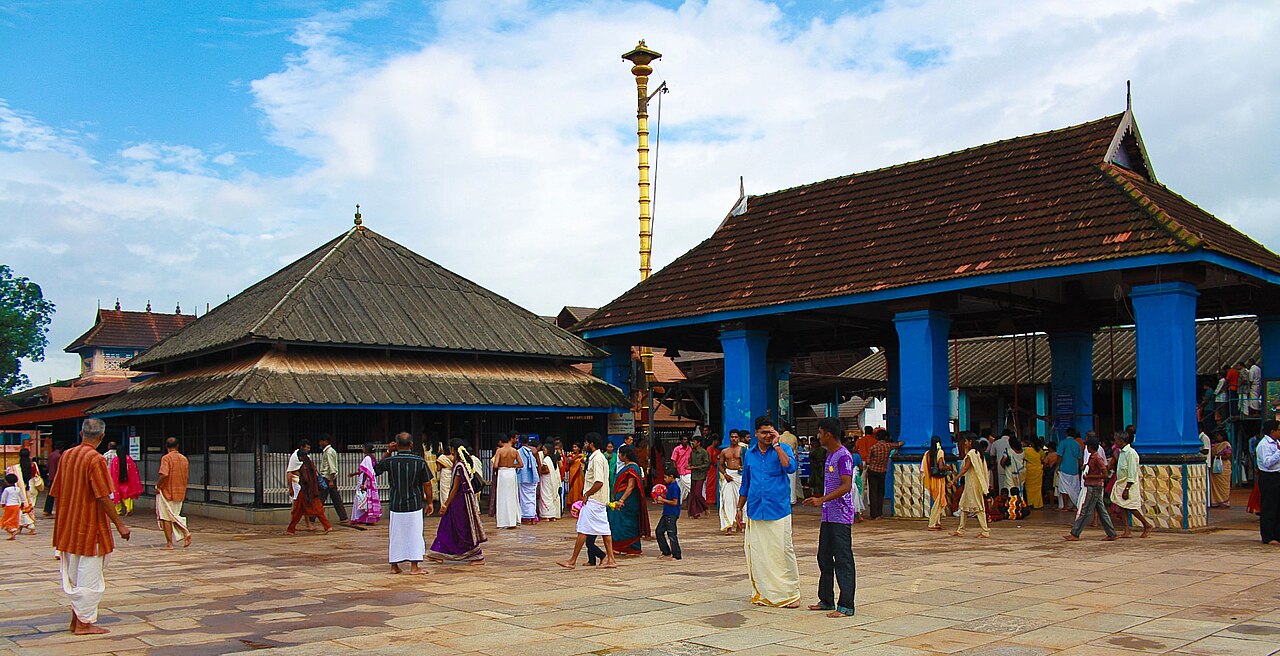
Chottanikkara Bhagavathy Temple · Photographed 2010-07-05 22:32:15
Chottanikkara Temple – Present-day Chottanikkara temple context
Chottanikkara Temple. Present-day Chottanikkara temple context. No claim that the visible building or ritual dates to the early historic period.
006Two views
Both views are shown at equal weight; this site does not choose between them.
Whether Tamil Korravai is the prototype of Kerala's Bhadrakali
- One view
- Chelnat Achyuta Menon and later scholars relate Kerala Bhadrakali to ancient Tamil Korravai as kin or prototype.
- Another view
- A source-critical reading treats the shared traits as comparison, because secure Kerala witnesses come many centuries later.
- What would settle it
- Dated intermediate shrines, inscriptions, manuscripts, ritual manuals or image sequences showing transmission between communities.
007Where next
The war goddess Korravai appears in the grammar's themes and in the epics. No documented line leads from her to Kerala's later goddess Bhadrakali.
On the timelineDates in this studySee these dates on the timeline
Explore nextKoṟṟavai (கொற்றவை / കൊറ്റവൈ)All related studies, connected material, books and sources10 · 15
Elsewhere on this site
Multi-Script Glossary Terms: Koṟṟavai (கொற்றவை / കൊറ്റവൈ) · veṟiyāṭṭu (வெறியாட்டு / വെറിയാട്ട്) · Murukaṉ / Cēyōṉ (Deity of the Kuṟiñci Hills) (முருகன் / சேயோன் / മുരുകൻ / ചേയോൻ) · Māyōṉ, Vēntaṉ & Varuṇaṉ (Tiṇai Landscape Deities) (மாயோன், வேந்தன் & வருணன் / മായോൻ, വേന്തൻ, വരുണൻ) · Ayirai Malai (Sacred Western Ghats Peak of the Cheras) (அயிரை மலை / അയിരൈ മല) · pāvai nōṉpu & tai-nīrāṭal (Seasonal River-Bathing Vow) (பாவை நோன்பு & தை நீராடல் / പാവൈ നോമ്പും തൈ നീരാടലും)
Connected material
Photographs, drawings, books, videos and other studies linked to this study. A link helps you explore; it does not prove a historical claim.
- Chottanikkara Temple – Present-day Chottanikkara temple contextphotographBackground
008Sources
The study lists the sources it consulted; we have not rechecked them. A working link does not show that a source was read, and a valid identifier does not show that it supports a claim. We do not link to unofficial uploads or copies of publications. Where a study cited one, we show the published citation, or a publisher, DOI or Internet Archive link when we have one. Tracking codes are removed from links, and the sources themselves are not republished here.
Tolkāppiyam, Poruḷatikāram, Puṟattiṇaiyiyal; Project Madurai electronic Tamil text.
Cilappatikāram, Maduraik Kāṇṭam, canto 12 Vēṭṭuva Vari and later Madurai court passage; Project Madurai electronic Tamil text.
Lynn Ate, Journal of Hindu Studies, 2014, DOI 10.1093/jhs/hiu027.
K. N. Ganesh, Space-time, Event and Expression in Early Tamil Texts, Indian Historical Review 38(1), 2011.
Marianne Pasty-Abdul Wahid, Religions 11(4):170, 2020, DOI 10.3390/rel11040170.
Noor van Brussel, Religions 11(3):119, 2020, DOI 10.3390/rel11030119.
Chelnat Achyuta Menon, Kēraḷattile kāḷisēva (Kāḷi-Worship in Kerala), University of Madras, Malayalam Series no. 8, 1943.
Print or offline sourceSource recordChelnat Achyutha Menon, Kali-worship in Kerala, second edition, Madras University, 1959.
Rich Freeman, Śāktism, Polity and Society in Medieval Malabar, 2016.
Gananath Obeyesekere, The Cult of the Goddess Pattini, University of Chicago Press, 1984.
Print or offline sourceSource recordKerala Tourism/Muziris, Kodungallur Bhagavathy Temple.
Kerala Tourism, Chottanikkara Bhagavathy Temple.
Cochin Devaswom Board, About Us.
Modern Asian Studies article, Elections can wait! The politics of constructing a Hindu atmosphere in Kerala, South India.
Sahapedia, Black Mother: Bharani in Kodungallur.
Print or offline sourceSource record
Researchers and institutions whose work this study uses: K. N. Ganesh
How we know The evidence, claims and dates behind this study
What this study draws on
- Tolkāppiyam and Cilappatikāram passages read in Project Madurai's Tamil electronic texts.
- Pasty-Abdul Wahid's 2020 study of Bhadrakali worship in central Kerala, read in full.
- Van Brussel's 2020 study of the sixteenth-century Bhadrakāḷīmāhātmya.
- Official heritage pages for Kodungallur and Chottanikkara, treated as records of tradition.
Dates in this study
| What is dated | Date | How it was dated |
|---|---|---|
| fifth century CE | 400–499 CE | How it was dated is not stated |
| 10th century CE | 900–999 CE | Period assigned by excavators or scholars |
| sixteenth century | 1500–1599 CE | Period assigned by excavators or scholars |
See these dates on the timeline
The study’s claims
9 claims · 16 source passages · 63 paragraphs
Browse the study paragraph by paragraphThe consulted Tolkāppiyam passage places koṟṟavai nilai within the martial veṭci/puṟam classification rather than simply defining Korravai as a hill goddess.
Supported in this study
The text's composition/redaction history is disputed. Poetic classification is not identical with cult ethnography.
The catalogue label 'Hill Goddess Kotravai' is too narrow because the explicit read reference occurs in a martial veṭci/puṟam framework, while the kuṟiñci connection is structural rather than a simple deity-to-landscape equation.
Supported in this study
The Cilappatikāram's Vēṭṭuva Vari represents Korravai in an Eyinar/hunter and martial setting involving possession, ritual debt, weapons, animal ornaments, a blackbuck mount, victory and cattle-raiding.
Supported in this study
Fifth-century dating is one scholarly placement, not an uncontested absolute date.
The Vēṭṭuva Vari's Korravai is represented through a composite mythic vocabulary that already overlaps with wider Śaiva, Devī and Vaiṣṇava imagery.
Supported in this study
The inherited source lead 'Chelnat Achyuta Menon, Kali Worship in Kerala' resolves to a modern work first published as Kēraḷattile kāḷisēva in 1943, University of Madras Malayalam Series no. 8, rather than an ancient primary source.
Supported in this study
A second edition dated 1959 is independently represented in metadata.
Modern scholarship has proposed a kinship or prototype relationship between ancient Tamil Korravai and Kerala Bhadrakali, but the proposal is interpretive rather than a documented continuous institutional chain.
Supported with qualifications
Intermediate dated institutions and transmission mechanisms remain unestablished in the consulted evidence.
Kerala Tourism attributes Chottanikkara Bhagavathy Temple to the tenth century CE, which if accepted places the temple outside the project's core period.
Supported with qualifications
Heritage date pending primary-source verification.
The Cochin Devaswom Board's statutory administrative framework dates to the Travancore-Cochin Hindu Religious Institutions Act of 1950 and therefore constitutes a modern institutional horizon distinct from shrine antiquity.
Supported in this study
Similarity in martial function, weapons, blood imagery, victory or protective power is comparative evidence but is not by itself proof of genealogical identity or uninterrupted cult continuity.
Supported in this study
Trace one claim through the study’s records
Explore the evidenceOther source lists
Numbered citation links from the study
The numbered links in the study text point here.
தொல்காப்பியர் அருளிய தொல்காப்பியம் /tolkAppiyam of tolkAppiyar (in Tamil script, unicode format)
cilappathikaaram - part 2 (maduraik kANTam)
Oṉṟaṉpakuti – a ‘Single Part’ of the Tamil Epic Cilappatikāram and its significance to the study of South Indian Vaiṣṇavism1 | The Journal of Hindu Studies
Space-time, Event and Expression in Early Tamil Texts - K.N. Ganesh, 2011
Bloodthirsty, or Not, That Is the Question: An Ethnography-Based Discussion of Bhadrakāḷi’s Use of Violence in Popular Worship, Ritual Performing Arts and Narratives in Central Kerala (South India)1
Bloodthirsty, or Not, That Is the Question: An Ethnography-Based Discussion of Bhadrakāḷi’s Use of Violence in Popular Worship, Ritual Performing Arts and Narratives in Central Kerala (South India)1
தொல்காப்பியர் அருளிய தொல்காப்பியம் /tolkAppiyam of tolkAppiyar (in Tamil script, unicode format)
cilappathikaaram - part 2 (maduraik kANTam)
Kodungallur bhagavathy temple | Kurumbakavu | Shaktipeedham | Adi Shankaracharya | Muziris |
Bloodthirsty, or Not, That Is the Question: An Ethnography-Based Discussion of Bhadrakāḷi’s Use of Violence in Popular Worship, Ritual Performing Arts and Narratives in Central Kerala (South India)1
தொல்காப்பியர் அருளிய தொல்காப்பியம் /tolkAppiyam of tolkAppiyar (in Tamil script, unicode format)
CiNii Books - Tolkappiam - Porulatikaram : Akattinai iyal, Kalaviyal, Karpiyal, and Poruliyal
The Tale of an Anklet | Columbia University Press
தொல்காப்பியர் அருளிய தொல்காப்பியம் /tolkAppiyam of tolkAppiyar (in Tamil script, unicode format)
cilappathikaaram - part 2 (maduraik kANTam)
cilappathikaaram - part 2 (maduraik kANTam)
cilappathikaaram - part 2 (maduraik kANTam)
Bloodthirsty, or Not, That Is the Question: An Ethnography-Based Discussion of Bhadrakāḷi’s Use of Violence in Popular Worship, Ritual Performing Arts and Narratives in Central Kerala (South India)1
Tales of Endings and Beginnings: Cycles of Violence as a Leitmotif in the Narrative Structure of the Bhadrakāḷīmāhātmya
cilappathikaaram - part 2 (maduraik kANTam)
Bloodthirsty, or Not, That Is the Question: An Ethnography-Based Discussion of Bhadrakāḷi’s Use of Violence in Popular Worship, Ritual Performing Arts and Narratives in Central Kerala (South India)1
Kodungallur bhagavathy temple | Kurumbakavu | Shaktipeedham | Adi Shankaracharya | Muziris |
Black Mother: Bharani in Kodungallur | Sahapedia
‘Elections can wait!’ The politics of constructing a ‘Hindu atmosphere’ in Kerala, South India | Modern Asian Studies
Bloodthirsty, or Not, That Is the Question: An Ethnography-Based Discussion of Bhadrakāḷi’s Use of Violence in Popular Worship, Ritual Performing Arts and Narratives in Central Kerala (South India)1
Chottanikkara Bhagavathy Temple & Makam Thozhal | Temples in Ernakulam | Kerala Temple Architecture
Bloodthirsty, or Not, That Is the Question: An Ethnography-Based Discussion of Bhadrakāḷi’s Use of Violence in Popular Worship, Ritual Performing Arts and Narratives in Central Kerala (South India)1
About CDB - Cochin Devaswom Board
Bloodthirsty, or Not, That Is the Question: An Ethnography-Based Discussion of Bhadrakāḷi’s Use of Violence in Popular Worship, Ritual Performing Arts and Narratives in Central Kerala (South India)1
cilappathikaaram - part 2 (maduraik kANTam)
Bloodthirsty, or Not, That Is the Question: An Ethnography-Based Discussion of Bhadrakāḷi’s Use of Violence in Popular Worship, Ritual Performing Arts and Narratives in Central Kerala (South India)1
Chottanikkara Bhagavathy Temple & Makam Thozhal | Temples in Ernakulam | Kerala Temple Architecture
cilappathikaaram - part 2 (maduraik kANTam)
Bloodthirsty, or Not, That Is the Question: An Ethnography-Based Discussion of Bhadrakāḷi’s Use of Violence in Popular Worship, Ritual Performing Arts and Narratives in Central Kerala (South India)1
Bloodthirsty, or Not, That Is the Question: An Ethnography-Based Discussion of Bhadrakāḷi’s Use of Violence in Popular Worship, Ritual Performing Arts and Narratives in Central Kerala (South India)1
தொல்காப்பியர் அருளிய தொல்காப்பியம் /tolkAppiyam of tolkAppiyar (in Tamil script, unicode format)
Bloodthirsty, or Not, That Is the Question: An Ethnography-Based Discussion of Bhadrakāḷi’s Use of Violence in Popular Worship, Ritual Performing Arts and Narratives in Central Kerala (South India)1
Bloodthirsty, or Not, That Is the Question: An Ethnography-Based Discussion of Bhadrakāḷi’s Use of Violence in Popular Worship, Ritual Performing Arts and Narratives in Central Kerala (South India)1
Kodungallur bhagavathy temple | Kurumbakavu | Shaktipeedham | Adi Shankaracharya | Muziris |
Chottanikkara Bhagavathy Temple & Makam Thozhal | Temples in Ernakulam | Kerala Temple Architecture
CiNii Books - The cult of the goddess Pattini
CiNii Books - Tolkappiam - Porulatikaram : Akattinai iyal, Kalaviyal, Karpiyal, and Poruliyal
cilappathikaaram - part 2 (maduraik kANTam)
Bloodthirsty, or Not, That Is the Question: An Ethnography-Based Discussion of Bhadrakāḷi’s Use of Violence in Popular Worship, Ritual Performing Arts and Narratives in Central Kerala (South India)1
Goddess Traditions in Tantric Hinduism: History, Practice and Doctrine
CiNii Books - The cult of the goddess Pattini
About this study Status, corrections and how it was made
Status
Draft study, revision 7. No historian, archaeologist, or Tamil or Malayalam specialist has reviewed it yet.
How it was made
Compiled as an editorial synthesis from published scholarship around questions we framed. About this project & workflow
The summary, How sure lines and Two views notes on this page were prepared from this study and cross-checked against its passages. That is an editorial check, not a specialist review.
Technical details
Study code R188. The text fingerprint changes whenever the study text changes.
- The study text is shown as written. Links from its paragraphs to citations help you move around the study; they are not new claims or checked source passages.
See how this study’s records were extracted
Text fingerprint (SHA-256): R188 · bab2817acf8798b0f6f8aa4c… · v7
Evidence tables and technical details are on the web page: https://layersofthesouth.org/read/cb7564693f