Places on the atlas that name this study.
- Belief & memory
- Mangadu
Mangadu's urn burials give southern Kerala early dated charcoal
Two charcoal dates from Mangadu, in Kollam (Urn 6 in Megalith II and Urn 10 in Megalith I, 95 cm), fall roughly between 1300 and 800 BCE (or slightly later under the 5,730-year half-life sheet note), wider than the shorthand '900 BCE'.
- This page
- 6,254 words · revision 9
Draft study · Awaiting specialist review · Updated
001Dates and places
Places on the atlas that name this study.
- Mangadu Iron Age Urn Burial Site
Coarse locality orientation · Kollam District
Dates in this study are stated in words only.
- 2 Well supported
- 1 Likely
- 1 Possible
002How sure
In brief
Mangadu lies near Ashtamudi Lake in Kollam district, southern Kerala. Excavated in 1991 by Kerala's State Department of Archaeology and published by T. Satyamurthy in 1992, the site contained three intersecting laterite stone circles over twelve urns (two in Megalith I, nine in Megalith II, one in Megalith III). Finds include handmade red-ware urns, black-and-red ware, iron tools, roughly 120 pieces of analysed iron slag (18.8–66.5% iron) and 30 carnelian beads, 20 of them etched; spears, tridents and horse bits were absent. The 1992 report ties BS-958 (2890 ± 70 BP) to charcoal inside Urn 6 of Megalith II (95 cm) and BS-957 (2850 ± 90 BP) to Urn 10 of Megalith I (95 cm). Abhayan (2018) calibrates these ages to 1299–902 and 1269–821 BCE, though the BS-957 laboratory sheet states calculation on the 5,730 ± 40-year half-life (implying slightly younger 5,568-year conventional ages and calibrations around 1300–800 BCE or later). Satyamurthy proposed a c. 1000–100 BCE span, whereas the department summary extends the upper limit to the first century CE by bead comparison with Porkalam.
Key researchers cited in this study: T. Satyamurthy (Adichanallur & Kerala Iron Age Excavations) · Full bibliography
How sure
- Likely
Charcoal from Mangadu dates to roughly 1300–800 BCE, possibly slightly later
Two Birbal Sahni radiocarbon ages (BS-958, 2890 ± 70 BP; BS-957, 2850 ± 90 BP) calibrate to 1299–902 and 1269–821 BCE in Abhayan (2018), though the BS-957 sheet specifies the 5,730-year half-life.
- Well supported
Mangadu’s iron finds were tools, with no spears
T. Satyamurthy's 1992 excavation report, the department page, and Vinuraj et al. (2020) all report iron tools without spears, tridents or horse bits.
- Possible
The cemetery stayed in use until the first century CE
Satyamurthy (1992) proposed c. 1000–100 BCE; the department summary extends to the first century CE on etched-bead comparison with Porkalam without a later laboratory date.
- Well supported
BS-958 came from Urn 6 in Megalith II and BS-957 from Urn 10 in Megalith I, both at 95 cm
Satyamurthy's 1992 excavation report (p. 32) and the printed Birbal Sahni Institute laboratory sheets link each code to its exact urn, megalith and 95 cm depth.
Why it matters
It is one of few Kerala burial sites with early radiocarbon dates, so it anchors southern Kerala’s early chronology.
The summary above is the short read. The full study is the complete text it was drawn from, with its tables and source notes.
What the full study covers
003The study
Question, orientation and accessible explanation
Question and scope.
What do the Mangadu burial excavations establish about southern Kerala's archaeological sequence?
Region: Mangad/Mangadu in Kollam district, southern Kerala, with comparison limited to evidence-relevant Kerala and nearby southern Indian archaeology.
Period: Mixed. The collection’s main period is 1000 BCE–600 CE, but one later published calibration of Mangadu’s reported radiocarbon determinations extends before 1000 BCE. The 1991 excavation, 1992 publication and later scholarship are modern research history, not ancient-period findings. The Kerala State Archaeology Department identifies the protected site as Madankavu/Mangad in Kollam and states that excavation took place in 1991. ↗1 ↗2
Scope decision: This study treats “Mangadu,” “Mangad,” and the Kerala State Archaeology Department’s “Madankavu Mangad/Madankavu Urn-burial Site” as the same Kollam archaeological site under investigation. It does not import finds from other places called Mangadu or from the separately excavated Cheramanangadu/Cheramanangad site. Modern sources read here also give differing coordinate points and slightly differing circle measurements, so this study generalizes the archaeological location rather than treating one modern pin as an exact ancient boundary. ↗3 ↗2 ↗4
Primary report integrated: T. Satyamurthy’s 1992 excavation report (The Iron Age in Kerala: A Report on Mangadu Excavation, Department of Archaeology, Government of Kerala) identifies the exact contexts for both radiocarbon determinations (BS-958 from charcoal inside Urn 6 of Megalith II at 95 cm; BS-957 from charcoal inside Urn 10 of Megalith I at 95 cm), prints the Birbal Sahni laboratory sheets, and records ~120 analysed iron slag pieces (18.8–66.5% iron) alongside an excavator span of c. 1000–100 BCE (see also “Kerala's Iron Age graves are many; only a handful are dated”). (Satyamurthy 1992)
Orientation.
Mangadu matters because it is one of the comparatively few Kerala mortuary sites for which scholarship reports early radiocarbon determinations alongside a substantial excavated assemblage. The most important chronological result is not a neat point date of “900 BCE.” Satyamurthy’s 1992 report and laboratory sheets tie BS-958 (2890 ± 70 BP) to charcoal inside Urn 6 of Megalith II (95 cm) and BS-957 (2850 ± 90 BP) to charcoal inside Urn 10 of Megalith I (95 cm). Abhayan G. S.’s 2018 synthesis tabulates broad calibrated ranges extending across c. 1299–902 cal BCE and 1269–821 cal BCE (13th to 9th/8th centuries BCE); however, the BS-957 laboratory sheet explicitly states the age is calculated on the 5,730 ± 40-year half-life (and BS-958 begins the same wording), meaning conventional 5,568-year Libby ages would be roughly 3% younger (~2806 ± 70 and ~2767 ± 90 BP, placing calibrations slightly later, roughly 1300–800 BCE or somewhat younger). Those measurements date sampled charcoal in two urns rather than every burial or a continuous millennium of cemetery use. (Satyamurthy 1992) ↗5
The excavation tradition also documents intersecting laterite stone circles, large handmade red-ware urns, black-and-red ware, iron tools, slag and etched carnelian beads. But several claims about the site do not survive checking: site-specific sources explicitly say spears were absent; Mangadu’s urns are described as globular with truncated or rounded bases rather than specifically as pyriform; and russet-coated painted ware was not identified in either Mangadu-specific pottery inventory read here. ↗1 ↗4
Accessible explanation.
At Mangadu, in the low-lying landscape south of Ashtamudi Lake in Kollam, archaeologists opened a roughly 10 × 10 m trench across laterite blocks forming three overlapping circles. A later scholarly restatement of the excavation assigns two urn burials to MEG I, nine to MEG II and one to MEG III – twelve in all. Satyamurthy (1992) and Vinuraj et al. (2020) establish twelve urns across the three intersecting stone circles (two in MEG I, nine in MEG II, one in MEG III, including Urn 12 in a deeper cut, explaining the department webpage’s slightly awkward phrasing of “another” deeper urn before returning to twelve). (Satyamurthy 1992) [↗1] [↗4]
The pottery is clearer. Both the department and the 2020 Kollam study describe the burial urns and medium jars as handmade red ware, with associated wheel-made black-and-red and red wares. Mangadu’s large urns are described as having globular bodies with truncated or rounded bases, sometimes covered by black-and-red ware conical lids. A wider Kerala discussion does list pyriform, legged and pointed urn types, but that is a regional typology and does not establish that a particular Mangadu urn was pyriform. ↗6 ↗1 ↗4
The same evidential rule applies to russet-coated painted ware, or RCPW. RCPW is a genuine south Indian archaeological ceramic category and remains an active subject of specialist research – the recent Ambily and Morrison study appeared in Archaeological Research in Asia in 2025 – but neither Mangadu-specific inventory read here calls the Mangadu pottery RCPW. The proper finding is therefore “RCPW at Mangadu not verified in the consulted record,” not “RCPW archaeologically absent.” ↗1 ↗4 ↗7
The iron inventory corrects another claim. Mangadu yielded wedges, a long cutting knife, a sickle, a tanged knife and blades. The department explicitly calls attention to the absence of spears, tridents and horse bits, and Vinuraj and colleagues repeat the same point. Claims of “iron spears” at Mangadu should therefore be dropped unless the primary report or catalogue produces contrary context-specific evidence. ↗1 ↗4
Slag was also reported. That is potentially significant evidence of iron-working activity, and Satyamurthy’s 1992 report records roughly 120 analysed iron slag pieces (18.8–66.5% iron content), indicating iron-working proximity, though without an excavated furnace context or metallographic slag-phase sequence in the burial trench itself. A later statement that slag demonstrates “knowledge of iron metallurgy” should consequently be identified as an archaeological interpretation, not confused with a laboratory demonstration of smelting technology at the burial itself. ↗1 ↗4
The strongest chronological evidence is charcoal. Abhayan’s 2018 table gives BS-958 at 2890 ± 70 BP and BS-957 at 2850 ± 90 BP, both attributed to the Birbal Sahni Institute of Palaeobotany, Lucknow and ultimately to Satyamurthy 1992. For BS-958 it reports a 2σ range of 1299–902 cal BCE. For BS-957 it reports two 2σ intervals:** 1289–1282 cal BCE (0.37%)** and 1269–821 cal BCE (99.63%). The calibration curve and software are not specified in the accessible table, and the measurements are cited as published without independent recalculation. ↗5
Satyamurthy’s 1992 report clarifies both contexts directly: BS-958 (2890 ± 70 BP) comes from charcoal inside Urn 6 of Megalith II at 95 cm, and BS-957 (2850 ± 90 BP) from charcoal inside Urn 10 of Megalith I at 95 cm (p. 32 and lab sheets). Satyamurthy dated most urns around 900 BCE, placed the lowest burial (Urn 12) at c. 1000 BCE on deeper stratigraphy and simpler iron tools, and set the cemetery’s overall upper bound around 100 BCE (a general span of c. 1000–100 BCE, whereas the department’s summary extends it to the first century CE by etched-bead comparison with Porkalam). (Satyamurthy 1992) [↗1]
What, therefore, does Mangadu establish? It provides southern Kerala with a strong early mortuary anchor: by the early first millennium BCE – and under the later published calibration, potentially beginning in the late second millennium BCE – people in the Kollam region were making and using urn-and-stone-circle funerary contexts associated with iron objects and characteristic ceramic traditions. What Mangadu does not presently establish is a continuously demonstrated sequence from that early horizon to the first century CE. The department’s proposed extension to that later period rests on comparison between etched carnelian beads and Porkalam, not on a later directly dated Mangadu context read here. ↗5 ↗1
Main investigation
Site, campaign and source history.
The investigated site is the protected Madankavu urn-burial site at Mangad/Mangadu, Kollam, rather than an identically named site in Tamil Nadu or another Kerala locality. Kerala State Archaeology places it close to Ashtamudi Lake and says excavations occurred in 1991. A later Kollam study describes the same low laterite setting near Madan Kavu and substantially reproduces the excavation evidence while citing Satyamurthy 1992. ↗1 ↗2 ↗4
Descriptions that cite “Kerala State Archaeology Department interim excavation reports (1990s)” are too vague: the central publication is T. Satyamurthy’s 1992 departmental The Iron Age in Kerala: A Report on Mangadu Excavation, with minor title/spelling variations in later bibliographies. Later literature also identifies K. K. Ramamurti’s pottery contribution within the Mangadu publication tradition. Satyamurthy’s 1992 report directly supplies the sample contexts (Urn 6 in Megalith II for BS-958; Urn 10 in Megalith I for BS-957, both at 95 cm), prints the BSIP sheets noting the 5,730 ± 40-year half-life, and records roughly 120 analysed iron slag pieces (18.8–66.5% iron content), resolving most secondary discrepancies noted in later summaries. (Satyamurthy 1992)
Later sources are therefore not counted as independent excavations merely because they repeat the findings. The 2020 Kollam chapter, for example, repeatedly attributes the Mangadu information to Satyamurthy. Its bibliographic identity – authors, 2020 publication, pages 639–646, publisher New Bharatiya Book Corporation and ISBN – is independently confirmed in Abhayan’s University of Kerala curriculum vitae. ↗8
This dependence explains why small discrepancies matter. Kerala State Archaeology gives the three circle diameters as approximately 3.5 m, 4.15 m and 5 m; Vinuraj et al. give 3.5 m, 4.75 m and 5 m. Both measurements (4.15 m on the department summary vs 4.75 m in Vinuraj et al. 2020) are preserved side by side as reported variants pending direct plan measurement. ↗1 ↗4
Architecture and burial contexts.
The common core is a compact mortuary complex rather than a settlement trench. Twenty-eight hard laterite blocks formed three circles which intersected around the center, and a 10 × 10 m excavation trench was laid out to encompass them. Vinuraj et al. say the urns were sealed by a compact gravelly/brown-soil layer and identify twelve burials across MEG I–III. ↗1 ↗4
The department gives a general excavation depth of about 1.15 m and says that in one circle a conical cutting descended a further 1.15 m, to roughly 2.3 m below the surface, where an urn with a conical lid was exposed. But its wording first mentions twelve urns before describing “another” deeper urn and later states again that twelve were recovered. The later scholarly account avoids this problem by assigning exactly two, nine and one urn to the three circles. The safest current formulation is therefore: twelve urns in the later scholarly reconstruction, with an unresolved ambiguity in the department website’s description of the deeper context. ↗1 ↗4
No accessible source read here supplies enough primary stratigraphic information for a phase-by-phase Harris matrix or for demonstrating that all pottery, beads, iron and charcoal belonged to one depositional event. “Stone circle,” “urn burial” and “associated grave goods” are contextual descriptions; they should not be converted automatically into claims about a single ceremony, single generation or uninterrupted occupation.
Vinuraj et al. additionally state that most pots were without preserved skeletal remains and grave goods. That does not invalidate the mortuary interpretation or prove that bone was originally absent. Kerala’s acidic/humid conditions and variable preservation are recurrent concerns in regional discussions of mortuary material, and the same 2018 synthesis notes fragmentary skeletal preservation across Kerala. ↗5 ↗4
Pottery: what belongs to Mangadu.
The Mangadu-specific pottery classification is remarkably consistent between the institutional summary and later scholarship: large urns, medium-sized jars and associated pottery. The urns and jars are handmade red ware; the associated vessels are wheel-made black-and-red and red wares. The later account gives the large urns as approximately 70–90 cm high and 40–70 cm in diameter, with globular bodies and truncated or rounded bases. The department page appears to contain a typographic “10–90 cm” height range while retaining the same diameter and shape description. ↗1 ↗4
Some urns had flat-topped conical black-and-red ware lids. The later account records thumb impressions, nail marks and loop patterns on parts of the urns. The department also reports nineteen medium-sized red-ware jars, including one containing a small black-and-red ware vessel. Its larger black-and-red assemblage included shallow bowls, deep bowls, miniature pots, dishes, vases and a short-stemmed cup form. ↗1
This lets us speak concretely about ordinary technologies: people selected and levigated clay, hand-built very large containers, turned smaller vessels on a wheel, controlled firing atmospheres sufficiently to create red and black surfaces, and decorated some large urns with impressed or applied designs. Those observable craft choices are firmer than claims about ethnicity, migration or a named social group.
The evidence does not justify the phrase “pyriform burial urns” as a Mangadu-specific fact. A 2016 overview and Ambily’s broader Kerala discussion both identify pyriform forms among Kerala urn categories, but that is not the same as finding the term in a Mangadu context catalogue. Mangadu’s read site-specific descriptions say “globular body” with a truncated or round base. ↗6 ↗9 ↗4
The RCPW claim requires still more restraint. RCPW appears in wider Kerala and south Indian discussions, and Abhayan’s synthesis illustrates russet-coated painted ware from Pattanam rather than Mangadu. The Mangadu lists read here use red ware and black-and-red ware and provide no RCPW catalogue number, painted-sherd description, photograph or context. Thus RCPW remains a source-verification gap, not part of the established Mangadu assemblage. ↗5 ↗1 ↗4
Iron, work and everyday activity.
The site-specific iron list names wedges, a long cutting knife, a sickle, a tanged knife and blades. This makes activities such as cutting vegetation, harvesting or processing plants plausible parts of the technological world represented in the graves. The important negative statement is equally explicit: the Mangadu accounts call attention to the absence of spears, tridents and horse bits. ↗1 ↗4
That finding illustrates why generic inventories are dangerous. Kerala-wide lists contain swords, spears and other weapons, but the official page itself first discusses those generic megalithic categories and then distinguishes Mangadu’s actual assemblage from them. A summary that reads only the generic sentence could accidentally import “spears” into Mangadu. ↗1
Satyamurthy’s interpretation, preserved in Arya Nair’s 2021–22 article, was that the abundance of agricultural implements together with an arable landscape showed that the monument builders were primarily agriculturalists. Nair places that argument alongside wider models that have characterized megalithic societies as agrarian, pastoral or mixed agro-pastoral. ↗10
The observations justify a narrower conclusion: cultivation-related tools were represented in the mortuary assemblage, in a landscape the excavator regarded as cultivable. They do not by themselves demonstrate the percentage of the living population engaged in farming, exclude herding, fishing, gathering, craft or exchange, or tell us whether a sickle was placed in a burial because it represented ordinary work, personal status, ritual symbolism or several of these at once.
Iron slag adds another dimension. It is explicitly reported from the site, and Vinuraj et al. infer knowledge of iron metallurgy from it. Satyamurthy’s 1992 report documents roughly 120 slag pieces in the pit with chemical assays showing 18.8–66.5% iron, but still supplies no furnace architecture, tuyères, or metallographic manufacturing study proving on-site smelting inside the burial complex itself. (Satyamurthy 1992) The evidence therefore supports an association with iron-working debris, while a detailed reconstruction of local smelting or smithing remains unproven. ↗1 ↗4
Beads and the danger of turning resemblance into contact or date.
The excavation is reported to have produced thirty carnelian beads, twenty etched. Vinuraj et al. further divide them into twenty-five long-barrel circular and five circular tubular forms and compare some to examples at Maski, Paravai and Porkalam. ↗1 ↗4
These beads can raise important questions about craft, movement of raw materials and exchange. Abhayan observes more generally that carnelian raw material is not naturally abundant in Kerala and discusses bead finds across several Kerala sites. But resemblance does not by itself prove a particular trade route, workshop, migration or direct contact between Mangadu and another named place. ↗5
The same caution applies chronologically. Kerala State Archaeology says the etched beads from one medium jar resemble beads from Porkalam, which it places roughly between the second century BCE and first century CE, and on that basis suggests Mangadu “should have been in use” from about 900 BCE to the first century CE. This is a typological inference, not a later Mangadu radiocarbon determination. ↗1
That distinction changes the historical conclusion. Mangadu may contain deposits or objects representing more than one temporal horizon, but a roughly thousand-year continuous duration is not established merely by putting an early charcoal age at one end and a bead analogy at the other. A securely contextualized later radiocarbon result, thermoluminescence result, stratigraphically sealed diagnostic assemblage or primary catalogue demonstrating a defensible ceramic/bead sequence would materially strengthen the late-date claim.
Radiocarbon evidence and what it dates.
The most important chronological publication read is Abhayan G. S.’s “Iron Age Culture in Kerala, South India: An Appraisal,” published in Akinori Uesugi’s 2018 Iron Age in South Asia. The volume identifies itself as South Asian Archaeology Series 2, issued by the Research Group for South Asian Archaeology, Archaeological Research Institute, Kansai University, ISBN 978-4-9909150-1-8. ↗5
Its Table 1 reports:
| Laboratory code | Material | Conventional radiocarbon age | Reported 1σ calibration | Reported 2σ calibration |
|---|---|---|---|---|
| BS-958 (Urn 6, Megalith II, 95 cm) | Charcoal | 2890 ± 70 BP (5730-yr sheet) | 1207–1203 cal BCE (1.3%); 1195–1140 (21.2%); 1134–977 (77.4%) | 1299–902 cal BCE (100%) (slightly younger if converted to 5568-yr) |
| BS-957 (Urn 10, Megalith I, 95 cm) | Charcoal | 2850 ± 90 BP (5730-yr sheet) | 1189–1180 cal BCE (2.3%); 1156–1145 (3.43%); 1130–904 (94.29%) | 1289–1282 cal BCE (0.37%); 1269–821 cal BCE (99.63%) (slightly younger if converted to 5568-yr) |
These values are reproduced from the published table, not recalculated. The table attributes both Mangadu entries to Satyamurthy 1992 and BSIP Lucknow. It does not state the calibration curve or software in the accessible text. ↗5
Ambily’s 2020 South Kerala review independently confirms that later literature circulated the two raw ages, giving 2850 ± 90 and 2890 ± 70 BP and attributing them to Sathyamurthy 1992. That is not independent laboratory replication; it is secondary confirmation of the published values’ transmission through scholarship. ↗9
The department’s “2890 ± 70 BP = 900 B.C.” formulation should not be treated as equivalent to Abhayan’s calibrated range. A conventional radiocarbon age in BP and a calibrated calendar range answer related but different chronological questions. The responsible public presentation is therefore to preserve both the reported laboratory measurement and the published calibration, with their uncertainty, rather than silently turn the sample into a single-year date. ↗5 ↗1
This matters for the collection’s main period. Mangadu’s 2σ ranges cross 1000 BCE: parts of the reported probability lie before 1000 BCE, while substantial portions fall after it. The early portions are scientific evidence that crosses the boundary, and should not be discarded merely to make the site fit the period.
A sample also does not automatically date every aspect of its archaeological context. The newer department page says a charcoal sample was collected from an urn in the “middle level,” but the accessible source does not map that phrase onto BS-957 or BS-958. Nor did this study find charcoal species, pretreatment, submission sheet, sample coordinates or calibration software. Those are unknown – not evidence of bad laboratory practice and not evidence that such records never existed. ↗5 ↗2
What Mangadu establishes in the regional sequence.
The strongest defensible answer is that Mangadu gives southern Kerala a scientifically anchored early mortuary horizon in which urn burial, laterite stone-circle architecture, red and black-and-red ceramics, iron implements, slag and carnelian beads occur together within the excavated burial complex. On the calibration published in 2018, the dated charcoal may extend substantially earlier than the familiar 900 BCE shorthand. ↗5 ↗1 ↗4
That makes Mangadu highly significant, but not sufficient to define “the southern Kerala Iron Age” as a single fixed block. Abhayan’s chronology discussion explicitly emphasizes the limited number of radiocarbon measurements then available from Kerala megalithic contexts and points out that anomalously late dates at sites such as Kuttikkol may represent later disturbance or interference rather than the original construction of a burial. ↗5
Ambily’s South Kerala review likewise compares Mangadu with dates from other Kerala sites and argues that more scientific dates are needed to establish the upper chronological limits of megalithic traditions securely. ↗9
The regional sequence is consequently better understood as an expanding set of locally contextualized dated events – construction, burial, reopening, later activity and disturbance – rather than a single uniform “Megalithic period” into which every monument automatically fits.
Disambiguation reinforces this conclusion. Jaseera C. M.’s study of Cheramanangadu describes a separate site with excavations in 1990–91 and again in 2002–03, its own monument classes and its own pottery contexts. A targeted Tamil-language search also surfaced an unrelated Mangadu in Salem district, Tamil Nadu, in current discussions of early iron. Those records were deliberately excluded from the Mangadu-Kollam assemblage. ↗9
The central methodological rule is simple: the same place-name, a similar urn, a spear elsewhere or a painted ware type elsewhere is not an excavation context at Mangadu.
Evidence, chronology, and interpretive limits
Passage inventory.
| Source and precise locator | Role | Content represented |
|---|---|---|
| S002, site-description paragraphs | editorial paraphrase | Location, 28 laterite blocks, three circles, 10 × 10 m trench, urns, iron, beads, charcoal and slag. ↗1 |
| S002, pottery paragraphs | editorial paraphrase | Handmade red-ware urns/jars; wheel-made black-and-red/red associated ware; globular urns. ↗1 |
| S002, iron paragraphs | editorial paraphrase | Wedges, cutting knife, sickle, tanged knife and blades; explicit absence of spears/tridents/horse bits. ↗1 |
| S002, bead paragraph | editorial paraphrase | Thirty carnelian beads; twenty etched. ↗1 |
| S002, chronology paragraphs | editorial paraphrase | 2890 ± 70 BP rendered as 900 BCE; Porkalam bead analogy used to extend proposed site use. ↗1 |
| S003, “Madankavu Mangad” summary | editorial paraphrase | Excavation dated to 1991; middle-level urn charcoal summarized as 900 BCE. ↗2 |
| S004, pp.641–642 | editorial paraphrase | MEG I–III distribution; 2/9/1 urns; ceramic classification and urn morphology. ↗4 |
| S004, pp.642–643 | editorial paraphrase | Bead counts, iron list, weapon absence and slag interpretation. ↗4 |
| S005, Table 1, “Radiocarbon dates for Megalithic period in Kerala” | editorial paraphrase | Lab codes, materials, raw ages and reported calibrated intervals. ↗5 |
| S005, chronology discussion, pp.177–178 | editorial paraphrase | Dating limitations, disturbance and need for more chronometric evidence. ↗5 |
| S006, printed p.125 | editorial paraphrase, facsimile checked | Repeats 2850 ± 90 and 2890 ± 70 BP and identifies Mangadu as earliest in the dataset discussed. ↗9 |
| S006, general pottery discussion | editorial paraphrase | Regional urn categories include pyriform forms; passage is not Mangadu-specific. ↗9 |
| S008, printed p.511 | editorial paraphrase | Nair preserves Satyamurthy’s agriculturalist interpretation and reviews wider models. ↗10 |
| S010, pp.83–85, relevant PDF page image read | editorial paraphrase | Cheramanangadu is a distinct excavation with 1990–91 and 2002–03 campaigns. ↗9 |
| S010, pp.97–98 | editorial paraphrase | Cheramanangadu study acknowledges missing contextual detail and weak internal chronology for parts of its ceramic dataset. ↗9 |
| S011, Pleiades place description | editorial paraphrase | Modern scholarly gazetteer record for Mangadu in Kollam and reported site disturbance. ↗3 |
Chronology and scientific-sample ledger. Missing entries mean “not documented in the consulted passages” or “absent from the sources consulted,” not “archaeologically absent.”
| Date/sample ID | Original wording / result | Date role and context | Method and uncertainty | Evidence |
|---|---|---|---|---|
| ** / ** | BS-958, 2890 ± 70 BP; 1σ: 1207–1203 (1.3%), 1195–1140 (21.2%), 1134–977 cal BCE (77.4%); 2σ: 1299–902 cal BCE (100%). | charcoal inside Urn 6, Megalith II (95 cm; 5,730-yr sheet) – Satyamurthy 1992 | Radiocarbon, BSIP Lucknow; calibration curve/software unstated in read table | S005/P009. ↗5 |
| ** + D003 / ** | BS-957, 2850 ± 90 BP; 1σ: 1189–1180 (2.3%), 1156–1145 (3.43%), 1130–904 cal BCE (94.29%); 2σ: 1289–1282 (0.37%), 1269–821 cal BCE (99.63%). | charcoal inside Urn 10, Megalith I (95 cm; 5,730-yr sheet) – Satyamurthy 1992 | Radiocarbon, BSIP Lucknow; curve/software unstated | S005/P009. ↗5 |
| “900 B.C.” | institutional shorthand for a C-14 result | public summary rather than full calibration | S002/P005, S003/P006. ↗1 ↗2 | |
| “excavations in 1991” | excavation date | documentary, modern | S003/P006. ↗2 | |
| 1992 | publication date | bibliographic, modern | S001 | |
| “from 900 B.C. to first century C.E.” | proposed overall use-span | mixed direct/typological inference, not one scientific measurement | S002/P005. ↗1 |
The scientific ledger deliberately does not supply a charcoal taxon, pretreatment protocol, calibration curve, calibration software, reservoir correction, old-wood correction (though Satyamurthy 1992 supplies Urn 6/Megalith II and Urn 10/Megalith I contexts at 95 cm and prints the BSIP sheets noting the 5,730 ± 40-yr half-life). Likewise, it does not recalculate the radiocarbon determinations.
Interpretations, disagreements and limits.
The most important disagreement is over precision, not necessarily over the existence of the site or the samples. A public 900 BCE shorthand and a calibrated 1299–902 BCE probability interval are different forms of chronological representation. The latter should carry the load in a modern chronology discussion because it preserves the uncertainty reported by the later synthesis. ↗5 ↗1
A second clarification comes from excavation context: Satyamurthy (1992) resolves both radiocarbon sample links (BS-958 = Urn 6, Megalith II, 95 cm; BS-957 = Urn 10, Megalith I, 95 cm) and the 12-urn total, while also revealing the 5,730 ± 40-year half-life on the BSIP laboratory sheets (meaning conventional 5,568-year ages would be ~3% younger, c. 80–90 radiocarbon years younger; see Stuiver & Polach 1977 and “Kerala's Iron Age graves are many; only a handful are dated”). (Satyamurthy 1992)
A third is duration. The first-century-CE possibility is a bead-comparison argument. It may be archaeologically useful as a hypothesis, but evidence from analogous objects cannot be treated as though it were a directly sampled later Mangadu layer. ↗1
A fourth is economy. A sickle and other cutting implements make agricultural work visible, which is valuable for a public history resource. But burial goods are selected objects, not an occupational census; “primarily agriculturalists” should therefore remain attributed to Satyamurthy rather than silently transformed into a demographic fact. ↗10
A fifth is metallurgy. Slag plus iron objects is positive archaeological evidence and deserves discussion, but the dataset read here cannot distinguish confidently between on-site smelting, smithing, displaced production waste or ritual deposition of material produced elsewhere. No contact, production-center or technological-specialization claim should be inferred beyond the evidence. ↗4
Finally, the claims about finds can be sorted plainly: iron spears – contradicted; pyriform Mangadu urns – not verified; RCPW at Mangadu – not verified; early charcoal chronology – supported but more complex than 900 BCE; first-century-CE continuation – typological and qualified.
Sources, entities, and proposed connections
Source register. Inspection level records what was actually opened for this study, not the general importance of a publication.
| Full recoverable reference and durable URL | Language / type / date | Actual inspection and dependence | Claims |
|---|---|---|---|
| T. Satyamurthy, The Iron Age in Kerala: A Report on Mangadu Excavation, Thiruvananthapuram: Department of Archaeology, Government of Kerala, 1992. (print monograph; Kerala university library holdings) | English; excavation monograph; 1992 | Report and lab sheets consulted (matching “Kerala's Iron Age graves are many; only a handful are dated”). Supplies BS-957/BS-958 contexts, 120 analysed slag pieces, and c. 1000–100 BCE span. | Core primary evidence |
Kerala State Archaeology Department, “Madankavu Urn-burial Site.” https://www.archaeology.kerala.gov.in/monuments/madankavu-urnburial-site/44 |
English; institutional site record; date unstated | Full webpage read. Official summary, not independent of the excavation/report tradition. ↗1 | C001, C003–C007, C010–C014 |
Kerala State Archaeology Department, “Madankavu Mangad.” https://www.archaeology.kerala.gov.in/pages/madankavu-mangad/108 |
English; institutional site record; date unstated | Full webpage read. Supplies 1991 campaign and “middle level” sample wording. ↗2 | C001, C002, C008, C010 |
Vinuraj B., Ajit Kumar, Rajesh S. V., Abhayan G. S., Roshna C. R. and Kumbhodaran S., “The Megalithic Burial Monuments in Kollam: A Preliminary Study,” in Rajesh S. V., Abhayan G. S., Ajit Kumar and Ehsan Rahmath Ilahi, eds., The Archaeology of Burials: Examples from Indian Subcontinent, Vol. II, New Delhi: New Bharatiya Book Corporation, 2020, pp.639–646. ISBN 978-81-8315-366-9. https://www.researchgate.net/publication/353481687_The_Megalithic_Burial_Monuments_in_Kollam_A_Preliminary_Study |
English; research chapter; 2020 | Relevant text read. Depends substantially on Satyamurthy for Mangadu; bibliographic details cross-checked against University of Kerala material. ↗8 ↗4 | C001, C003–C008, C012–C014 |
| Abhayan G. S., “Iron Age Culture in Kerala, South India: An Appraisal,” in Akinori Uesugi, ed., Iron Age in South Asia, South Asian Archaeology Series 2, Osaka: Research Group for South Asian Archaeology, Archaeological Research Institute, Kansai University, 2018, pp.145–188. ISBN 978-4-9909150-1-8. | English; research chapter; 2018 | Relevant text/Table 1 read. Raw Mangadu measurements derive from Satyamurthy, while the table supplies the later calibration presentation. ↗5 | C008–C010, C012, C015 |
Ambily C. S., “Funerary goods in the Iron Age/Megalithic Burials of Pamba River Basin, South Kerala – A Discussion,” Social Orbit 6 (2020): 103–129. ISSN 2395-7719. https://farookcollege.ac.in/imgserver/uploads/attachments/social-orbit-2020_8eeb2f65-311e-4178-a0e4-2fae8a7aa901_0.pdf |
English; research article; 2020 | Relevant text and PDF page image read. Secondary comparative study; Mangadu raw ages depend on Satyamurthy. ↗9 | C004, C008, C012, C015 |
Arya Nair V. S., “Historical Archaeology of Iron Age and Early Historic Society of Kerala,” Heritage: Journal of Multidisciplinary Studies in Archaeology 9 (2021–22): 507–540. https://heritageuniversityofkerala.com/JournalPDF/Volume9/33.pdf |
English; research article; 2021–22 | Relevant extracted text read. Nair’s Mangadu argument explicitly depends on Satyamurthy (1992). ↗10 | C013 |
K. S. Arun Kumar, G. S. Abhayan and S. V. Rajesh, “Iron Age/Megalithic Remains in Kollam District, Kerala: Fresh Investigations and Inferences on Distribution Pattern,” Heritage 9 (2021–22): 270–287. Volume archive: https://heritageuniversityofkerala.com/VolumeDetails.aspx?VID=9 |
English; research article; 2021–22 | Metadata/limited-text level. Used as a regional follow-up lead, not as a load-bearing Mangadu excavation source. ↗12 | contextual to C015 |
| Jaseera C. M., “Revisiting Cheramanangadu: A Study on Pottery Assemblage,” Social Orbit 6 (2020): 83–102. Same issue PDF as another source in this list. | English; research article; 2020 | Relevant text plus PDF page image read. Separate site, used only for disambiguation/comparison. ↗9 | C001 context / G006 |
Pleiades, “Mangadu Megalithic Site,” place 210176087, created 2022. https://pleiades.stoa.org/places/210176087 |
English; scholarly gazetteer; 2022 | Record read at descriptive/metadata level. Used for modern locator/disambiguation only, never to date the ancient site. ↗3 | C001 context |
Sources still to consult, not evidence substituted for the excavation.
C. S. Ambily and Kathleen D. Morrison’s “Russet-coated painted ware pottery: The potential chronological, social, and economic significance of a poorly-understood south Indian ceramic type,” Archaeological Research in Asia 41 (2025), article 100589, DOI 10.1016/j.ara.2024.100589, was consulted only at metadata and abstract level. Its existence confirms that RCPW chronology remains an active specialist problem, but it does not establish an RCPW context at Mangadu. ↗7 ↗13
Targeted Malayalam searches for മാങ്ങാട് കൊല്ലം combined with archaeology/Iron Age/megalithic terms and Tamil searches for மாங்காடு கொல்லம் with Iron Age/megalithic terms did not recover a substantive original-language Mangadu-Kollam excavation edition. The searches did surface popular Malayalam material and unrelated Tamil “Mangadu” results, illustrating the disambiguation problem. This is an access/discovery limitation, not evidence that Malayalam or Tamil scholarship does not exist.
Meaningful relationships are expressed through claims rather than resemblance. E001 has reported assemblage E010 through C006; E001 has reported assemblage E011 through C007; charcoal E012 was analyzed through E015 as represented by C008–C010; and E001’s association with E013 remains unresolved through C005. Maski, Paravai and Porkalam are comparison sites in later authors’ typological discussions, not proof of direct contact. ↗4
Summary of evidence checks
| Claim or question checked | Assessment | Evidence-based result |
|---|---|---|
| Specific Mangadu site in Kollam | supported | Resolved as Madankavu/Mangadu urn-burial site, Kollam. ↗1 ↗2 |
| 1990s excavation campaign | qualified | Department explicitly gives 1991; principal report is 1992. “Interim report” is not an adequately verified bibliographic characterization. ↗2 |
| Urn burials | supported | Three-circle complex with multiple large urn burials. ↗4 |
| “Pyriform burial urns” | unresolved | Mangadu-specific descriptions say globular with truncated/round bases; pyriform is verified only as a broader regional category. ↗6 ↗4 |
| “Iron spears” | contested and corrected | Site-specific sources explicitly report spears absent. ↗1 ↗4 |
| “Russet-coated painted ware” | unresolved | Not documented in read Mangadu-specific inventories; primary pottery catalogue is required. ↗1 ↗4 |
| Iron implements | supported | Wedges, long cutting knife, sickle, tanged knife and blades are reported. ↗1 |
| Iron slag / metallurgy | qualified | Slag is reported; complete production technology is not analytically demonstrated in read Mangadu evidence. ↗4 |
| Southern Kerala Iron Age timeline | qualified | Mangadu supplies an unusually early mortuary anchor but cannot alone define a continuous regional sequence. ↗5 |
| “900 BCE” | qualified | Institutional shorthand; later published calibration is broader and extends earlier. ↗5 ↗1 |
| Use through first century CE | unresolved / qualified | Proposed by bead comparison, not directly dated in the evidence read. ↗1 |
| Similarly named sites | kept separate | Cheramanangadu and a Tamil Nadu Mangadu were found in searches and kept separate. ↗9 |
Remaining unresolved details center on formal IntCal20 recalibration after half-life conversion from the 5,730 ± 40-year BSIP sheets, charcoal taxon/pretreatment metadata, museum accession records, and reconciliation of the 4.15 m vs 4.75 m circle-diameter discrepancy.
Key points, glossary and open questions
Key points.
- Mangadu is a mortuary complex, not an excavated settlement sequence. Burial architecture and sampled charcoal carry most of its chronological weight. ↗5 ↗4
- The two radiocarbon measurements are more informative than the single “900 BCE” shorthand. Their published calibrated ranges are broad and partly earlier than 1000 BCE. ↗5 ↗1
- Mangadu’s reported iron assemblage is tool-heavy, and site-specific sources explicitly say spears were absent. ↗1 ↗4
- Pottery labels must follow excavation context. Mangadu urns are described as globular; a regional “pyriform” category cannot be imported automatically. ↗6 ↗4
- A bead resemblance can suggest a chronological comparison without directly dating a burial. The proposed first-century-CE endpoint is therefore less secure than the charcoal evidence. ↗1
- Mangadu is an early anchor, not the whole regional timeline. Kerala’s sequence needs multiple contextualized dates and careful treatment of disturbance and reuse. ↗9 ↗5
Glossary.
Black-and-red ware (BRW) – pottery with black and red surface zones produced through controlled firing conditions. At Mangadu it is an excavated ceramic class, not by itself a precise calendar date. ↗1
Urn burial – mortuary deposition using a large pottery container. At Mangadu, large urns occur in association with the laterite stone-circle complex. ↗4
Radiocarbon age (BP) – a conventional radiocarbon measurement expressed in years Before Present; it should not be converted into a calendar date by naïve subtraction when a published calibration exists.
cal BCE – a calibrated calendar-year range before the Common Era.
2σ – a wider reported statistical/calibration band. This study preserves the source’s stated intervals and percentages and performs no recalibration.
Pyriform – pear-shaped. In the accessible evidence it is a broader Kerala urn-form term, not a verified label for an excavated Mangadu vessel. ↗6
RCPW – russet-coated painted ware, a recognized south Indian ceramic category. Its presence at Mangadu is not verified. ↗7
Abhayan’s English-language chapter reports nannangādi and mutumakkattāzhi as local terms associated with urns/burials in Kerala. No Malayalam dictionary or specialist source was consulted for their spelling or meaning. ↗5
Still open. While Satyamurthy (1992) resolves the radiocarbon contexts (BS-958 = Urn 6, Megalith II, 95 cm; BS-957 = Urn 10, Megalith I, 95 cm), the 12-urn count across MEG I–III, and ~120 slag analyses (18.8–66.5% iron), open questions remain around charcoal taxon and pretreatment protocols, explicit 5,568-yr vs 5,730-yr IntCal20 recalibration, and museum accession links.
Evidence challenge: Can we say Mangadu was occupied continuously from about 900 BCE to the first century CE?
Answer: No. The consulted evidence supports early charcoal measurements and a later typological comparison of etched carnelian beads. It does not supply a directly dated continuous occupation sequence extending to the first century CE. The defensible wording is that Mangadu has an early radiocarbon anchor, while a possible later mortuary horizon was inferred from artifact comparison. ↗5 ↗1
What is secure and what is not
Supported by the sources used: the corrected site identity; 1991 excavation/1992 report history; the broad three-circle urn-burial context; Mangadu-specific red ware, black-and-red ware, iron-object and bead inventories; the two reported radiocarbon measurements and their 2018 published calibrations; and the distinction between direct sample dating and bead typology. The central conclusion:** Mangadu is an important early chronological anchor for southern Kerala mortuary archaeology, but it does not by itself establish a continuous southern Kerala sequence or a securely demonstrated 900 BCE–first-century-CE site span.** ↗5 ↗1
Needs further study: formal IntCal20 recalibration accounting for the 5,730 ± 40-year BSIP sheets, charcoal taxon and pretreatment details, resolution of the 4.15 m vs 4.75 m circle measurement discrepancy, and individual museum accession numbers.
Not supported as fact unless new sources settle it: “Mangadu yielded iron spears”; “Mangadu yielded RCPW”; “the Mangadu burial urns were pyriform”; “Mangadu was continuously occupied from 900 BCE to the first century CE”; or “the slag proves a complete on-site smelting industry.”
References and citations
- Satyamurthy, T. (1992). The Iron Age in Kerala: A Report on Mangadu Excavation. Thiruvananthapuram: Department of Archaeology, Government of Kerala. (print monograph)
- Stuiver, Minze, and Henry A. Polach (1977). “Discussion: Reporting of 14C Data.” Radiocarbon 19(3): 355–363 (5,568-year Libby half-life vs 5,730-year physical half-life reporting convention).
- Abhayan, G. S. (2018). “Iron Age Culture in Kerala, South India: An Appraisal,” in Akinori Uesugi, ed., Iron Age in South Asia, Kansai University, pp. 145–188. Academia
004Photographs
We have no rights-cleared photograph of this study’s own site or objects yet.
005Two views
Both views are shown at equal weight; this site does not choose between them.
How the Mangadu charcoal dates should be stated
- One view
- The Kerala State Archaeology Department summarises one result as about 900 BCE.
- Another view
- Abhayan (2018) tabulates 1299–902 and 1269–821 cal BCE, while the BS-957 sheet records the 5,730-year half-life (~2806 and ~2767 BP conventional equivalents, roughly 1300–800 BCE or slightly later).
- What would settle it
- Original raw-count laboratory data calibrated on the standard 5,568-year Libby half-life using IntCal20.
006Where next
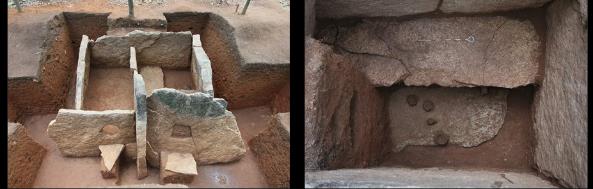 Related studyKerala's Iron Age graves are many; only a handful are dated
Kerala's two oldest burial dates come from urns at Mangadu, near Kollam. The 1992 excavation report ties each laboratory number to its urn.
On the atlasMangadu Iron Age Urn Burial SiteCoarse locality orientation · Kollam District
Explore nextStones Have Different Stories: Shape Alone Cannot Date a MonumentAll related studies, connected material, books and sources15 · 15
Elsewhere on this site
Excavation Atlas Sites: Mangadu Iron Age Urn Burial Site
Junior Detective Quests: Stones Have Different Stories: Shape Alone Cannot Date a Monument
Multi-Script Glossary Terms: mutumakkaḷ tāḻi (முதுமக்கள் தாழி / നന്നങ്ങാടി / മുതുമക്കൾ താഴി) · irumpu īmapporuṭkaḷ (Megalithic Iron Hoards) (இரும்பு ஈமப்பொருட்கள் / മഹാശിലായുഗ ഇരുമ്പായുധങ്ങൾ) · Secondary Fractional Burial (இரண்டாம் நிலை எலும்பு அடக்கம் / ദ്വിതീയ അസ്ഥി അടക്കം ചെയ്യൽ)
Connected material
Photographs, drawings, books, videos and other studies linked to this study. A link helps you explore; it does not prove a historical claim.
- Four ways of making a burial placediagramThe urn panel follows the sealed urn pits and laterite stone circles described for Mangadu in this study.
- Stone, cut and builtillustrationThe lidded globular urn follows this study’s description of the Mangadu urns, about 70–90 cm high.
007Sources
The study lists the sources it consulted; we have not rechecked them. A working link does not show that a source was read, and a valid identifier does not show that it supports a claim. We do not link to unofficial uploads or copies of publications. Where a study cited one, we show the published citation, or a publisher, DOI or Internet Archive link when we have one. Tracking codes are removed from links, and the sources themselves are not republished here.
Web page (archaeology.kerala.gov.in)
Madankavu Urn-Burial Site: A Significant Megalithic Site in Kollam
Web page (pleiades.stoa.org)
researchgate.net · 353481687 The Megalithic Burial Monuments in Kollam A Prelim
Iron Age in South Asia
Online copy not linked · use the published editionSource recordasc.iitgn.ac.in · Iron Age in Kerala Vinod V AR Pillai 2016.pdf
Russet-coated painted ware pottery
CV Abhayan_detailed_20240601
farookcollege.ac.in · social orbit 2020 8eeb2f65 311e 4178 a0e4 2fae8a7aa901 0.pdf
heritageuniversityofkerala.com
tnpscthervupettagam.com · இரும்புக் காலம் ஏன் முக்கியம்
Archaeology - Volume Details
Russet-coated painted ware pottery: The potential ...
മൂവായിരം വർഷത്തിനപ്പുറത്തേക്ക് നീളുന്ന ...
T. Satyamurthy (1992), The Iron Age in Kerala: A Report on Mangadu Excavation (Dept. of Archaeology, Govt. of Kerala)
T. Satyamurthy, The Iron Age in Kerala: A Report on Mangadu Excavation (Thiruvananthapuram: Department of Archaeology, Government of Kerala, 1992).
Print or offline sourceSource record
Researchers and institutions whose work this study uses: T. Satyamurthy
How we know The evidence, claims and dates behind this study
What this study draws on
- T. Satyamurthy's 1992 excavation report (The Iron Age in Kerala: A Report on Mangadu Excavation), with urn-by-urn context, slag analyses and BSIP sheets
- Kerala State Archaeology Department site pages for Madankavu/Mangad
- Vinuraj B. and colleagues' 2020 study of Kollam megaliths and Ambily C. S.'s 2020 South Kerala review
- Abhayan G. S.'s 2018 table of Kerala radiocarbon dates (BS-957 and BS-958)
Dates in this study
This study has no dates recorded in a form we can chart, so there is no date chart. Any dates it gives are in the full study.
The study’s claims
16 claims · 0 source passages · 82 paragraphs
Browse the study paragraph by paragraphThe investigated site is the Madankavu urn-burial site at Mangad/Mangadu, Kollam district.
Supported in this study
Official identification; precise modern coordinates generalized.
Kerala State Archaeology excavated Mangadu in 1991, and T. Satyamurthy published the primary report in 1992.
Supported in this study
Full 1992 report uninspected.
Three intersecting laterite circles were excavated; the later reconstruction gives 2 + 9 + 1 = 12 urns, while the department webpage can be read as twelve plus another deeper urn.
Supported with qualifications
Sources agree on basic architecture but conflict/are ambiguous on exact detail.
Mangadu-specific sources describe large red-ware urns as globular with truncated/round bases; “pyriform” is not established for these particular vessels.
Supported with qualifications
Regional pyriform terminology cannot be transferred without catalogue evidence.
Read Mangadu inventories list red ware and black-and-red ware but do not document RCPW.
Unresolved in this study
This is limited negative inventory evidence; it does not prove archaeological absence.
Mangadu yielded wedges, cutting knife, sickle, tanged knife and blades; site-specific sources say spears were absent.
Supported in this study
Directly challenges the “iron spears” assumption in popular summaries.
Thirty carnelian beads are reported, twenty etched.
Supported in this study
Counts do not establish provenance or exact date.
Satyamurthy (1992) assigns BS-958 (2890 ± 70 BP) to charcoal inside Urn 6 of Megalith II (95 cm) and BS-957 (2850 ± 90 BP) to charcoal inside Urn 10 of Megalith I (95 cm); the BSIP sheets note a 5,730 ± 40-year half-life.
Supported in this study
Both later accounts ultimately depend on Satyamurthy rather than independent lab replication.
Published 2σ intervals are 1299–902 cal BCE for BS-958 and 1289–1282 plus 1269–821 cal BCE for BS-957.
Supported in this study
Curve/software not stated; no recalculation performed.
The public “900 B.C.” date is a simplification and should not replace the published calibrated ranges.
Supported in this study
Comparison of two published presentations, not a new calibration.
Satyamurthy (1992) placed the cemetery between c. 1000 and 100 BCE (using etched carnelian beads and sealing-layer grey-ware sprinklers), whereas the department webpage extends use to the 1st century CE by comparison with Porkalam.
Supported with qualifications
Typological analogy is weaker than direct chronological measurement.
Mangadu is an important early mortuary anchor but its samples do not date the whole southern Kerala Iron Age.
Supported with qualifications
Regional synthesis requires multiple sites and context-sensitive dates.
Cultivation-related tools occur, but “primarily agriculturalists” is a higher-level interpretation of selected burial evidence and setting.
Supported with qualifications
Satyamurthy’s interpretation preserved by Nair; dossier narrows it.
Iron slag is reported, but a complete smelting-production reconstruction is not established in read evidence.
Supported with qualifications
No consulted analytical slag study or furnace assemblage.
Kerala’s megalithic/iron-associated chronology remains dependent on a limited and context-sensitive dating record.
Supported in this study
Regional claim is about the accessible published dataset, not proof that no later research exists.
The primary 1992 report is a full departmental excavation monograph by T. Satyamurthy, resolving the vague secondary description 'interim reports'.
Supported in this study
Report full text remains a priority source.
About this study Status, corrections and how it was made
Status
Draft study, revision 9. No historian, archaeologist, or Tamil or Malayalam specialist has reviewed it yet.
How it was made
Compiled as an editorial synthesis from published scholarship around questions we framed. About this project & workflow
The summary, How sure lines and Two views notes on this page were prepared from this study and cross-checked against its passages. That is an editorial check, not a specialist review.
Technical details
Study code R140. The text fingerprint changes whenever the study text changes.
- Table headings decide what each column means. Citation links, sample mentions and dates copied as text are kept apart from checked source passages and calibrated measurements.
See how this study’s records were extracted
Text fingerprint (SHA-256): R140 · f2b1429fc2ad43183c213d48… · v9
Evidence tables and technical details are on the web page: https://layersofthesouth.org/read/01711921e9