What was found, what it shows, and what stays open
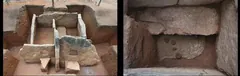
Mangadu lies near Ashtamudi Lake in Kollam. Kerala's State Department of Archaeology excavated it in 1991 and found twelve urns under three overlapping laterite stone circles. The urns held burnt bone, black-and-red pottery, iron wedges, knives, a sickle and blades, and 30 carnelian beads. No spears were found. Charcoal from two urns gave radiocarbon dates of roughly 1300–820 BCE.
Why it matters: It is one of the few Kerala burial sites with early radiocarbon dates, so it anchors southern Kerala's early history.
The place summary's grade
How sure:Likely. Two dates from one cemetery; the laboratory sheets raise a half-life question that could make them read slightly too old.
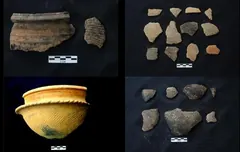
Black-and-red ware pottery profile. Schematic drawing, not to scale.
Twelve burial urns under three overlapping laterite stone circles excavated in 1991 (published 1992), holding burnt bone, black-and-red pottery, iron wedges, knives, a sickle, blades, 30 carnelian beads, and dated charcoal from two urns (BS-957 and BS-958).
What it is taken to show
Its two charcoal dates are the oldest laboratory dates from any Kerala burial. They are few, and the laboratory sheets raise a half-life question that could make them read slightly too old.
Still uncertain
How broadly Mangadu's early 1st millennium BCE dates apply to unexcavated urn fields across southern and central Kerala.
Dates and how they were obtained
Radiocarbon-dated Iron Age urn burial site: in Table 1 of G. S. Abhayan's 2018 synthesis (calibration curve not named in the table), two charcoal samples calibrate at 2σ to 1299–902 cal BCE (BS-958) and primarily 1269–821 cal BCE (BS-957, 99.63% of 2σ probability, with a minor 1289–1282 cal BCE interval at 0.37%); a state department page simplifies one result to 900 BCE. (Radiocarbon dating at the Birbal Sahni Institute, Lucknow (report by T. Satyamurthy, 1992), with pottery and bead comparison.) Two charcoal dates (2σ in Abhayan 2018 Table 1, curve unspecified): 1299–902 cal BCE and 1269–821 cal BCE (main 99.63% interval; minor 1289–1282 cal BCE, 0.37%)
Who dug or recorded it
Kerala State Department of Archaeology (T. Satyamurthy, 1991–92)
Main finds
Multiple burial urns (mutumakkal tali), Black-and-Red Ware, iron wedges, knives and sickles, and carnelian beads.
Evidence basis
Iron tools, carnelian beads and black-and-red pottery
Visiting
Research excavation site; finds curated by Kerala State Archaeology Department.
003Studies filed at this place
Graded statements from studies filed at this place
Each block shows one study's graded statements in stored order. A core says how sure that study is about each statement; it is not a score for the place.
Two Birbal Sahni radiocarbon ages (BS-958, 2890 ± 70 BP; BS-957, 2850 ± 90 BP) calibrate to 1299–902 and 1269–821 BCE in Abhayan (2018), though the BS-957 sheet specifies the 5,730-year half-life.
Satyamurthy (1992) proposed c. 1000–100 BCE; the department summary extends to the first century CE on etched-bead comparison with Porkalam without a later laboratory date.
Satyamurthy's 1992 excavation report (p. 32) and the printed Birbal Sahni Institute laboratory sheets link each code to its exact urn, megalith and 95 cm depth.
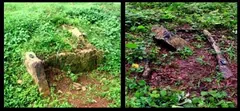
Comparative / Regional Reference (Enadimangalam): Not a direct trench photograph of Mangadu Iron Age Urn Burial Site.
Unexcavated cist burials in the Enadimangalam study area, Figure 2, published page 568R Harinarayanan · CC BY 4.0 · Source ↗ · Open photograph recordCOMPARATIVE REGIONAL SPECIMEN
Comparative / Regional Reference (Enadimangalam): Not a direct trench photograph of Mangadu Iron Age Urn Burial Site.