What was found, what it shows, and what stays open
Porkalam, in Thrissur district, has rock-cut caves, cists and urn burials. In early 1948 B. K. Thapar opened just one burial there. Under a granite capstone ringed by laterite blocks, a large pear-shaped urn stood in a cut pit. Inside lay seven pots, crushed bone, three iron objects and 48 beads, 41 of them etched carnelian.
Why it matters: Its pots and beads became a long-used comparison set for dating Kerala's burial monuments.
The place summary's grade
How sure:Possible. Thapar's date of about the third century BCE–first century CE rests on comparisons, not on a laboratory date.
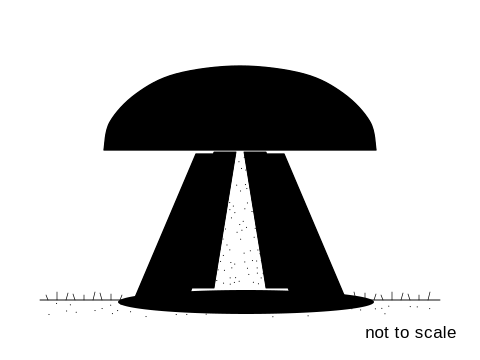
Laterite megalithic monument form in elevation. Schematic drawing, not to scale.
One urn burial, opened by B. K. Thapar in 1948, with a laterite circle, a granite capstone, pottery, three iron objects and etched carnelian beads.
What it is taken to show
Its pots and beads became a long-used comparison set for dating central Kerala's burial monuments.
Still uncertain
Because Porkalam was excavated in 1948 before radiocarbon dating was available in India, Thapar's proposed low chronology (c. 3rd century BCE–1st century CE) is no longer treated as a ceiling for Kerala megaliths.
Dates and how they were obtained
Iron Age / Megalithic burial complex; B. K. Thapar's 1948 excavation initially proposed c. 3rd century BCE – 1st century CE, now read alongside broader Iron Age sequences. (Comparative ceramic and bead typology (etched carnelian beads, Black-and-Red Ware, iron implements) published in Ancient India No. 8 (1952).) Dated by comparison: c. 3rd century BCE–1st century CE (Thapar)
Who dug or recorded it
Archaeological Survey of India (B. K. Thapar, 1948)
Main finds
A large pear-shaped urn in a cut pit under a granite capstone ringed by laterite blocks. Inside: seven pots, crushed bone, three iron objects and 48 beads, 41 of them etched carnelian. At least 18 more pots sat above the urn's lid; the so-called legged pots are four-legged vases.
Evidence basis
Etched carnelian beads and pottery compared with other sites
Visiting
Protected ASI monument near Kunnamkulam.
003Studies filed at this place
Graded statements from studies filed at this place
Each block shows one study's graded statements in stored order. A core says how sure that study is about each statement; it is not a score for the place.
Monument typology, black-and-red ware and Kuttikol Burial 2 (8th–6th centuries BCE) support this, though Kuttikol Burial 1 yielded 15th–17th century CE charcoal.
Only Kuttikol has published radiocarbon dates (Burial 2, 8th–6th c. BCE; Burial 1, 15th–17th c. CE), and they date sampled charcoal rather than the cutting of the chamber.
004Timeline, photographs and talks
On the timeline
Named in
Entries located at another place whose own wording also names this one. They do not ink this cross.
Roughly 800 BCE–200 CE, mostly from comparisons; few laboratory dates
North and Central Kerala (Kuttikol in Kasaragod; Cheramanangad, Ariyannur, Porkalam and Kattakampal in Thrissur)
Photographs
For comparison: finds from other sites (5)
COMPARATIVE REGIONAL SPECIMEN
Comparative / Regional Reference (Chowannur): Not a direct trench photograph of Porkalam Megalithic Urn & Cist Site.
Chowannur burial cave, showing the approach and chamber entranceRanjith Siji (Wikimedia Commons) · CC BY-SA 4.0 · Source ↗ · Open photograph recordCOMPARATIVE REGIONAL SPECIMEN
Comparative / Regional Reference (Chowannur): Not a direct trench photograph of Porkalam Megalithic Urn & Cist Site.
Comparative / Regional Reference (Kandanassery): Not a direct trench photograph of Porkalam Megalithic Urn & Cist Site.
Side view of the sunken approach and circular opening at Kandanassery burial caveSmokingsingh (Wikimedia Commons) · CC BY-SA 3.0 · Source ↗ · Open photograph recordCOMPARATIVE REGIONAL SPECIMEN
Comparative / Regional Reference (Kandanassery): Not a direct trench photograph of Porkalam Megalithic Urn & Cist Site.
Kandanassery burial cave, showing the approach and small chamber doorwaySmokingsingh (Wikimedia Commons) · CC BY-SA 3.0 · Source ↗ · Open photograph recordCOMPARATIVE REGIONAL SPECIMEN
Comparative / Regional Reference (Kakkad): Not a direct trench photograph of Porkalam Megalithic Urn & Cist Site.