Rock-cut beds at the Jambai Jain shelter
Jambai
Photographed 2011-12-25
- Words & worlds
- 500–200 BCE
- 200 BCE–300 CE
- Jambai, Mangulam & Pugalur Rock Inscription Sites
The Jambai inscription ties Aśoka's Satiyaputo to the Atiyan line
A one-line cave inscription at Jambai calls the donor Atiyan Neṭumāṉ Añci satiyaputō, strong evidence that Aśoka's Satiyaputo meant the Atiyan line.
- This page
- 3,275 words · revision 7
Draft study · Awaiting specialist review · Updated
001Dates and places
Places on the atlas that name this study.
- Jambai, Mangulam & Pugalur Rock Inscription Sites
Protected ASI / TNSDA rock-shelter monuments
1000–500 BCE
Different beginnings
500–200 BCE
Marks & materials
200 BCE–300 CE
Connected worlds
300–600 CE
Change & continuity
- third century BCE
- ca. first century CE
- Date from writing, coins or texts
Each date belongs to what was dated (a sample, an object, a layer or a text), which is not always the event the study asks about.
Each period has the same width, so spacing is not to scale.
The full table of dates, with their ranges, is under How we know.
- 1 Well supported
- 2 Likely
- 1 Not known
002How sure
In brief
At Jambai in Tamil Nadu, one line of Tamil-Brāhmī on the rear wall of the Dāsimaḍam cave records a gift. It says that Atiyan Neṭumāṉ Añci, called satiyaputō, gave a paḷi, a hermitage or cave shelter. Later accounts say it was found in 1981; Iravatham Mahadevan edited it, and a Central Institute of Classical Tamil survey photographed it. Its letter shapes place it around the first century CE, and the sources reviewed give no laboratory date. Aśoka's Rock Edict II, about three centuries earlier, names a southern people called Satiyaputo. Jambai sets that word beside an Atiyan ruler's name, so the link to the Atiyan line is strong. Matching the donor with the Atiyamān of Caṅkam poems is likely but still an inference. The stone gives no genealogy, no borders and no date for those poems.
Key researchers cited in this study: Iravatham Mahadevan (Tamil-Brāhmī Epigraphy) · R. Nagaswamy (Tamil Epigraphy & Numismatics) · E. Hultzsch (Edakkal & South Indian Inscriptions) · Full bibliography
How sure
- Well supported
The inscription names Atiyan Neṭumāṉ Añci, calls him satiyaputō and records his gift of a paḷi.
Directly established in the edited reading; the official and corpus readings agree.
- Likely
Aśoka's Satiyaputo refers to the Atiyan or Atiyaman political line.
A strong identification, but still an inference between inscriptions about three centuries apart.
- Likely
The Jambai donor is the Atiyamān Neṭumāṉ Añci of Caṅkam poetry.
A distinctive name cluster matches closely, but the poems themselves are not written on the rock.
- Not known
The line's genealogy, its territory and the date of the related poems.
A one-line donor inscription cannot supply these; the study marks each as not established.
Why it matters
It sets a word from Aśoka's edict beside a named Tamil ruler, giving strong evidence in an old debate about who the Satiyaputo were.
003Key findings
What the study concludes
- The edited inscription reads satiyaputō atiyan neṭumān añci ītta paḷi.
- The inscription directly associates satiyaputō with an Atiyan ruler.
- Comparison with Aśoka makes the Atiyan/Atiyaman identification of Satiyaputo very strong.
- The literary-ruler identification is strong but remains cross-corpus inference.
- A one-line donor inscription cannot independently supply a complete regnal chronology or territorial history.
In the study’s own words. How sure each point is, is shown above.
The summary above is the short read. The full study is the complete text it was drawn from, with its tables and source notes.
What the full study covers
004The study
Overview
What does the Jambai inscription establish about Atiyan Netuman Anci and Satiyaputo?
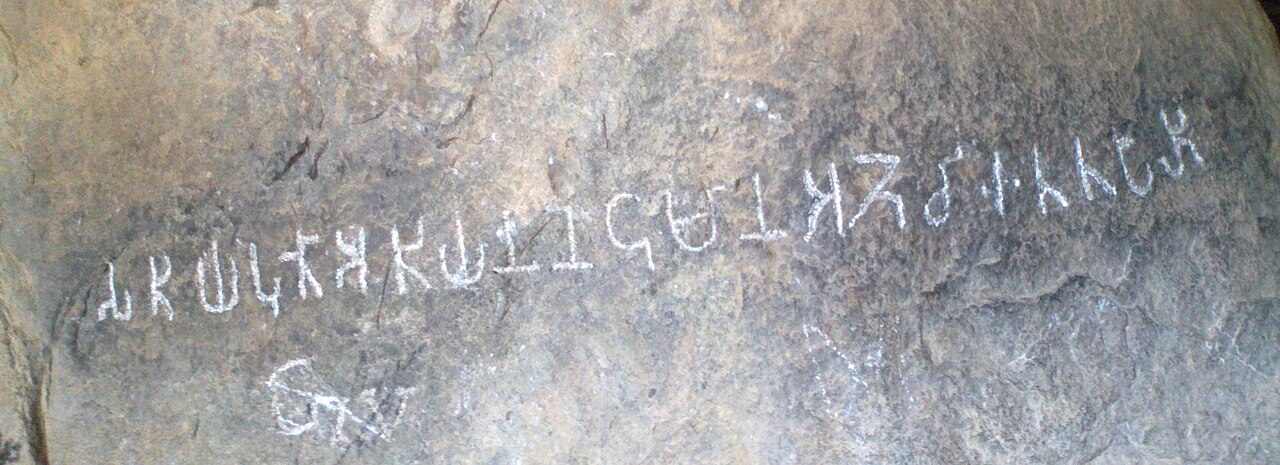
The strongest defensible answer is narrower than the claim that Jambai simply proves the Satiyaputo identification, but it is historically important. The Jambai Tamil-Brāhmī inscription records a donor named Atiyan Neṭumāṉ Añci and places immediately before that name the designation satiyaputō. The CICT/Mahadevan digital edition reads the one-line inscription as satiyaputō atiyan neṭumān añci ītta paḷi and translates its substance as a paḷi – rendered by the edition as a hermitage – given by Atiyan Neṭumāṉ Añci, “the Satiyaputta.” The same edition describes the inscription as a well-preserved, approximately 120 cm line on the rear wall of the Dāsimaḍam cave at Jambai and assigns it approximately to the first century CE. ↗1
Entrance and floor of the Jain rock shelter at Jambaimalai
Jambai
Photographed 2011-12-25
That is the direct epigraphic datum. It matters because versions of Aśoka's Major Rock Edict II, many centuries earlier, contain the southern name Satiyaputo/Satiyaputra in a sequence that also includes names rendered in Hultzsch's edition as Choda, Pandiya and Kelalaputo/Keralaputra. The appearance of satiyaputō together with an Atiyan ruler's name at Jambai therefore supplies unusually strong evidence for the long-standing identification of Aśoka's Satiyaputo with the Atiyan/Atiyaman political lineage or group of the Tamil region. ↗2 ↗3 Mahadevan explicitly made this argument, describing the Jambai occurrence as resolving the earlier debate in favor of the Atiyan identification. ↗4
It is nevertheless too strong to say that Jambai “proves” every proposition often bundled with that identification. The inscription does not state that its donor is the same individual mentioned by Aśoka; chronology rules out such an equation. Nor does it supply a genealogy linking the third century BCE to the first century CE, define the geographical boundaries of a “Satiyaputra kingdom,” demonstrate uninterrupted political continuity, or independently establish a regnal chronology. Those are separate historical questions.
The identification of the Jambai donor with the Atiyamān Neṭumāṉ Añci known in Puṟanāṉūṟu and related Caṅkam poetry is also powerful but inferential. The inscription supplies an exceptionally distinctive cluster of names/designations; literary texts supply parallel ruler names. The literary identification therefore deserves substantially more confidence than a generic name resemblance, but the poetry is not written on the rock. Furthermore, as Herman Tieken's counterargument usefully illustrates, a historical name match in an inscription cannot by itself establish when the poems containing that name were composed, edited, or compiled. ↗5 ↗6
Jambai Tamil-Brahmi inscription on the rock surface, with modern highlighting visible
Jambai
Photographed 2011-12-25
The dating requires one additional qualification. Both the CICT object record and the Tamil Nadu Department of Archaeology's dedicated Jambai page favor approximately the first century CE, with the state page explicitly invoking palaeographic style. ↗1 ↗7 A separate Tamil Nadu archaeology listing, however, labels Jambai “1st Century BCE.” ↗8 Because the detailed palaeographic comparator table or discussion in the complete 2014 Mahadevan corpus was not read here, ca. first century CE should be retained as the best-supported working date, not as an absolute or laboratory-dated year.
Bottom-line assessment
| Proposition | Evidential status | What Jambai actually contributes |
|---|---|---|
| A person called Atiyan Neṭumāṉ Añci is named in the inscription | Directly established | The name is part of the edited inscriptional text. ↗1 |
| That person bears/is associated with satiyaputō | Directly established at the textual level | satiyaputō immediately precedes the personal name. ↗1 |
| He gave a paḷi | Directly established | The line contains ītta paḷi; the edition renders this as a donated hermitage. ↗1 |
| Aśoka's Satiyaputo denotes the Atiyan/Atiyaman political group | Strong historical identification | Jambai provides the decisive cross-corpus linkage, but the identification remains an inference between inscriptions separated by centuries. ↗4 ↗3 |
| The donor is the Caṅkam ruler Atiyamān Neṭumāṉ Añci | Strong prosopographical identification | The distinctive name cluster corresponds closely to literary ruler names; this is not literal wording about the poems. ↗6 ↗7 |
| Jambai dates the relevant Puṟanāṉūṟu poems | Not established | Historical reference and literary composition/transmission chronology are separate questions. ↗6 |
| Jambai proves a continuous Satiyaputra kingdom from Aśoka to the first century CE | Not established | No intervening genealogy, constitutional continuity, or territorial series is supplied by the inscription. |
| Jambai supplies an exact Atiyaman territorial map or regnal chronology | Not established | Neither follows from this single donor inscription. |
Scope, method, and chronology
This study distinguishes literal epigraphic observation from literary and Aśokan identifications, and keeps the Layers of the South principal period of 1000 BCE–600 CE distinct from the actual dates argued for individual pieces of evidence. The ancient evidence is comfortably inside that core window: Aśoka's Major Rock Edict II belongs to the third century BCE, while the principal Jambai edition places the inscription around the first century CE. The 1981 discovery, 1994 analytical publication, modern corpus editions, and photographic documentation are later reception and research history, not dates of the ancient object. ↗1 ↗4 ↗3
The evidentiary sequence used here is deliberately hierarchical. For Jambai, the most useful accessible source was the CICT Photographic Survey object record, which supplies the segmented characters, normalized transliteration, translation, locus, dimensions, date, and reference to plate 59. The survey's methodology page states that the 2007–2010 project combined high-resolution photography and video with comparison to earlier tracings, in-situ checking, and delineation/trace-painting; it also explains that its textual presentation builds on Mahadevan's Early Tamil Epigraphy. ↗9 ↗1
Boulder landscape at Jambaimalai, near the inscription and rock shelter
Jambai
Photographed 2011-12-25
That methodology matters. A highlighted or trace-painted photograph is excellent for showing where editors understand the strokes to be, but it should not be silently treated as an untouched rock-surface photograph. The Tamil Nadu Department of Archaeology's published image likewise displays emphasized letterforms, and the CICT project's methodology page confirms that delineation and temporary trace-painting were part of its documentation workflow. ↗9 ↗7 Because the CICT project's unenhanced higher-resolution image plates were not examined directly, this study treats the text as an edition reading, not as a new independent grapheme-by-grapheme autopsy.
The main chronology can be kept simple:
| Period | Event or evidence | Significance |
|---|---|---|
| Core period, third century BCE | Major Rock Edict II of Aśoka contains Satiyaputo/Satiyaputra among southern names | Earlier epigraphic comparator for the designation. ↗2 ↗3 |
| Core period, working date ca. first century CE | Jambai inscription names satiyaputō atiyan neṭumān añci | Direct association between satiyaputō and an Atiyan ruler. ↗1 |
| Later research history, 1981 | Jambai inscription reported as discovered by K. Selvaraj; R. Nagaswamy issued early notices | Modern discovery/publication, not ancient chronology. ↗10 ↗4 |
| Later research history, 1994 | Mahadevan publishes a sustained Jambai discussion | Explicit argument connecting Jambai's Satiyaputo with Aśoka's name. ↗4 |
| Later research history, 2007–2010 | CICT photographic survey | New systematic photographic documentation and checking methodology. ↗9 |
| Later research history, 2014 | Revised/enlarged second edition of Mahadevan's Early Tamil Epigraphy | Current major corpus edition; full volume not read for this study. ↗11 ↗12 |
No radiocarbon, thermoluminescence, OSL, or other laboratory sample dates the inscription in the evidence reviewed. Its date is palaeographic. This is important because a palaeographic date is an expert relative chronology, not a hidden absolute measurement.
The inscription as an epigraphic object
The CICT record identifies the Jambai item as XVIII.59 / plate 59. It locates the inscription on the rear wall of the cave known as Dāsimaḍam on Āḷuruṭṭimalai hill, describes it as well preserved and consisting of a single approximately 120 cm line, and gives a date around the first century CE. ↗1 The inscription is therefore an in-situ rock inscription rather than a portable object with a conventional museum accession number. The precise legal custody/protection identifier was not established in the sources read and should not be invented.
The character-by-character sequence presented by the digital edition is:
sa ti ya pu to a ti ya na ne ṭu mā na a ña ci ī ta ta pā ḷi
Its normalized transliteration is:
satiyaputō atiyan neṭumān añci ītta paḷi
The accessible record displays the line without restoration brackets. This is significant: the edition is not openly presenting satiyaputō, atiyan, or neṭumān añci as conjectural reconstructions of missing rock. ↗1 Nevertheless, “no restoration brackets in the edition” and “every stroke independently verified from an unenhanced plate” are different claims. Only the former can be made here.
The grammatical-historical substance is straightforward: Atiyan Neṭumāṉ Añci gave a paḷi. The CICT record translates paḷi as a hermitage; Mahadevan's earlier discussion describes the donation as a cave-shelter. ↗1 ↗4 The term should not be expanded without evidence into a detailed institutional reconstruction. In particular, Mahadevan notes that the recipient is not named. ↗4 Thus, even where the broader cave context is interpreted as Jaina, the line itself does not say “to a Jain monk,” name a monastic recipient, or state the rules of an institution. The most secure translation keeps paḷi visible and glosses rather than over-specifies it.
The first word is the decisive one here: satiyaputō. Mahadevan treats it as a Prakrit-form designation or title in an otherwise Tamil inscriptional context and compares it directly with Aśoka's Satiyaputo. ↗4 It is safer editorially to call it a designation unless discussing an author's own terminology, because “royal title” can imply an institutional rank not separately demonstrated by the inscription.
The Tamil Nadu Department of Archaeology independently presents essentially the same reading – “Satiyaputo Atiyan Netuman Anci itta Pali” – and translates it as a hermitage given by Atiyan Netuman Anci, whom its interpretive page identifies with the famous Takatur chieftain and with Aśoka's Satyaputo. ↗7 This is useful official corroboration of the accepted reading, although it is not independent archaeological evidence in the strict sense: the state page and CICT/Mahadevan tradition are modern interpretations of the same single ancient inscription.
The date deserves a visible uncertainty label. The dedicated Department of Archaeology page says approximately the first century CE, explicitly on palaeographic grounds, matching CICT's date. ↗1 ↗7 Yet the department's broader Tamil-Brāhmī listing labels the Jambai inscription first century BCE. ↗8 No basis for the discrepancy is supplied on the aggregate listing. Given the convergence of the more detailed object-specific sources, ca. first century CE is the preferable working date, while an exact palaeographic re-evaluation should wait for direct inspection of Mahadevan's full corpus entry, plate, and comparative letterform argument.
From Jambai to Aśoka and Caṅkam literature
The Aśokan comparison is unusually strong because it involves not merely a familiar personal name but the rare form Satiyaputo/Satiyaputra. Hultzsch's critical edition of Aśoka records Major Rock Edict II recensional forms in which the southern names include Choda, Pandiya, Satiyaputo/Satiyaputra and Kelalaputo/Keralaputra; his grammatical discussion also treats forms such as Satiyaputo and Kelalaputo as masculine nominative singular forms. ↗2 ↗3 The exact orthography therefore varies across Aśokan recensions, and an editorial presentation should not manufacture a single diplomatic text where the inscriptional witnesses differ.
Before Jambai, Satiyaputo in Aśoka was susceptible to competing geographical or dynastic identifications. Jambai changes the evidentiary situation because it puts cognate satiyaputō directly beside atiyan neṭumān añci in an inscription from Tamil Nadu. Mahadevan's 1994 treatment accordingly argued that the Jambai occurrence settled the older identification debate in favor of the Atiyans/Atiyamans. ↗4 The inference can be represented transparently:
Aśoka MRE II: Satiyaputo ↓ lexical correspondence Jambai: satiyaputō + Atiyan Neṭumāṉ Añci ↓ historically strong group identification Inference: Aśoka's Satiyaputo is best identified with the Atiyan/Atiyaman political line or community.
What the arrow does not mean is that Jambai's donor lived in Aśoka's reign. On the preferred chronology, the inscriptions are separated by roughly three centuries. The appropriate claim is therefore identity or continuity of a designation associated with a political lineage/group, not identity of the two individual historical actors. Nor can a single later inscription establish how uninterrupted that lineage was during the intervening centuries.
The literary comparison involves a different inferential step. The state archaeology page and Mahadevan identify the donor with the celebrated Atiyaman ruler known from Caṅkam literature. ↗4 ↗7 Tieken's discussion confirms that Puṟanāṉūṟu contains related name forms including Añci and Neṭumāṉ Añci, even while he disputes what such correspondences can prove about the dating of the poems. ↗6
This distinction produces a useful hierarchy of claims. First, the rock names Atiyan Neṭumāṉ Añci: direct. Second, this is the ruler represented under closely corresponding names in Caṅkam poems: strong prosopographical inference. Third, therefore the extant poems were composed in the inscription's palaeographic period: not entailed. Texts can preserve older people, events, and names through composition, recomposition, oral transmission, compilation, or later literary framing. Tieken's broader literary chronology is itself debated, but that logical caution does not depend on accepting his entire reconstruction. ↗5 ↗6
The same restraint applies geographically. Because Aśoka names Satiyaputo and because Jambai links that designation with an Atiyan ruler, the inscription is highly consequential for identifying the name in the edict. It does not, by itself, draw the boundaries of Atiyan territory in the third century BCE or first century CE. Territorial reconstruction requires independent inscriptions, archaeological distributions, securely contextualized finds, historical geography, and critical handling of literary place references.
Disagreements, boundaries, and evidentiary limits
The most important disagreement is now not primarily over how the standard edition reads the Jambai line. The accessible official and corpus-derived sources converge closely on its wording. ↗1 ↗7 Secondary accounts note an early debate after its 1981 discovery over whether the inscription was genuine, before Iravatham Mahadevan defended it in a 1994 paper (not read in full for this study) and included it in his standard corpus. ↗4 The consequential open questions therefore lie one inferential layer above the reading: its exact date, how far the Aśokan equation should be pushed, whether the literary donor identification can date Caṅkam compositions, and what political continuity may responsibly be inferred.
The first unresolved technical matter is the palaeographic date. The object-specific sources favor ca. first century CE, while one state aggregate page says first century BCE. ↗1 ↗7 ↗8 To discriminate properly would require the actual Jambai discussion and palaeographic comparanda in Mahadevan's revised corpus, preferably alongside a clean photograph/estampage rather than only highlighted tracings. This gap qualifies precision; it does not erase the inscription or its Satiyaputo–Atiyan linkage.
Second, unenhanced high-resolution CICT plate images were not examined directly. CICT's methodology is unusually helpful because it states how photographic documentation, comparison with earlier tracings, delineation, and on-site verification were performed. ↗9 That provides strong reason to trust that the edition reading is grounded in serious epigraphic inspection, without claiming independent stroke-by-stroke autopsy.
Third, the 2014 revised Mahadevan corpus was bibliographically identified but its full Jambai entry was not read. The bibliographic record identifies the work as Early Tamil Epigraphy: From the Earliest Times to the Sixth Century C.E., revised and enlarged second edition, volume 1, issued by the Central Institute of Classical Tamil in 2014, ISBN 9789381744147. ↗11 ↗12 ↗13 That volume is the most important source not yet read, because the CICT web presentation explicitly stands in the Mahadevan corpus tradition. ↗9
Fourth, the original 1981 Nagaswamy publication was not read. A later bibliographic notice identifies it as R. Nagaswamy, “Asoka and Tamil country: a new link,” The Indian Express Sunday Magazine, 6 December 1981. ↗10 Mahadevan's 1994 account says the inscription had been discovered by Selvaraj and that early publication was through Nagaswamy's newspaper notices. ↗4 Because those original notices were not read, details of the discovery history should remain attributed to later sources rather than presented as independently checked field documentation.
Finally, the status of “confirmation” should be stated with some care. The evidence supports high confidence in the Atiyan–Satiyaputo identification, but archaeological reasoning benefits from saying exactly what is confirmed. One ancient inscription confirms that an Atiyan ruler used or bore the designation satiyaputō. Comparison with Aśoka then makes the group identification compelling. What remains inferential is the historical architecture built around that equation.
Conclusions, open questions, and bibliography
Supported conclusions
The claim that Jambai confirms the identification holds only in a qualified form. Jambai is powerful epigraphic confirmation of the identification of Aśoka's Satiyaputo with the Atiyan/Atiyaman political line, because the inscription directly juxtaposes satiyaputō and Atiyan Neṭumāṉ Añci. ↗1 ↗4 ↗3 “Confirmation” should not be expanded to mean proof of an unchanged kingdom, a complete genealogy, exact territorial borders, or a continuous political regime from Aśoka's reign to the date of Jambai.
The donor's identification with the literary Atiyamān Neṭumāṉ Añci is likewise very strong, but it remains a comparison between epigraphic and literary corpora. It cannot on its own date the composition or compilation of the Caṅkam poems in which the ruler appears. ↗6
In short:
At Jambai, a Tamil-Brāhmī inscription names Atiyan Neṭumāṉ Añci together with the designation satiyaputō. This provides strong epigraphic evidence that the Satiyaputo named centuries earlier in Aśoka's Major Rock Edict II referred to the Atiyan/Atiyaman political line. The inscription does not by itself establish the line's full genealogy, territory, or the date of the Caṅkam poems associated with Atiyamān Neṭumāṉ Añci.
Sources not yet read
The most consequential source not yet read is the actual Jambai entry, plate/estampage, and palaeographic argument in Mahadevan's 2014 revised Early Tamil Epigraphy. That would allow the c. first-century-CE dating and any letter-level editorial qualifications to be checked against the corpus itself rather than through its digital derivative. ↗9 ↗12
Next come a clean high-resolution photograph or estampage of the unenhanced inscription; the original 1981 Nagaswamy notice; and direct page-level inspection of Hultzsch's Major Rock Edict II apparatus. These would improve documentation and source proximity, but none presently appears likely to overturn the central Satiyaputo–Atiyan conclusion. ↗10
Prioritized bibliography
Mahadevan, Iravatham. Early Tamil Epigraphy: From the Earliest Times to the Sixth Century A.D. Harvard Oriental Series 62. Chennai: Cre-A / Cambridge, MA: Department of Sanskrit and Indian Studies, Harvard University, 2003, corpus no. 59 (Jambai XVIII.59; also in the CICT Photographic Survey digital presentation). Used for text, segmentation, translation, dimensions, location, and dating. ↗1
CICT Photographic Survey of Tamil-Brāhmī Stone Inscriptions. “About.” Project methodology for the 2007–2010 photographic survey, including photography, tracing/delineation and relationship to Mahadevan's corpus. https://brahmi.mvbhaskar.com/About/About.html ↗9
Mahadevan, Iravatham. Early Tamil Epigraphy: From the Earliest Times to the Sixth Century C.E. Vol. 1: Tamil-Brāhmī Inscriptions. Revised and enlarged 2nd ed. Chennai: Central Institute of Classical Tamil, 2014. ISBN 9789381744147. Bibliographic identity checked; full Jambai entry not read. https://openlibrary.org/books/OL44265878M/Early_Tamil_epigraphy ↗11 ↗12
Mahadevan, Iravatham. “Recent Discoveries of Jaina Cave Inscriptions in Tamilnadu.” Rishabh Saurabh (1994), pp. 116–134. Reprinted text consulted for the 1991 site re-examination and authenticity discussion; original print volume remains desirable for verification. ↗4
Tamil Nadu Department of Archaeology. “Brahmi Inscription” [Jambai]. Official state interpretation and photograph. https://www.tnarch.gov.in/brahmi-inscription-0 ↗7
Hultzsch, Eugen. Corpus Inscriptionum Indicarum, Vol. I: Inscriptions of Asoka. New ed. Oxford: Clarendon Press for the Government of India, 1925. Edition metadata and searchable transcription/OCR were consulted; the original plate scan page was not read for this study. https://archive.org/details/InscriptionsOfAsoka.NewEditionByE.Hultzsch ↗2 ↗3
Nagaswamy, R. “Asoka and Tamil country: a new link.” The Indian Express, Sunday Magazine, 6 December 1981. Exact citation recovered through later bibliographic correspondence; original article not read. ↗10
Tieken, Herman. “Myth versus concocted empiricist histories: David Shulman's reconstruction of the history of Tamil Caṅkam Poetry.” Revised 28 November 2016. Used specifically for the methodological counterpoint that historical-name correspondence does not automatically date literary composition. https://hermantieken.files.wordpress.com/2013/02/shulman-tamil-biography.pdf ↗5 ↗6
Ganesan, N. “Asoka: a new link.” INDOLOGY mailing-list correspondence, 11 May 1998. Useful bibliographic trail to Nagaswamy 1981 and Mahadevan 1994; not treated as independent epigraphic evidence. https://list.indology.info/pipermail/indology/1998-May/012154.html ↗10
Karkotagan. “Jambai inscription on Adhiyamaan Nedumaan Anji.” Wikimedia Commons, 2016. Modern documentary photograph; Commons records it as own work under CC BY-SA 4.0. https://commons.wikimedia.org/wiki/File:Jambai_inscription_on_Adhiyamaan_Nedumaan_Anji.jpg ↗15
005Photographs
Photographs of the places and objects this study discusses. Each item carries its creator’s credit, licence and documented source. See all 412 photographs and source images ↗

Jambai · Photographed 2011-12-25
Rock-cut beds at the Jambai Jain shelter

Jambai · Photographed 2011-12-25
Entrance and floor of the Jain rock shelter at Jambaimalai
Jambai · Photographed 2011-12-25
Jambai Tamil-Brahmi inscription on the rock surface, with modern highlighting visible

Jambai · Photographed 2011-12-25
Boulder landscape at Jambaimalai, near the inscription and rock shelter

Jambai · Photographed 2011-12-25
Granite rock face at Jambaimalai, in the setting of the Jambai inscription

Jambai · Photographed 2011-12-25
Rock-cut pit or basin at Jambaimalai
Rock-cut pit or basin at Jambaimalai; its date and original function are not established by the image.
Jambai · Photographed 2011-12-25
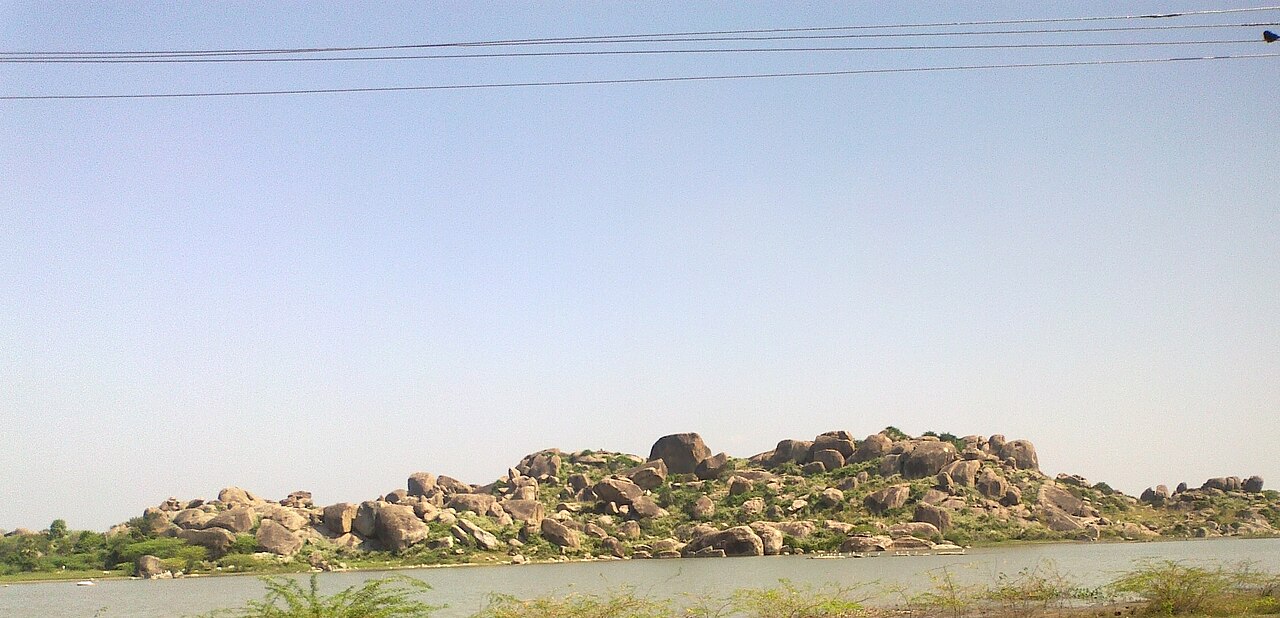
Jambaimalai hill and adjoining water body in the modern landscape
006Where next
All related studies, connected material, books and sources18 · 12
Elsewhere on this site
Excavation Atlas Sites: Jambai, Mangulam & Pugalur Rock Inscription Sites
Junior Detective Quests: One Poem, Five Dates: How Copying Saved Ancient Poems
Classroom Lesson Plans: Module 4 · From Cave Drip-Ledges to Potsherds: Scripts & Literacy in the Deep South
Multi-Script Glossary Terms: Vēḷir (வேளிர் / വേളിർ) · Satiyaputō Atiyaṉ Neṭumāṉ Añci (சதியபுதோ அதியன் நெடுமான் அஞ்சி / സതിയപുതോ അതിയൻ നെടുമാൻ അഞ്ചി)
Connected material
Photographs, drawings, books, videos and other studies linked to this study. A link helps you explore; it does not prove a historical claim.
- Jambai Tamil-Brahmi inscription on the rock surface, with modern highlighting visiblephotographShows the subject
- Boulder landscape at Jambaimalai, near the inscription and rock shelterphotographBackground
- Granite rock face at Jambaimalai, in the setting of the Jambai inscriptionphotographBackground
- Rock-cut beds at the Jambai Jain shelterphotographShows the subject
- Rock-cut pit or basin at JambaimalaiphotographBackground
- Entrance and floor of the Jain rock shelter at JambaimalaiphotographShows the subject
- Jambaimalai hill and adjoining water body in the modern landscapephotographBackground
007Sources
The study lists the sources it consulted; we have not rechecked them. A working link does not show that a source was read, and a valid identifier does not show that it supports a claim. We do not link to unofficial uploads or copies of publications. Where a study cited one, we show the published citation, or a publisher, DOI or Internet Archive link when we have one. Tracking codes are removed from links, and the sources themselves are not republished here.
Tamil Nadu Department of Archaeology, 'Brahmi Inscription' (Jambai).
Early Tamil Epigraphy (2003), corpus no. 59: Jambai XVIII.59
Iravatham Mahadevan, Early Tamil Epigraphy: From the Earliest Times to the Sixth Century A.D. (Harvard Oriental Series 62, 2003), corpus no. 59 (Jambai XVIII.59; CICT Photographic Survey).
Print or offline sourceSource recordAbout the CICT Photographic Survey of Tamil-Brāhmī Stone Inscriptions
CICT Photographic Survey of Tamil-Brāhmī Stone Inscriptions, About / methodology.
Iravatham Mahadevan, Early Tamil Epigraphy: From the Earliest Times to the Sixth Century C.E., Vol. 1: Tamil-Brāhmī Inscriptions, revised and enlarged 2nd ed. (Chennai: Central Institute of Classical Tamil, 2014).
Iravatham Mahadevan, 'Recent Discoveries of Jaina Cave Inscriptions in Tamilnadu,' Rishabh Saurabh (1994), pp. 116–134.
Print or offline sourceSource recordE. Hultzsch, Corpus Inscriptionum Indicarum, Vol. I: Inscriptions of Asoka, new ed. (Oxford: Clarendon Press for the Government of India, 1925).
R. Nagaswamy, 'Asoka and Tamil country: a new link,' The Indian Express Sunday Magazine, 6 December 1981.
Print or offline sourceSource recordHerman Tieken, 'Myth versus concocted empiricist histories: David Shulman's reconstruction of the history of Tamil Caṅkam Poetry,' revised 28 November 2016.
IGNCA digital catalogue for Epigraphia Indica; used to investigate the inherited K. V. Ramesh lead.
Karkotagan, 'Jambai inscription on Adhiyamaan Nedumaan Anji,' Wikimedia Commons, 2016.
Tamil-Brāhmī inscription listing
Tamil Nadu Department of Archaeology Tamil-Brāhmī listing containing Jambai.
N. Ganesan, 'Asoka: a new link,' INDOLOGY mailing-list correspondence, 11 May 1998.
Researchers and institutions whose work this study uses: Iravatham Mahadevan, R. Nagaswamy, E. Hultzsch
How we know The evidence, claims and dates behind this study
What this study draws on
- The reading comes from the CICT/Mahadevan digital edition of Jambai XVIII.59, checked against the Tamil Nadu archaeology department's page.
- The Aśoka comparison uses Hultzsch's edition of Major Rock Edict II.
- Mahadevan's 1994 discussion makes the Satiyaputo argument; Tieken's work supplies the caution about dating poems by name matches.
- The date rests on letter shapes (palaeography); the sources reviewed report no laboratory date.
Dates in this study
| What is dated | Date | How it was dated |
|---|---|---|
| third century BCE | 300–200 BCE | Date from writing, coins or texts |
| ca. first century CE | 1–100 CE | Date from writing, coins or texts |
See these dates on the timeline
The study’s claims
13 claims · 10 source passages · 49 paragraphs
Browse the study paragraph by paragraphThe CICT/Mahadevan digital reading of the Jambai inscription is satiyaputō atiyan neṭumān añci ītta paḷi, with no restoration brackets indicated in the accessible object record.
Supported in this study
Edition reading read; not a fresh grapheme-by-grapheme autopsy.
The inscription records Atiyan Netuman Anci as the donor of a paḷi, interpreted by the principal editions as a hermitage or cave-shelter.
Supported in this study
The historical institution represented by paḷi should not be over-specified from this line alone.
The Jambai line does not name a recipient or explicitly state that the donation was to a Jain monk.
Supported in this study
Broader cave context may support religious interpretation, but that is separate from the wording of this inscription.
Approximately the first century CE is the best-supported working date in the object-specific sources, based on palaeography, but one Tamil Nadu archaeology aggregate page instead labels Jambai first century BCE.
Supported with qualifications
This is a relative palaeographic date, not a laboratory determination.
Aśoka's Major Rock Edict II contains Satiyaputo/Satiyaputra in recensional sequences of southern names that also include Choda, Pandiya and Kelalaputo/Keralaputra.
Supported in this study
Do not collapse recensional variants into one falsely diplomatic spelling.
Jambai provides strong epigraphic evidence that Aśoka's Satiyaputo designation referred to the Atiyan/Atiyaman political line or group.
Supported in this study
The inference identifies a political line/group, not the same individual across the two inscriptions.
The Satiyaputo identification does not independently demonstrate uninterrupted political continuity, a complete genealogy, or unchanged territorial borders from Aśoka's period to Jambai.
Supported in this study
Additional evidence would be required for genealogy, territorial history, or constitutional continuity.
Identification of the Jambai donor with the Atiyaman Netuman Anci represented in Caṅkam literature is a strong prosopographical inference rather than literal inscriptional wording about the literary corpus.
Supported with qualifications
The inscription does not mention Puṟanāṉūṟu or identify itself as evidence about poem composition.
The Jambai inscription by itself does not establish the composition or compilation date of Puṟanāṉūṟu poems referring to Atiyaman/Neṭumāṉ Añci.
Supported in this study
Historical reference, composition, redaction, transmission and compilation are distinct chronological questions.
Later accounts report that K. Selvaraj discovered the Jambai inscription in 1981 and that R. Nagaswamy issued early newspaper publication of it.
Supported with qualifications
Discovery history remains attributed to later sources pending the original 1981 notices.
The available CICT visual documentation involves an explicit delineation/trace-painting methodology, so highlighted images should not be confused with untouched rock-surface photographs.
Supported in this study
This is a documentation-method qualification, not an accusation that the edited reading is unreliable.
An unverified reference to 'K. V. Ramesh, Epigraphia Indica' was not resolved to a Jambai-specific publication in the targeted searches undertaken for this study.
Unresolved in this study
Do not cite this unverified reference as read evidence until author-title-volume-pages are recovered.
Jambai is not independently sufficient to construct a complete Atiyaman regnal chronology or territorial map.
Supported in this study
Such reconstructions require independent archaeological, epigraphic, geographical and literary evidence.
Trace one claim through the study’s records
Explore the evidenceOther source lists
Numbered citation links from the study
The numbered links in the study text point here.
Mahadevan, Early Tamil Epigraphy (2003/2014), Jambai no. 59 (via CICT Photographic Survey)
Print or offline sourceHultzsch, E., Corpus Inscriptionum Indicarum Vol. I: Inscriptions of Asoka (1925)
Hultzsch, E., Corpus Inscriptionum Indicarum Vol. I: Inscriptions of Asoka, Girnar Rock Edict II (1925)
Mahadevan, Iravatham, 'Recent Discoveries of Jaina Cave Inscriptions in Tamilnadu,' Rishabh Saurabh (1994), pp. 116–134
Print or offline sourceArticles – Herman Tieken
Tieken, Herman, 'Myth versus concocted empiricist histories: David Shulman's reconstruction of the history of Tamil Caṅkam Poetry' (2016)
Brahmi Inscription | Department Of Archaeology
Inscriptions in Thamizhi (Tamil- Brahmi) Script | Department Of Archaeology
About the CICT Tamil-Brahmi Photographic Survey
Asoka: a new link
Early Tamil epigraphy : from the earliest times to the sixth century C.E. | CiNii Research
Early Tamil epigraphy by Iravatham Mahadevan | Open Library
Early Tamil epigraphy
Epigraphia Indica | IGNCA
Jambai inscription on Adhiyamaan Nedumaan Anji.jpg
About this study Status, corrections and how it was made
Status
Draft study, revision 7. No historian, archaeologist, or Tamil or Malayalam specialist has reviewed it yet.
How it was made
Compiled as an editorial synthesis from published scholarship around questions we framed. About this project & workflow
The summary, How sure lines and Two views notes on this page were prepared from this study and cross-checked against its passages. That is an editorial check, not a specialist review.
Technical details
Study code R218. The text fingerprint changes whenever the study text changes.
- The study text is shown as written. Links from its paragraphs to citations help you move around the study; they are not new claims or checked source passages.
See how this study’s records were extracted
Text fingerprint (SHA-256): R218 · 99b00815f1a60a284ff9d37f… · v7
Evidence tables and technical details are on the web page: https://layersofthesouth.org/read/3624e5a222