Photomicrographs of subfossil Calophyllum and Careya wood, with numbered anatomical sections and scale bars
This material does not come from an excavated settlement and is not direct evidence of farming.
- Everyday lives
- Marayoor
Western Ghats uplands were settled; forest producers are unnamed
Dated evidence shows settled, mixed upland economies and traded forest goods, but no link between ancient producers and today's Kanikkar or Malai Vedan.
- This page
- 3,856 words · revision 4
Draft study · Awaiting specialist review · Updated
001Dates and places
Places on the atlas that name this study.
- Marayoor & Kovilkadavu Dolmen Fields
Protected heritage zone · Marayoor / Kovilkadavu, Idukki
Before 1000 BCE
1000–500 BCE
Different beginnings
500–200 BCE
Marks & materials
200 BCE–300 CE
Connected worlds
300–600 CE
Change & continuity
- 1200–300 BCE
- Broad Early Historic Pattanam phase within approximately the final centuries BCE through the early centuries CE
- mid-first century CE
- Date from writing, coins or texts
- Period assigned by excavators or scholars
Each date belongs to what was dated (a sample, an object, a layer or a text), which is not always the event the study asks about.
Each period has the same width, so spacing is not to scale.
The full table of dates, with their ranges, is under How we know.
- 2 Well supported
- 1 Possible
- 1 Not known
002How sure
In brief
This study asks what dated evidence shows about forest economies and upland peoples in the southern Western Ghats. A survey at Koppa in Coorg, further north, recorded 39 Iron Age sites, 13 of them habitation sites, dated broadly to 1200–300 BCE. The early Tamil poem Malaipaṭukaṭām shows hill people gathering honey and also guarding fields from elephants. The first-century Periplus lists pepper, ivory and malabathrum, an aromatic leaf, among Malabar trade goods. Colonial accounts of 1909 and 1937 describe Kanikkar collecting honey, cardamom, dammar resin and elephant tusks. No evidence checked links ancient producers to today's Kanikkar, Malai Vedan or any other named community. A cardamom-like seed from a peat layer at Pattanam (read here in its published abstract) is a promising lead, though its layer has not been dated directly. No securely dated early evidence for dammar was found.
Key researchers cited in this study: Lionel Casson (Periplus Maris Erythraei Philology) · Wilfred H. Schoff (Periplus Translation & Commentary) · L. A. Krishna Iyer (Prehistoric Archaeology & Anthropology of Kerala) · Full bibliography
How sure
- Well supported
Forested Western Ghats uplands had Iron Age settlements as well as burial sites.
The Koppa survey recorded 13 habitation sites, though in Coorg, north of the study area.
- Well supported
Pepper and ivory were traded from the Malabar coast in the first century CE.
The Periplus lists both as traded goods, but it does not name who produced them.
- Possible
Cardamom reached Pattanam in the early period.
The 2020 study abstract reports a specimen morphologically resembling cardamom from a Pattanam peat deposit whose layer date was not checked in full text here.
- Not known
Ancient upland producers were ancestors of today's Kanikkar or Malai Vedan.
No dated source links an ancient group name to these later names.
Why it matters
It shows how to describe early forest economies without treating living Scheduled Tribe communities as stand-ins for ancient peoples.
003Key findings
What the study concludes
- Iron Age habitation is archaeologically visible in Western Ghats uplands, although the best read survey is north of Agasthyamalai.
- Malaipaṭukaṭām depicts honey collection and other hill products alongside cultivated-field protection, making a forager-only model too narrow.
- The Periplus establishes Early Historic demand for pepper, ivory and malabathrum but not the identity of upstream producers.
- Colonial ethnography securely documents Kanikkar honey, cardamom, dammar and tusk collection but cannot be projected two millennia backward.
In the study’s own words. How sure each point is, is shown above.
The summary above is the short read. The full study is the complete text it was drawn from, with its tables and source notes.
What the full study covers
004The study
Overview
Exact What can dated evidence reveal about forest economies and upland communities?
This study tests the common grouping of “Western Ghats forest foragers” against separate strands of evidence. It keeps ancient textual terms, archaeological traces, colonial ethnonyms, and present-day community identities analytically separate, and it tests commodities such as honey, ivory, cinnamon-like aromatics, cardamom, and dammar individually.
The strongest conclusion is negative in one important respect and positive in another. There is credible dated evidence for upland occupation, mixed hill and forest production, and the incorporation of some forest-linked commodities into Early Historic exchange. There is not presently a defensible dated chain identifying the ancient producers as Kanikkar/Kāni, Vēdar, Malai Vedan, or any other named modern community. An Iron Age archaeological survey in the upper Kaveri/Coorg Western Ghats documented habitation as well as megalithic sites in a forested high-rainfall landscape; early Tamil poetry depicts named literary-social categories such as kānavar and kuṟavar gathering honey, using animal products, and protecting cultivation; and the Periplus Maris Erythraei describes pepper, ivory, and malabathrum within the Malabar trade sphere. These evidence classes independently establish parts of an upland economy, but none supplies the missing identification between an ancient actor and a present ethnonym. ↗1
The word “foragers” is also too narrow. Malaipaṭukaṭām represents upland people collecting honey and forest foods, but it also represents kuṟavar protecting cultivated fields from elephants. Colonial ethnographies likewise describe Kanikkar settlement and shifting cultivation alongside honey and forest-product collection. The historically supportable category is therefore a mixed upland economy, not an invariant forager mode. ↗2
The commodity results are uneven:
| Commodity/activity | Evidence within or relevant to 1000 BCE–600 CE | Later comparative evidence | What can safely be concluded | Confidence |
|---|---|---|---|---|
| Honey | Malaipaṭukaṭām depicts kānavar obtaining substantial honey in difficult mountain terrain | Kanikkar honey gathering is documented ethnographically in the early twentieth century | Honey gathering was part of represented early Tamil upland life; continuity into one named modern community is not demonstrated | Moderate for ancient activity; low for continuity |
| Ivory / elephant tusks | Periplus lists ivory among Malabar exports; early Tamil poetry includes elephant-tusk imagery | Kanikkar collection of tusks for government is reported in colonial ethnography | Ivory circulated in Early Historic trade, but the ancient procurers are unnamed | High for commodity circulation; low for producer identity |
| Black pepper | Periplus explicitly places pepper in Malabar export; Pattanam research provides archaeobotanical context for spice use/trade | Not needed to establish the ancient commodity | Strong evidence for an Early Historic pepper trade does not reveal which upland communities supplied it | High for trade; low for producers |
| Malabathrum / aromatic leaf | Periplus associates malabathrum with interior supply | Modern Cinnamomum malabatrum occurs in western and southern India | The ancient commodity term is secure; equating it automatically with “wild cinnamon” or a single modern taxon is unsafe | Moderate for commodity; low for species |
| Cardamom | Pattanam study abstract reports remains morphologically resembling cardamom, with specimen-level context and dating not yet checked | Kanikkar cardamom collection is well attested in colonial ethnography | A potentially important ancient lead exists, but it is not strong enough here to reconstruct a named upland supply chain | Low–moderate ancient; high colonial-period |
| Dammar resin | No securely dated core-period southern Western Ghats instance was established in the bounded source set read here | Kanikkar dammar collection is explicitly reported by colonial ethnographers | Secure as later documented forest production; ancient projection is presently unsupported | Very low ancient; high colonial-period |
For this reason, the study treats forest economies and upland communities in general, and places Kanikkar/Kāni and Vēdar/Malai Vedan evidence in a clearly marked later period, not as if their first-millennium BCE/CE identity had already been established.
Scope, assumptions, chronology, and method
The geographical center is the southern Western Ghats and adjoining Kerala–Tamil country, but evidence from connected Western Ghats landscapes and Indian Ocean exchange is admitted where it tests a specific proposition. This matters because the strongest archaeological upland survey examined here, the Koppa Archaeological Research Project, concerns the upper Kaveri/Coorg sector rather than Agasthyamalai itself. It demonstrates that Iron Age settlement in a forested Western Ghats landscape is archaeologically visible; it cannot simply be transferred southward as proof of identical settlement organization. ↗3
Three explicit assumptions govern the synthesis. First, similar activity is not proof of ethnic continuity: honey gathering in an early Tamil poem and honey gathering by twentieth-century Kanikkars are two observations separated by many centuries. Second, a traded commodity is not evidence for a named producer: an export list at a port terminus leaves procurement, aggregation, tribute, brokerage, and transport largely invisible. Third, modern botany establishes ecological possibility and taxonomic facts in the modern scientific sense; it does not establish which ancient term denoted which species or who collected it.
The chronology is consequently mixed rather than artificially compressed into 1000 BCE–600 CE. The Koppa survey's Iron Age horizon falls broadly around 1200–300 BCE; Malaipaṭukaṭām cannot be given a single precise date; the Periplus is conventionally dated to the mid-first century CE; the colonial ethnographies date from 1909 and 1937; and the Scheduled Tribe list is current.
The early Tamil textual evidence requires special caution. Malaipaṭukaṭām survives through a long textual transmission, and scholarship on the Tamil classical corpus warns against treating extant editions as transparent transcripts of a single precisely dated ethnographic moment. Eva Wilden's study of Tamil manuscript, oral, and print transmission is particularly important for keeping composition, transmission, manuscript history, and modern publication conceptually distinct. ↗4 Date debates surrounding early Tamil poetry likewise make a falsely precise single year inappropriate. ↗5
Methodologically, the investigation used four linked tests: textual reading of relevant early Tamil and Periplus passages; archaeological and archaeobotanical checks for dated material evidence; source criticism of colonial ethnography; and modern official/taxonomic sources only for present classification or ecological comparison. A quantitative trend chart would be misleading: counts of archaeological sites, lines of poetry, commodities in an export list, and twentieth-century ethnographic observations are not commensurate observations from one statistical population.
What the ancient and archaeological evidence actually shows
Upland occupation is archaeologically real, but group ethnicity is unknown
The Koppa Archaeological Research Project reported 39 Iron Age sites – 13 habitation sites and 26 megalithic sites – in the upper Kaveri/Coorg Western Ghats, with the investigated archaeological horizon placed broadly around 1200–300 BCE. Its importance here is not that it identifies the ancient inhabitants, which it does not, but that it counters any simplistic assumption that high-rainfall Western Ghats landscapes left only funerary traces or lacked archaeologically visible settlement. ↗3
Kerala scholarship itself has identified the scarcity or poor recognition of habitation contexts as a long-running archaeological problem. Das, Joglekar, and Mohanty's 2013 article explicitly frames the earlier absence of known megalithic habitation sites in Kerala as an unresolved issue and reports habitation evidence associated with burial landscapes on Kerala's eastern fringes. Only the article's abstract was read, so its site-by-site details were not checked directly. ↗6
The result is important but bounded: Western Ghats uplands were occupied landscapes, not an archaeologically empty “wild” margin, yet present evidence does not turn those inhabitants into Kanikkars, Vēdars, or any other historically named people. Material culture, settlement, and burial evidence can establish occupation and practice without recovering later ethnonyms.
Montane landscape in the Nilgiris, Western Ghats (modern ecological context)
Photographed 2025-08-25
Early Tamil poetry depicts a mixed hill economy
The Project Madurai text of Malaipaṭukaṭām preserves several passages directly relevant to upland production. One cluster associates kānavar with honey, tubers, meat, and elephant tusks; another describes kuṟavar protecting cultivated fields from elephants with sling-stones; another depicts kānavar obtaining a major honey yield from difficult mountain terrain, in a passage embedded in relationships of offering, reception, and celebration around Nannan. ↗7
This evidence supports three propositions, but not a fourth. It supports forest collection, because honey and other gathered resources are explicit. It supports mixed subsistence, because field protection appears alongside collection and hunting. It supports political/social transfer of upland goods, because the poem represents products moving within chiefly relations. But it does not support equating the terms kānavar or kuṟavar with Kanikkar or Malai Vedan. Lexical resemblance, overlapping habitat, or later occupation does not supply a dated genealogical identification. ↗2
The poem is therefore more useful when read as evidence about categories of activity and landscape than as an ethnic census. It shows literary knowledge of upland collection, animal encounters, cultivation, hunting-related activity, and circulation of products. Its transmitted literary form also means that a represented scene and the date of the surviving textual tradition must not be collapsed. ↗4
Port trade confirms demand, not the identity of collectors
The Periplus Maris Erythraei, conventionally dated to the mid-first century CE, is the strongest textual bridge from the western coast to Indian Ocean commodity exchange. In the accessible older English translation, the Malabar section lists pepper and ivory, while also associating malabathrum with supply from the interior. Casson's later critical edition is the better text for close philological work, but only its bibliographic record, not its full commentary, was read here. ↗8
The key inferential limit is decisive. A coastal export text gives an endpoint in an exchange chain. It does not document every preceding link. Between an upland collector and a maritime cargo could stand household production, exchange partners, chiefly extraction, market aggregation, merchants, transport specialists, or several of these. The phrase “harvesting … for royal coastal export” therefore joins two independently plausible phenomena into a supply chain for which no continuous dated source was found in the literature consulted.
Commodity tests
Honey
Honey has the clearest cross-chronological activity parallel. Malaipaṭukaṭām depicts mountain honey procurement by kānavar; Thurston and Rangachari later describe Kanikkar honey collection, including cliff-related collection techniques; Krishna Iyer independently preserves twentieth-century ethnographic material about Kanikkar honey gathering. ↗9
Yet this is precisely the case in which apparent continuity can be overread. Honey is a recurrent forest resource, and comparable collection across time does not identify the populations as one continuous ethnic entity. The proper conclusion is continuity of ecological opportunity and recurrence of an activity, not demonstrated continuity of community identity.
Ivory and elephant tusks
The Early Historic trade case is stronger for ivory than for the identity of its suppliers. The Periplus includes ivory among western-coast exports, while early Tamil poetry places elephant products within its upland representational world. ↗10
Colonial ethnography then reports Kanikkars being engaged to collect elephant tusks alongside other forest products. ↗11 This produces a striking long chronological series, but its middle is empty: ancient ivory circulation + twentieth-century Kanikkar tusk collection ≠ proof of ancient Kanikkar tusk procurement. That missing identity link is not a minor caveat; it is exactly what the named-group framing presupposes.
Pepper
Pepper is the most secure of the tested export commodities in the Early Historic textual record. The Periplus explicitly associates Malabar with pepper production/export. ↗12 Archaeobotanical research at Pattanam has likewise investigated plant use and spice trade, while institutional summaries place the site's principal Early Historic activity within the centuries relevant to this study. ↗13
Pepper is therefore a useful methodological control. A commodity can be extremely well established in long-distance exchange while the social identity of upland cultivators, collectors, intermediaries, and transporters remains unknown. This cautions against turning commodity confidence into ethnic confidence.
Cardamom
Cardamom requires substantially more restraint. The Pattanam archaeobotanical article's accessible abstract reports macrobotanical specimens morphologically resembling several plants, including cardamom, in material associated with a peat formation. The abstract alone does not provide enough read specimen-level information to verify diagnostic morphology, stratigraphic association, contamination/taphonomic concerns, or a direct absolute date for the particular cardamom-like specimen. ↗14
Institutional Pattanam summaries also list cardamom among archaeobotanical findings, but those summaries do not substitute for inspection of the original specimen table, figures, and dating argument. One project account itself points toward further morphological, characterization, or DNA work, reinforcing the need to distinguish an identification lead from a fully resolved taxonomic determination. ↗15
By contrast, later Kanikkar cardamom collection is explicit in Thurston/Rangachari and Krishna Iyer. ↗11 The defensible formulation is therefore: cardamom is securely documented in the later Kanikkar forest economy; an ancient Pattanam-linked cardamom signal is promising but, on the evidence read here, insufficient to assign ancient procurement to that community.
Malabathrum and “wild cinnamon”
The Periplus attests malabathrum as an interior-linked commodity, but translating this automatically as a particular “wild cinnamon” species introduces a taxonomic conclusion not contained in the commercial term itself. ↗12 Stephen Haw's reassessment of cinnamon/cassia terminology and ancient trade illustrates the broader problem of mapping ancient aromatic names directly onto modern Linnaean species. ↗16
Modern Kew taxonomy recognizes Cinnamomum malabatrum and records a native range in western and southern India. That establishes modern botanical plausibility, not an ancient identification. ↗17 Until the relevant critical Periplus commentary and archaeobotanical/residue evidence are brought together, the safest ancient term is simply malabathrum, with the botanical identification explicitly qualified.
Dammar
Dammar is well supported in later ethnography: Thurston/Rangachari and Krishna Iyer both place dammar among products collected by Kanikkars under government-linked forest arrangements. ↗11
No securely dated 1000 BCE–600 CE southern Western Ghats archaeological or textual instance was found to anchor dammar procurement in the target period. That is a negative result limited to the sources read, not a claim that no such evidence exists. The next step is specific: locate and inspect archaeological resin identifications, residue analyses, or Canarium/dammar archaeobotanical studies with secure contexts and diagnostic methods.
Colonial ethnonyms, present identities, and the continuity problem
The colonial sources are valuable because they document forest economies in unusually concrete detail; they are dangerous when treated as keys that unlock ancient ethnic identities.
Thurston and Rangachari's 1909 Kanikar entry places Kanikkars/Kānis in the mountains of South Travancore and describes settlement and cultivation as well as forest collection. It also reports government employment of Kanikkars to collect honey, wax, ginger, cardamom, dammar, and elephant tusks for remuneration, and gives detail on honey-gathering practices. ↗18 This is strong evidence for an early twentieth-century political economy of forest extraction. It is not evidence that the same administrative or ethnographic category existed in the Iron Age or Early Historic period.
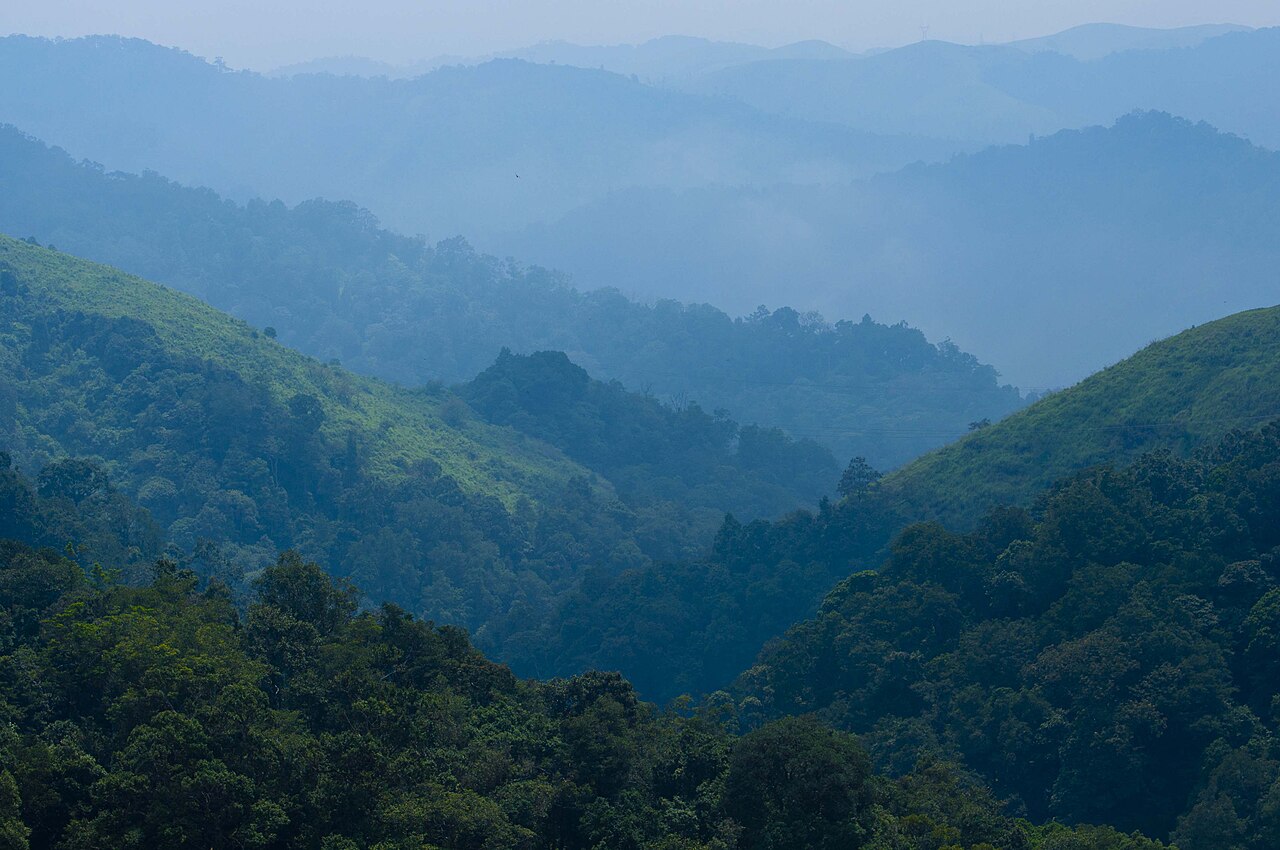
Mountains of Western Ghats – Modern woodland context
Photographed 2011-10-22
The Vēdan evidence makes identity projection even more hazardous. Thurston's entry says the name, connected with “hunter,” was used loosely in some colonial classifications and could be applied to people categorized differently elsewhere. His Travancore discussion distinguishes Vēdars/Mala Vēdans and describes activities that include jungle clearance, rice-field labor, tuber use, crop guarding, bow-and-arrow use, and basketry. ↗19 “Vēdan” is thus demonstrably not a simple, timeless ethnographic label with one unchanging referent.
L. A. Krishna Iyer's 1937 The Travancore Tribes and Castes is an important second ethnographic witness but is not wholly independent in every respect. His preface explains that earlier Travancore Ethnographic Survey material had fed into Thurston's work and that his own renewed field investigations took place in the 1930s. His Kanikkar account again records honey gathering and government-linked collection of cardamom, ginger, dammar, and elephant tusks. ↗20 The overlap strengthens confidence that these activities were documented in the colonial/early modern administrative setting, but shared documentary genealogy means the two publications should not be counted mechanically as two fully independent confirmations of every detail.
Present administrative evidence points in the same direction of distinction rather than automatic merger. Kerala's Scheduled Tribes Development Department currently lists Kanikaran/Kanikkar and Malai Vedan/Malavedan as separate Scheduled Tribe entries. ↗21 That is evidence about present government classification only. It neither proves ancient separation nor establishes how all members of the communities self-identify.
The evidence lanes should therefore remain explicit:
| Evidence | Terms legitimately observable | What the lane can answer | What it cannot answer by itself |
|---|---|---|---|
| Early Tamil literature | kānavar, kuṟavar and other literary/social terms | Represented activity, landscape, exchange, cultivation, hunting/collection | Modern ethnic equivalence |
| Archaeology | Sites, contexts, materials, botanical remains | Occupation, chronology, production and consumption where methods permit | Ethnonym absent independent identification |
| Greco-Roman trade text | Pepper, ivory, malabathrum, ports/markets | Commercial demand and movement | Identity of upland producers |
| Colonial ethnography | Kanikkar/Kāni, Vēdan/Vēdar/Mala Vēdan and administrative classifications | Nineteenth-/twentieth-century activity and classification | Direct first-millennium ancestry |
| Present administration | Kanikaran/Kanikkar; Malai Vedan/Malavedan | Current official classification | Ancient continuity or complete self-identification |
This separation is not excessive skepticism. It is what allows later community history to be treated respectfully, without turning living people into archaeological proxies merely because they inhabit comparable landscapes or perform activities also described in old texts.
Disagreements, conclusions, and evidential limits
The largest interpretive disagreement is not over whether upland forest production existed; several independent evidence classes make that proposition reasonable. The disagreement concerns how much social continuity can be inferred across the gaps between them.
One possible model emphasizes persistence: the southern Western Ghats offered recurrent access to honey, aromatic plants, elephants, tubers, and other products; early Tamil texts describe upland specialists; Early Historic maritime trade demanded valuable products from hinterlands; and colonial ethnographers later found named communities carrying out similar forest work. This makes long-lived regional traditions of expertise ecologically and historically plausible.
The competing model stresses discontinuity and changing labels: landscapes can sustain similar practices among different populations; commodities can be procured through changing institutions; early Tamil social terms need not map to colonial ethnonyms; colonial administrations themselves used labels inconsistently; and modern administrative categories are products of still later legal regimes. The currently read evidence favors activity continuity as a possibility but ethnic continuity as unresolved. ↗22
Several observations would materially discriminate between the models. A securely dated inscription or text explicitly linking an ancient ethnonym to one of the later names would be powerful. So would a well-contextualized archaeological sequence in Agasthyamalai/South Travancore showing repeated specialized production over centuries, especially if paired with historical documents tracking terminology and settlement. Conversely, merely finding the same plant in an ancient deposit and in a modern community's forest economy would not establish ancestry.
The supply-chain question is similarly unresolved. Malaipaṭukaṭām shows upland products embedded in relations involving a chief; the Periplus shows valuable commodities leaving western-coast commercial centers. ↗23 No consulted source here connects those two endpoints into a single documented “royal coastal export” chain operated by a named Kanikkar or Vēdar population. That specific formulation therefore cannot stand, even in softened form.
The principal conclusions are:
-
Dated occupation: Western Ghats archaeology demonstrates that forested uplands supported Iron Age habitation as well as mortuary landscapes. The strongest surveyed case read here is in Coorg/upper Kaveri and is comparative rather than direct evidence for Agasthyamalai. ↗3
-
Economic diversity: Early Tamil poetry represents upland people collecting honey and animal products while also protecting cultivation. “Forager” is consequently an inadequate umbrella term. ↗7
-
Commodity circulation: Pepper and ivory are firmly present in the Early Historic Malabar trade record; malabathrum is also attested but botanically less secure. ↗24
-
Uneven botanical evidence: Pattanam provides a potentially important cardamom lead, but the accessible abstract is not enough for a specimen-level historical claim. ↗14
-
Secure later forest economy: Colonial sources document Kanikkar involvement in honey, cardamom, dammar, and elephant-tusk collection, in addition to cultivation and other work. ↗11
-
Identity continuity is unproven: Neither ancient literature, archaeology, nor the Periplus read here justifies identifying Kanikkar or Malai Vedan as the named ancient suppliers. Present official classification keeps those communities distinct. ↗21
This study is therefore not a claim about community origins. The safest summary is that southern Indian uplands participated in long histories of collection, cultivation, hunting-related activity, and exchange, while the names and identities of specific producers change with the evidence and cannot simply be projected backward.
Further research, bibliography, and remaining uncertainties
The most consequential remaining work is tightly defined rather than open-ended. First, acquire and inspect the full Rithin Varghese et al. Pattanam archaeobotanical paper, especially the specimen table, diagnostic images, trench profile, exact layer associations, and dating evidence for the purported cardamom-like material. Second, inspect Lionel Casson's critical text and commentary for Periplus §56 and malabathrum rather than relying for final philology on the older Schoff translation. Third, pair Malaipaṭukaṭām with a current critical edition/commentary and a focused review of its composition/transmission chronology. Fourth, seek primary excavation reports from southern Western Ghats upland zones – notably Agasthyamalai-adjacent areas, Idukki/Anjunad, and relevant Palani/Thandikudi work – rather than extrapolating indefinitely from Coorg. Fifth, undertake a targeted search for analytically identified dammar/Canarium residues or remains in secure pre-600 CE contexts.
Any account of living Kanikkar/Kāni or Malai Vedan communities should supplement government schedules and colonial ethnography with community-led, contemporary ethnographic, linguistic, and historical sources. Administrative classification is not a substitute for self-identification.
Selected bibliography
Anonymous. Malaipaṭukaṭām, attributed to Perungunrur Perungausikanar. Project Madurai electronic Tamil text. Accessible text used for relevant passages. https://www.projectmadurai.org/pm_etexts/utf8/pmuni0078.html ↗7
Casson, Lionel. The Periplus Maris Erythraei: Text with Introduction, Translation, and Commentary. Princeton University Press, 1989. DOI: https://doi.org/10.2307/j.ctt7t6tp. Bibliographic/edition record read; full relevant commentary not obtained. ↗25
Western Ghats foothills at Malampuzha, Palakkad Gap margin (modern woodland context)
Photographed 2021-07-30
Schoff, Wilfred H., trans. The Periplus of the Erythraean Sea. 1912. Accessible University of Washington presentation used for the Malabar export passage. https://depts.washington.edu/silkroad/texts/periplus/periplus.html ↗12
Arjun, R., et al. “Koppa Archaeological Research Project (KARP): Exclusive Iron Age Landscapes in the Western Ghats, India.” Archaeological Research in Asia 17 (2019): 173–180. DOI: https://doi.org/10.1016/j.ara.2019.01.001. ↗3
Das, K. S., P. P. Joglekar, and R. K. Mohanty. “New Light on the Unresolved Problem of Megalithic Habitation Sites in Kerala.” Artha Journal of Social Sciences 12, no. 3 (2013). https://journals.christuniversity.in/index.php/artha/article/view/724 ↗26
Varghese, C. Rithin, et al. “Evidences for Plant Utilization, Spice Trade and Paleo-environment from Peat Formation of Pattanam Archaeological Site.” Proceedings of the Indian National Science Academy 86, no. 2 (2020): 1097–1106. DOI: https://doi.org/10.16943/ptinsa/2019/49715. Abstract-level evidence read. ↗14
Thurston, Edgar, and K. Rangachari. Castes and Tribes of Southern India. 1909. “Kanikar” and “Vēdan” entries read via Wikisource. https://en.wikisource.org/wiki/Castes_and_Tribes_of_Southern_India/Kanikar https://en.wikisource.org/wiki/Castes_and_Tribes_of_Southern_India/V%C4%93dan ↗27
Krishna Iyer, L. A. The Travancore Tribes and Castes, vol. 1. 1937. Internet Archive digitization. https://archive.org/details/pli.kerala.rare.46868 ↗28
Wilden, Eva. Manuscript, Print and Memory: Relics of the Cankam in Tamilnadu. De Gruyter, 2014. DOI: https://doi.org/10.1515/9783110352764. Used for transmission-method caution. ↗4
Haw, Stephen G. “Cinnamon, Cassia and Ancient Trade.” Journal of Ancient History and Archaeology 4, no. 1 (2017). DOI: https://doi.org/10.14795/j.v4i1.211. Used for taxonomic/terminological caution. ↗16
Royal Botanic Gardens, Kew. Plants of the World Online entry for Cinnamomum malabatrum. Modern taxonomic/ecological comparison only. https://powo.science.kew.org/taxon/urn:lsid:ipni.org:names:77109082-1 ↗17
Government of Kerala, Scheduled Tribes Development Department. “Scheduled Tribes in Kerala.” Current administrative classification. https://www.stdd.kerala.gov.in/index.php/about-us/tribes-in-kerala/scheduled-tribes-in-kerala ↗21
Mahatma Gandhi University. Pattanam / Early Historic Age collection summary. https://sss.mgu.ac.in/early-historic-age-collection/ ↗29
The unresolved points are therefore precise: exact Malaipaṭukaṭām chronology; specimen-level identification and dating of Pattanam cardamom-like remains; the botanical identification of malabathrum in the relevant textual context; securely dated pre-600 CE dammar evidence in the study region; and any source capable of bridging ancient activity terms to later Kanikkar or Malai Vedan identities. None of these gaps warrants restoring the unverified named-group export narrative.
005Photographs
Photographs of the places and objects this study discusses. Each item carries its creator’s credit, licence and documented source. See all 412 photographs and source images ↗

Photomicrographs of subfossil Calophyllum and Careya wood, with numbered anatomical sections and scale bars
This material does not come from an excavated settlement and is not direct evidence of farming.

Photographed 2025-08-25 12:12:09
Montane landscape in the Nilgiris, Western Ghats (modern ecological context)
Montane landscape in the Nilgiris, Western Ghats, shown for ecological context.
Photographed 2011-10-22 12:29:47
Mountains of Western Ghats – Modern woodland context
Mountains of Western Ghats. Modern woodland context; no inference of unchanged communities or ancient vegetation.

Photographed 2021-07-30 07:07:47
Western Ghats foothills at Malampuzha, Palakkad Gap margin (modern woodland context)
Western Ghats foothills at Malampuzha near the Palakkad Gap, Kerala.

Photographed 2023-02-26 06:45:35
Sunrise light on mountain peak near Munnar Kerala – Modern mountain landscape for understanding a poetic landscape category
Sunrise light on mountain peak near Munnar Kerala. Modern mountain landscape for understanding a poetic landscape category; not a photograph of Sangam-period land use.
006Two views
Both views are shown at equal weight; this site does not choose between them.
How much continuity links ancient and later forest peoples
- One view
- A persistence model: recurring forest resources, upland specialists in early poems, trade demand and later named communities make long traditions of expertise plausible.
- Another view
- A discontinuity model: different populations can share practices, labels change over time, and colonial and modern categories came much later.
- What would settle it
- A dated text naming an ancient group by a later name, or a dated sequence of specialized production in the Agasthyamalai area.
007Where next
 Related studyPattanam finds: wide trade links, unevenly dated and sourced
Compare the evidence for upland forest goods and Pattanam’s plant remains with the excavated Pattanam finds and craft evidence.
On the atlasMarayoor & Kovilkadavu Dolmen FieldsProtected heritage zone · Marayoor / Kovilkadavu, Idukki
Explore nextkuṟiñci (குறிஞ்சி / കുറിഞ്ഞി)All related studies, connected material, books and sources15 · 10
Elsewhere on this site
Excavation Atlas Sites: Marayoor & Kovilkadavu Dolmen Fields
Multi-Script Glossary Terms: kuṟiñci (குறிஞ்சி / കുറിഞ്ഞി) · kuṟavar (குறவர் / കുറവർ) · mañcaḷ (Turmeric – Curcuma longa) (மஞ்சள் / മഞ്ഞൾ) · akil (Agarwood) & cantaṉam (Sandalwood) (அகில் & சந்தனம் / അകിലും ചന്ദനവും) · tēṉ & tiṉai (Wild Hill Honey & Foxtail Millet) (தேன் & தினை / തേനും തിനയും)
Connected material
Photographs, drawings, books, videos and other studies linked to this study. A link helps you explore; it does not prove a historical claim.
- Photomicrographs of subfossil Calophyllum and Careya wood, with numbered anatomical sections and scale barsscientific photomicrographShows the subject
- Sunrise light on mountain peak near Munnar Kerala – Modern mountain landscape for understanding a poetic landscape categoryphotographBackground
- Montane landscape in the Nilgiris, Western Ghats (modern ecological context)photographBackground
- Western Ghats foothills at Malampuzha, Palakkad Gap margin (modern woodland context)photographBackground
- Mountains of Western Ghats – Modern woodland contextphotographBackground
008Sources
The study lists the sources it consulted; we have not rechecked them. A working link does not show that a source was read, and a valid identifier does not show that it supports a claim. We do not link to unofficial uploads or copies of publications. Where a study cited one, we show the published citation, or a publisher, DOI or Internet Archive link when we have one. Tracking codes are removed from links, and the sources themselves are not republished here.
Malaipaṭukaṭām, Project Madurai Unicode Tamil electronic text.
Lionel Casson, The Periplus Maris Erythraei: Text with Introduction, Translation, and Commentary, Princeton University Press, 1989.
Wilfred H. Schoff, trans., The Periplus of the Erythraean Sea, 1912, accessible University of Washington presentation.
Arjun et al., Koppa Archaeological Research Project (KARP): Exclusive Iron Age landscapes in the Western Ghats, India, Archaeological Research in Asia 17 (2019) 173–180.
C. Rithin Varghese et al., Evidences for plant utilization, spice trade and paleo-environment from peat formation of Pattanam archaeological site, PINSA 86(2), 2020, 1097–1106.
Edgar Thurston and K. Rangachari, Castes and Tribes of Southern India, 1909, Kanikar and Vēdan entries.
The Travancore Tribes and Castes, Volume 1
L. A. Krishna Iyer, The Travancore Tribes and Castes, vol. 1, 1937.
Government of Kerala Scheduled Tribes Development Department, Scheduled Tribes in Kerala.
Royal Botanic Gardens, Kew, Plants of the World Online, Cinnamomum malabatrum.
Stephen G. Haw, Cinnamon, Cassia and Ancient Trade, Journal of Ancient History and Archaeology 4(1), 2017.
Researchers and institutions whose work this study uses: Lionel Casson, Wilfred H. Schoff, L. A. Krishna Iyer
How we know The evidence, claims and dates behind this study
What this study draws on
- The Koppa Archaeological Research Project survey of Iron Age sites in the upper Kaveri and Coorg Western Ghats.
- Passages of Malaipaṭukaṭām from Project Madurai, and the Periplus in an older English translation.
- Thurston and Rangachari (1909) and Krishna Iyer (1937), read as colonial-period comparison only.
- Kerala's current Scheduled Tribe list and the abstract of a 2020 Pattanam plant-remains study.
Dates in this study
| What is dated | Date | How it was dated |
|---|---|---|
| 1200–300 BCE | 1200–300 BCE | Period assigned by excavators or scholars |
| Broad Early Historic Pattanam phase within approximately the final centuries BCE through the early centuries CE | 300 BCE – 500 CE | Period assigned by excavators or scholars |
| mid-first century CE | 40–70 CE | Date from writing, coins or texts |
See these dates on the timeline
The study’s claims
10 claims · 11 source passages · 65 paragraphs
Browse the study paragraph by paragraphWestern Ghats archaeology establishes Iron Age upland habitation in a forested high-rainfall setting but does not identify those inhabitants as Kanikkar or Malai Vedan.
Supported in this study
The archaeological evidence is comparative connected-region evidence and supplies no ancient ethnicity.
Malaipaṭukaṭām represents a mixed hill economy including honey and animal products alongside protection of cultivated fields.
Supported in this study
Ancient terms such as kānavar and kuṟavar are not equated with named modern communities.
The Periplus attests pepper, ivory and malabathrum in the Malabar trade sphere without identifying a Kanikkar, Vēdar or other modern upland community as producer.
Supported in this study
Port-level commodity evidence does not identify all upstream collectors, cultivators, brokers or transporters.
Pattanam provides a tentative cardamom-like archaeobotanical lead, but the abstract-level evidence read is insufficient for a specimen-level ancient cardamom claim.
Supported with qualifications
The broad Pattanam period is not a direct date for the individual cardamom-like specimen.
Colonial and early twentieth-century ethnography securely documents Kanikkar collection of honey, cardamom, dammar and elephant tusks, alongside other activities.
Supported in this study
This later evidence cannot be projected automatically into the first millennium BCE or first millennium CE.
The colonial label Vēdan/Vēdar was polysemous and inconsistently applied, making it unsafe to treat it as a timeless single ethnic category.
Supported in this study
Current Kerala administrative classification lists Kanikaran/Kanikkar and Malai Vedan/Malavedan separately.
Supported in this study
Present legal-administrative categories must not be projected backward.
Ancient malabathrum should not be automatically equated with a single modern wild-cinnamon species such as Cinnamomum malabatrum.
Supported with qualifications
Critical Periplus commentary and diagnostic archaeobotanical or residue evidence remain desirable.
No consulted core-period evidence in this bounded investigation ties named Kanikkar or Malai Vedan communities to the tested ancient commodity extraction or export activities.
Supported in this study
This is a negative result limited to the sources read: it means no such link was established in the consulted evidence, not that no evidence could exist elsewhere.
Literary representation of upland products moving within chiefly relations and Periplus evidence for coastal exports are separate evidentiary endpoints; they do not by themselves establish a named-group royal coastal supply chain.
Supported in this study
An intermediate dated documentary, archaeological or inscriptional chain would be required to support the catalogue formulation.
Trace one claim through the study’s records
Explore the evidenceOther source lists
Numbered citation links from the study
The numbered links in the study text point here.
Koppa Archaeological Research Project (KARP): Exclusive Iron Age landscapes in the Western Ghats, India - ScienceDirect
malaipaTukaTAm of perungkaucikanAr (in tamil script, unicode format)
Koppa Archaeological Research Project (KARP): Exclusive Iron Age landscapes in the Western Ghats, India - ScienceDirect
Manuscript, Print and Memory...
Tamil Heroic Poetry - K.Kailasapathy
New Light on the Unresolved Problem of Megalithic Habitation Sites in Kerala | Artha Journal of Social Sciences
malaipaTukaTAm of perungkaucikanAr (in tamil script, unicode format)
Periplus of the Erythraean Sea - Wikisource, the free online library
malaipaTukaTAm of perungkaucikanAr (in tamil script, unicode format)
Periplus of the Erythraean Sea - Wikisource, the free online library
Castes and Tribes of Southern India/Kanikar - Wikisource, the free online library
Periplus of the Erythraean Sea - Wikisource, the free online library
Evidences for plant utilization, ... preview & related info | Mendeley
Evidences for plant utilization, ... preview & related info | Mendeley
PAMA - Bridging the Past, Present and Future.
CINNAMON, CASSIA AND ANCIENT TRADE | JOURNAL OF ANCIENT HISTORY AND ARCHAEOLOGY
Cinnamomum malabatrum (Burm.f.) J.Presl | Plants of the World Online | Kew Science
Castes and Tribes of Southern India/Kanikar - Wikisource, the free online library
Castes and Tribes of Southern India/Vēdan - Wikisource, the free online library
Travancore Tribes and Castes. Vol. 1
Scheduled Tribes in Kerala
malaipaTukaTAm of perungkaucikanAr (in tamil script, unicode format)
malaipaTukaTAm of perungkaucikanAr (in tamil script, unicode format)
Periplus of the Erythraean Sea - Wikisource, the free online library
The Periplus Maris Erythraei: Text with Introduction, Translation, and Commentary | JSTOR
New Light on the Unresolved Problem of Megalithic Habitation Sites in Kerala | Artha Journal of Social Sciences
Castes and Tribes of Southern India/Kanikar - Wikisource, the free online library
Travancore Tribes and Castes. Vol. 1
Early Historic Age Collection - MG School of Social Sciences : MG School of Social Sciences
About this study Status, corrections and how it was made
Status
Draft study, revision 4. No historian, archaeologist, or Tamil or Malayalam specialist has reviewed it yet.
How it was made
Compiled as an editorial synthesis from published scholarship around questions we framed. About this project & workflow
The summary, How sure lines and Two views notes on this page were prepared from this study and cross-checked against its passages. That is an editorial check, not a specialist review.
Corrections and updates
Technical details
Study code R173. The text fingerprint changes whenever the study text changes.
- The study text is shown as written. Links from its paragraphs to citations help you move around the study; they are not new claims or checked source passages.
See how this study’s records were extracted
Text fingerprint (SHA-256): R173 · 296e3c33207c61ae9db60176… · v4
Evidence tables and technical details are on the web page: https://layersofthesouth.org/read/73794df7df