Excavated burial urns and associated pottery at Adichanallur
Adichanallur
Photographed 05-07-2023
- How we know
After the dig: custody and slow publication shape the evidence
At Adichanallur, Arikamedu and Pattanam, scattered collections, missing plans and late reports shape what the excavated finds can still show.
- This page
- 3,635 words · revision 5
Draft study · Awaiting specialist review · Updated
001Dates and places

No mapped place in this study.
1000–500 BCE
Different beginnings
500–200 BCE
Marks & materials
200 BCE–300 CE
Connected worlds
300–600 CE
Change & continuity
- 905–806 BCE (95.4%)
- 791–701 BCE (27.7%)
- 696–540 BCE (67.7%)
- most active Early Historic phase: third century BCE to fifth century CE
- about the middle of the third century BCE
- Laboratory date
- How it was dated is not stated
Each date belongs to what was dated (a sample, an object, a layer or a text), which is not always the event the study asks about.
Each period has the same width, so spacing is not to scale.
The full table of dates, with their ranges, is under How we know.
- 2 Well supported
- 1 Likely
- 1 Not known
002How sure
In brief
This study follows finds from three sites after they left the ground: Adichanallur in Tamil Nadu, Arikamedu in Puducherry and Pattanam in Kerala. After Adichanallur came to notice in 1876, finds went to Berlin and to the Madras museum. Alexander Rea's 1915 catalogue survives, but the Archaeological Survey of India's 2020 report says his digging points were not recorded on adequate plans. That report appeared about fifteen years after the 2004–05 excavation, which recorded 178 burials in about 600 square metres. At Arikamedu, Vimala Begley argued in 1983 that occupation began around the mid-third century BCE, earlier than Wheeler's Augustan date. Roberta Tomber reported that many jars in India once called Roman amphorae were Mesopotamian. At Pattanam, digs have opened about one percent of a disturbed mound. No object-level conservation records were found, and Wheeler's 1946 report was not read directly for this study.
Key researchers cited in this study: Vimala Begley (The Ancient Port of Arikamedu) · P. J. Cherian (KCHR Pattanam Excavations) · Roberta Tomber (Indo-Roman Ceramic Analysis) · Gwendolyn O. Kelly (Kodumanal & Pattanam Stone Bead Studies) · Full bibliography
How sure
- Well supported
Early Adichanallur finds were split between Berlin and the Madras museum.
Recorded in Rea's 1915 catalogue preface, which was read directly.
- Well supported
Many older Adichanallur finds have lost their exact findspots.
The ASI's 2020 report says Rea's excavation points were not shown on adequate plans.
- Likely
The Pattanam beads do not support tying bead-making methods to separate ethnic groups.
Kelly's 2024 full study finds no support, while noting limits of sample and comparison.
- Not known
How well Pattanam's excavated finds represent the whole settlement.
Only about one percent of a disturbed mound has been excavated.
Why it matters
What a museum object can still tell us depends on the records that travelled with it from the dig.
003Key findings
What the study concludes
- Physical survival and contextual survival are different evidential properties.
- Adichanallur's legacy collections preserve important objects while the modern ASI sample preserves much stronger contextual information.
- At Arikamedu, renewed excavation and re-cataloguing changed chronology and made legacy collections analytically useful again.
- At Pattanam, the excavated fraction is small enough that site-wide generalization requires caution.
- Later specialist analysis can weaken social or trade interpretations by revising classifications rather than adding new excavation.
- Object-level conservation-treatment histories remain a significant documentary gap.
In the study’s own words. How sure each point is, is shown above.
The summary above is the short read. The full study is the complete text it was drawn from, with its tables and source notes.
What the full study covers
004The study
Synthesis & Core Assessment
This study asks how the histories of excavation, collecting, conservation and publication have shaped the archaeological evidence that survives from southern India.
The answer from the three case studies examined here – Adichanallur in Tamil Nadu, Arikamedu in Puducherry, and Pattanam in Kerala – is that the surviving archaeological record is a filtered record, not a transparent sample of the ancient past. The most important distinction is between physical survival and contextual survival. An object can remain intact in a museum for a century while the trench, layer, associated objects, recovery method, or exact findspot that gave it archaeological meaning is partly or wholly lost. Conversely, later re-excavation can produce much better context, but only for the newly sampled area; it cannot recreate documentation that was never made. Adichanallur makes this contrast unusually clear: Alexander Rea's 1915 catalogue records early dispersal of finds between Berlin and Madras/Chennai, while the Archaeological Survey of India's 2020 report explicitly notes the difficulty of reconstructing exact locations for much of the older work because adequate plans were lacking. ↗1
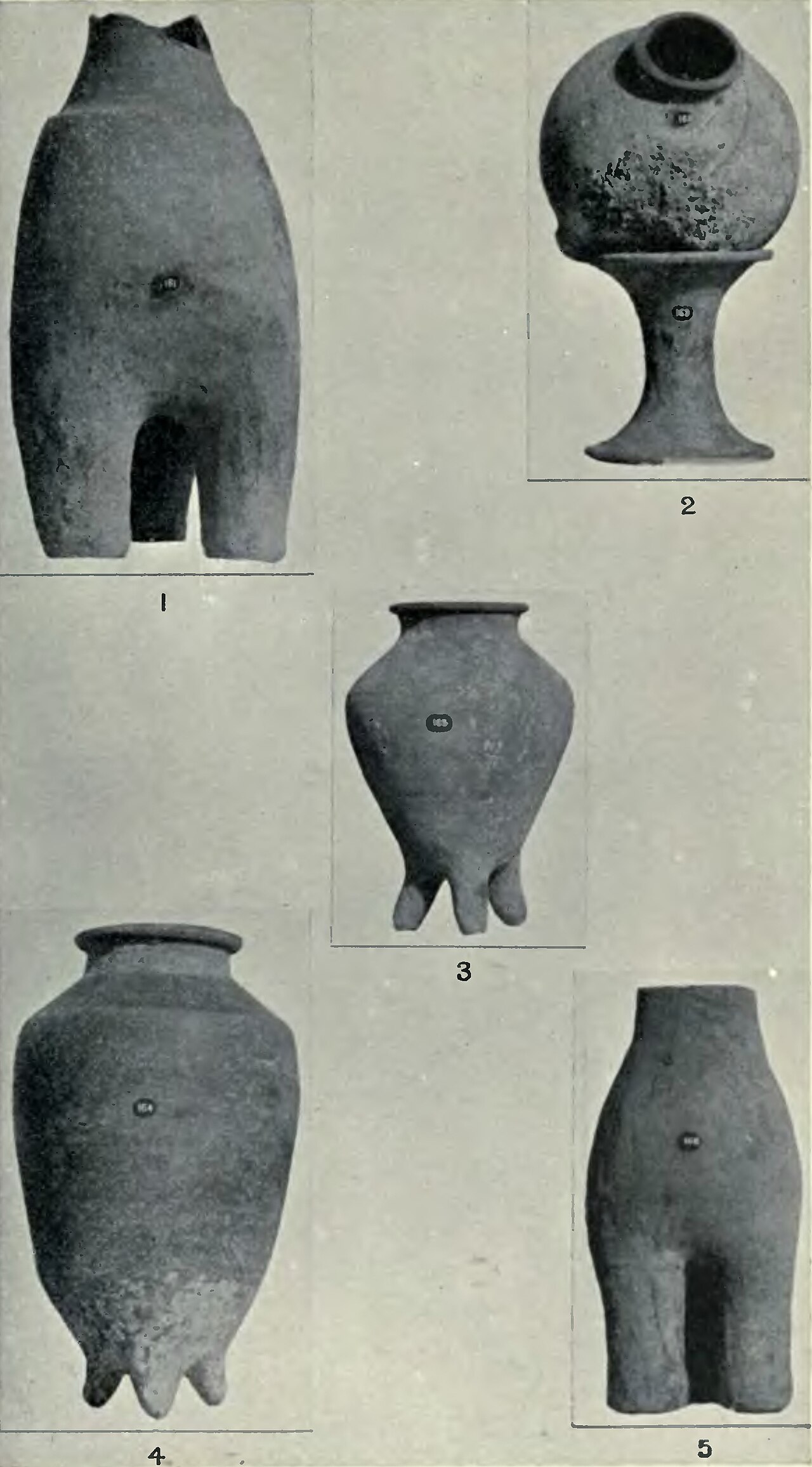
Legged pottery vessels from Perumbair, plate XII in Alexander Rea's 1915 catalogue
Perumbair
Publication is not a neutral final step. It determines when evidence becomes checkable, what categories structure it, and which older interpretations continue to circulate. The comprehensive ASI volume for the 2004–05 Adichanallur excavation appeared in 2020, roughly fifteen years after fieldwork; it supplies contextual and scientific information that cannot responsibly be inferred from the old museum catalogue alone. ↗2 At Arikamedu, Vimala Begley's reassessment challenged Wheeler's narrow Augustan-period beginning, while the later 1989–92 project was expressly framed around unresolved problems, a heavily disturbed site, and detailed examination and cataloguing of finds from both new and earlier excavations. ↗3 At Pattanam, a very large artifact corpus nevertheless derives from less than or about one percent of a disturbed mound in the accessible institutional descriptions, and a 2024 specialist study of the 2007–08 bead material challenged an earlier attempt to map manufacturing techniques directly onto distinct cultural or ethnic groups. ↗4
The practical conclusion is therefore methodological rather than spectacular: a defensible regional history should expose the chain recovery → custody/accession → conservation/documentation → specialist analysis → publication/re-identification and mark missing links instead of silently converting them into historical facts. This is a comparative inference from selected assemblages, not a quantified estimate of bias across all of Kerala and Tamil Nadu. Modern museum standards reinforce why provenance, due diligence, accessioning and documentation matter, but those standards are used here only as a present-day benchmark; they are not projected backward as evidence for nineteenth-century practice. ↗5
Scope, chronology, assumptions and method
This is a mixed-chronology investigation. The ancient evidence used for substantive interpretation falls largely inside 1000 BCE–600 CE, the period this site covers: the two Adichanallur radiocarbon determinations examined below fall in the first millennium BCE, while Mahatma Gandhi University describes Pattanam's most active Early Historic phase as approximately the third century BCE through the fifth century CE. ↗6 Arikamedu's Early Historic chronology is also within that period, although the proposed starting date is itself one of the points altered by later reassessment. ↗7 The nineteenth-, twentieth- and twenty-first-century histories of excavation, collecting, museums, conservation, cataloguing and publication belong to later evidence history: they matter because they determine how the ancient record reached the present.
Excavated burial urns and associated pottery at Adichanallur
Adichanallur
Photographed 2025-10-10
This study keeps secure find context separate from rediscovery, later labels, dealer attribution and reconstruction, and treats that separation as an evidential control rather than a historical conclusion. Exact site coordinates are not reproduced, even where institutional pages make them public.
The inquiry is deliberately case-based, not exhaustive. Adichanallur was selected because it connects nineteenth-century collecting, institutional dispersal, a surviving museum catalogue, modern re-excavation and scientific dating. Arikamedu was selected because successive excavation and re-cataloguing changed chronology and the classification of overseas material. Pattanam was selected because it combines recent multidisciplinary excavation, public heritage interpretation, museum display, a small sampled fraction of a larger disturbed mound, and later specialist reanalysis. The three cases test distinct evidential failure modes rather than constituting a statistically representative sample of southern Indian archaeology. ↗8
The source search prioritized excavation reports, official institutional records, original research articles, publisher records and museum documentation. Rea's 1915 catalogue and the ASI's 2020 Adichanallur report were read directly; selected ASI pages and its radiocarbon table were also visually read. ↗9 Kelly's 2024 Pattanam article was accessed as a full PDF and its opening page visually read. ↗10 The official Wheeler–Ghosh–Deva 1946 Arikamedu PDF was identified but was not consulted directly for this study, so no passage below is represented as if that primary publication had been read. Wheeler's interpretation is instead reported through Begley's later scholarly reassessment and EFEO's publication records. ↗11 Tamil and Malayalam discovery searches were also performed. Accessible results included Tamil discussion of Arikamedu and Malayalam discussion of Pattanam, but the sources consulted did not identify an original-language primary record that required displacement of the primary/official English-source conclusions used here. ↗12
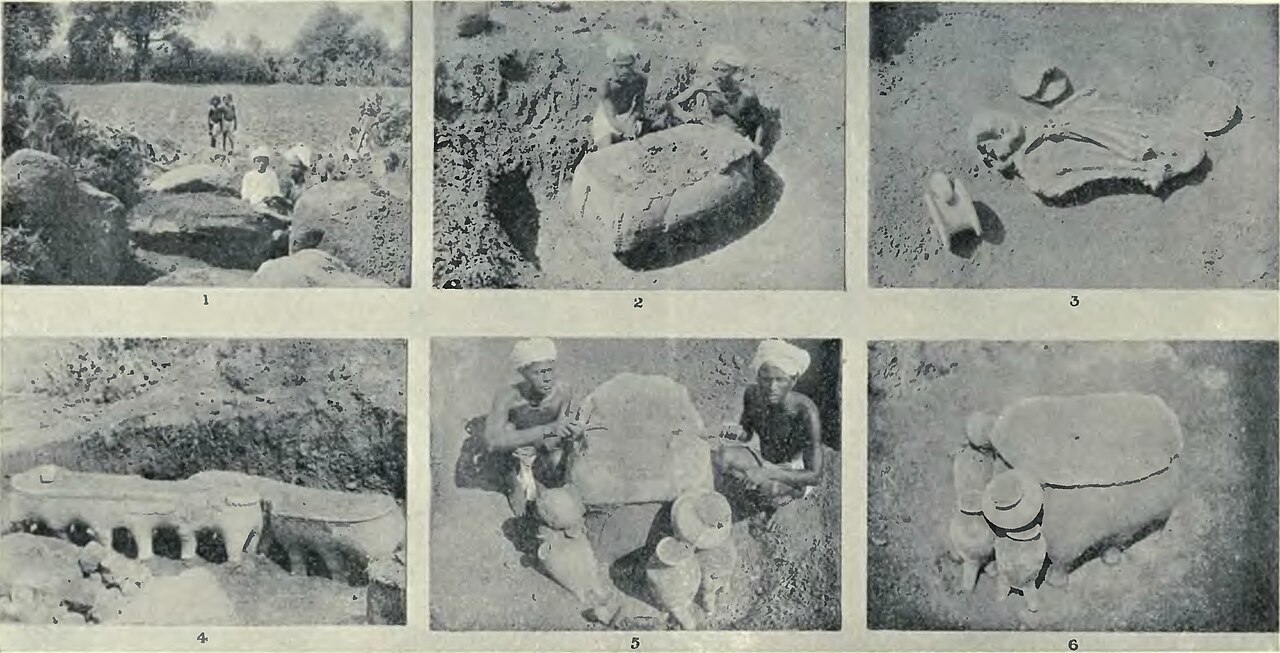
Sarcophagi and their contents from Perumbair, plate XIII in Alexander Rea's 1915 catalogue
Perumbair
The inferential chain runs: recovery → custody and accession → conservation and documentation → specialist analysis → publication and re-identification.
This is not a claim that every assemblage passed through identical institutional procedures. It is a way to keep the evidential transformations exposed by the cases analytically separate.
Adichanallur: objects survived better than some of their contexts
Adichanallur supplies the clearest recovery-to-publication chain. In the preface to his 1915 Catalogue of the Prehistoric Antiquities from Adichanallur and Perumbair, Alexander Rea says the site came to attention in 1876 and that Dr. Jagor secured a substantial group of objects for Berlin's ethnological museum. Rea also records later collecting by Lapicque and his own investigations from 1899 to 1905. His excavated collection was displayed in a specially provided extension of the prehistoric gallery of the Madras Government Museum. ↗13 This establishes two propositions that should not be collapsed: early Adichanallur material was dispersed between institutions, while at least one major collection was deliberately catalogued and preserved in Madras. The present location and accession history of every Jagor, Lapicque and Rea object were not resolved in this study. “Adichanallur cemetery: varied burials over a long span of time” covers the Adichanallur cemetery itself.
That custody history preserved material but did not preserve every archaeological relationship. The 2020 ASI report states that Rea's operations were spread over the site without adequate plans showing exact excavation points, making it difficult to know precisely where many finds had been recovered. It also explains why modern re-excavation was needed: archaeological method and systematic documentation had changed, and older discoveries lacked the contextual record expected of a modern excavation. ↗14 A bronze vessel, iron implement, pot or skeletal element from a legacy museum collection can therefore remain useful for typological, technological or scientific study, while an asserted association with a particular urn, stratum, feature or neighboring object may be substantially less secure. Museum co-storage is not a substitute for excavated association.
The 2004–05 ASI campaign improved context for a new sample; it did not retroactively repair the entire legacy record. The published report records 178 burials in about 600 m². ↗15 This is strong contextual evidence for the excavated area, not a census of the full cemetery. The contrast matters: old collections may be broad in object variety yet weak in precise provenience; a modern excavation can be spatially much narrower while preserving substantially stronger associations among feature, object and sample.
The radiocarbon table shows why exact publication matters. Paddy associated with Urn 58, laboratory code Beta-519499, is reported as 2510 ± 30 BP, with two calibrated intervals at the reported 95.4% coverage: 791–701 BCE (27.7%) and 696–540 BCE (67.7%). Paddy associated with Urn 105, Beta-519500, is reported as 2700 ± 30 BP, calibrated to 905–806 BCE (95.4%). ↗16 The disjoint ranges for Beta-519499 should not be replaced by a midpoint, and neither sample should become a date for every burial at Adichanallur. These determinations apply to sampled material from particular reported contexts. The consulted table did not identify the calibration curve or software, so those fields remain unresolved rather than inferred.
Publication delay is itself an evidential filter. The ASI report was issued in 2020 for the 2004–05 field seasons, and its author notes the difficulties of reporting excavation undertaken roughly fifteen years earlier. ↗2 That does not imply that no information circulated before 2020. It means that readers relying on older catalogues or interim accounts did not possess the same integrated context, sample tables and methodological discussion later made auditable in the final publication. Publication history therefore changes not the ancient deposit but the auditable past: the body of claims later researchers can test against a disclosed record.
Conservation has to be stated more cautiously. Rea's catalogue, later ASI work and the Government Museum Chennai's archaeology description establish long-term institutional custody, preservation and documentation activities. The museum describes acquisition, preservation, display, organization of archaeological collections and scholarly publication among its functions. ↗17 But no object-level conservation-treatment dossier – cleaning, consolidation, restoration, environmental history or earlier destructive sampling – was found for the selected Adichanallur objects. The defensible result is thus: custody and documentation survival are demonstrated; named-object treatment histories are not.
Arikamedu and Pattanam: re-cataloguing and later analysis change the story
Arikamedu demonstrates how later analysis can change chronology even after an influential label becomes entrenched. Begley's 1983 reassessment describes Wheeler's interpretation of the site as an “Indo-Roman trading station” with an Augustan-period beginning and argues, from renewed study of material excavated by Wheeler and Casal, that occupation connected with the relevant sequence began around the middle of the third century BCE. ↗7 Because only the article's abstract was accessible in this study, this is reported as Begley's published conclusion, not as an independently re-performed audit of every underlying trench and ceramic sequence. “Arikamedu was a South Indian craft port, not a Roman colony” covers Arikamedu's phases, crafts and overseas contacts.
The subsequent 1989–92 project is especially important because its publication strategy joined new excavation to legacy collections. EFEO's record for the 1996 first volume states that unresolved problems prompted renewed work, characterizes the site as extremely disturbed through a long history, and describes detailed examination and cataloguing of finds recovered both by the new team and earlier excavators. Its contents include Mediterranean amphorae from the 1941–50 excavations and fine wares held in the Pondicherry museum. ↗18 The 2004 second volume completed the two-volume final report. ↗19 This shows what legacy collections can still contribute: re-cataloguing does not recreate lost stratigraphy, but improved typology and campaign-level provenience can make old objects newly comparable with material from better-documented excavations.
Changing ceramic identifications can also redraw historical geography. Roberta Tomber reported that many vessels in India previously treated as Roman amphorae were instead Mesopotamian torpedo jars. ↗20 That does not abolish evidence for Mediterranean exchange. It alters attribution of particular transport containers and therefore changes the evidential balance among exchange zones. MGU's Pattanam collection page itself distinguishes Mesopotamian torpedo jars from amphora fragments among its categories. ↗21 “Roman,” “Mesopotamian,” “local” and “imported” are thus analytical identifications applied through comparative study, not intrinsic labels carried by a sherd; a revised classification can alter a trade narrative without a new excavation.
Pattanam illustrates both the strength and limits of a modern high-volume assemblage. The Muziris Heritage Project states that KCHR excavation began in 2007 and that after eight seasons 61 trenches represented about one percent of the mound; it also says finds were classified, documented and displayed in a site museum. ↗22 MGU reports 60 trenches, less than one percent of the mound, describes the densely inhabited site as considerably disturbed, and places its most active Early Historic phase in the third century BCE–fifth century CE. ↗21 The 60/61-trench discrepancy is better treated as a difference in reporting date or counting than harmonized by guesswork. Both records support the more important conclusion: a very small excavated fraction cannot automatically be assumed to represent artifact frequencies throughout the complete settlement. “Pattanam finds: wide trade links, unevenly dated and sourced” covers what has been found at Pattanam and how securely it is dated.
The same official sources are revealing about the well-known Pattanam = Muziris proposal. Kerala Tourism says the finds and location suggest the possibility that Pattanam was ancient Muziris, while MGU likewise frames the relationship probabilistically. ↗23 The relationship is therefore treated here as a proposed identification, not an established one. This distinction is essential: identifying an ancient place-name is a different inferential operation from documenting a stratified bead, sherd or feature. A more decisive discriminator would be secure in-situ epigraphic/toponymic evidence or a sufficiently convergent archaeological, landscape and textual case capable of excluding serious alternatives.
Publication at Pattanam is distributed among season reports, institutional pages and specialist studies rather than represented here by a single fully read all-season corpus. The bibliographic record resolves P. J. Cherian's edited Pattanam Excavations: Interim Report of the Eighth Season-2014 as a 2014 KCHR volume of 685 pages, ISBN 9788185499550, but the consulted record did not provide the book as an accessible electronic full text. ↗24 No single openly accessible all-season trench-and-accession dataset was located in the sources consulted. That is an access/publication gap, not evidence that the underlying documentation does not exist.
Gwendolyn Kelly's 2024 study shows why preservation and specialist publication continue to matter after excavation. Her full article examines stone beads, debitage, roughouts and raw materials from Pattanam's 2007 and 2008 seasons and compares the material with arguments previously made about South Indian bead-manufacturing traditions. ↗10 Kelly concludes that the available Pattanam evidence and comparative material do not support a direct assignment of particular raw-material/technological traditions to exclusive cultural or ethnic groups; she also explicitly limits the claim because of sample size, chronological and contextual differences, and the fact that not all comparative Arikamedu material was reanalysed firsthand. ↗25 The historiographic importance is not that one specialist has supplied a final social identity, but that a preserved assemblage allowed a previously stronger ethnic inference to be tested and weakened.
Comparative findings, disagreements and limits
The three cases can be compared directly:
| Case | Recovery and context | Custody/cataloguing | What later work changed | Evidential status |
|---|---|---|---|---|
| Adichanallur | Nineteenth-/early-twentieth-century collections preserved many objects but often lack mapped exact recovery points; 2004–05 ASI work provides much stronger context for a limited 600 m² sample. ↗26 | Early material was dispersed while Rea's own collection was catalogued/displayed in Madras; a complete modern accession concordance was not documented in the sources consulted. ↗13 | Re-excavation and radiocarbon publication provide sample-specific chronology rather than a retrospective date for a whole legacy collection. ↗27 | Strong for documented modern contexts; qualified for legacy associations. |
| Arikamedu | Several campaigns worked on a site later described as heavily disturbed. ↗18 | The 1989–92 project explicitly re-examined material from previous excavations and museum collections. ↗28 | Begley revised Wheeler's chronology; changing ceramic identifications altered attribution of some imported containers. ↗29 | Strong evidence that interpretation changed; the foundational 1946 primary-report audit remains incomplete. |
| Pattanam | Modern multi-season excavation, but less than/about one percent of a disturbed mound in accessible institutional descriptions. ↗23 | Finds are classified, documented and displayed; a complete all-season accession/trench database was not consulted directly for this study. ↗30 | Specialist bead study weakens direct ethnic assignment from manufacturing technique; official sources retain probabilistic language for Muziris. ↗31 | Strong for excavated finds; qualified for site-wide frequencies and ancient place-name identity. |
Three disagreements are particularly instructive.
First, Arikamedu's chronology and historical character should not be reduced to Wheeler's famous formula. Begley's 1983 reassessment explicitly challenges a narrow Augustan beginning, while the later excavation volumes present a more complex and disturbed archaeological sequence. ↗11 What would best discriminate the chronological issue is direct comparison of Wheeler's 1946 stratigraphic tables and context descriptions with the detailed artifact sequences in the Begley volumes. Because the official 1946 PDF was not consulted directly for this study, that comparison has not been made here.
Second, Pattanam's identification with Muziris remains distinct from the secure fact that Pattanam is an excavated archaeological site. The accessible official sources themselves use possibility language. ↗23 What would materially strengthen the identity claim is securely contextualized name-bearing evidence or a landscape/textual convergence strong enough to discriminate among competing locations. Until then, the accurate terms are “proposed identification” or “possible location.”
Third, social identity inferred from craft technique illustrates the danger of turning a material pattern into a population label. Kelly argues that the Pattanam/Kodumanal/Arikamedu comparison does not support exclusive ethnic assignment from chaînes opératoires and raw materials while openly retaining sample and comparative limitations. ↗32 Distinguishing migration, apprenticeship, shared technological traditions and movement of raw or semi-finished materials would require better-controlled contextual comparison, sourcing studies and direct reanalysis of relevant legacy assemblages – not a stronger ethnic label.
A practical hierarchy follows. Highest contextual weight belongs to documented stratified contexts linked to stable identifiers and samples. Intermediate weight belongs to museum objects with reliable site or campaign provenance but incomplete locus association; these can remain strong evidence for typology, material composition and production technology. Lower contextual weight should be assigned to loose finds, retrospective labels, dealer attributions or objects whose custody trails are unclear when the question depends on archaeological association. Current ICOM guidance emphasizing provenance, due diligence and documentation provides a useful modern benchmark for this distinction. ↗5 No central claim in this study depends on dealer attribution; that bounded finding should not be generalized into an assertion that dealer-mediated material is absent from regional collections.
Conservation is the least completely documented component of the question. Museum custody and institutional preservation are demonstrable, and the Government Museum Chennai explicitly includes preservation among the functions of its archaeology section. ↗17 Object-level treatment histories – cleaning, stabilization, reconstruction, coatings, environmental histories and earlier sampling – are absent from the sources consulted for the selected assemblages. Conservation's effect can therefore be stated securely at the level of survival, custody, documentation and present accessibility, but not as a specific physical alteration of any named object.
The principal limitations are bounded. This is not a systematic review of every excavation or museum in Kerala and Tamil Nadu; Wheeler's foundational 1946 report was bibliographically resolved but not yet read directly; Pattanam's 2014 interim volume was identified but not available as full text in the consulted interface; Adichanallur's legacy collections still require accession-level concordance; and Tamil/Malayalam discovery did not amount to an exhaustive original-language archive survey. ↗33 These limitations do not overturn the central conclusion because independent parts of it are demonstrated by the consulted Adichanallur primary publications, EFEO's Arikamedu publication record, Pattanam's institutional documentation and Kelly's full specialist paper. ↗34
Conclusions, remaining work and bibliography
The question can be answered directly. Excavation history determines how much context was recorded; collecting history affects which objects were selected, retained and dispersed; museum custody and conservation/documentation affect what remains physically and analytically available; cataloguing structures the categories in which objects can be compared; and publication determines when observations become auditable and which interpretations are inherited by later scholarship. The surviving regional record is therefore not simply “incomplete.” It is selectively complete in different ways: some legacy collections preserve objects better than relationships; some modern excavations preserve relationships better than broad spatial coverage; and some later studies improve historical knowledge by reclassifying old objects rather than discovering new ones. ↗35
The highest-priority remaining work is specific. For Adichanallur, obtain Berlin and Chennai accession registers, labels, notebooks and transfer records for Jagor, Lapicque and Rea material, then construct an object-level concordance between surviving accessions, Rea's 1915 catalogue and later ASI references. For Arikamedu, acquire and inspect Wheeler, Ghosh and Deva 1946 directly, together with the full 1996 and 2004 Begley volumes and relevant museum accession concordances, so chronological changes can be mapped to exact strata and object identifiers. For Pattanam, acquire the official season reports and available trench/accession database so artifact distributions can be assessed by season, trench, layer and recovery method instead of extrapolated from undifferentiated totals. Across all three cases, object-level condition and conservation-treatment records are required before claims are made about restoration, residues or sampling history.
Bibliography, primary and official sources first
Alexander Rea. Catalogue of the Prehistoric Antiquities from Adichanallur and Perumbair. Madras: Government Press, 1915. Scan/metadata: https://commons.wikimedia.org/wiki/File:Catalogue_of_the_prehistoric_antiquities_from_Adichanallur_and_Perumbair_(IA_catalogueofprehi00goverich).pdf. ↗36
Sathyabhama Badhreenath. Excavations at Adichchanallur. Archaeological Survey of India, 2020. Official PDF: https://asi.nic.in/pdf/Adichchanallur-Excavation-Report.pdf. ↗37
R. E. M. Wheeler, A. Ghosh and Krishna Deva. “Arikamedu: An Indo-Roman Trading Station on the East Coast of India.” Ancient India 2 (1946): 17–124. Official ASI PDF: https://asi.nic.in/Ancient_India/Ancient_India_Volume_2/article_3.pdf. The target was identified but not successfully fetched during this study. ↗38
Vimala Begley. “Arikamedu Reconsidered.” American Journal of Archaeology 87, no. 4 (1983). DOI 10.2307/504104. https://doi.org/10.2307/504104. Abstract consulted; full article was not read directly for this study. ↗7
Vimala Begley et al. The Ancient Port of Arikamedu: New Excavations and Researches 1989–1992. Volume One. Pondichéry: École française d'Extrême-Orient / Centre d'histoire et d'archéologie, 1996. ISBN 9782855394213. Publisher record: https://publications.efeo.fr/en/livres/36_the-ancient-port-of-arikamedu-new-excavations-and-researches-1989-1992. ↗18
Vimala Begley et al. The Ancient Port of Arikamedu: New Excavations and Researches 1989–1992. Volume Two. Paris: École française d'Extrême-Orient, 2004. ISBN 9782855396392. Publisher record: https://publications.efeo.fr/fr/livres/380_the-ancient-port-of-arikamedu-new-excavations-and-researches-1989-1992. ↗19
P. J. Cherian, ed. Pattanam Excavations: Interim Report of the Eighth Season-2014, vol. 1. Kerala Council for Historical Research, 2014. ISBN 9788185499550. Bibliographic record: https://books.google.com/books/about/Pattanam_Excavations.html?id=Dkn-jwEACAAJ. ↗24
Kerala Tourism / Muziris Heritage Project. “Pattanam.” https://www.keralatourism.org/muziris/historical-sites/pattanam. ↗22
Mahatma Gandhi University, School of Social Sciences. “Early Historic Age Collection.” https://sss.mgu.ac.in/early-historic-age-collection/. ↗21
Gwendolyn Kelly. “Report on the Stone Beads, Debitage and Raw Materials from the 2007 and 2008 Excavation Seasons at Pattanam, Kerala.” BEADS: Journal of the Society of Bead Researchers 36 (2024): 48–62. DOI 10.7264/x0p2vy06. https://doi.org/10.7264/x0p2vy06. ↗32
Roberta Tomber. “Rome and Mesopotamia – importers into India in the first millennium AD.” Antiquity 81, no. 314 (2007): 972–988. DOI 10.1017/S0003598X00096058. https://doi.org/10.1017/S0003598X00096058. ↗20
Government Museum, Chennai. “Archaeology.” https://govtmuseumchennai.org/museum-section/archaeology. ↗17
International Council of Museums. “Code of Ethics for Museums” and accessioning standards resources. https://icom.museum/en/resources/standards-guidelines/code-of-ethics/ and https://icom.museum/en/news/icom-code-of-ethics-new-standards-for-fundraising-and-accessioning/. ↗5
005Photographs
Photographs of the places and objects this study discusses. Each item carries its creator’s credit, licence and documented source. See all 412 photographs and source images ↗

Adichanallur · Photographed 05-07-2023
Excavated burial urns and associated pottery at Adichanallur
Perumbair
Legged pottery vessels from Perumbair, plate XII in Alexander Rea's 1915 catalogue

Sivagalai · Photographed 2025-10-10 10:13:01
Overview of protected excavation trenches at Sivagalai (Sivakalai)
Enadimangalam
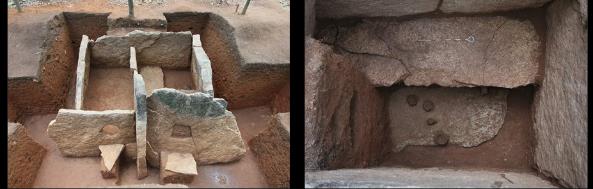
Excavated cist burial at Enadimangalam, Figure 1, published page 568

Adichanallur · Photographed 2025-10-10 08:58:18
Excavated burial urns and associated pottery at Adichanallur
Perumbair
Sarcophagi and their contents from Perumbair, plate XIII in Alexander Rea's 1915 catalogue

Sivagalai · Photographed 2025-10-10 10:11:46
Archaeological features exposed inside a Sivagalai (Sivakalai) excavation trench
Enadimangalam
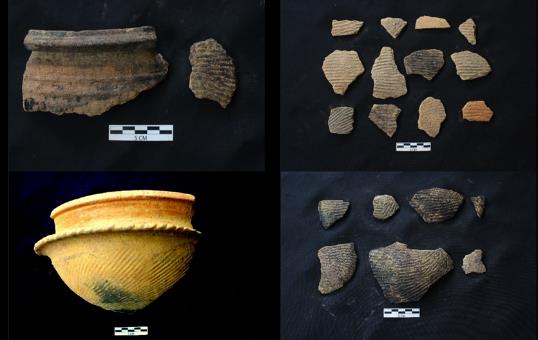
Ceramics from the Enadimangalam study area, Figure 3, published page 569
Show 12 more photographs and source images ↓

Adichanallur · Photographed 2025-10-10 09:07:41
Excavated burial urns and associated pottery at Adichanallur
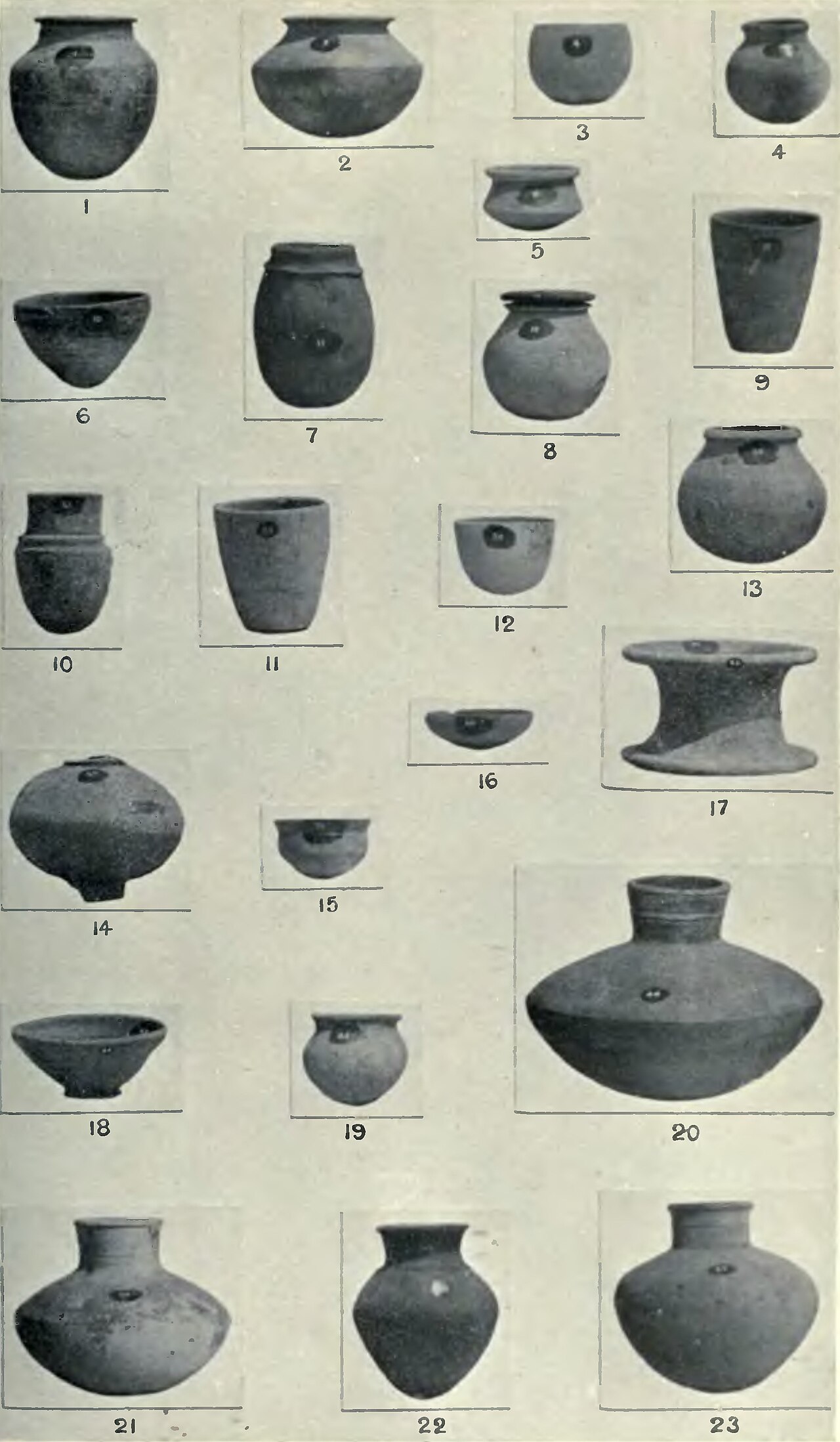
Perumbair
Pottery vessels from Perumbair, plate X in Alexander Rea's 1915 catalogue

Sivagalai · Photographed 2025-10-10 10:10:58
Excavated burial urns and trenches at Sivagalai (Sivakalai)
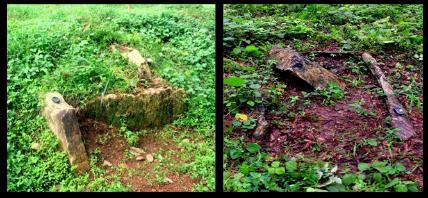
Enadimangalam
Unexcavated cist burials in the Enadimangalam study area, Figure 2, published page 568

Adichanallur · Photographed 05-07-2023
Excavated burial urns and associated pottery at Adichanallur

Perumbair
Pottery, stone objects and other small finds from Perumbair, plate XI in Alexander Rea's 1915 catalogue

Sivagalai · Photographed 2025-10-10 10:10:10
Excavated burial urns and trenches at Sivagalai (Sivakalai)

Adichanallur · Photographed 05-07-2023
Excavated burial urns and associated pottery at Adichanallur

Sivagalai · Photographed 2025-10-10 10:07:32
Excavated burial urns and trenches at Sivagalai (Sivakalai)

Adichanallur · Photographed 2025-10-10 08:55:41
Excavated burial urns and associated pottery at Adichanallur

Sivagalai · Photographed 2025-10-10 10:09:34
Excavated burial urns and trenches at Sivagalai (Sivakalai)
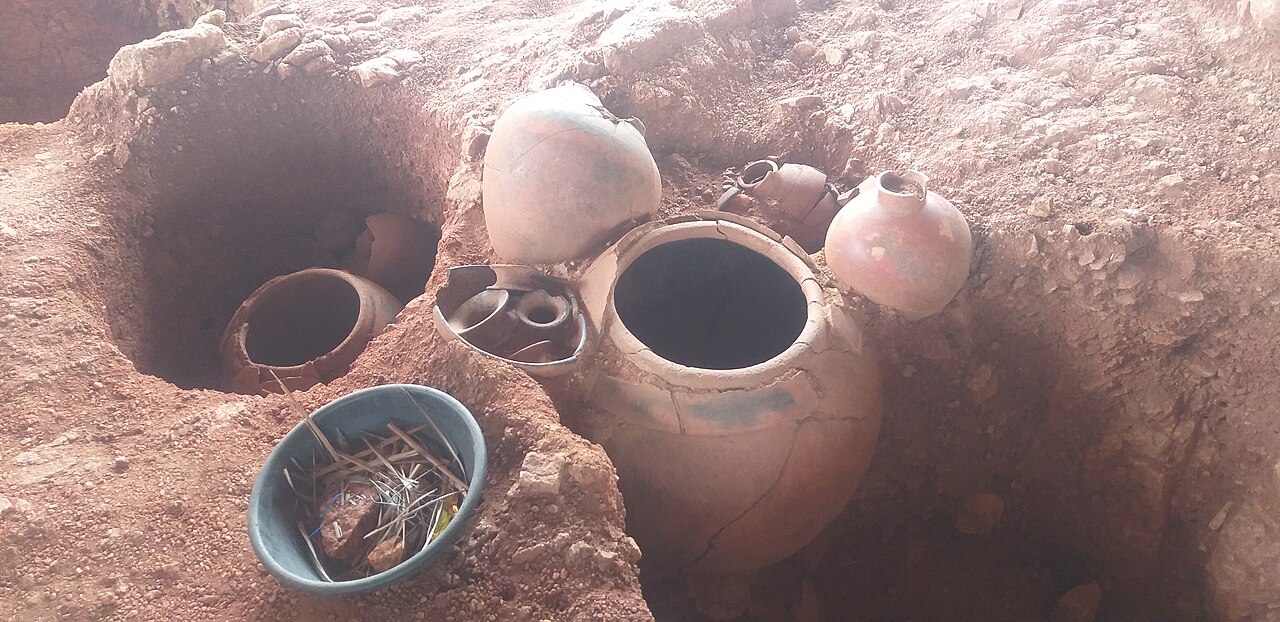
Adichanallur · Photographed 4 September 2023 (according to Exif data)
Excavated burial urns and associated pottery at Adichanallur
006Two views
Both views are shown at equal weight; this site does not choose between them.
When occupation at Arikamedu began
- One view
- Wheeler, Ghosh and Deva's 1946 report, as Begley summarises it, described an Indo-Roman trading station that began in the Augustan period.
- Another view
- Vimala Begley (1983), restudying material from Wheeler's and Casal's digs, argued that the sequence began around the mid-third century BCE.
- What would settle it
- A direct comparison of Wheeler's 1946 layer tables with the detailed artefact sequences in the 1996 and 2004 Arikamedu volumes.
Whether bead-making methods at Pattanam mark distinct peoples
- One view
- Earlier work on South Indian bead-making, tested in Kelly's study, tied raw materials and techniques to distinct cultural or ethnic groups.
- Another view
- Gwendolyn Kelly (2024) found that the Pattanam beads and comparative material do not support exclusive ethnic assignment.
- What would settle it
- Better-controlled context comparisons, raw-material sourcing studies and direct reanalysis of older bead collections.
007Where next
 Related study
All related studies, connected material, books and sources18 · 13
Elsewhere on this site
Junior Detective Quests: The Deep-Pit Trap: Depth Alone Is Never a Date
Connected material
Photographs, drawings, books, videos and other studies linked to this study. A link helps you explore; it does not prove a historical claim.
- Excavated cist burial at Enadimangalam, Figure 1, published page 568photographic figureBackground
- Unexcavated cist burials in the Enadimangalam study area, Figure 2, published page 568photographic figureBackground
- Ceramics from the Enadimangalam study area, Figure 3, published page 569photographic figureBackground
- Gold ornaments from Adichanallur, plate I in Alexander Rea's 1915 cataloguehistorical printed plateShows the subject
- Bronze vessels, ornaments and small objects from Adichanallur, plate II in Alexander Rea's 1915 cataloguehistorical printed plateShows the subject
- Iron weapons and implements from Adichanallur, plate III in Alexander Rea's 1915 cataloguehistorical printed plateShows the subject
- Iron tools and weapons from Adichanallur, plate IV in Alexander Rea's 1915 cataloguehistorical printed plateShows the subject
- Iron implements from Adichanallur, plate V in Alexander Rea's 1915 cataloguehistorical printed plateShows the subject
- Bowls and small pottery vessels from Adichanallur, plate VI in Alexander Rea's 1915 cataloguehistorical printed plateShows the subject
- Pottery vessels and stands from Adichanallur, plate VII in Alexander Rea's 1915 cataloguehistorical printed plateShows the subject
- Pottery vessels from Adichanallur, plate VIII in Alexander Rea's 1915 cataloguehistorical printed plateShows the subject
- Three large burial urns from Adichanallur, plate IX in Alexander Rea's 1915 cataloguehistorical printed plateShows the subject
- Pottery vessels from Perumbair, plate X in Alexander Rea's 1915 cataloguehistorical printed plateShows the subject
- Pottery, stone objects and other small finds from Perumbair, plate XI in Alexander Rea's 1915 cataloguehistorical printed plateShows the subject
- Legged pottery vessels from Perumbair, plate XII in Alexander Rea's 1915 cataloguehistorical printed plateShows the subject
- Sarcophagi and their contents from Perumbair, plate XIII in Alexander Rea's 1915 cataloguehistorical printed plateShows the subject
- Excavated burial urns and associated pottery at AdichanallurphotographShows the subject
- Excavated burial urns and associated pottery at AdichanallurphotographShows the subject
- Excavated burial urns and associated pottery at AdichanallurphotographShows the subject
- Excavated burial urns and associated pottery at AdichanallurphotographShows the subject
- Excavated burial urns and associated pottery at AdichanallurphotographShows the subject
- Excavated burial urns and associated pottery at AdichanallurphotographShows the subject
- Excavated burial urns and associated pottery at AdichanallurphotographShows the subject
- Archaeological pottery from Adichanallur displayed at the Government Museum, ChennaiphotographShows the subject
- Archaeological pottery from Adichanallur displayed at the Government Museum, ChennaiphotographShows the subject
- Archaeological pottery from Adichanallur displayed at the Government Museum, ChennaiphotographShows the subject
- Archaeological pottery from Adichanallur displayed at the Government Museum, ChennaiphotographShows the subject
- Archaeological pottery from Adichanallur displayed at the Government Museum, ChennaiphotographShows the subject
- Archaeological pottery from Adichanallur displayed at the Government Museum, ChennaiphotographShows the subject
- Excavated burial urns and trenches at Sivagalai (Sivakalai)photographBackground
- Excavated burial urns and trenches at Sivagalai (Sivakalai)photographBackground
- Excavated burial urns and trenches at Sivagalai (Sivakalai)photographBackground
- Excavated burial urns and trenches at Sivagalai (Sivakalai)photographBackground
- Excavated burial urns and trenches at Sivagalai (Sivakalai)photographBackground
- Excavated burial urns and trenches at Sivagalai (Sivakalai)photographBackground
- Excavated burial urns and trenches at Sivagalai (Sivakalai)photographBackground
- Archaeological features exposed inside a Sivagalai (Sivakalai) excavation trenchphotographBackground
- Overview of protected excavation trenches at Sivagalai (Sivakalai)photographBackground
- Excavated pit and stratified deposits at Sivagalai (Sivakalai)photographBackground
- A date belongs to a samplediagramThis study explains why the split range for Urn 58 must not be replaced by a midpoint.
Books, videos and websites
Outside reading on this topic. These are not part of the study and we have not checked every claim in them. See all books and videos
- Histories: A Glimpse into Pattanam Excavation Methodology Video · Kerala Council for Historical Research (KCHR, film producer); Sahapedia (publisher) · 8:48 · A short introduction to the methods used in the Pattanam excavations. One of the strongest introductory links: it directs attention to fieldwork and archaeological context, and credits the excavation institution. A 2015 upload, not a current excavation report. Use for method and fieldwork; do not infer that Pattanam and Muziris are conclusively identical. Full film not watched.
- Histories: Romila Thapar on The Pattanam Excavations Video · Romila Thapar & P. J. Cherian · Sahapedia · 11:23 · A conversation about Indian Ocean connections, specialist collaboration, state and trade, and the limits of identifying Pattanam with Muziris. Especially valuable for evidence literacy: the published transcript explicitly leaves the identification open pending decisive evidence. Edited transcript, not an unedited audiovisual audit. Remarks about cosmopolitanism, maritime conflict and Arikamedu are interpretations; present them as discussion, not universal historical facts. Some comparisons extend after 600 CE.
- 'Soqotra's Forgotten and Endangered Heritage' by Dr Julian Jansen van Rensburg Video · Julian Jansen van Rensburg · Soqotra Cultural Heritage Project / IASA (event affiliation) · 26:11 · An accessible introduction to Soqotra’s recorded sites, cultural practices and threats to its heritage. Highlights how local knowledge and collaborative documentation contribute to archaeological knowledge. Recorded in 2020. Threats and conservation circumstances may have changed; use the dated account for research history and direct readers to current project information. This is a contextual alternative to the 2023 ARWA lecture.
- Archaeological Museum | School of Social Sciences | Mahatma Gandhi University | Pullarikunnu Campus Video · Archaeological Museum, School of Social Sciences · Mahatma Gandhi University (Pullarikunnu Campus) · 0:48 · A 48-second glimpse of the university’s archaeological museum and its material collections. Highlights the institution preserving and teaching with regional archaeological finds. The collection contains multiple periods, including medieval material. This short is visual orientation, not evidence for a particular object’s date or findspot; avoid labelling every displayed item ancient.
- Edakkal Caves: In conversation with Prof. M.G.S. Narayanan Video · M. G. S. Narayanan, Azeez Tharuvana · M. G. S. Narayanan, historian; Azeez Tharuvana, Farook College at the time of the module. · 18:18 · An interview on visits to Edakkal, the engravings and the historical setting of Wayanad. Preserves the voice and recollections of an important regional historian and names a participant in earlier scholarship. Recorded recollections and rock-art interpretations require comparison with published studies. Do not treat all carvings as one dated horizon; this interview is not independent dating evidence.
- Excavating Pattanam - Scientific Pursuit with a Human Face | P J Cherian | TEDxAGBSKochi Video · P. J. Cherian · Kerala Council for Historical Research; affiliation at time of talk. · 18:58 · Cherian presents the Pattanam project and its relationship with local communities and conservation. An accessible way to introduce the excavation director and the people-centred side of archaeological work. TEDx hosting is not peer review. This 2015 account predates later seasons; distinguish excavation observations from the speaker’s broader interpretations.
- Nichole Sheldrick: archaeology with satellite imagery Video · Nichole Sheldrick · University of Leicester; St Cross College, University of Oxford event · 59:09 · A research-method lecture on satellite imagery and archaeology. Explains another way that archaeological observations can be collected and interpreted. Methodological background. The lecture is not evidence for a particular Kerala palaeochannel, coastline, settlement or flood event.
- P L Udaya Kumar. "Advancing Indian Epigraphy". Oct 5, 2024 Video · P. L. Udaya Kumar · Mythic Society, Bengaluru Inscriptions 3D Digital Conservation Project · 2:17:25 · The project director explains digital recording and study of inscriptions in the Bengaluru region. Makes the practical labour of recording, re-reading and conserving inscriptions visible. Primarily a Kannada-region methods comparison with much later material. Computer-rendered scans document real objects; they are not ancient photographs.
Show 1 more
- Webinar: Dr. Rajesh Venkatasubramanian on "Classical Tamil Literature in Colonial India" Video · Rajesh Venkatasubramanian · Indian Institute of Science Education and Research, Mohali · 1:02:46 · A historian discusses how classical Tamil literature was transmitted, recovered and framed in colonial India. Makes the modern work and choices behind apparently straightforward ancient-text editions visible. The main subject is the colonial period; label it later reception and source history, not early-period evidence.
008Sources
The study lists the sources it consulted; we have not rechecked them. A working link does not show that a source was read, and a valid identifier does not show that it supports a claim. We do not link to unofficial uploads or copies of publications. Where a study cited one, we show the published citation, or a publisher, DOI or Internet Archive link when we have one. Tracking codes are removed from links, and the sources themselves are not republished here.
Alexander Rea, Catalogue of the Prehistoric Antiquities from Adichanallur and Perumbair, Madras: Government Press, 1915.
Sathyabhama Badhreenath, Excavations at Adichchanallur, Archaeological Survey of India, 2020.
Government Museum, Chennai, Archaeology.
R. E. M. Wheeler, A. Ghosh and Krishna Deva, Arikamedu: An Indo-Roman Trading Station on the East Coast of India, Ancient India 2 (1946), 17–124.
Vimala Begley, Arikamedu Reconsidered, American Journal of Archaeology 87(4), 1983, DOI 10.2307/504104.
The Ancient Port of Arikamedu: New Excavations and Researches 1989–1992. Volume One
Vimala Begley et al., The Ancient Port of Arikamedu: New Excavations and Researches 1989–1992, Volume One, EFEO, 1996.
The Ancient Port of Arikamedu: New Excavations and Researches 1989–1992. Volume Two
Vimala Begley et al., The Ancient Port of Arikamedu: New Excavations and Researches 1989–1992, Volume Two, EFEO, 2004.
Roberta Tomber, Rome and Mesopotamia – importers into India in the first millennium AD, Antiquity 81(314), 2007, 972–988.
Kerala Tourism / Muziris Heritage Project, Pattanam.
Mahatma Gandhi University, School of Social Sciences, Early Historic Age Collection.
P. J. Cherian, ed., Pattanam Excavations: Interim Report of the Eighth Season-2014, vol. 1, Kerala Council for Historical Research, 2014.
Gwendolyn Kelly, Report on the Stone Beads, Debitage and Raw Materials from the 2007 and 2008 Excavation Seasons at Pattanam, Kerala, BEADS 36 (2024), 48–62.
International Council of Museums, Code of Ethics for Museums and accessioning standards resources.
Researchers and institutions whose work this study uses: Vimala Begley, P. J. Cherian, Roberta Tomber, Gwendolyn O. Kelly, A. Ghosh, Alexander Rea, Krishna Deva, Archaeological Survey of India
How we know The evidence, claims and dates behind this study
What this study draws on
- Alexander Rea's 1915 catalogue and the ASI's 2020 Adichanallur report, both read directly, including radiocarbon dates Beta-519499 and Beta-519500.
- EFEO publication records for the 1989–92 Arikamedu project; Begley's 1983 article read as abstract only.
- Gwendolyn Kelly's 2024 Pattanam bead study, read in full; trench counts from Kerala Tourism and Mahatma Gandhi University web pages.
- Wheeler, Ghosh and Deva's 1946 Arikamedu report is identified bibliographically and was not read directly for this study.
Dates in this study
| What is dated | Date | How it was dated |
|---|---|---|
| 905–806 BCE (95.4%) | 905–806 BCE | Laboratory date |
| 791–701 BCE (27.7%) | 791–700 BCE | Laboratory date |
| 696–540 BCE (67.7%) | 696–540 BCE | Laboratory date |
| most active Early Historic phase: third century BCE to fifth century CE | 300 BCE – 500 CE | How it was dated is not stated |
| about the middle of the third century BCE | 250–200 BCE | How it was dated is not stated |
See these dates on the timeline
The study’s claims
15 claims · 16 source passages · 48 paragraphs
Browse the study paragraph by paragraphThe selected regional evidence is a filtered surviving record in which physical object survival and survival of archaeological context must be distinguished.
Supported in this study
Selected case studies only.
Early Adichanallur material was dispersed between collections, including material obtained by Jagor for Berlin and Rea's collection preserved and displayed in Madras.
Supported in this study
Much of the older Adichanallur excavation record lacks sufficiently precise plans to reconstruct exact recovery points, limiting association-level interpretation of legacy objects.
Supported in this study
Object-level provenience must be assessed individually.
The 2004–05 ASI Adichanallur excavation documented 178 burials within approximately 600 square metres, providing stronger modern context for a spatially limited sample.
Supported in this study
Spatially limited sample.
Adichanallur sample Beta-519499 from paddy associated with Urn 58 is reported as 2510 ± 30 BP with calibrated intervals 791–701 BCE (27.7%) and 696–540 BCE (67.7%), totaling 95.4% probability.
Supported in this study
Disjoint calibrated intervals retained exactly as reported.
Adichanallur sample Beta-519500 from paddy associated with Urn 105 is reported as 2700 ± 30 BP and calibrated to 905–806 BCE at 95.4% probability.
Supported in this study
The final ASI Adichanallur report was published in 2020 for fieldwork conducted in 2004–05, illustrating how publication timing affects when contextual and scientific results become readily auditable.
Supported in this study
Begley's 1983 reassessment challenged an Augustan-period beginning for Arikamedu and proposed a beginning around the middle of the third century BCE.
Supported with qualifications
Recorded as Begley's stated conclusion rather than an independently reproduced stratigraphic analysis.
The 1989–92 Arikamedu project combined new excavation with detailed examination and cataloguing of artifacts from earlier campaigns and museum collections at a heavily disturbed site.
Supported in this study
Later ceramic analysis showed that some vessels in India previously classified as Roman amphorae were Mesopotamian torpedo jars, demonstrating that changed typology can alter reconstruction of exchange geography without new excavation.
Supported in this study
Accessible institutional accounts describe Pattanam as a disturbed mound of which less than or about one percent had been excavated in 60–61 trenches, so excavated artifact frequencies cannot automatically be generalized to the whole settlement.
Supported in this study
The institutional sources differ by one trench.
Pattanam's identification with ancient Muziris/Muciri should remain a candidate relation rather than an established identity in this study.
Supported with qualifications
No decisive in-situ name-bearing evidence was established in the consulted evidence.
Kelly's 2024 analysis does not support assigning distinct Pattanam bead-manufacturing/raw-material traditions directly to exclusive cultural or ethnic groups.
Supported with qualifications
This weakens a categorical ethnic inference; it does not determine the identities of ancient craftspeople.
For the selected assemblages, museum custody and preservation are documented more securely than object-level conservation-treatment histories.
Supported with qualifications
A negative result limited to the sources read of the search made for this study, not proof that conservation files do not exist.
Publication and re-cataloguing can change the auditable historical record by exposing context, revising classifications and making earlier objects newly comparable, even without new discoveries.
Supported in this study
The ancient past does not change; the evidence available for auditing interpretations changes.
Trace one claim through the study’s records
Explore the evidenceOther source lists
Numbered citation links from the study
The numbered links in the study text point here.
Catalogue of the prehistoric antiquities from Adichanallur and Perumbair
asi.nic.in
Arikamedu Reconsidered | American Journal of Archaeology: Vol 87, No 4
Pattanam | Urban Settlement | Excavations | Muziris heritage project | KCHR
Code of Ethics - International Council of Museums - International Council of Museums
asi.nic.in
Arikamedu Reconsidered | American Journal of Archaeology: Vol 87, No 4
Catalogue of the prehistoric antiquities from Adichanallur and Perumbair
Catalogue of the prehistoric antiquities from Adichanallur and Perumbair
journals.uoregon.edu
Arikamedu Reconsidered | American Journal of Archaeology: Vol 87, No 4
Kezhadi and Arikkamedu Archaeological Excavations
Catalogue of the prehistoric antiquities from Adichanallur and Perumbair
asi.nic.in
asi.nic.in
asi.nic.in
Archaeology | Government Museum
The Ancient Port of Arikamedu - École française d'Extrême-Orient
The Ancient Port of Arikamedu - École française d'Extrême-Orient
Rome and Mesopotamia – importers into India in the first millennium AD | Antiquity
Early Historic Age Collection - MG School of Social Sciences : MG School of Social Sciences
Pattanam | Urban Settlement | Excavations | Muziris heritage project | KCHR
Pattanam | Urban Settlement | Excavations | Muziris heritage project | KCHR
Pattanam Excavations: Interim Report of the Eighth Season-2014 - Google Books
journals.uoregon.edu
Catalogue of the prehistoric antiquities from Adichanallur and Perumbair
asi.nic.in
The Ancient Port of Arikamedu - École française d'Extrême-Orient
Arikamedu Reconsidered | American Journal of Archaeology: Vol 87, No 4
Pattanam | Urban Settlement | Excavations | Muziris heritage project | KCHR
journals.uoregon.edu
journals.uoregon.edu
Pattanam Excavations: Interim Report of the Eighth Season-2014 - Google Books
Catalogue of the prehistoric antiquities from Adichanallur and Perumbair
asi.nic.in
Catalogue of the prehistoric antiquities from Adichanallur and Perumbair (IA catalogueofprehi00goverich).pdf
asi.nic.in
Rome and Mesopotamia – importers into India in the first millennium AD | Antiquity
About this study Status, corrections and how it was made
Status
Draft study, revision 5. No historian, archaeologist, or Tamil or Malayalam specialist has reviewed it yet.
How it was made
Compiled as an editorial synthesis from published scholarship around questions we framed. About this project & workflow
The summary, How sure lines and Two views notes on this page were prepared from this study and cross-checked against its passages. That is an editorial check, not a specialist review.
Corrections and updates
Technical details
Study code LTS-SUP12. The text fingerprint changes whenever the study text changes.
- The study text is shown as written. Links from its paragraphs to citations help you move around the study; they are not new claims or checked source passages.
See how this study’s records were extracted
Text fingerprint (SHA-256): LTS-SUP12 · dd36a364f62d23d3670889b3… · v5
Evidence tables and technical details are on the web page: https://layersofthesouth.org/read/a1189a1ef7