Places on the atlas that name this study.
- Made by hand
- 500–200 BCE
- 200 BCE–300 CE
- Arikamedu
Arikamedu was a South Indian craft port, not a Roman colony
Arikamedu was a South Indian settlement before Mediterranean imports arrived; its bead-making and imported goods point to a craft port, not a Roman colony.
- This page
- 3,765 words · revision 11
Draft study · Awaiting specialist review · Updated
001Dates and places
Places on the atlas that name this study.
- Arikamedu
Protected ASI heritage site · Ariyankuppam River, Puducherry
1000–500 BCE
Different beginnings
500–200 BCE
Marks & materials
200 BCE–300 CE
Connected worlds
300–600 CE
Change & continuity
- Phase A: third to first centuries BCE, most likely second century BCE
- Rouletted Ware approximately second century BCE to late first century CE in Begley 1988
- Phase C generally in the first century BCE
- “first quarter of the first century A.D.” Arretine phase in the 1983 reassessment
- Phases E/F: second half of first century CE to third century, possibly later
- Period assigned by excavators or scholars
Each date belongs to what was dated (a sample, an object, a layer or a text), which is not always the event the study asks about.
Each period has the same width, so spacing is not to scale.
The full table of dates, with their ranges, is under How we know.
- 1 Well supported
- 2 Likely
- 1 Not known
002How sure
In brief
Arikamedu is an estuary site on India's east coast. Wheeler's 1945 excavation presented it as an Indo-Roman trading station that began in the time of Augustus. Later work by Casal and by Begley's team in 1989–92 shows a longer history. People lived there before Rouletted Ware and before any known Mediterranean imports, probably by the second century BCE. Transport jars (amphorae) later arrived from Kos, Knidos, Rhodes, Italy, Spain, France and the Adriatic. Imported terra sigillata tableware dates one phase to about 10 BCE–50 CE. Beads were made and glass beads worked on site, but making raw glass there is not established. The 1989–90 excavators found that two brick enclosures lacked the paved floors and drains of dyeing vats. The full 1996–2004 excavation volumes were not read directly for this study, and the site is badly disturbed.
Key researchers cited in this study: Vimala Begley (The Ancient Port of Arikamedu) · Jean-Marie Casal (Arikamedu & Souttoukeny Excavations) · A. Ghosh (Archaeological Survey of India) · Mortimer Wheeler (Arikamedu Stratigraphic Excavations) · Full bibliography
How sure
- Well supported
People lived at Arikamedu before Mediterranean imports and Rouletted Ware arrived.
Begley's published phase sequence places local Southern Sector occupation (Phase A) before both Rouletted Ware and Mediterranean amphorae.
- Likely
Rouletted Ware was made in South Asia, though not proven to be made at Arikamedu.
Ceramic study (Begley 1988) and elemental geochemistry (Ford et al. 2005) converge on a South Asian origin; both were read as abstracts, and no Arikamedu kiln is demonstrated.
- Likely
Arikamedu was the port called Poduke in the Periplus.
Named in Periplus §60 and Ptolemy between Kamara and Sopatma; the standard identification since 1941, though no inscription confirms it.
- Not known
Whether Rouletted Ware was fired at Arikamedu itself, or whether Mediterranean merchants lived there permanently.
No Arikamedu kiln or waster dump is demonstrated, and imported goods do not prove permanent foreign residence.
Why it matters
Arikamedu's imported pottery became a dating yardstick for South Indian archaeology, so how its sequence is read affects how comparable finds elsewhere are dated.
003Key findings
What the study concludes
- The earliest known Southern Sector occupation predates Rouletted Ware and known Mediterranean imports.
- Mediterranean imports are diverse: Aegean, Italian, Spanish, French and Adriatic origins are represented in the specialist synthesis.
- Rouletted Ware is strongly supported as South Asian production, but an Arikamedu kiln source is not established.
- Bead manufacture is secure enough to discuss; primary glass manufacture is not.
- Warehouse, dye-vat, Roman-colony and Poduke labels have different evidential strengths and must remain explicitly qualified.
In the study’s own words. How sure each point is, is shown above.
The summary above is the short read. The full study is the complete text it was drawn from, with its tables and source notes.
What the full study covers
004The study
Question and scope
What does the full excavation record establish about Arikamedu's phases, production and external contacts?
Later brick mission ruins within the present-day Arikamedu archaeological site
Arikamedu
Photographed Taken on 13 September 2012,
This study treats the familiar labels “Poduke,” “warehouse,” “dyeing facilities,” “Mediterranean factory,” and “Roman colony” as propositions to test, not as archaeological observations. It also keeps four different inferential problems separate: the chronology of occupation; the function of excavated structures; the provenance and local production of objects; and the identity or residence of people involved in exchange.
The chronological scope is mixed. The principal archaeological sequence falls within the Layers of the South window, from the later centuries BCE through the early centuries CE; possible occupation or redeposition after the third century extends toward and, in some interpretations, beyond 600 CE. Modern excavations and publications are later reception of the ancient site, not part of its ancient chronology. Begley’s mature chronology, written in 1997 and published in 2004, is directly inspectable in a full web transcription and is the most important source used here. It explicitly revises Wheeler’s short Roman-period model, describes a pre-import Southern Sector occupation, and separates later phases with repeated cautions about disturbance. ↗1
Two findings are especially concrete. First, Spanish amphorae are attested: Begley’s synthesis of Elizabeth Lyding Will’s work explicitly lists Spain among the source regions, together with Kos, Knidos, Rhodes, Italy, France, and the Adriatic. ↗1 Second, the 1989–90 field report gives more than a generic caveat about “dye vats”: it reports that newly exposed brick enclosures near the riverfront had no securely determined function and lacked the paved floors and drainage outlets expected by the excavators for dyeing installations. ↗2
The full multi-volume excavation reports were not read directly for this study: EFEO’s records describe Begley et al. Volume One (1996, 433 pp.) and Volume Two (2004, 682 pp.), ↗3 and Casal’s 1949 monograph is supplemented here by a preliminary campaign report while its full text, plans, and plates were not consulted for this study. ↗4
Public orientation
Arikamedu is best understood neither as a miniature Roman colony nor as a site whose history begins when Mediterranean pottery appears. The excavated sequence indicates a South Indian settlement already in existence before the principal Mediterranean-import horizon. Imported terra sigillata and amphorae remain extraordinarily useful because their external chronologies help date archaeological deposits; what changes in the later scholarship is the inference drawn from them. They date and connect the site more securely than they identify its inhabitants. ↗5
The site’s production evidence is similarly local in emphasis. Begley’s work on Rouletted Ware argues that the characteristic fine ware was regionally produced rather than imported from the Mediterranean, and later geochemical analysis places Rouletted Ware and related fine wares in an Indian geological source context. That does not mean a kiln at Arikamedu has been demonstrated. The defensible sequence of inference is “Indian/South Asian material origin” first, “specific Arikamedu workshop” only if kiln, waster, clay-reference, or equivalent evidence supports it. ↗6
Beads require another distinction. Arikamedu has strong evidence for beadmaking and glass-bead working, but “glass bead production” is not the same proposition as primary glassmaking from raw batch materials. Analytical glass scholarship explicitly treats the former as evidenced at Arikamedu while withholding the latter. Francis’s influential beadmaking work likewise establishes Arikamedu as a major craft centre without turning a modern comparative furnace into an excavated ancient furnace. ↗7
Finally, the familiar architectural labels differ sharply in evidential strength. A large brick building was interpreted as a warehouse in the Wheeler tradition, but its commercial-storage function still requires closer checking of plans, associated finds, and later architectural phasing. The dyeing interpretation fares worse for the newly excavated 1989–90 brick enclosures: the field report itself says their function was not established and rejects dyeing for those features because diagnostic construction details were absent. ↗2 A fair public summary should therefore say port and craft settlement with Mediterranean and wider Indian Ocean connections, not “Mediterranean factory with dye vats.”
Excavation sequence and revised chronology
Wheeler’s 1945 excavation remains historically important because imported Mediterranean ceramics gave South Indian archaeology a comparative chronological datum. Begley’s retrospective account says Wheeler concluded that Arikamedu began in Augustan times and continued through roughly the first two centuries CE, using amphorae, terra sigillata, and Classical trade texts as principal chronological evidence. That method was productive: it made Arikamedu a reference point for dating comparable ceramics elsewhere. The problem was not the use of imports as chronological evidence; it was the tendency to let the import horizon define the beginning and character of the whole settlement. ↗1
Casal’s French campaign changed that picture by exposing material understood as earlier than the principal Mediterranean horizon. Begley states that the pre-import occupation had been known since Casal’s excavations and associates the earliest known Southern Sector settlement with late-Iron-Age or “Megalithic” ceramic traditions. The accessible 1949 preliminary report confirms Casal’s contemporary excavation publication, while library records identify the fuller monograph as roughly seventy pages with twenty-four plates, including plans. ↗9 What remains unavailable is the most important part: Casal’s complete stratigraphic argument, ceramic descriptions, and plates. Accordingly, “Casal reached earlier levels” is supported chiefly through Begley’s reanalysis plus the accessible preliminary source, not represented here as a fresh page-by-page reading of the monograph.
Begley’s mature phase narrative is considerably more informative than the shorthand “foundation in the mid-third century BCE.” She describes the earliest known Southern Sector settlement as predating both known Mediterranean trade and Rouletted Ware. She retains a broad third-to-first-century BCE range for this phase, while saying the second century BCE is the most likely estimate. She also explicitly rejects a claimed Neolithic horizon as unsupported by the excavated evidence then available. ↗1 This is Phase A in her sequence.
Roman, possibly Cypriot, terracotta amphora with painted Greek letters on its shoulder
ca. 3rd century CE
In Phase B, brick architecture and Rouletted Ware appear within that indigenous ceramic sequence. Phase C marks the arrival of Mediterranean products transported in amphorae. Begley emphasizes that no precise date can yet be assigned to the first Rouletted Ware or earliest Koan/Knidian amphorae; because Rouletted Ware repeatedly precedes amphorae, she continues to distinguish Phases B and C. Phase C is placed generally in the first century BCE. ↗1 This ordering matters: locally rooted settlement and fine-ware use are not consequences that begin with Roman-period imports.
Phase D is tied most closely to terra sigillata. Begley reports that stamped sigillata at Arikamedu was dated about 10 BCE–30 CE and the site’s overall sigillata range about 10 BCE–50 CE, leading her to place Phase D approximately from the end of the first century BCE to the middle of the first century CE. She immediately warns that an imported object’s manufacture date is not identical with its arrival, period of use, discard, or final deposition, and that disturbed contexts can destroy its dating value. ↗1 This is a crucial methodological improvement over a simple “Roman object = layer date” equation.
For Phases E and F, Begley proposes a broad range from the later first century CE through the third century, perhaps later, but says that disturbance prevents a clean division. Some later amphora fragments and epigraphic arguments raise the possibility of third- to sixth/seventh-century material, yet she explicitly says that no specific architectural horizon of the third–sixth centuries could be distinguished because of disturbance. ↗1 For Layers of the South, evidence after 600 CE belongs in a later period rather than being silently folded into the core period.
Rouletted Ware illustrates why the chronology must remain contextual. Begley’s 1988 study of about six hundred sherds proposed two fine regional varieties and a “chattering” rather than true roulette technique. ↗10 Her later chronology says Rouletted Ware is securely associated with first-century-BCE and first-century-CE contexts, may begin earlier, and could survive later if certain Tamil-Brahmi graffiti are contemporary with the vessels; however, several relevant finds come from mixed deposits. ↗1 Rouletted Ware is therefore a broad chronological indicator, not a self-dating token that assigns every site where it occurs to a fixed two-century band.
The renewed 1989–92 project was designed precisely for a site this complicated. EFEO describes three seasons conducted collaboratively by the University of Pennsylvania Museum and Madras University and characterizes Arikamedu as extremely disturbed. Volume One contains field investigations, northern-sector trenches and pottery, inscriptions, and the earlier-excavation amphora corpus; Volume Two contains the chronology chapter, southern-sector trenches and pottery, the 1990–92 amphorae, graffiti, beads, and other specialist studies. ↗3 The architecture and craft conclusions in this study must therefore be read against a strong taphonomic warning: later disturbance, pits, and mixed deposits make “one layer = one historical episode” unsafe.
No laboratory-coded Arikamedu radiocarbon, thermoluminescence, OSL, or comparable absolute-dating record with sample ID, raw measurement, error, and calibrated interval was recovered for this study. Begley sometimes uses “absolute dates” in the archaeological sense of imported objects with externally established chronologies; that is not a radiometric sample record. ↗1
Production, warehouse functions, dyeing, and bead technology
The strongest production conclusion concerns Rouletted Ware, but it must be phrased at the right scale. Begley’s 1988 article argues that the best Arikamedu examples were probably regional products rather than Classical imports and that the decoration was produced by chattering. ↗10 Ford and colleagues later used elemental/geochemical analysis on Rouletted Ware and related fine wares and concluded that they share an Indian geological origin, reinforcing an indigenous South Asian production model. ↗11 These two evidence classes – ceramic study and geochemistry – are mutually reinforcing but not identical. Neither establishes that all Rouletted Ware was fired at Arikamedu, and the older idea of a single workshop centre remains more specific than the evidence permits. Making, buying and using a vessel are also separate events: revising where a ware was made changes the questions asked of it, but does not by itself identify who used it.
That distinction is important for local agency. The archaeological story does not need to choose between “Roman influence” and “indigenous isolation.” Local producers were making and using regionally rooted ceramics while imported Mediterranean containers and tablewares entered the site. Begley’s phase ordering places Rouletted Ware before the amphora horizon, which makes a simple model in which local fine ware begins as an imitation caused by Roman arrival chronologically unattractive. ↗12 Exchange can introduce objects, ideas, and demand without making the settlement’s entire productive economy foreign.
Bead manufacture is well supported, but production stages should not be collapsed. Francis’s work identifies Arikamedu as a major early beadmaking centre and emphasizes drawn glass beads and lapidary production. ↗13 Analytical glass research, however, draws an explicit line between evidence for making glass beads and evidence for primary glass manufacture: Arikamedu has the former, while the latter is not established by the available analytical evidence. ↗14 That means cullet or imported glass could in principle have been reheated, drawn, cut, and finished locally without the site having produced raw glass from batch ingredients. The technological chain should therefore be represented as separate evidential stages. “Glass beads: where glass was made, shaped and found can differ” follows beads, raw glass and working waste through these different histories in more detail.
The furnace problem reinforces the distinction. Francis’s well-known Papanaidupet tube-making furnace image is a modern technological comparison, not an excavated Arikamedu furnace. Other scholarship notes a furnace-like archaeological feature at Arikamedu but also notes that it was not associated with glass or bead debris, which prevents its secure identification as a glass-bead furnace. ↗15 The defensible formulation is: glass-bead working and bead manufacture at Arikamedu are supported; an excavated primary-glass furnace is not demonstrated.
The warehouse label remains weaker than the object-production evidence. ASI-derived site summaries describe a long brick, lime-plastered structure in the northern sector, near the riverfront, and repeat Wheeler’s interpretation of it as a warehouse. [↗16]((ASI IAR 1989–90)) Its position and scale make storage plausible, but a functional name needs more than architectural plausibility. The missing discriminators are the building’s full plan and construction sequence; repeated in-situ concentrations of transport containers or standardized storage fittings; sealings or administrative debris; cargo-related botanical or residue evidence; and secure association with access/loading arrangements. Until the Wheeler plan and Begley’s later architectural phasing are checked together, “large riverfront brick structure interpreted as a warehouse” is safer than “warehouse.”
The dyeing claim can now be narrowed more firmly. The 1989–90 field report describes two brick enclosures close to the riverfront and says that neither their structural form nor associated finds established their function. Although they were partly comparable to earlier brick-lined tanks or pits that Wheeler and Casal had associated with textile dyeing, the excavators concluded that the newly exposed examples could not be dyeing installations because they lacked paved floors and drainage outlets. ↗2 This is not merely an absence of modern chemical testing; it is a contemporary excavation-based challenge to the functional analogy itself.
That finding does not prove that no textile finishing or dyeing ever occurred at Arikamedu. It does mean that “dyeing facilities” should not be presented as an established site feature without feature-by-feature evidence. A stronger claim would require secure construction details, drainage or water-management logic, associated tools or fibres, and preferably residue analysis from provenanced surfaces. No such residue study was recovered. The phrase “terracotta dye vats” is especially misleading: the debated features are brick or walled installations, not securely identified portable terracotta vats. ↗2
Amphorae, external contacts, Roman influence, and Poduke
Amphorae provide the clearest evidence for movement of Mediterranean containers into Arikamedu. Begley’s mature chronology, summarizing Will’s specialist work, says amphora-related trade represented products from Kos, Knidos, Rhodes, Italy, Spain, France, and the Adriatic. She identifies Koan and Knidian products among the earliest datable Mediterranean imports and places most amphora material in the first century BCE/CE, with a few later fragments. ↗1 Spanish amphora provenance is therefore attested in the specialist synthesis, even though its proportion in the total corpus should not be guessed without the full catalogues.
The view that Will’s studied material was strongly Koan/Aegean remains useful, but the geographic picture is broader than “Roman jars.” The assemblage spans multiple Mediterranean production regions and periods. That diversity is itself evidence against treating every import as the material signature of a single homogeneous “Roman” agent. An amphora’s fabric and form may locate a production region and suggest an original commodity; it cannot identify the ethnicity of the last carrier, the route of every transshipment, or whether a foreign merchant lived permanently at Arikamedu. That is an inference from what provenance evidence can and cannot encode, supported by the multi-origin assemblage and the site’s complex trade setting. ↗5
For the same reason, Roman influence, Roman presence, and Roman political control are separate propositions. Imported sigillata, amphorae, glass, and other Mediterranean goods securely establish contact and consumption. They may be compatible with visits or residence by Mediterranean merchants, but those artifacts do not by themselves distinguish direct voyages from multi-stage exchange, seasonal stays from permanent residence, or a few foreigners from an organized enclave. “Roman colony” is therefore not an established classification. The positive formulation is stronger and less speculative: Arikamedu was a South Indian port and craft settlement integrated into regional and transoceanic exchange. “Alagankulam's pots and coins show changing sea links” applies the same reasoning to the imports at Alagankulam.
Roman terracotta jug in Cnidian relief ware, made at Cnidus in southwestern Anatolia
2nd–3rd century CE
The Poduke/Podouke identification should remain qualified. Tchernia’s review notes that Jouveau-Dubreuil first proposed in 1941 that Arikamedu was the Podukē of the Periplus, and describes Arikamedu’s estuarine location and long-distance maritime significance. ↗17 Modern reference scholarship commonly treats the identification as probable rather than demonstrated. ↗18 The two propositions are not the same: “Arikamedu fits a historically proposed location for Poduke” is defensible; “an excavated inscription proves this site was named Poduke” is not supported by the evidence read here.
This distinction also prevents circular argument. One should not identify the site as Poduke because it had Mediterranean imports and then use “Poduke” to prove that a Graeco-Roman merchant community occupied it. Textual identification, object provenance, architecture, residence, and political status need independent support. A direct critical reading of the relevant Periplus passage was not made for this study, so it keeps the wording “Arikamedu, often proposed as Poduke/Podouke.”
The most robust model of external contact is therefore networked rather than colonial. Arikamedu’s pre-import occupation and South Asian fine-ware production show strong local foundations; Mediterranean amphorae and sigillata show substantial overseas connections; beads and related craft evidence connect the site to broader South and Southeast Asian circuits; and later disturbance warns against reconstructing a clean ethnic quarter from artifact distributions alone. ↗19 Local agency and overseas connectivity are not competing explanations – they are different dimensions of the same archaeological settlement.
Conclusions, disagreements, and open questions
The strongest conclusion is chronological. Arikamedu did not begin as an Augustan “Roman station.” Begley’s mature synthesis supports an earlier South Indian occupation, probably by the second century BCE and potentially within a broader third-to-first-century-BCE range, before known Mediterranean imports and before Rouletted Ware in the earliest Southern Sector phase. Mediterranean contact then becomes archaeologically visible in succeeding phases, with the principal terra-sigillata horizon around the end of the first century BCE to the middle of the first century CE. ↗1
The strongest production conclusion is that Rouletted Ware belongs on the South Asian side of the ledger and that beadmaking is genuinely important at the site. The unresolved questions concern scale and production stages: how many ceramic workshops existed, whether any can be localized to Arikamedu, which beadmaking steps are securely represented by excavated debris, and whether glass arrived as finished objects, cullet, preformed tubes, or other intermediates. Primary glassmaking is not established. ↗20
The strongest functional correction concerns dyeing. The newly exposed 1989–90 enclosures were not securely functionalized and were specifically judged inconsistent with dyeing because they lacked paved floors and drainage outlets. ↗2 The warehouse interpretation is less directly refuted but remains an attribution rather than an observed function. A public account should accordingly avoid “dyeing facilities” and present “warehouse” only with an attribution marker.
The strongest contact finding is the Spanish-amphora point. Spain is explicitly among the origins named in Begley’s synthesis of Will’s work. ↗1 Yet this finding does not revive a Roman-colony narrative: provenance expands the map of goods, not the demographic certainty of the people who moved them.
The central disagreements and their discriminating evidence are:
| Issue | Best current outcome | Evidence that would materially discriminate |
|---|---|---|
| Earliest occupation | Pre-Mediterranean Southern Sector occupation is supported; broad third–first c. BCE range, probably second c. BCE. | Full Casal stratigraphy and Begley trench/ceramic tables; securely contextualized absolute dates if they exist. |
| Warehouse | Plausible attributed function, not demonstrated function. | Wheeler/Begley plans, phasing, associated storage/cargo evidence, access/loading analysis. |
| Dye vats | Not established; 1989–90 enclosures were specifically judged unsuitable for dyeing. | Provenanced floor/drainage sequence, tools/textiles, residue chemistry from surviving surfaces. |
| Beadmaking vs glassmaking | Bead manufacture/working supported; primary glassmaking unestablished. | Secure furnace/crucible context tied to raw-glass batch, compositional production waste, and process-stage debris. |
| Rouletted Ware source | South Asian/Indian geological origin supported; unique Arikamedu workshop unproven. | Kilns/wasters, petrography, reference clays, and larger comparative elemental datasets. |
| Roman colony/residence | Imported goods do not establish colony or permanent foreign quarter. | Independent personal/administrative markers, distinctive architecture, inscriptions, or tightly contextualized residence evidence. |
| Arikamedu = Poduke | Plausible conventional proposal, not archaeologically demonstrated identity. | Direct critical text/geography analysis plus any independent ancient naming evidence. |
The missing evidence is specific. First are the chapter bodies of Begley et al. 1996 Volume One and 2004 Volume Two: northern and southern trenches, pottery, the two Will amphora chapters, chronology, and Francis’s bead/small-find chapter. EFEO’s official records confirm that these chapters exist. ↗3 Second is Casal’s 1949 monograph with all plates and plans. ↗21 Third are Wheeler’s architecture pages and plans, especially for the riverfront structure and tank features. Fourth is a critical edition of Periplus §60. Fifth is any laboratory-coded absolute-dating or residue dataset tied to secure Arikamedu contexts.
Bibliography
Selected source register
R. E. M. Wheeler, A. Ghosh, and Krishna Deva, “Arikamedu: an Indo-Roman Trading-station on the East Coast of India,” Ancient India 2 (1946), beginning p. 17. Baseline PDF: https://ia601504.us.archive.org/30/items/in.ernet.dli.2015.242839/2015.242839.Ancient-India_text.pdf. Partial text consulted; full architecture pages and plans were not checked directly.
Jean-Marie Casal, Fouilles de Virampatnam-Arikamedu: rapport de l'Inde et de l'Occident aux environs de l'ère chrétienne (Paris: Imprimerie Nationale/Klincksieck, 1949), about 70 pp. plus 24 plates. Bibliographic access: https://openlibrary.org/works/OL38494372W/Fouilles_de_Virampatnam-Arikamedu. Full monograph absent from the sources consulted. ↗21
Jean-Marie Casal, “Les fouilles de Virapatnam-Arikamedu,” Comptes rendus des séances de l'Académie des Inscriptions et Belles-Lettres 93.2 (1949): 142–147, DOI 10.3406/crai.1949.78389. https://www.persee.fr/doc/crai_0065-0536_1949_num_93_2_78389. Primary preliminary report, partially read. ↗22
Vimala Begley, “Arikamedu Reconsidered,” American Journal of Archaeology 87.4 (1983): 461–481, DOI 10.2307/504104. https://www.journals.uchicago.edu/doi/abs/10.2307/504104. Abstract consulted. ↗23
Vimala Begley, “Rouletted Ware at Arikamedu: A New Approach,” American Journal of Archaeology 92.3 (1988): 427–440, DOI 10.2307/505557. https://www.journals.uchicago.edu/doi/abs/10.2307/505557. Abstract read. ↗10
Vimala Begley et al., The Ancient Port of Arikamedu: New Excavations and Researches 1989–1992, Vol. I, Mémoires archéologiques 22.1 (Pondichéry: EFEO/Centre d’histoire et d’archéologie, 1996), 433 pp., ISBN 9782855394213. https://publications.efeo.fr/en/livres/36_the-ancient-port-of-arikamedu-new-excavations-and-researches-1989-1992. Official abstract and contents read; chapter bodies not yet consulted directly. ↗24
Vimala Begley et al., The Ancient Port of Arikamedu: New Excavations and Researches 1989–1992, Vol. II, Mémoires archéologiques 22.2 (Paris: EFEO, 2004), 682 pp., ISBN 9782855396392. https://publications.efeo.fr/en/livres/380_the-ancient-port-of-arikamedu-new-excavations-and-researches-1989-1992. Official abstract and contents read; chapter bodies not yet consulted directly. ↗25
Vimala Begley, “The Dating of Arikamedu and its Bearing on the Archaeology of Early Historical South India,” in South-Indian Horizons (2004; manuscript sent April 1997). Full web transcription read at https://www.wisdomlib.org/history/book/south-indian-horizons/d/doc1540548.html; the transcription is not a publisher facsimile. ↗1
Elizabeth Lyding Will, “From Italy to India: Mediterranean Amphoras and Roman Economic History,” Amphora 2.2, pp. 16–18. https://classicalstudies.org/sites/default/files/documents/amphora2.2.pdf. Relevant pages consulted alongside Begley’s later synthesis on Spanish amphorae.
Archaeological Survey of India, Indian Archaeology 1989–90: A Review, ed. S. K. Mahapatra (New Delhi: ASI, 1994), Arikamedu feature report (text copy consulted; official ASI PDF verification pending). ↗2
L. A. Ford, A. M. Pollard, R. A. E. Coningham, and B. Stern, “A geochemical investigation of the origin of Rouletted and other related South Asian fine wares,” Antiquity 79.306 (2005): 909–920, DOI 10.1017/S0003598X00115030. https://www.cambridge.org/core/journals/antiquity/article/abs/geochemical-investigation-of-the-origin-of-rouletted-and-other-related-south-asian-fine-wares/F404F2B8D1D818313B6CDC352B928B5A. Abstract read. ↗11
Laure Dussubieux et al., 2008 Archaeometry study of ancient South Asian and East African soda-alumina glass beads. Indexed abstract material was read for the distinction between glass-bead production at Arikamedu and primary glass manufacture; DOI 10.1111/j.1475-4754.2007.00350.x; full article was not read directly for this study. ↗14
Peter Francis Jr., “Beadmaking at Arikamedu and beyond,” World Archaeology (1991). Indexed abstract read. ↗13
André Tchernia, “Arikamedu et le graffito naval d'Alagankulam,” Topoi 8.1 (1998), review/discussion of Begley et al. 1996. https://www.persee.fr/doc/topoi_1161-9473_1998_num_8_1_1395. Relevant text read. ↗17
005Photographs
Photographs of the places and objects this study discusses. Each item carries its creator’s credit, licence and documented source. See all 412 photographs and source images ↗
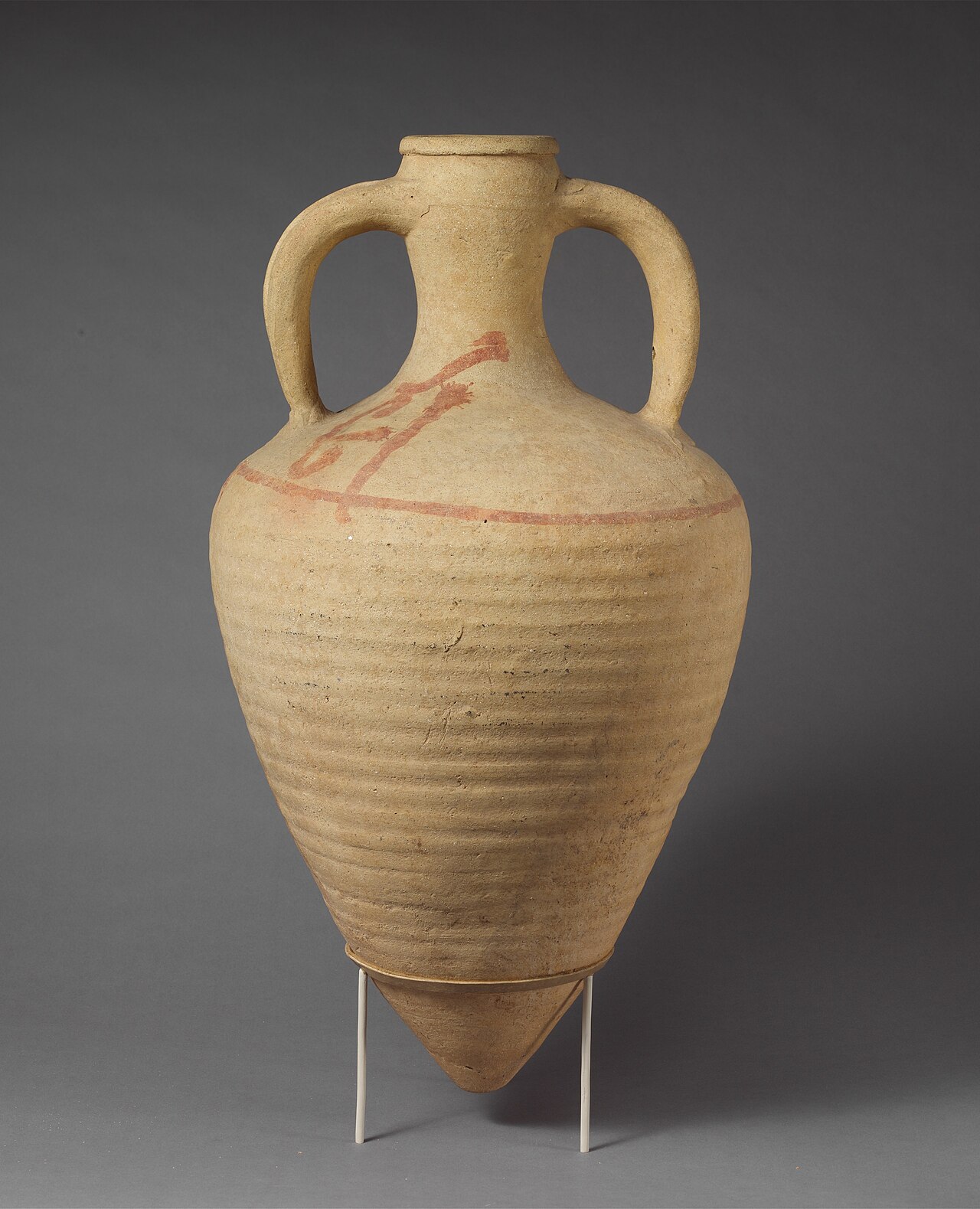
ca. 3rd century CE
Roman, possibly Cypriot, terracotta amphora with painted Greek letters on its shoulder
Roman, possibly Cypriot, terracotta amphora with painted Greek letters on its shoulder. Metropolitan Museum of Art, 74.51.2434.
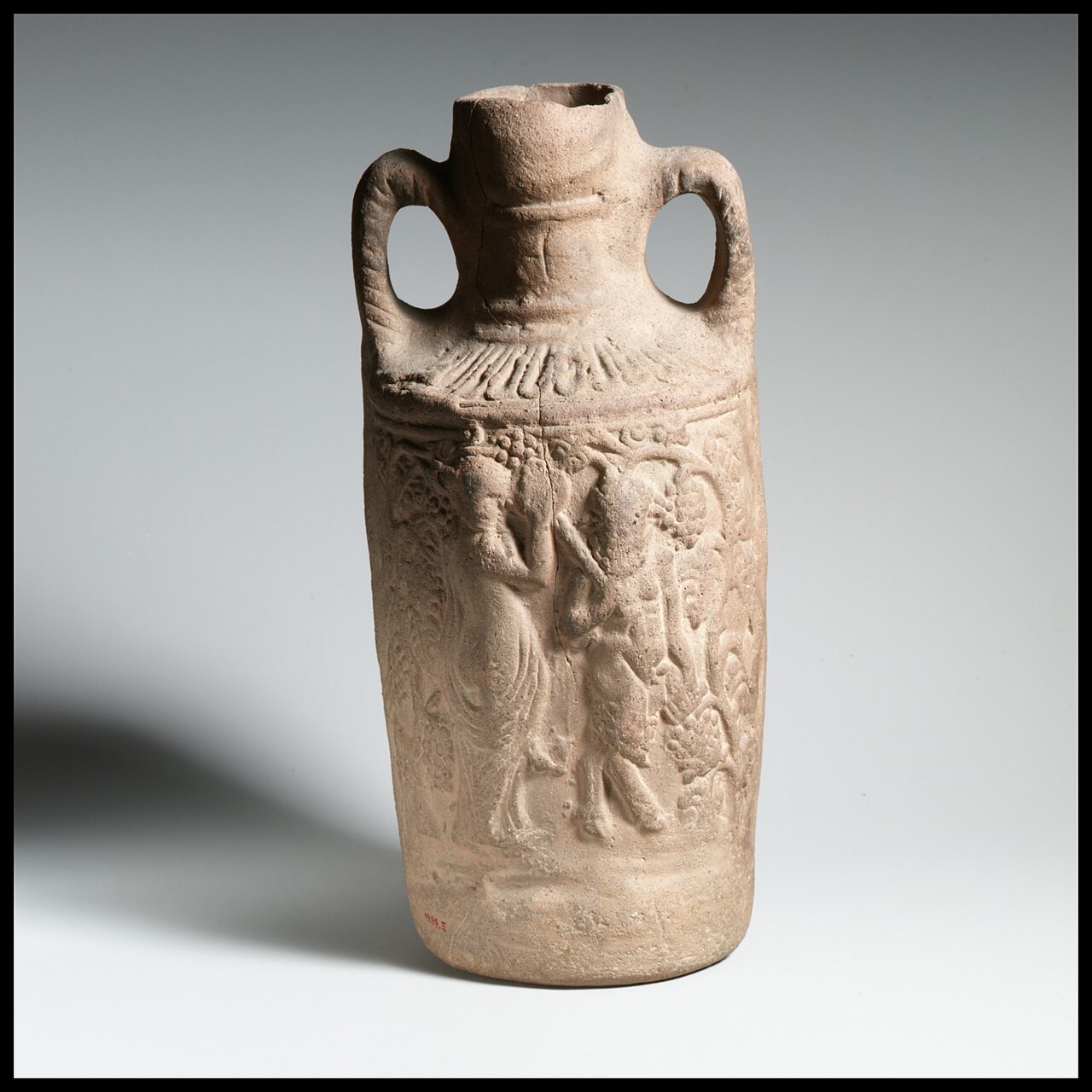
2nd–3rd century CE
Roman terracotta jug in Cnidian relief ware, made at Cnidus in southwestern Anatolia
Roman terracotta jug in Cnidian relief ware, made at Cnidus in southwestern Anatolia. Metropolitan Museum of Art, 49.94.5.

Arikamedu · Photographed Taken on 13 September 2012, 12:46:19
Later brick mission ruins within the present-day Arikamedu archaeological site
Later brick mission ruins within the present-day Arikamedu archaeological site; these visible walls are not the ancient trading settlement.

1912
Periplus §§58–60: Comari, Colchi, pearl divers and eastern ports,1912 edition
Printed p 46 of Schoff’s 1912 Periplus translation: Comari, Colchi, pearl fisheries, the Pandian kingdom and the ports Camara, Poduca and Sopatma.

Arikamedu · Photographed 2022-10-05 12:52:52
Later brick mission ruins within the present-day Arikamedu archaeological site
Later brick mission ruins within the present-day Arikamedu archaeological site; these visible walls are not the ancient trading settlement.
The masonry visible here belongs to the later mission, not to the Roman-period or early historic settlement.

Arikamedu · Photographed 2022-10-05 12:57:59
Later brick mission ruins within the present-day Arikamedu archaeological site
Later brick mission ruins within the present-day Arikamedu archaeological site; these visible walls are not the ancient trading settlement.
The masonry visible here belongs to the later mission, not to the Roman-period or early historic settlement.

Arikamedu · Photographed 2022-10-05 12:47:47
Later brick mission ruins within the present-day Arikamedu archaeological site
Later brick mission ruins within the present-day Arikamedu archaeological site; these visible walls are not the ancient trading settlement.
The masonry visible here belongs to the later mission, not to the Roman-period or early historic settlement.

Arikamedu · Photographed 2015-06-21 16:01:21
Later brick mission ruins within the present-day Arikamedu archaeological site
Later brick mission ruins within the present-day Arikamedu archaeological site; these visible walls are not the ancient trading settlement.
The masonry visible here belongs to the later mission, not to the Roman-period or early historic settlement.
Show 1 more photographs and source images ↓

Arikamedu · Photographed Taken on 22 September 2012, 10:58:20
Present-day entrance and protected-site sign at Arikamedu
The masonry visible here belongs to the later mission, not to the Roman-period or early historic settlement.
006Two views
Both views are shown at equal weight; this site does not choose between them.
When did settlement at Arikamedu begin
- One view
- Wheeler (1945) used amphorae, sigillata and Classical texts to argue that the site began in Augustan times as an Indo-Roman trading station.
- Another view
- Begley's mature chronology, building on Casal's excavations, places a South Indian settlement earlier, probably by the second century BCE.
- What would settle it
- Casal's full stratigraphy, Begley's trench and ceramic tables, and securely contextualized absolute dates if any exist.
Were the riverfront brick enclosures dyeing vats
- One view
- Wheeler and Casal associated earlier brick-lined tanks or pits at Arikamedu with textile dyeing.
- Another view
- The 1989–90 excavators judged the newly exposed enclosures unsuitable for dyeing because they lacked paved floors and drainage outlets.
- What would settle it
- A provenanced floor and drainage sequence, associated tools or textiles, and residue chemistry from surviving surfaces.
007Where next
All related studies, connected material, books and sources12 · 19
Elsewhere on this site
Excavation Atlas Sites: Arikamedu (Virampattinam / Poduke)
Multi-Script Glossary Terms: Dressel 2–4 Amphora (டிரெஸெல் 2–4 ஆம்போரா சாடி / ഡ്രെസ്സൽ 2–4 ആംഫോറ ഭരണി) · Terra Sigillata (Arretine / Eastern Sigillata Ware) (டெர்ரா சிஜில்லாட்டா மண்பாண்டம் / ടെറ സിജില്ലാറ്റ മൺപാത്രങ്ങൾ) · Rouletted Ware (cakkara-p-poṟippu pāṉai) (சக்கரப் பொறிப்பு மண்பாண்டம் (ரௌலட்டட் பாண்டம்) / റൗലറ്റഡ് വെയർ (കൊത്തുപണി മൺപാത്രങ്ങൾ)) · Prakrit Brāhmī & Kharōṣṭhī Mercantile Graffiti (பிராகிருத பிராமி & கரோஷ்டி பொறிப்புகள் / പ്രാകൃത ബ്രാഹ്മിയും ഖരോഷ്ഠി പോറൽ ലിഖിതങ്ങളും)
Connected material
Photographs, drawings, books, videos and other studies linked to this study. A link helps you explore; it does not prove a historical claim.
- Later brick mission ruins within the present-day Arikamedu archaeological sitephotographBackground
- Present-day entrance and protected-site sign at ArikameduphotographBackground
- Later brick mission ruins within the present-day Arikamedu archaeological sitephotographBackground
- Later brick mission ruins within the present-day Arikamedu archaeological sitephotographBackground
- Later brick mission ruins within the present-day Arikamedu archaeological sitephotographBackground
- Later brick mission ruins within the present-day Arikamedu archaeological sitephotographBackground
- Periplus §§58–60: Comari, Colchi, pearl divers and eastern ports,1912 editionhistorical printed pageBackground
- Roman, possibly Cypriot, terracotta amphora with painted Greek letters on its shoulderphotographBackground
- Roman terracotta jug in Cnidian relief ware, made at Cnidus in southwestern AnatoliaphotographBackground
Books, videos and websites
Outside reading on this topic. These are not part of the study and we have not checked every claim in them. See all books and videos
- Indo-Roman Trade: From Pots to Pepper Book · Roberta Tomber · 2008 · Concise ceramic guide connecting Red Sea ports (Myos Hormos, Berenike), Southern Arabia (Khor Rori, Qana), and Indian ports (Pattanam, Arikamedu, Alagankulam) through petrography of amphorae, torpedo jars, and Indian coarse wares.
- The Ancient Port of Arikamedu: New Excavations and Researches 1989–1992 (Vols. 1 & 2) Book · Vimala Begley, Peter Francis Jr., Iravatham Mahadevan, K. V. Raman, Steven Sidebotham, Kathleen Warner Slane & Elizabeth Lyding Will · 1996 & 2004 · Two-volume specialist reassessment of Arikamedu (Poduke), replacing Mortimer Wheeler's 1945 'Roman trading station' model with an indigenous South Indian port and Indo-Pacific glass/stone bead manufacturing hub.
- Lecture 174: "FUSION OF FIRE AND CULTURE: PABALUGALA AS A CENTRE FOR ANCIENT GLASS BEAD PRODUCTION" Video · Mangala Katugampola · University of Kelaniya; Central Cultural Fund / Sri Lanka Department of Archaeology advisory roles (organizer biography) · 1:15:31 · Katugampola presents excavated furnaces, production material and beads from the early-historic workshop complex at Pabalugala. A recent presentation by the project leader; supplies a regional craft-production comparison rather than a generic history of beads. The official abstract places peak activity in the second–fifth centuries CE. This is a different site, not direct evidence for a particular South Indian workshop. Its YouTube unlisted flag explains why ordinary searches may miss it; the organizer publicly provides the link.
- ASI – Archaeological Survey of India (Thrissur & Chennai Circles / IAR Archive) Website · National heritage authority responsible for protected monuments across Kerala (Ariyannur, Cheramanangad, Porkalam, Kattakampal, Bekal, Vizhinjam) and Tamil Nadu/Puducherry (Arikamedu, Adichanallur, Sittanavasal, Puhar) and publisher of Indian Archaeology: A Review.
- The British Museum – Online Collection (South India, Nilgiris & Indo-Roman Finds) Website · Digital catalogue holding 19th-century excavated assemblages from the Nilgiri hills and Coimbatore/Perur megaliths, etched carnelian beads, Arikamedu comparative sherds, and Roman gold/silver coins found in South India.
- Internet Archive – Ancient India Bulletins (Archaeological Survey of India) Website · Full-text open-access scans of the historic ASI bulletin Ancient India, including Mortimer Wheeler's 'Arikamedu: An Indo-Roman Trading-Station' (No. 2, 1946), B. K. Thapar's 'Porkalam 1948' (No. 8, 1952), and V. D. Krishnaswami's megalithic typologies.
008Sources
The study lists the sources it consulted; we have not rechecked them. A working link does not show that a source was read, and a valid identifier does not show that it supports a claim. We do not link to unofficial uploads or copies of publications. Where a study cited one, we show the published citation, or a publisher, DOI or Internet Archive link when we have one. Tracking codes are removed from links, and the sources themselves are not republished here.
R. E. M. Wheeler, A. Ghosh and Krishna Deva, “Arikamedu: an Indo-Roman Trading-station on the East Coast of India,” Ancient India 2 (1946).
Jean-Marie Casal, Fouilles de Virampatnam-Arikamedu: rapport de l'Inde et de l'Occident aux environs de l'ère chrétienne, Paris, 1949.
Vimala Begley, “Arikamedu Reconsidered,” American Journal of Archaeology 87.4 (1983): 461–481.
Vimala Begley, “Rouletted Ware at Arikamedu: A New Approach,” American Journal of Archaeology 92.3 (1988): 427–440.
The Ancient Port of Arikamedu: New Excavations and Researches 1989–1992. Volume One
Vimala Begley et al., The Ancient Port of Arikamedu: New Excavations and Researches 1989–1992, Volume One, EFEO, 1996.
The Ancient Port of Arikamedu: New Excavations and Researches 1989–1992. Volume Two
Vimala Begley et al., The Ancient Port of Arikamedu: New Excavations and Researches 1989–1992, Volume Two, EFEO, 2004.
Elizabeth Lyding Will, “From Italy to India: Mediterranean Amphoras and Roman Economic History,” Amphora 2.2, pp. 16–18.
Peter Francis Jr., “Final Report on Arikamedu,” The Margaretologist 13.2, no. 30 (2001).
L. A. Ford et al., “A geochemical investigation of the origin of Rouletted and other related South Asian fine wares,” Antiquity 79.306 (2005): 909–920.
Peter Magee, “Revisiting Indian Rouletted Ware and the Impact of Indian Ocean Trade in Early Historic South Asia,” Antiquity 84 (2010): 1043–1054.
Bram Fauconnier, “Graeco-Roman merchants in the Indian Ocean: Revealing a multicultural trade,” Topoi, Suppl. 11 (2012): 75–109.
Pinakpani, “Arikamedu, archaeological site near Puducherry, India 10.jpg,” Wikimedia Commons, 5 October 2022.
Lionel Casson, ed. and trans., The Periplus Maris Erythraei (Princeton University Press, 1989).
Print or offline sourceSource recordVimala Begley, “The Dating of Arikamedu and its Bearing on the Archaeology of Early Historical South India,” in South-Indian Horizons (2004); manuscript sent April 1997.
Jean-Marie Casal, “Les fouilles de Virapatnam-Arikamedu,” CRAI 93.2 (1949): 142–147.
ASI / S. K. Mahapatra, ed. (1994), Indian Archaeology 1989–90: A Review (Arikamedu)
Archaeological Survey of India (S. K. Mahapatra, ed.), Indian Archaeology 1989–90: A Review (New Delhi: ASI, 1994), Arikamedu report.
Print or offline sourceSource recordThe Trading of Ancient Glass Beads: New Analytical Data from South Asian and East African Soda-Alumina Glass Beads
Laure Dussubieux et al., 2008 Archaeometry study of ancient South Asian and East African soda-alumina glass beads.
Print or offline sourceSource recordPeter Francis Jr., “Beadmaking at Arikamedu and beyond,” World Archaeology (1991).
Print or offline sourceSource recordAndré Tchernia, “Arikamedu et le graffito naval d'Alagankulam,” Topoi 8.1 (1998), review/discussion of Begley et al. 1996.
Researchers and institutions whose work this study uses: Vimala Begley, Jean-Marie Casal, A. Ghosh, Mortimer Wheeler, Lionel Casson, Peter Francis Jr., Laure Dussubieux, Archaeological Survey of India
How we know The evidence, claims and dates behind this study
What this study draws on
- Begley's 2004 chronology chapter, read in a full web transcription.
- The Indian Archaeology – A Review 1989–90 report on the riverfront brick enclosures.
- Abstracts of Begley 1988 and Ford and colleagues 2005 on Rouletted Ware, and analytical glass-bead studies.
- The 1996 and 2004 excavation volumes and Casal's 1949 monograph were identified but not read in full.
Dates in this study
| What is dated | Date | How it was dated |
|---|---|---|
| Phase A: third to first centuries BCE, most likely second century BCE | 300–1 BCE | Period assigned by excavators or scholars |
| Rouletted Ware approximately second century BCE to late first century CE in Begley 1988 | 200 BCE – 100 CE | Period assigned by excavators or scholars |
| Phase C generally in the first century BCE | 100–1 BCE | Period assigned by excavators or scholars |
| “first quarter of the first century A.D.” Arretine phase in the 1983 reassessment | 1–25 CE | Period assigned by excavators or scholars |
| Phases E/F: second half of first century CE to third century, possibly later | 50–300 CE | Period assigned by excavators or scholars |
See these dates on the timeline
The study’s claims
26 claims · 16 source passages · 52 paragraphs
Browse the study paragraph by paragraphWheeler et al. framed Arikamedu as an “Indo-Roman Trading-station” and used imported ceramics as major chronological anchors.
Supported with qualifications
The chronology is retained as Wheeler’s model, not the current site chronology.
Begley reports Wheeler’s chronology as an Augustan foundation lasting roughly two centuries.
Supported in this study
This describes Wheeler’s model as reported by Begley.
Casal exposed deposits earlier than Wheeler’s main sequence.
Supported with qualifications
Full Casal stratigraphic wording remains an acquisition gap.
Begley’s 1983 reassessment moved settlement back to about the middle of the third century BCE and moved the key Roman-period ceramic horizon earlier than Wheeler’s model.
Supported in this study
The mature 1997/2004 synthesis further refines the phase boundaries.
Begley treated Rouletted Ware as regional production and its decoration as chattering rather than true roulette.
Supported in this study
Archaeometry supports Indian geological origin for Rouletted Ware and related wares, while a single production centre remains unproven.
Supported with qualifications
Indian origin is not equivalent to manufacture at Arikamedu.
Will’s studied amphora assemblage was strongly represented by Koan material, with other Aegean and western Mediterranean components.
Supported in this study
Applies to the specialist studied corpus rather than every amphora ever recovered.
Mediterranean amphorae establish material movement, not the ethnicity or residence of their carriers or consumers.
Supported in this study
Residence or ethnicity requires independent evidence.
“Warehouse” is a functional interpretation, not an independently demonstrated function in the evidence read here.
Supported with qualifications
Full Wheeler/Begley architecture documentation and storage-specific associated-find data were not obtained directly.
Tanks and basins have been interpreted as dye or textile installations, but that interpretation is not a self-evident archaeological function.
Supported in this study
The phrase “terracotta dye vats” is unsupported for the debated brick/walled features.
Beadworking is well associated with Arikamedu, but the Papanaidupet furnace used by Francis is a modern comparison rather than an excavated Arikamedu furnace.
Supported with qualifications
An archaeological furnace-like feature cannot be identified as a bead or glass furnace solely by shape.
Begley’s 1989–1992 project explicitly revisited earlier problems and worked across a heavily disturbed site.
Supported in this study
Imported Mediterranean objects do not establish a Roman colony at Arikamedu.
Supported in this study
Visits or individual residence by Mediterranean people remain possible.
Best-fit synthesis is a South Indian port and craft settlement participating in regional and transoceanic networks; resident Mediterranean merchants remain possible but unproven.
Supported with qualifications
Permanent foreign residence is not demonstrated.
No qualifying laboratory-coded absolute-dating sample record was recovered.
Supported with qualifications
This is a negative result limited to the sources read, not proof that no such sample exists.
Heavy disturbance limits simple layer-to-history equations at Arikamedu.
Supported in this study
“Spanish/Italian amphorae” is only partly supported: Italian material is present, while Spanish origin is absent from the sources consulted in the prior read summary.
Debated in the sources
Superseded earlier claim; must not be used as the current conclusion.
Wheeler’s “factory” analogy invoked early modern European trading stations (merchants' lodges) rather than an industrial manufacturing plant, and does not prove a Roman-administered enclave at Arikamedu.
Supported in this study
Wheeler 1954 remains citation-only in the current revision; the Fauconnier reading from the earlier version supports the historiographic point.
Arikamedu = Poduke/Podouke remains a proposed identification.
Supported with qualifications
Use “often proposed as Poduke/Podouke,” not an unqualified identity.
Spanish amphora provenance is attested in Begley’s 1997/2004 synthesis of Elizabeth Lyding Will’s Arikamedu amphora studies, alongside Koan, Knidian, Rhodian, Italian, French and Adriatic origins.
Supported in this study
Corrects.
Begley’s mature phase model places a pre-import Southern Sector occupation in Phase A; Phase B adds brick architecture and Rouletted Ware; Phase C brings the earliest amphorae; Phase D is the principal terra-sigillata horizon.
Supported in this study
Boundaries are archaeological approximations and later phases are difficult to separate because of disturbance.
The brick enclosures exposed in the 1989–90 campaign near the riverfront cannot be securely identified as dye vats; the field report notes the absence of paved floors and drainage outlets and says form and associated finds did not establish their function.
Supported in this study
Arikamedu has evidence for glass-bead manufacture or working, but current analytical synthesis does not establish primary glass manufacture from raw batch materials at the site.
Supported with qualifications
Bead-forming, tube drawing, reheating, cutting and finishing are separate from primary raw-glass manufacture. A furnace-like feature without associated glass or bead debris is not decisive.
Rouletted Ware and related fine wares are better supported as South Asian products than as Mediterranean imports; geochemistry indicates Indian geological origin, but the number and location of workshops remain unresolved.
Supported with qualifications
Do not translate South Asian manufacture into Arikamedu manufacture without workshop evidence.
The Arikamedu–Poduke equation is a conventional scholarly proposal first made in the modern literature in 1941; it remains plausible as a geographic and textual identification but is not independently demonstrated by an excavated naming inscription in the evidence read.
Supported with qualifications
Proposal history and archaeological identity are separate propositions.
Post-first-century occupation is likely, but Begley cautions that disturbance prevents clean architectural separation of the third–sixth-century horizon; some later amphora fragments and graffiti may extend activity into the third century and possibly later.
Supported with qualifications
Possible survival into the seventh century lies beyond the 600 CE core window.
Trace one claim through the study’s records
Explore the evidenceOther source lists
Numbered citation links from the study
The numbered links in the study text point here.
The Dating of Arikamedu [Chapter 6]
The Dating of Arikamedu [Chapter 6]
The Dating of Arikamedu [Chapter 6]
The Dating of Arikamedu [Chapter 6]
The Dating of Arikamedu [Chapter 6]
ASI / S. K. Mahapatra, ed. (1994), Indian Archaeology 1989–90: A Review (Arikamedu)
Archaeological Survey of India (S. K. Mahapatra, ed.), Indian Archaeology 1989–90: A Review (New Delhi: ASI, 1994), Arikamedu report.
Print or offline sourceThe Ancient Port of Arikamedu - École française d'Extrême-Orient
The Ancient Port of Arikamedu - École française d'Extrême-Orient
Fouilles de Virampatnam-Arikamedu by J. M. Casal | Open Library
Fouilles de Virampatnam-Arikamedu by J. M. Casal | Open Library
Fouilles de Virampatnam-Arikamedu by J. M. Casal | Open Library
Rouletted Ware at Arikamedu: A New Approach | American Journal of Archaeology: Vol 92, No 3
Rouletted Ware at Arikamedu: A New Approach | American Journal of Archaeology: Vol 92, No 3
Rouletted Ware at Arikamedu: A New Approach | American Journal of Archaeology: Vol 92, No 3
THE TRADING OF ANCIENT GLASS BEADS: NEW ANALYTICAL DATA FROM SOUTH ASIAN AND EAST AFRICAN SODA–ALUMINA GLASS BEADS - DUSSUBIEUX - 2008 - Archaeometry - Wiley Online Library
THE TRADING OF ANCIENT GLASS BEADS: NEW ANALYTICAL DATA FROM SOUTH ASIAN AND EAST AFRICAN SODA–ALUMINA GLASS BEADS - DUSSUBIEUX - 2008 - Archaeometry - Wiley Online Library
ASI / S. K. Mahapatra, ed. (1994), Indian Archaeology 1989–90: A Review (Arikamedu)
Archaeological Survey of India (S. K. Mahapatra, ed.), Indian Archaeology 1989–90: A Review (New Delhi: ASI, 1994), Arikamedu report.
Print or offline sourceASI / S. K. Mahapatra, ed. (1994), Indian Archaeology 1989–90: A Review (Arikamedu)
Archaeological Survey of India (S. K. Mahapatra, ed.), Indian Archaeology 1989–90: A Review (New Delhi: ASI, 1994), Arikamedu report.
Print or offline sourceA geochemical investigation of the origin of Rouletted and other related South Asian fine wares | Antiquity
Beadmaking at Arikamedu and beyond: World Archaeology: Vol 23, No 1
In Search of Craft and Society
Arikamedu et le graffito naval d'Alagankulam. ; V. Begley, P. Francis, Jr., I. Mahadevan, K.V. Raman, S.E. Sidebotham, K. W. Slane, E. Lyding Will, The Ancient Port of Arikamedu. New Excavations and Researches 1989-1992 I (Mémoires archéologiques 22) (1996) - Persée
L'archeologia del subcontinente indiano. i paesi dravidici - Enciclopedia - Treccani
Les fouilles de Virapatnam-Arikamedu - Persée
Arikamedu Reconsidered | American Journal of Archaeology: Vol 87, No 4
The Ancient Port of Arikamedu - École française d'Extrême-Orient
About this study Status, corrections and how it was made
Status
Draft study, revision 11. No historian, archaeologist, or Tamil or Malayalam specialist has reviewed it yet.
The study itself says more research is needed before its question can be settled.
How it was made
Compiled as an editorial synthesis from published scholarship around questions we framed. About this project & workflow
The summary, How sure lines and Two views notes on this page were prepared from this study and cross-checked against its passages. That is an editorial check, not a specialist review.
Corrections and updates
Technical details
Study code R116. The text fingerprint changes whenever the study text changes.
- The study text is shown as written. Links from its paragraphs to citations help you move around the study; they are not new claims or checked source passages.
See how this study’s records were extracted
Text fingerprint (SHA-256): R116 · 22f6aade19388fbf64c2c044… · v11
Evidence tables and technical details are on the web page: https://layersofthesouth.org/read/728999a7e9