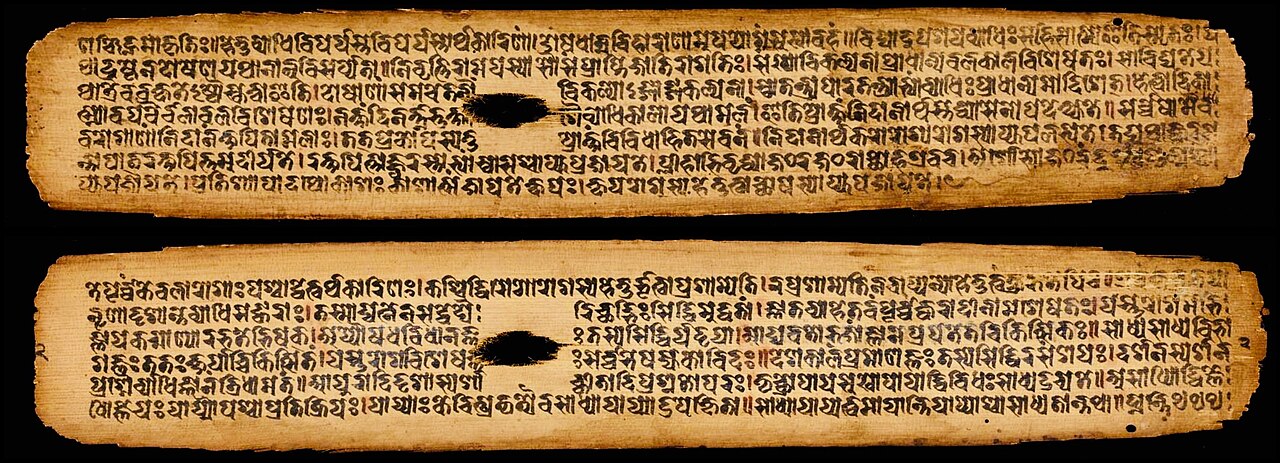
Leaves of a medical manuscript identified by the source as a thirteenth-century Cikitsa-sara-sangraha witness
13th century, as identified in the source record
- Everyday lives
Ayurvedic texts: author, text and manuscript have different dates
The Caraka and Suśruta medical works carry three kinds of date, and none of the sources used here comes from early Kerala.
- This page
- 1,867 words · revision 5
Draft study · Awaiting specialist review · Updated
001Dates and places

No mapped place in this study.
Dates in this study are stated in words only.
- 1 Well supported
- 2 Likely
- 1 Not known
002How sure
In brief
Ayurveda is often described as one ancient system, but its classic books have a long history of writing and copying. In a 2026 essay, Dominik Wujastyk rejects a blanket date of 600 BCE for the Suśruta compendium. He separates proposed earlier material from later editing and additions. A manuscript in Kathmandu, KL 699, is dated 878 CE; that date belongs to the copy, not to every passage in it. A University of Vienna project reports that the earliest Suśruta manuscript lacks the seasonal descriptions of the commonly printed chapter. The Caraka compendium describes prepared accommodation, attendants and companions for treatment. That is a recommended arrangement, not an observed institution. None of the sources used here is a dated medical text, manuscript or inscription from Kerala. They cannot show which texts or training reached early Kerala.
Key researchers cited in this study: Authors, editors, and translators cited in the Source Register below · Published primary editions, catalogues, and domain scholarship logged for this study · Full bibliography
How sure
- Well supported
Manuscript KL 699 of the Suśruta compendium is dated 878 CE.
Published by the Suśruta Project; the date belongs to the copy, not to its contents.
- Likely
The Suśruta compendium holds layers from different periods.
A specialist synthesis argues it; it is not a new dating of the whole work.
- Likely
The earliest Suśruta manuscript lacks the printed seasons passage.
Reported by the Vienna project's comparison; this study did not read the manuscript itself.
- Not known
Which medical texts were known in early Kerala.
None of the sources used here is a dated Kerala witness.
Why it matters
It separates three kinds of date that popular claims about ancient Ayurveda often merge into one.
003Key findings
What the study concludes
- A date attached to an author, a textual layer and a physical manuscript answers three different historical questions.
- Kathmandu KL 699 is dated to 878 CE. The project’s comparison with later received text is not a date for the origin of all its contents.
- The consulted sources support study of medical knowledge and organization, but do not locate a complete received system in first-century Pattanam.
In the study’s own words. How sure each point is, is shown above.
The summary above is the short read. The full study is the complete text it was drawn from, with its tables and source notes.
What the full study covers
- Main findings
- Begin with a book that has a history
- A broad tradition, not a shelf of herbal recipes
- An author's name need not mean one moment of composition
- The date 878 belongs to a witness
- A changing chapter makes the problem concrete
- The medical household inside a compendium
- Modern translation is another historical layer
- What still has to be researched in Kerala
- Questions for a regional medical history
- What remains uncertain
- The next questions
- References and access notes
- Further reading and listening
004The study
Main findings
- A date attached to an author, a textual layer and a physical manuscript answers three different historical questions.
- Kathmandu KL 699 is dated to 878 CE. The project’s comparison with later received text is not a date for the origin of all its contents.
- The sources used here support the study of medical knowledge and its organization, but none of them places these texts in early Kerala.
Begin with a book that has a history
The history of Ayurveda becomes more productive when divided into specific questions: which account of illness, which medical text, which part of that text, and what evidence of its use in a particular place? This study follows books and their transmission. A traditional author’s name is not the date stamp on a complete, unchanged system. This is historical research, not medical advice. Its aim is to understand the organization and transmission of knowledge. No historical treatment described by a source is recommended. A textual prescription is not evidence that a particular regional patient received it. Chronology must attach to identifiable passages, compilations and manuscripts rather than to the word Ayurveda alone.
A broad tradition, not a shelf of herbal recipes
Dominik Wujastyk's scholarly overview describes a medical literature represented by compendia associated with Caraka, Suśruta and Bhela. Its scope includes explanations of illness, diet and substances as well as hands-on interventions. The abstract stresses that causation was not exhausted by a simple bodily-humour formula. It also describes a therapeutic range broader than the modern image of gentle vegetarian herbalism. Only that abstract and its bibliographic setting were read here; the complete chapter's argument remains further work. 1 A better starting point than a list of celebrated discoveries is what the books attempt to explain. A system of diagnosis, a rule for training, a classification of substances and a discussion of prognosis are different achievements. We can appreciate their intellectual ambition without treating their historical status as a judgment about their clinical effectiveness today.
An author's name need not mean one moment of composition
In his July 2026 essay, Wujastyk rejects a blanket dating of the received Suśrutasaṃhitā to 600 BCE. Drawing on the history of scholarship, he distinguishes proposed earlier material from later redaction and additions. The essay is useful because it shows what is concealed by a single ancient date: the surviving work may preserve interventions by more than one generation. It is a specialist synthesis, not a new archaeological dating of the whole compendium. 2 A reader therefore needs two cautions at once. A late copy does not prove that everything in it was newly composed when copied. Conversely, an early attribution does not prove that every sentence in a modern edition was already present at that early date. Neither caution cancels the other. Together they make room for long transmission, deliberate revision and the uneven survival of evidence.
The date 878 belongs to a witness
The Suśruta Project's archive identifies Kathmandu manuscript KL 699 as dated to 878 CE. It describes the earlier printed tradition's dependence on much later manuscripts and records the project's diplomatic transcription of this older witness. The importance of the find lies in the actual text available for comparison, not merely the impressiveness of its age. The 878 date is neither the birth of surgery nor the date of every passage the manuscript preserves. 3 We have used the project's record rather than collating the manuscript leaf by leaf. That boundary matters. A catalogue date and a completed transcription make investigation possible, but they do not authorize this study to invent missing readings or certify a Sanskrit passage.
A changing chapter makes the problem concrete
The University of Vienna's epidemic-history project offers a specific comparison. It reports that the earliest Suśruta witness lacks the seasonal descriptions found in the commonly printed version of the relevant chapter. The remaining discussion is closer to Caraka's account of collective affliction. The analysis connects disordered seasons with damage to shared environmental supports such as plants and water. This is a comparison between textual forms, not a claim that ancient people lacked seasonal knowledge. 4 This example changes how the work should be cited. Saying Suśruta believed a particular thing is less useful than naming the section and identifying the textual presentation being used. It also discourages a tempting modern shortcut. Concern about shared surroundings is not by itself germ theory; nor does a different explanation of disease make the passage unworthy of study. The historical question concerns the explanatory work those surroundings performed within the text.
The medical household inside a compendium
The received Caraka text offers another kind of evidence. In Sūtrasthāna 15.6–7, the consulted translation describes prepared accommodation and a range of people supporting treatment, including attendants and companions. It is an organizational prescription embedded in a therapeutic discussion. Its existence makes arrangements of care a legitimate subject of inquiry; it does not identify any excavated institution. 5 A recommended arrangement is not an observed establishment. An author can advocate something because it is desirable, difficult to obtain or characteristic of ideal practice. Those possibilities should not be resolved by the modern word hospital. Identifying a local institution requires chronological and regional evidence this study does not provide.
Modern translation is another historical layer
The online Caraka edition supplies ancient-language passages, English translation and modern commentary in a single interface. A citation needs to mark which of those it uses. Modern explanations of management or clinical relevance are not automatically translations of the underlying verses. This study relies on the numbered passage for the organizational example and does not adopt the site's introductory assertion of a hospital three millennia ago. 6 A consistent citation can make that separation easy for readers: work, section, verse, edition or translator, and the actual access obtained. When only a translated passage has been examined, say so. When an interpretation depends on a disputed Sanskrit term, leave room for linguistic review. Better presentation should reduce the reader's labor of verification, not disguise the steps between an ancient manuscript and an English sentence.
What still has to be researched in Kerala
None of the sources used here is a dated medical text, manuscript or inscription from Kerala. The evidence assembled here therefore does not establish which compendia, passages or training arrangements were available in first-century western South India. The later reception of Vāgbhaṭa, relations between Sanskrit and regional medical writing, household transmission and named practitioner communities each require their own investigation. They remain open subjects rather than footnotes assumed to follow from the fame of Ayurveda. Evidence that could answer them would pair a dated local witness with its transmission history: an inscription, manuscript colophon, documented teaching lineage or carefully contextualized testimony. Such evidence would answer different questions from a general date assigned to a Sanskrit work.
Questions for a regional medical history
The useful contribution is not a catalogue of impressive procedures but a discipline of asking who knew something, how that knowledge was learned, what resources were available and who bore the consequences of uncertainty. An undocumented practitioner cannot represent an entire tradition. This history should remain open to revision as manuscript work advances. Its present conclusion is bounded but useful: a medical tradition has a history of composition, copying, selection and interpretation. Honoring that history means preserving its layers, not assigning every layer the oldest date anyone has proposed.
What remains uncertain
- The exact composition dates and relationships of all relevant passages have not been settled or independently reconstructed here.
- We used project descriptions, selected translated passages and one scholarly abstract; no new Sanskrit edition or manuscript decipherment was produced.
- Early Kerala circulation, later Vāgbhaṭa reception and regional teaching arrangements remain separate investigations.
The next questions
- Which dated Kerala witnesses attest particular medical texts or passages?
- How do KL 699’s relevant readings compare with specified later manuscripts and editions?
- What evidence distinguishes household knowledge, professional training and textual prescription?
References and access notes
1 Dominik Wujastyk (2022). The Science of Medicine. Abstract of chapter 23, The Science of Medicine, in The Wiley Blackwell Companion to Hinduism, second edition. Abstract and bibliographic metadata consulted; full chapter was not read directly for this study. Used only for the broad scope of the scholarly tradition described in the abstract. No unseen chapter argument, page quotation or exact chronology is attributed to it. Historical therapies are not recommended. Open source: onlinelibrary.wiley.com
2 Dominik Wujastyk (2026-07-17). On the Date of the Suśrutasaṃhitā. On the Date of the Suśrutasaṃhitā: discussion of early datings and successive textual layers. Full HTML essay read. An authorial synthesis by a manuscript-project researcher, not a newly dated archaeological find. Earlier scholarship is reported through this essay unless separately read. Its project affiliations overlap with the Suśruta Project archive in 3; these are not independent manuscript discoveries. Open source: sushrutaproject2.github.io
3 The Suśruta Project; Dominik Wujastyk (Project archive, read 2026). The Suśruta Project 1.0 (2020–2024). Project overview: KL 699, its 878 CE date, the manuscript announcement and diplomatic transcription. Full project overview read. The date 878 CE belongs to a physical manuscript witness, not the composition of every passage it transmits. Project descriptions do not replace a critical edition or independent inspection of every manuscript leaf. No manuscript images are reproduced. Open source: sushrutaproject1.github.io
4 University of Vienna, Epidemics and Crisis Management in Pre-modern South Asia project (Undated project essay; read 2026). Epidemics in Suśruta. Epidemics in Suśruta: comparison of the oldest witness with the printed seasons chapter and Caraka Vimānasthāna 3. HTML research discussion read. A specific textual comparison, not proof that seasonal medicine was absent from early South Asia. The project’s analysis of collective affliction is not a modern diagnosis or a claim of germ theory. Open source: epidemics.univie.ac.at
5 V. K. Shrivastav, A. Srivastava and Y. S. Deole, online contributors (2020 online edition). Upakalpaniya Adhyaya: Caraka Saṃhitā, Sūtrasthāna 15. Caraka Sūtrasthāna 15.6–7: prepared accommodation and personnel; numbered translation only. Selected English/Sanskrit passages 6–7 and edition information read. Only the organizational passages are used. The modern introductory claim of a hospital 3,000 years ago is not adopted. Procedural therapies, dosages and preparation instructions are neither reproduced nor recommended. Open source: www.carakasamhitaonline.com
6 V. K. Shrivastav, A. Srivastava and Y. S. Deole, online contributors (2020 online edition). Upakalpaniya Adhyaya: Caraka Saṃhitā, Sūtrasthāna 15. Distinction between numbered verses 15.6–7 and the modern introductory/commentarial material. Selected English/Sanskrit passages 6–7 and edition information read. Only the organizational passages are used. The modern introductory claim of a hospital 3,000 years ago is not adopted. Procedural therapies, dosages and preparation instructions are neither reproduced nor recommended. Open source: www.carakasamhitaonline.com
Further reading and listening
Onward resources, not additional evidence for this article. The recorded access limits still apply. Lu Lu (2025). Translating Medicine Across Cultures: The Divergent Strategies of An Shigao and Dharmarakṣa in Introducing Indian Medical Concepts to China. Bibliographic metadata verified; full article was not read directly for this study. Further reading only. No unseen conclusion about the date of a received Indian medical compendium is used as evidence. The translation-history question deserves a separate specialist study. Open source: www.mdpi.com
005Photographs
Photographs of the places and objects this study discusses. Each item carries its creator’s credit, licence and documented source. See all 412 photographs and source images ↗
13th century, as identified in the source record
Leaves of a medical manuscript identified by the source as a thirteenth-century Cikitsa-sara-sangraha witness
Leaves of a thirteenth-century Nepalese palm-leaf manuscript (Cambridge MS Add.1707) of Vangasena’s eleventh-century Bengali Ayurvedic compendium Cikitsasarasangraha.
006Where next

All related studies, connected material, books and sources8 · 6
Elsewhere on this site
Multi-Script Glossary Terms: iñci & cukku (Ginger – Zingiber officinale) (இஞ்சி & சுக்கு / ഇഞ്ചിയും ചുക്കും)
Connected material
Photographs, drawings, books, videos and other studies linked to this study. A link helps you explore; it does not prove a historical claim.
- Manimekalai: opening text in the 1898 Swaminatha Iyer edition – A later printed witness to an older work, not an ancient manuscripthistorical printed textBackground
- Indian madder flowers and buds (Rubia cordifolia L., modern botanical context)photographBackground
- Indian madder plant (Rubia cordifolia, modern botanical context)photographBackground
- Leaves of a medical manuscript identified by the source as a thirteenth-century Cikitsa-sara-sangraha witnesshistorical documentBackground
- Haritaki (Terminalia chebula) fruits 01 – Modern medicinal-plant identificationphotographBackground
- Leafy trees identified in the source record as Terminalia chebula (modern botanical context)photographBackground
Books, videos and websites
Outside reading on this topic. These are not part of the study and we have not checked every claim in them. See all books and videos
- Dominik Wujastyk on Sanskrit manuscripts and the history of science Video · Dominik Wujastyk, Sudha Gopalakrishnan · University of Alberta researcher; India International Centre / SAMHiTA programme; Gopalakrishnan chairs · 1:26:05 · A research conversation about Sanskrit manuscripts, textual history and the history of Indian science and medicine. Foregrounds textual scholarship and the distinction between a surviving copy and the earlier text it transmits. Later manuscript witnesses do not directly date an original composition or establish medical practice at an early Kerala site. An IIC development-page entry gives 28 April; the contemporaneous organizer announcement and upload identify 29 April 2022.
007Sources
The study lists the sources it consulted; we have not rechecked them. A working link does not show that a source was read, and a valid identifier does not show that it supports a claim. We do not link to unofficial uploads or copies of publications. Where a study cited one, we show the published citation, or a publisher, DOI or Internet Archive link when we have one. Tracking codes are removed from links, and the sources themselves are not republished here.
Dominik Wujastyk (2022). The Science of Medicine. Abstract of chapter 23, The Science of Medicine, in The Wiley Blackwell Companion to Hinduism, second edition. Abstract and bibliographic information read; full chapter not yet checked directly. Used only for the broad scope of the scholarly tradition described in the abstract. No unseen chapter argument, page quotation or exact chronology is attributed to it. Historical therapies are not recommended.
Dominik Wujastyk (2026-07-17). On the Date of the Suśrutasaṃhitā. On the Date of the Suśrutasaṃhitā: discussion of early datings and successive textual layers. Full HTML essay insp
Dominik Wujastyk (2026-07-17). On the Date of the Suśrutasaṃhitā. On the Date of the Suśrutasaṃhitā: discussion of early datings and successive textual layers. Full HTML essay read. An authorial synthesis by a manuscript-project researcher, not a newly dated archaeological find. Earlier scholarship is reported through this essay unless separately read. Its project affiliations overlap with S281; these are not independent manuscript discoveries.
The Suśruta Project; Dominik Wujastyk (Project archive, read 2026). The Suśruta Project 1.0 (2020–2024). Project overview: KL 699, its 878 CE date, the manuscript announcement and diplomatic transcription. Full project overview read. The date 878 CE belongs to a physical manuscript witness, not the composition of every passage it transmits. Project descriptions do not replace a critical edition or independent inspection of every manuscript leaf. No manuscript images are reproduced.
University of Vienna, Epidemics and Crisis Management in Pre-modern South Asia project (Undated project essay; read 2026). Epidemics in Suśruta. Epidemics in Suśruta: comparison of the oldest witness with the printed seasons chapter and Caraka Vimānasthāna 3. HTML research discussion read. A specific textual comparison, not proof that seasonal medicine was absent from early South Asia. The project’s analysis of collective affliction is not a modern diagnosis or a claim of germ theory.
V. K. Shrivastav, A. Srivastava and Y. S. Deole, online contributors (2020 online edition). Upakalpaniya Adhyaya: Caraka Saṃhitā, Sūtrasthāna 15. Caraka Sūtrasthāna 15.6–7: prepared accommodation and personnel; numbered translation only. Selected English/Sanskrit passages 6–7 and edition information read. Only the organizational passages are used. The modern introductory claim of a hospital 3,000 years ago is not adopted. Procedural therapies, dosages and preparation instructions are neither reproduced nor recommended.
V. K. Shrivastav, A. Srivastava and Y. S. Deole, online contributors (2020 online edition). Upakalpaniya Adhyaya: Caraka Saṃhitā, Sūtrasthāna 15. Distinction between numbered verses 15.6–7 and the modern introductory/commentarial material. Selected English/Sanskrit passages 6–7 and edition information read. Only the organizational passages are used. The modern introductory claim of a hospital 3,000 years ago is not adopted. Procedural therapies, dosages and preparation instructions are neither reproduced nor recommended.
Researchers and institutions whose work this study uses: Authors, editors, and translators cited in the Source Register below, Published primary editions, catalogues, and domain scholarship logged for this study
How we know The evidence, claims and dates behind this study
What this study draws on
- The Suśruta Project's record and transcription of Kathmandu manuscript KL 699, dated 878 CE.
- Wujastyk's 2026 essay on dating the Suśrutasaṃhitā and the abstract of his 2022 overview.
- The University of Vienna epidemics project's comparison of the seasons chapter.
- Caraka Sūtrasthāna 15.6-7 in a 2020 online English translation.
Dates in this study
This study has no dates recorded in a form we can chart, so there is no date chart. Any dates it gives are in the full study.
The study’s claims
0 claims · 0 source passages · 19 paragraphs
Browse the study paragraph by paragraphThis study has no separately listed claims. Its paragraphs can be browsed one by one.
About this study Status, corrections and how it was made
Status
Draft study, revision 5. No historian, archaeologist, or Tamil or Malayalam specialist has reviewed it yet.
How it was made
Compiled as an editorial synthesis from published scholarship around questions we framed. About this project & workflow
The summary, How sure lines and Two views notes on this page were prepared from this study and cross-checked against its passages. That is an editorial check, not a specialist review.
Technical details
Study code R065. The text fingerprint changes whenever the study text changes.
- The study text is shown as written. Links from its paragraphs to citations help you move around the study; they are not new claims or checked source passages.
See how this study’s records were extracted
Text fingerprint (SHA-256): R065 · 9bbe3c1b8c5718eec2bc2c7e… · v5
Evidence tables and technical details are on the web page: https://layersofthesouth.org/read/32862bb637