Each period has the same width, so spacing is not to scale.
- Land & water
- 200 BCE–300 CE
Kallanai: an old Kaveri weir whose building date is unknown
Kallanai on the Kaveri is old and often repaired, but no source dates its first building or shows that Karikala Chola built it.
- This page
- 4,661 words · revision 5
Draft study · Awaiting specialist review · Updated
001Dates and places

No mapped place in this study.
1000–500 BCE
Different beginnings
500–200 BCE
Marks & materials
200 BCE–300 CE
Connected worlds
300–600 CE
Change & continuity
After 600 CE
- first or second century CE in differing modern attributional sources
- roughly seventh century for the Mālepādu inscription in updated modern discussion
- sixth regnal year of Rajendra Chola I, approximately 1018 CE
- Date from writing, coins or texts
- Period assigned by excavators or scholars
Each date belongs to what was dated (a sample, an object, a layer or a text), which is not always the event the study asks about.
Each period has the same width, so spacing is not to scale.
The full table of dates, with their ranges, is under How we know.
- 2 Well supported
- 1 Possible
- 1 Not known
002How sure
In brief
Kallanai, the Grand Anicut, is a stone-and-clay weir on the Kaveri in Tamil Nadu. British engineers found it already old in the early 1800s, then surveyed, repaired and altered it. Popular accounts say the Chola king Karikala built it in the first or second century CE. The poem Pattinappalai praises Karikala for digging tanks, but it does not name Kallanai. Later copper plates, from about the seventh century and from about 1018 CE, credit him with Kaveri banks. Neither names Kallanai, and the 1920 editor of the later plates said their word meant embankments, not a weir. No laboratory or layer-based date has been found for any part of the structure. Modern sources even disagree between the first and second centuries. Kallanai is best seen as a long-lived, often repaired and modified work attributed to Karikala.
Key researchers cited in this study: H. Krishna Sastri (Early Tamil Cave Inscriptions) · Full bibliography
How sure
- Well supported
Kallanai was an old working anicut before British engineers arrived.
Engineers surveyed it from 1804 and treated it as an existing old work.
- Well supported
Later inscriptions credit Karikala with work on the Kaveri banks.
Published editions of the Mālepādu and Tiruvalangadu plates state this directly.
- Possible
Karikala built Kallanai.
A long tradition says so, but no early text or inscription names Kallanai.
- Not known
When the earliest surviving part of Kallanai was built.
No radiocarbon, luminescence or sealed-layer date has been found for any part of it.
Why it matters
It shows how a famous monument's popular date can rest on tradition rather than on any measured evidence.
The summary above is the short read. The full study is the complete text it was drawn from, with its tables and source notes.
What the full study covers
- Executive summary and public orientation
- Scope, chronology, and research method
- Literary and epigraphic evidence for Karikala
- Fabric, hydraulics, and documented interventions
- Dating synthesis, quantitative comparison, and competing hypotheses
- Critical appraisal and open questions
- Prioritized bibliography and source trail
003The study
Executive summary and public orientation
What evidence dates the different components of Kallanai and supports its attributed history?
Kallanai, or the Grand Anicut, is a major and demonstrably old hydraulic work on the Kaveri system in Tamil Nadu. The evidence reviewed here does not, however, justify treating its present visible fabric as a securely dated second-century-CE construction made in one event by Karikala Chola. The historically defensible picture is more layered: an old precolonial anicut; a later literary and epigraphic tradition connecting Karikala with improvements to the Kaveri and its banks; major documented colonial-period observation and intervention; and a modern heritage narrative that often fuses those different evidentiary layers into a single construction story. ↗1 ↗2 ↗3
Present-day Kallanai (Grand Anicut), showing its visible structure and river setting
Kallanai
Photographed 2012-09-09
This study separates current fabric, repairs, historical descriptions and attribution, and it tests rather than assumes that Paṭṭiṉappālai describes Kallanai. On those tests, the principal findings are:
| Proposition | Assessment | Why |
|---|---|---|
| Kallanai was an established precolonial hydraulic work before British engineering intervention | Strongly supported | Early nineteenth-century engineers encountered it as an existing old work; later historical research documents survey, silting problems, repair and system modification rather than first construction. ↗3 |
| Present Kallanai can be read as untouched ancient fabric | Rejected | The site and surrounding hydraulic system were repeatedly modified after British acquisition of the delta; modern descriptions therefore cannot simply be projected back to an original phase. ↗1 ↗2 |
| Paṭṭiṉappālai says Karikala built Kallanai | Not supported by the consulted text | The poem celebrates Kaveri fertility and Karikala, and says the king dug tanks/increased prosperity, but the consulted complete Unicode text does not name Kallanai or state that he built an anicut across the Kaveri. ↗4 ↗5 |
| Early epigraphy connects Karikala with management of the Kaveri | Supported as later historical tradition | The Mālepādu plates associate Karikala with restraining Kaveri waters/banks; the early-eleventh-century Tiruvalangadu plates credit him with Kaveri embankments. Both postdate the conventionally assigned Karikala period by centuries. ↗6 ↗7 ↗8 |
| Those inscriptions specifically identify Kallanai | No | Neither read inscription names Kallanai. The editor of the Tiruvalangadu plates explicitly cautioned that its term for Karikala's work denotes embankments rather than an anicut across the river. ↗8 |
| Surviving stones or an identified construction phase have been directly dated to the first/second century CE | Not known; no direct laboratory date appears in the consulted sources | No traceable radiocarbon, OSL/TL, archaeomagnetic, dendrochronological, stratigraphically sealed diagnostic assemblage, or equivalent component-specific dating result was found in the consulted scholarly and official sources. |
| “Unmortared” means a completely dry-stone ancient structure | Too strong | Historical engineering literature describes the old anicut as held together by stone and clay, while ICID describes interlocking stone without cementing material. The narrower claim “without modern cement/lime mortar” is therefore safer than “binder-free dry stone.” ↗2 ↗9 ↗3 |
| A precise second-century-CE construction date is established | No | Second-century attribution is widespread in heritage literature, but a peer-reviewed hydrological review gives the first century CE instead. The disagreement is itself evidence that the conventional date has not been fixed by direct scientific dating. ↗10 ↗2 |
The resulting conclusion is therefore deliberately narrower than the popular story: Kallanai is a long-lived, repeatedly modified Kaveri anicut conventionally attributed to Karikala; later inscriptions independently establish a tradition that Karikala undertook major Kaveri bank or flood-control works, but the evidence read here does not securely identify those works with Kallanai or directly date surviving Kallanai fabric to his reign.
The evidence falls into separate strands. Early Tamil literary tradition links Karikala with Kaveri fertility and tank-digging. The later Mālepādu tradition has him restraining the Kaveri waters and banks, and the early-eleventh-century Tiruvalangadu plates credit him with Kaveri embankments. Colonial engineers found an old stone-and-clay hydraulic work, which nineteenth-century repairs and system changes then modified. Modern heritage accounts join Karikala, Kallanai and a first- or second-century date into one story, although none of the literary or inscriptional witnesses names Kallanai and the Tiruvalangadu editor distinguished embankments from an anicut.
The solid historical point is the convergence on an old hydraulic structure plus an old Karikala–Kaveri improvement tradition. The weak links – the equation of that tradition with this particular surviving structure and its precise date – are the steps that still require independent proof. ↗7 ↗3 ↗5 ↗8
Scope, chronology, and research method
This study uses this collection's period, 1000 BCE–600 CE, as a frame for testing claims, not as a reason to force Kallanai into an early date. Four layers of time therefore matter.
Within 1000 BCE–600 CE, the problem is the proposed Karikala-era origin, normally placed by modern accounts in the first or second century CE. No independently dated Kallanai construction context from this period was located. Paṭṭiṉappālai belongs to the classical Tamil evidence traditionally brought into discussion of Karikala, but its own composition history and manuscript transmission must be distinguished from the historical event it may describe. The CICT record identifies Kaṭiyalūr Uruttiraṅkaṇṇaṉār as composer and Karikala and Kāvirippūmpaṭṭiṉam as central subjects. ↗4
Later reception supplies much of the evidence normally invoked for the king's hydraulic reputation. The Mālepādu plates are generally placed around the seventh century in updated discussion, while the Tiruvalangadu grant belongs to the sixth regnal year of Rajendra Chola I, approximately 1018 CE. These are important historical witnesses to a Karikala–Kaveri tradition but are not contemporary building inscriptions for Kallanai. ↗11 ↗12 ↗13
Early modern and colonial documentation is essential for reconstructing what engineers actually encountered. Caldwell surveyed the Cauvery and the silting problem in 1804; subsequent engineers studied and altered the system, and Cotton's major Cauvery/Coleroon interventions followed in the 1830s. ↗3
Modern reconstruction includes Chitra Krishnan's 2003 IIT Delhi dissertation and Wiebe Bijker's peer-reviewed 2007 study, together with current governmental and ICID heritage descriptions and the 2020 hydrology review by Singh and colleagues. The IIT Delhi repository confirms the dissertation's title, author, year, and institutional location, while the full dissertation text was not checked directly; claims drawn from Krishnan's argument are therefore mediated here through Bijker's published account. ↗14 ↗15 ↗16
Search and appraisal strategy
This study begins with the most common claims: the Karikala attribution, the alleged witness of Paṭṭiṉappālai, the “unmortared” construction claim, the hydraulic diversion model, and the history of British intervention. It then followed those propositions backward toward primary or near-primary evidence: the Tamil poem; published epigraphic texts of the Mālepādu and Tiruvalangadu plates; nineteenth-century engineering documentation identified by recent scholarship; and engineering reconstruction.
The source hierarchy was: ancient/classical text or inscription in an identified edition; historical engineering record; peer-reviewed analytical scholarship; institutional repository metadata; then official heritage syntheses. Modern tourism and heritage pages were used to document current institutional claims, not as independent proof of ancient chronology.
Recent literature alone cannot answer this question: the consequential source editions date to 1911 and 1920, Baird Smith's engineering report to 1856, Bijker's important analytical article to 2007, and Krishnan's dissertation to 2003. Recent work was used to check whether those older claims had been superseded or whether new absolute dating had appeared.
The search found no measured dating samples, so there is nothing to compare statistically. The quantitative evidence instead consists of reported dimensions, flows, irrigated areas and intervention measurements; these are summarized descriptively below. No radiometric sample is listed because no traceable laboratory result was located.
The text of Bijker's article was read, but its page images were not; no claim in this study depends on reading its diagrams. This matters because an extracted textual description of reconstructed geometry is not a substitute for verification of a measured drawing.
Literary and epigraphic evidence for Karikala
What Paṭṭiṉappālai does and does not say
Paṭṭiṉappālai is relevant, but not for the reason usually implied. CICT describes the poem as a 301-line work associated with Kaṭiyalūr Uruttiraṅkaṇṇaṉār, Karikala and Kāvirippūmpaṭṭiṉam, and lists several modern editions, including U. V. Swaminatha Iyer's 1906 edition with Naccinarkkiniyar's commentary. ↗4
In the Project Madurai Unicode text, the opening Kaveri passage praises the river's dependable waters and agricultural fecundity. Later, in the praise of the king, the poem says in substance that he transformed forest into inhabited/productive country and dug tanks to increase prosperity (kuḷam toṭṭu vaḷam perukki). That is genuine evidence for a literary memory of royal landscape and water management. ↗5
But the distinction is decisive: a full-text search found no occurrence of கல்லணை / Kallanai, and the relevant passages read do not say that Karikala constructed an anicut across the Kaveri. The string aṇai is not itself a reliable rescue for the claim: the available occurrence does not provide a Kallanai construction statement. ↗5
The defensible formulation is therefore:
Paṭṭiṉappālai associates Karikala's praised rule with Kaveri prosperity and tank construction, but it is not an explicit textual witness to his construction of Kallanai.
That is more than a caveat. It removes one supposed “primary source” from the direct proof chain for the specific monument while retaining its real historical value.
The Mālepādu tradition
The Mālepādu copper plates of Punyakumāra are materially more relevant to the Karikala hydraulic tradition. H. Krishna Sastri's publication presents a genealogy in which Karikala's fame includes control of the waters of the daughter of Kavera – the Kaveri – and the accompanying discussion understands the traditional feat as construction or strengthening of river banks. ↗6 ↗12 ↗7
This is consequential because it supplies an epigraphic Karikala–Kaveri association substantially earlier than the Tiruvalangadu plates. Yet it still does not identify a structure called Kallanai. It therefore supports the proposition “a later dynastic tradition credited Karikala with major Kaveri flood/bank control”, not the stronger proposition “this inscription records Karikala building the surviving Grand Anicut.”
The chronological distance is also integral to interpretation. Even on a roughly seventh-century date for the plates, they are several centuries later than the first-/second-century placement conventionally assigned to Karikala in modern summaries. They are evidence for the existence of the tradition by their own date, not a contemporary construction record. ↗7 ↗17
The Tiruvalangadu plates and a crucial philological caution
The Tiruvalangadu copper plates of Rajendra Chola I provide an explicit later Chola dynastic memory. Verse 42 credits Karikala with establishing his fame through construction of embankments of the Kaveri. ↗8
This might appear at first glance to prove the Kallanai attribution. The editor's own note is therefore particularly important. Krishna Sastri cautioned that if the author had meant an anicut or dam across the Kaveri, the term taṭa/tata would not have been used. In other words, the critical edition itself distinguishes river-bank embankment construction from the cross-river structure that the popular attribution wants the text to prove. ↗8
The evidentiary sequence can thus be stated without either dismissing or over-reading the tradition:
| Witness | Approximate witness date | Direct proposition | Kallanai named? | Evidentiary force |
|---|---|---|---|---|
| Paṭṭiṉappālai | Classical Tamil work; exact historical layering debated | Karikala; prosperous Kaveri landscape; tank digging | No | Relevant background, not direct dam testimony. ↗4 ↗5 |
| Mālepādu plates | Roughly seventh century in updated dating | Karikala associated with restraining Kaveri waters / construction of banks | No | Strong evidence that a Karikala–Kaveri hydraulic tradition existed by the inscription's period. ↗6 ↗7 |
| Tiruvalangadu plates | Rajendra I, sixth regnal year, c. 1018 CE | Karikala constructed Kaveri embankments | No | Explicit Chola dynastic tradition; editor warns wording does not mean a cross-river anicut. ↗13 ↗8 |
| Modern attribution | Twentieth–twenty-first centuries | Kallanai built by Karikala in first/second century CE | Yes | Widely repeated synthesis, but varies in date and is not itself component dating. ↗10 ↗2 |
The strongest conclusion from the textual evidence is therefore not “Karikala did nothing at Kaveri”; that would go beyond the evidence in the opposite direction. It is that the consulted sources establish a durable tradition of Karikala as an improver/controller of the Kaveri, while the step that identifies those works specifically with Kallanai remains inferential.
Fabric, hydraulics, and documented interventions
Kallanai's physical history creates a second evidentiary problem: the object visible today is not a single sealed archaeological context. Bijker's analysis explicitly warns that the system has undergone substantial alteration since the late eighteenth and nineteenth centuries, with additional hydraulic structures around it. Accordingly, modern appearance cannot be uncritically projected backward to an original early-historic configuration. ↗1
What the engineering reconstruction establishes
Bijker's 2007 article reports and discusses Chitra Krishnan's interdisciplinary reconstruction. Her work combined historical descriptions from archives, archaeological and anthropological field survey, and hydraulic analysis. Bijker characterizes Kallanai as an ancient irrigation work attributed to Karikala and conventionally believed to be about second-century CE; that modal wording is significant because the article does not claim an absolute archaeological date for the surviving masonry. ↗1 ↗16
The reconstruction offers a persuasive functional explanation. Around 1800, the Kollidam/Coleroon was the wider, steeper and faster branch and acted primarily as a flood carrier, while roughly 600,000 acres of irrigated land lay in the delta south of the Kaveri branch. On this model, Kallanai helped manage the hydraulic partition: high flows could be directed toward the flood-carrying Kollidam while water was sustained for the agrarian delta. ↗1 ↗2
Krishnan's reconstruction, as reported by Bijker, also interprets the old work as a curved, irregular masonry body with a sloping crest rather than as a modern vertical barrage. Mathematical and physical reasoning was used to test how such geometry could operate under flood and sediment conditions. That is valuable engineering identification: it makes an apparently crude low masonry mass intelligible as a hydraulic form. It is not, by itself, a method for establishing the calendar date when each surviving stone was placed. ↗1
The official IIT Delhi repository record resolves one bibliographic problem in the secondary literature: it lists Chitra Krishnan's dissertation as Tank and anicut irrigation systems: engineering analysis, completed in 2003. The full dissertation text was not read directly for this study before its field observations, drawings, and archival citations can be verified first-hand. ↗15
Construction fabric: stone and clay
Descriptions of the old fabric call for precision. Historical engineering scholarship reports that nineteenth-century engineers found the Grand Anicut held together by stone and clay, and the Thanjavur district administration likewise describes rough stone and clay, whereas the International Commission on Irrigation and Drainage (ICID) describes interlocking unhewn stone without cementing material. These accounts are compatible if clay served as packing, bedding, or sealing without lime or modern hydraulic cement. Until a fabric study differentiates stone courses, clay bedding, later mortar, concrete, and reconstructed sections, the anicut is best described as a stone-and-clay work whose early fabric is reported as lacking cement or lime mortar, rather than as a binder-free dry-stone dam. ↗2 ↗9 ↗3
Colonial observation is evidence for phases, not proof of Karikala's phase
Aditya Ramesh's peer-reviewed study of nineteenth-century Madras public works provides a well-sourced reconstruction of colonial intervention. Captain Caldwell surveyed the Cauvery in 1804 and warned about silting associated with the Grand Anicut. By the 1830s British engineers were explicitly studying the long-established work and the changing distribution of flow between Cauvery and Coleroon. ↗3
Ramesh reports a pre-bifurcation flow estimate of 16,875 cubic feet per second and an estimated irrigation requirement of 16,745.5 cubic feet per second for 669,900 acres. The historical allocation figures he reproduces distinguish 9,375 cusecs associated with 584,900 acres on the Cauvery side and 7,500 cusecs associated with 165,000 acres on the Coleroon side. These are nineteenth-century hydraulic estimates embedded in colonial engineering argument; they are useful for understanding the problem engineers thought they were solving, not for dating Kallanai's stones. ↗3
Cotton's major engineering program beginning in 1836 altered the Cauvery–Coleroon system at and around the bifurcation, including construction of the Upper Anicut with masonry, hydraulic cement and sluices. Ramesh therefore helps distinguish the older Grand Anicut that engineers encountered from new nineteenth-century regulating works inspired by and integrated with the existing river system. ↗3
ICID supplies additional intervention details: it attributes a 1804 repair to Captain “Coldwell/Caldwell,” including stones about 0.69 m high added on the crest; it records Major Sim's 1829 proposal for under-sluices and subsequent Cotton-era improvements. Those particulars are useful leads, but because the underlying Public Works Department records for each intervention were not checked directly, the exact 1804 repair statement should remain attributed to ICID rather than merged uncritically with Ramesh's account of an 1804 survey. ↗2
R. Baird Smith's nineteenth-century report, The Cauvery, Kistnah, and Godavery (1856), is repeatedly cited in the scholarly source trail, though its full text was not checked directly. Ramesh cites it extensively for the historical engineering discussion. ↗18 ↗19 ↗3
While modern delta management distributes water through the Vennaru and other branches, the engineering reconstruction centres on the hydraulic division between the Kaveri and the steeper flood-carrying Kollidam rather than showing that diversion into the Vennaru was an original early-historic design. ↗1 ↗2
Dating synthesis, quantitative comparison, and competing hypotheses
No scientific dating study – with radiocarbon, luminescence, or other laboratory measurements tied to Kallanai's masonry – was found in the consulted sources, so no absolute construction date can be tabulated here.
What the available numbers actually measure
| Measure | Reported value | Source/use | Dating significance |
|---|---|---|---|
| Modern/current length | over 300 m; ICID also gives about 329 m | Bijker/ICID modern description ↗1 ↗2 | None by itself |
| Modern/current width | about 20 m | Bijker/ICID ↗1 ↗2 | None |
| Height | Bijker approximately 4.5 m; ICID description also reports a higher figure around 5.4 m | Different modern descriptions ↗1 ↗2 | Variation cautions against treating a single modern dimension as original geometry |
| Irrigated area around 1800 | roughly 600,000 acres south of Kaveri branch in Krishnan/Bijker reconstruction | Engineering-history reconstruction ↗1 | Function/history, not construction date |
| Pre-split river flow used in nineteenth-century calculation | 16,875 cusecs | Historical engineering estimate ↗3 | None |
| Estimated irrigation requirement | 16,745.5 cusecs for 669,900 acres | Historical engineering estimate ↗3 | None |
| ICID-reported 1804 crest addition | 0.69 m | Heritage synthesis of repair history ↗2 | Directly relevant to a later phase, pending primary-record verification |
| Directly documented radiometric/OSL samples | None | Consulted scholarly and official sources | No absolute construction date can be synthesized from current publications |
The quantitative literature is therefore unusually easy to misuse. Dimensions, irrigated acreage and hydraulic discharge can validate aspects of function, but none is a chronometer.
Modern date disagreement is informative
ICID gives a second-century-CE construction attribution to Karikala. The peer-reviewed review by Singh, Dey, Jain and Mujumdar instead describes Kallanai as constructed by Karikalan in the first century CE. Their paper reports no underlying Kallanai dating dataset; it is a broad review of ancient Indian hydrology. ↗10 ↗2
This one-century discrepancy should not be “averaged” into a date such as 100 or 150 CE. It shows that modern authors are reproducing different historical conventions rather than reporting the result of a component-specific chronological measurement.
Competing historical hypotheses
Three hypotheses remain admissible.
Karikala-origin hypothesis. Karikala initiated an anicut at essentially this location during the early centuries CE, and the structure was subsequently enlarged, repaired and transformed. This fits the persistent later attribution and the broader epigraphic memory of his Kaveri works. It also fits the fact that nineteenth-century engineers encountered Kallanai as an already very old indigenous work. Its weakness is the present lack of direct component dating or an early inscription explicitly identifying the anicut. ↗7 ↗3 ↗8
Broader-Kaveri-works hypothesis. The Karikala tradition originally concerned bank construction, flood control and water management at multiple places on the Kaveri; Kallanai was later identified as the monumental embodiment of that tradition. The literal wording of the Tiruvalangadu plates – and their editor's warning about taṭa – makes this a serious alternative rather than special pleading. ↗8
Ancient-anicut/uncertain-patron hypothesis. Kallanai is genuinely ancient, perhaps early historic, but its founder and exact construction century are not recoverable from currently read evidence. Karikala may have built it, repaired it, belonged to a broader hydraulic memory later attached to it, or have no demonstrable connection to the initial surviving phase.
Current evidence discriminates strongly against one simplistic model – “today's dam is an intact, scientifically dated second-century construction described in Paṭṭiṉappālai” – but it does not discriminate decisively among the three more careful hypotheses.
The evidence required to do so is specific: a published structural phase plan tied to masonry units; documented foundations or buried interfaces with controlled stratigraphy; datable organic material demonstrably sealed in an early construction phase; laboratory codes and calibration information for any radiocarbon claims; diagnostic ceramics or other associated finds with secure deposition; or a demonstrably early inscription/text explicitly naming the anicut rather than only Kaveri embankments.
Critical appraisal and open questions
The most important bias in the source base is retrospective convergence. Later dynastic texts, colonial engineers, modern engineering reconstruction and twenty-first-century heritage institutions all discuss a famous landscape whose antiquity was already culturally meaningful. Agreement among these sources is therefore not automatically independent confirmation of a second-century construction event.
The classical literary evidence has the opposite problem from that often assigned to it. Paṭṭiṉappālai is genuinely relevant to Karikala and water-enabled prosperity, but it becomes misleading only when a modern monument name or engineering concept is inserted into language that does not contain it. A Tamil philological review of the complete relevant passages and commentary tradition is therefore still needed. ↗4 ↗5
The inscriptions are considerably stronger for the existence of the Karikala hydraulic tradition. Their limitation is chronological and referential: they are later witnesses, and neither identifies Kallanai. The Tiruvalangadu editor's explicit lexical caution makes it especially difficult to use that grant as direct testimony to a cross-river anicut. ↗7 ↗8
Colonial engineers supply the first source layer in this study capable of telling us much about the physical hydraulic work actually standing before them. Yet their descriptions concern an object that was already old, partially silted and then altered. Their direct observation makes them powerful evidence for the terminus ante quem and for nineteenth-century state of preservation; it does not tell us when the earliest masonry was laid. ↗3
Bijker and Krishnan are strongest where they ask how the old geometry could have worked hydraulically. Their reconstruction is an important corrective to judging the structure by modern-dam assumptions. But functional plausibility does not create a calendar date. In addition, the full Krishnan dissertation – including its plans, field observations, and archival references – was not read directly for this study. ↗15 ↗16
ICID and Tamil Nadu government pages are useful evidence of the current official heritage interpretation and for identifying repair traditions, but they cannot substitute for archaeological phase documentation. The discrepancy between modern sources over first versus second century, and over dimensions such as height, reinforces the need to distinguish measured present-day form, reconstructed precolonial form and attributed original construction. ↗10 ↗2 ↗9
Summary
Kallanai is a long-lived Kaveri anicut whose precolonial existence and later repair history are well established. Later inscriptions credit Karikala with major works on the Kaveri, but neither those inscriptions nor Paṭṭiṉappālai explicitly says that he built Kallanai. Modern sources conventionally place the anicut in the first or second century CE, yet no direct scientific date for a surviving construction phase appears in the consulted literature. The visible hydraulic work should therefore be understood as a composite stone-and-clay structure with an ancient attribution, not as an untouched and independently dated second-century monument.
What would settle open questions
First, reading Chitra Krishnan's full 2003 IIT Delhi dissertation – especially its measured plans, field observations, archival source list, and observations of masonry interfaces – would clarify what primary physical data underlie the engineering reconstruction. ↗15
Second, consulting R. Baird Smith's 1856 The Cauvery, Kistnah, and Godavery alongside the underlying Madras Public Works records for Caldwell, Sim, and Cotton would verify the nineteenth-century repair sequence directly. ↗18 ↗19 ↗3
Third, checking the relevant Paṭṭiṉappālai passages in a critical Tamil edition alongside Naccinarkkiniyar's commentary and a documented English translation (such as J. V. Chelliah's Pattupattu; Ten Tamil Idylls) would verify the philological nuances of the tank-digging passage. ↗4 ↗20
Finally, a publishable fabric-history claim requires a current conservation/engineering drawing or archaeological phase survey that distinguishes old stone-and-clay work from colonial masonry, crest additions, regulators and modern concrete. Until that exists, marking any part of the structure as “Karikala fabric” would be false precision.
Prioritized bibliography and source trail
The following order reflects evidentiary weight, not ease of access.
| Priority | Source | Role and access assessment |
|---|---|---|
| Primary textual witness | Central Institute of Classical Tamil. Paṭṭiṉappālai. CICT work/edition record; Project Madurai Unicode text separately read. | Establishes work identity and edition history; poem itself read through the Project Madurai e-text for Kaveri, Karikala/tank and Kallanai searches. It does not explicitly supply the claimed dam statement. ↗4 ↗5 |
| Primary epigraphic witness | Krishna Sastri, H., ed. South Indian Inscriptions, vol. III. Tiruvalangadu Copper Plates of Rajendra-Chola I. Government Epigraphist publication, 1920. | Relevant verse and editorial note read. Direct evidence for an early-eleventh-century Chola tradition of Karikala's Kaveri embankments; explicitly not secure testimony to a cross-river anicut. ↗8 |
| Primary epigraphic witness | Krishna Sastri, H. “Mālepādu Plates of Punyakumāra; the Fifth Year of His Reign.” Epigraphia Indica XI (1911), pp. 337ff. | Relevant published pages read. Supports a substantially earlier post-Karikala tradition of Kaveri flood/bank control, without naming Kallanai. ↗6 ↗12 ↗7 |
| Foundational engineering study | Krishnan, Chitra. Tank and anicut irrigation systems: engineering analysis. PhD dissertation, Indian Institute of Technology Delhi, 2003. | Institutional metadata verified; full dissertation was not read directly for this study. ↗15 |
| Peer-reviewed analytical synthesis | Bijker, Wiebe E. “Dikes and Dams, Thick with Politics.” Isis 98, no. 1 (2007): 109–123. DOI: https://doi.org/10.1086/512835. |
Full article text read. Important for Krishnan's reconstruction, altered-site caution and functional interpretation; does not supply absolute construction dating. ↗1 ↗16 |
| Peer-reviewed colonial-history analysis | Ramesh, Aditya. “Indian Rivers, ‘Productive Works’, and the Emergence of Large Dams in Nineteenth-Century Madras.” The Historical Journal 64, no. 2 (2021): 281–309. DOI: https://doi.org/10.1017/S0018246X20000163. |
Full HTML and relevant notes read. Best source used here for Caldwell/Cotton-era intervention and the stone-and-clay observation. ↗3 |
| Nineteenth-century engineering report | Smith, R. Baird. The Cauvery, Kistnah, and Godavery: Being a Report on the Works Constructed on Those Rivers for the Irrigation of Provinces in the Presidency of Madras. London: Smith, Elder & Co., 1856. | Bibliographic record verified; full text was not checked directly. ↗18 ↗19 |
| Official heritage synthesis | International Commission on Irrigation and Drainage. “Grand Anicut Canal (Kallanai).” World Heritage Irrigation Structures. https://icid-ciid.org/award/his_details/152 |
Full page read. Useful for current heritage interpretation, dimensions and repair-history leads, but derivative for ancient chronology. ↗2 |
| Official local-government interpretation | Thanjavur District Administration, Government of Tamil Nadu. “Grand Anicut Canal.” | Current official description read; useful for stone-and-clay characterization and official attribution, not independent dating evidence. ↗9 |
| Recent hydrological review | Singh, P. K., P. Dey, S. K. Jain, and P. P. Mujumdar. “Hydrology and water resources management in ancient India.” Hydrology and Earth System Sciences 24 (2020): 4691–4707. DOI: https://doi.org/10.5194/hess-24-4691-2020. |
Full HTML read. Demonstrates modern first-century dating convention and provides broader context; reports no Kallanai-specific dating dataset. ↗10 |
| Published translation | Chelliah, J. V. Pattupattu; Ten Tamil Idylls. 2nd ed. Tirunelveli: South India Saiva Siddhanta Works Publishing Society, 1962. | Bibliographic metadata verified; translation was not checked directly alongside the Tamil critical edition. ↗20 |
Overall evidence grade: strong for Kallanai's precolonial existence and nineteenth-century intervention history; strong for the existence of a later Karikala–Kaveri embankment tradition; moderate for reconstructed precolonial hydraulic function; unresolved for an absolute date of the earliest surviving Kallanai fabric and for direct identification of that fabric with Karikala.
004Photographs
Photographs of the places and objects this study discusses. Each item carries its creator’s credit, licence and documented source. See all 412 photographs and source images ↗
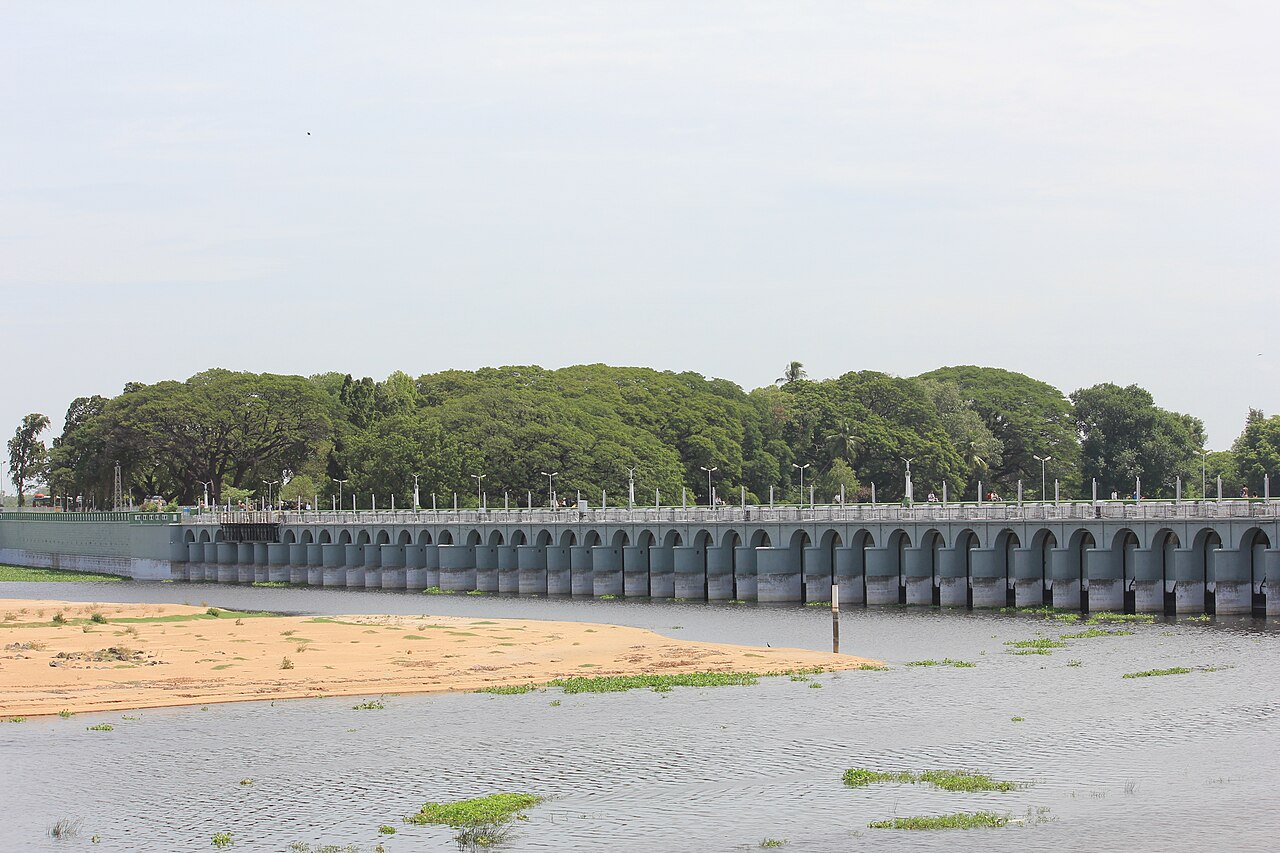
Kallanai · Photographed 2012-09-09 10:20:49
Present-day Kallanai (Grand Anicut), showing its visible structure and river setting
Present-day Kallanai (Grand Anicut), showing its visible structure and river setting. The image does not establish the date of any individual construction phase.
005Two views
Both views are shown at equal weight; this site does not choose between them.
Whether Karikala built Kallanai itself
- One view
- Heritage bodies such as the International Commission on Irrigation and Drainage attribute Kallanai to Karikala in the second century CE, following a long-standing tradition.
- Another view
- Another reading, set out in this study: the tradition first concerned bank and flood works along the Kaveri, and Kallanai was later identified with it. H. Krishna Sastri's 1920 note that the Tiruvalangadu plates' word means river-bank embankments makes this a serious alternative.
- What would settle it
- A dated early construction phase in the surviving masonry, or an early inscription that names the anicut itself.
006Where next
All related studies, connected material, books and sources11 · 12
Elsewhere on this site
Multi-Script Glossary Terms: Kāviri (Poṉṉi) & Noyyal valleys (காவிரி (பொன்னி) & நொய்யல் / കാവേരി (പൊന്നി) & നൊയ്യൽ)
Connected material
Photographs, drawings, books, videos and other studies linked to this study. A link helps you explore; it does not prove a historical claim.
007Sources
The study lists the sources it consulted; we have not rechecked them. A working link does not show that a source was read, and a valid identifier does not show that it supports a claim. We do not link to unofficial uploads or copies of publications. Where a study cited one, we show the published citation, or a publisher, DOI or Internet Archive link when we have one. Tracking codes are removed from links, and the sources themselves are not republished here.
Central Institute of Classical Tamil, Classical Tamil work record for Paṭṭiṉappālai, including composer, subject summary and listed editions.
Print or offline sourceSource recordPaṭṭiṉappālai (Project Madurai Unicode e-text)
Project Madurai Unicode electronic text of Paṭṭiṉappālai; complete searchable Tamil text read for Kaveri, Karikala-period hydraulic language and the string Kallanai.
Print or offline sourceSource recordSouth-Indian Inscriptions, Volume III: The Tiruvalangadu Copper-Plates of the Sixth Year of Rajendra-Chola I
H. Krishna Sastri, South-Indian Inscriptions, Volume III, Tiruvalangadu Copper-Plates of the Sixth Year of Rajendra-Chola I, 1920.
Print or offline sourceSource recordH. Krishna Sastri, Mālepādu Plates of Punyakumāra; the Fifth Year of His Reign, Epigraphia Indica XI, 1911, relevant pages around 337-340.
Print or offline sourceSource recordWiebe E. Bijker, Dikes and Dams, Thick with Politics, Isis 98(1), 2007, 109-123.
Chitra Krishnan, Tank and anicut irrigation systems: engineering analysis, IIT Delhi, 2003.
Print or offline sourceSource recordIndian Rivers, ‘Productive Works’, and the Emergence of Large Dams in Nineteenth-Century Madras
Aditya Ramesh, Indian Rivers, 'Productive Works', and the Emergence of Large Dams in Nineteenth-Century Madras, Historical Journal 64(2), 2021, 281-309.
R. Baird Smith, The Cauvery, Kistnah, and Godavery: Being a Report on the Works Constructed on Those Rivers for the Irrigation of Provinces in the Presidency of Madras, London, Smith, Elder & Co., 1856.
Print or offline sourceSource recordInternational Commission on Irrigation and Drainage, World Heritage Irrigation Structures, Grand Anicut Canal (Kallanai).
Thanjavur District Administration, Government of Tamil Nadu, Grand Anicut Canal.
Print or offline sourceSource recordJ. V. Chelliah, Pattupattu; Ten Tamil Idylls, 2nd ed., Tirunelveli, South India Saiva Siddhanta Works Publishing Society, 1962.
Print or offline sourceSource recordP. K. Singh, P. Dey, S. K. Jain and P. P. Mujumdar, Hydrology and water resources management in ancient India, HESS 24, 2020, 4691-4707.
Researchers and institutions whose work this study uses: H. Krishna Sastri
How we know The evidence, claims and dates behind this study
What this study draws on
- The full Tamil text of Pattinappalai, searched for Kallanai and for Karikala's water works.
- Published editions of the Mālepādu plates (1911) and the Tiruvalangadu plates (1920), with the editor's notes.
- Aditya Ramesh's 2021 study of colonial river works and Wiebe Bijker's 2007 account of Chitra Krishnan's engineering reconstruction.
- Current heritage descriptions from the irrigation commission and Thanjavur district, and a 2020 review of ancient Indian hydrology.
Dates in this study
| What is dated | Date | How it was dated |
|---|---|---|
| first or second century CE in differing modern attributional sources | 1–200 CE | Period assigned by excavators or scholars |
| roughly seventh century for the Mālepādu inscription in updated modern discussion | 600–699 CE | Date from writing, coins or texts |
| sixth regnal year of Rajendra Chola I, approximately 1018 CE | 1018 CE | Date from writing, coins or texts |
See these dates on the timeline
The study’s claims
11 claims · 19 source passages · 66 paragraphs
Browse the study paragraph by paragraphThe present Kallanai should be treated as a composite, repeatedly modified hydraulic work rather than as untouched early-historic fabric.
Supported in this study
Composite does not imply that no early fabric survives.
No component-specific absolute or stratigraphic date tying surviving Kallanai fabric to the first or second century CE was located in the consulted source set.
Unresolved in this study
This is a source-search outcome, not an assertion that direct dating has never been attempted. No unsupported online claim of radiocarbon-dated timber was admitted without a traceable laboratory result.
Paṭṭiṉappālai credits Karikala with digging tanks and increasing prosperity.
Supported in this study
Royal-praise poetry is not equivalent to an engineering construction record.
The Tiruvalangadu plates preserve an early-eleventh-century Chola dynastic tradition crediting Karikala with construction of Kaveri embankments.
Supported in this study
This dates the attestation of the tradition, not the construction event narrated.
The Mālepādu plates preserve a later tradition associating Karikala with control of Kaveri waters and construction of river banks.
Supported in this study
Kallanai is not named.
Neither the read Mālepādu nor Tiruvalangadu inscriptional witness specifically names Kallanai.
Supported in this study
The statement is limited to the consulted passages and editions.
Bijker's published study treats the Karikala/second-century date as an attribution or belief rather than reporting an absolute archaeological date for Kallanai fabric.
Supported in this study
Nineteenth-century surveys, repairs and new regulating works materially changed the Cauvery-Kollidam hydraulic system around Kallanai.
Supported in this study
System-level alteration must be distinguished from direct alteration of specific Kallanai masonry.
ICID's second-century Karikala attribution and interlocking-stone description are current institutional heritage interpretations, not independent component-specific archaeological dates.
Supported with qualifications
Modern scholarly and institutional sources disagree between a first-century and second-century CE conventional date for Kallanai.
Debated in the sources
The disagreement should not be resolved by averaging the dates.
The best-supported synthesis is that Kallanai is a long-lived precolonial and repeatedly modified Kaveri anicut conventionally attributed to Karikala, while direct identification and dating of surviving fabric to Karikala remain unresolved.
Supported with qualifications
This synthesis distinguishes existence, attribution and component dating as separate propositions.
Trace one claim through the study’s records
Explore the evidenceOther source lists
Numbered citation links from the study
The numbered links in the study text point here.
Dikes and Dams, Thick with Politics (author manuscript PDF)
Grand Anicut Canal (Kallanai) | International Commission on Irrigation & Drainage (ICID)
INDIAN RIVERS, ‘PRODUCTIVE WORKS’, AND THE EMERGENCE OF LARGE DAMS IN NINETEENTH-CENTURY MADRAS | The Historical Journal
CICT Library | CICT – AI-Powered Digital Library
paTTinappAlai (in tamil script, unicode /utf-8 format)
Epigraphia Indica Vol 11 - Jain Quantum
Online copy not linked · use the published editionEpigraphia Indica Vol 11
Online copy not linked · use the published editionSouth Indian Inscriptions Volume_3 - Tiruvalangadu copper-plates of Rajendra-Chola Inscriptions @ whatisindia.com
Grand Anicut Canal | Thanjavur District | India
HESS - Hydrology and water resources management in ancient India
The copper chronicles that detail the reign and deeds of Rajendra Chola I - India Live
Print or offline sourceEpigraphia Indica Vol 11
Online copy not linked · use the published editionSouth Indian Inscriptions Volume_3 - Tiruvalangadu copper-plates of Rajendra-Chola Inscriptions @ whatisindia.com
Dikes and Dams, Thick with Politics - Maastricht University
Department of Applied Mechanics
Dikes and Dams, Thick with Politics | Isis: Vol 98, No 1
From Tamil Pāṇar to the Bāṇas: Sanskritization and Sovereignty in South India
The Cauvery, Kistnah, and Godavery
The Cauvery, Kistnah, and Godavery by R. Baird Smith | Open Library
Pattupattu; ten Tamil idylls. by J. V. Chelliah | Open Library
About this study Status, corrections and how it was made
Status
Draft study, revision 5. No historian, archaeologist, or Tamil or Malayalam specialist has reviewed it yet.
How it was made
Compiled as an editorial synthesis from published scholarship around questions we framed. About this project & workflow
The summary, How sure lines and Two views notes on this page were prepared from this study and cross-checked against its passages. That is an editorial check, not a specialist review.
Technical details
Study code R213. The text fingerprint changes whenever the study text changes.
- The study text is shown as written. Links from its paragraphs to citations help you move around the study; they are not new claims or checked source passages.
See how this study’s records were extracted
Text fingerprint (SHA-256): R213 · 61ca1f8262477e63f0f372e9… · v5
Evidence tables and technical details are on the web page: https://layersofthesouth.org/read/f1391bc9c7