Skip to content
Layers of the South
Search

Classroom screen · C1

Megaliths as sources

The screen fills the window. Right and Left arrows, or Page Down and Page Up, move between screens. Home and End go to the first and last. F fills the whole screen. T starts a timer.

Each screen prints on its own landscape page, for a classroom without a projector.

Back to the lesson plan

00:00 / 05:00

    Timings are the plan's suggestion, not a measure of pupils.

    Look first

    A broad rounded laterite capstone rests on upright support stones among trees.

    Photo: Ranjith Siji (Wikimedia Commons). Licence: CC BY-SA 4.0 (https://creativecommons.org/licenses/by-sa/4.0). Source: https://commons.wikimedia.org/wiki/File:Kudakkallu_Parambu_DSC_0638.JPG

    This photograph shows a stone monument at Cheramanangad in Kerala. What do you see? What do you think? What do you wonder?

    • I see
    • I think
    • I wonder

    1/10

    From the ground

    An umbrella stone

    A broad rounded laterite capstone rests on upright support stones among trees.

    Photo: Ranjith Siji (Wikimedia Commons). Licence: CC BY-SA 4.0 (https://creativecommons.org/licenses/by-sa/4.0). Source: https://commons.wikimedia.org/wiki/File:Kudakkallu_Parambu_DSC_0638.JPG

    • The photograph shows an umbrella stone at Kudakkallu Parambu, Cheramanangad.
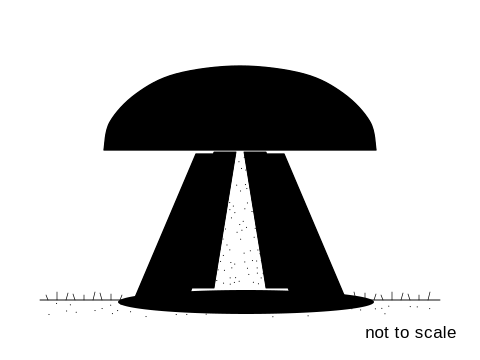
    • An umbrella stone is a dome of laterite resting on four shaped stone supports.
    • Laterite is a rock that can be cut and shaped with hand tools.

    What it cannot tell us The shape on the surface does not, on its own, tell us what lies beneath.

    • Teacher notes Umbrella stones cluster in central and northern Kerala. They are distinctive, but they have not been shown to be found only in Kerala.
    • Look Describe the monument: its parts, its shape and what it is made of.
    • Talk What can you tell from the outside, and what can't you?
    • Ask What would you need to do to find out what lies beneath it?

    2/10

    From the ground

    What lay beneath at Cheramanangad

    An umbrella stone: a dome-shaped cap of laterite resting on four slabs that lean in towards each other. Nothing is drawn under the ground. Not to scale.
    • In 1990–91 the Archaeological Survey of India opened one example of five monument types here.
    • Two of the five held no burial; one of these was an umbrella stone.
    • Another held an urn with bones, pots and an iron object.

    What it cannot tell us The study found no laboratory date for this site.

    • Teacher notes A monument with a granite capstone covered an urn, pots and bone. A stone circle held three pits, each with iron objects and a copper bowl. The excavators called the empty monuments symbolic burials.
    • Look What was found under each kind of monument?
    • Talk Which sentence on this card was worked out rather than found?
    • Ask Why might people build a grave monument with no burial in it?

    3/10

    From a laboratory

    Many graves, few dates

    A strip of this website’s 1000 BCE–600 CE window zooms to 1000–400 BCE, where two Adichanallur urn paddy samples show their ASI-reported calibrated ranges and probabilities.
    • More than a thousand Iron Age burial sites are recorded in Kerala.
    • The oldest laboratory dates from any Kerala burial come from two charcoal samples at Mangadu.
    • Scientists think that charcoal dates to roughly 1300–800 BCE.

    What it cannot tell us The Mangadu samples do not date the whole of southern Kerala's Iron Age.

    • Teacher notes A laboratory date measures the sample, such as charcoal, not the building of a monument. No umbrella stone has a laboratory date in the published sources the study read. Excavated umbrella stones lack the beads that are used to date graves by comparison.
    • Look Which monuments on this card have a laboratory date, and which have none?
    • Talk A laboratory date measures a sample. Why does that matter when we try to date a monument?
    • Ask Which sample would you most like to find under an umbrella stone, and why?

    4/10

    How sure can we be? 1/5

    Umbrella stones cluster in central and northern Kerala.

    • Well supported
    • Likely
    • Possible
    • Not known

    5/10

    How sure can we be? 2/5

    Monument burial in Kerala had begun by the first half of the first millennium BCE.

    • Well supported
    • Likely
    • Possible
    • Not known

    6/10

    How sure can we be? 3/5

    The empty monuments were symbolic burials.

    • Well supported
    • Likely
    • Possible
    • Not known

    7/10

    How sure can we be? 4/5

    How old are Kerala's umbrella stones and hood stones?

    • Well supported
    • Likely
    • Possible
    • Not known

    8/10

    How sure can we be? 5/5

    Graves with gold and bronze mark a ranked elite.

    • Well supported
    • Likely
    • Possible
    • Not known

    9/10

    Before you go

    What can megaliths tell us, and what can't they? Write one sentence for each, and name the card each comes from.

    10/10