Toy carts: Cut-out cards
Cut-out cards
A3 Toy carts
2 pages, A4 or US Letter3 pages, A4 or US Letter
Print at actual size, with scaling turned off.
Lesson A3 · Ages 7 to 9 · Cut-out cards
Cut along the lines. One set for each group.
A3-SC1 · From a poem
Two old poems
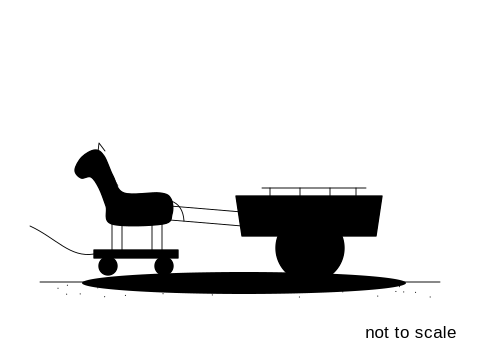
Drawing: Not to scale. Drawn from a poem, not a find.
- Long ago, poets made poems in the Tamil language.
- The poems Kuruntokai 61 and Ainkurunuru 403 show children with small toy carts.
- In one poem, a child has the same name as the grandfather.
- The grown-ups in the poems are tender towards children.
What it cannot tell us A poem is not a photo. It shows a world the poet imagined. It is not a record of a real family.
- Look What do the children in the poems have?
- Talk Is a poem the same as a photo? Why or why not?
- Ask What would you like to ask the poet?
A3-SC2 · From a text
How old poems reach us

- Many old Tamil poems are now called Sangam poems.
- They are about love, war, kings, gifts and ports.
- Each poem has a note, added later, that names its poet.
- People copied the poems by hand onto palm leaves.
- Much later, the poems were printed in books.
What it cannot tell us The copies we read today were made long after the poems.
- Look What were the poems copied onto?
- Talk Why might people copy a poem by hand?
- Ask What would you like to know about the people who copied the poems?
Lesson A3 · Ages 7 to 9 · Cut-out cards
Cut along the lines. One set for each group.
A3-SC3 · From the ground
Game pieces and missing rules

Drawing: Grid of five micro-object inspection cards showing a peppercorn, an inscribed sherd, a carnelian bead, a spindle whorl, and an iron chisel.
- An ivory die was found in Egypt, far away from South India.
- It is not shown here as a toy from South India.
- It does not show how children played in South India.
- Old game boards and pieces have been found.
- But their rules did not survive with them.
- The rules people show today were worked out much later.
What it cannot tell us A game piece does not come with its rules.
- Look Why is an ivory die from Egypt not proof of games in South India?
- Talk Can a die tell us the rules of a game?
- Ask What would you like to know about the people who played with it?
The four certainty cards
Lesson A3 · Ages 7 to 9 · Cut-out cards
Cut along the lines. One set for each group.
A3-SC1 · From a poem
Two old poems
Drawing: Not to scale. Drawn from a poem, not a find.
- Long ago, poets made poems in the Tamil language.
- The poems Kuruntokai 61 and Ainkurunuru 403 show children with small toy carts.
- In one poem, a child has the same name as the grandfather.
- The grown-ups in the poems are tender towards children.
What it cannot tell us A poem is not a photo. It shows a world the poet imagined. It is not a record of a real family.
- Look What do the children in the poems have?
- Talk Is a poem the same as a photo? Why or why not?
- Ask What would you like to ask the poet?
Lesson A3 · Ages 7 to 9 · Cut-out cards
Cut along the lines. One set for each group.
A3-SC2 · From a text
How old poems reach us
- Many old Tamil poems are now called Sangam poems.
- They are about love, war, kings, gifts and ports.
- Each poem has a note, added later, that names its poet.
- People copied the poems by hand onto palm leaves.
- Much later, the poems were printed in books.
What it cannot tell us The copies we read today were made long after the poems.
- Look What were the poems copied onto?
- Talk Why might people copy a poem by hand?
- Ask What would you like to know about the people who copied the poems?
Lesson A3 · Ages 7 to 9 · Cut-out cards
Cut along the lines. One set for each group.
A3-SC3 · From the ground
Game pieces and missing rules
Drawing: Grid of five micro-object inspection cards showing a peppercorn, an inscribed sherd, a carnelian bead, a spindle whorl, and an iron chisel.
- An ivory die was found in Egypt, far away from South India.
- It is not shown here as a toy from South India.
- It does not show how children played in South India.
- Old game boards and pieces have been found.
- But their rules did not survive with them.
- The rules people show today were worked out much later.
What it cannot tell us A game piece does not come with its rules.
- Look Why is an ivory die from Egypt not proof of games in South India?
- Talk Can a die tell us the rules of a game?
- Ask What would you like to know about the people who played with it?