Unit pack
Unit D: How sure can we be?
66 pages, A4 or US Letter93 pages, A4 or US Letter
Print at actual size, with scaling turned off.
Unit D · Ages 14 to 18
How sure can we be?
How sure can we be about early South India's links with the wider world, and why do scholars disagree?
Five lessons for ages 14 to 18, each 50 to 60 minutes. Students test what dates measure, compare texts with finds, weigh popular claims against the evidence, and argue about where scholars disagree and what would settle it.
Lessons in this pack
| D1 What does a date measure? | What does a date actually date? | 50 / 60 |
|---|---|---|
| D2 Pepper, texts and finds | Do the texts and the finds tell the same story about trade? | 50 / 60 |
| D3 Where was Muziris? | Is Pattanam Muziris? | 50 / 60 |
| D4 Testing popular claims | Why do some popular claims go further than the evidence? | 50 / 60 |
| D5 Two views | Why do historians disagree, and what would settle it? | 50 / 60 / 90 |
When the lessons sit in time
- D1
- D2
- D3
1000 BCE–600 CE Entire principal period: D4, D5
Places in this unit
- Sivagalai Urn Burial & Habitation Complex Thoothukudi District, Tamil Nadu D1, D4, D5
- Mayiladumparai Iron Age & Microlithic-to-Early Historic Site Krishnagiri District, Tamil Nadu D1
- Porunthal Habitation & Megalithic Grave Site Dindigul District, Tamil Nadu D1
- Pattanam (North Paravur, Periyar Delta) Ernakulam District, Kerala D1, D3
- Berenike (Red Sea Port, Egypt) Red Sea Governorate, Egypt (Inset View) D2
- Arikamedu (Virampattinam / Poduke) Puducherry (Union Territory) D2, D5
- Kodungallur & Cheraman Parambu Thrissur District, Kerala D3
- Keezhadi (Vaigai River Brick Settlement) Sivaganga District, Tamil Nadu D4
- Puhar (Kaveripoompattinam) Mayiladuthurai District, Tamil Nadu D4
- Adichanallur Urn Field & Habitation Mound Thoothukudi District, Tamil Nadu D4
- Kodumanal (Noyyal River Craft & Trade Town) Erode District, Tamil Nadu D4
- Ariyannur Umbrella Stones Thrissur District, Kerala D5
- Mangadu Iron Age Urn Burial Site Kollam District, Kerala D5
Unit D · Ages 14 to 18
Class record sheet
Write pupils' names by hand. Nothing here is stored or sent anywhere.
| Pupil | D1 | D2 | D3 | D4 | D5 | Comment |
|---|---|---|---|---|---|---|
Unit D · Ages 14 to 18
Marking rubric
Choose the two or three dimensions that match a lesson's objectives. The levels describe what a pupil's answer shows, never a pupil's ability.
| Not yet | Developing | Secure | Extended | |
|---|---|---|---|---|
| 1. Observation & Source Handling | Gives an unsupported impression or confuses a modern reconstruction/diagram with an excavated find. | Identifies a relevant detail from the source card but mixes visible observation with interpretation. | Accurately identifies relevant details and distinguishes what the source records from one's own inference. | Explains how excavation recording, preservation, translation, or sampling affects what can be observed. |
| 2. Claim & Evidence Connection | States a conclusion without citing any clue from the source cards. | Mentions a relevant detail from a source card but leaves its link to the claim implicit. | Answers the historical question with specific evidence and explains why ('because...') it supports the claim. | Weighs evidence of differing strength and revises or calibrates the claim to match its actual reach. |
| 3. Context, Chronology & Genre | Transfers facts between sites, centuries, or genres without justification. | Notices a date, site, or genre difference but does not apply it consistently. | Keeps the relevant site, period window (1000 BCE–600 CE vs earlier/later), and source purpose attached to the claim. | Explains how stratigraphic context, textual transmission, or poetic convention changes the historical interpretation. |
| 4. Limits & Alternative Explanations | Treats a possibility as 100% settled fact, or claims nothing at all can be known. | Mentions a generic uncertainty ('we weren't there') without tying it to the specific source. | States a specific evidential limit and explains what remains reasonably supported alongside what is open. | Compares a plausible alternative model and names the exact kind of new evidence that could distinguish between them. |
| 5. Communication & Attribution | Reasoning cannot be followed or sources are unidentifiable. | Gives a partly clear explanation with incomplete references to the source cards. | Makes the reasoning clear in any accessible format and cites the relevant source card or locator. | Builds a coherent argument while representing scholarly disagreement and source dependence accurately. |
Unit D · Ages 14 to 18
Cut along the lines. One set for each group.
The four certainty cards
Lesson D1 · Ages 14 to 18 · Lesson plan
What does a date measure?
What does a date actually date?
Unit D: How sure can we be? · Ladder step Test · Draft written with AI assistance; not yet tried in a classroom
Objectives
- I can say what material a date was measured on, and which event people want it to date.
- I can follow a date from the laboratory result to the published figure to the claim, and say where the claim goes further than the measurement.
- I can grade a dating statement and name the evidence that would tie the date to the event.
Pupils should already know
- Students know the four How-sure levels and have graded statements in units B and C. In lesson C4 they tested a text against a find.
- In lesson B1, students met a radiocarbon date on the Pattanam canoe that dates the tree, not the boat. If they have not, the model step covers it in full.
- Students know that BCE years count backwards from year one.
Materials
- Print One sheet per student: support, core or stretch; The cut-out page for each group: three source cards and the key-word strip; A date-chain grid for each group, on the sheet or copied from the board
- Screen The classroom screen for this lesson; Optional: the radiocarbon lab on the projector
- Devices Optional: the radiocarbon lab, one device per group
- Paper only Print the cut-out page for each group and a sheet for each student. Draw the date-chain grid on the board with its column heads, and fill the canoe row with the class. Read the two views aloud from this lesson plan. Students grade on paper and shade their levels in pencil.
Lesson D1 · Ages 14 to 18 · Lesson plan
What does a date measure?
Timings
| Step | 50 minutes | 60 minutes |
|---|---|---|
| hook Show the announcement on the screen and run the think, puzzle, explore routine. | 4 | 5 |
| model Model the date chain with the Pattanam canoe from lesson B1, filling one row of the grid aloud. | 7 | 8 |
| guided Groups take the three cards and fill one row of the grid for each date on them. | 12 | 14 |
| independent Introduce the note in the study of Tamil Nadu iron that sets out two views on whether the Sivagalai charcoal dates date the iron. | 8 | 10 |
| claim Students grade the statements in the claim task and write a reason for each that names the link, or the missing link, between the date and the event. | 12 | 15 |
| exit Return to the puzzles from the start. | 7 | 8 |
Misunderstandings to listen for (not yet observed in a classroom)
- A radiocarbon date tells you the year an object was made. It dates the sampled material, and it does not by itself date a whole site. At Sivagalai the measurement belongs to the paddy.
- If charcoal was found with iron, the charcoal's date is the iron's date. The 2025 book links the Sivagalai charcoal dates to iron only by association with urn burials containing iron objects, and publishes no direct date on Sivagalai iron.
- A figure in BP is a calendar year. A radiocarbon age in BP is not a calendar year. It has to be calibrated into a range.
- A short-lived sample such as a grain guarantees that the event nearby has been dated. An annual seed avoids the long growth history of heartwood, but short-lived material is not a guarantee that a nearby event has been dated. It still needs a secure context.
Lesson D1 · Ages 14 to 18 · Support
What does a date measure?
What does a date actually date?
Look first
In 2025 the state government announced that iron was in use at Sivagalai, in Tamil Nadu, some 5,300 years ago. What do you think was actually dated? What puzzles you? How could you check?
- BP Radiocarbon years before the present. A BP age is not a calendar year.
- calibrated Converted from a radiocarbon measurement into calendar years, using a laboratory curve.
- paddy Rice grain still in its husk.
- charcoal Partly burnt wood. It can be older than the burial it lies in.
- association A link made because things were found together, not because each one was dated.
Date-chain grid
Fill one row of the grid for each date on the cards: material, laboratory result, published figure, event, link.
| Material dated | Laboratory result | Published figure | Event people want | Link | |
|---|---|---|---|---|---|
| Canoe | |||||
- 01
For each date on the cards, circle the material that was measured: paddy or charcoal.
- 02
For each date, tick what it dates directly: the sample itself, the burial, or the iron.
- 03
Fill in the grid for the Sivagalai charcoal: the material, the laboratory result, the printed figure, the claim.
Lesson D1 · Ages 14 to 18 · Support
What does a date measure?
NameThe four levels
- Well supportedShade it inDirect, clear evidence supports this specific statement.
- LikelySlanting linesThe available evidence favours this interpretation, with uncertainty.
- PossibleDotsPlausible, but the evidence is limited or contested.
- Not knownLeave it empty and ring itThe evidence reviewed here does not settle the question.
- 04
Choose a level for each statement from the box and circle the word on the card that decided you.
| Well supported | Likely | Possible | Not known | ||
|---|---|---|---|---|---|
| A | The dated paddy lay inside the intact, lidded urn, not in the pot's clay. | ||||
| B | The rice grain dates to about 1155 BCE. | ||||
| C | The paddy was placed in the urn as a funeral offering. | ||||
| D | Iron was in use at Sivagalai about 5,300 years ago. | ||||
| E | Iron was smelted at Mayiladumparai by 2172 BCE. | ||||
| F | The marks on the ring stand are Tamil-Brahmi writing. |
- 05
Complete: This date measures It does not tell us It would change if
What nobody knows yet
After you have graded, write one thing nobody knows yet.
Exit ticket
Cut along the line and hand it in.What does a date actually date? Answer with a rule, one example from the cards, and the evidence that would tie a date to the event people want.
Lesson D1 · Ages 14 to 18 · Core
What does a date measure?
What does a date actually date?
Look first
In 2025 the state government announced that iron was in use at Sivagalai, in Tamil Nadu, some 5,300 years ago. What do you think was actually dated? What puzzles you? How could you check?
Date-chain grid
Fill one row of the grid for each date on the cards: material, laboratory result, published figure, event, link.
| Material dated | Laboratory result | Published figure | Event people want | Link | |
|---|---|---|---|---|---|
| Canoe | |||||
- 01
The card dates The event people want it to date is
- 02
Between the laboratory result and the claim about iron, these steps happen:
- 03
View A says the charcoal dates the iron because View B says It would be settled by
- 04
I graded this statement … because …
| Well supportedShade it in | LikelySlanting lines | PossibleDots | Not knownLeave it empty and ring it | ||
|---|---|---|---|---|---|
| A | The dated paddy lay inside the intact, lidded urn, not in the pot's clay. | ||||
Because | |||||
Lesson D1 · Ages 14 to 18 · Core
What does a date measure?
Name| Well supportedShade it in | LikelySlanting lines | PossibleDots | Not knownLeave it empty and ring it | ||
|---|---|---|---|---|---|
| B | The rice grain dates to about 1155 BCE. | ||||
Because | |||||
| C | The paddy was placed in the urn as a funeral offering. | ||||
Because | |||||
| D | Iron was in use at Sivagalai about 5,300 years ago. | ||||
Because | |||||
| E | Iron was smelted at Mayiladumparai by 2172 BCE. | ||||
Because | |||||
| F | The marks on the ring stand are Tamil-Brahmi writing. | ||||
Because | |||||
The study's level differs from mine because
- 05
My rule: a date measures So the claim about iron is because
What nobody knows yet
After you have graded, write one thing nobody knows yet.
Exit ticket
Cut along the line and hand it in.What does a date actually date? Answer with a rule, one example from the cards, and the evidence that would tie a date to the event people want.
Lesson D1 · Ages 14 to 18 · Stretch
What does a date measure?
What does a date actually date?
Look first
In 2025 the state government announced that iron was in use at Sivagalai, in Tamil Nadu, some 5,300 years ago. What do you think was actually dated? What puzzles you? How could you check?
- 01
For each date on the cards, separate the thing dated from the event it is used for.
- 02
Trace the 5,300-year figure from the laboratory to the announcement. At which steps does the claim go further than the measurement?
- 03
Weigh the two views on whether the Sivagalai charcoal dates the iron. Which test would settle it, and why would it work?
- 04
Grade each statement and say what kind of link joins its date to its event: direct, by association, or not shown.
| Well supportedShade it in | LikelySlanting lines | PossibleDots | Not knownLeave it empty and ring it | ||
|---|---|---|---|---|---|
| A | The dated paddy lay inside the intact, lidded urn, not in the pot's clay. | ||||
Because | |||||
Lesson D1 · Ages 14 to 18 · Stretch
What does a date measure?
Name| Well supportedShade it in | LikelySlanting lines | PossibleDots | Not knownLeave it empty and ring it | ||
|---|---|---|---|---|---|
| B | The rice grain dates to about 1155 BCE. | ||||
Because | |||||
| C | The paddy was placed in the urn as a funeral offering. | ||||
Because | |||||
| D | Iron was in use at Sivagalai about 5,300 years ago. | ||||
Because | |||||
| E | Iron was smelted at Mayiladumparai by 2172 BCE. | ||||
Because | |||||
| F | The marks on the ring stand are Tamil-Brahmi writing. | ||||
Because | |||||
- 05
Answer the enquiry question with a general rule, and test your rule on one date from each card.
What nobody knows yet
After you have graded, write one thing nobody knows yet.
Exit ticket
Cut along the line and hand it in.What does a date actually date? Answer with a rule, one example from the cards, and the evidence that would tie a date to the event people want.
Lesson D1 · Ages 14 to 18 · Cut-out cards
Cut along the lines. One set for each group.
D1-SC1 · From the ground
Rice in a burial urn at Sivagalai

Photo: Perumalism (Wikimedia Commons). Licence: CC BY-SA 4.0 (https://creativecommons.org/licenses/by-sa/4.0). Source: https://commons.wikimedia.org/wiki/File:Sivakalai_archaeological_site_14.jpg
- One burial urn at Sivagalai is reported as intact and lidded, with bones, iron objects and paddy inside it.
- The paddy from that urn measured 2950 ± 30 BP.
- The state archaeology department publishes it as 1155 BCE: one calendar value, not a complete range.
- Paddy grows in a single season, so it avoids the centuries of inbuilt age possible in heartwood.
- The measurement belongs to the sampled plant material. It does not by itself date the whole Sivagalai site.
What it cannot tell us Iron objects in the same urn support an association, but they do not turn the paddy's date into a direct date on each iron object.
- Look What exactly was dated, and where did it lie?
- Talk Which event does this date come closest to, and which events can it not reach on its own?
- Ask What would you need to know before using this date for the iron objects in the same urn?
D1-SC2 · From a laboratory
Charcoal and the iron announcement
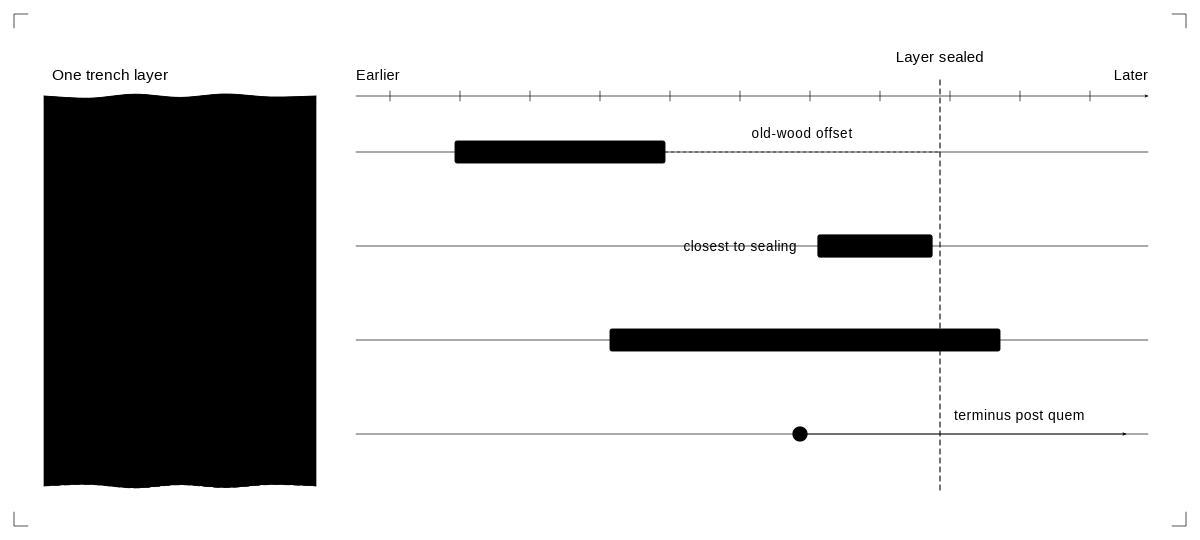
Drawing: Chronometric comparison diagram contrasting old-wood charcoal, short-lived grain AMS dates, ceramic style horizons, and coin terminus post quem against one sealing event.
- A laboratory measured three charcoal samples from Sivagalai at 4300 to 4670 radiocarbon years BP.
- The 2025 government book links these charcoal dates to iron only by association with urn burials that contained iron objects.
- It does not publish the samples' positions, depths or wood species, or any direct date on Sivagalai iron.
- For one charcoal sample, the state book publishes 3345 BCE; the laboratory measured charcoal, not an iron object.
- The government announcement said iron was in use at Sivagalai by about 3345 BCE, some 5,300 years ago.
What it cannot tell us Charcoal can be older than the burial it lies in.
- Look Which material did the laboratory measure, and which material does the announcement talk about?
- Talk How many steps lie between the charcoal and the claim about iron? Name each one.
- Ask What would a direct test on the iron itself need?
Lesson D1 · Ages 14 to 18 · Cut-out cards
Cut along the lines. One set for each group.
D1-SC3 · From a laboratory
Charcoal at Mayiladumparai, grain at Porunthal
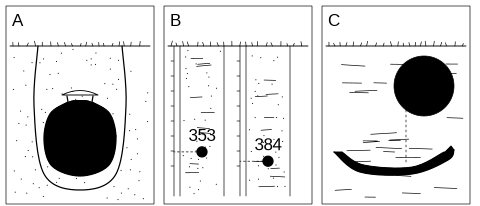
- At Mayiladumparai, two charcoal samples gave the reported second- and third-millennium BCE dates (one laboratory sheet calibrates to 1634–1504 cal BCE).
- The excavators assigned the charcoal to an iron-bearing layer. No named iron object was dated directly.
- Published depths for the samples disagree: 104 and 130 cm in one tradition, 120 and 140 cm in another.
- At Porunthal, paddy from the graves known as MEG I and MEG IV was dated directly.
- One grave held a ring stand with marks that the excavation team read as Tamil-Brahmi letters.
- The dated grain dates the grain. It does not independently date an inscription.
What it cannot tell us Harry Falk argues that the Porunthal marks are megalithic signs, not Brahmi letters. His criticism concerns the marks, not the rice date.
- Look For each site, what material was dated, and what is the date used for?
- Talk Why does it matter that the reports give different depths for the Mayiladumparai samples?
- Ask What would you need before using the Porunthal grain to date the marks?
Key words English · Malayalam · Tamil
BP
Radiocarbon years before the present. A BP age is not a calendar year.
calibrated
Converted from a radiocarbon measurement into calendar years, using a laboratory curve.
paddyനെല്ല് / അരിநெல் / அரிசி
Rice grain still in its husk.
burial urnനന്നങ്ങാടി / മുതുമക്കൾ താഴിமுதுமக்கள் தாழி
A large clay jar used for a burial.
charcoal
Partly burnt wood. It can be older than the burial it lies in.
heartwood
The inner wood of a tree, which can be centuries older than the day the timber was used.
association
A link made because things were found together, not because each one was dated.
Tamil-Brahmiതമിഴി (തമിഴ് ബ്രാഹ്മി)தமிழி (தமிழ் பிராமி)
The earliest known way of writing Tamil: Brahmi letters adapted, with extra letters for Tamil sounds.
Lesson D1 · Ages 14 to 18 · Answer key and mark guidance
What the study says
What does a date measure? What does a date actually date?
For the teacher only. Each level and reason below comes from this website's own draft summary of the published research. Keep this page away from pupils until they have answered.
How sure can we be?
Well supportedstrong evidence
The dated paddy lay inside the intact, lidded urn, not in the pot's clay
Pupils read The dated paddy lay inside the intact, lidded urn, not in the pot's clay.
The 2025 state monograph lists paddy found inside the urn with bones and iron objects.
Likelyprobably
The rice grain dates to about 1155 BCE
Pupils read The rice grain dates to about 1155 BCE.
Measured at 2950 ± 30 BP, but the tables we used give no calibration details or laboratory certificate.
Possiblemaybe
The paddy was placed in the urn as a funeral offering
Pupils read The paddy was placed in the urn as a funeral offering.
The reported arrangement suggests it, but the sources checked include no study of how the grain got there.
Not knownnobody knows yet
Iron was in use at Sivagalai about 5,300 years ago.
The charcoal's position and wood species are unpublished, and in one trench the early charcoal is centuries to millennia older than rice and pottery dates.
Not knownnobody knows yet
Iron was smelted at Mayiladumparai by 2172 BCE.
No furnace, slag or other production debris tied to the dated layer appears in the sources checked.
Possiblemaybe
The marks on the ring stand are Tamil-Brahmi writing.
The excavators read them as va-y-ra; Falk rejects them as Brahmi letters.
The other tasks
D1-SC1 Talk Which event does this date come closest to, and which events can it not reach on its own?
It comes closest to the life of the paddy, which grew in a single season. On its own it does not date the whole site, and it does not become a direct date on the iron objects in the same urn.
D1-SC2 Talk How many steps lie between the charcoal and the claim about iron? Name each one.
At least three. The laboratory measured charcoal in radiocarbon years BP. The book linked the charcoal to iron only by association with urn burials that held iron objects, without publishing depths or wood species. The announcement then presented the charcoal date as iron in use some 5,300 years ago.
D1-SC3 Talk Why does it matter that the reports give different depths for the Mayiladumparai samples?
The charcoal is tied to the iron only through the layer it was assigned to. The excavators assign the charcoal to an iron-bearing layer, but published sample depths conflict and field records remain unresolved, so the link cannot yet be checked.
Core 03 View A says the charcoal dates the iron because ... View B says ... It would be settled by ...
View A: the charcoal came from urn burials with iron, and several samples, laboratories and methods were used. View B: early dates need proper context, charcoal and pottery ages were transferred to the iron, and charcoal can be older than the burial it lies in. It would be settled by direct AMS dates on carbon extracted from Sivagalai iron objects, and short-lived grain from inside the urns that gave the early charcoal.
Lesson D1 · Ages 14 to 18 · Answer key and mark guidance
What does a date measure?
Stretch 02 Trace the 5,300-year figure from the laboratory to the announcement. At which steps does the claim go further than the measurement?
It goes further when a date on charcoal is transferred to iron objects solely by association in urn burials, without published sample depths, wood species, or a direct date on iron, and again when that published charcoal figure becomes iron in use some 5,300 years ago. Credit either step with a reason.
Exit ticket What does a date actually date? Answer with a rule, one example from the cards, and the evidence that would tie a date to the event people want.
A date measures the sampled material: paddy, charcoal or wood. It reaches an event only through a link that has to be shown, such as a direct date on the object itself. Credit any rule that keeps the thing dated apart from the event, with an example from a card and a test, such as a direct date on carbon extracted from an iron object, or short-lived grain from inside the urns that gave the early charcoal.
What to look for
- Observation & Source Handling Names the material each date was measured on: paddy, charcoal or wood.
- Claim & Evidence Connection Separates the thing dated from the event it is used for, with a named example from the cards.
- Limits & Alternative Explanations Names the missing link between a date and an event, such as no direct date on iron or no study of how the grain got into the urn.
- Communication & Attribution Writes a rule that carries a level and names a test that would change it.
A different level with a reason that names real evidence or a real gap earns the reasoning credit. Note the reason.
Secure Example written by us, not real pupil work
A date measures the sample that went to the laboratory, not everything found near it. The Sivagalai paddy was measured directly, so its date belongs to that grain. The 5,300-year claim is different: the laboratory measured charcoal, and the 2025 book links the charcoal to iron only because it came from urn burials that held iron. The book does not publish where each sample lay or what wood it was, and its printed 3345 BCE lies outside the laboratory's own range. So I grade iron at Sivagalai about 5,300 years ago as Not known. A direct date on carbon extracted from a Sivagalai iron object would change my answer.
Comment Gives a general rule, separates the paddy's direct date from the charcoal's link by association, follows the figure from laboratory to announcement, and names the test that the study's note on the two views says would settle it.
Developing Example written by us, not real pupil work
Scientists dated the Sivagalai urns, so iron was used there 5,300 years ago. The rice is from exactly 1155 BCE.
Comment Knows the figures, but treats a date on charcoal as a date on iron and the published rice value as an exact year. Next step: for each date, ask what went to the laboratory and what links it to the event.
What nobody knows yet
- Nobody knows yet whether iron was in use at Sivagalai about 5,300 years ago.
- Nobody knows yet whether iron was smelted at Mayiladumparai by 2172 BCE.
Lesson D2 · Ages 14 to 18 · Lesson plan
Pepper, texts and finds
Do the texts and the finds tell the same story about trade?
Unit D: How sure can we be? · Ladder step Test · Draft written with AI assistance; not yet tried in a classroom
Objectives
- I can sort evidence about trade into texts and finds, and say what each kind can show.
- I can find where a text and a find agree, and tell that apart from two texts agreeing with each other.
- I can grade statements about the people in the trade and explain why goods are easier to show than people.
Pupils should already know
- In lesson C4, students read the Periplus and Pliny and found one point where a text and the Berenike pepper jar agree. If they have not, recap the jar in two minutes.
- In lesson D1, students asked what a date actually measures. This lesson asks the same of a document or a find: what exactly does it show?
Materials
- Print One sheet per student: support, core or stretch; The cut-out page for each group: three source cards and the key-word strip; A three-column grid for each group, on the sheet or copied from the board
- Screen The classroom screen for this lesson
- Devices Optional: the trade bench set on the students page, one device per pair
- Paper only Print the cut-out page for each group and a sheet for each student. Draw the three-column grid on the board and fill the route row with the class. Print the classroom screen that shows the note on the two readings of the pepper cargo, one copy per group, so that students can read its numbers. Students sort, grade and shade their levels in pencil.
Timings
| Step | 50 minutes | 60 minutes |
|---|---|---|
| hook Show the photograph of the Muziris Papyrus facsimile at the Pattanam Museum and run the think, puzzle, explore routine. | 4 | 5 |
Lesson D2 · Ages 14 to 18 · Lesson plan
Pepper, texts and finds
| Step | 50 minutes | 60 minutes |
|---|---|---|
| model Draw the grid on the board with its columns: texts say, finds show, do they agree? | 7 | 8 |
| guided Groups take the cards. | 10 | 12 |
| independent Introduce the note in the study of the Muziris Papyrus on how much pepper the Hermapollon cargo held. | 8 | 10 |
| claim Students grade the statements in the claim task, then compare with the studies. | 14 | 17 |
| exit Students answer the enquiry question with a judgement that carries a level, two pieces of evidence of different kinds, and one thing that neither kind shows. | 7 | 8 |
Misunderstandings to listen for (not yet observed in a classroom)
- Roman coins and jars in South India show that Romans ruled or settled there. The Kerala hoards do not establish resident Roman communities. Roman-origin objects demonstrate connections, not who handled them or where those people lived.
- Yavana means Roman. No source examined establishes the nationality or legal status of the Yavanas of the Tamil poems. The first card adds that the poems probably use the word for people in several roles.
- The famous pepper figures of the Muziris Papyrus can be read on the document. The pepper quantities are reconstructions from damaged figures, arithmetic and external parallels, not fully legible cargo labels.
- When several documents agree, the finds have confirmed them. Receipts, the tariff, Pliny and the papyrus agree about the corridor across Egypt, but that is documents agreeing with documents. A find is a separate kind of check.
Lesson D2 · Ages 14 to 18 · Support
Pepper, texts and finds
Do the texts and the finds tell the same story about trade?
Look first
This is a photograph of a copy of a damaged Greek document about a valuable cargo. What do you think a document like this can tell us about trade? What puzzles you? What could it never tell us?
- Muziris Papyrus A Greek loan and customs document that records a valuable cargo shipment.
- Periplus A Greek handbook for merchants that describes ports and cargoes.
- Rouletted Ware Fine grey-and-black dishes made on a wheel, with rings of small pressed marks inside the base.
- amphora A Mediterranean clay transport jar. Some types carried mainly wine.
- hoard A group of coins or valuables deposited together and found together.
Three-column grid
Copy the grid. Fill the route row as your teacher talks, and note why it is texts agreeing with texts.
| Texts say | Finds show | Do they agree? | |
|---|---|---|---|
| Route | |||
- 01
For each card, circle the kind of evidence: texts or finds.
- D2-SC1
- texts
- finds
- D2-SC2
- texts
- finds
- D2-SC3
- texts
- finds
- D2-SC1
- 02
For each line on the cards, tick goods or people.
- 03
Circle one text and one find that agree about goods, and draw a line between them.
Lesson D2 · Ages 14 to 18 · Support
Pepper, texts and finds
NameThe four levels
- Well supportedShade it inDirect, clear evidence supports this specific statement.
- LikelySlanting linesThe available evidence favours this interpretation, with uncertainty.
- PossibleDotsPlausible, but the evidence is limited or contested.
- Not knownLeave it empty and ring itThe evidence reviewed here does not settle the question.
- 04
Choose a level for each statement from the box and circle the word on the card that decided you.
| Well supported | Likely | Possible | Not known | ||
|---|---|---|---|---|---|
| A | Tamil was written on pottery that reached Egypt's Red Sea ports. | ||||
| B | Pepper was part of the missing cargo. | ||||
| C | Tamil-speaking people were present at the ports themselves. | ||||
| D | Tamil or Malabar merchant communities lived at the ports. | ||||
| E | Rouletted Ware was fired at Arikamedu and Mediterranean merchants lived there. | ||||
| F | The Yavanas of the Tamil poems were Roman citizens or soldiers. |
- 05
Complete: The texts and the finds agree that They do not show because
What nobody knows yet
- Nobody knows yet who buried the Kerala coin hoards, or why.
Exit ticket
Cut along the line and hand it in.Do the texts and the finds tell the same story about trade? Write a judgement with a level, two pieces of evidence of different kinds, and one thing neither kind shows.
Lesson D2 · Ages 14 to 18 · Core
Pepper, texts and finds
Do the texts and the finds tell the same story about trade?
Look first
This is a photograph of a copy of a damaged Greek document about a valuable cargo. What do you think a document like this can tell us about trade? What puzzles you? What could it never tell us?
Three-column grid
Copy the grid. Fill the route row as your teacher talks, and note why it is texts agreeing with texts.
| Texts say | Finds show | Do they agree? | |
|---|---|---|---|
| Route | |||
- 01
The card is made of It shows but not
- 02
A text and a find agree that
- 03
Morelli reads De Romanis reads The question would be settled by
- 04
I graded this statement … because …
| Well supportedShade it in | LikelySlanting lines | PossibleDots | Not knownLeave it empty and ring it | ||
|---|---|---|---|---|---|
| A | Tamil was written on pottery that reached Egypt's Red Sea ports. | ||||
Because | |||||
Lesson D2 · Ages 14 to 18 · Core
Pepper, texts and finds
Name| Well supportedShade it in | LikelySlanting lines | PossibleDots | Not knownLeave it empty and ring it | ||
|---|---|---|---|---|---|
| B | Pepper was part of the missing cargo. | ||||
Because | |||||
| C | Tamil-speaking people were present at the ports themselves. | ||||
Because | |||||
| D | Tamil or Malabar merchant communities lived at the ports. | ||||
Because | |||||
| E | Rouletted Ware was fired at Arikamedu and Mediterranean merchants lived there. | ||||
Because | |||||
| F | The Yavanas of the Tamil poems were Roman citizens or soldiers. | ||||
Because | |||||
The study's level differs from mine because
- 05
The texts and the finds tell the same story about but not about , because
What nobody knows yet
- Nobody knows yet who buried the Kerala coin hoards, or why.
Exit ticket
Cut along the line and hand it in.Do the texts and the finds tell the same story about trade? Write a judgement with a level, two pieces of evidence of different kinds, and one thing neither kind shows.
Lesson D2 · Ages 14 to 18 · Stretch
Pepper, texts and finds
Do the texts and the finds tell the same story about trade?
Look first
This is a photograph of a copy of a damaged Greek document about a valuable cargo. What do you think a document like this can tell us about trade? What puzzles you? What could it never tell us?
- 01
Classify the evidence on the cards by kind, and say how close each item is to the trade it describes.
- 02
Find the strongest agreement between a text and a find, and say why two texts agreeing is not the same.
- 03
Weigh the two readings of the pepper cargo. What do they share, and what would settle the difference?
- 04
Compare the levels the studies give to people at the two ends of the route. Explain the difference and say whether it is fair.
Lesson D2 · Ages 14 to 18 · Stretch
Pepper, texts and finds
Name- 05
Exit ticket Answer the enquiry question with a judgement that carries a level, and name the evidence that would change it.
How sure can we be?
Grade each statement on the four levels and give the reason. Then compare your level with the study's, and explain any difference.
| Well supportedShade it in | LikelySlanting lines | PossibleDots | Not knownLeave it empty and ring it | ||
|---|---|---|---|---|---|
| A | Tamil was written on pottery that reached Egypt's Red Sea ports. | ||||
Because | |||||
| B | Pepper was part of the missing cargo. | ||||
Because | |||||
| C | Tamil-speaking people were present at the ports themselves. | ||||
Because | |||||
| D | Tamil or Malabar merchant communities lived at the ports. | ||||
Because | |||||
| E | Rouletted Ware was fired at Arikamedu and Mediterranean merchants lived there. | ||||
Because | |||||
| F | The Yavanas of the Tamil poems were Roman citizens or soldiers. | ||||
Because | |||||
What nobody knows yet
- Nobody knows yet who buried the Kerala coin hoards, or why.
Lesson D2 · Ages 14 to 18 · Cut-out cards
Cut along the lines. One set for each group.
Key words English · Malayalam · Tamil
Muziris Papyrusമുസിരിസ് പാപ്പിറസ് രേഖமுசிறிப் பாப்பிரஸ் ஆவணம்
A Greek loan and customs document that records a valuable cargo shipment.
Periplusപെരിപ്ലസ് മാരിസ് എറിത്രേയിபெரிப்ளஸ் (செங்கடல் பயண நூல்)
A Greek handbook for merchants that describes ports and cargoes.
Yavanaയവനർயவனர்
An early Tamil word for people from the west.
Rouletted Wareറൗലറ്റഡ് വെയർ (കൊത്തുപണി മൺപാത്രങ്ങൾ)சக்கரப் பொறிப்பு மண்பாண்டம் (ரௌலட்டட் பாண்டம்)
Fine grey-and-black dishes made on a wheel, with rings of small pressed marks inside the base.
amphora
A Mediterranean clay transport jar. Some types carried mainly wine.
Tamil-Brahmiതമിഴി (തമിഴ് ബ്രാഹ്മി)தமிழி (தமிழ் பிராமி)
The earliest known way of writing Tamil: Brahmi letters adapted, with extra letters for Tamil sounds.
facsimile
A close copy of a document, shown in place of the original.
hoard
A group of coins or valuables deposited together and found together.
corroborate
To check a claim against a separate, independent source.
D2-SC1 · From a text
What the documents say
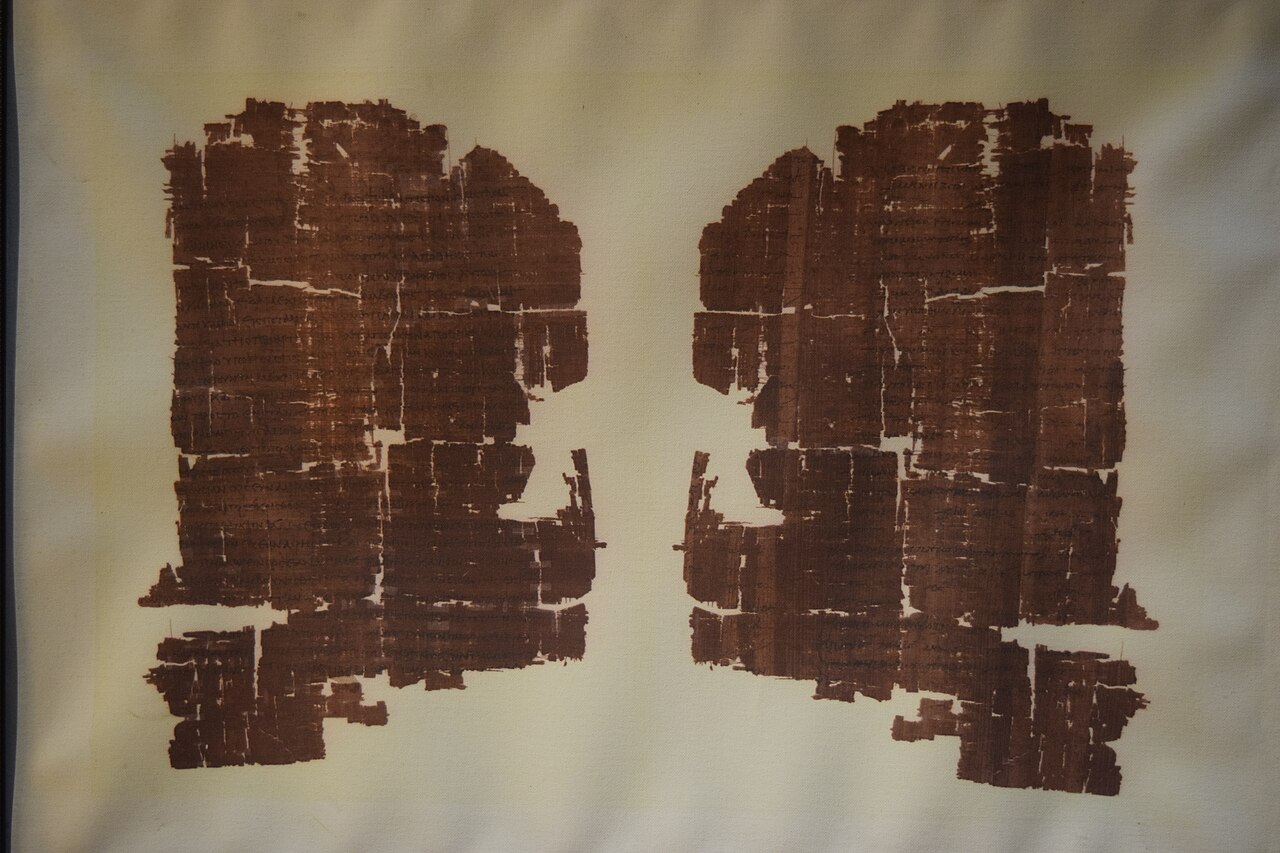
Photo: KannanVM (Wikimedia Commons). Licence: CC BY-SA 4.0 (https://creativecommons.org/licenses/by-sa/4.0). Source: https://commons.wikimedia.org/wiki/File:Muziris_Papyrus.jpg
- The Muziris Papyrus is a Greek papyrus placed by its handwriting around the mid-second century CE.
- It sets out how the cargo was to be moved: from a Red Sea arrival point across the desert to Koptos, into public warehouses, on a Nile boat and on to Alexandria.
- Its pepper quantities are reconstructions from damaged figures, arithmetic and parallels, not labels that can be read on the papyrus.
- The Periplus, a Greek guide for sea traders, names Cottonara as the inland pepper district.
- Early Tamil poems probably use the word Yavana for people in several different roles: the study read the Tamil through one modern translation.
What it cannot tell us Documents survive in pieces: the papyrus has lost the name of the Red Sea port where its cargo arrived.
- Look What does each document say about goods, and what does it say about people?
- Talk Which of these statements rest on a surviving word, and which on a reconstruction?
- Ask What would you want to know about who wrote each document, and why?
Lesson D2 · Ages 14 to 18 · Cut-out cards
Cut along the lines. One set for each group.
D2-SC2 · From the ground
What was found in Egypt

Drawing: A diagram shows a storage jar, probably made in India, set into a first-century CE courtyard floor at Berenike, with black peppercorns inside and the Great Temple to the south. The courtyard is only conditionally linked to the temple. A map shows Berenike and the south-west Indian pepper region as geographical context; it does not identify the growers or carriers of this find. The jar shape and section are explanatory, not a measured excavation drawing.
- Tamil inscriptions in Tamil-Brahmi letters have been published from pots at Quseir al-Qadim and at Berenike, Red Sea ports of Roman Egypt.
- Iravatham Mahadevan reads personal names on two Quseir sherds.
- At Berenike, an Indian-made storage jar excavated in 1999 held more than 7.5 kg of black peppercorns.
- Berenike has teak pieces with maritime features, and reused Late Roman beams interpreted as ship parts.
- One Indian pot at Quseir carries a South Arabian monogram: where a pot was made does not tell us who later wrote on it.
What it cannot tell us The sherds show Tamil written in the trade network. On their own they do not show where the writers lived, what work they did or who they were.
- Look Which finds are goods, and which carry writing?
- Talk Which tells you more about people: a jar of pepper or a name scratched on a pot? Why?
- Ask What else would you need to find to show that Tamil speakers lived at these ports?
D2-SC3 · From the ground
What was found in South India

Drawing: Five stages of a quartz bead with waste chips; a clay air pipe with a glazed tip and glassy slag; two schematic Roman gold coins, one slashed and one pierced, with a gold plug.
- At Arikamedu, people lived before Mediterranean imports and Rouletted Ware arrived.
- Mediterranean amphorae there show that goods moved, not who carried or used them.
- Imported Mediterranean objects do not establish a Roman colony at Arikamedu.
- Roman gold and silver coins reached several parts of Kerala, including inland Thrissur and Idukki.
- Nobody knows yet who buried the coin hoards, or why: their find contexts are poor.
- Roman coins do not by themselves prove that Roman traders were physically present.
What it cannot tell us A findspot cannot identify the carrier, the direction or the exact route.
- Look Which finds came from far away, and which were made or used locally?
- Talk Which statements on this card are about goods, and which are about people?
- Ask What kind of find would show that foreign merchants lived here?
Lesson D2 · Ages 14 to 18 · Answer key and mark guidance
What the study says
Pepper, texts and finds Do the texts and the finds tell the same story about trade?
For the teacher only. Each level and reason below comes from this website's own draft summary of the published research. Keep this page away from pupils until they have answered.
How sure can we be?
Well supportedstrong evidence
Tamil was written on pottery that reached Egypt's Red Sea ports
Pupils read Tamil was written on pottery that reached Egypt's Red Sea ports.
Published Tamil-Brahmi inscriptions come from both Quseir al-Qadim and Berenike.
Likelyprobably
Pepper was part of the missing cargo.
It is reconstructed from damaged figures and the Periplus; the word does not survive legibly.
Likelyprobably
Tamil-speaking people were present at the ports themselves
Pupils read Tamil-speaking people were present at the ports themselves.
Highly plausible, but a mark may have been scratched before the pot reached Egypt.
Possiblemaybe
Tamil or Malabar merchant communities lived at the ports
Pupils read Tamil or Malabar merchant communities lived at the ports.
Tomber infers merchant communities from the wider finds; single sherds cannot show residence or ethnicity.
Not knownnobody knows yet
Whether Rouletted Ware was fired at Arikamedu itself, or whether Mediterranean merchants lived there permanently.
Pupils read Rouletted Ware was fired at Arikamedu and Mediterranean merchants lived there.
No Arikamedu kiln or waster dump is demonstrated, and imported goods do not prove permanent foreign residence.
Not knownnobody knows yet
The Yavanas of the Tamil poems were Roman citizens or soldiers.
No source examined establishes their nationality, legal status or a Roman garrison.
The other tasks
D2-SC1 Talk Which of these statements rest on a surviving word, and which on a reconstruction?
From surviving words: the papyrus's route across Egypt to Alexandria, and the Periplus naming Cottonara as the pepper district. From reconstruction: the papyrus's pepper quantities, rebuilt from damaged figures, arithmetic and parallels.
D2-SC2 Talk Which tells you more about people: a jar of pepper or a name scratched on a pot? Why?
A name scratched on a pot, because it shows someone writing Tamil in the trade network; the jar of pepper shows that goods moved. Even the writing does not by itself show where its writer lived, what work they did or who they were.
Core 02 A text and a find agree that ...
The strongest agreement is about goods: the Periplus names Cottonara as the inland pepper district, and at Berenike an Indian-made storage jar held more than 7.5 kg of black peppercorns. Credit any genuine pairing of a text with a find.
Core 03 Morelli reads ... De Romanis reads ... The question would be settled by ...
Morelli (2011): about 4,400 weight talents, roughly 130 to 140 tonnes, at 24 drachmas a mina, treated as uncertain. De Romanis: a fiscal value of 6 drachmas a mina, giving roughly 544 tonnes of pepper. It would be settled by a high-resolution or multispectral reading of the damaged numerals, or a parallel customs account using the same price schedule.
Lesson D2 · Ages 14 to 18 · Answer key and mark guidance
Pepper, texts and finds
Stretch 04 Compare the levels the studies give to people at the two ends of the route. Explain the difference and say whether it is fair.
Tamil writing on pots at the Red Sea ports is evidence of Tamil writers in the network, so Tamil speakers at the ports is rated Likely, held back because a mark may have been scratched before the pot reached Egypt. Imported amphorae at Arikamedu establish material movement, not the residence of their carriers, so the statement that Mediterranean merchants lived there permanently is rated Not known: possible, but not shown. Credit any reasoned case, including an argument that both ends should be graded alike.
Exit ticket Do the texts and the finds tell the same story about trade? Write a judgement with a level, two pieces of evidence of different kinds, and one thing neither kind shows.
A strong judgement says that texts and finds agree well about goods and routes: Tamil writing and Indian goods reached Egypt's Red Sea ports, Roman coins reached inland Kerala, and several documents describe the route across Egypt. It says they show much less about people: who carried the goods and who lived where. Credit any level with a reason that names real evidence or a real gap.
What to look for
- Observation & Source Handling Sorts the evidence into texts and finds, and says what each kind can show.
- Claim & Evidence Connection Finds a real agreement between a text and a find, and does not count two texts as a text and a find.
- Limits & Alternative Explanations Says what neither kind shows, such as who carried the goods or who lived at a port.
- Communication & Attribution Writes a judgement that carries a level and attributes each reading to its scholar.
A different level with a reason that names real evidence or a real gap earns the reasoning credit. Note the reason.
Secure Example written by us, not real pupil work
The texts and the finds tell the same story about goods, but not about people. The Periplus names Cottonara as the inland pepper district, and at Berenike an Indian-made storage jar held more than 7.5 kg of black peppercorns: a text and a find agree. Several documents also agree about the route across Egypt, but that is texts agreeing with texts. About people the evidence is thinner. Tamil written on pots at the Red Sea ports makes Tamil speakers there Likely, but imported goods at Arikamedu show contact and use, not who lived there. So I judge that the story is the same for goods and only partly the same for people. Convergent evidence of residence, not single sherds, would change my answer.
Comment Finds a real agreement between a text and a find, separates it from texts agreeing with texts, and explains why the evidence reaches further for goods than for people.
Developing Example written by us, not real pupil work
Yes, they tell the same story. The papyrus says the ship carried a lot of pepper and pepper was found in Egypt, and the Yavanas were Romans who lived in South India.
Comment Links a text to a find, but treats a reconstructed pepper figure as if it were read from the papyrus, and gives the word Yavana a meaning that no source examined establishes. Next step: for each statement, ask whether it rests on a surviving word or a reconstruction.
What nobody knows yet
- Nobody knows yet who buried the Kerala coin hoards, or why.
- Nobody knows yet whether Rouletted Ware was fired at Arikamedu itself, or whether Mediterranean merchants lived there permanently.
- Nobody knows yet whether the Yavanas of the Tamil poems were Roman citizens or soldiers.
Lesson D3 · Ages 14 to 18 · Lesson plan
Where was Muziris?
Is Pattanam Muziris?
Unit D: How sure can we be? · Ladder step Test, Argue · Draft written with AI assistance; not yet tried in a classroom
Objectives
- I can separate the questions hidden in 'Is Pattanam Muziris?' and match each to the evidence it needs.
- I can weigh two scholarly views on where the main port lay and say what evidence would settle the question.
- I can write a judgement that carries a How-sure level and the reason for it.
Pupils should already know
- Students know the four How-sure levels and have graded statements before, in units B and C.
- Students know that the Greek Periplus and the Latin writer Pliny mention a port called Muziris; lesson C4 covers both, or give a short recap. Tamil poems call the port Muciri or Musiri; students read one of them, a love poem, in lesson C2, so recap it briefly if they have not.
Materials
- Print One sheet per student: support, core or stretch; The cut-out page for each group: three source cards and the key-word strip
- Screen The classroom screen for this lesson
- Devices Optional: the Muziris bench set on the students page, one device per pair
- Paper only Print the cut-out page for each group and a sheet for each student. Write the parts of the enquiry question on the board as column heads. Read the Two views note aloud from this lesson plan. Students grade and write on paper and can read their judgements to a partner.
Timings
| Step | 50 minutes | 60 minutes |
|---|---|---|
| hook Show the amphora outline at the Pattanam museum and run the think, puzzle, explore routine. | 4 | 5 |
Lesson D3 · Ages 14 to 18 · Lesson plan
Where was Muziris?
| Step | 50 minutes | 60 minutes |
|---|---|---|
| model Show the statements from the study 'Pattanam is a candidate for ancient Muziris', one at each level. | 7 | 8 |
| guided Groups take the source cards. | 12 | 14 |
| independent Introduce the note in the study that sets out the views on where the main port of Muziris lay. | 8 | 10 |
| claim Students grade the statements in the claim task, then compare with the studies. | 12 | 15 |
| exit Students write a judgement on the enquiry question. | 7 | 8 |
Misunderstandings to listen for (not yet observed in a classroom)
- Pattanam has been proved to be Muziris. Pattanam is a candidate. Its exact identification with ancient Muziris is rated Possible, because one published case argues for Pattanam and another study proposes a main port near Kodungallur.
- Nothing ancient was found at Kodungallur, so Muziris cannot have been there. The 1968–69 trench at Cheraman Parambu held only medieval occupation, but that result applies to that trench, not the whole delta, and the trench stopped at the water level.
- Everything found at Pattanam dates from the time of the Roman trade. Finds at Pattanam come from different times. West Asian jars lined with bitumen came from later layers.
- A great flood in 1341 moved the port away from Pattanam. The evidence inspected does not establish the 1341 CE flood as the cause of Pattanam's decline, and its main Early Historic occupation had waned centuries before 1341 CE.
Lesson D3 · Ages 14 to 18 · Support
Where was Muziris?
Is Pattanam Muziris?
Look first
At the Pattanam museum, sherds were pieced together into the outline of a tall jar. What does a find like this tell you about the place? What can it not tell you?
- candidate A place proposed as a match: plausible, but not demonstrated.
- satellite A smaller settlement linked to a main centre.
- sediment core A column of layered deposits taken from a borehole, used to read how a coast changed.
- delta Low land built up where a river spreads out and meets the sea.
- 01
Write the four parts of the question into the first column of the grid: long-distance links, part of the port landscape, exactly Muziris, shoreline and river mouth.
Which card What it shows What it cannot show long-distance links part of the port landscape exactly Muziris shoreline and river mouth - 02
For each card, tick the parts of the question it can show; cross the parts it cannot.
- D3-SC1 What the ground at Pattanam shows
- D3-SC2 What the texts and the map say
- D3-SC3 The river, the coast and the trenches
Lesson D3 · Ages 14 to 18 · Support
Where was Muziris?
Name- 03
Sort the evidence into view A (a case for Pattanam) and view B (a main port near Kodungallur).
View A (a case for Pattanam)View B (a main port near Kodungallur) - 04
Choose a level for each statement and circle the word in its reason that decided you.
| Well supportedShade it in | LikelySlanting lines | PossibleDots | Not knownLeave it empty and ring it | ||
|---|---|---|---|---|---|
| A | The 1968–69 Cheraman Parambu trench held only medieval occupation. | ||||
| B | Pattanam was the ancient port of Muziris. | ||||
| C | Settlement centres shifted within a changing Periyar delta. | ||||
| D | Muziris lay at Kodungallur, with Pattanam as a satellite. | ||||
| E | A temple to Augustus stood at Muziris. | ||||
| F | Persian merchants lived at Pattanam. |
- 05
Exit ticket Complete the judgement: Pattanam is Muziris. I rate this because It would change if
What nobody knows yet
- Nobody knows yet where the Roman-period shoreline, harbour and river mouth lay.
Lesson D3 · Ages 14 to 18 · Core
Where was Muziris?
Is Pattanam Muziris?
Look first
At the Pattanam museum, sherds were pieced together into the outline of a tall jar. What does a find like this tell you about the place? What can it not tell you?
- 01
The question 'Is Pattanam Muziris?' hides these questions:
- 02
The card shows but cannot show
- 03
View A rests on View B rests on The question would be settled by
- 04
I graded this statement … because …
| Well supportedShade it in | LikelySlanting lines | PossibleDots | Not knownLeave it empty and ring it | ||
|---|---|---|---|---|---|
| A | The 1968–69 Cheraman Parambu trench held only medieval occupation. | ||||
Because | |||||
Lesson D3 · Ages 14 to 18 · Core
Where was Muziris?
Name| Well supportedShade it in | LikelySlanting lines | PossibleDots | Not knownLeave it empty and ring it | ||
|---|---|---|---|---|---|
| B | Pattanam was the ancient port of Muziris. | ||||
Because | |||||
| C | Settlement centres shifted within a changing Periyar delta. | ||||
Because | |||||
| D | Muziris lay at Kodungallur, with Pattanam as a satellite. | ||||
Because | |||||
| E | A temple to Augustus stood at Muziris. | ||||
Because | |||||
| F | Persian merchants lived at Pattanam. | ||||
Because | |||||
The study's level differs from mine because
- 05
Exit ticket My judgement: I rate it because It would change if
What nobody knows yet
- Nobody knows yet where the Roman-period shoreline, harbour and river mouth lay.
Lesson D3 · Ages 14 to 18 · Stretch
Where was Muziris?
Is Pattanam Muziris?
Look first
At the Pattanam museum, sherds were pieced together into the outline of a tall jar. What does a find like this tell you about the place? What can it not tell you?
- 01
Break 'Is Pattanam Muziris?' into its separate questions and say what kind of evidence each needs.
- 02
Assess what each card can and cannot show, and how far its evidence reaches.
- D3-SC1 What the ground at Pattanam shows
- D3-SC2 What the texts and the map say
- D3-SC3 The river, the coast and the trenches
- 03
Weigh the two views. Which is better supported now, and what would settle it?
- 04
Compare how the studies grade Pattanam's long-distance links and its exact match with Muziris. Explain why those two questions get different levels, and say whether you agree.
Lesson D3 · Ages 14 to 18 · Stretch
Where was Muziris?
Name- 05
Exit ticket Write a judgement on the enquiry question with a level, a reason and the evidence that would change it.
How sure can we be?
Grade each statement on the four levels and give the reason. Then compare your level with the study's, and explain any difference.
| Well supportedShade it in | LikelySlanting lines | PossibleDots | Not knownLeave it empty and ring it | ||
|---|---|---|---|---|---|
| A | The 1968–69 Cheraman Parambu trench held only medieval occupation. | ||||
Because | |||||
| B | Pattanam was the ancient port of Muziris. | ||||
Because | |||||
| C | Settlement centres shifted within a changing Periyar delta. | ||||
Because | |||||
| D | Muziris lay at Kodungallur, with Pattanam as a satellite. | ||||
Because | |||||
| E | A temple to Augustus stood at Muziris. | ||||
Because | |||||
| F | Persian merchants lived at Pattanam. | ||||
Because | |||||
What nobody knows yet
- Nobody knows yet where the Roman-period shoreline, harbour and river mouth lay.
Lesson D3 · Ages 14 to 18 · Cut-out cards
Cut along the lines. One set for each group.
D3-SC1 · From the ground
What the ground at Pattanam shows

Photo: Ranjithsiji (Wikimedia Commons). Licence: CC BY-SA 4.0 (https://creativecommons.org/licenses/by-sa/4.0). Source: https://commons.wikimedia.org/wiki/File:Amphorae_shards,_Pattanam_Museum.jpg
- Imported Mediterranean pottery reached Pattanam around the turn of the era.
- The ceramic report describes Pattanam as an Early Historic settlement with long-distance connections.
- A waterlogged waterfront with a canoe, posts and a brick-lined edge was excavated there.
- Later layers held West Asian jars lined with bitumen.
- No inscription found at Pattanam names the port, so its link to Muziris rests on finds and texts.
What it cannot tell us No source checked for this website's study reports a secure Early Historic inscription naming Muziris or Muciri from Pattanam or Kodungallur. That does not prove that no such inscription exists. A find bearing the name would change the assessment.
- Look Which finds point to long-distance contact? Which belong to a later time?
- Talk What would a find have to show to prove the name of the place?
- Ask Where on the site would you look next, and for what?
D3-SC2 · From a text
What the texts and the map say

Drawing: Three linked clue panels use schematic vessel and tool motifs to discuss Pattanam’s waterfront finds, sediment and sand spits, and the limits of locating ancient harbours from modern shorelines.
- Scholars treat Muziris and Muciri as names in different languages for the same celebrated port.
- That the names match does not tell us which modern site the port was.
- Pliny's description implies that the town and its anchorage lay apart, with smaller boats carrying cargo between them.
- Tamil poems link Muciri with ships, gold and pepper.
- The Peutinger Table survives only as a medieval copy, made about 1200–1220.
- That map places a Templum Augusti label and building symbol near Muziris.
What it cannot tell us The Periplus gives the order of ports and distances between them, not positions on a modern map.
- Look What does each source say about the port itself?
- Talk Which of these sources could, on its own, place Muziris on a modern map?
- Ask If a temple stood at Muziris, what traces might it leave?
Lesson D3 · Ages 14 to 18 · Cut-out cards
Cut along the lines. One set for each group.
D3-SC3 · About a place
The river, the coast and the trenches

Drawing: Regional orientation map: Central Kerala: Periyar delta, Thrissur megaliths and Palakkad Gap, with Natural Earth coastline, graticule, and km scale bar.
- The lower Periyar coast has changed greatly over time.
- Nobody yet knows where the Roman-period shoreline, harbour and river mouth lay.
- At Cheraman Parambu in Kodungallur, a 1968–69 trench held only medieval occupation, in its top 1.5 m.
- Pattanam preserves a much deeper Iron Age and Early Historic sequence.
- One explanation is that settlement centres shifted within a changing Periyar delta.
- A 2024 coastal study proposes that Muziris lay at Kodungallur, with Pattanam as a satellite.
What it cannot tell us The 1968–69 trench speaks for that trench, not the whole delta. It stopped at the water table at about 5 m.
- Look What did each trench reach, and what did it find?
- Talk Why does a changing coast make the question harder to settle?
- Ask Where would you dig or drill next, and why?
Key words English · Malayalam · Tamil
Muzirisമുസിരിസ് / മുചിരിமுசிறி
A celebrated early port named in Sangam poems and in Greco-Roman accounts.
candidate
A place proposed as a match: plausible, but not demonstrated.
amphora
A Mediterranean clay transport jar. Some types carried mainly wine.
torpedo jarപേർഷ്യൻ ഗൾഫ് ഭരണികൾமேற்காசியச் சாடி
A tall, handleless transport jar lined with bitumen, made in Mesopotamia or the Persian Gulf.
sediment core
A column of layered deposits taken from a borehole, used to read how a coast changed.
delta
Low land built up where a river spreads out and meets the sea.
satellite
A smaller settlement linked to a main centre.
Templum Augusti
Latin for "Temple of Augustus": a label that a map places near Muziris.
sherd
A broken piece of pottery.
occupation
In archaeology, the layers and finds left by people living at a place.
Lesson D3 · Ages 14 to 18 · Answer key and mark guidance
What the study says
Where was Muziris? Is Pattanam Muziris?
For the teacher only. Each level and reason below comes from this website's own draft summary of the published research. Keep this page away from pupils until they have answered.
How sure can we be?
Well supportedstrong evidence
The 1968–69 Cheraman Parambu trench held only medieval occupation
A 3 × 3 m trench dug to 5 m held thirteenth–sixteenth-century occupation only in its top 1.5 m.
Possiblemaybe
Pattanam was the ancient port of Muziris.
Its dates, imports and river setting make Pattanam a leading candidate, while other scholars propose Kodungallur or a wider estuary; excavators still keep the match open with no naming inscription.
Likelyprobably
Settlement centres shifted within a changing Periyar delta
Dated beach ridges and Pattanam's ridge setting support it, but no dated channel map exists.
Possiblemaybe
Muziris lay at Kodungallur, with Pattanam as a satellite
Proposed by Das and colleagues in an open-access 2024 study; its full core logs were not consulted directly for this study.
Possiblemaybe
A temple to Augustus stood at Muziris.
Plausible given strong trade, but one map label is the only evidence.
Not knownnobody knows yet
Persian merchants lived at Pattanam.
Jars show that goods moved, not who carried or used them.
The other tasks
Stretch 04 Compare how the studies grade Pattanam's long-distance links and its exact match with Muziris. Explain why those two questions get different levels, and say whether you agree.
These questions rest on different evidence. Long-distance connections at Pattanam are graded Well supported from imported Mediterranean pottery and the excavated waterfront. Identifying Pattanam as exactly ancient Muziris is graded Possible across the Periplus and Pattanam studies because excavators still treat the match as a hypothesis and no inscription names the port. Credit any explanation grounded in the reasons and a reasoned argument for another level.
D3-SC2 Talk Which of these sources could, on its own, place Muziris on a modern map?
None of them on its own. The Periplus gives the order of ports and distances along the route, not modern positions; Pliny's description does not name Pattanam; matching names does not identify a modern site.
Lesson D3 · Ages 14 to 18 · Answer key and mark guidance
Where was Muziris?
Exit ticket Is Pattanam Muziris? Write a judgement with a How-sure level, the reason for it, and the evidence that would change your mind.
A strong judgement keeps the exact identification apart from the well-supported long-distance links, grades it no higher than the evidence allows, and names a deciding test: an inscription naming the port in a dated Early Historic layer, or published core data mapping the ancient river channels. Likely, Possible or Not known each earn credit with a reason that names real evidence or a real gap, such as the missing inscription or the unmapped channels. "Well supported" for the exact identification earns reasoning credit only if the reason names evidence that names the site, and no source checked for the study reports such a find.
What to look for
- Context, Chronology & Genre Separates the questions: long-distance links, part of the port landscape, exact identification, and the ancient shoreline.
- Claim & Evidence Connection Uses specific evidence from the ground, the texts and the coast, and keeps later finds apart from those of the turn of the era.
- Limits & Alternative Explanations Weighs the two views fairly and names the evidence that would settle the question.
- Communication & Attribution Writes a judgement that carries a level and the reason for it, and attributes each view to its source.
A different level with a reason that names real evidence or a real gap earns the reasoning credit. Note the reason.
Secure Example written by us, not real pupil work
The evidence clearly shows that Pattanam was linked to distant places: imported Mediterranean pottery reached it around the turn of the era. It was probably part of the wider Muziris port landscape on the lower Periyar. Whether it was exactly Muziris is only Possible. No inscription found there names the port, and a 2024 coastal study proposes a main port near Kodungallur, though its core data could not be checked. The Cheraman Parambu trench found only medieval occupation, but it covers one small trench. Both the Periplus study and the Pattanam study rate the exact match Possible, because the excavators themselves still treat it as a hypothesis. An inscription naming the port in a dated Early Historic layer, or published core data mapping the ancient river channels, would change my answer.
Comment Separates the questions, uses every card, weighs both studies fairly by reading their reasons, and names the evidence that the study's note on the views says would settle it.
Developing Example written by us, not real pupil work
Pattanam is Muziris because lots of foreign pottery was found there and the old writers talk about Muziris. I am sure.
Comment Knows the strongest evidence for long-distance contact, but merges the separate questions and treats a plausible identification as certain. Next step: ask which source names the site, and grade the exact identification on its own.
What nobody knows yet
- Nobody knows yet where Naura, Tyndis, Nelkynda and Bakare lay today.
- Nobody knows yet where the Roman-period shoreline, harbour and river mouth lay.
- Nobody knows yet whether Persian merchants lived at Pattanam.
Lesson D4 · Ages 14 to 18 · Lesson plan
Testing popular claims
Why do some popular claims go further than the evidence?
Unit D: How sure can we be? · Ladder step Test, Argue · Draft written with AI assistance; not yet tried in a classroom
Objectives
- I can trace a claim back to the evidence it rests on and find the step where it goes further.
- I can name the kind of stretch: a date moved to another thing, an absence read as proof, a local change read as a lost land, or a resemblance read as a line of descent.
- I can write a fair judgement on a claim that matters to people today, with a level and the evidence that would change it.
Pupils should already know
- In lesson D1, students found that the iron announcement rests on charcoal dated by association. If they have not done D1, the model step gives the example in full.
- In lesson D3, students wrote a judgement with a level and the evidence that would change it. This lesson asks them to do the same for claims that many people repeat.
Materials
- Print One sheet per student: support, core or stretch; The cut-out page for each group: three source cards and the key-word strip; A claim-testing grid for each group, on the sheet or copied from the board
- Screen The classroom screen for this lesson
- Devices Optional: the claims bench set on the students page, one device per pair
- Paper only Print the cut-out page for each group and a sheet for each student. Draw the claim-testing grid on the board and fill the iron row with the class. Print the classroom screen that shows the two notes, one copy per group, and tell each half of the class which note to work on. Students grade on paper and shade their levels in pencil.
Lesson D4 · Ages 14 to 18 · Lesson plan
Testing popular claims
Timings
| Step | 50 minutes | 60 minutes |
|---|---|---|
| hook Show the photograph of the coast at Poompuhar and run the think, puzzle, explore routine. | 4 | 5 |
| model Model a claim test with the iron announcement from lesson D1. | 7 | 8 |
| guided Groups take the cards. | 10 | 12 |
| independent Give half the groups the note on whether Keezhadi's brick tanks were dye vats, and half the note on whether Theyyam continues a deep ancient complex. | 8 | 10 |
| claim Students grade the statements in the claim task, then compare with the studies. | 14 | 17 |
| exit Students answer the enquiry question with two examples of different kinds of stretch, each with its level, and the evidence that would change one of them. | 7 | 8 |
Misunderstandings to listen for (not yet observed in a classroom)
- If something has not been found, it did not exist. At Keezhadi, the absence of identified worship objects in a partial excavation is insufficient to establish a secular settlement.
- A study that rates a claim Not known is saying the claim is false. Not known means the evidence does not settle it. The Theyyam finding is a bounded result of one source search, not a claim that no future evidence can exist.
- Anything found deep under the sea must be very old. Present water depth is not an archaeological date. The 23 m feature off Poompuhar has no dated cultural material securely tied to it in the record inspected.
- Old iron weapons prove that a martial art is ancient. The Kodumanal dagger's analysis establishes how it was made, not a particular fighting style or training institution.
Lesson D4 · Ages 14 to 18 · Support
Testing popular claims
Why do some popular claims go further than the evidence?
Look first
This is the coast at Poompuhar today. What do you think the sea has changed here? What puzzles you? How could you find out?
- secular Not connected with religion or worship.
- residue analysis A laboratory test of traces left on a surface, such as pigment or chemicals.
- geophysics Detecting buried or underwater features by measurement, without digging.
- institution An established practice with its own schools, training or rules.
- continuity An unbroken line of passing on, from an earlier practice to a later one.
Claim-testing grid
Fill one row of the grid for each claim: the claim, the evidence, the gap, the kind of stretch.
| The claim | The evidence | The gap | The kind of stretch | |
|---|---|---|---|---|
| Iron | ||||
- 01
For each card, underline the claim and circle the evidence.
- 02
Match each claim to its kind of stretch: a date moved, an absence read as proof, a local change read as a lost land, a resemblance read as descent.
- 03
For your note, tick the evidence each view accepts and circle what would settle the question.
Lesson D4 · Ages 14 to 18 · Support
Testing popular claims
NameThe four levels
- Well supportedShade it inDirect, clear evidence supports this specific statement.
- LikelySlanting linesThe available evidence favours this interpretation, with uncertainty.
- PossibleDotsPlausible, but the evidence is limited or contested.
- Not knownLeave it empty and ring itThe evidence reviewed here does not settle the question.
- 04
Choose a level for each statement from the box and circle the evidence on the card that decided you.
| Well supported | Likely | Possible | Not known | ||
|---|---|---|---|---|---|
| A | Keezhadi was a secular society. | ||||
| B | Particular brick tanks were dye vats. | ||||
| C | A lost continent called Lemuria or Kumari Kandam is a modern construction, not a finding from Poompuhar. | ||||
| D | Is PMR2, the 23 m feature, a human-built structure of known age? | ||||
| E | Kalaripayattu's schools and drills can be traced back only to about the twelfth century, long after 600 CE. | ||||
| F | Theyyam descends in an unbroken line from megaliths or hero stones. |
- 05
Complete: This claim goes further than the evidence because It would change if
What nobody knows yet
After you have graded, write one thing nobody knows yet.
Exit ticket
Cut along the line and hand it in.Why do some popular claims go further than the evidence? Use two examples of different kinds of stretch, each with its level, and say what evidence would change one of them.
Lesson D4 · Ages 14 to 18 · Core
Testing popular claims
Why do some popular claims go further than the evidence?
Look first
This is the coast at Poompuhar today. What do you think the sea has changed here? What puzzles you? How could you find out?
Claim-testing grid
Fill one row of the grid for each claim: the claim, the evidence, the gap, the kind of stretch.
| The claim | The evidence | The gap | The kind of stretch | |
|---|---|---|---|---|
| Iron | ||||
- 01
The claim says The evidence shows The gap is
- 02
This claim stretches the evidence by
- 03
View A accepts as evidence. View B accepts It would be settled by
- 04
I graded this statement … because …
| Well supportedShade it in | LikelySlanting lines | PossibleDots | Not knownLeave it empty and ring it | ||
|---|---|---|---|---|---|
| A | Keezhadi was a secular society. | ||||
Because | |||||
Lesson D4 · Ages 14 to 18 · Core
Testing popular claims
Name| Well supportedShade it in | LikelySlanting lines | PossibleDots | Not knownLeave it empty and ring it | ||
|---|---|---|---|---|---|
| B | Particular brick tanks were dye vats. | ||||
Because | |||||
| C | A lost continent called Lemuria or Kumari Kandam is a modern construction, not a finding from Poompuhar. | ||||
Because | |||||
| D | Is PMR2, the 23 m feature, a human-built structure of known age? | ||||
Because | |||||
| E | Kalaripayattu's schools and drills can be traced back only to about the twelfth century, long after 600 CE. | ||||
Because | |||||
| F | Theyyam descends in an unbroken line from megaliths or hero stones. | ||||
Because | |||||
The study's level differs from mine because
- 05
Some popular claims go further than the evidence because
What nobody knows yet
After you have graded, write one thing nobody knows yet.
Exit ticket
Cut along the line and hand it in.Why do some popular claims go further than the evidence? Use two examples of different kinds of stretch, each with its level, and say what evidence would change one of them.
Lesson D4 · Ages 14 to 18 · Stretch
Testing popular claims
Why do some popular claims go further than the evidence?
Look first
This is the coast at Poompuhar today. What do you think the sea has changed here? What puzzles you? How could you find out?
- 01
For each claim, trace it back to the evidence and name the step where it goes further.
- 02
Sort the claims by the kind of stretch. Is any claim stretched in more than one way?
- 03
Weigh the two views on your note. What kind of evidence does each accept, and what would settle it?
- 04
Grade each statement. Which statements are well supported because they say that a claim is not, and why do such statements matter?
| Well supportedShade it in | LikelySlanting lines | PossibleDots | Not knownLeave it empty and ring it | ||
|---|---|---|---|---|---|
| A | Keezhadi was a secular society. | ||||
Because | |||||
Lesson D4 · Ages 14 to 18 · Stretch
Testing popular claims
Name| Well supportedShade it in | LikelySlanting lines | PossibleDots | Not knownLeave it empty and ring it | ||
|---|---|---|---|---|---|
| B | Particular brick tanks were dye vats. | ||||
Because | |||||
| C | A lost continent called Lemuria or Kumari Kandam is a modern construction, not a finding from Poompuhar. | ||||
Because | |||||
| D | Is PMR2, the 23 m feature, a human-built structure of known age? | ||||
Because | |||||
| E | Kalaripayattu's schools and drills can be traced back only to about the twelfth century, long after 600 CE. | ||||
Because | |||||
| F | Theyyam descends in an unbroken line from megaliths or hero stones. | ||||
Because | |||||
- 05
Write a judgement on one claim that a person who holds the claim could read as fair.
What nobody knows yet
After you have graded, write one thing nobody knows yet.
Exit ticket
Cut along the line and hand it in.Why do some popular claims go further than the evidence? Use two examples of different kinds of stretch, each with its level, and say what evidence would change one of them.
Lesson D4 · Ages 14 to 18 · Cut-out cards
Cut along the lines. One set for each group.
D4-SC1 · From the ground
Keezhadi: what the trenches show
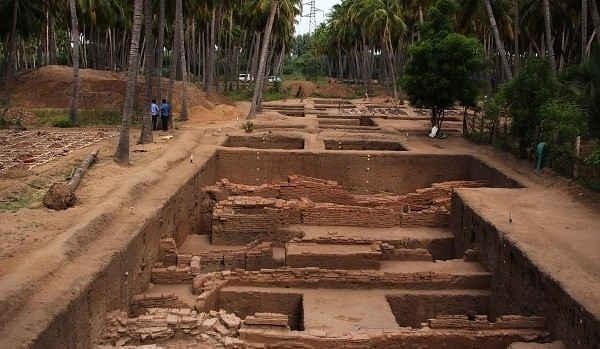
Photo: Ophelia S (Wikimedia Commons). Licence: CC BY-SA 4.0 (https://creativecommons.org/licenses/by-sa/4.0). Source: https://commons.wikimedia.org/wiki/File:Keezhadi_excavation.jpg
- Excavation reports describe brick buildings, ring wells, drains and furnaces at Keezhadi, trench by trench.
- Several published radiocarbon dates suggest that people were active there in the sixth century BCE; full calibration details were not found.
- Spindle whorls, bone tools and a needle support textile work.
- Some reports read brick tanks, ring wells, pipes and textile tools together as a dyeing system; an earlier report called the use of partly exposed tanks tentative.
- Some accounts describe Keezhadi as a secular settlement.
What it cannot tell us Only part of the site has been excavated.
- Look What did the excavators find, and what is the claim about?
- Talk Can the absence of a kind of find show what people believed? Why or why not?
- Ask What would you need to find to test the claim either way?
D4-SC2 · About a place
Poompuhar: a coast partly lost to the sea

Photo: Destination8infinity (Wikimedia Commons). Licence: CC BY-SA 4.0 (https://creativecommons.org/licenses/by-sa/4.0). Source: https://commons.wikimedia.org/wiki/File:Poompuhar-Kaveri-Puhum-Pattinam-View-from-Lighthouse.jpg
- Parts of the Early Historic port landscape at Poompuhar were eroded or submerged by coastal change.
- Brickwork between the tides, ring wells and finds in shallow water are documented.
- A seabed feature called PMR2, about 23 m deep, was detected by geophysics and inspected by divers.
- The publication record inspected ties no diagnostic dated cultural material to it.
- A 2022 core study proposes a tsunami about 1,540 years ago; independent cores and secure dating are still needed.
- The lost continent of Lemuria, or Kumari Kandam, has been traced to nineteenth-century speculation.
What it cannot tell us Present water depth is not an archaeological date.
- Look What has been found here, and where?
- Talk How does a local drowned coast differ from a lost continent?
- Ask What evidence would show the age of the 23 m feature?
Lesson D4 · Ages 14 to 18 · Cut-out cards
Cut along the lines. One set for each group.
D4-SC3 · From the ground
Old weapons, later traditions

Photo: Alexander Rea (catalogue author; individual plate photographer not separately credited) (Wikimedia Commons). Licence: Public domain (https://commons.wikimedia.org/wiki/Template:PD-old-auto-expired). Source: https://commons.wikimedia.org/wiki/File:Catalogue_of_the_prehistoric_antiquities_from_Adichanallur_and_Perumbair_(page_73_crop).jpg
- Iron weapons were buried in Iron Age and Early Historic graves: swords, spearheads, daggers and arrowheads are listed at Adichanallur.
- A Kodumanal dagger had a relatively hard high-carbon edge, apparently forge-welded to a softer core. That shows how it was made, not a fighting style or a training school.
- The scholar Zarrilli traces Kalaripayattu to at least the twelfth century. The study found no source before 600 CE that shows its schools or drills.
- Scholars place the present form of Theyyam in late-medieval north Malabar, as an attributed reconstruction.
- An early Tamil poem values guarded trees in groves, but the passage does not attest serpent worship.
What it cannot tell us The dating of a present ritual form is not the same as the age of every motif within it.
- Look Which of these things are dated, and how?
- Talk Does an old weapon or an old poem show that a present-day tradition is ancient? What would show it?
- Ask What kind of dated evidence would link a tradition to the period before 600 CE?
Key words English · Malayalam · Tamil
secular
Not connected with religion or worship.
residue analysis
A laboratory test of traces left on a surface, such as pigment or chemicals.
ring wellഉറക്കിണർஉறைகிணறு
A well lined with stacked rings of baked clay.
geophysics
Detecting buried or underwater features by measurement, without digging.
Lemuria or Kumari Kandam
A lost continent proposed in modern times; not a finding from Poompuhar.
institution
An established practice with its own schools, training or rules.
continuity
An unbroken line of passing on, from an earlier practice to a later one.
hero stoneനടുകല്ല് / വീരക്കല്ല്நடுகல்
A memorial stone set up to honour a fallen warrior or another person.
sacred groveകാവ്காவு / பொழில்
A protected sacred grove or wooded shrine.
Lesson D4 · Ages 14 to 18 · Answer key and mark guidance
What the study says
Testing popular claims Why do some popular claims go further than the evidence?
For the teacher only. Each level and reason below comes from this website's own draft summary of the published research. Keep this page away from pupils until they have answered.
How sure can we be?
Not knownnobody knows yet
Keezhadi was a secular society
Pupils read Keezhadi was a secular society.
Not finding worship objects in part of a site cannot show that a society was secular.
Possiblemaybe
Particular brick tanks were dye vats
Pupils read Particular brick tanks were dye vats.
Textile tools are well attested, but the reports checked publish no residue analysis from a named tank.
Well supportedstrong evidence
A lost continent called Lemuria or Kumari Kandam is a modern construction, not a finding from Poompuhar.
Early and medieval Tamil texts tell of land lost to the sea; the idea that this was a continent, and its equation with the nineteenth-century 'Lemuria', are modern (Ramaswamy).
Not knownnobody knows yet
PMR2, the 23 m feature, is a human-built structure of known age.
Pupils read Is PMR2, the 23 m feature, a human-built structure of known age?
No diagnostic dated material or securely published finds are tied to it.
Likelyprobably
Kalaripayattu's schools and drills can be traced back only to about the twelfth century, long after 600 CE.
Zarrilli traces the institution to at least the twelfth century; no source before 600 CE shows its schools or drills.
Not knownnobody knows yet
Theyyam descends in an unbroken line from megaliths or hero stones.
Early Tamil-Brāhmī hero stones and naṭukal poems show hero commemoration in Tamil Nadu, but no consulted source supplies dated steps from monument to a Kerala shrine or Theyyam.
The other tasks
D4-SC1 Talk Can the absence of a kind of find show what people believed? Why or why not?
Not on its own. Only part of the site has been excavated, and the absence of identified worship objects in a partial excavation is insufficient to show a secular settlement.
D4-SC2 Talk How does a local drowned coast differ from a lost continent?
Coastal change drowned parts of one port's landscape. Localised submergence at Poompuhar gives no support to a continent-scale Lemuria or Kumari Kandam, an idea with a separate, modern history.
D4-SC3 Talk Does an old weapon or an old poem show that a present-day tradition is ancient? What would show it?
No. A dated weapon or a poem shows its own time, not the age of a later tradition. For Theyyam, the note names the dated steps that would link them: early Kerala memorials of known findspot with later cult use, dated medieval shrine records, or dated early manuscripts of the songs. For Kalaripayattu, a source before 600 CE that shows its schools or drills would be needed.
Support 02 Match each claim to its kind of stretch: a date moved, an absence read as proof, a local change read as a lost land, a resemblance read as descent.
A date moved: the iron announcement. An absence read as proof: Keezhadi as a secular settlement. A local change read as a lost land: Lemuria or Kumari Kandam. A resemblance read as descent: Theyyam and the megaliths or hero stones. Credit another match with a reason from the card.
Lesson D4 · Ages 14 to 18 · Answer key and mark guidance
Testing popular claims
Core 03 View A accepts ... as evidence. View B accepts ... It would be settled by ...
On the tanks: View A reads tanks, ring wells, pipes and textile tools together as a dyeing system; View B called the functions of partly exposed tanks tentative. Settled by residue, pigment or sediment-chemistry tests on a named tank, published with its exact context.
On Theyyam: View A treats hero and possession motifs, memorial stones, hero cults and Theyyam as stages of one regional complex; View B accepts the resemblances as clues but requires dated intermediate steps. Settled by early Kerala memorials of known findspot with later cult use, dated medieval shrine records, or dated early manuscripts of the songs.
Stretch 04 Grade each statement. Which statements are well supported because they say that a claim is not, and why do such statements matter?
The statement that Lemuria or Kumari Kandam is a modern idea, not a finding from Poompuhar, is rated Well supported. Statements like this show where the evidence stops a claim, not only where it supports one. Credit any reasoned answer.
Exit ticket Why do some popular claims go further than the evidence? Use two examples of different kinds of stretch, each with its level, and say what evidence would change one of them.
A strong answer names two kinds of stretch with examples and levels: for instance, a date on charcoal moved to iron, which the study rates Not known, and an absence of worship objects read as proof of a secular settlement; or Lemuria, which the study rates Well supported as a modern idea. It names a test, such as a direct date on carbon from an iron object or residue tests on a named tank. Credit any level with a reason that names real evidence or a real gap.
What to look for
- Claim & Evidence Connection Traces each claim to the evidence it rests on and names the step where it goes further.
- Context, Chronology & Genre Names the kind of stretch with an example from the cards.
- Limits & Alternative Explanations Keeps the gap in the evidence apart from any judgement of the people who hold the claim.
- Communication & Attribution Writes a judgement with a level and the evidence that would change it.
A different level with a reason that names real evidence or a real gap earns the reasoning credit. Note the reason.
Secure Example written by us, not real pupil work
Some claims go further than the evidence by changing what the evidence is about. The announcement about iron at Sivagalai moved a date from charcoal to iron, and the study rates iron there about 5,300 years ago as Not known. The claim that Keezhadi was a secular society reads an absence as proof: worship objects have not been identified in the parts excavated, which is not enough. Poompuhar's drowned coast is real, but turning a local change into a lost continent is a modern idea, and the study rates that finding Well supported. A direct date on carbon extracted from a Sivagalai iron object would change my first judgement.
Comment Names several kinds of stretch with examples and levels, locates each gap in the evidence, and names a test that would change one judgement.
Developing Example written by us, not real pupil work
Popular claims are wrong. Keezhadi was not secular and Theyyam is not ancient.
Comment Reverses the claims instead of testing them. "Keezhadi was a secular society" is rated Not known: the evidence does not settle it, which is not the same as the opposite being true. For Theyyam, the study rates an unbroken line from the megaliths Not known and a late-medieval present form Possible; neither makes every part of Theyyam recent. Next step: for each claim, ask what the evidence shows and where the gap is.
What nobody knows yet
- Nobody knows yet whether iron was in use at Sivagalai about 5,300 years ago.
- Nobody knows yet whether Keezhadi was a secular society.
- Nobody knows yet whether PMR2, the 23 m offshore feature, is a human-built structure of known age.
- Nobody knows yet whether Theyyam descends in an unbroken line from megaliths or hero stones.
- Nobody knows yet whether a serpent-grove institution existed in Kerala before 600 CE.
Lesson D5 · Ages 14 to 18 · Lesson plan
Two views
Why do historians disagree, and what would settle it?
Unit D: How sure can we be? · Ladder step Argue · Draft written with AI assistance; not yet tried in a classroom
Objectives
- I can set out a scholarly disagreement fairly: the question, each view, and the evidence each rests on.
- I can say what kind of disagreement it is and what evidence would settle it.
- I can rank the evidence and write a judgement that carries a level and the reason for it.
Pupils should already know
- In lessons D1 to D4, students weighed one note of two views at a time: on the Sivagalai charcoal, the pepper cargo, the port of Muziris, and Keezhadi's tanks or Theyyam. This lesson compares several disagreements to ask why they happen.
- Students know the four How-sure levels and have written judgements that carry a level.
Materials
- Print One sheet per student: support, core or stretch; The cut-out page for each group: three source cards and the key-word strip; An anatomy grid for each group, on the sheet or copied from the board; For the longer version: the further notes that do not concern faith, copied from this lesson plan, one per group. The faith notes stay with the teacher.
- Screen The classroom screen for this lesson; Optional: the evidence-ranking bench on the projector
- Devices Optional: the evidence-ranking bench on the students page, one device per pair
- Paper only Print the cut-out page for each group and a sheet for each student. Draw the anatomy grid on the board and fill it with the class for the Muziris note from lesson D3. For the longer version, print the further notes from this lesson plan, one per group. Students rank, grade and write on paper and shade their levels in pencil.
Lesson D5 · Ages 14 to 18 · Lesson plan
Two views
Timings
| Step | 50 minutes | 60 minutes | 90 minutes |
|---|---|---|---|
| hook Show the photograph of the entrance to Arikamedu and run the think, puzzle, explore routine. | 4 | 5 | 6 |
| model Model how to take a disagreement apart, using the note students met in lesson D3 on where the main port of Muziris lay. | 7 | 8 | 10 |
| guided Each group takes one card, so that every card is covered, and fills the grid for it. | 12 | 14 | 20 |
| independent Groups rank the settling tests and the evidence on their card from most to least decisive, and write a reason for each place in the order. | 8 | 10 | 22 |
| claim Students grade the statements in the claim task. | 12 | 13 | 17 |
| exit Students answer the enquiry question using two of the cards. | 7 | 10 | 15 |
Misunderstandings to listen for (not yet observed in a classroom)
- When experts disagree, one side must be biased or careless. The notes show disagreements with different causes. At Sivagalai both views start from the same rice date and differ about how much history it can carry.
- A disagreement means that nothing is known. At Arikamedu, that people lived there before the Mediterranean imports is the study's strongest conclusion, even though the start date is disputed.
- The newest view is always right. Begley's later chronology builds on Casal's excavations, yet the note still names what would settle the question: Casal's full stratigraphy, Begley's tables and securely contextualized absolute dates.
- More dates of any kind would settle the question. The note asks for short-lived samples, such as charred seeds, from sealed primary contexts in several monument types and districts: the right kind of date, not just more of them.
Lesson D5 · Ages 14 to 18 · Support
Two views
Why do historians disagree, and what would settle it?
Look first
This is the entrance to Arikamedu today. What do you think you know about the place? What puzzles you? How would you find out when people first lived here?
- chronology The order and dating of events at a site.
- sigillata Fine red-slipped tableware from the Roman and Eastern Mediterranean world.
- stratigraphy The order of soil layers, used with other evidence to date a site.
- short-lived sample Material such as grain that grew in a single season, without the inbuilt age of old wood.
- umbrella stone A Kerala stone monument: a laterite dome resting on four shaped stone supports.
Anatomy grid
Fill the grid for your card: the question, each view and its evidence, the kind of disagreement, what would settle it.
| The question | |
|---|---|
| View A and its evidence | |
| View B and its evidence | |
| The kind of disagreement | |
| What would settle it |
- 01
For your card, copy the question, then tick the evidence each view uses.
- 02
Circle the kind of disagreement: how far the evidence reaches, which evidence counts, or how little evidence there is.
Lesson D5 · Ages 14 to 18 · Support
Two views
Name- 03
Number the settling tests on your card from most to least decisive. If your card has only one test, rank it against the evidence on the card.
The four levels
- Well supportedShade it inDirect, clear evidence supports this specific statement.
- LikelySlanting linesThe available evidence favours this interpretation, with uncertainty.
- PossibleDotsPlausible, but the evidence is limited or contested.
- Not knownLeave it empty and ring itThe evidence reviewed here does not settle the question.
- 04
Choose a level for each statement from the box and circle the evidence on the card that decided you.
| Well supported | Likely | Possible | Not known | ||
|---|---|---|---|---|---|
| A | People lived at Arikamedu before Mediterranean imports and Rouletted Ware arrived. | ||||
| B | Arikamedu was the port called Poduke in the Periplus. | ||||
| C | Monument burial in Kerala had begun by the first half of the first millennium BCE. | ||||
| D | How old are Kerala's umbrella stones and hood stones? | ||||
| E | Sivagalai's rice was grown in irrigated fields as a staple food. |
- 05
Exit ticket Complete the judgement: Historians disagree because It would be settled by I rate it because
What nobody knows yet
After you have graded, write one thing nobody knows yet.
Lesson D5 · Ages 14 to 18 · Core
Two views
Why do historians disagree, and what would settle it?
Look first
This is the entrance to Arikamedu today. What do you think you know about the place? What puzzles you? How would you find out when people first lived here?
Anatomy grid
Fill the grid for your card: the question, each view and its evidence, the kind of disagreement, what would settle it.
| The question | |
|---|---|
| View A and its evidence | |
| View B and its evidence | |
| The kind of disagreement | |
| What would settle it |
- 01
The question is View A says because View B says because
- 02
This is a disagreement about
- 03
The most decisive test would be because The least decisive would be because
Lesson D5 · Ages 14 to 18 · Core
Two views
Name- 04
I graded this statement … because …
| Well supportedShade it in | LikelySlanting lines | PossibleDots | Not knownLeave it empty and ring it | ||
|---|---|---|---|---|---|
| A | People lived at Arikamedu before Mediterranean imports and Rouletted Ware arrived. | ||||
Because | |||||
| B | Arikamedu was the port called Poduke in the Periplus. | ||||
Because | |||||
| C | Monument burial in Kerala had begun by the first half of the first millennium BCE. | ||||
Because | |||||
| D | How old are Kerala's umbrella stones and hood stones? | ||||
Because | |||||
| E | Sivagalai's rice was grown in irrigated fields as a staple food. | ||||
Because | |||||
The study's level differs from mine because
- 05
Historians disagree here because It would be settled by I rate the question now because
What nobody knows yet
After you have graded, write one thing nobody knows yet.
Exit ticket
Cut along the line and hand it in.Why do historians disagree, and what would settle it? Use two of the cards. For each, name the kind of disagreement and the test that would settle it, then give one judgement with a level.
Lesson D5 · Ages 14 to 18 · Stretch
Two views
Why do historians disagree, and what would settle it?
Look first
This is the entrance to Arikamedu today. What do you think you know about the place? What puzzles you? How would you find out when people first lived here?
- 01
Set out the disagreement on your card so fairly that a supporter of each view would accept your summary.
- 02
Classify the disagreements on the cards. Is each about evidence, about reading the evidence, or about how much evidence there is?
- 03
Rank the settling tests across the cards. Which single new find would change most, and why?
Lesson D5 · Ages 14 to 18 · Stretch
Two views
Name- 04
Grade each statement. Explain how a disagreement about dates can sit beside a well-supported order of events.
| Well supportedShade it in | LikelySlanting lines | PossibleDots | Not knownLeave it empty and ring it | ||
|---|---|---|---|---|---|
| A | People lived at Arikamedu before Mediterranean imports and Rouletted Ware arrived. | ||||
Because | |||||
| B | Arikamedu was the port called Poduke in the Periplus. | ||||
Because | |||||
| C | Monument burial in Kerala had begun by the first half of the first millennium BCE. | ||||
Because | |||||
| D | How old are Kerala's umbrella stones and hood stones? | ||||
Because | |||||
| E | Sivagalai's rice was grown in irrigated fields as a staple food. | ||||
Because | |||||
- 05
Exit ticket Write a judgement on one disagreement with a level, the reason, and the evidence that would change it.
What nobody knows yet
After you have graded, write one thing nobody knows yet.
Lesson D5 · Ages 14 to 18 · Cut-out cards
Cut along the lines. One set for each group.
D5-SC1 · From a laboratory
How much can one rice date carry?

Photo: Perumalism (Wikimedia Commons). Licence: CC BY-SA 4.0 (https://creativecommons.org/licenses/by-sa/4.0). Source: https://commons.wikimedia.org/wiki/File:Sivakalai_archaeological_site_16.jpg
- The question: how much history one rice date from Sivagalai can carry.
- Both views start from one paddy sample, measured at 2950 ± 30 BP and published as 1155 BCE.
- View A: The Tamil Nadu State Department of Archaeology's publications place the date within a Porunai river civilization about 3,200 years old.
- View B: Other archaeologists tie the date to one grain sample in one urn; Eleanor Kingwell-Banham's 2019 study warns that rice alone does not show irrigation.
- What would settle it: more dated samples from sealed burial and living layers, a specialist plant report and the laboratory's full calibration record.
What it cannot tell us The measurement belongs to the sampled plant material. It does not by itself date the whole site or a river-wide civilization.
- Look What is the question, and what does each view claim?
- Talk Do the two views disagree about the evidence itself, or about how far it reaches?
- Ask Which of the settling tests could be done soonest, and why?
D5-SC2 · From the ground
When did Arikamedu begin?

Photo: Muthukumaran pk (Wikimedia Commons). Licence: CC BY-SA 3.0 (https://creativecommons.org/licenses/by-sa/3.0). Source: https://commons.wikimedia.org/wiki/File:Arikamedu,_Puducherry,_India_(1).JPG
- The question: when did settlement at Arikamedu begin?
- View A: Wheeler (1945) used amphorae, sigillata and Classical texts to argue that the site began in Augustan times as an Indo-Roman trading station.
- View B: Begley's mature chronology, building on Casal's excavations, places a South Indian settlement earlier, probably by the second century BCE.
- Casal had exposed deposits earlier than Wheeler's main sequence.
- Heavy disturbance at the site limits simple links between layers and history.
- What would settle it: Casal's full stratigraphy, Begley's trench and ceramic tables, and securely contextualized absolute dates if any exist.
What it cannot tell us This research recovered no record of a laboratory-dated sample from Arikamedu. That is a bounded search result, not proof that no such sample exists.
- Look What evidence did each view use?
- Talk Why might imported objects and Classical texts give a later start than the layers beneath them?
- Ask Which kind of evidence should decide when a site began, and why?
Lesson D5 · Ages 14 to 18 · Cut-out cards
Cut along the lines. One set for each group.
D5-SC3 · From the ground
When did Kerala's monument-building begin?

Photo: Ranjith Siji (Wikimedia Commons). Licence: CC BY-SA 4.0 (https://creativecommons.org/licenses/by-sa/4.0). Source: https://commons.wikimedia.org/wiki/File:Ariyannur_Umbrellas_DSC_0779.JPG
- The question: when monument-building began in Kerala.
- View A (Satyamurthy; Cherian and colleagues; Abhayan and Rajesh): around 1000 to 900 BCE, relying mainly on the early Mangadu, Kuttikol and Pattanam radiocarbon results.
- View B (Peter, Varghese, and historians following Gurukkal and Varier): most monuments belong to the later Iron Age; Varghese gives a span of about the fifth century BCE to the fifth century CE.
- More than 1,000 burial sites are recorded, but fewer than 25 had been systematically excavated by 2015.
- The early dates are few, and the wood may be older than its use.
- What would settle it: short-lived samples, such as charred seeds, from sealed primary contexts in several monument types and districts, including umbrella stones.
What it cannot tell us No laboratory date from an umbrella stone or hood stone appears in the sources the study inspected.
- Look What evidence does each view lean on?
- Talk Why do so few dates leave room for two views?
- Ask Which monuments would you sample first, and why?
Key words English · Malayalam · Tamil
chronology
The order and dating of events at a site.
sigillataടെറ സിജില്ലാറ്റ മൺപാത്രങ്ങൾடெர்ரா சிஜில்லாட்டா மண்பாண்டம்
Fine red-slipped tableware from the Roman and Eastern Mediterranean world.
amphora
A Mediterranean clay transport jar. Some types carried mainly wine.
Augustan
From the time of Augustus, whose Roman imperial coins are among those found in Kerala hoards.
stratigraphy
The order of soil layers, used with other evidence to date a site.
short-lived sample
Material such as grain that grew in a single season, without the inbuilt age of old wood.
umbrella stoneകുടക്കല്ല്குடைக்கல்
A Kerala stone monument: a laterite dome resting on four shaped stone supports.
hood stone
A Kerala monument name that different authors use in different ways.
Poduke
A port named in the Periplus. Arikamedu is often proposed as Poduke.
Rouletted Wareറൗലറ്റഡ് വെയർ (കൊത്തുപണി മൺപാത്രങ്ങൾ)சக்கரப் பொறிப்பு மண்பாண்டம் (ரௌலட்டட் பாண்டம்)
Fine grey-and-black dishes made on a wheel, with rings of small pressed marks inside the base.
Lesson D5 · Ages 14 to 18 · Answer key and mark guidance
What the study says
Two views Why do historians disagree, and what would settle it?
For the teacher only. Each level and reason below comes from this website's own draft summary of the published research. Keep this page away from pupils until they have answered.
How sure can we be?
Well supportedstrong evidence
People lived at Arikamedu before Mediterranean imports and Rouletted Ware arrived.
Begley's published phase sequence places local Southern Sector occupation (Phase A) before both Rouletted Ware and Mediterranean amphorae.
Likelyprobably
Arikamedu was the port called Poduke in the Periplus.
Named in Periplus §60 and Ptolemy between Kamara and Sopatma; the standard identification since 1941, though no inscription confirms it.
Likelyprobably
Monument burial in Kerala had begun by the first half of the first millennium BCE.
Two Mangadu charcoal dates and one Kuttikol wood date support it. They are few, the wood may be older than its use, and the Mangadu sheets raise a half-life question.
Not knownnobody knows yet
The age of Kerala's umbrella stones and hood stones.
Pupils read How old are Kerala's umbrella stones and hood stones?
None has a laboratory date in the published sources we read, and excavated umbrella stones lack the beads used for comparative dating.
Not knownnobody knows yet
Whether Sivagalai's rice was irrigated, rainfed or a staple food
Pupils read Sivagalai's rice was grown in irrigated fields as a staple food.
The checked publication reports no field system, weed study or habitation plant remains for the site.
The other tasks
D5-SC1 Talk Do the two views disagree about the evidence itself, or about how far it reaches?
About how far it reaches. Both start from the same paddy sample; View A places it within a river civilization about 3,200 years old, and View B ties it to one grain sample in one urn.
D5-SC2 Talk Why might imported objects and Classical texts give a later start than the layers beneath them?
Imported objects date the imports, not the people who were there before them. Casal exposed deposits earlier than Wheeler's main sequence, and Begley's chronology places a South Indian settlement earlier.
D5-SC3 Talk Why do so few dates leave room for two views?
With more than 1,000 sites recorded and few dates, each early result carries great weight, and its doubts (few dates, wood that may be older than its use) leave both readings open.
Support 02 Circle the kind of disagreement: how far the evidence reaches, which evidence counts, or how little evidence there is.
Sivagalai: how far the evidence reaches. Arikamedu: which evidence counts, imports and texts or the layers beneath them. Kerala's monuments: how little evidence there is. Credit another kind with a reason from the card.
Core 03 The most decisive test would be ... because ... The least decisive would be ... because ...
There is no single right order. Credit an order whose reasons say what each test would show: for example, short-lived samples such as charred seeds from sealed primary contexts would date the burials more directly than wood, which may be older than its use.
Lesson D5 · Ages 14 to 18 · Answer key and mark guidance
Two views
Stretch 04 Grade each statement. Explain how a disagreement about dates can sit beside a well-supported order of events.
At Arikamedu, the order of events (people there before the Mediterranean imports) rests on Begley's published phase sequence, the study's strongest conclusion. The disagreement is about when that sequence began. Credit any explanation that keeps the order apart from its dating.
Exit ticket Why do historians disagree, and what would settle it? Use two of the cards. For each, name the kind of disagreement and the test that would settle it, then give one judgement with a level.
A strong answer shows that disagreements have different causes: how far one sample reaches at Sivagalai, which evidence counts at Arikamedu, imports and texts or the layers beneath them, and too few dates for Kerala's monuments. It names the settling test from each note, such as short-lived samples from sealed primary contexts, Casal's full stratigraphy or the laboratory's full calibration record, and gives a judgement with a level. Credit any level with a reason that names real evidence or a real gap.
What to look for
- Context, Chronology & Genre States the question each view answers and attributes each view to its scholars.
- Claim & Evidence Connection Names the evidence each view rests on, not only its conclusion.
- Limits & Alternative Explanations Names the kind of disagreement and the test that would settle it.
- Communication & Attribution Writes a judgement with a level and a reason that a supporter of either view could accept as fair.
A different level with a reason that names real evidence or a real gap earns the reasoning credit. Note the reason.
Secure Example written by us, not real pupil work
Historians disagree for different reasons. At Sivagalai both views start from one paddy sample: one places it within a river civilization about 3,200 years old, the other ties it to one grain in one urn. That is a disagreement about how far the evidence reaches, and more dated samples from sealed burial and living layers, a specialist plant report and the full calibration record would settle it. At Arikamedu the disagreement is about which evidence counts: Wheeler used imports and Classical texts, while Begley built on Casal's earlier deposits. The order of events there is the study's strongest conclusion, so I rate "people lived at Arikamedu before the imports" as Well supported, though the start date stays open until Casal's full stratigraphy is available.
Comment Treats each view fairly, names the kind of each disagreement and its settling test, and keeps the well-supported order of events apart from the disputed start date.
Developing Example written by us, not real pupil work
Historians disagree because some of them are wrong. At Arikamedu Wheeler was wrong and Begley was right, so it is settled.
Comment Right that the order of events is Well supported, so Wheeler's Augustan start is not the current chronology. Wrong that the start date is settled: the note names Casal's full stratigraphy and dated samples as still needed, and the answer names no evidence. Next step: ask what each scholar used as evidence, and what would settle it.
What nobody knows yet
- Nobody knows yet the exact age of Kerala's umbrella stones and hood stones.
- Nobody knows yet whether Sivagalai's rice was irrigated, rainfed or a staple food.
Lesson D5 · Ages 14 to 18 · Further notes for groups
Cut along the lines. One note for each group.
Further note 1/5
How imported cargo was taxed on its way to Alexandria.
- View A
- The standard reading: one 25 percent quarter-tax, settled at the Alexandrian warehouse, as the papyrus states.
- View B
- Federico De Romanis: several assessments at different points, possibly adding up to more.
- What would settle it
- More of the papyrus, or another customs document showing which charges fell on one cargo at each stage.
From the study: India-trade cargo crossed Egypt by camel, warehouse and Nile boat
Further note 2/5
Whether Nicanor's desert freight supplied the ports or ships bound for India.
- View A
- Provisioning, since wheat dominates and moved all year without a peak in the July to September India sailing season (Kruse).
- View B
- Export, since some wine and ship-related goods could be cargo.
- What would settle it
- Receipts or passes that state the purpose of individual consignments.
From the study: India-trade cargo crossed Egypt by camel, warehouse and Nile boat
Further note 3/5
Whether the riverfront brick enclosures at Arikamedu were dyeing vats.
- View A
- Wheeler and Casal associated earlier brick-lined tanks or pits with textile dyeing.
- View B
- The 1989–90 excavators judged the newly exposed enclosures unsuitable, because they lacked paved floors and drainage outlets.
- What would settle it
- A provenanced floor and drainage sequence, associated tools or textiles, and residue chemistry from surviving surfaces.
From the study: Arikamedu was a South Indian craft port, not a Roman colony
Lesson D5 · Ages 14 to 18 · Further notes for groups
Cut along the lines. One note for each group.
Further note 4/5
Whether Pattanam's lowest layer was a settlement of the monument builders.
- View A
- Yes; Cherian and colleagues (2009) call it the first Iron Age habitation remains found in Kerala.
- View B
- Not yet shown; several scholars ask for more checking or find no direct link with the monuments.
- What would settle it
- A wider exposure and full publication of the lower sands, new short-lived dates, or a dated burial ground clearly tied to that occupation.
From the study: Kerala's Iron Age graves are many; only a handful are dated
Further note 5/5
Whether iron and megalithic burial reached South India first through the Kerala coast.
- View A
- Yes, T. Satyamurthy (1992), from the early Mangadu dates.
- View B
- No, K. Rajan (2014) and Joanna Sudyka (2010), who cite earlier dated iron in Karnataka and Tamil Nadu.
- What would settle it
- Securely dated iron-bearing contexts on the Kerala coast that are older than the inland ones.
From the study: Kerala's Iron Age graves are many; only a handful are dated
Unit D · Ages 14 to 18
How sure can we be?
How sure can we be about early South India's links with the wider world, and why do scholars disagree?
Five lessons for ages 14 to 18, each 50 to 60 minutes. Students test what dates measure, compare texts with finds, weigh popular claims against the evidence, and argue about where scholars disagree and what would settle it.
Lessons in this pack
| D1 What does a date measure? | What does a date actually date? | 50 / 60 |
|---|---|---|
| D2 Pepper, texts and finds | Do the texts and the finds tell the same story about trade? | 50 / 60 |
| D3 Where was Muziris? | Is Pattanam Muziris? | 50 / 60 |
| D4 Testing popular claims | Why do some popular claims go further than the evidence? | 50 / 60 |
| D5 Two views | Why do historians disagree, and what would settle it? | 50 / 60 / 90 |
When the lessons sit in time
- D1
- D2
- D3
1000 BCE–600 CE Entire principal period: D4, D5
Places in this unit
- Sivagalai Urn Burial & Habitation Complex Thoothukudi District, Tamil Nadu D1, D4, D5
- Mayiladumparai Iron Age & Microlithic-to-Early Historic Site Krishnagiri District, Tamil Nadu D1
- Porunthal Habitation & Megalithic Grave Site Dindigul District, Tamil Nadu D1
- Pattanam (North Paravur, Periyar Delta) Ernakulam District, Kerala D1, D3
- Berenike (Red Sea Port, Egypt) Red Sea Governorate, Egypt (Inset View) D2
- Arikamedu (Virampattinam / Poduke) Puducherry (Union Territory) D2, D5
- Kodungallur & Cheraman Parambu Thrissur District, Kerala D3
- Keezhadi (Vaigai River Brick Settlement) Sivaganga District, Tamil Nadu D4
- Puhar (Kaveripoompattinam) Mayiladuthurai District, Tamil Nadu D4
- Adichanallur Urn Field & Habitation Mound Thoothukudi District, Tamil Nadu D4
- Kodumanal (Noyyal River Craft & Trade Town) Erode District, Tamil Nadu D4
- Ariyannur Umbrella Stones Thrissur District, Kerala D5
- Mangadu Iron Age Urn Burial Site Kollam District, Kerala D5
Unit D · Ages 14 to 18
Class record sheet
Write pupils' names by hand. Nothing here is stored or sent anywhere.
| Pupil | D1 | D2 | D3 | D4 | D5 | Comment |
|---|---|---|---|---|---|---|
Unit D · Ages 14 to 18
Marking rubric
Choose the two or three dimensions that match a lesson's objectives. The levels describe what a pupil's answer shows, never a pupil's ability.
| Not yet | Developing | Secure | Extended | |
|---|---|---|---|---|
| 1. Observation & Source Handling | Gives an unsupported impression or confuses a modern reconstruction/diagram with an excavated find. | Identifies a relevant detail from the source card but mixes visible observation with interpretation. | Accurately identifies relevant details and distinguishes what the source records from one's own inference. | Explains how excavation recording, preservation, translation, or sampling affects what can be observed. |
| 2. Claim & Evidence Connection | States a conclusion without citing any clue from the source cards. | Mentions a relevant detail from a source card but leaves its link to the claim implicit. | Answers the historical question with specific evidence and explains why ('because...') it supports the claim. | Weighs evidence of differing strength and revises or calibrates the claim to match its actual reach. |
Unit D · Ages 14 to 18
| Not yet | Developing | Secure | Extended | |
|---|---|---|---|---|
| 3. Context, Chronology & Genre | Transfers facts between sites, centuries, or genres without justification. | Notices a date, site, or genre difference but does not apply it consistently. | Keeps the relevant site, period window (1000 BCE–600 CE vs earlier/later), and source purpose attached to the claim. | Explains how stratigraphic context, textual transmission, or poetic convention changes the historical interpretation. |
| 4. Limits & Alternative Explanations | Treats a possibility as 100% settled fact, or claims nothing at all can be known. | Mentions a generic uncertainty ('we weren't there') without tying it to the specific source. | States a specific evidential limit and explains what remains reasonably supported alongside what is open. | Compares a plausible alternative model and names the exact kind of new evidence that could distinguish between them. |
| 5. Communication & Attribution | Reasoning cannot be followed or sources are unidentifiable. | Gives a partly clear explanation with incomplete references to the source cards. | Makes the reasoning clear in any accessible format and cites the relevant source card or locator. | Builds a coherent argument while representing scholarly disagreement and source dependence accurately. |
Unit D · Ages 14 to 18
Cut along the lines. One set for each group.
The four certainty cards
Lesson D1 · Ages 14 to 18 · Lesson plan
What does a date measure?
What does a date actually date?
Unit D: How sure can we be? · Ladder step Test · Draft written with AI assistance; not yet tried in a classroom
Objectives
- I can say what material a date was measured on, and which event people want it to date.
- I can follow a date from the laboratory result to the published figure to the claim, and say where the claim goes further than the measurement.
- I can grade a dating statement and name the evidence that would tie the date to the event.
Pupils should already know
- Students know the four How-sure levels and have graded statements in units B and C. In lesson C4 they tested a text against a find.
- In lesson B1, students met a radiocarbon date on the Pattanam canoe that dates the tree, not the boat. If they have not, the model step covers it in full.
- Students know that BCE years count backwards from year one.
Materials
- Print One sheet per student: support, core or stretch; The cut-out page for each group: three source cards and the key-word strip; A date-chain grid for each group, on the sheet or copied from the board
- Screen The classroom screen for this lesson; Optional: the radiocarbon lab on the projector
- Devices Optional: the radiocarbon lab, one device per group
- Paper only Print the cut-out page for each group and a sheet for each student. Draw the date-chain grid on the board with its column heads, and fill the canoe row with the class. Read the two views aloud from this lesson plan. Students grade on paper and shade their levels in pencil.
Lesson D1 · Ages 14 to 18 · Lesson plan
What does a date measure?
Timings
| Step | 50 minutes | 60 minutes |
|---|---|---|
| hook Show the announcement on the screen and run the think, puzzle, explore routine. | 4 | 5 |
| model Model the date chain with the Pattanam canoe from lesson B1, filling one row of the grid aloud. | 7 | 8 |
| guided Groups take the three cards and fill one row of the grid for each date on them. | 12 | 14 |
| independent Introduce the note in the study of Tamil Nadu iron that sets out two views on whether the Sivagalai charcoal dates date the iron. | 8 | 10 |
| claim Students grade the statements in the claim task and write a reason for each that names the link, or the missing link, between the date and the event. | 12 | 15 |
| exit Return to the puzzles from the start. | 7 | 8 |
Misunderstandings to listen for (not yet observed in a classroom)
- A radiocarbon date tells you the year an object was made. It dates the sampled material, and it does not by itself date a whole site. At Sivagalai the measurement belongs to the paddy.
- If charcoal was found with iron, the charcoal's date is the iron's date. The 2025 book links the Sivagalai charcoal dates to iron only by association with urn burials containing iron objects, and publishes no direct date on Sivagalai iron.
- A figure in BP is a calendar year. A radiocarbon age in BP is not a calendar year. It has to be calibrated into a range.
- A short-lived sample such as a grain guarantees that the event nearby has been dated. An annual seed avoids the long growth history of heartwood, but short-lived material is not a guarantee that a nearby event has been dated. It still needs a secure context.
Lesson D1 · Ages 14 to 18 · Support
What does a date measure?
What does a date actually date?
Look first
In 2025 the state government announced that iron was in use at Sivagalai, in Tamil Nadu, some 5,300 years ago. What do you think was actually dated? What puzzles you? How could you check?
- BP Radiocarbon years before the present. A BP age is not a calendar year.
- calibrated Converted from a radiocarbon measurement into calendar years, using a laboratory curve.
- paddy Rice grain still in its husk.
- charcoal Partly burnt wood. It can be older than the burial it lies in.
- association A link made because things were found together, not because each one was dated.
Date-chain grid
Fill one row of the grid for each date on the cards: material, laboratory result, published figure, event, link.
| Material dated | Laboratory result | Published figure | Event people want | Link | |
|---|---|---|---|---|---|
| Canoe | |||||
Lesson D1 · Ages 14 to 18 · Support
What does a date measure?
Name- 01
For each date on the cards, circle the material that was measured: paddy or charcoal.
- 02
For each date, tick what it dates directly: the sample itself, the burial, or the iron.
- 03
Fill in the grid for the Sivagalai charcoal: the material, the laboratory result, the printed figure, the claim.
The four levels
- Well supportedShade it inDirect, clear evidence supports this specific statement.
- LikelySlanting linesThe available evidence favours this interpretation, with uncertainty.
- PossibleDotsPlausible, but the evidence is limited or contested.
- Not knownLeave it empty and ring itThe evidence reviewed here does not settle the question.
- 04
Choose a level for each statement from the box and circle the word on the card that decided you.
| Well supported | Likely | Possible | Not known | ||
|---|---|---|---|---|---|
| A | The dated paddy lay inside the intact, lidded urn, not in the pot's clay. |
Lesson D1 · Ages 14 to 18 · Support
What does a date measure?
Name| Well supported | Likely | Possible | Not known | ||
|---|---|---|---|---|---|
| B | The rice grain dates to about 1155 BCE. | ||||
| C | The paddy was placed in the urn as a funeral offering. | ||||
| D | Iron was in use at Sivagalai about 5,300 years ago. | ||||
| E | Iron was smelted at Mayiladumparai by 2172 BCE. | ||||
| F | The marks on the ring stand are Tamil-Brahmi writing. |
- 05
Complete: This date measures It does not tell us It would change if
What nobody knows yet
After you have graded, write one thing nobody knows yet.
Exit ticket
Cut along the line and hand it in.What does a date actually date? Answer with a rule, one example from the cards, and the evidence that would tie a date to the event people want.
Lesson D1 · Ages 14 to 18 · Core
What does a date measure?
What does a date actually date?
Look first
In 2025 the state government announced that iron was in use at Sivagalai, in Tamil Nadu, some 5,300 years ago. What do you think was actually dated? What puzzles you? How could you check?
Date-chain grid
Fill one row of the grid for each date on the cards: material, laboratory result, published figure, event, link.
| Material dated | Laboratory result | Published figure | Event people want | Link | |
|---|---|---|---|---|---|
| Canoe | |||||
- 01
The card dates The event people want it to date is
Lesson D1 · Ages 14 to 18 · Core
What does a date measure?
Name- 02
Between the laboratory result and the claim about iron, these steps happen:
- 03
View A says the charcoal dates the iron because View B says It would be settled by
- 04
I graded this statement … because …
| Well supportedShade it in | LikelySlanting lines | PossibleDots | Not knownLeave it empty and ring it | ||
|---|---|---|---|---|---|
| A | The dated paddy lay inside the intact, lidded urn, not in the pot's clay. | ||||
Because | |||||
| B | The rice grain dates to about 1155 BCE. | ||||
Because | |||||
| C | The paddy was placed in the urn as a funeral offering. | ||||
Because | |||||
| D | Iron was in use at Sivagalai about 5,300 years ago. | ||||
Because | |||||
Lesson D1 · Ages 14 to 18 · Core
What does a date measure?
Name| Well supportedShade it in | LikelySlanting lines | PossibleDots | Not knownLeave it empty and ring it | ||
|---|---|---|---|---|---|
| E | Iron was smelted at Mayiladumparai by 2172 BCE. | ||||
Because | |||||
| F | The marks on the ring stand are Tamil-Brahmi writing. | ||||
Because | |||||
The study's level differs from mine because
- 05
My rule: a date measures So the claim about iron is because
What nobody knows yet
After you have graded, write one thing nobody knows yet.
Exit ticket
Cut along the line and hand it in.What does a date actually date? Answer with a rule, one example from the cards, and the evidence that would tie a date to the event people want.
Lesson D1 · Ages 14 to 18 · Stretch
What does a date measure?
What does a date actually date?
Look first
In 2025 the state government announced that iron was in use at Sivagalai, in Tamil Nadu, some 5,300 years ago. What do you think was actually dated? What puzzles you? How could you check?
- 01
For each date on the cards, separate the thing dated from the event it is used for.
- 02
Trace the 5,300-year figure from the laboratory to the announcement. At which steps does the claim go further than the measurement?
- 03
Weigh the two views on whether the Sivagalai charcoal dates the iron. Which test would settle it, and why would it work?
Lesson D1 · Ages 14 to 18 · Stretch
What does a date measure?
Name- 04
Grade each statement and say what kind of link joins its date to its event: direct, by association, or not shown.
| Well supportedShade it in | LikelySlanting lines | PossibleDots | Not knownLeave it empty and ring it | ||
|---|---|---|---|---|---|
| A | The dated paddy lay inside the intact, lidded urn, not in the pot's clay. | ||||
Because | |||||
| B | The rice grain dates to about 1155 BCE. | ||||
Because | |||||
| C | The paddy was placed in the urn as a funeral offering. | ||||
Because | |||||
| D | Iron was in use at Sivagalai about 5,300 years ago. | ||||
Because | |||||
Lesson D1 · Ages 14 to 18 · Stretch
What does a date measure?
Name| Well supportedShade it in | LikelySlanting lines | PossibleDots | Not knownLeave it empty and ring it | ||
|---|---|---|---|---|---|
| E | Iron was smelted at Mayiladumparai by 2172 BCE. | ||||
Because | |||||
| F | The marks on the ring stand are Tamil-Brahmi writing. | ||||
Because | |||||
- 05
Answer the enquiry question with a general rule, and test your rule on one date from each card.
What nobody knows yet
After you have graded, write one thing nobody knows yet.
Exit ticket
Cut along the line and hand it in.What does a date actually date? Answer with a rule, one example from the cards, and the evidence that would tie a date to the event people want.
Lesson D1 · Ages 14 to 18 · Cut-out cards
Cut along the lines. One set for each group.
D1-SC1 · From the ground
Rice in a burial urn at Sivagalai
Photo: Perumalism (Wikimedia Commons). Licence: CC BY-SA 4.0 (https://creativecommons.org/licenses/by-sa/4.0). Source: https://commons.wikimedia.org/wiki/File:Sivakalai_archaeological_site_14.jpg
- One burial urn at Sivagalai is reported as intact and lidded, with bones, iron objects and paddy inside it.
- The paddy from that urn measured 2950 ± 30 BP.
- The state archaeology department publishes it as 1155 BCE: one calendar value, not a complete range.
- Paddy grows in a single season, so it avoids the centuries of inbuilt age possible in heartwood.
- The measurement belongs to the sampled plant material. It does not by itself date the whole Sivagalai site.
What it cannot tell us Iron objects in the same urn support an association, but they do not turn the paddy's date into a direct date on each iron object.
- Look What exactly was dated, and where did it lie?
- Talk Which event does this date come closest to, and which events can it not reach on its own?
- Ask What would you need to know before using this date for the iron objects in the same urn?
Lesson D1 · Ages 14 to 18 · Cut-out cards
Cut along the lines. One set for each group.
D1-SC2 · From a laboratory
Charcoal and the iron announcement
Drawing: Chronometric comparison diagram contrasting old-wood charcoal, short-lived grain AMS dates, ceramic style horizons, and coin terminus post quem against one sealing event.
- A laboratory measured three charcoal samples from Sivagalai at 4300 to 4670 radiocarbon years BP.
- The 2025 government book links these charcoal dates to iron only by association with urn burials that contained iron objects.
- It does not publish the samples' positions, depths or wood species, or any direct date on Sivagalai iron.
- For one charcoal sample, the state book publishes 3345 BCE; the laboratory measured charcoal, not an iron object.
- The government announcement said iron was in use at Sivagalai by about 3345 BCE, some 5,300 years ago.
What it cannot tell us Charcoal can be older than the burial it lies in.
- Look Which material did the laboratory measure, and which material does the announcement talk about?
- Talk How many steps lie between the charcoal and the claim about iron? Name each one.
- Ask What would a direct test on the iron itself need?
Lesson D1 · Ages 14 to 18 · Cut-out cards
Cut along the lines. One set for each group.
D1-SC3 · From a laboratory
Charcoal at Mayiladumparai, grain at Porunthal
- At Mayiladumparai, two charcoal samples gave the reported second- and third-millennium BCE dates (one laboratory sheet calibrates to 1634–1504 cal BCE).
- The excavators assigned the charcoal to an iron-bearing layer. No named iron object was dated directly.
- Published depths for the samples disagree: 104 and 130 cm in one tradition, 120 and 140 cm in another.
- At Porunthal, paddy from the graves known as MEG I and MEG IV was dated directly.
- One grave held a ring stand with marks that the excavation team read as Tamil-Brahmi letters.
- The dated grain dates the grain. It does not independently date an inscription.
What it cannot tell us Harry Falk argues that the Porunthal marks are megalithic signs, not Brahmi letters. His criticism concerns the marks, not the rice date.
- Look For each site, what material was dated, and what is the date used for?
- Talk Why does it matter that the reports give different depths for the Mayiladumparai samples?
- Ask What would you need before using the Porunthal grain to date the marks?
Key words English · Malayalam · Tamil
BP
Radiocarbon years before the present. A BP age is not a calendar year.
calibrated
Converted from a radiocarbon measurement into calendar years, using a laboratory curve.
paddyനെല്ല് / അരിநெல் / அரிசி
Rice grain still in its husk.
burial urnനന്നങ്ങാടി / മുതുമക്കൾ താഴിமுதுமக்கள் தாழி
A large clay jar used for a burial.
charcoal
Partly burnt wood. It can be older than the burial it lies in.
heartwood
The inner wood of a tree, which can be centuries older than the day the timber was used.
association
A link made because things were found together, not because each one was dated.
Tamil-Brahmiതമിഴി (തമിഴ് ബ്രാഹ്മി)தமிழி (தமிழ் பிராமி)
The earliest known way of writing Tamil: Brahmi letters adapted, with extra letters for Tamil sounds.
Lesson D1 · Ages 14 to 18 · Answer key and mark guidance
What the study says
What does a date measure? What does a date actually date?
For the teacher only. Each level and reason below comes from this website's own draft summary of the published research. Keep this page away from pupils until they have answered.
How sure can we be?
Well supportedstrong evidence
The dated paddy lay inside the intact, lidded urn, not in the pot's clay
Pupils read The dated paddy lay inside the intact, lidded urn, not in the pot's clay.
The 2025 state monograph lists paddy found inside the urn with bones and iron objects.
Likelyprobably
The rice grain dates to about 1155 BCE
Pupils read The rice grain dates to about 1155 BCE.
Measured at 2950 ± 30 BP, but the tables we used give no calibration details or laboratory certificate.
Possiblemaybe
The paddy was placed in the urn as a funeral offering
Pupils read The paddy was placed in the urn as a funeral offering.
The reported arrangement suggests it, but the sources checked include no study of how the grain got there.
Not knownnobody knows yet
Iron was in use at Sivagalai about 5,300 years ago.
The charcoal's position and wood species are unpublished, and in one trench the early charcoal is centuries to millennia older than rice and pottery dates.
Not knownnobody knows yet
Iron was smelted at Mayiladumparai by 2172 BCE.
No furnace, slag or other production debris tied to the dated layer appears in the sources checked.
Lesson D1 · Ages 14 to 18 · Answer key and mark guidance
What does a date measure?
Possiblemaybe
The marks on the ring stand are Tamil-Brahmi writing.
The excavators read them as va-y-ra; Falk rejects them as Brahmi letters.
The other tasks
D1-SC1 Talk Which event does this date come closest to, and which events can it not reach on its own?
It comes closest to the life of the paddy, which grew in a single season. On its own it does not date the whole site, and it does not become a direct date on the iron objects in the same urn.
D1-SC2 Talk How many steps lie between the charcoal and the claim about iron? Name each one.
At least three. The laboratory measured charcoal in radiocarbon years BP. The book linked the charcoal to iron only by association with urn burials that held iron objects, without publishing depths or wood species. The announcement then presented the charcoal date as iron in use some 5,300 years ago.
D1-SC3 Talk Why does it matter that the reports give different depths for the Mayiladumparai samples?
The charcoal is tied to the iron only through the layer it was assigned to. The excavators assign the charcoal to an iron-bearing layer, but published sample depths conflict and field records remain unresolved, so the link cannot yet be checked.
Core 03 View A says the charcoal dates the iron because ... View B says ... It would be settled by ...
View A: the charcoal came from urn burials with iron, and several samples, laboratories and methods were used. View B: early dates need proper context, charcoal and pottery ages were transferred to the iron, and charcoal can be older than the burial it lies in. It would be settled by direct AMS dates on carbon extracted from Sivagalai iron objects, and short-lived grain from inside the urns that gave the early charcoal.
Stretch 02 Trace the 5,300-year figure from the laboratory to the announcement. At which steps does the claim go further than the measurement?
It goes further when a date on charcoal is transferred to iron objects solely by association in urn burials, without published sample depths, wood species, or a direct date on iron, and again when that published charcoal figure becomes iron in use some 5,300 years ago. Credit either step with a reason.
Exit ticket What does a date actually date? Answer with a rule, one example from the cards, and the evidence that would tie a date to the event people want.
A date measures the sampled material: paddy, charcoal or wood. It reaches an event only through a link that has to be shown, such as a direct date on the object itself. Credit any rule that keeps the thing dated apart from the event, with an example from a card and a test, such as a direct date on carbon extracted from an iron object, or short-lived grain from inside the urns that gave the early charcoal.
Lesson D1 · Ages 14 to 18 · Answer key and mark guidance
What does a date measure?
What to look for
- Observation & Source Handling Names the material each date was measured on: paddy, charcoal or wood.
- Claim & Evidence Connection Separates the thing dated from the event it is used for, with a named example from the cards.
- Limits & Alternative Explanations Names the missing link between a date and an event, such as no direct date on iron or no study of how the grain got into the urn.
- Communication & Attribution Writes a rule that carries a level and names a test that would change it.
A different level with a reason that names real evidence or a real gap earns the reasoning credit. Note the reason.
Secure Example written by us, not real pupil work
A date measures the sample that went to the laboratory, not everything found near it. The Sivagalai paddy was measured directly, so its date belongs to that grain. The 5,300-year claim is different: the laboratory measured charcoal, and the 2025 book links the charcoal to iron only because it came from urn burials that held iron. The book does not publish where each sample lay or what wood it was, and its printed 3345 BCE lies outside the laboratory's own range. So I grade iron at Sivagalai about 5,300 years ago as Not known. A direct date on carbon extracted from a Sivagalai iron object would change my answer.
Comment Gives a general rule, separates the paddy's direct date from the charcoal's link by association, follows the figure from laboratory to announcement, and names the test that the study's note on the two views says would settle it.
Developing Example written by us, not real pupil work
Scientists dated the Sivagalai urns, so iron was used there 5,300 years ago. The rice is from exactly 1155 BCE.
Comment Knows the figures, but treats a date on charcoal as a date on iron and the published rice value as an exact year. Next step: for each date, ask what went to the laboratory and what links it to the event.
What nobody knows yet
- Nobody knows yet whether iron was in use at Sivagalai about 5,300 years ago.
- Nobody knows yet whether iron was smelted at Mayiladumparai by 2172 BCE.
Lesson D2 · Ages 14 to 18 · Lesson plan
Pepper, texts and finds
Do the texts and the finds tell the same story about trade?
Unit D: How sure can we be? · Ladder step Test · Draft written with AI assistance; not yet tried in a classroom
Objectives
- I can sort evidence about trade into texts and finds, and say what each kind can show.
- I can find where a text and a find agree, and tell that apart from two texts agreeing with each other.
- I can grade statements about the people in the trade and explain why goods are easier to show than people.
Pupils should already know
- In lesson C4, students read the Periplus and Pliny and found one point where a text and the Berenike pepper jar agree. If they have not, recap the jar in two minutes.
- In lesson D1, students asked what a date actually measures. This lesson asks the same of a document or a find: what exactly does it show?
Materials
- Print One sheet per student: support, core or stretch; The cut-out page for each group: three source cards and the key-word strip; A three-column grid for each group, on the sheet or copied from the board
- Screen The classroom screen for this lesson
- Devices Optional: the trade bench set on the students page, one device per pair
- Paper only Print the cut-out page for each group and a sheet for each student. Draw the three-column grid on the board and fill the route row with the class. Print the classroom screen that shows the note on the two readings of the pepper cargo, one copy per group, so that students can read its numbers. Students sort, grade and shade their levels in pencil.
Timings
| Step | 50 minutes | 60 minutes |
|---|---|---|
| hook Show the photograph of the Muziris Papyrus facsimile at the Pattanam Museum and run the think, puzzle, explore routine. | 4 | 5 |
Lesson D2 · Ages 14 to 18 · Lesson plan
Pepper, texts and finds
| Step | 50 minutes | 60 minutes |
|---|---|---|
| model Draw the grid on the board with its columns: texts say, finds show, do they agree? | 7 | 8 |
| guided Groups take the cards. | 10 | 12 |
| independent Introduce the note in the study of the Muziris Papyrus on how much pepper the Hermapollon cargo held. | 8 | 10 |
| claim Students grade the statements in the claim task, then compare with the studies. | 14 | 17 |
| exit Students answer the enquiry question with a judgement that carries a level, two pieces of evidence of different kinds, and one thing that neither kind shows. | 7 | 8 |
Misunderstandings to listen for (not yet observed in a classroom)
- Roman coins and jars in South India show that Romans ruled or settled there. The Kerala hoards do not establish resident Roman communities. Roman-origin objects demonstrate connections, not who handled them or where those people lived.
- Yavana means Roman. No source examined establishes the nationality or legal status of the Yavanas of the Tamil poems. The first card adds that the poems probably use the word for people in several roles.
- The famous pepper figures of the Muziris Papyrus can be read on the document. The pepper quantities are reconstructions from damaged figures, arithmetic and external parallels, not fully legible cargo labels.
- When several documents agree, the finds have confirmed them. Receipts, the tariff, Pliny and the papyrus agree about the corridor across Egypt, but that is documents agreeing with documents. A find is a separate kind of check.
Lesson D2 · Ages 14 to 18 · Support
Pepper, texts and finds
Do the texts and the finds tell the same story about trade?
Look first
This is a photograph of a copy of a damaged Greek document about a valuable cargo. What do you think a document like this can tell us about trade? What puzzles you? What could it never tell us?
- Muziris Papyrus A Greek loan and customs document that records a valuable cargo shipment.
- Periplus A Greek handbook for merchants that describes ports and cargoes.
- Rouletted Ware Fine grey-and-black dishes made on a wheel, with rings of small pressed marks inside the base.
- amphora A Mediterranean clay transport jar. Some types carried mainly wine.
- hoard A group of coins or valuables deposited together and found together.
Three-column grid
Copy the grid. Fill the route row as your teacher talks, and note why it is texts agreeing with texts.
| Texts say | Finds show | Do they agree? | |
|---|---|---|---|
| Route | |||
Lesson D2 · Ages 14 to 18 · Support
Pepper, texts and finds
Name- 01
For each card, circle the kind of evidence: texts or finds.
- D2-SC1
- texts
- finds
- D2-SC2
- texts
- finds
- D2-SC3
- texts
- finds
- D2-SC1
- 02
For each line on the cards, tick goods or people.
- 03
Circle one text and one find that agree about goods, and draw a line between them.
The four levels
- Well supportedShade it inDirect, clear evidence supports this specific statement.
- LikelySlanting linesThe available evidence favours this interpretation, with uncertainty.
- PossibleDotsPlausible, but the evidence is limited or contested.
- Not knownLeave it empty and ring itThe evidence reviewed here does not settle the question.
- 04
Choose a level for each statement from the box and circle the word on the card that decided you.
| Well supported | Likely | Possible | Not known | ||
|---|---|---|---|---|---|
| A | Tamil was written on pottery that reached Egypt's Red Sea ports. |
Lesson D2 · Ages 14 to 18 · Support
Pepper, texts and finds
Name| Well supported | Likely | Possible | Not known | ||
|---|---|---|---|---|---|
| B | Pepper was part of the missing cargo. | ||||
| C | Tamil-speaking people were present at the ports themselves. | ||||
| D | Tamil or Malabar merchant communities lived at the ports. | ||||
| E | Rouletted Ware was fired at Arikamedu and Mediterranean merchants lived there. | ||||
| F | The Yavanas of the Tamil poems were Roman citizens or soldiers. |
- 05
Complete: The texts and the finds agree that They do not show because
What nobody knows yet
- Nobody knows yet who buried the Kerala coin hoards, or why.
Exit ticket
Cut along the line and hand it in.Do the texts and the finds tell the same story about trade? Write a judgement with a level, two pieces of evidence of different kinds, and one thing neither kind shows.
Lesson D2 · Ages 14 to 18 · Core
Pepper, texts and finds
Do the texts and the finds tell the same story about trade?
Look first
This is a photograph of a copy of a damaged Greek document about a valuable cargo. What do you think a document like this can tell us about trade? What puzzles you? What could it never tell us?
Three-column grid
Copy the grid. Fill the route row as your teacher talks, and note why it is texts agreeing with texts.
| Texts say | Finds show | Do they agree? | |
|---|---|---|---|
| Route | |||
- 01
The card is made of It shows but not
Lesson D2 · Ages 14 to 18 · Core
Pepper, texts and finds
Name- 02
A text and a find agree that
- 03
Morelli reads De Romanis reads The question would be settled by
- 04
I graded this statement … because …
| Well supportedShade it in | LikelySlanting lines | PossibleDots | Not knownLeave it empty and ring it | ||
|---|---|---|---|---|---|
| A | Tamil was written on pottery that reached Egypt's Red Sea ports. | ||||
Because | |||||
| B | Pepper was part of the missing cargo. | ||||
Because | |||||
| C | Tamil-speaking people were present at the ports themselves. | ||||
Because | |||||
| D | Tamil or Malabar merchant communities lived at the ports. | ||||
Because | |||||
Lesson D2 · Ages 14 to 18 · Core
Pepper, texts and finds
Name| Well supportedShade it in | LikelySlanting lines | PossibleDots | Not knownLeave it empty and ring it | ||
|---|---|---|---|---|---|
| E | Rouletted Ware was fired at Arikamedu and Mediterranean merchants lived there. | ||||
Because | |||||
| F | The Yavanas of the Tamil poems were Roman citizens or soldiers. | ||||
Because | |||||
The study's level differs from mine because
- 05
The texts and the finds tell the same story about but not about , because
What nobody knows yet
- Nobody knows yet who buried the Kerala coin hoards, or why.
Exit ticket
Cut along the line and hand it in.Do the texts and the finds tell the same story about trade? Write a judgement with a level, two pieces of evidence of different kinds, and one thing neither kind shows.
Lesson D2 · Ages 14 to 18 · Stretch
Pepper, texts and finds
Do the texts and the finds tell the same story about trade?
Look first
This is a photograph of a copy of a damaged Greek document about a valuable cargo. What do you think a document like this can tell us about trade? What puzzles you? What could it never tell us?
- 01
Classify the evidence on the cards by kind, and say how close each item is to the trade it describes.
- 02
Find the strongest agreement between a text and a find, and say why two texts agreeing is not the same.
Lesson D2 · Ages 14 to 18 · Stretch
Pepper, texts and finds
Name- 03
Weigh the two readings of the pepper cargo. What do they share, and what would settle the difference?
- 04
Compare the levels the studies give to people at the two ends of the route. Explain the difference and say whether it is fair.
- 05
Exit ticket Answer the enquiry question with a judgement that carries a level, and name the evidence that would change it.
How sure can we be?
Grade each statement on the four levels and give the reason. Then compare your level with the study's, and explain any difference.
| Well supportedShade it in | LikelySlanting lines | PossibleDots | Not knownLeave it empty and ring it | ||
|---|---|---|---|---|---|
| A | Tamil was written on pottery that reached Egypt's Red Sea ports. | ||||
Because | |||||
Lesson D2 · Ages 14 to 18 · Stretch
Pepper, texts and finds
Name| Well supportedShade it in | LikelySlanting lines | PossibleDots | Not knownLeave it empty and ring it | ||
|---|---|---|---|---|---|
| B | Pepper was part of the missing cargo. | ||||
Because | |||||
| C | Tamil-speaking people were present at the ports themselves. | ||||
Because | |||||
| D | Tamil or Malabar merchant communities lived at the ports. | ||||
Because | |||||
| E | Rouletted Ware was fired at Arikamedu and Mediterranean merchants lived there. | ||||
Because | |||||
| F | The Yavanas of the Tamil poems were Roman citizens or soldiers. | ||||
Because | |||||
What nobody knows yet
- Nobody knows yet who buried the Kerala coin hoards, or why.
Lesson D2 · Ages 14 to 18 · Cut-out cards
Cut along the lines. One set for each group.
D2-SC1 · From a text
What the documents say
Photo: KannanVM (Wikimedia Commons). Licence: CC BY-SA 4.0 (https://creativecommons.org/licenses/by-sa/4.0). Source: https://commons.wikimedia.org/wiki/File:Muziris_Papyrus.jpg
- The Muziris Papyrus is a Greek papyrus placed by its handwriting around the mid-second century CE.
- It sets out how the cargo was to be moved: from a Red Sea arrival point across the desert to Koptos, into public warehouses, on a Nile boat and on to Alexandria.
- Its pepper quantities are reconstructions from damaged figures, arithmetic and parallels, not labels that can be read on the papyrus.
- The Periplus, a Greek guide for sea traders, names Cottonara as the inland pepper district.
- Early Tamil poems probably use the word Yavana for people in several different roles: the study read the Tamil through one modern translation.
What it cannot tell us Documents survive in pieces: the papyrus has lost the name of the Red Sea port where its cargo arrived.
- Look What does each document say about goods, and what does it say about people?
- Talk Which of these statements rest on a surviving word, and which on a reconstruction?
- Ask What would you want to know about who wrote each document, and why?
Lesson D2 · Ages 14 to 18 · Cut-out cards
Cut along the lines. One set for each group.
D2-SC2 · From the ground
What was found in Egypt
Drawing: A diagram shows a storage jar, probably made in India, set into a first-century CE courtyard floor at Berenike, with black peppercorns inside and the Great Temple to the south. The courtyard is only conditionally linked to the temple. A map shows Berenike and the south-west Indian pepper region as geographical context; it does not identify the growers or carriers of this find. The jar shape and section are explanatory, not a measured excavation drawing.
- Tamil inscriptions in Tamil-Brahmi letters have been published from pots at Quseir al-Qadim and at Berenike, Red Sea ports of Roman Egypt.
- Iravatham Mahadevan reads personal names on two Quseir sherds.
- At Berenike, an Indian-made storage jar excavated in 1999 held more than 7.5 kg of black peppercorns.
- Berenike has teak pieces with maritime features, and reused Late Roman beams interpreted as ship parts.
- One Indian pot at Quseir carries a South Arabian monogram: where a pot was made does not tell us who later wrote on it.
What it cannot tell us The sherds show Tamil written in the trade network. On their own they do not show where the writers lived, what work they did or who they were.
- Look Which finds are goods, and which carry writing?
- Talk Which tells you more about people: a jar of pepper or a name scratched on a pot? Why?
- Ask What else would you need to find to show that Tamil speakers lived at these ports?
Lesson D2 · Ages 14 to 18 · Cut-out cards
Cut along the lines. One set for each group.
D2-SC3 · From the ground
What was found in South India
Drawing: Five stages of a quartz bead with waste chips; a clay air pipe with a glazed tip and glassy slag; two schematic Roman gold coins, one slashed and one pierced, with a gold plug.
- At Arikamedu, people lived before Mediterranean imports and Rouletted Ware arrived.
- Mediterranean amphorae there show that goods moved, not who carried or used them.
- Imported Mediterranean objects do not establish a Roman colony at Arikamedu.
- Roman gold and silver coins reached several parts of Kerala, including inland Thrissur and Idukki.
- Nobody knows yet who buried the coin hoards, or why: their find contexts are poor.
- Roman coins do not by themselves prove that Roman traders were physically present.
What it cannot tell us A findspot cannot identify the carrier, the direction or the exact route.
- Look Which finds came from far away, and which were made or used locally?
- Talk Which statements on this card are about goods, and which are about people?
- Ask What kind of find would show that foreign merchants lived here?
Key words English · Malayalam · Tamil
Muziris Papyrusമുസിരിസ് പാപ്പിറസ് രേഖமுசிறிப் பாப்பிரஸ் ஆவணம்
A Greek loan and customs document that records a valuable cargo shipment.
Periplusപെരിപ്ലസ് മാരിസ് എറിത്രേയിபெரிப்ளஸ் (செங்கடல் பயண நூல்)
A Greek handbook for merchants that describes ports and cargoes.
Yavanaയവനർயவனர்
An early Tamil word for people from the west.
Rouletted Wareറൗലറ്റഡ് വെയർ (കൊത്തുപണി മൺപാത്രങ്ങൾ)சக்கரப் பொறிப்பு மண்பாண்டம் (ரௌலட்டட் பாண்டம்)
Fine grey-and-black dishes made on a wheel, with rings of small pressed marks inside the base.
amphora
A Mediterranean clay transport jar. Some types carried mainly wine.
Tamil-Brahmiതമിഴി (തമിഴ് ബ്രാഹ്മി)தமிழி (தமிழ் பிராமி)
The earliest known way of writing Tamil: Brahmi letters adapted, with extra letters for Tamil sounds.
facsimile
A close copy of a document, shown in place of the original.
hoard
A group of coins or valuables deposited together and found together.
corroborate
To check a claim against a separate, independent source.
Lesson D2 · Ages 14 to 18 · Answer key and mark guidance
What the study says
Pepper, texts and finds Do the texts and the finds tell the same story about trade?
For the teacher only. Each level and reason below comes from this website's own draft summary of the published research. Keep this page away from pupils until they have answered.
How sure can we be?
Well supportedstrong evidence
Tamil was written on pottery that reached Egypt's Red Sea ports
Pupils read Tamil was written on pottery that reached Egypt's Red Sea ports.
Published Tamil-Brahmi inscriptions come from both Quseir al-Qadim and Berenike.
Likelyprobably
Pepper was part of the missing cargo.
It is reconstructed from damaged figures and the Periplus; the word does not survive legibly.
Likelyprobably
Tamil-speaking people were present at the ports themselves
Pupils read Tamil-speaking people were present at the ports themselves.
Highly plausible, but a mark may have been scratched before the pot reached Egypt.
Possiblemaybe
Tamil or Malabar merchant communities lived at the ports
Pupils read Tamil or Malabar merchant communities lived at the ports.
Tomber infers merchant communities from the wider finds; single sherds cannot show residence or ethnicity.
Not knownnobody knows yet
Whether Rouletted Ware was fired at Arikamedu itself, or whether Mediterranean merchants lived there permanently.
Pupils read Rouletted Ware was fired at Arikamedu and Mediterranean merchants lived there.
No Arikamedu kiln or waster dump is demonstrated, and imported goods do not prove permanent foreign residence.
Lesson D2 · Ages 14 to 18 · Answer key and mark guidance
Pepper, texts and finds
Not knownnobody knows yet
The Yavanas of the Tamil poems were Roman citizens or soldiers.
No source examined establishes their nationality, legal status or a Roman garrison.
The other tasks
D2-SC1 Talk Which of these statements rest on a surviving word, and which on a reconstruction?
From surviving words: the papyrus's route across Egypt to Alexandria, and the Periplus naming Cottonara as the pepper district. From reconstruction: the papyrus's pepper quantities, rebuilt from damaged figures, arithmetic and parallels.
D2-SC2 Talk Which tells you more about people: a jar of pepper or a name scratched on a pot? Why?
A name scratched on a pot, because it shows someone writing Tamil in the trade network; the jar of pepper shows that goods moved. Even the writing does not by itself show where its writer lived, what work they did or who they were.
Core 02 A text and a find agree that ...
The strongest agreement is about goods: the Periplus names Cottonara as the inland pepper district, and at Berenike an Indian-made storage jar held more than 7.5 kg of black peppercorns. Credit any genuine pairing of a text with a find.
Core 03 Morelli reads ... De Romanis reads ... The question would be settled by ...
Morelli (2011): about 4,400 weight talents, roughly 130 to 140 tonnes, at 24 drachmas a mina, treated as uncertain. De Romanis: a fiscal value of 6 drachmas a mina, giving roughly 544 tonnes of pepper. It would be settled by a high-resolution or multispectral reading of the damaged numerals, or a parallel customs account using the same price schedule.
Stretch 04 Compare the levels the studies give to people at the two ends of the route. Explain the difference and say whether it is fair.
Tamil writing on pots at the Red Sea ports is evidence of Tamil writers in the network, so Tamil speakers at the ports is rated Likely, held back because a mark may have been scratched before the pot reached Egypt. Imported amphorae at Arikamedu establish material movement, not the residence of their carriers, so the statement that Mediterranean merchants lived there permanently is rated Not known: possible, but not shown. Credit any reasoned case, including an argument that both ends should be graded alike.
Exit ticket Do the texts and the finds tell the same story about trade? Write a judgement with a level, two pieces of evidence of different kinds, and one thing neither kind shows.
A strong judgement says that texts and finds agree well about goods and routes: Tamil writing and Indian goods reached Egypt's Red Sea ports, Roman coins reached inland Kerala, and several documents describe the route across Egypt. It says they show much less about people: who carried the goods and who lived where. Credit any level with a reason that names real evidence or a real gap.
Lesson D2 · Ages 14 to 18 · Answer key and mark guidance
Pepper, texts and finds
What to look for
- Observation & Source Handling Sorts the evidence into texts and finds, and says what each kind can show.
- Claim & Evidence Connection Finds a real agreement between a text and a find, and does not count two texts as a text and a find.
- Limits & Alternative Explanations Says what neither kind shows, such as who carried the goods or who lived at a port.
- Communication & Attribution Writes a judgement that carries a level and attributes each reading to its scholar.
A different level with a reason that names real evidence or a real gap earns the reasoning credit. Note the reason.
Secure Example written by us, not real pupil work
The texts and the finds tell the same story about goods, but not about people. The Periplus names Cottonara as the inland pepper district, and at Berenike an Indian-made storage jar held more than 7.5 kg of black peppercorns: a text and a find agree. Several documents also agree about the route across Egypt, but that is texts agreeing with texts. About people the evidence is thinner. Tamil written on pots at the Red Sea ports makes Tamil speakers there Likely, but imported goods at Arikamedu show contact and use, not who lived there. So I judge that the story is the same for goods and only partly the same for people. Convergent evidence of residence, not single sherds, would change my answer.
Comment Finds a real agreement between a text and a find, separates it from texts agreeing with texts, and explains why the evidence reaches further for goods than for people.
Developing Example written by us, not real pupil work
Yes, they tell the same story. The papyrus says the ship carried a lot of pepper and pepper was found in Egypt, and the Yavanas were Romans who lived in South India.
Comment Links a text to a find, but treats a reconstructed pepper figure as if it were read from the papyrus, and gives the word Yavana a meaning that no source examined establishes. Next step: for each statement, ask whether it rests on a surviving word or a reconstruction.
What nobody knows yet
- Nobody knows yet who buried the Kerala coin hoards, or why.
- Nobody knows yet whether Rouletted Ware was fired at Arikamedu itself, or whether Mediterranean merchants lived there permanently.
- Nobody knows yet whether the Yavanas of the Tamil poems were Roman citizens or soldiers.
Lesson D3 · Ages 14 to 18 · Lesson plan
Where was Muziris?
Is Pattanam Muziris?
Unit D: How sure can we be? · Ladder step Test, Argue · Draft written with AI assistance; not yet tried in a classroom
Objectives
- I can separate the questions hidden in 'Is Pattanam Muziris?' and match each to the evidence it needs.
- I can weigh two scholarly views on where the main port lay and say what evidence would settle the question.
- I can write a judgement that carries a How-sure level and the reason for it.
Pupils should already know
- Students know the four How-sure levels and have graded statements before, in units B and C.
- Students know that the Greek Periplus and the Latin writer Pliny mention a port called Muziris; lesson C4 covers both, or give a short recap. Tamil poems call the port Muciri or Musiri; students read one of them, a love poem, in lesson C2, so recap it briefly if they have not.
Materials
- Print One sheet per student: support, core or stretch; The cut-out page for each group: three source cards and the key-word strip
- Screen The classroom screen for this lesson
- Devices Optional: the Muziris bench set on the students page, one device per pair
- Paper only Print the cut-out page for each group and a sheet for each student. Write the parts of the enquiry question on the board as column heads. Read the Two views note aloud from this lesson plan. Students grade and write on paper and can read their judgements to a partner.
Timings
| Step | 50 minutes | 60 minutes |
|---|---|---|
| hook Show the amphora outline at the Pattanam museum and run the think, puzzle, explore routine. | 4 | 5 |
Lesson D3 · Ages 14 to 18 · Lesson plan
Where was Muziris?
| Step | 50 minutes | 60 minutes |
|---|---|---|
| model Show the statements from the study 'Pattanam is a candidate for ancient Muziris', one at each level. | 7 | 8 |
| guided Groups take the source cards. | 12 | 14 |
| independent Introduce the note in the study that sets out the views on where the main port of Muziris lay. | 8 | 10 |
| claim Students grade the statements in the claim task, then compare with the studies. | 12 | 15 |
| exit Students write a judgement on the enquiry question. | 7 | 8 |
Misunderstandings to listen for (not yet observed in a classroom)
- Pattanam has been proved to be Muziris. Pattanam is a candidate. Its exact identification with ancient Muziris is rated Possible, because one published case argues for Pattanam and another study proposes a main port near Kodungallur.
- Nothing ancient was found at Kodungallur, so Muziris cannot have been there. The 1968–69 trench at Cheraman Parambu held only medieval occupation, but that result applies to that trench, not the whole delta, and the trench stopped at the water level.
- Everything found at Pattanam dates from the time of the Roman trade. Finds at Pattanam come from different times. West Asian jars lined with bitumen came from later layers.
- A great flood in 1341 moved the port away from Pattanam. The evidence inspected does not establish the 1341 CE flood as the cause of Pattanam's decline, and its main Early Historic occupation had waned centuries before 1341 CE.
Lesson D3 · Ages 14 to 18 · Support
Where was Muziris?
Is Pattanam Muziris?
Look first
At the Pattanam museum, sherds were pieced together into the outline of a tall jar. What does a find like this tell you about the place? What can it not tell you?
- candidate A place proposed as a match: plausible, but not demonstrated.
- satellite A smaller settlement linked to a main centre.
- sediment core A column of layered deposits taken from a borehole, used to read how a coast changed.
- delta Low land built up where a river spreads out and meets the sea.
Lesson D3 · Ages 14 to 18 · Support
Where was Muziris?
Name- 01
Write the four parts of the question into the first column of the grid: long-distance links, part of the port landscape, exactly Muziris, shoreline and river mouth.
Which card What it shows What it cannot show long-distance links part of the port landscape exactly Muziris shoreline and river mouth - 02
For each card, tick the parts of the question it can show; cross the parts it cannot.
- D3-SC1 What the ground at Pattanam shows
- D3-SC2 What the texts and the map say
- D3-SC3 The river, the coast and the trenches
- 03
Sort the evidence into view A (a case for Pattanam) and view B (a main port near Kodungallur).
View A (a case for Pattanam)View B (a main port near Kodungallur)
Lesson D3 · Ages 14 to 18 · Support
Where was Muziris?
Name- 04
Choose a level for each statement and circle the word in its reason that decided you.
| Well supportedShade it in | LikelySlanting lines | PossibleDots | Not knownLeave it empty and ring it | ||
|---|---|---|---|---|---|
| A | The 1968–69 Cheraman Parambu trench held only medieval occupation. | ||||
| B | Pattanam was the ancient port of Muziris. | ||||
| C | Settlement centres shifted within a changing Periyar delta. | ||||
| D | Muziris lay at Kodungallur, with Pattanam as a satellite. | ||||
| E | A temple to Augustus stood at Muziris. | ||||
| F | Persian merchants lived at Pattanam. |
- 05
Exit ticket Complete the judgement: Pattanam is Muziris. I rate this because It would change if
What nobody knows yet
- Nobody knows yet where the Roman-period shoreline, harbour and river mouth lay.
Lesson D3 · Ages 14 to 18 · Core
Where was Muziris?
Is Pattanam Muziris?
Look first
At the Pattanam museum, sherds were pieced together into the outline of a tall jar. What does a find like this tell you about the place? What can it not tell you?
- 01
The question 'Is Pattanam Muziris?' hides these questions:
- 02
The card shows but cannot show
Lesson D3 · Ages 14 to 18 · Core
Where was Muziris?
Name- 03
View A rests on View B rests on The question would be settled by
- 04
I graded this statement … because …
| Well supportedShade it in | LikelySlanting lines | PossibleDots | Not knownLeave it empty and ring it | ||
|---|---|---|---|---|---|
| A | The 1968–69 Cheraman Parambu trench held only medieval occupation. | ||||
Because | |||||
| B | Pattanam was the ancient port of Muziris. | ||||
Because | |||||
| C | Settlement centres shifted within a changing Periyar delta. | ||||
Because | |||||
Lesson D3 · Ages 14 to 18 · Core
Where was Muziris?
Name| Well supportedShade it in | LikelySlanting lines | PossibleDots | Not knownLeave it empty and ring it | ||
|---|---|---|---|---|---|
| D | Muziris lay at Kodungallur, with Pattanam as a satellite. | ||||
Because | |||||
| E | A temple to Augustus stood at Muziris. | ||||
Because | |||||
| F | Persian merchants lived at Pattanam. | ||||
Because | |||||
The study's level differs from mine because
- 05
Exit ticket My judgement: I rate it because It would change if
What nobody knows yet
- Nobody knows yet where the Roman-period shoreline, harbour and river mouth lay.
Lesson D3 · Ages 14 to 18 · Stretch
Where was Muziris?
Is Pattanam Muziris?
Look first
At the Pattanam museum, sherds were pieced together into the outline of a tall jar. What does a find like this tell you about the place? What can it not tell you?
- 01
Break 'Is Pattanam Muziris?' into its separate questions and say what kind of evidence each needs.
- 02
Assess what each card can and cannot show, and how far its evidence reaches.
- D3-SC1 What the ground at Pattanam shows
- D3-SC2 What the texts and the map say
- D3-SC3 The river, the coast and the trenches
- 03
Weigh the two views. Which is better supported now, and what would settle it?
Lesson D3 · Ages 14 to 18 · Stretch
Where was Muziris?
Name- 04
Compare how the studies grade Pattanam's long-distance links and its exact match with Muziris. Explain why those two questions get different levels, and say whether you agree.
- 05
Exit ticket Write a judgement on the enquiry question with a level, a reason and the evidence that would change it.
How sure can we be?
Grade each statement on the four levels and give the reason. Then compare your level with the study's, and explain any difference.
| Well supportedShade it in | LikelySlanting lines | PossibleDots | Not knownLeave it empty and ring it | ||
|---|---|---|---|---|---|
| A | The 1968–69 Cheraman Parambu trench held only medieval occupation. | ||||
Because | |||||
Lesson D3 · Ages 14 to 18 · Stretch
Where was Muziris?
Name| Well supportedShade it in | LikelySlanting lines | PossibleDots | Not knownLeave it empty and ring it | ||
|---|---|---|---|---|---|
| B | Pattanam was the ancient port of Muziris. | ||||
Because | |||||
| C | Settlement centres shifted within a changing Periyar delta. | ||||
Because | |||||
| D | Muziris lay at Kodungallur, with Pattanam as a satellite. | ||||
Because | |||||
| E | A temple to Augustus stood at Muziris. | ||||
Because | |||||
| F | Persian merchants lived at Pattanam. | ||||
Because | |||||
What nobody knows yet
- Nobody knows yet where the Roman-period shoreline, harbour and river mouth lay.
Lesson D3 · Ages 14 to 18 · Cut-out cards
Cut along the lines. One set for each group.
D3-SC1 · From the ground
What the ground at Pattanam shows
Photo: Ranjithsiji (Wikimedia Commons). Licence: CC BY-SA 4.0 (https://creativecommons.org/licenses/by-sa/4.0). Source: https://commons.wikimedia.org/wiki/File:Amphorae_shards,_Pattanam_Museum.jpg
- Imported Mediterranean pottery reached Pattanam around the turn of the era.
- The ceramic report describes Pattanam as an Early Historic settlement with long-distance connections.
- A waterlogged waterfront with a canoe, posts and a brick-lined edge was excavated there.
- Later layers held West Asian jars lined with bitumen.
- No inscription found at Pattanam names the port, so its link to Muziris rests on finds and texts.
What it cannot tell us No source checked for this website's study reports a secure Early Historic inscription naming Muziris or Muciri from Pattanam or Kodungallur. That does not prove that no such inscription exists. A find bearing the name would change the assessment.
- Look Which finds point to long-distance contact? Which belong to a later time?
- Talk What would a find have to show to prove the name of the place?
- Ask Where on the site would you look next, and for what?
Lesson D3 · Ages 14 to 18 · Cut-out cards
Cut along the lines. One set for each group.
D3-SC2 · From a text
What the texts and the map say
Drawing: Three linked clue panels use schematic vessel and tool motifs to discuss Pattanam’s waterfront finds, sediment and sand spits, and the limits of locating ancient harbours from modern shorelines.
- Scholars treat Muziris and Muciri as names in different languages for the same celebrated port.
- That the names match does not tell us which modern site the port was.
- Pliny's description implies that the town and its anchorage lay apart, with smaller boats carrying cargo between them.
- Tamil poems link Muciri with ships, gold and pepper.
- The Peutinger Table survives only as a medieval copy, made about 1200–1220.
- That map places a Templum Augusti label and building symbol near Muziris.
What it cannot tell us The Periplus gives the order of ports and distances between them, not positions on a modern map.
- Look What does each source say about the port itself?
- Talk Which of these sources could, on its own, place Muziris on a modern map?
- Ask If a temple stood at Muziris, what traces might it leave?
Lesson D3 · Ages 14 to 18 · Cut-out cards
Cut along the lines. One set for each group.
D3-SC3 · About a place
The river, the coast and the trenches
Drawing: Regional orientation map: Central Kerala: Periyar delta, Thrissur megaliths and Palakkad Gap, with Natural Earth coastline, graticule, and km scale bar.
- The lower Periyar coast has changed greatly over time.
- Nobody yet knows where the Roman-period shoreline, harbour and river mouth lay.
- At Cheraman Parambu in Kodungallur, a 1968–69 trench held only medieval occupation, in its top 1.5 m.
- Pattanam preserves a much deeper Iron Age and Early Historic sequence.
- One explanation is that settlement centres shifted within a changing Periyar delta.
- A 2024 coastal study proposes that Muziris lay at Kodungallur, with Pattanam as a satellite.
What it cannot tell us The 1968–69 trench speaks for that trench, not the whole delta. It stopped at the water table at about 5 m.
- Look What did each trench reach, and what did it find?
- Talk Why does a changing coast make the question harder to settle?
- Ask Where would you dig or drill next, and why?
Key words English · Malayalam · Tamil
Muzirisമുസിരിസ് / മുചിരിமுசிறி
A celebrated early port named in Sangam poems and in Greco-Roman accounts.
candidate
A place proposed as a match: plausible, but not demonstrated.
amphora
A Mediterranean clay transport jar. Some types carried mainly wine.
torpedo jarപേർഷ്യൻ ഗൾഫ് ഭരണികൾமேற்காசியச் சாடி
A tall, handleless transport jar lined with bitumen, made in Mesopotamia or the Persian Gulf.
sediment core
A column of layered deposits taken from a borehole, used to read how a coast changed.
delta
Low land built up where a river spreads out and meets the sea.
satellite
A smaller settlement linked to a main centre.
Templum Augusti
Latin for "Temple of Augustus": a label that a map places near Muziris.
sherd
A broken piece of pottery.
occupation
In archaeology, the layers and finds left by people living at a place.
Lesson D3 · Ages 14 to 18 · Answer key and mark guidance
What the study says
Where was Muziris? Is Pattanam Muziris?
For the teacher only. Each level and reason below comes from this website's own draft summary of the published research. Keep this page away from pupils until they have answered.
How sure can we be?
Well supportedstrong evidence
The 1968–69 Cheraman Parambu trench held only medieval occupation
A 3 × 3 m trench dug to 5 m held thirteenth–sixteenth-century occupation only in its top 1.5 m.
Possiblemaybe
Pattanam was the ancient port of Muziris.
Its dates, imports and river setting make Pattanam a leading candidate, while other scholars propose Kodungallur or a wider estuary; excavators still keep the match open with no naming inscription.
Likelyprobably
Settlement centres shifted within a changing Periyar delta
Dated beach ridges and Pattanam's ridge setting support it, but no dated channel map exists.
Possiblemaybe
Muziris lay at Kodungallur, with Pattanam as a satellite
Proposed by Das and colleagues in an open-access 2024 study; its full core logs were not consulted directly for this study.
Possiblemaybe
A temple to Augustus stood at Muziris.
Plausible given strong trade, but one map label is the only evidence.
Not knownnobody knows yet
Persian merchants lived at Pattanam.
Jars show that goods moved, not who carried or used them.
Lesson D3 · Ages 14 to 18 · Answer key and mark guidance
Where was Muziris?
The other tasks
Stretch 04 Compare how the studies grade Pattanam's long-distance links and its exact match with Muziris. Explain why those two questions get different levels, and say whether you agree.
These questions rest on different evidence. Long-distance connections at Pattanam are graded Well supported from imported Mediterranean pottery and the excavated waterfront. Identifying Pattanam as exactly ancient Muziris is graded Possible across the Periplus and Pattanam studies because excavators still treat the match as a hypothesis and no inscription names the port. Credit any explanation grounded in the reasons and a reasoned argument for another level.
D3-SC2 Talk Which of these sources could, on its own, place Muziris on a modern map?
None of them on its own. The Periplus gives the order of ports and distances along the route, not modern positions; Pliny's description does not name Pattanam; matching names does not identify a modern site.
Exit ticket Is Pattanam Muziris? Write a judgement with a How-sure level, the reason for it, and the evidence that would change your mind.
A strong judgement keeps the exact identification apart from the well-supported long-distance links, grades it no higher than the evidence allows, and names a deciding test: an inscription naming the port in a dated Early Historic layer, or published core data mapping the ancient river channels. Likely, Possible or Not known each earn credit with a reason that names real evidence or a real gap, such as the missing inscription or the unmapped channels. "Well supported" for the exact identification earns reasoning credit only if the reason names evidence that names the site, and no source checked for the study reports such a find.
What to look for
- Context, Chronology & Genre Separates the questions: long-distance links, part of the port landscape, exact identification, and the ancient shoreline.
- Claim & Evidence Connection Uses specific evidence from the ground, the texts and the coast, and keeps later finds apart from those of the turn of the era.
- Limits & Alternative Explanations Weighs the two views fairly and names the evidence that would settle the question.
Lesson D3 · Ages 14 to 18 · Answer key and mark guidance
Where was Muziris?
- Communication & Attribution Writes a judgement that carries a level and the reason for it, and attributes each view to its source.
A different level with a reason that names real evidence or a real gap earns the reasoning credit. Note the reason.
Secure Example written by us, not real pupil work
The evidence clearly shows that Pattanam was linked to distant places: imported Mediterranean pottery reached it around the turn of the era. It was probably part of the wider Muziris port landscape on the lower Periyar. Whether it was exactly Muziris is only Possible. No inscription found there names the port, and a 2024 coastal study proposes a main port near Kodungallur, though its core data could not be checked. The Cheraman Parambu trench found only medieval occupation, but it covers one small trench. Both the Periplus study and the Pattanam study rate the exact match Possible, because the excavators themselves still treat it as a hypothesis. An inscription naming the port in a dated Early Historic layer, or published core data mapping the ancient river channels, would change my answer.
Comment Separates the questions, uses every card, weighs both studies fairly by reading their reasons, and names the evidence that the study's note on the views says would settle it.
Developing Example written by us, not real pupil work
Pattanam is Muziris because lots of foreign pottery was found there and the old writers talk about Muziris. I am sure.
Comment Knows the strongest evidence for long-distance contact, but merges the separate questions and treats a plausible identification as certain. Next step: ask which source names the site, and grade the exact identification on its own.
What nobody knows yet
- Nobody knows yet where Naura, Tyndis, Nelkynda and Bakare lay today.
- Nobody knows yet where the Roman-period shoreline, harbour and river mouth lay.
- Nobody knows yet whether Persian merchants lived at Pattanam.
Lesson D4 · Ages 14 to 18 · Lesson plan
Testing popular claims
Why do some popular claims go further than the evidence?
Unit D: How sure can we be? · Ladder step Test, Argue · Draft written with AI assistance; not yet tried in a classroom
Objectives
- I can trace a claim back to the evidence it rests on and find the step where it goes further.
- I can name the kind of stretch: a date moved to another thing, an absence read as proof, a local change read as a lost land, or a resemblance read as a line of descent.
- I can write a fair judgement on a claim that matters to people today, with a level and the evidence that would change it.
Pupils should already know
- In lesson D1, students found that the iron announcement rests on charcoal dated by association. If they have not done D1, the model step gives the example in full.
- In lesson D3, students wrote a judgement with a level and the evidence that would change it. This lesson asks them to do the same for claims that many people repeat.
Materials
- Print One sheet per student: support, core or stretch; The cut-out page for each group: three source cards and the key-word strip; A claim-testing grid for each group, on the sheet or copied from the board
- Screen The classroom screen for this lesson
- Devices Optional: the claims bench set on the students page, one device per pair
- Paper only Print the cut-out page for each group and a sheet for each student. Draw the claim-testing grid on the board and fill the iron row with the class. Print the classroom screen that shows the two notes, one copy per group, and tell each half of the class which note to work on. Students grade on paper and shade their levels in pencil.
Lesson D4 · Ages 14 to 18 · Lesson plan
Testing popular claims
Timings
| Step | 50 minutes | 60 minutes |
|---|---|---|
| hook Show the photograph of the coast at Poompuhar and run the think, puzzle, explore routine. | 4 | 5 |
| model Model a claim test with the iron announcement from lesson D1. | 7 | 8 |
| guided Groups take the cards. | 10 | 12 |
| independent Give half the groups the note on whether Keezhadi's brick tanks were dye vats, and half the note on whether Theyyam continues a deep ancient complex. | 8 | 10 |
| claim Students grade the statements in the claim task, then compare with the studies. | 14 | 17 |
| exit Students answer the enquiry question with two examples of different kinds of stretch, each with its level, and the evidence that would change one of them. | 7 | 8 |
Misunderstandings to listen for (not yet observed in a classroom)
- If something has not been found, it did not exist. At Keezhadi, the absence of identified worship objects in a partial excavation is insufficient to establish a secular settlement.
- A study that rates a claim Not known is saying the claim is false. Not known means the evidence does not settle it. The Theyyam finding is a bounded result of one source search, not a claim that no future evidence can exist.
- Anything found deep under the sea must be very old. Present water depth is not an archaeological date. The 23 m feature off Poompuhar has no dated cultural material securely tied to it in the record inspected.
- Old iron weapons prove that a martial art is ancient. The Kodumanal dagger's analysis establishes how it was made, not a particular fighting style or training institution.
Lesson D4 · Ages 14 to 18 · Support
Testing popular claims
Why do some popular claims go further than the evidence?
Look first
This is the coast at Poompuhar today. What do you think the sea has changed here? What puzzles you? How could you find out?
- secular Not connected with religion or worship.
- residue analysis A laboratory test of traces left on a surface, such as pigment or chemicals.
- geophysics Detecting buried or underwater features by measurement, without digging.
- institution An established practice with its own schools, training or rules.
- continuity An unbroken line of passing on, from an earlier practice to a later one.
Claim-testing grid
Fill one row of the grid for each claim: the claim, the evidence, the gap, the kind of stretch.
| The claim | The evidence | The gap | The kind of stretch | |
|---|---|---|---|---|
| Iron | ||||
Lesson D4 · Ages 14 to 18 · Support
Testing popular claims
Name- 01
For each card, underline the claim and circle the evidence.
- 02
Match each claim to its kind of stretch: a date moved, an absence read as proof, a local change read as a lost land, a resemblance read as descent.
- 03
For your note, tick the evidence each view accepts and circle what would settle the question.
The four levels
- Well supportedShade it inDirect, clear evidence supports this specific statement.
- LikelySlanting linesThe available evidence favours this interpretation, with uncertainty.
- PossibleDotsPlausible, but the evidence is limited or contested.
- Not knownLeave it empty and ring itThe evidence reviewed here does not settle the question.
- 04
Choose a level for each statement from the box and circle the evidence on the card that decided you.
| Well supported | Likely | Possible | Not known | ||
|---|---|---|---|---|---|
| A | Keezhadi was a secular society. | ||||
| B | Particular brick tanks were dye vats. |
Lesson D4 · Ages 14 to 18 · Support
Testing popular claims
Name| Well supported | Likely | Possible | Not known | ||
|---|---|---|---|---|---|
| C | A lost continent called Lemuria or Kumari Kandam is a modern construction, not a finding from Poompuhar. | ||||
| D | Is PMR2, the 23 m feature, a human-built structure of known age? | ||||
| E | Kalaripayattu's schools and drills can be traced back only to about the twelfth century, long after 600 CE. | ||||
| F | Theyyam descends in an unbroken line from megaliths or hero stones. |
- 05
Complete: This claim goes further than the evidence because It would change if
What nobody knows yet
After you have graded, write one thing nobody knows yet.
Exit ticket
Cut along the line and hand it in.Why do some popular claims go further than the evidence? Use two examples of different kinds of stretch, each with its level, and say what evidence would change one of them.
Lesson D4 · Ages 14 to 18 · Core
Testing popular claims
Why do some popular claims go further than the evidence?
Look first
This is the coast at Poompuhar today. What do you think the sea has changed here? What puzzles you? How could you find out?
Claim-testing grid
Fill one row of the grid for each claim: the claim, the evidence, the gap, the kind of stretch.
| The claim | The evidence | The gap | The kind of stretch | |
|---|---|---|---|---|
| Iron | ||||
- 01
The claim says The evidence shows The gap is
- 02
This claim stretches the evidence by
Lesson D4 · Ages 14 to 18 · Core
Testing popular claims
Name- 03
View A accepts as evidence. View B accepts It would be settled by
- 04
I graded this statement … because …
| Well supportedShade it in | LikelySlanting lines | PossibleDots | Not knownLeave it empty and ring it | ||
|---|---|---|---|---|---|
| A | Keezhadi was a secular society. | ||||
Because | |||||
| B | Particular brick tanks were dye vats. | ||||
Because | |||||
| C | A lost continent called Lemuria or Kumari Kandam is a modern construction, not a finding from Poompuhar. | ||||
Because | |||||
| D | Is PMR2, the 23 m feature, a human-built structure of known age? | ||||
Because | |||||
Lesson D4 · Ages 14 to 18 · Core
Testing popular claims
Name| Well supportedShade it in | LikelySlanting lines | PossibleDots | Not knownLeave it empty and ring it | ||
|---|---|---|---|---|---|
| E | Kalaripayattu's schools and drills can be traced back only to about the twelfth century, long after 600 CE. | ||||
Because | |||||
| F | Theyyam descends in an unbroken line from megaliths or hero stones. | ||||
Because | |||||
The study's level differs from mine because
- 05
Some popular claims go further than the evidence because
What nobody knows yet
After you have graded, write one thing nobody knows yet.
Exit ticket
Cut along the line and hand it in.Why do some popular claims go further than the evidence? Use two examples of different kinds of stretch, each with its level, and say what evidence would change one of them.
Lesson D4 · Ages 14 to 18 · Stretch
Testing popular claims
Why do some popular claims go further than the evidence?
Look first
This is the coast at Poompuhar today. What do you think the sea has changed here? What puzzles you? How could you find out?
- 01
For each claim, trace it back to the evidence and name the step where it goes further.
- 02
Sort the claims by the kind of stretch. Is any claim stretched in more than one way?
- 03
Weigh the two views on your note. What kind of evidence does each accept, and what would settle it?
Lesson D4 · Ages 14 to 18 · Stretch
Testing popular claims
Name- 04
Grade each statement. Which statements are well supported because they say that a claim is not, and why do such statements matter?
| Well supportedShade it in | LikelySlanting lines | PossibleDots | Not knownLeave it empty and ring it | ||
|---|---|---|---|---|---|
| A | Keezhadi was a secular society. | ||||
Because | |||||
| B | Particular brick tanks were dye vats. | ||||
Because | |||||
| C | A lost continent called Lemuria or Kumari Kandam is a modern construction, not a finding from Poompuhar. | ||||
Because | |||||
| D | Is PMR2, the 23 m feature, a human-built structure of known age? | ||||
Because | |||||
Lesson D4 · Ages 14 to 18 · Stretch
Testing popular claims
Name| Well supportedShade it in | LikelySlanting lines | PossibleDots | Not knownLeave it empty and ring it | ||
|---|---|---|---|---|---|
| E | Kalaripayattu's schools and drills can be traced back only to about the twelfth century, long after 600 CE. | ||||
Because | |||||
| F | Theyyam descends in an unbroken line from megaliths or hero stones. | ||||
Because | |||||
- 05
Write a judgement on one claim that a person who holds the claim could read as fair.
What nobody knows yet
After you have graded, write one thing nobody knows yet.
Exit ticket
Cut along the line and hand it in.Why do some popular claims go further than the evidence? Use two examples of different kinds of stretch, each with its level, and say what evidence would change one of them.
Lesson D4 · Ages 14 to 18 · Cut-out cards
Cut along the lines. One set for each group.
Key words English · Malayalam · Tamil
secular
Not connected with religion or worship.
residue analysis
A laboratory test of traces left on a surface, such as pigment or chemicals.
ring wellഉറക്കിണർஉறைகிணறு
A well lined with stacked rings of baked clay.
geophysics
Detecting buried or underwater features by measurement, without digging.
Lemuria or Kumari Kandam
A lost continent proposed in modern times; not a finding from Poompuhar.
institution
An established practice with its own schools, training or rules.
continuity
An unbroken line of passing on, from an earlier practice to a later one.
hero stoneനടുകല്ല് / വീരക്കല്ല്நடுகல்
A memorial stone set up to honour a fallen warrior or another person.
sacred groveകാവ്காவு / பொழில்
A protected sacred grove or wooded shrine.
D4-SC1 · From the ground
Keezhadi: what the trenches show
Photo: Ophelia S (Wikimedia Commons). Licence: CC BY-SA 4.0 (https://creativecommons.org/licenses/by-sa/4.0). Source: https://commons.wikimedia.org/wiki/File:Keezhadi_excavation.jpg
- Excavation reports describe brick buildings, ring wells, drains and furnaces at Keezhadi, trench by trench.
- Several published radiocarbon dates suggest that people were active there in the sixth century BCE; full calibration details were not found.
- Spindle whorls, bone tools and a needle support textile work.
- Some reports read brick tanks, ring wells, pipes and textile tools together as a dyeing system; an earlier report called the use of partly exposed tanks tentative.
- Some accounts describe Keezhadi as a secular settlement.
What it cannot tell us Only part of the site has been excavated.
- Look What did the excavators find, and what is the claim about?
- Talk Can the absence of a kind of find show what people believed? Why or why not?
- Ask What would you need to find to test the claim either way?
Lesson D4 · Ages 14 to 18 · Cut-out cards
Cut along the lines. One set for each group.
D4-SC2 · About a place
Poompuhar: a coast partly lost to the sea
Photo: Destination8infinity (Wikimedia Commons). Licence: CC BY-SA 4.0 (https://creativecommons.org/licenses/by-sa/4.0). Source: https://commons.wikimedia.org/wiki/File:Poompuhar-Kaveri-Puhum-Pattinam-View-from-Lighthouse.jpg
- Parts of the Early Historic port landscape at Poompuhar were eroded or submerged by coastal change.
- Brickwork between the tides, ring wells and finds in shallow water are documented.
- A seabed feature called PMR2, about 23 m deep, was detected by geophysics and inspected by divers.
- The publication record inspected ties no diagnostic dated cultural material to it.
- A 2022 core study proposes a tsunami about 1,540 years ago; independent cores and secure dating are still needed.
- The lost continent of Lemuria, or Kumari Kandam, has been traced to nineteenth-century speculation.
What it cannot tell us Present water depth is not an archaeological date.
- Look What has been found here, and where?
- Talk How does a local drowned coast differ from a lost continent?
- Ask What evidence would show the age of the 23 m feature?
Lesson D4 · Ages 14 to 18 · Cut-out cards
Cut along the lines. One set for each group.
D4-SC3 · From the ground
Old weapons, later traditions
Photo: Alexander Rea (catalogue author; individual plate photographer not separately credited) (Wikimedia Commons). Licence: Public domain (https://commons.wikimedia.org/wiki/Template:PD-old-auto-expired). Source: https://commons.wikimedia.org/wiki/File:Catalogue_of_the_prehistoric_antiquities_from_Adichanallur_and_Perumbair_(page_73_crop).jpg
- Iron weapons were buried in Iron Age and Early Historic graves: swords, spearheads, daggers and arrowheads are listed at Adichanallur.
- A Kodumanal dagger had a relatively hard high-carbon edge, apparently forge-welded to a softer core. That shows how it was made, not a fighting style or a training school.
- The scholar Zarrilli traces Kalaripayattu to at least the twelfth century. The study found no source before 600 CE that shows its schools or drills.
- Scholars place the present form of Theyyam in late-medieval north Malabar, as an attributed reconstruction.
- An early Tamil poem values guarded trees in groves, but the passage does not attest serpent worship.
What it cannot tell us The dating of a present ritual form is not the same as the age of every motif within it.
- Look Which of these things are dated, and how?
- Talk Does an old weapon or an old poem show that a present-day tradition is ancient? What would show it?
- Ask What kind of dated evidence would link a tradition to the period before 600 CE?
Lesson D4 · Ages 14 to 18 · Answer key and mark guidance
What the study says
Testing popular claims Why do some popular claims go further than the evidence?
For the teacher only. Each level and reason below comes from this website's own draft summary of the published research. Keep this page away from pupils until they have answered.
How sure can we be?
Not knownnobody knows yet
Keezhadi was a secular society
Pupils read Keezhadi was a secular society.
Not finding worship objects in part of a site cannot show that a society was secular.
Possiblemaybe
Particular brick tanks were dye vats
Pupils read Particular brick tanks were dye vats.
Textile tools are well attested, but the reports checked publish no residue analysis from a named tank.
Well supportedstrong evidence
A lost continent called Lemuria or Kumari Kandam is a modern construction, not a finding from Poompuhar.
Early and medieval Tamil texts tell of land lost to the sea; the idea that this was a continent, and its equation with the nineteenth-century 'Lemuria', are modern (Ramaswamy).
Not knownnobody knows yet
PMR2, the 23 m feature, is a human-built structure of known age.
Pupils read Is PMR2, the 23 m feature, a human-built structure of known age?
No diagnostic dated material or securely published finds are tied to it.
Likelyprobably
Kalaripayattu's schools and drills can be traced back only to about the twelfth century, long after 600 CE.
Zarrilli traces the institution to at least the twelfth century; no source before 600 CE shows its schools or drills.
Not knownnobody knows yet
Theyyam descends in an unbroken line from megaliths or hero stones.
Early Tamil-Brāhmī hero stones and naṭukal poems show hero commemoration in Tamil Nadu, but no consulted source supplies dated steps from monument to a Kerala shrine or Theyyam.
The other tasks
D4-SC1 Talk Can the absence of a kind of find show what people believed? Why or why not?
Not on its own. Only part of the site has been excavated, and the absence of identified worship objects in a partial excavation is insufficient to show a secular settlement.
Lesson D4 · Ages 14 to 18 · Answer key and mark guidance
Testing popular claims
D4-SC2 Talk How does a local drowned coast differ from a lost continent?
Coastal change drowned parts of one port's landscape. Localised submergence at Poompuhar gives no support to a continent-scale Lemuria or Kumari Kandam, an idea with a separate, modern history.
D4-SC3 Talk Does an old weapon or an old poem show that a present-day tradition is ancient? What would show it?
No. A dated weapon or a poem shows its own time, not the age of a later tradition. For Theyyam, the note names the dated steps that would link them: early Kerala memorials of known findspot with later cult use, dated medieval shrine records, or dated early manuscripts of the songs. For Kalaripayattu, a source before 600 CE that shows its schools or drills would be needed.
Support 02 Match each claim to its kind of stretch: a date moved, an absence read as proof, a local change read as a lost land, a resemblance read as descent.
A date moved: the iron announcement. An absence read as proof: Keezhadi as a secular settlement. A local change read as a lost land: Lemuria or Kumari Kandam. A resemblance read as descent: Theyyam and the megaliths or hero stones. Credit another match with a reason from the card.
Core 03 View A accepts ... as evidence. View B accepts ... It would be settled by ...
On the tanks: View A reads tanks, ring wells, pipes and textile tools together as a dyeing system; View B called the functions of partly exposed tanks tentative. Settled by residue, pigment or sediment-chemistry tests on a named tank, published with its exact context.
On Theyyam: View A treats hero and possession motifs, memorial stones, hero cults and Theyyam as stages of one regional complex; View B accepts the resemblances as clues but requires dated intermediate steps. Settled by early Kerala memorials of known findspot with later cult use, dated medieval shrine records, or dated early manuscripts of the songs.
Stretch 04 Grade each statement. Which statements are well supported because they say that a claim is not, and why do such statements matter?
The statement that Lemuria or Kumari Kandam is a modern idea, not a finding from Poompuhar, is rated Well supported. Statements like this show where the evidence stops a claim, not only where it supports one. Credit any reasoned answer.
Exit ticket Why do some popular claims go further than the evidence? Use two examples of different kinds of stretch, each with its level, and say what evidence would change one of them.
A strong answer names two kinds of stretch with examples and levels: for instance, a date on charcoal moved to iron, which the study rates Not known, and an absence of worship objects read as proof of a secular settlement; or Lemuria, which the study rates Well supported as a modern idea. It names a test, such as a direct date on carbon from an iron object or residue tests on a named tank. Credit any level with a reason that names real evidence or a real gap.
Lesson D4 · Ages 14 to 18 · Answer key and mark guidance
Testing popular claims
What to look for
- Claim & Evidence Connection Traces each claim to the evidence it rests on and names the step where it goes further.
- Context, Chronology & Genre Names the kind of stretch with an example from the cards.
- Limits & Alternative Explanations Keeps the gap in the evidence apart from any judgement of the people who hold the claim.
- Communication & Attribution Writes a judgement with a level and the evidence that would change it.
A different level with a reason that names real evidence or a real gap earns the reasoning credit. Note the reason.
Secure Example written by us, not real pupil work
Some claims go further than the evidence by changing what the evidence is about. The announcement about iron at Sivagalai moved a date from charcoal to iron, and the study rates iron there about 5,300 years ago as Not known. The claim that Keezhadi was a secular society reads an absence as proof: worship objects have not been identified in the parts excavated, which is not enough. Poompuhar's drowned coast is real, but turning a local change into a lost continent is a modern idea, and the study rates that finding Well supported. A direct date on carbon extracted from a Sivagalai iron object would change my first judgement.
Comment Names several kinds of stretch with examples and levels, locates each gap in the evidence, and names a test that would change one judgement.
Developing Example written by us, not real pupil work
Popular claims are wrong. Keezhadi was not secular and Theyyam is not ancient.
Comment Reverses the claims instead of testing them. "Keezhadi was a secular society" is rated Not known: the evidence does not settle it, which is not the same as the opposite being true. For Theyyam, the study rates an unbroken line from the megaliths Not known and a late-medieval present form Possible; neither makes every part of Theyyam recent. Next step: for each claim, ask what the evidence shows and where the gap is.
What nobody knows yet
- Nobody knows yet whether iron was in use at Sivagalai about 5,300 years ago.
- Nobody knows yet whether Keezhadi was a secular society.
- Nobody knows yet whether PMR2, the 23 m offshore feature, is a human-built structure of known age.
- Nobody knows yet whether Theyyam descends in an unbroken line from megaliths or hero stones.
- Nobody knows yet whether a serpent-grove institution existed in Kerala before 600 CE.
Lesson D5 · Ages 14 to 18 · Lesson plan
Two views
Why do historians disagree, and what would settle it?
Unit D: How sure can we be? · Ladder step Argue · Draft written with AI assistance; not yet tried in a classroom
Objectives
- I can set out a scholarly disagreement fairly: the question, each view, and the evidence each rests on.
- I can say what kind of disagreement it is and what evidence would settle it.
- I can rank the evidence and write a judgement that carries a level and the reason for it.
Pupils should already know
- In lessons D1 to D4, students weighed one note of two views at a time: on the Sivagalai charcoal, the pepper cargo, the port of Muziris, and Keezhadi's tanks or Theyyam. This lesson compares several disagreements to ask why they happen.
- Students know the four How-sure levels and have written judgements that carry a level.
Materials
- Print One sheet per student: support, core or stretch; The cut-out page for each group: three source cards and the key-word strip; An anatomy grid for each group, on the sheet or copied from the board; For the longer version: the further notes that do not concern faith, copied from this lesson plan, one per group. The faith notes stay with the teacher.
- Screen The classroom screen for this lesson; Optional: the evidence-ranking bench on the projector
- Devices Optional: the evidence-ranking bench on the students page, one device per pair
- Paper only Print the cut-out page for each group and a sheet for each student. Draw the anatomy grid on the board and fill it with the class for the Muziris note from lesson D3. For the longer version, print the further notes from this lesson plan, one per group. Students rank, grade and write on paper and shade their levels in pencil.
Lesson D5 · Ages 14 to 18 · Lesson plan
Two views
Timings
| Step | 50 minutes | 60 minutes | 90 minutes |
|---|---|---|---|
| hook Show the photograph of the entrance to Arikamedu and run the think, puzzle, explore routine. | 4 | 5 | 6 |
| model Model how to take a disagreement apart, using the note students met in lesson D3 on where the main port of Muziris lay. | 7 | 8 | 10 |
| guided Each group takes one card, so that every card is covered, and fills the grid for it. | 12 | 14 | 20 |
| independent Groups rank the settling tests and the evidence on their card from most to least decisive, and write a reason for each place in the order. | 8 | 10 | 22 |
| claim Students grade the statements in the claim task. | 12 | 13 | 17 |
| exit Students answer the enquiry question using two of the cards. | 7 | 10 | 15 |
Misunderstandings to listen for (not yet observed in a classroom)
- When experts disagree, one side must be biased or careless. The notes show disagreements with different causes. At Sivagalai both views start from the same rice date and differ about how much history it can carry.
- A disagreement means that nothing is known. At Arikamedu, that people lived there before the Mediterranean imports is the study's strongest conclusion, even though the start date is disputed.
- The newest view is always right. Begley's later chronology builds on Casal's excavations, yet the note still names what would settle the question: Casal's full stratigraphy, Begley's tables and securely contextualized absolute dates.
- More dates of any kind would settle the question. The note asks for short-lived samples, such as charred seeds, from sealed primary contexts in several monument types and districts: the right kind of date, not just more of them.
Lesson D5 · Ages 14 to 18 · Support
Two views
Why do historians disagree, and what would settle it?
Look first
This is the entrance to Arikamedu today. What do you think you know about the place? What puzzles you? How would you find out when people first lived here?
- chronology The order and dating of events at a site.
- sigillata Fine red-slipped tableware from the Roman and Eastern Mediterranean world.
- stratigraphy The order of soil layers, used with other evidence to date a site.
- short-lived sample Material such as grain that grew in a single season, without the inbuilt age of old wood.
- umbrella stone A Kerala stone monument: a laterite dome resting on four shaped stone supports.
Anatomy grid
Fill the grid for your card: the question, each view and its evidence, the kind of disagreement, what would settle it.
| The question | |
|---|---|
| View A and its evidence | |
| View B and its evidence | |
| The kind of disagreement | |
| What would settle it |
Lesson D5 · Ages 14 to 18 · Support
Two views
Name- 01
For your card, copy the question, then tick the evidence each view uses.
- 02
Circle the kind of disagreement: how far the evidence reaches, which evidence counts, or how little evidence there is.
- 03
Number the settling tests on your card from most to least decisive. If your card has only one test, rank it against the evidence on the card.
The four levels
- Well supportedShade it inDirect, clear evidence supports this specific statement.
- LikelySlanting linesThe available evidence favours this interpretation, with uncertainty.
- PossibleDotsPlausible, but the evidence is limited or contested.
- Not knownLeave it empty and ring itThe evidence reviewed here does not settle the question.
Lesson D5 · Ages 14 to 18 · Support
Two views
Name- 04
Choose a level for each statement from the box and circle the evidence on the card that decided you.
| Well supported | Likely | Possible | Not known | ||
|---|---|---|---|---|---|
| A | People lived at Arikamedu before Mediterranean imports and Rouletted Ware arrived. | ||||
| B | Arikamedu was the port called Poduke in the Periplus. | ||||
| C | Monument burial in Kerala had begun by the first half of the first millennium BCE. | ||||
| D | How old are Kerala's umbrella stones and hood stones? | ||||
| E | Sivagalai's rice was grown in irrigated fields as a staple food. |
- 05
Exit ticket Complete the judgement: Historians disagree because It would be settled by I rate it because
What nobody knows yet
After you have graded, write one thing nobody knows yet.
Lesson D5 · Ages 14 to 18 · Core
Two views
Why do historians disagree, and what would settle it?
Look first
This is the entrance to Arikamedu today. What do you think you know about the place? What puzzles you? How would you find out when people first lived here?
Anatomy grid
Fill the grid for your card: the question, each view and its evidence, the kind of disagreement, what would settle it.
| The question | |
|---|---|
| View A and its evidence | |
| View B and its evidence | |
| The kind of disagreement | |
| What would settle it |
Lesson D5 · Ages 14 to 18 · Core
Two views
Name- 01
The question is View A says because View B says because
- 02
This is a disagreement about
- 03
The most decisive test would be because The least decisive would be because
- 04
I graded this statement … because …
| Well supportedShade it in | LikelySlanting lines | PossibleDots | Not knownLeave it empty and ring it | ||
|---|---|---|---|---|---|
| A | People lived at Arikamedu before Mediterranean imports and Rouletted Ware arrived. | ||||
Because | |||||
| B | Arikamedu was the port called Poduke in the Periplus. | ||||
Because | |||||
| C | Monument burial in Kerala had begun by the first half of the first millennium BCE. | ||||
Because | |||||
Lesson D5 · Ages 14 to 18 · Core
Two views
Name| Well supportedShade it in | LikelySlanting lines | PossibleDots | Not knownLeave it empty and ring it | ||
|---|---|---|---|---|---|
| D | How old are Kerala's umbrella stones and hood stones? | ||||
Because | |||||
| E | Sivagalai's rice was grown in irrigated fields as a staple food. | ||||
Because | |||||
The study's level differs from mine because
- 05
Historians disagree here because It would be settled by I rate the question now because
What nobody knows yet
After you have graded, write one thing nobody knows yet.
Exit ticket
Cut along the line and hand it in.Why do historians disagree, and what would settle it? Use two of the cards. For each, name the kind of disagreement and the test that would settle it, then give one judgement with a level.
Lesson D5 · Ages 14 to 18 · Stretch
Two views
Why do historians disagree, and what would settle it?
Look first
This is the entrance to Arikamedu today. What do you think you know about the place? What puzzles you? How would you find out when people first lived here?
- 01
Set out the disagreement on your card so fairly that a supporter of each view would accept your summary.
- 02
Classify the disagreements on the cards. Is each about evidence, about reading the evidence, or about how much evidence there is?
Lesson D5 · Ages 14 to 18 · Stretch
Two views
Name- 03
Rank the settling tests across the cards. Which single new find would change most, and why?
- 04
Grade each statement. Explain how a disagreement about dates can sit beside a well-supported order of events.
| Well supportedShade it in | LikelySlanting lines | PossibleDots | Not knownLeave it empty and ring it | ||
|---|---|---|---|---|---|
| A | People lived at Arikamedu before Mediterranean imports and Rouletted Ware arrived. | ||||
Because | |||||
| B | Arikamedu was the port called Poduke in the Periplus. | ||||
Because | |||||
Lesson D5 · Ages 14 to 18 · Stretch
Two views
Name| Well supportedShade it in | LikelySlanting lines | PossibleDots | Not knownLeave it empty and ring it | ||
|---|---|---|---|---|---|
| C | Monument burial in Kerala had begun by the first half of the first millennium BCE. | ||||
Because | |||||
| D | How old are Kerala's umbrella stones and hood stones? | ||||
Because | |||||
| E | Sivagalai's rice was grown in irrigated fields as a staple food. | ||||
Because | |||||
- 05
Exit ticket Write a judgement on one disagreement with a level, the reason, and the evidence that would change it.
What nobody knows yet
After you have graded, write one thing nobody knows yet.
Lesson D5 · Ages 14 to 18 · Cut-out cards
Cut along the lines. One set for each group.
Key words English · Malayalam · Tamil
chronology
The order and dating of events at a site.
sigillataടെറ സിജില്ലാറ്റ മൺപാത്രങ്ങൾடெர்ரா சிஜில்லாட்டா மண்பாண்டம்
Fine red-slipped tableware from the Roman and Eastern Mediterranean world.
amphora
A Mediterranean clay transport jar. Some types carried mainly wine.
Augustan
From the time of Augustus, whose Roman imperial coins are among those found in Kerala hoards.
stratigraphy
The order of soil layers, used with other evidence to date a site.
short-lived sample
Material such as grain that grew in a single season, without the inbuilt age of old wood.
umbrella stoneകുടക്കല്ല്குடைக்கல்
A Kerala stone monument: a laterite dome resting on four shaped stone supports.
hood stone
A Kerala monument name that different authors use in different ways.
Poduke
A port named in the Periplus. Arikamedu is often proposed as Poduke.
Rouletted Wareറൗലറ്റഡ് വെയർ (കൊത്തുപണി മൺപാത്രങ്ങൾ)சக்கரப் பொறிப்பு மண்பாண்டம் (ரௌலட்டட் பாண்டம்)
Fine grey-and-black dishes made on a wheel, with rings of small pressed marks inside the base.
D5-SC1 · From a laboratory
How much can one rice date carry?
Photo: Perumalism (Wikimedia Commons). Licence: CC BY-SA 4.0 (https://creativecommons.org/licenses/by-sa/4.0). Source: https://commons.wikimedia.org/wiki/File:Sivakalai_archaeological_site_16.jpg
- The question: how much history one rice date from Sivagalai can carry.
- Both views start from one paddy sample, measured at 2950 ± 30 BP and published as 1155 BCE.
- View A: The Tamil Nadu State Department of Archaeology's publications place the date within a Porunai river civilization about 3,200 years old.
- View B: Other archaeologists tie the date to one grain sample in one urn; Eleanor Kingwell-Banham's 2019 study warns that rice alone does not show irrigation.
- What would settle it: more dated samples from sealed burial and living layers, a specialist plant report and the laboratory's full calibration record.
What it cannot tell us The measurement belongs to the sampled plant material. It does not by itself date the whole site or a river-wide civilization.
- Look What is the question, and what does each view claim?
- Talk Do the two views disagree about the evidence itself, or about how far it reaches?
- Ask Which of the settling tests could be done soonest, and why?
Lesson D5 · Ages 14 to 18 · Cut-out cards
Cut along the lines. One set for each group.
D5-SC2 · From the ground
When did Arikamedu begin?
Photo: Muthukumaran pk (Wikimedia Commons). Licence: CC BY-SA 3.0 (https://creativecommons.org/licenses/by-sa/3.0). Source: https://commons.wikimedia.org/wiki/File:Arikamedu,_Puducherry,_India_(1).JPG
- The question: when did settlement at Arikamedu begin?
- View A: Wheeler (1945) used amphorae, sigillata and Classical texts to argue that the site began in Augustan times as an Indo-Roman trading station.
- View B: Begley's mature chronology, building on Casal's excavations, places a South Indian settlement earlier, probably by the second century BCE.
- Casal had exposed deposits earlier than Wheeler's main sequence.
- Heavy disturbance at the site limits simple links between layers and history.
- What would settle it: Casal's full stratigraphy, Begley's trench and ceramic tables, and securely contextualized absolute dates if any exist.
What it cannot tell us This research recovered no record of a laboratory-dated sample from Arikamedu. That is a bounded search result, not proof that no such sample exists.
- Look What evidence did each view use?
- Talk Why might imported objects and Classical texts give a later start than the layers beneath them?
- Ask Which kind of evidence should decide when a site began, and why?
Lesson D5 · Ages 14 to 18 · Cut-out cards
Cut along the lines. One set for each group.
D5-SC3 · From the ground
When did Kerala's monument-building begin?
Photo: Ranjith Siji (Wikimedia Commons). Licence: CC BY-SA 4.0 (https://creativecommons.org/licenses/by-sa/4.0). Source: https://commons.wikimedia.org/wiki/File:Ariyannur_Umbrellas_DSC_0779.JPG
- The question: when monument-building began in Kerala.
- View A (Satyamurthy; Cherian and colleagues; Abhayan and Rajesh): around 1000 to 900 BCE, relying mainly on the early Mangadu, Kuttikol and Pattanam radiocarbon results.
- View B (Peter, Varghese, and historians following Gurukkal and Varier): most monuments belong to the later Iron Age; Varghese gives a span of about the fifth century BCE to the fifth century CE.
- More than 1,000 burial sites are recorded, but fewer than 25 had been systematically excavated by 2015.
- The early dates are few, and the wood may be older than its use.
- What would settle it: short-lived samples, such as charred seeds, from sealed primary contexts in several monument types and districts, including umbrella stones.
What it cannot tell us No laboratory date from an umbrella stone or hood stone appears in the sources the study inspected.
- Look What evidence does each view lean on?
- Talk Why do so few dates leave room for two views?
- Ask Which monuments would you sample first, and why?
Lesson D5 · Ages 14 to 18 · Answer key and mark guidance
What the study says
Two views Why do historians disagree, and what would settle it?
For the teacher only. Each level and reason below comes from this website's own draft summary of the published research. Keep this page away from pupils until they have answered.
How sure can we be?
Well supportedstrong evidence
People lived at Arikamedu before Mediterranean imports and Rouletted Ware arrived.
Begley's published phase sequence places local Southern Sector occupation (Phase A) before both Rouletted Ware and Mediterranean amphorae.
Likelyprobably
Arikamedu was the port called Poduke in the Periplus.
Named in Periplus §60 and Ptolemy between Kamara and Sopatma; the standard identification since 1941, though no inscription confirms it.
Likelyprobably
Monument burial in Kerala had begun by the first half of the first millennium BCE.
Two Mangadu charcoal dates and one Kuttikol wood date support it. They are few, the wood may be older than its use, and the Mangadu sheets raise a half-life question.
Not knownnobody knows yet
The age of Kerala's umbrella stones and hood stones.
Pupils read How old are Kerala's umbrella stones and hood stones?
None has a laboratory date in the published sources we read, and excavated umbrella stones lack the beads used for comparative dating.
Not knownnobody knows yet
Whether Sivagalai's rice was irrigated, rainfed or a staple food
Pupils read Sivagalai's rice was grown in irrigated fields as a staple food.
The checked publication reports no field system, weed study or habitation plant remains for the site.
The other tasks
D5-SC1 Talk Do the two views disagree about the evidence itself, or about how far it reaches?
About how far it reaches. Both start from the same paddy sample; View A places it within a river civilization about 3,200 years old, and View B ties it to one grain sample in one urn.
Lesson D5 · Ages 14 to 18 · Answer key and mark guidance
Two views
D5-SC2 Talk Why might imported objects and Classical texts give a later start than the layers beneath them?
Imported objects date the imports, not the people who were there before them. Casal exposed deposits earlier than Wheeler's main sequence, and Begley's chronology places a South Indian settlement earlier.
D5-SC3 Talk Why do so few dates leave room for two views?
With more than 1,000 sites recorded and few dates, each early result carries great weight, and its doubts (few dates, wood that may be older than its use) leave both readings open.
Support 02 Circle the kind of disagreement: how far the evidence reaches, which evidence counts, or how little evidence there is.
Sivagalai: how far the evidence reaches. Arikamedu: which evidence counts, imports and texts or the layers beneath them. Kerala's monuments: how little evidence there is. Credit another kind with a reason from the card.
Core 03 The most decisive test would be ... because ... The least decisive would be ... because ...
There is no single right order. Credit an order whose reasons say what each test would show: for example, short-lived samples such as charred seeds from sealed primary contexts would date the burials more directly than wood, which may be older than its use.
Stretch 04 Grade each statement. Explain how a disagreement about dates can sit beside a well-supported order of events.
At Arikamedu, the order of events (people there before the Mediterranean imports) rests on Begley's published phase sequence, the study's strongest conclusion. The disagreement is about when that sequence began. Credit any explanation that keeps the order apart from its dating.
Exit ticket Why do historians disagree, and what would settle it? Use two of the cards. For each, name the kind of disagreement and the test that would settle it, then give one judgement with a level.
A strong answer shows that disagreements have different causes: how far one sample reaches at Sivagalai, which evidence counts at Arikamedu, imports and texts or the layers beneath them, and too few dates for Kerala's monuments. It names the settling test from each note, such as short-lived samples from sealed primary contexts, Casal's full stratigraphy or the laboratory's full calibration record, and gives a judgement with a level. Credit any level with a reason that names real evidence or a real gap.
What to look for
- Context, Chronology & Genre States the question each view answers and attributes each view to its scholars.
Lesson D5 · Ages 14 to 18 · Answer key and mark guidance
Two views
- Claim & Evidence Connection Names the evidence each view rests on, not only its conclusion.
- Limits & Alternative Explanations Names the kind of disagreement and the test that would settle it.
- Communication & Attribution Writes a judgement with a level and a reason that a supporter of either view could accept as fair.
A different level with a reason that names real evidence or a real gap earns the reasoning credit. Note the reason.
Secure Example written by us, not real pupil work
Historians disagree for different reasons. At Sivagalai both views start from one paddy sample: one places it within a river civilization about 3,200 years old, the other ties it to one grain in one urn. That is a disagreement about how far the evidence reaches, and more dated samples from sealed burial and living layers, a specialist plant report and the full calibration record would settle it. At Arikamedu the disagreement is about which evidence counts: Wheeler used imports and Classical texts, while Begley built on Casal's earlier deposits. The order of events there is the study's strongest conclusion, so I rate "people lived at Arikamedu before the imports" as Well supported, though the start date stays open until Casal's full stratigraphy is available.
Comment Treats each view fairly, names the kind of each disagreement and its settling test, and keeps the well-supported order of events apart from the disputed start date.
Developing Example written by us, not real pupil work
Historians disagree because some of them are wrong. At Arikamedu Wheeler was wrong and Begley was right, so it is settled.
Comment Right that the order of events is Well supported, so Wheeler's Augustan start is not the current chronology. Wrong that the start date is settled: the note names Casal's full stratigraphy and dated samples as still needed, and the answer names no evidence. Next step: ask what each scholar used as evidence, and what would settle it.
What nobody knows yet
- Nobody knows yet the exact age of Kerala's umbrella stones and hood stones.
- Nobody knows yet whether Sivagalai's rice was irrigated, rainfed or a staple food.
Lesson D5 · Ages 14 to 18 · Further notes for groups
Cut along the lines. One note for each group.
Further note 1/5
How imported cargo was taxed on its way to Alexandria.
- View A
- The standard reading: one 25 percent quarter-tax, settled at the Alexandrian warehouse, as the papyrus states.
- View B
- Federico De Romanis: several assessments at different points, possibly adding up to more.
- What would settle it
- More of the papyrus, or another customs document showing which charges fell on one cargo at each stage.
From the study: India-trade cargo crossed Egypt by camel, warehouse and Nile boat
Lesson D5 · Ages 14 to 18 · Further notes for groups
Cut along the lines. One note for each group.
Further note 2/5
Whether Nicanor's desert freight supplied the ports or ships bound for India.
- View A
- Provisioning, since wheat dominates and moved all year without a peak in the July to September India sailing season (Kruse).
- View B
- Export, since some wine and ship-related goods could be cargo.
- What would settle it
- Receipts or passes that state the purpose of individual consignments.
From the study: India-trade cargo crossed Egypt by camel, warehouse and Nile boat
Further note 3/5
Whether the riverfront brick enclosures at Arikamedu were dyeing vats.
- View A
- Wheeler and Casal associated earlier brick-lined tanks or pits with textile dyeing.
- View B
- The 1989–90 excavators judged the newly exposed enclosures unsuitable, because they lacked paved floors and drainage outlets.
- What would settle it
- A provenanced floor and drainage sequence, associated tools or textiles, and residue chemistry from surviving surfaces.
From the study: Arikamedu was a South Indian craft port, not a Roman colony
Lesson D5 · Ages 14 to 18 · Further notes for groups
Cut along the lines. One note for each group.
Further note 4/5
Whether Pattanam's lowest layer was a settlement of the monument builders.
- View A
- Yes; Cherian and colleagues (2009) call it the first Iron Age habitation remains found in Kerala.
- View B
- Not yet shown; several scholars ask for more checking or find no direct link with the monuments.
- What would settle it
- A wider exposure and full publication of the lower sands, new short-lived dates, or a dated burial ground clearly tied to that occupation.
From the study: Kerala's Iron Age graves are many; only a handful are dated
Further note 5/5
Whether iron and megalithic burial reached South India first through the Kerala coast.
- View A
- Yes, T. Satyamurthy (1992), from the early Mangadu dates.
- View B
- No, K. Rajan (2014) and Joanna Sudyka (2010), who cite earlier dated iron in Karnataka and Tamil Nadu.
- What would settle it
- Securely dated iron-bearing contexts on the Kerala coast that are older than the inland ones.
From the study: Kerala's Iron Age graves are many; only a handful are dated