Stones that mark: Cut-out cards
Cut-out cards
A2 Stones that mark
2 pages, A4 or US Letter3 pages, A4 or US Letter
Print at actual size, with scaling turned off.
Lesson A2 · Ages 7 to 9 · Cut-out cards
Cut along the lines. One set for each group.
A2-SC1 · From the ground
A stone like an umbrella

Photo: Ranjith Siji (Wikimedia Commons). Licence: CC BY-SA 4.0 (https://creativecommons.org/licenses/by-sa/4.0). Source: https://commons.wikimedia.org/wiki/File:Ariyannur_Umbrellas_DSC_0764.JPG
- This big stone stands at Ariyannur, in Kerala.
- It has a round stone top on upright stones.
- People call it an umbrella stone.
- Umbrella stones are found most in the middle and north of Kerala.
- The study found no report of a dig at Ariyannur. It found no test of how old the stones are.
What it cannot tell us From the outside, we cannot see what is under the stone.
- Look What shape is the top? What holds it up?
- Talk Why might people have made a stone like this?
- Ask What would you like to know about what is under it?
A2-SC2 · From the ground
What the diggers found
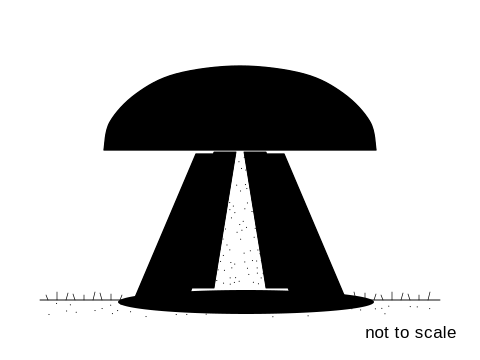
Drawing: Not to scale.
- At Cheramanangad, there are many old stone monuments close together.
- Diggers opened five of them, each of a different kind.
- Two of the five had no burial under them.
- One of the empty ones was an umbrella stone.
- Under some other kinds of stone, they found buried pots called urns.
What it cannot tell us One dig cannot tell us what is under every stone.
- Look How many of the five had no burial under them?
- Talk Does an umbrella stone always have a grave under it?
- Ask What else would you like the diggers to find out?
Lesson A2 · Ages 7 to 9 · Cut-out cards
Cut along the lines. One set for each group.
A2-SC3 · From a text
What the diggers think

Drawing: Four Kerala burial forms on one ground line with cutaway subsoil: an umbrella stone with no burial found below, a rock-cut chamber, a slab cist with a porthole, and a lidded urn deep in a pit.
- The diggers had an idea about the empty stones.
- They think the empty ones may be graves made as a sign, with nobody buried there.
- An empty pit on its own cannot show what it was for.
- Some old stones also stand outside the fence around the protected stones.
- So nobody knows yet how many stones there were at the start.
What it cannot tell us The study found no test of how old the stones at Cheramanangad are.
- Look Which sentence tells us an idea, not a find?
- Talk How could anyone check an idea like this?
- Ask What would you like to ask the diggers?
The four certainty cards
Lesson A2 · Ages 7 to 9 · Cut-out cards
Cut along the lines. One set for each group.
A2-SC1 · From the ground
A stone like an umbrella
Photo: Ranjith Siji (Wikimedia Commons). Licence: CC BY-SA 4.0 (https://creativecommons.org/licenses/by-sa/4.0). Source: https://commons.wikimedia.org/wiki/File:Ariyannur_Umbrellas_DSC_0764.JPG
- This big stone stands at Ariyannur, in Kerala.
- It has a round stone top on upright stones.
- People call it an umbrella stone.
- Umbrella stones are found most in the middle and north of Kerala.
- The study found no report of a dig at Ariyannur. It found no test of how old the stones are.
What it cannot tell us From the outside, we cannot see what is under the stone.
- Look What shape is the top? What holds it up?
- Talk Why might people have made a stone like this?
- Ask What would you like to know about what is under it?
Lesson A2 · Ages 7 to 9 · Cut-out cards
Cut along the lines. One set for each group.
A2-SC2 · From the ground
What the diggers found
Drawing: Not to scale.
- At Cheramanangad, there are many old stone monuments close together.
- Diggers opened five of them, each of a different kind.
- Two of the five had no burial under them.
- One of the empty ones was an umbrella stone.
- Under some other kinds of stone, they found buried pots called urns.
What it cannot tell us One dig cannot tell us what is under every stone.
- Look How many of the five had no burial under them?
- Talk Does an umbrella stone always have a grave under it?
- Ask What else would you like the diggers to find out?
Lesson A2 · Ages 7 to 9 · Cut-out cards
Cut along the lines. One set for each group.
A2-SC3 · From a text
What the diggers think
Drawing: Four Kerala burial forms on one ground line with cutaway subsoil: an umbrella stone with no burial found below, a rock-cut chamber, a slab cist with a porthole, and a lidded urn deep in a pit.
- The diggers had an idea about the empty stones.
- They think the empty ones may be graves made as a sign, with nobody buried there.
- An empty pit on its own cannot show what it was for.
- Some old stones also stand outside the fence around the protected stones.
- So nobody knows yet how many stones there were at the start.
What it cannot tell us The study found no test of how old the stones at Cheramanangad are.
- Look Which sentence tells us an idea, not a find?
- Talk How could anyone check an idea like this?
- Ask What would you like to ask the diggers?