Skip to content
Layers of the South
Search

Lesson A2 · Unit A: What did people leave behind?

Stones that mark

Do these stones always mark a grave?

Project this lessonClass vote

Ages
Ages 7 to 9
Minutes
30 / 45
Ladder step
1 Look, 2 Sort

Curriculum

No curriculum line is published for this lesson.

Draft written with AI assistance; not yet tried in a classroom

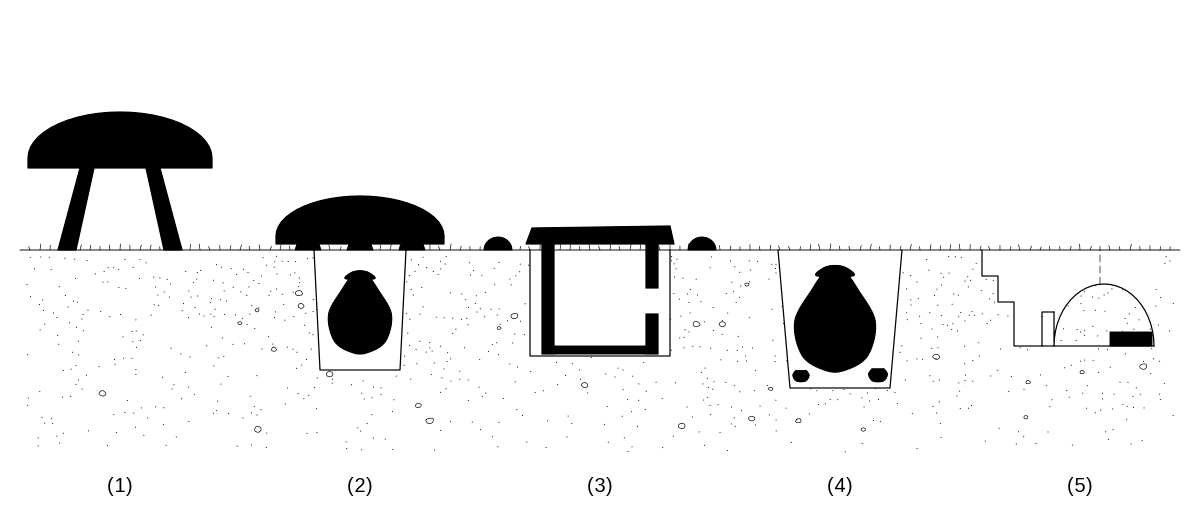
Schematic cross-sections across one ground line showing five burial monument forms numbered (1) to (5): an umbrella stone with nothing drawn below ground, a low cap stone over a pit with an urn, a cist with an east porthole inside a stone circle, an urn burial pit with a lidded urn and small pots, and a laterite rock-cut chamber with stepped court and bench. Not to scale.
Schematic sections of five monument forms, drawn from the descriptions in the studies. Not to scale. Not one real monument. What is drawn under each form is one thing that has been found under such forms, not a rule.

001At a glance

Children look closely at an umbrella stone, find out what diggers found under five stone monuments, and sort what was found from what people think.

Objectives

  • I can say what I see on a stone before I say what I think.
  • I can sort what the diggers found from what people think.
  • I can hold up a how-sure card with my group and say what its words mean.

Pupils should already know

  • Children have used "I see, I think, I wonder" to look at a pot in lesson A1.
  • Children have met the four certainty cards in lesson A1. If they have not, add five minutes at the start to introduce the cards.

Materials

Print
  • One sheet per child: support, core or stretch
  • The cut-out page for each group: three source cards and the four certainty cards
  • For a lesson of 45 minutes: a paper plate, four paper tubes and sticky tape for each group, to build a model umbrella stone
Screen
  • The classroom screen for this lesson, if you have a projector

Key words

umbrella stone കുടക്കല്ല്
A big stone with a round top, raised on upright stones.
monument
Something big that people built, often of stone, to mark a place.
burial
Putting a person who has died into the ground.
grave
A place where a person who has died is buried.
urn
A big clay pot. Some urns were buried in the ground.
diggers
People who dig carefully to find out about the past.

002Sequence

Step by step

Lesson length
  1. 57hook

    Teacher Show the umbrella stone on the screen or hold up the stone card. Ask the children to say only what they can see first, and write their words in a "We see" column. Then ask what they think it is for and what they wonder, and write those in two more columns. Keep the columns apart: seeing comes first.

    Pupils Look at the stone. Say what you see. Then say what you think and what you wonder.

    Screen 1 of 11: Look first

  2. 45model

    Teacher Show the difference between a find and an idea. Point to the stone and say: "I see a round stone top on four legs. That is what I see. I think somebody is buried under it. That is my idea, and I have not checked it." Ask the class: which of my sentences is something I found, and which is something I think?

    Pupils Listen. Say one thing you see and one thing you think. Start with "I see" and "I think".

    Screen 2 of 11: A stone like an umbrella

  3. 68guided

    Teacher Read the diggers' card aloud. Point to the drawing: it shows only what stands above the ground. Ask what might lie below it. Stop after "Two of the five had no burial under them" and ask: so does every stone mark a grave? Then read the third card, which tells what the diggers think about the empty stones.

    Pupils Listen to the cards. Put up your hand each time you hear something the diggers found.

    Screen 3 of 11: What the diggers found

  4. 69independent

    Teacher Children sort six sentences into two boxes on their sheet, Found and Think. Read each one aloud, or write them on the board. Found: "Diggers opened five of them, each of a different kind." "Two of the five had no burial under them." "One of the empty ones was an umbrella stone." "Under some other kinds of stone, they found buried pots called urns." "Some old stones stand outside the fence around the protected stones." Think: "They think the empty ones may be graves made as a sign." The sentence "So nobody knows yet how many stones there were at the start" is already printed in the "What nobody knows yet" box at the foot of the sheet: find it there and read it together. Walk round and ask each child how they decided for one sentence.

    Pupils Sort the six sentences into two boxes: Found and Think.

    Screen 5 of 11: Sort

  5. 69claim

    Teacher Give each group a set of certainty cards and read their words: strong evidence, probably, maybe, nobody knows yet. Read the claim sentences one at a time, and let each group hold up the card it thinks fits. After each one, say which card the study gives it and the reason in simple words. After the idea about the empty stones, say that this is the first time the maybe card fits: the idea matches what was found, but an empty pit on its own cannot show what it was for.

    Pupils Listen to each sentence. With your group, hold up a card: strong evidence, probably, maybe or nobody knows yet.

    Screen 7 of 11: How sure can we be?

  6. 37exit

    Teacher Ask each child to draw an umbrella stone with the ground under it, and to write or say one thing the diggers found and one thing people think. In a lesson of 45 minutes, groups build a model umbrella stone instead of drawing: a paper plate taped onto four paper tubes. Say that a model is not the real size. Each child then says one thing found and one thing people think.

    Pupils Draw an umbrella stone. Write one thing the diggers found and one thing people think.

    Screen 11 of 11: Before you go

003Source cards

The three source cards

18 bound lines · 8 graded · 5 claims · 5 other records

Graded lines carry their How-sure glyph and 6-char hash; claims carry no fill glyph.

A2-SC1 · From the ground

A stone like an umbrella

A rounded mossy capstone sits above a squat arrangement of upright supports.

Photo: Ranjith Siji (Wikimedia Commons). Licence: CC BY-SA 4.0 (https://creativecommons.org/licenses/by-sa/4.0). Source: https://commons.wikimedia.org/wiki/File:Ariyannur_Umbrellas_DSC_0764.JPG

What it cannot tell us From the outside, we cannot see what is under the stone. Stands on: media asset 'KL-51556474'
Look
What shape is the top? What holds it up?
Talk
Why might people have made a stone like this?
Ask
What would you like to know about what is under it?
A2-SC2 · From the ground

What the diggers found

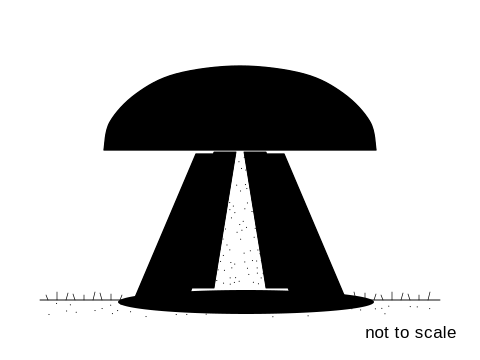
An umbrella stone: a dome-shaped cap of laterite resting on four slabs that lean in towards each other. Nothing is drawn under the ground. Not to scale.
What it cannot tell us One dig cannot tell us what is under every stone. Stands on: R135-C006 · a claim the study makes (not graded)
Look
How many of the five had no burial under them?
Talk
Does an umbrella stone always have a grave under it?
Ask
What else would you like the diggers to find out?

A2-SC3 · From a text

What the diggers think

Four Kerala burial forms on one ground line with cutaway subsoil: an umbrella stone with no burial found below, a rock-cut chamber, a slab cist with a porthole, and a lidded urn deep in a pit.
What it cannot tell us The study found no test of how old the stones at Cheramanangad are. Stands on: R135-HS4 · Not known #247eb9
Look
Which sentence tells us an idea, not a find?
Talk
How could anyone check an idea like this?
Ask
What would you like to ask the diggers?

    004Differentiation

    One task at three levels

    The three sheets use the same sources and the same task. Only the help changes.

    Support

    1. Circle what holds up the round top: upright stones or a wall.
    2. Circle how many of the five stones had no burial under them: two or five.
    3. Draw a line from each sentence to its box: Found or Think.
    4. Shade a box for the card your group held up for the empty stones.

    Help on the sheet

    • A picture of an umbrella stone with the ground drawn underneath
    • A word box: umbrella stone, burial, urn, found, think
    • The four how-sure boxes drawn ready to shade, each with its words

    Core

    1. I see ...
    2. The diggers opened five stones. They found ...
    3. Sort each sentence into a box: Found or Think.
    4. Shade a box for the card your group held up for the empty stones. The study gives it the card ...

    Stretch

    1. Describe the umbrella stone to someone who cannot see it.
    2. Explain what the diggers found under the five stones.
    3. Sort each sentence into Found or Think. Say why for one of them.
    4. Shade a box for the card your group held up for the empty stones. Then write the reason your teacher gave for the study's card.

    Extension

    Do these stones always mark a grave? Write your answer and one reason from the cards.

    005Assessment

    How you will know

    The grading task

    Your teacher will read a sentence. Your group holds up the card that shows how sure we can be.

    1. Umbrella stones are found most in the middle and north of Kerala.
    2. Two of the five stones the diggers opened had no burial under them.
    3. The empty stones were graves made as a sign, with nobody buried there.
    4. When were the Ariyannur umbrella stones built?

    Exit task

    Draw an umbrella stone. Write or say one thing the diggers found and one thing people think.

    Open the answer key

    The key gives what this website's summary says for each task, two examples written by us, and how to credit a reasoned disagreement.

    006Misunderstandings

    Misunderstandings to listen for (not yet observed in a classroom)

    • There is a grave under every umbrella stone.

      Two of the five excavated monument forms at Cheramanangad held no burial, so a stone on the surface does not always mark a grave.

    • If the diggers think something, it must be true.

      The idea that the empty monuments were symbolic burials is the excavators' interpretation. It is rated Possible, because an empty pit alone cannot show its purpose.

    • If nobody knows when a stone was built, nobody has tried to find out.

      "Nobody knows yet" means the evidence checked does not settle it. For Ariyannur the study recovered no excavation report or laboratory date.

    007With or without a screen

    With or without a screen

    Paper only

    Print the cut-out page once per group and a sheet for each child. Hold up the stone card for the looking routine; the photograph works in black and white. Read the diggers' card and the idea card aloud. Write the six sentences to sort on the board, or read them aloud one at a time. Children sort on paper and shade their certainty boxes with a pencil.

    One screen and a projector

    Show the stone card for the looking routine, then the diggers' card with its drawing, then the idea card, one per screen. Leave each claim sentence on the screen while groups hold up their cards.

    Classroom screen

    008Teacher notes

    Teacher notes

    • These stones are burial monuments, so the lesson talks about graves. Say it calmly and plainly. No card shows human remains. If a child asks what was inside the urns, you can say that one monument held an urn, bones, pots and an iron object.
    • The excavation report records no burial in two of the five monuments, called Megaliths II and III in the report.
    • The idea that the empty monuments were symbolic burials is the excavators' interpretation. The study rates it Possible because an empty pit alone cannot show its purpose. This is the first lesson where the "maybe" card fits a statement; in A1 it stayed on the table.
    • If a child asks what the stone is: it is laterite, a rock found across coastal and midland Kerala that can be cut and shaped with hand tools.
    • The drawing on the diggers' card shows one umbrella stone, its cap resting on slabs that lean in. It is a model, not a drawing of one monument, and it is not to scale. Nothing is drawn under the ground.
    • If you take the class to a monument, the site's visit template for teachers asks pupils to observe and sketch without touching fragile surfaces, moving stones or climbing monuments.
    • Cheramanangad is listed as "Protected ASI monument open to visitors; walking on or leaning against the stones is not allowed." This line is undated; check before you travel, and read the rule to the class before any visit.
    • No laboratory date was found for Cheramanangad, so this lesson sits on the whole timeline strip rather than in one window.

    Sensitive topics

    This lesson is about graves. It uses a photograph of a stone and a drawing of an umbrella stone, never human remains. Say plainly that some stones covered burials and some did not, and answer questions honestly and briefly. Do not ask children to act out a burial.

    On this website

    009Sources used

    Sources used

    Every fact in this lesson comes from these studies. The codes name the statements the lesson cites.

    010Downloads

    Everything to print

    Each document prints on A4 or US Letter. The Malayalam sheets are drafts that no Malayalam editor has yet reviewed.

    The unit pack

    Lesson A2 · Ages 7 to 9 · Lesson plan

    Stones that mark

    Do these stones always mark a grave?

    Unit A: What did people leave behind? · Ladder step Look, Sort · Draft written with AI assistance; not yet tried in a classroom

    Objectives

    • I can say what I see on a stone before I say what I think.
    • I can sort what the diggers found from what people think.
    • I can hold up a how-sure card with my group and say what its words mean.

    Pupils should already know

    • Children have used "I see, I think, I wonder" to look at a pot in lesson A1.
    • Children have met the four certainty cards in lesson A1. If they have not, add five minutes at the start to introduce the cards.

    Key words: umbrella stone (A big stone with a round top, raised on upright stones.); monument (Something big that people built, often of stone, to mark a place.); burial (Putting a person who has died into the ground.); grave (A place where a person who has died is buried.); urn (A big clay pot. Some urns were buried in the ground.); diggers (People who dig carefully to find out about the past.).

    Materials

    • Print One sheet per child: support, core or stretch; The cut-out page for each group: three source cards and the four certainty cards; For a lesson of 45 minutes: a paper plate, four paper tubes and sticky tape for each group, to build a model umbrella stone
    • Screen The classroom screen for this lesson, if you have a projector
    • Paper only Print the cut-out page once per group and a sheet for each child. Hold up the stone card for the looking routine; the photograph works in black and white. Read the diggers' card and the idea card aloud. Write the six sentences to sort on the board, or read them aloud one at a time. Children sort on paper and shade their certainty boxes with a pencil.

    Teacher notes

    • These stones are burial monuments, so the lesson talks about graves. Say it calmly and plainly. No card shows human remains. If a child asks what was inside the urns, you can say that one monument held an urn, bones, pots and an iron object.
    Layers of the South/educators/lessons/stones-that-mark/a97585a61f00Draft written with AI assistance; not yet tried in a classroomMalayalam draft, not yet reviewed by a Malayalam editorText CC BY-SA 4.0; photos as creditedPage 1/2

    Lesson A2 · Ages 7 to 9 · Lesson plan

    Stones that mark

    • The excavation report records no burial in two of the five monuments, called Megaliths II and III in the report.
    • The idea that the empty monuments were symbolic burials is the excavators' interpretation. The study rates it Possible because an empty pit alone cannot show its purpose. This is the first lesson where the "maybe" card fits a statement; in A1 it stayed on the table.
    • If a child asks what the stone is: it is laterite, a rock found across coastal and midland Kerala that can be cut and shaped with hand tools.
    • The drawing on the diggers' card shows one umbrella stone, its cap resting on slabs that lean in. It is a model, not a drawing of one monument, and it is not to scale. Nothing is drawn under the ground.
    • If you take the class to a monument, the site's visit template for teachers asks pupils to observe and sketch without touching fragile surfaces, moving stones or climbing monuments.
    • Cheramanangad is listed as "Protected ASI monument open to visitors; walking on or leaning against the stones is not allowed." This line is undated; check before you travel, and read the rule to the class before any visit.
    • No laboratory date was found for Cheramanangad, so this lesson sits on the whole timeline strip rather than in one window.

    Misunderstandings to listen for (not yet observed in a classroom)

    • There is a grave under every umbrella stone. Two of the five excavated monument forms at Cheramanangad held no burial, so a stone on the surface does not always mark a grave.
    • If the diggers think something, it must be true. The idea that the empty monuments were symbolic burials is the excavators' interpretation. It is rated Possible, because an empty pit alone cannot show its purpose.
    • If nobody knows when a stone was built, nobody has tried to find out. "Nobody knows yet" means the evidence checked does not settle it. For Ariyannur the study recovered no excavation report or laboratory date.

    Sources used

    • Umbrella stones and rock-cut tombs: distinctive but not unique R105-HS1, R105-HS4
    • Cheramanangad’s stone markers do not predict what lies beneath R135-C004, R135-HS1, R135-C007, R135-C015, R135-C006, R135-HS2, R135-C003, R135-HS3, R135-HS4, R135-C005
    Layers of the South/educators/lessons/stones-that-mark/a97585a61f00Draft written with AI assistance; not yet tried in a classroomMalayalam draft, not yet reviewed by a Malayalam editorText CC BY-SA 4.0; photos as creditedPage 2/2