Skip to content
Layers of the South
Search

Classroom screen · A2

Stones that mark

The screen fills the window. Right and Left arrows, or Page Down and Page Up, move between screens. Home and End go to the first and last. F fills the whole screen. T starts a timer.

Each screen prints on its own landscape page, for a classroom without a projector.

Back to the lesson plan

00:00 / 05:00

    Timings are the plan's suggestion, not a measure of pupils.

    Look first

    A rounded mossy capstone sits above a squat arrangement of upright supports.

    Photo: Ranjith Siji (Wikimedia Commons). Licence: CC BY-SA 4.0 (https://creativecommons.org/licenses/by-sa/4.0). Source: https://commons.wikimedia.org/wiki/File:Ariyannur_Umbrellas_DSC_0764.JPG

    Look at the big stone. What do you see? What do you think? What do you wonder?

    • I see
    • I think
    • I wonder

    1/11

    From the ground

    A stone like an umbrella

    A rounded mossy capstone sits above a squat arrangement of upright supports.

    Photo: Ranjith Siji (Wikimedia Commons). Licence: CC BY-SA 4.0 (https://creativecommons.org/licenses/by-sa/4.0). Source: https://commons.wikimedia.org/wiki/File:Ariyannur_Umbrellas_DSC_0764.JPG

    • This big stone stands at Ariyannur, in Kerala.
    • It has a round stone top on upright stones.
    • People call it an umbrella stone.

    What it cannot tell us From the outside, we cannot see what is under the stone.

    • Teacher notes Umbrella stones are found most in the middle and north of Kerala. The study found no report of a dig at Ariyannur. It found no test of how old the stones are.
    • Look What shape is the top? What holds it up?
    • Talk Why might people have made a stone like this?
    • Ask What would you like to know about what is under it?

    2/11

    From the ground

    What the diggers found

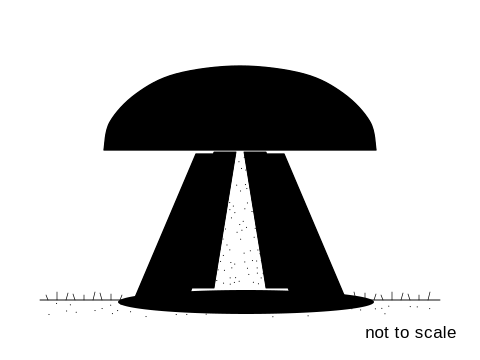
    An umbrella stone: a dome-shaped cap of laterite resting on four slabs that lean in towards each other. Nothing is drawn under the ground. Not to scale.
    • At Cheramanangad, there are many old stone monuments close together.
    • Diggers opened five of them, each of a different kind.
    • Two of the five had no burial under them.

    What it cannot tell us One dig cannot tell us what is under every stone.

    • Teacher notes One of the empty ones was an umbrella stone. Under some other kinds of stone, they found buried pots called urns.
    • Look How many of the five had no burial under them?
    • Talk Does an umbrella stone always have a grave under it?
    • Ask What else would you like the diggers to find out?

    3/11

    From a text

    What the diggers think

    Four Kerala burial forms on one ground line with cutaway subsoil: an umbrella stone with no burial found below, a rock-cut chamber, a slab cist with a porthole, and a lidded urn deep in a pit.
    • The diggers had an idea about the empty stones.
    • They think the empty ones may be graves made as a sign, with nobody buried there.
    • An empty pit on its own cannot show what it was for.

    What it cannot tell us The study found no test of how old the stones at Cheramanangad are.

    • Teacher notes Some old stones also stand outside the fence around the protected stones. So nobody knows yet how many stones there were at the start.
    • Look Which sentence tells us an idea, not a find?
    • Talk How could anyone check an idea like this?
    • Ask What would you like to ask the diggers?

    4/11

    Sort

    Sort the six sentences into two boxes: Found and Think.

    1. 1Diggers opened five of them, each of a different kind.
    2. 2Two of the five had no burial under them.
    3. 3One of the empty ones was an umbrella stone.
    4. 4Under some other kinds of stone, they found buried pots called urns.
    • Found
    • Think

    5/11

    Sort

    Sort the six sentences into two boxes: Found and Think.

    1. 5Some old stones stand outside the fence around the protected stones.
    2. 6They think the empty ones may be graves made as a sign.
    • Found
    • Think

    6/11

    How sure can we be? 1/4

    Umbrella stones are found most in the middle and north of Kerala.

    • strong evidence
    • probably
    • maybe
    • nobody knows yet

    7/11

    How sure can we be? 2/4

    Two of the five stones the diggers opened had no burial under them.

    • strong evidence
    • probably
    • maybe
    • nobody knows yet

    8/11

    How sure can we be? 3/4

    The empty stones were graves made as a sign, with nobody buried there.

    • strong evidence
    • probably
    • maybe
    • nobody knows yet

    9/11

    How sure can we be? 4/4

    When were the Ariyannur umbrella stones built?

    • strong evidence
    • probably
    • maybe
    • nobody knows yet

    10/11

    Before you go

    Draw an umbrella stone. Write or say one thing the diggers found and one thing people think.

    11/11