001Brush first
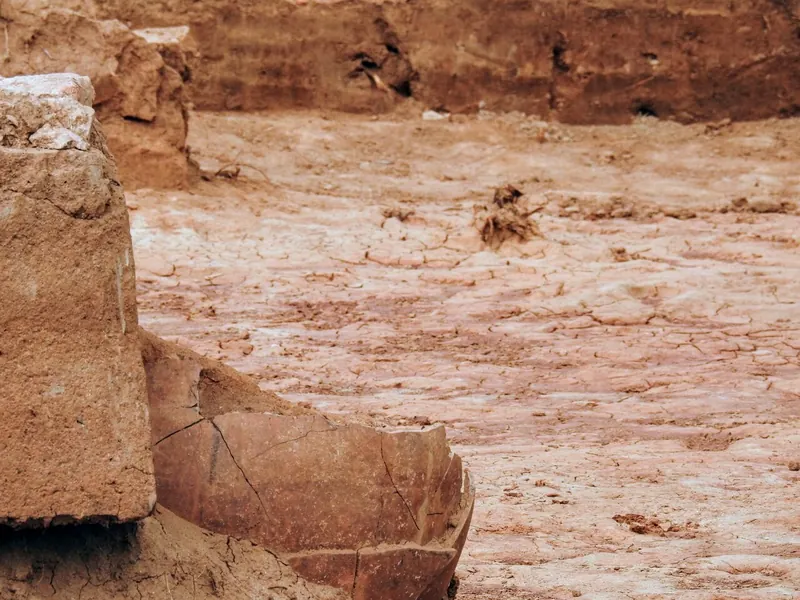
The photograph is real and from Keezhadi (Keeladi). The case below is made up for practice and is not this trench.
Before the case
Something is under this soil. Brush gently.
The soil is drawn. The photograph under it is real.
002Work the case
Step 1 · Put the steps in order
Put the four events in order, oldest first
Use Up and Down to put the four events of this practice section in order, with the oldest event at the bottom and the youngest at the top:
Stratigraphic stack · earliest deposit at the bottom
- Clay Floor B is laid down sealing Deposit A below it
- Pit Fill D (containing the later coin) accumulates inside Pit Cut C
- Ground Deposit A forms at the base of the trench
- Pit Cut C is dug down from above, slicing through Floor B into Deposit A
The case's order (without moving)
- Ground Deposit A forms at the base of the trench
- Clay Floor B is laid down sealing Deposit A below it
- Pit Cut C is dug down from above, slicing through Floor B into Deposit A
- Pit Fill D (containing the later coin) accumulates inside Pit Cut C
✓ Correct Harris Matrix order (A → B → C → D)! Because Pit Cut C sliced through Floor B, Pit Fill D at the bottom of the pit is the YOUNGEST event of the four!
Level · Discover · short clues and pictures
The case: Look at the trench wall. Which came first: the floor or the pit?
Clue A
Clue 1: Soil builds up in layers. Flat lower layers are normally older.
Clue B
Clue 2: Someone had to dig the pit down through layers already there.
Clue C
Clue 3: Pit cut C slices through every layer it cuts, so the cut and its fill are younger than those layers.
Step 2 · Choose the best answer
Why is the coin at the bottom of the pit YOUNGER than the clay floor beside it?
Level · Investigate · more clues and named scholars
The case: Order A → B → C → D using the cut relationship and explain why depth in centimetres does not equal age.
Clue A
Clue A (The Early Deposits – A & B): First, lower Deposit A was laid down, and a rammed clay Floor B (around 200 BCE) was built sealing Deposit A below it.
Clue B
Clue B (The Later Intrusive Cut – C & D): Centuries later, builders dug a deep Pit Cut C slicing down through Floor B into Deposit A, and Pit Fill D accumulated inside that cut containing a teaching coin struck in 200 CE.
Clue C
Clue C (The Tape-Measure Trap & Coin Rule): On a simple tape measure, the coin in Pit Fill D and an intact pot on Floor B both sit at 180 cm below the grass – yet if the coin is securely sealed in the original fill, it provides only a terminus post quem (earliest possible date) for Pit Fill D, never a date for Floor B!
Step 2 · Choose the best answer
How must an archaeologist interpret Deposit A, Floor B, Pit Cut C, Pit Fill D, and the coin at 180 cm depth?
Level · Make a case · source extracts and an overclaim to repair
The case: Evaluate a museum label dating Floor B from the coin in Pit Fill D – and state the residuality and intrusion assumptions!
Clue A
Extract 1 (Stratigraphic cut principle · Context Lab): Any pit cut (C) is younger than the highest layer it cuts through (Floor B), and the fill (D) inside that cut is younger still (A → B → C → D).
Clue B
Extract 2 (Terminus Post Quem & Residuality): If the 200 CE coin is securely part of the original Pit Fill D, 200 CE is only the earliest possible date (terminus post quem) for Fill D – because a coin can circulate for decades before burial, and residual older objects can also be redeposited into younger fills.
Clue C
Extract 3 (Later Intrusion Check): If an animal burrow or root channel later disturbed Pit Fill D, the coin's association with Fill D itself would be compromised. To date Floor B, archaeologists must sample sealed material inside or directly beneath an undisturbed section of Floor B.
Made up for Case 6 · Draft Excavation Label (Constructed Teaching Case)
“Because a coin minted in 200 CE was recovered at 180 cm depth alongside Clay Floor B, Clay Floor B is securely dated to 200 CE.”
Made up for this case. It goes too far: use the clues to show where.
Step 2 · Choose the best answer
Which evaluation of the draft label best demonstrates advanced stratigraphic reasoning?
Word help
- Superposition: In undisturbed soil, lower layers were laid down earlier than the layers resting on top of them.
- Intrusive pit cut: A hole (like a well, posthole, or rubbish pit) dug down from a higher level through older soil layers.
- Terminus post quem (TPQ): The 'date after which' a layer must have been closed – for example, a pit fill containing a 200 CE coin could not have been sealed before 200 CE.
Ways to start your answer: “Even though the coin in Pit Fill D is at 180 cm depth, it arrived later than Floor B because ___.” · “The coin can only help date ___ (and only if it was not dropped in later).”
Hints, one at a time
Hint 1 (Where to look): Can you dig a hole through a clay floor (Floor B) BEFORE that clay floor exists?
Hint 2 (What relationship matters): Once Pit Cut C slices through Floor B, is the soil filling that pit (Fill D) older or younger than Floor B?
Hint 3 (Worked reasoning): Order the sequence A → B → C → D, and remember that a coin sealed in Fill D only gives an earliest possible closing date (terminus post quem) for Fill D.
Step 3 · Try the same idea on a new case: The Deep Brick Well Shaft
The new case: In a new trench (Constructed Transfer Diagram), excavators uncover an Iron Age hearth at 150 cm depth. Three metres away, a medieval brick-lined well shaft cuts straight down from the upper soil to 300 cm depth. At the very bottom of the well shaft (300 cm deep), they find a glazed medieval potsherd.
Why doesn't the glazed potsherd at 300 cm depth make the medieval well older than the Iron Age hearth at 150 cm depth?
What we learned, and things to talk about
What we learned: Depth alone is never a date. Separating the older layer, the later pit cut, the pit fill, and the terminus post quem of objects inside the fill is fundamental to scientific archaeology.
Talk about this together: Why is looting or digging up an ancient object without recording its soil layer and pit-cut boundaries like tearing a page out of the only copy of a history book?
For teachers: A worked example at all three levels. The section is invented for teaching and goes with the Context Lab and educator module 1.
How we know
- Core methodological framework: observation, stratigraphic context, and inference: Establishes why context and depositional relationship take precedence over raw depth.
- Section 'Excavated sequence and formation of the waterfront': Illustrates why intervening pits and distinct stratigraphic loci prevent pooling objects by depth alone.