Skip to content
Layers of the South
Search

Lesson C3 · Unit C: Kingdoms, trade and the evidence

Kings in stone and coin

How do we know the names of early kings?

Project this lessonClass vote

Ages
Ages 11 to 14
Minutes
30 / 45 / 60
Ladder step
3 Grade

Curriculum

  • SCERT Kerala Social Science Part 2, Standard VI, Unit 8 "Towards South Indian History"
  • NCERT Exploring Society: India and Beyond, Grade 7 Part 1, Ch. 6 "The Age of Reorganisation", section "Kingdoms and Life in the South"
  • NCERT Exploring Society: India and Beyond, Grade 7 Part 1, Ch. 5 "The Rise of Empires"
  • SCERT Kerala Social Science I Part 1, Standard IX, Units 01–03

No school board has reviewed or endorsed these mappings.

Draft written with AI assistance; not yet tried in a classroom

The Arittapatti rock face with a drip ledge above a line of Tamil-Brahmi letters, a Berenike amphora fragment with scratched writing whose Tamil-Brāhmī identification is disputed, and a palm-leaf bundle with a stylus.
Rock, pot and leaf preserve writing differently. A Berenike sherd’s Tamil-Brāhmī reading, identified by Mahadevan, is disputed. Arittapatti’s letters remain where they were cut; palm-leaf texts survive as later copies.

001At a glance

Students read rulers' names in cave inscriptions, an emperor's edict and silver coins, test whether a name in one kind of evidence matches a name in another, and grade five statements.

Objectives

  • I can grade a statement about an early ruler and give a reason that names the evidence.
  • I can find a name that appears in two kinds of evidence and judge how strong the match is.
  • I can explain why a matching name is a clue, not a proof.

Pupils should already know

  • Students have read early Tamil poems as evidence in lesson C2, including a praise poem.
  • Students have graded statements on the four How-sure levels. If they have not, add five minutes at the start to introduce the levels.
  • Students may have met letters scratched on pots in lesson B2. Today the writing is on rock and on coins.

Materials

Print
  • One sheet per student: support, core or stretch
  • The cut-out page for each group: three source cards and the key-word strip
  • A grid for each group, on the sheet or copied from the board: kind of source, names, how it is dated, what it cannot show
Screen
  • The classroom screen for this lesson

Key words

inscription
Writing cut or scratched into stone or another hard surface.
Tamil-Brahmi തമിഴി (തമിഴ് ബ്രാഹ്മി)
The earliest known way of writing Tamil: Brahmi letters adapted, with extra letters for Tamil sounds.
edict
A public message from a ruler, such as the edicts cut into rock.
Aśoka
The emperor whose Rock Edict II names southern peoples by the third century BCE.
generation
One step in a family line: a father, his son, his grandson.
paḷi പാഴി / പള്ളി
A rock shelter with a ledge to keep off rain and stone beds, made for monks.
Atiyan Neṭumāṉ Añci സതിയപുതോ അതിയൻ നെടുമാൻ അഞ്ചി
The giver named in the Jambai cave inscription, who is called satiyaputō there.
Pugalur inscriptions പുകളൂർ ചേര ഇരുമ്പൊറൈ തമിഴ്-ബ്രാഹ്മി ലിഖിതം
Tamil-Brahmi inscriptions near Karur that name three generations of one ruling family.
portrait coin മാക്കോതൈ, കുട്ടുവൻ കോതൈ ചേര നാണയങ്ങൾ
An early silver coin with a portrait head and a Tamil-Brahmi name, found mainly at Karur.
Pathitruppathu
An early Tamil collection of poems that praise rulers; also spelled Patiṟṟuppattu.
Jaina
Belonging to the Jain religion.

002Sequence

Step by step

Lesson length
  1. 356hook

    Teacher Show the photograph of the Jambai inscription and run the see, think, wonder routine. Point out that the letters were highlighted in modern times to make them easier to see. Collect wonders such as "Who wrote it?" and "Who is named?" on the board.

    Pupils Look at the photograph. Say what you see, what you think and what you wonder.

    Screen 1 of 12: Look first

  2. 6810model

    Teacher Model how to judge a name match with a statement that is not in the claim task. Say: "An inscription at Mangulam names a Nedunchezhiyan, and the poem Maturaikkāñci praises a king of that name. Does that make them the same man?" The study rates "Mangulam's Nedunchezhiyan is the king praised in Maturaikkāñci" as Possible: the names match, but exact readings and identity remain unsettled. Write the rule of the lesson on the board: same name, same person? A matching name is a clue, not a proof.

    Pupils Copy the rule. Note the level the study gives and its reason.

    Screen 2 of 12: Look at how these statements differ.

  3. 71014guided

    Teacher Groups read the Pugalur card and the coin card. For each, they fill one row of the grid: what kind of source it is, which names it gives, how it is dated and what it cannot show. Check that groups see that both are dated by the shapes of their letters, and that scholars disagree on the dates.

    Pupils Fill one row of the grid for each card: kind of source, names, how it is dated, what it cannot show.

    Screen 4 of 12: A family named at Pugalur

  4. 5811independent

    Teacher Pairs look for a name that appears in different kinds of evidence. Guide them to the edict and the cave: Aśoka's edict lists a southern people called Satiyaputo, and the Jambai line calls Atiyan Neṭumāṉ Añci satiyaputō. Then ask them to look for a weaker match: a name on a coin or on the Pugalur rock that might also be a king in a poem.

    Pupils Find a name that appears in different kinds of evidence. Then find a weaker match and say why it is weaker.

    Screen 5 of 12: A gift at Jambai and an emperor's edict

  5. 6912claim

    Teacher Students grade the statements in the claim task, then compare with the study's level and its reason. Explain that the Pathitruppathu is an early Tamil collection of poems that praise rulers. Before they grade the statement about a list of kings, ask them what each card names: a family, a single giver, peoples in an edict, names on coins. Ask anyone whose level differs to explain. A reason that names real evidence or a real gap earns credit even when the level differs. In 30 minutes, grade the first three sentences and set the rest for next time.

    Pupils Grade each statement. Write a reason that names the evidence. Then compare with the study.

    Screen 7 of 12: How sure can we be?

  6. 357exit

    Teacher Return to the rule on the board. Students answer the enquiry question in two sentences: one on the kinds of evidence that give us rulers' names, and one on why joining the names up is hard.

    Pupils How do we know the names of early kings? Write one sentence on the evidence and one on what makes it hard.

    Screen 4 of 12: A family named at Pugalur

003Source cards

The three source cards

20 bound lines · 9 graded · 9 claims · 2 other records

Graded lines carry their How-sure glyph and 6-char hash; claims carry no fill glyph.

C3-SC1 · Writing on stone or pottery

A family named at Pugalur
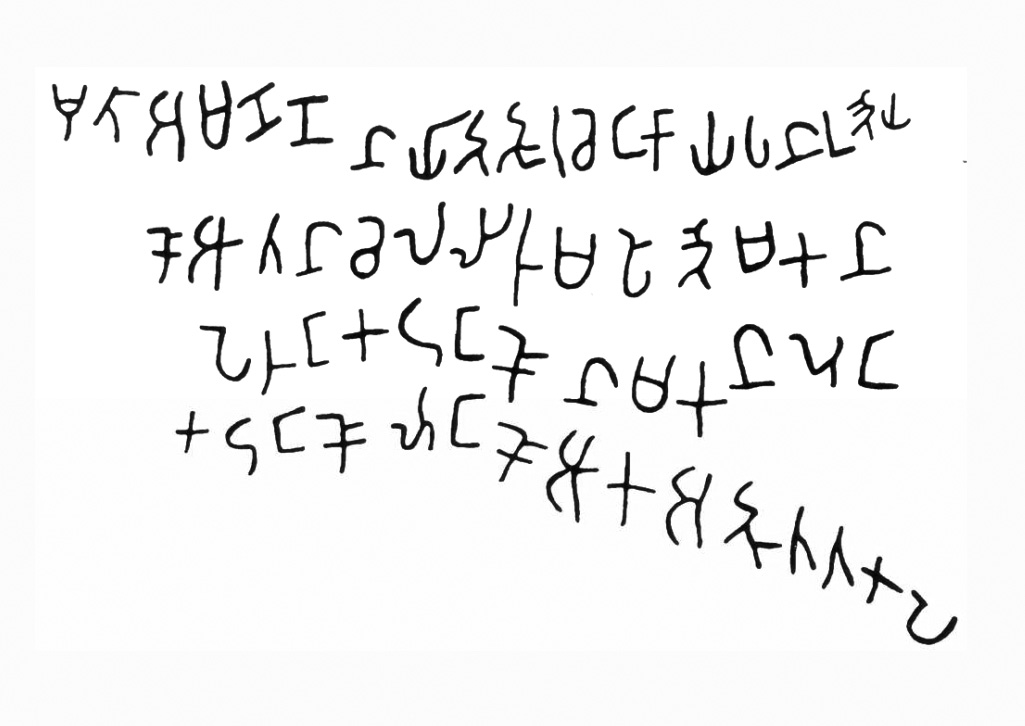
Several lines of Tamil-Brahmi letter forms drawn in black on white.

Photo: Rajesh of Raigad (Wikimedia Commons). Licence: CC BY-SA 4.0 (https://creativecommons.org/licenses/by-sa/4.0). Source: https://commons.wikimedia.org/wiki/File:Chera_Inscription_from_Pugalur,_near_Karur.jpg

What it cannot tell us The inscriptions give no reign years, no capital and no borders. Stands on: R221-C011 · a claim the study makes (not graded)
Look
Which names does the inscription give, and how are they linked?
Talk
The stone names a family. What would you need before calling them the kings of a kingdom?
Ask
Which other kind of evidence could tell us when these men lived?
C3-SC2 · Writing on stone or pottery

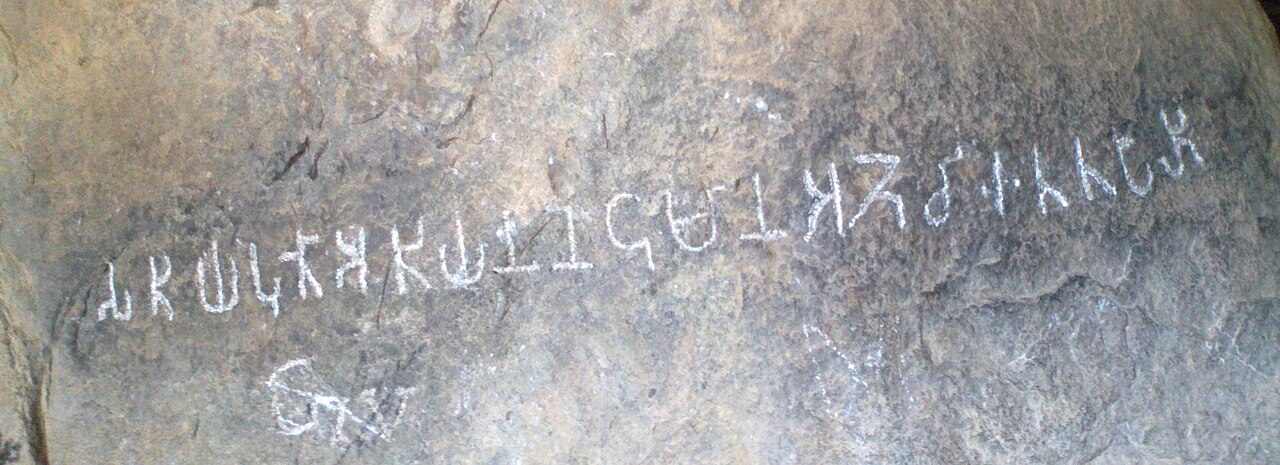
A gift at Jambai and an emperor's edict

Jambai Tamil-Brahmi inscription on the rock surface, with modern highlighting visible.

Photo: Tnexplore (Wikimedia Commons). Licence: CC BY-SA 3.0 (https://creativecommons.org/licenses/by-sa/3.0). Source: https://commons.wikimedia.org/wiki/File:Jambai_Tamil_Brahmi.jpg

What it cannot tell us A one-line gift gives no family tree, no territory and no date for any poem. Stands on: R218-HS4 · Not known #0a8a0f
Look
Which word appears both in the edict and at Jambai?
Talk
The edict and the Jambai line were cut centuries apart. Does a shared word make them about the same people? Why?
Ask
What would you want to know about the person who cut the Jambai line?

C3-SC3 · From the ground

Silver coins with a ruler's name

A worn punch-marked silver piece, a schematic Roman denarius with a chisel cut, both faces of a square Chera copper coin, and an Eyyal jar timeline: minted, cut, buried after 98–99 CE, found 1945.
What it cannot tell us A name on a coin does not, on its own, give the ruler's family or the poem that praised him. Stands on: R162-C013 · a claim the study makes (not graded)
Look
From the card, what is on each side of the coin?
Talk
The coins were not found in a dated layer. Why does that make them harder to date?
Ask
What test could help to date the coins?

    004Differentiation

    One task at three levels

    The three sheets use the same sources and the same task. Only the help changes.

    Support

    1. For each card, circle the kind of evidence: writing on stone, or writing on a coin.
    2. Draw a line from each name to its card: Kō Ātaṉ Cel Irumpoṟai, Atiyan Neṭumāṉ Añci, Makkotai.
    3. Circle the word that is found both in Aśoka's edict and at Jambai.
    4. Choose a level for each statement from the box.
    5. Complete: A matching name is a clue, but ...

    Help on the sheet

    • A grid with a row already labelled for each card
    • Key words glossed beside the text: inscription, edict, paḷi, Tamil-Brahmi
    • The four levels with their meanings in a box
    • A box of reasons to choose from: the names match, the letter shapes, no dated layer, no list of reigns

    Core

    1. The ... card is writing on ... It names ...
    2. It is dated by ... so its date is ...
    3. The name ... appears in both ... and ...
    4. I graded this statement ... because ...
    5. We know the names of early kings from ... but joining them up is hard because ...

    Stretch

    1. Compare how the three cards are dated, and how secure each date is.
    2. Which match between two kinds of evidence is strongest, and why?
    3. What would you need before calling the Pugalur family the kings of a kingdom?
    4. Grade each statement and explain how you weighed the evidence.
    5. How do we know the names of early kings? Use all three cards, and say how far the names can be joined into one history.

    Extension

    Choose one name from the cards. Plan how you would test whether it belongs to a king praised in a poem. What evidence would you need, and where would you look?

    005Assessment

    How you will know

    The grading task

    Grade each statement as Well supported, Likely, Possible or Not known. Give a reason that names the evidence or the gap.

    1. Inscription 61 names three generations linked by the word makaṉ, 'son'.
    2. Aśoka's Satiyaputo refers to the Atiyan or Atiyaman political line.
    3. The coin names belong to kings praised in early Tamil poems.
    4. The Pugalur rulers are the kings praised in the Pathitruppathu poems.
    5. What was the exact, continuous list of early Pandya and Chola kings?

    Exit task

    How do we know the names of early kings? Write one sentence on the evidence and one on what makes it hard.

    Open the answer key

    The key gives what this website's summary says for each task, two examples written by us, and how to credit a reasoned disagreement.

    006Misunderstandings

    Misunderstandings to listen for (not yet observed in a classroom)

    • If two names match, they belong to the same person.

      Even the strong Satiyaputo match links a political line or group, not the same individual across the two inscriptions.

    • Aśoka ruled the south, because his edict names southern peoples.

      Naming a people is not evidence of Mauryan rule over them.

    • The coins were made by Roman craftsmen, because the portraits look Roman.

      Production by Roman or Yavana artisans is not shown by the evidence the study inspected. It is one scholar's interpretation.

    • The Pugalur inscriptions show that Karur was the capital of the Cheras.

      The Pugalur family tree alone does not establish fixed reign years, a capital at Karur, or Chera borders.

    007With or without a screen

    With or without a screen

    Paper only

    Print the cut-out page for each group and a sheet for each student. The Jambai photograph and the Pugalur tracing are on the cards, so each group can do the hook from its own Jambai card. Write the rule "same name, same person?" on the board. Students shade their levels in pencil.

    One screen and a projector

    Show the Jambai photograph for the hook, then the model statement about Mangulam, then each card in turn, then the claim statements. Fill the first row of the grid with the class before groups fill the rest.

    Classroom screen

    008Teacher notes

    Teacher notes

    • Kerala Class VI Unit 8 names the Chera, Chola and Pandya. This lesson shows the named evidence behind those names: an emperor's edict, cave inscriptions and coins. NCERT Grade 7 Chapter 5 covers Asokan inscriptions and Brahmi, and Chapter 6 the southern kingdoms and Chera coins. Kerala Class IX Part 1 has Brahmi inscriptions and a map with the three kingdoms; use the stretch sheet there.
    • Say the names on the cards aloud before students read them. The marks over some letters show how the Tamil sounds are written in English letters.
    • Scholars disagree whether the Pugalur kings are the rulers praised in Patiṟṟuppattu. Iravatham Mahadevan and Kamil Zvelebil identified the Pugalur generations with the Irumporai kings of Patiṟṟuppattu; Herman Tieken argued the names are not similar enough, and that even matching names would not date the poems. Teach it as an open question.
    • Patiṟṟuppattu and Pathitruppathu are spellings of the same name in different studies: a collection of poems praising kings.
    • The study thinks the Jambai giver is probably the Atiyamān Neṭumāṉ Añci of Caṅkam poetry: a distinctive set of names matches closely, but the poems are not written on the rock.
    • Where the early Chera royal city of Vanchi stood is debated. One view places it at Karur, from texts, excavations and later commentary; another places it on the coast near Kodungallur. An early inscription from a secure context naming Vanchi would settle it. Use this with students who finish early.
    • The Jambai photograph shows modern highlighting. It is not the untouched rock surface.
    • The Pugalur image on the first card is a modern line tracing, not a photograph of the rock.
    • If you plan a visit, the atlas line reads: "Protected ASI / TNSDA monuments open to visitors; touching or chalking inscriptions is a punishable offence under the AMASR Act." The line is undated; check before you travel.
    • Lesson C4 tests a text against a find. This lesson prepares for it: a matching name is a first kind of test between two sources.
    • The study of Vanchi rates "Vanchi was at Karur" Likely: better supported than Kodungallur, but the explicit equation appears only in later commentary and inscription.

    009Sources used

    Sources used

    Every fact in this lesson comes from these studies. The codes name the statements the lesson cites.

    010Downloads

    Everything to print

    Each document prints on A4 or US Letter. The Malayalam sheets are drafts that no Malayalam editor has yet reviewed.

    The unit pack

    Lesson C3 · Ages 11 to 14 · Lesson plan

    Kings in stone and coin

    How do we know the names of early kings?

    Unit C: Kingdoms, trade and the evidence · Ladder step Grade · Draft written with AI assistance; not yet tried in a classroom

    Objectives

    • I can grade a statement about an early ruler and give a reason that names the evidence.
    • I can find a name that appears in two kinds of evidence and judge how strong the match is.
    • I can explain why a matching name is a clue, not a proof.

    Pupils should already know

    • Students have read early Tamil poems as evidence in lesson C2, including a praise poem.
    • Students have graded statements on the four How-sure levels. If they have not, add five minutes at the start to introduce the levels.
    • Students may have met letters scratched on pots in lesson B2. Today the writing is on rock and on coins.

    Materials

    • Print One sheet per student: support, core or stretch; The cut-out page for each group: three source cards and the key-word strip; A grid for each group, on the sheet or copied from the board: kind of source, names, how it is dated, what it cannot show
    • Screen The classroom screen for this lesson
    • Paper only Print the cut-out page for each group and a sheet for each student. The Jambai photograph and the Pugalur tracing are on the cards, so each group can do the hook from its own Jambai card. Write the rule "same name, same person?" on the board. Students shade their levels in pencil.
    Layers of the South/educators/lessons/kings-in-stone-and-coin/a97585a61f00Draft written with AI assistance; not yet tried in a classroomMalayalam draft, not yet reviewed by a Malayalam editorText CC BY-SA 4.0; photos as creditedPage 1/2

    Lesson C3 · Ages 11 to 14 · Lesson plan

    Kings in stone and coin

    Misunderstandings to listen for (not yet observed in a classroom)

    • If two names match, they belong to the same person. Even the strong Satiyaputo match links a political line or group, not the same individual across the two inscriptions.
    • Aśoka ruled the south, because his edict names southern peoples. Naming a people is not evidence of Mauryan rule over them.
    • The coins were made by Roman craftsmen, because the portraits look Roman. Production by Roman or Yavana artisans is not shown by the evidence the study inspected. It is one scholar's interpretation.
    • The Pugalur inscriptions show that Karur was the capital of the Cheras. The Pugalur family tree alone does not establish fixed reign years, a capital at Karur, or Chera borders.
    Layers of the South/educators/lessons/kings-in-stone-and-coin/a97585a61f00Draft written with AI assistance; not yet tried in a classroomMalayalam draft, not yet reviewed by a Malayalam editorText CC BY-SA 4.0; photos as creditedPage 2/2