008Catalogue page 8 of 12
Catalogue page 8.
Every title is a complete research study. Return to the study catalogue to inspect all 199 studies side by side.
Paṭṭiṉappālai sets its celebrated picture of Puhar's tolls, cargo transfers and tiger-marked goods – and its praise of the Chola king Karikāla – inside an akam separation frame; waterfront…
Land & waterPerur yielded glass beads but no sign that they were made thereExcavations at Perur on the Noyyal establish occupation through much of the first millennium CE, with glass beads but no reported furnace or workshop; when occupation began remains uncertain.
Everyday livesPeruñcōṟu, royal food-giving in Tamil poems, had several meaningsTamil poems use peruñcōṟu, royal food-giving, for praise, warrior feasts and ancestral offerings; Puṟanāṉūṟu 2 speaks only of 'the five' and 'the twice-fifty', and the old commentary names…
Across the waterPliny's forty days run from Ocelis to Muziris, not from EgyptIn Latin, Pliny's Natural History 6.104 gives forty days only for the Ocelis–Muziris crossing; the route from Egypt had several other legs.
Words & worldsPoems praise a Chera king's sea victory but name no fleetPatiṟṟuppattu poems praise Ceṅkuṭṭuvaṉ's sea feat and a second-ten poem of the Patiṟṟuppattu places his father's kaṭampu enemies on an island (turutti) in the sea; organised navies and…
Words & worldsPoems tie Nannan to Eḻil, but naval power at Ezhimala is unprovenEarly Tamil poems link a chieftain Nannan with Eḻil and gold; Ezhimala is a plausible match, but naval power and pepper control are unproven.
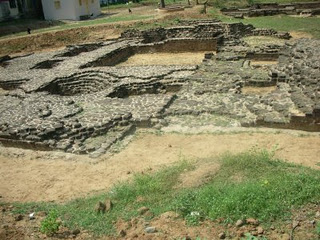 Land & waterPoompuhar's drowned remains show coastal change, not a lost land
Coastal change drowned parts of the Poompuhar port, but water depth is not a date, and the lost continent of Lemuria is a modern idea.
Land & waterPoompuhar: a river-mouth port landscape partly lost to the seaDigs and dives at Poompuhar found a likely wharf, wells and drowned walls, but no single sunken city and no proven ancient deep harbour.
Belief & memoryPorkalam 1948: one urn burial that became a reference pointIn 1948 B. K. Thapar opened a single urn burial at Porkalam; its pots and beads later became a comparison set, not a dated sequence.
How we knowPorunthal's graves hold dated rice; the writing claim is disputedRice from two Porunthal graves most probably dates to the sixth or fifth century BCE; whether marks on a ring stand in one grave are writing is disputed.
Across the waterPtolemy's Malabar coast coordinates are not modern map positionsPtolemy's second-century place list keeps the order of ports on the Malabar coast, but its numbers cannot fix where they lay.
Words & worldsPugalur inscriptions record a three-generation royal genealogyTwo cave inscriptions at Pugalur name a king, his son and grandson, and link a Jaina monk's shelter to the grandson becoming heir.
Words & worldsPulankurichi rock texts record land rights, officers and templesPulankurichi’s rock inscriptions, dated “year 192” of an unidentified era and placed by their letters in about the fifth century, record land rights, officers and religious foundations.
Everyday livesPurananuru gift poems show poets judging how gifts were givenSelected Purananuru poems show poets judging gifts by manner, recognition and ongoing need, not only size, and sometimes refusing them.
Across the waterReported frankincense at Pattanam still needs a chemical testFrankincense is reported among Pattanam's plant remains; residue chemistry, as used at Qasr Ibrim and Pompeii, shows what confirming it would require.

Terracotta rings at Pattanam, Keezhadi (Keeladi) and Korkai look alike; only fill, floors and connections can show which were wells or soakage pits.
Across the waterRoman coins in South India were slashed, pierced and copiedRoman coins found in South India were sometimes slashed, pierced or copied. Portrait slashing is especially common in the Pudukkottai material, but varies greatly between hoards. The…
Made by handRusset-coated ware occurs in Kerala; its source and age are openRusset-coated painted ware is found at several Kerala burial and settlement sites, but it is not an ethnic marker and cannot date a site alone.